1750s Interior Prints
to
1
Overall Width
to
Overall Height
to
1
1
123
215
1,066
724
11
13
22
52
38
62
73
210
238
92
103
1
1
1
1
1
Period: 1750s
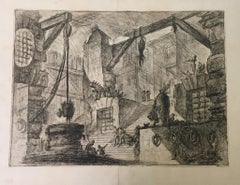
The Well, Carcere XIII - Etching by G.B.Piranesi - 1750s
Located in Roma, IT
Giovanni Battista Piranesi, The Well, Carcere XIII , from “ Images of Prisons”, Buchard , Rome, 1749-50
Etching on laid paper. Signed on plate “ Piranesi F.” lower-right. Very good ...
Category
Modern 1750s Interior Prints
Materials
Etching
Related Items
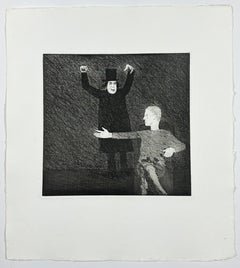
Inside the castle by David Hockney (Six Fairy Tales from the Brothers Grimm)
Located in New York, NY
From David Hockney’s celebrated Six Fairy Tales from the Brothers Grimm portfolio, an image of the story ‘The boy who left home to learn fear’. Hockney chose this story for its obscu...
Category
Modern 1750s Interior Prints
Materials
Etching, Aquatint

$2,250
H 17.75 in W 16 in
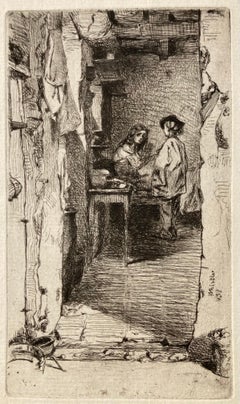
THE RAG GATHERERS
Located in Santa Monica, CA
JAMES ABBOTT McNEILL WHISTLER (1834-1903)
THE RAG GATHERERS 1858 (Glasgow 29 v/v, - K.23)
Etching on laid paper, signed and dated in the plate, image 5 7/8” x 3 ½”, full sheet 8 x...
Category
Impressionist 1750s Interior Prints
Materials
Etching
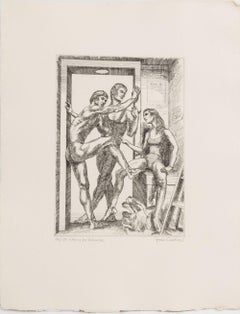
"Waiting for Rehearsal"
By Paul Cadmus
Located in Astoria, NY
Paul Cadmus (American, 1904-1999), "Waiting for Rehearsal", Etching on Paper, signed in pencil lower right, titled and numbered edition "138/175" lower left, and blind stamped "Pelav...
Category
Modern 1750s Interior Prints
Materials
Paper, Etching
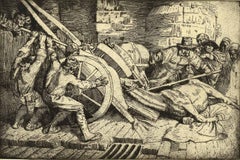
Knackers
Located in New Orleans, LA
Binyon 232 - A fine impression in fine condition in an edition of 55 signed and inscribed by the artist.
Strang was a prolific printmaker and across his lifetime produced over 750 o...
Category
Modern 1750s Interior Prints
Materials
Etching
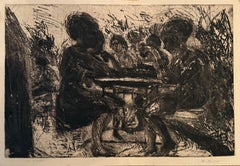
12 Noon
Located in New York, NY
May Lesser graduated with a Bachelor of Fine Arts from H. Sophie Newcomb College at Tulane University with honors in drawing. She then earned her Master of Fine Arts from the Univers...
Category
1750s Interior Prints
Materials
Etching
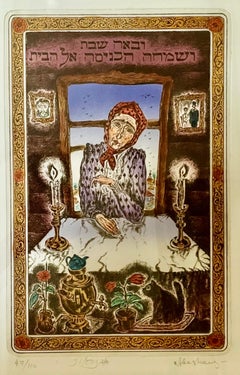
Jewish Shtetl Shabbat Candles Russian Judaica Etching w Hand Watercolor Painting
Located in Surfside, FL
EUGENE ABESHAUS Leningrad, Russia, (1939-2008)
Hand-Colored, with watercolor painting, Etching hand signed in pencil in English and Hebrew
Numbered 47/110
Framed 21.5 x 16. image 13.5 x 9
Eugene Abeshaus (also spelled Evgeny Abezgauz, Евгений Абезгауз in Russian; 1939–2008) was a Jewish artist who worked in Russia (then USSR) and Israel.
Born in Leningrad to a typical intelligentsia family, Abeshaus was educated as an electrical engineer but soon abandoned this career and enrolled in the Mukhina School for Applied Art. By the time of his graduation from the famous “Mukha” (Fly in Russian), he had already developed a critical stance towards the official Soviet art dominated by the Communist ideology and began exhibiting at semi-underground exhibitions. This was culminated by his taking part in a famous 1975 exhibition at the Nevsky Palace of Culture. Abeshaus was fired from his job and censured by the official press – which however admitted his "artistic taste, a good sense of color and form".
Soon afterwards, Abeshaus set up, together with several Jewish artists, the Alef Group and became its leader. The group’s first exhibition in November 1975 was held at Abeshauses’ small apartment. According to the Alef Manifesto written by Alek Rapoport, “We are trying to conquer the influence of small-town Jewish art and find sources for our work in deeper, wiser, and more spiritual European culture, and from it build a bridge to today and tomorrow". He was part of a generation of Russian, mostly Jewish artist's that included Oskar Rabin, Evgeny Rukhin...
Category
Modern 1750s Interior Prints
Materials
Watercolor, Etching, Paper
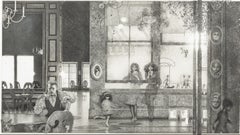
Interiors I: Family Reunion — A penetrating scene with a hidden homage to Eadwea
By Peter Milton
Located in Middletown, NY
Interiors I: Family Reunion
1984
Resist ground etching and engraving on BFK Rives wove paper, 20 x 36 inches (501 x 913 mm), full margins. Signed, titled, dated and numbered 49/175 in pencil, lower margin. In excellent condition with minor mat tone. A luminous, rich, and well-inked impression of this haunting image, with astonishing detail and depth. Framed handsomely under museum grade glass with archival materials in a solid wood frame with silver finish. [Milton 107]
Intended to be a stand alone image in its inception, Family Reunion ended up spawning seven additional images, and became a sort of Primo Pensiero in the sprawling, masterpiece suite now known as Interiors. The suite took eight years to complete, and consists of works of varying format, psychological intensity, and subject matter. The thematic darkness in the eight images waxes and wanes, and Milton intentionally included several interlude works to lighten the tension he felt while composing several of the darker images. The first two in the series, Family Reunion, and Hotel Paradise Café, were meant to be companion pieces. The equilibrium of each composition is anchored on a central brooding figure; a man (perhaps based on a Thomas Eakins portrait of the American anthropologist Frank Hamilton...
Category
American Modern 1750s Interior Prints
Materials
Engraving, Etching
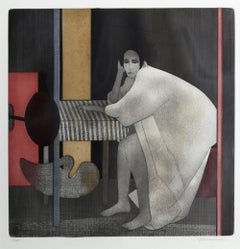
Waking Up, Signed Modern Portrait Etching by Andre Minaux
By Andre Minaux
Located in Long Island City, NY
Waking Up
Andre Minaux, French (1923–1986)
Etching, signed and numbered in pencil
Edition of 25/45
Image Size: 15.5 x 15.5 inches
Frame Size: 31.75 x 27.7...
Category
Modern 1750s Interior Prints
Materials
Etching
$1,200
H 31.75 in W 27.75 in
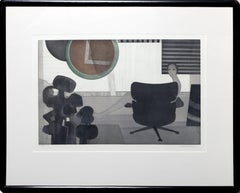
Woman in Chair, Modern Art Etching by Andre Minaux
By Andre Minaux
Located in Long Island City, NY
Woman in Chair
Andre Minaux, French (1923–1986)
Etching, signed and numbered in pencil
Edition of HC 7/12
Image Size: 15 x 23 inches
Frame Size: 27.5 x 34...
Category
Modern 1750s Interior Prints
Materials
Etching
$1,200
H 27.5 in W 34.25 in
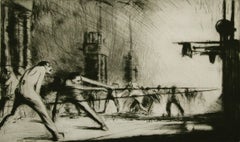
France at her Furnaces
By James McBey
Located in Storrs, CT
1917. Etching. Hardie 175. 8 x 15 (sheet 10 1/8 x 16 15/16). Edition 76. Slight mat line; otherwise excellent condition. A rich impression printed on antique laid paper with full m...
Category
Modern 1750s Interior Prints
Materials
Drypoint, Etching
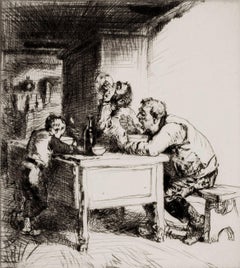
Soup
Located in Storrs, CT
Soup. 1920. Drypoint. Appleby 65. 9 x 8 1/8 (sheet 15 x 11 9/16). Edition 100. Illlustrated: Print Collector's Quarterly 13 (1926): 85. Signed in pencil.
Edmund Blampied was a painter, etcher, lithographer and sculptor. Born in 1886 to a family of three boys in St. Martin, Jersey, Blampied became interested in drawing at an early age. After visiting the studio of John Helier Lander in 1899, Blampied decided to make a career as an artist. In 1903 he went to London to attend Lambeth Art School, where he studied etching under Walter Seymour.
In 1905, he joined the Daily Chronicle as an artist. In that year he was awarded a scholarship to Bolt Court Scool of Photo-engraving and Lithography.
In 1912 he left the Chronicle and established his own studio. He earned a living by illustrating novels and short stories.
In 1913, he had his first exhibition at the Leicester Gallery in London. The following year he married Marianne Van Abbé.
During the 1920's, he became a member of the Royal Society of Painter-Etchers and Engravers. During the 1920s Blampied became a member of the Royal Society of Painters-Etchers and Engravers and exhibited in London to critical acclaim. He produced a folio of comic drawings in the 1930s which was published in New York in 1934 and another that was published in London in 1936. The Keeper of Prints and Drawings at the British Museum published a mongraph on his work. His London exhibitions were highly successful.
In 1938, he moved to Bulwarks, St.Aubin in Jersey, but at the onset of the Occupation, had to relocate to Route Orange, St. Brelade. remained there throughout World War II during the German Occupation, despite the fact that his wife was Jewish. During the Occupation he designed bank...
Category
Modern 1750s Interior Prints
Materials
Drypoint, Etching
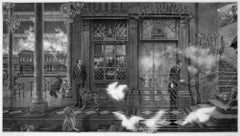
Interiors VII: The Train from Munich
By Peter Milton
Located in Middletown, NY
Interiors VII: The Train from Munich
Robert E. Townsend, 1991.
Resist ground etching and engraving with hand refinement in charcoal, pencil, stabilo, and eraser on BFK Rives white wove paper, 20 x 36 inches (507 x 914 mm), full margins. Signed, titled, dated and numbered 51/175 by the artist in pencil, lower margin. A brilliant, inky impression with luminous light and gradient tones. In excellent condition with one extremely minor and superficial spot of light tan adhesive residue on the verso, unobtrusive and not visible on the recto, with no other visible defects. With the blind stamp of the printer, Robert E. Townsend in the lower left margin. An especially fine impression in superb condition. [Milton 113].
When asked about this work in particular, Milton expressed that his favorite images were his darkest images, in theme, mood, and in ink. Milton, who has said that his work is infused with a postmodern awareness of the past, has focused here in a deeply personal way on a segment of history that continues to haunt us all. The work, published in 1991, evokes one of the darkest periods of European history, the eroding and erasing of European culture under fascism, and the eventual total loss of humanity. The Train from Munich is an especially relevant and emotional work for Milton, who created the piece for his wife, Edith, who escaped Munich in 1939 as a child on the fabled Kinderstransport. The Kinderstransport was a desperate rescue effort on the part of the British government to save as many Jewish children as possible by railway before borders closed on the precipice of the Second World War. Children left their parents behind, and boarded the trains alone, leaving the impending doom of Nazi Germany, they arrived in Great Britain as refugees. More than 10,000 children escaped the holocaust via the Kinderstransport. In Train from Munich, the image itself holds an almost immeasurable amount of symbolism; each inch of the matrix is a successful effort to confront this history in a way that is poignant through a series of motifs. We see the Café disappearing into a ghostlike memory of the past, an allegory to the disintegration of culture, while through the windows we can see a rampant, snarling dog; a portrait of Hitler's shepherd, Blondi. Blondi isn't the only notable figure in the composition. Milton has pointed out that the fading figure of the doorman at the Hotel Metropole is modeled after the artist and intellectual Marcel Duchamp, and the face of the young girl peering...
Category
American Modern 1750s Interior Prints
Materials
Charcoal, ABS, Engraving, Etching
Previously Available Items
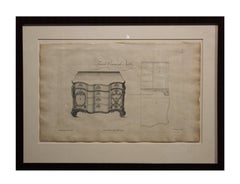
French Commode Table Etching From "The Gentleman and Cabinet-Maker
s Director"
By Thomas Chippendale
Located in Houston, TX
Engraving from a book titled, "The Gentleman and Cabinet-Maker's Director" printed in 1753. Thomas Chippendale was the designer and Mary and Matthew Darly...
Category
Rococo 1750s Interior Prints
Materials
Etching
H 16.5 in W 22.5 in D 0.75 in
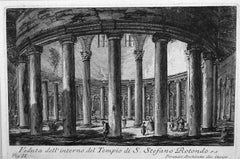
Interior view of the Church of San Stefano Rotondo
Located in New York, NY
Giovanni Battista Piranesi (1720-1778), Veduta dell’interno del Tempio di S. Stefano Rotondo (Interior view of the Church of San Stefano Rotondo), etching, 1756. First Edition, from the series Le Antichita Romane, Bouchard e Gravier 1756, section XXV, figure 2 [signed, numbered and titled in the plate]. References: Focillon 192, Wilton-Ely 327. In good condition, with margins, 5 1/2 x 8, the sheet 6 1/4 x 9 inches.
A very good impression, printed on a stiff cream laid paper.
Piranesi developed the plates of the Antichita Romane (Roman Antiquities) after eight...
Category
Old Masters 1750s Interior Prints
Materials
Etching