Want more images or videos?
Request additional images or videos from the seller
1 of 6
Judith BledsoeNoah
s Ark, Lithograph by Judith Bledsoecirca 1970
circa 1970
$600List Price
About the Item
- Creator:Judith Bledsoe (1928, French)
- Creation Year:circa 1970
- Dimensions:Height: 30.5 in (77.47 cm)Width: 24 in (60.96 cm)
- Medium:
- Movement Style:
- Period:
- Framing:Framing Options Available
- Condition:
- Gallery Location:Long Island City, NY
- Reference Number:Seller: 704781stDibs: LU46614406132
About the Seller
4.9
Platinum Seller
Premium sellers with a 4.7+ rating and 24-hour response times
Established in 1979
1stDibs seller since 2014
3,192 sales on 1stDibs
Typical response time: 1 hour
Authenticity Guarantee
In the unlikely event there’s an issue with an item’s authenticity, contact us within 1 year for a full refund. DetailsMoney-Back Guarantee
If your item is not as described, is damaged in transit, or does not arrive, contact us within 7 days for a full refund. Details24-Hour Cancellation
You have a 24-hour grace period in which to reconsider your purchase, with no questions asked.Vetted Professional Sellers
Our world-class sellers must adhere to strict standards for service and quality, maintaining the integrity of our listings.Price-Match Guarantee
If you find that a seller listed the same item for a lower price elsewhere, we’ll match it.Trusted Global Delivery
Our best-in-class carrier network provides specialized shipping options worldwide, including custom delivery.You May Also Like
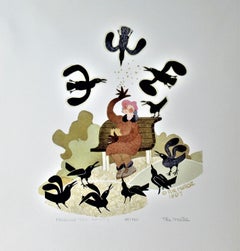
Feeding the Ravens
Located in San Francisco, CA
This artwork titled "Feeding the Ravens" 1997 is a color offset lithograph on paper by noted American artist Rie Mounier Munoz, 1921-2015. It is hand signed and numbered 29/950 in pencil by the artist. The image size is 9.65 x 8.35 inches, sheet size is 13.85 x 12.25 inches. It is in excellent condition, has never been framed.
About the artist:
Alaska painter Rie Mounier Munoz was the child of Dutch parents who immigrated to California, where she was born and raised. She is known for her colorful scenes of everyday life in Alaska.
Rie (from Marie) Munoz (moo nyos), studied art at Washington and Lee University in Virginia. In 1950, she traveled up the Inside Passage by steamship, fell in love with Juneau, and gave herself until the boat left the next day to find a job and a place to live. Since then Juneau has been home to Munoz. She began painting small vignettes of Alaska soon after arriving in Juneau, and also studied art at the University of Alaska-Juneau.
Munoz painted in oils in what she describes as a "painstakingly realistic" style, which she found stiff and "somewhat boring." Her breakthrough came a few years later when an artist friend introduced her to a versatile, water-soluble paint called casein. The immediacy of this inexpensive medium prompted an entirely new style. Rie's paintings became colorful and carefree, mirroring her own optimistic attitude toward life. With her newfound technique she set about recording everyday scenes of Alaskans at work and at play.
Of the many jobs she has held journalist, teacher, museum curator, artist, mother, Munoz recalls one of her most memorable was as a teacher on King Island in 1951, where she taught 25 Eskimo children. The island was a 13-hour umiak (a walrus skin boat) voyage from Nome, an experience she remembers vividly. After teaching in the Inupiat Eskimo village on the island with her husband during one school year, she felt a special affinity for Alaska's Native peoples and deliberately set about recording their traditional lifestyles that she knew to be changing very fast.
For the next twenty years, Rie practiced her art as a "Sunday painter," in and around prospecting with her husband, raising a son, and working as a freelance commercial artist, illustrator, cartoonist, and curator of exhibits for the Alaska State Museum. During her years in Alaska, Munoz has lived in a variety of small Alaskan communities, including prospecting and mining camps.
Her paintings reflect an interest in the day-to-day activities of village life such as fishing, berry picking, children at play, as well as her love of folklore and legends. Munoz says that what has appealed to her most were "images you might not think an artist would want to paint," such as people butchering crab, skinning a seal, or doing their laundry in a hand-cranked washing machine.
In 1972, with her hand-cut stencil and serigraph prints selling well in four locations in Alaska, she felt confident enough to leave her job at the Alaska State Museum and devote herself full time to her art. Freed from the constraints of an office job, she began to produce close to a hundred paintings a year, in addition to stone lithograph and serigraph prints.
From her earliest days as an artist, Rie had firm beliefs about selling her work. First, she insisted the edition size should be kept modest. When she decided in 1973 to reproduce Eskimo Story Teller as an offset lithography print and found the minimum print run to be 500, she destroyed 200 of the prints. She did the same with King Island, her second reproduction. Reluctantly, to meet market demand, she increased the edition size of the reproductions to 500 and then 750. The editions stayed at that level for almost ten years before climbing to 950 and 1250.
Her work has been exhibited many solo watercolor exhibits in Alaska, Oregon and Washington State, including the Charles and Emma Frye Art Museum, Alaska State Museum in Juneau, Anchorage Historical and Fine Arts Museum, Tongass Historical Museum in Ketchikan, and Yukon Regional Library in Whitehorse; Yukon Territory, and included in exhibits at the Smithsonian Institute and Russell Senate Office Building in Washington, D.C.
Munozs paintings have graced the covers of countless publications, from cookbooks to mail order catalogs, and been published in magazines, newspapers, posters, calendars, and two previous collections of her work: Rie Munoz...
Category
Late 20th Century Folk Art Animal Prints
Materials
Lithograph
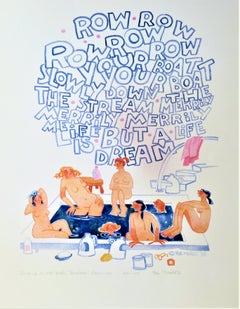
Singing in the Bath, Tenakee Springs
Located in San Francisco, CA
This artwork titled "Singing in the Bath, Tenakee Springs" 1996 is a color offset lithograph on paper by noted American artist Rie Mounier Munoz, 1921-2015. It is hand signed and numbered 1077/1100 in pencil by the artist. The image size is 13.5 x 10 inches, sheet size is 16 x 12.35 inches. It is in excellent condition, has never been framed.
About the artist:
Alaska painter Rie Mounier Munoz was the child of Dutch parents who immigrated to California, where she was born and raised. She is known for her colorful scenes of everyday life in Alaska.
Rie (from Marie) Munoz (moo nyos), studied art at Washington and Lee University in Virginia. In 1950, she traveled up the Inside Passage by steamship, fell in love with Juneau, and gave herself until the boat left the next day to find a job and a place to live. Since then Juneau has been home to Munoz. She began painting small vignettes of Alaska soon after arriving in Juneau, and also studied art at the University of Alaska-Juneau.
Munoz painted in oils in what she describes as a "painstakingly realistic" style, which she found stiff and "somewhat boring." Her breakthrough came a few years later when an artist friend introduced her to a versatile, water-soluble paint called casein. The immediacy of this inexpensive medium prompted an entirely new style. Rie's paintings became colorful and carefree, mirroring her own optimistic attitude toward life. With her newfound technique she set about recording everyday scenes of Alaskans at work and at play.
Of the many jobs she has held journalist, teacher, museum curator, artist, mother, Munoz recalls one of her most memorable was as a teacher on King Island in 1951, where she taught 25 Eskimo children. The island was a 13-hour umiak (a walrus skin boat) voyage from Nome, an experience she remembers vividly. After teaching in the Inupiat Eskimo village on the island with her husband during one school year, she felt a special affinity for Alaska's Native peoples and deliberately set about recording their traditional lifestyles that she knew to be changing very fast.
For the next twenty years, Rie practiced her art as a "Sunday painter," in and around prospecting with her husband, raising a son, and working as a freelance commercial artist, illustrator, cartoonist, and curator of exhibits for the Alaska State Museum. During her years in Alaska, Munoz has lived in a variety of small Alaskan communities, including prospecting and mining camps.
Her paintings reflect an interest in the day-to-day activities of village life such as fishing, berry picking, children at play, as well as her love of folklore and legends. Munoz says that what has appealed to her most were "images you might not think an artist would want to paint," such as people butchering crab, skinning a seal, or doing their laundry in a hand-cranked washing machine.
In 1972, with her hand-cut stencil and serigraph prints selling well in four locations in Alaska, she felt confident enough to leave her job at the Alaska State Museum and devote herself full time to her art. Freed from the constraints of an office job, she began to produce close to a hundred paintings a year, in addition to stone lithograph and serigraph prints.
From her earliest days as an artist, Rie had firm beliefs about selling her work. First, she insisted the edition size should be kept modest. When she decided in 1973 to reproduce Eskimo Story Teller as an offset lithography print and found the minimum print run to be 500, she destroyed 200 of the prints. She did the same with King Island, her second reproduction. Reluctantly, to meet market demand, she increased the edition size of the reproductions to 500 and then 750. The editions stayed at that level for almost ten years before climbing to 950 and 1250.
Her work has been exhibited many solo watercolor exhibits in Alaska, Oregon and Washington State, including the Charles and Emma Frye Art Museum, Alaska State Museum in Juneau, Anchorage Historical and Fine Arts Museum, Tongass Historical Museum in Ketchikan, and Yukon Regional Library in Whitehorse; Yukon Territory, and included in exhibits at the Smithsonian Institute and Russell Senate Office Building in Washington, D.C.
Munozs paintings have graced the covers of countless publications, from cookbooks to mail order catalogs, and been published in magazines, newspapers, posters, calendars, and two previous collections of her work: Rie Munoz...
Category
Late 20th Century Folk Art Nude Prints
Materials
Lithograph
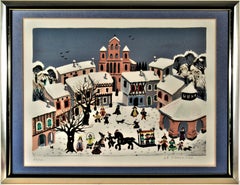
Village en Hiver
Located in San Francisco, CA
This artwork "Village en Hiver" c.1980 is an original color lithograph by French artist Madeleine (Mady) De La Giraudiere, 1922-2018. It is hand signed a...
Category
Late 20th Century Folk Art Figurative Prints
Materials
Lithograph
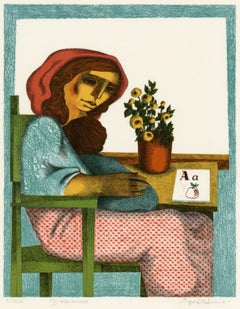
Descanso (Break)
By Jorge Dumas
Located in Fairlawn, OH
Signed, titled and numbered in pencil
Edition: 250 (5/250)
Signed, titled and numbered in pencil
Published by Circle Gallery Ltd.
Printer: Atelier Dumas, New York
Condition: Very good
Atelier Dumas opened in New York printing own work as well as
those of Peter Max, Agam, Romare Bearden, Dali, Erté, Peter Hurd,
Ting, Karl Appel...
Category
1970s Folk Art Figurative Prints
Materials
Lithograph
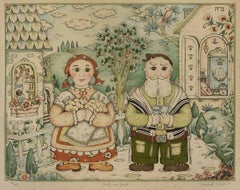
Bubby and Zayde, Judaica Folk Art Jewish Lithograph
By Michoel Muchnik
Located in Surfside, FL
The title of the piece makes reference to the subject of the piece, in this case Bubby (Grandmother in Yiddish) and Zayde (Grandfather in Yiddish). In terms of style, it looks illustrative, cartoonist, and fairy-tale like. Edition 76/260.
Michoel Muchnik was born in Philadelphia in 1952. Muchnik received his artistic training at the Rhode Island School of Design. He later studied Jewish and Talmudic studies at the Rabbinical College of America in Morristown, New Jersey.
Michoel Muchnik's art focuses on imaginative and joyful depictions of traditional and mystical Jewish and Hasidic themes. Muchnik has exhibited his work and lectured on Hasidic art throughout the United States as well as abroad. In 1977, Muchnik was selected alongside four other Hasidic artists, including Hendel Lieberman...
Category
Late 20th Century Folk Art Figurative Prints
Materials
Lithograph
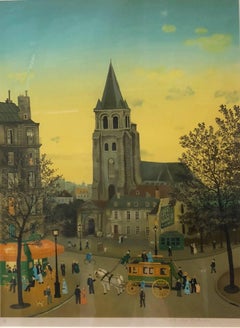
Hand signed Folk Art Naive lithograph on Arches paper Paris Evening Cafe Scene
By Michel Delacroix
Located in Surfside, FL
size includes frame: 32.5" H x 26.5" W;
Lithograph in colors depicting an enchanted evening in Paris with a bright cafe and a church or public building on a charming Paris square. ...
Category
20th Century Folk Art Figurative Prints
Materials
Lithograph
$1,750
H 32.5 in W 26.5 in
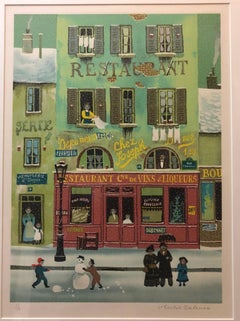
Hand signed Folk Art Naive lithograph on Arches Paper Paris Snowman Scene
By Michel Delacroix
Located in Surfside, FL
Lithograph in colors depicting an enchanted evening in Paris with a snowman and children playing outside the restaurant Chez Joseph on a winter day. Signed in bottom right margin "M...
Category
20th Century Folk Art Figurative Prints
Materials
Lithograph
$1,450
H 28.75 in W 22.75 in
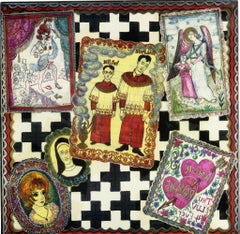
Lithograph from from the Artsounds Collection, signed/n famed cult artist LGBTQ
By Thomas Lanigan-Schmidt
Located in New York, NY
Thomas Lanigan-Schmidt
Untitled, from from the Artsounds Collection, 1986
Lithograph on paper
Signed and numbered from the edition of 200 in ink on the back; also bears artist's stamped name and provenance - Art Sounds portfolio.
12 × 12 inches
Unframed
Signed and numbered from the edition of 200 in ink on the back; also bears artist's stamped name and provenance - Art Sounds portfolio.
This terrific offset lithograph print exemplifies the combination of religion and kitsch that Lanigan Schmidt is best known for. This print was created in the 1980s for the famous Artsounds portfolio, which featured prints by Marcel Duchamp, Jonathan Borofsky among others. Lanigan-Schmidt was a subject of a 2013 retrospective at PS1 MOMA and is on the faculty of the School of Visual Arts in New York.
Provenance:
Artsounds Portfolio
About Thomas Lanigan-Schmidt:
Thomas Lanigan-Schmidt is represented in the collections of the Metropolitan Museum of Art, Whitney Museum of American Art, MoMA, Brooklyn Museum, Ludwig Forum für Internationale Kunst, Ackland Art Museum, Columbus Museum of Art, and Wadsworth Atheneum Museum of Art, among others. He has exhibited extensively throughout the United States and Europe, including the 1980 and 1984 Venice Biennales, the 1991 Whitney Biennial, and the 1999 exhibition The American Century: Art and Culture, 1950-2000, Whitney Museum of American Art, New York, NY. Recent solo exhibitions include Tenemental: With Sighs Too Deep for Words, Howl! Happening, New York (2018); Thomas Lanigan-Schmidt: Mysterium Tremendum, Rockland Art Center, NY (2013); and Ecce Homo: Thomas Lanigan-Schmidt & The Art of Rebellion, Pavel Zoubok...
Category
1980s Outsider Art Figurative Prints
Materials
Lithograph
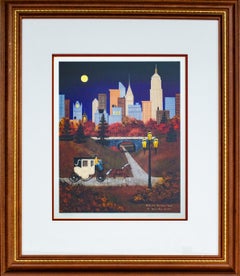
Autumn in New York by Jane Wooster Scott
By Jane Wooster Scott
Located in New York, NY
Jane Wooster Scott (American, b. 1920)
Autumn in New York, c. 20th Century
Lithograph
Sight: 15 x 12 in.
Framed: 27 3/4 x 23 3/4 x 1 in.
Signed and titled lower right in plate: Autum...
Category
20th Century Folk Art Landscape Prints
Materials
Lithograph
$700
H 27.75 in W 23.75 in D 1 in
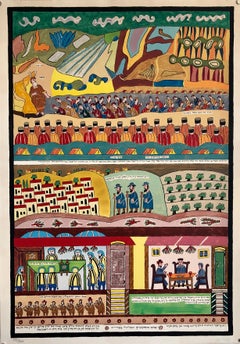
Israeli Folk Art Hebrew Naive Judaica Lithograph Jewish Holiday Shavuot
By Shalom Moskovitz
Located in Surfside, FL
Vintage pencil signed and numbered limited edition lithograph on deckle edged Arches paper.
Shalom of Sefad (Shulem der Zeigermacher in Yiddish Shalom Moskowitz) Shalom of Tzfat lived for over seventeen years in his native town of Safed in the hills of the Galilee. There he worked as a watchmaker, stonemason and silversmith, during the 50's. Since then this self-taught artist has achieved an international reputation. Shalom is a naive painter, but not a rustic one, he expresses a very elaborate way of thinking in his own way. While belonging to Hasidism, Shalom of Safed uses his artistic talents positively. 'I don't paint', he explains, 'to tell the story of the Bible in color and lines. His works have been exhibited in prominent museums and galleries in Europe and the United States, and are included in the collections of the Museums of Modern Art in Paris and New York, the Israel Museum in Jerusalem, the Stedelijk Museum in Amsterdam, the Modern Museum in Stockholm and the Jewish Museum in New York
He has exhibited alongside all of the Israeli great artists. Israel has had a Vibrant Folk Art, Naive art scene for a long time now artists like Yisrael Paldi, Nahum Guttman, Reuven Rubin and even Yefim Ladizhinsky had naive periods. The most well know if the strict naive artists are Shalom of Safed, Irene Awret...
Category
20th Century Folk Art Figurative Prints
Materials
Lithograph
$1,250
H 22 in W 29.75 in
More From This Seller
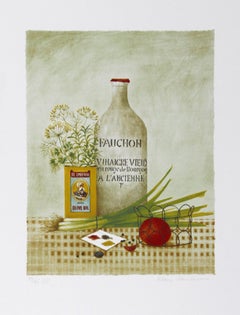
View AllVinegar, Folk Art Lithograph by Mary Faulconer
By Mary Faulconer
Located in Long Island City, NY
Mary Faulconer, American (1912 - 2011) - Vinegar, Year: circa 1980, Medium: Lithograph, signed and numbered in pencil, Edition: 250, AP 35, Image Size: 14 x 11 inches, Size: 26....
Category
1980s Folk Art Still-life Prints
Materials
Lithograph
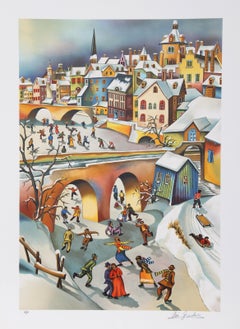
Winter
s Play, Folk Art Lithograph by Ari Gradus
By Ari Gradus
Located in Long Island City, NY
Ari Gradus, Israeli (1943 - ) - Winter's Play, Year: 1980, Medium: Lithograph, signed and numbered in pencil, Edition: AP, Image Size: 26 x 18 inches, Size: 30 in. x 22 in. (76....
Category
1980s Folk Art Landscape Prints
Materials
Lithograph
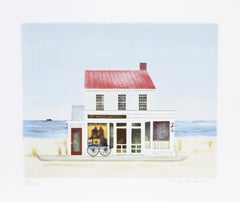
Sag Harbor Antique Shop, Folk Art Lithograph by Mary Faulconer
By Mary Faulconer
Located in Long Island City, NY
Mary Faulconer, American (1912 - 2011) - Sag Harbor Antique Shop, Year: circa 1980, Medium: Lithograph, signed and numbered in pencil, Edition: 250, AP 35, Image Size: 12 x 15.5 ...
Category
1980s Folk Art Landscape Prints
Materials
Lithograph
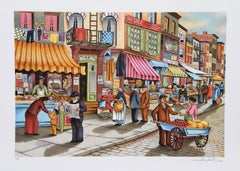
Old New York, Folk Art Lithograph by Ari Gradus
By Ari Gradus
Located in Long Island City, NY
Ari Gradus, Israeli (1943 - ) - Old New York, Year: 1980, Medium: Lithograph, signed in pencil, Edition: AP, Image Size: 18 x 26 inches, Size: 22 in. x 30 in. (55.88 cm x 76.2 c...
Category
1980s Folk Art Landscape Prints
Materials
Lithograph
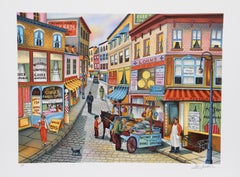
Knife Sharpener, Folk Art Lithograph by Ari Gradus
By Ari Gradus
Located in Long Island City, NY
Ari Gradus, Israeli (1943 - ) - Knife Sharpener, Year: 1980, Medium: Lithograph. Signed and Numbered in Pencil, Edition: AP, Image Size: 18.5 x 25 inche...
Category
1980s Folk Art Landscape Prints
Materials
Lithograph
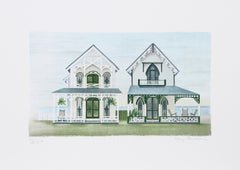
Cottage City, Folk Art Lithograph by Mary Faulconer
By Mary Faulconer
Located in Long Island City, NY
Mary Faulconer, American (1912 - 2011) - Cottage City, Year: circa 1980, Medium: Lithograph, signed and numbered in pencil, Edition: 250, AP 35, Image Size: 10 x 17 inches, Size:...
Category
1980s Folk Art Landscape Prints
Materials
Lithograph
Recently Viewed
View AllMore Ways To Browse
Folk Art Noah Ark
Bucking Horse
Carlo Pellegrini
Chagall Jacob
Chagall Jerusalem Windows
Charles White Artist
Chartres Cathedral
Christmas Lithograph
Cote D Azur Vintage Posters
Cote D Azur Vintage Travel Poster
Craig Martin
Curtis Engraving
Dali 1977
Jim Dine Poster
La Revue Blanche
Matador And Bull
Maurice Utrillo Montmartre
Max Jaffe