Small Landscape Prints
to
1,106
8,114
3,260
2,909
1,609
1,184
Overall Width
to
Overall Height
to
795
610
205
148
138
117
95
80
60
14
9
8
2
2
72
59
56
36
30
265
515
1,747
731
30
13
100
66
76
161
334
353
195
115
136
1,947
1,167
140
1,299
609
461
394
371
311
260
251
220
193
174
160
136
135
131
129
117
110
108
90
1,259
874
535
270
234
404
891
1,962
1,084
Size: Small
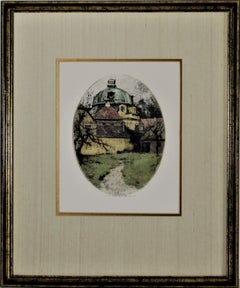
Klosterneuburg, Austria
Located in San Francisco, CA
This artwork titled "Klosterneuburg, Austria" c.1950 is a color etching by Austrian artist Luigi Kasimir 1881-1962. It is hand signed by the artist's estate in pencil at the lower center. The plate mark (image) size is 7.75 x 5.85 inches, framed is 18.15 x 15.15 inches. It is framed in a wooden antique silver frame. It is in very good condition.
About the artist.
Luigi Kasimir was born in 1881 at Pettau, today Ptuj, Slovenia, then a part of the Austro-Hungarian monarchy. He inherited his talent from his ancestors; his grandfather was a painter and a poet, and his father an officer in the Habsburg army, who later became a professional painter. Kasimir attended the Vienna Academy of Art where he studied under Wilhelm Unger, who introduced him to the technique of the coloured etching, and also to his future wife, the artist Tanna Hoernes.[1] He died in 1962 in Grinzing, a suburb of Vienna.Kasimir was among the first to develop the technique of the coloured etching. Before this, prints were usually hand-coloured with the colour being applied in a casual, haphazard manner. Kasimir would first create a sketch usually in pastel, he then transferred the design on as many as four to six plates, printing one after the other and applying the colour on the plate, all done by hand.
Kasimir is mainly famous for his etchings, but he also produced some oil painting, as well as some pastels. One of his favourite genres was the landscape, or veduta. He demonstrated a predisposition street scenes, and tourist landmarks. He depicted places from all over Europe, mainly Italy, Austria, and Germany. He also travelled to the United States to do a series of etchings of famous sights ranging from urban landmarks such as New York City skyscrapers, to natural wonders like Yosemite Valley. Luigi Kasimir’s etchings...
Category
Early 20th Century Realist Figurative Prints
Materials
Etching
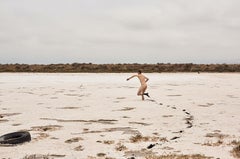
"Untitled (Nr. 0737)" Landscape Photography 18" x 24" Edition of 20 by Ben Cope
By Ben Cope
Located in Culver City, CA
"Untitled (Nr. 0737)" Landscape Photography 18" x 24" Edition of 20 by Ben Cope
Unframed - ships rolled in a tube
Ben Cope + Rowan Daly Off the Grid
Off the Grid is the culmina...
Category
21st Century and Contemporary Contemporary Landscape Photography
Materials
Archival Pigment
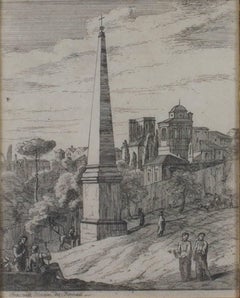
17th century etching black and white figurative landscape obelisk buildings
Located in Milwaukee, WI
"Figures at the Obelisk" is an original etching by Jan Frans van Bloemen. It depicts two people conversing in front of a monument. Behind them, an expansive landscape sprawls.
9 1/4" x 6 3/4" art
21 3/4" x 19 3/8" frame
Jan Frans van Bloemen (baptized 12 May 1662 - buried 13 June 1749) was a Flemish landscape painter mainly active in Rome. Here he was able to establish himself as the leading painter of views (vedute) of the Roman countryside depicted in the aesthetic of the classical landscape tradition.
Van Bloemen predominantly painted classical landscapes, taking his inspiration from the Roman Campagna. His landscapes, with their recession through a series of planes, soft, warm lightning and classical and religious subject matter, drew on the examples of artists such as Claude Lorrain and Gaspard Dughet. His paintings are exquisitely imbued with that "difficult-to-define pastoral ambience" which helped to make him such a great painter in the eyes of his contemporaries. The technique and subjects of the work of Jan Frans van Bloemen are also related to painters such as Jan Asselijn, Thomas Wyck...
Category
18th Century Old Masters Landscape Prints
Materials
Etching
19th century color lithograph birds landscape nature grass sky water figure
By Currier
Ives
Located in Milwaukee, WI
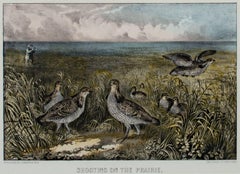
"Shooting on the Prairie" is an original hand-colored lithograph by Currier & Ives. It depicts a hunter shooting at fowl in an open field.
8 1/2" x 12 1/2" art
20 1/4" x 23 3/4" frame
Nathaniel Currier was a tall introspective man with a melancholy nature. He could captivate people with his piercing stare or charm them with his sparkling blue eyes. Nathaniel was born in Roxbury, Massachusetts on March 27th, 1813, the second of four children. His parents, Nathaniel and Hannah Currier, were distant cousins who lived a humble yet spartan life. When Nathaniel was eight years old, tragedy struck. Nathaniel’s father unexpectedly passed away leaving Nathaniel and his eleven-year-old brother Lorenzo to provide for the family. In addition to their mother, Nathaniel and Lorenzo had to care for six-year-old sister Elizabeth and two-year-old brother Charles. Nathaniel worked a series of odd jobs to support the family, and at fifteen, he started what would become a life-long career when he apprenticed in the Boston lithography shop of William and John Pendleton.
A Bavarian gentleman named Alois Senefelder invented lithography just 30 years prior to young Nat Currier’s apprenticeship. While under the employ of the brothers Pendleton, Nat was taught the art of lithography by the firm’s chief printer, a French national named Dubois, who brought the lithography trade to America.
Lithography involves grinding a piece of limestone flat and smooth then drawing in mirror image on the stone with a special grease pencil. After the image is completed, the stone is etched with a solution of aqua fortis leaving the greased areas in slight relief. Water is then used to wet the stone and greased-ink is rolled onto the raised areas. Since grease and water do not mix, the greased-ink is repelled by the moisture on the stone and clings to the original grease pencil lines. The stone is then placed in a press and used as a printing block to impart black on white images to paper.
In 1833, now twenty-years old and an accomplished lithographer, Nat Currier left Boston and moved to Philadelphia to do contract work for M.E.D. Brown, a noted engraver and printer. With the promise of good money, Currier hired on to help Brown prepare lithographic stones of scientific images for the American Journal of Sciences and Arts. When Nat completed the contract work in 1834, he traveled to New York City to work once again for his mentor John Pendleton, who was now operating his own shop located at 137 Broadway. Soon after the reunion, Pendleton expressed an interest in returning to Boston and offered to sell his print shop to Currier. Young Nat did not have the financial resources to buy the shop, but being the resourceful type he found another local printer by the name of Stodart. Together they bought Pendleton’s business.
The firm ‘Currier & Stodart’ specialized in "job" printing. They produced many different types of printed items, most notably music manuscripts for local publishers. By 1835, Stodart was frustrated that the business was not making enough money and he ended the partnership, taking his investment with him. With little more than some lithographic stones, and a talent for his trade, twenty-two year old Nat Currier set up shop in a temporary office at 1 Wall Street in New York City. He named his new enterprise ‘N. Currier, Lithographer’
Nathaniel continued as a job printer and duplicated everything from music sheets to architectural plans. He experimented with portraits, disaster scenes and memorial prints, and any thing that he could sell to the public from tables in front of his shop. During 1835 he produced a disaster print Ruins of the Planter's Hotel, New Orleans, which fell at two O’clock on the Morning of the 15th of May 1835, burying 50 persons, 40 of whom Escaped with their Lives. The public had a thirst for newsworthy events, and newspapers of the day did not include pictures. By producing this print, Nat gave the public a new way to “see” the news. The print sold reasonably well, an important fact that was not lost on Currier.
Nat met and married Eliza Farnsworth in 1840. He also produced a print that same year titled Awful Conflagration of the Steamboat Lexington in Long Island Sound on Monday Evening, January 18, 1840, by which melancholy occurrence over One Hundred Persons Perished. This print sold out very quickly, and Currier was approached by an enterprising publication who contracted him to print a single sheet addition of their paper, the New York Sun. This single page paper is presumed to be the first illustrated newspaper ever published.
The success of the Lexington print launched his career nationally and put him in a position to finally lift his family up. In 1841, Nat and Eliza had their first child, a son they named Edward West Currier. That same year Nat hired his twenty-one year old brother Charles and taught him the lithography trade, he also hired his artistically inclined brother Lorenzo to travel out west and make sketches of the new frontier as material for future prints. Charles worked for the firm on and off over the years, and invented a new type of lithographic crayon which he patented and named the Crayola. Lorenzo continued selling sketches to Nat for the next few years.
In 1843, Nat and Eliza had a daughter, Eliza West Currier, but tragedy struck in early 1847 when their young daughter died from a prolonged illness. Nat and Eliza were grief stricken, and Eliza, driven by despair, gave up on life and passed away just four months after her daughter’s death.
The subject of Nat Currier’s artwork changed following the death of his wife and daughter, and he produced many memorial prints and sentimental prints during the late 1840s. The memorial prints generally depicted grief stricken families posed by gravestones (the stones were left blank so the purchasers could fill in the names of the dearly departed). The sentimental prints usually depicted idealized portraits of women and children, titled with popular Christian names of the day.
Late in 1847, Nat Currier married Lura Ormsbee, a friend of the family. Lura was a self-sufficient woman, and she immediately set out to help Nat raise six-year-old Edward and get their house in order. In 1849, Lura delivered a son, Walter Black Currier, but fate dealt them a blow when young Walter died one year later. While Nat and Lura were grieving the loss of their new son, word came from San Francisco that Nat’s brother Lorenzo had also passed away from a brief illness. Nat sank deeper into his natural quiet melancholy. Friends stopped by to console the couple, and Lura began to set an extra place at their table for these unexpected guests. She continued this tradition throughout their lives.
In 1852, Charles introduced a friend, James Merritt Ives, to Nat and suggested he hire him as a bookkeeper. Jim Ives was a native New Yorker born in 1824 and raised on the grounds of Bellevue Hospital where his father was employed as superintendent. Jim was a self-trained artist and professional bookkeeper. He was also a plump and jovial man, presenting the exact opposite image of his new boss.
Jim Ives met Charles Currier through Caroline Clark, the object of Jim’s affection. Caroline’s sister Elizabeth was married to Charles, and Caroline was a close friend of the Currier family. Jim eventually proposed marriage to Caroline and solicited an introduction to Nat Currier, through Charles, in hopes of securing a more stable income to support his future wife.
Ives quickly set out to improve and modernize his new employer’s bookkeeping methods. He reorganized the firm’s sizable inventory, and used his artistic skills to streamline the firm’s production methods. By 1857, Nathaniel had become so dependent on Jims’ skills and initiative that he offered him a full partnership in the firm and appointed him general manager. The two men chose the name ‘Currier & Ives’ for the new partnership, and became close friends.
Currier & Ives produced their prints in a building at 33 Spruce Street where they occupied the third, fourth and fifth floors. The third floor was devoted to the hand operated printing presses that were built by Nat's cousin, Cyrus Currier, at his shop Cyrus Currier & Sons in Newark, NJ. The fourth floor found the artists, lithographers and the stone grinders at work. The fifth floor housed the coloring department, and was one of the earliest production lines in the country. The colorists were generally immigrant girls, mostly German, who came to America with some formal artistic training. Each colorist was responsible for adding a single color to a print. As a colorist finished applying their color, the print was passed down the line to the next colorist to add their color. The colorists worked from a master print displayed above their table, which showed where the proper colors were to be placed. At the end of the table was a touch up artist who checked the prints for quality, touching-in areas that may have been missed as it passed down the line. During the Civil War, demand for prints became so great that coloring stencils were developed to speed up production.
Although most Currier & Ives prints were colored in house, some were sent out to contract artists. The rate Currier & Ives paid these artists for coloring work was one dollar per one hundred small folios (a penny a print) and one dollar per one dozen large folios. Currier & Ives also offered uncolored prints to dealers, with instructions (included on the price list) on how to 'prepare the prints for coloring.' In addition, schools could order uncolored prints from the firm’s catalogue to use in their painting classes.
Nathaniel Currier and James Merritt Ives attracted a wide circle of friends during their years in business. Some of their more famous acquaintances included Horace Greeley, Phineas T. Barnum, and the outspoken abolitionists Rev. Henry Ward, and John Greenleaf Whittier (the latter being a cousin of Mr. Currier).
Nat Currier and Jim Ives described their business as "Publishers of Cheap and Popular Pictures" and produced many categories of prints. These included Disaster Scenes, Sentimental Images, Sports, Humor, Hunting Scenes, Politics, Religion, City and Rural Scenes, Trains, Ships, Fire Fighters, Famous Race Horses, Historical Portraits, and just about any other topic that satisfied the general public's taste. In all, the firm produced in excess of 7500 different titles, totaling over one million prints produced from 1835 to 1907.
Nat Currier retired in 1880, and signed over his share of the firm to his son Edward. Nat died eight years later at his summer home 'Lion’s Gate' in Amesbury, Massachusetts. Jim Ives remained active in the firm until his death in 1895, when his share of the firm passed to his eldest son, Chauncey.
In 1902, faced will failing health from the ravages of Tuberculosis, Edward Currier sold his share of the firm to Chauncey Ives...
Category
1870s Other Art Style Animal Prints
Materials
Lithograph
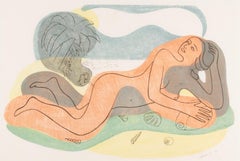
Mexican Idyll, 1936 - 20th Century Nude Linocut Print with Trees and Shells
Located in Kingsclere, GB
Leon Underwood was a British sculptor, wood engraver, painter and writer of the twentieth century. Underwood was born 25 December 1890 in London, and studied at the Regent Street Pol...
Category
20th Century Nude Prints
Materials
Linocut
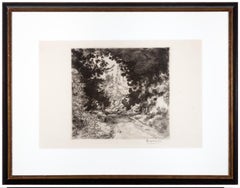
"Road Landscape, " Original Etching and Aquatinit
Located in Milwaukee, WI
"Road Landscape" is an original etching and aquatint by Felix Bracquemond. This piece depicts a shadowy path through the foliage. The artist signed the piece in the lower right and i...
Category
1870s Impressionist Landscape Prints
Materials
Etching, Aquatint
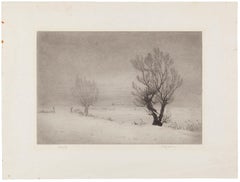
Nevel
Located in Columbia, MO
Abe Gerlsma
Category
Early 20th Century Realist Landscape Prints
Materials
Etching
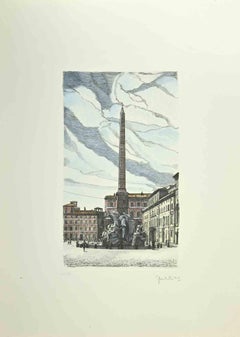
Saint Peter - Etching by Giuseppe Malandrino - 1970s
Located in Roma, IT
Piazza Navona is an artwork realized by Giuseppe Malandrino.
Print in etching technique
Hand-signed by the artist in pencil on the lower right corner.
Numbered edition,26/199.
Go...
Category
1970s Contemporary Landscape Prints
Materials
Etching
$216 Sale Price
35% Off
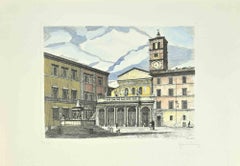
Santa Maria Maggiore di Trastevere - Etching by Giuseppe Malandrino - 1970s
Located in Roma, IT
Santa Maria Maggiore di Trastevere is an artwork realized by Giuseppe Malandrino.
Print in etching technique
Hand-signed by the artist in pencil on the lower right corner.
Numbere...
Category
1970s Contemporary Landscape Prints
Materials
Etching
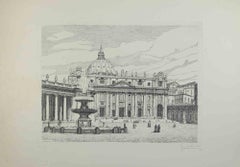
St. Peter
s Square - Etching by Giuseppe Malandrino - 1970s
Located in Roma, IT
Saint Peter is an artwork realized by Giuseppe Malandrino.
Print in etching technique
Hand-signed by the artist in pencil on the lower right corner.
Numbered edition,80/199.
Good...
Category
1970s Contemporary Landscape Prints
Materials
Etching

$216 Sale Price
35% Off
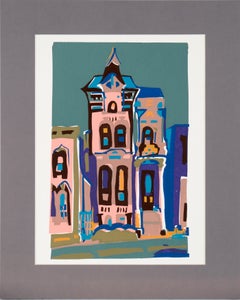
Victorian House - Multi Layer Fauvist Screenprint on Archival Paper
By Doris Warner
Located in Soquel, CA
Bold and bright depiction of a Victorian house by Virginia J Hughins (Virginia Brubaker DeWolf) (American, 1923-2004). The scene is composed of chunky,...
Category
1980s Abstract Impressionist Landscape Prints
Materials
Paper, Ink, Screen
Le Soleil Rouge (1950) [Red] Limited Edition of 200 by Zao Wou-ki (AGE 41)
By Zao Wou-Ki
Located in Hong Kong, HK
Le Soleil Rouge, color Lithograph on Arches paper
1950 by Zao Wou-ki
Printed by E. and J. Desjobert Paris
signed and numbered
image 48 x 34 cm; sheet 56 x 38 cm
image 18 ⁵⁷/₆₄ x 13 ²⁵/₆₄cm; sheet 22 ³/₆₄ x 14 ⁶¹/₆₄ cm
Edition 48/200
Another copy of the same edition is in the MoMA collection (New York).
Framed
Provenance
Redfern Gallery. Purchased on 20 December 1952 at Redfern Gallery's Zao Wou-ki Exhibition (label at the back)
Literature:
Catalogue Raisonné of Zao Wou-ki's graphic works (AGERUP) plate 41
About the Artist:
Born in 1920 in Beijing, Zao Wou-Ki attended the National School of Arts, Hangzhou for six years under the supervision of Lin Fengmian...
Category
1950s French School Landscape Prints
Materials
Paper, Lithograph
![Le Soleil Rouge (1950) [Red] Limited Edition of 200 by Zao Wou-ki (AGE 41)](https://a.1stdibscdn.com/zao-wou-ki-prints-works-on-paper-le-soleil-rouge-1950-red-limited-edition-of-200-by-zao-wou-ki-age-41-for-sale/a_15452/a_107252821660863378214/458_01_3_cropped_master.jpg?width=240 "zao wou-ki")
UNTITLED - SHIPPING YARD
Located in Portland, ME
Wilson, Edward A. (American, born Scotland, 1886 - 1970). UNTITLED - SHIPPING YARD. Lithograph, 1945. Edition of 25, signed and numbered 23/25. 11 x 13 inches (image), 13 1/2 x 15 in...
Category
Mid-20th Century Landscape Prints
Materials
Lithograph
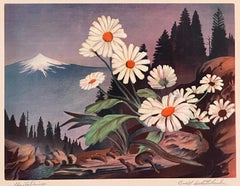
SHASTA DAISIES
Located in Portland, ME
Whitehead, Buell (American, 1919-1993) SHASTA DAISIES. Newsom pg 32. Lithograph in colors, 1946. Edition size not known. Signed and dated in pencil, lower right. In excellent conditi...
Category
1940s Landscape Prints
Materials
Lithograph
"Gnomes Homes I, II,
III, " Trio of Etchings by Jenny Tapping
By Jenny Tapping
Located in Milwaukee, WI
"Gnomes I, II, & III" are three original etchings by Jenny Tapping. Each etching is signed, titled, and numbered by the artist, and all three are in one frame. Each etching depicts a...
Category
1980s Post-Modern Landscape Prints
Materials
Etching
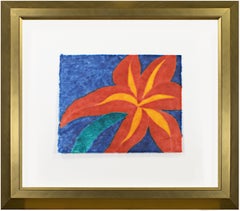
Narcissus Braziliana
original woodcut
monotype signed by Carol Summers
Located in Milwaukee, WI
The present artwork is a vibrant and colorful example of the woodcut prints of Carol Summers. The image is dominated by the form of a red tropical flower, closely cropped around the petals like in the photographs of Imogen Cunningham and the paintings of Georgia O'Keeffe. The playfulness of the image is enhanced by Summers' signature printmaking technique, which allows the ink from the woodblock to seep through the paper, blurring the edges of each form.
9.63 x 11.63 inches, artwork
21 x 23 inches, frame
Edition 16/50 in pencil, lower right
Titled in pencil, lower right
Signed in pencil, lower center
Framed to conservation standards using archival materials including 100 percent rag matting, Museum Glass to inhibit fading, and housed in a modern profile gold gilded wood moulding.
Carol Summers (1925-2016) has worked as an artist throughout the second half of the 20th century and into the first years of the next, outliving most of his mid-century modernist peers. Initially trained as a painter, Summers was drawn to color woodcuts around 1950 and it became his specialty thereafter. Over the years he has developed a process and style that is both innovative and readily recognizable. His art is known for it’s large scale, saturated fields of bold color, semi-abstract treatment of landscapes from around the world and a luminescent quality achieved through a printmaking process he invented.
In a career that has extended over half a century, Summers has hand-pulled approximately 245 woodcuts in editions that have typically run from 25 to 100 in number. His talent was both inherited and learned. Born in 1925 in Kingston, a small town in upstate New York, Summers was raised in nearby Woodstock with his older sister, Mary. His parents were both artists who had met in art school in St. Louis. During the Great Depression, when Carol was growing up, his father supported the family as a medical illustrator until he could return to painting. His mother was a watercolorist and also quite knowledgeable about the different kinds of papers used for various kinds of painting. Many years later, Summers would paint or print on thinly textured paper originally collected by his mother.
From 1948 to 1951, Carol Summers trained in the classical fine and studio arts at Bard College and at the Art Students League of New York. He studied painting with Steven Hirsh and printmaking with Louis Schanker. He admired the shapes and colors favored by early modernists Paul Klee (Sw: 1879-1940) and Matt Phillips (Am: b.1927- ). After graduating, Summers quit working as a part-time carpenter and cabinetmaker (which had supported his schooling and living expenses) to focus fulltime on art. That same year, an early abstract, Bridge No. 1 was selected for a Purchase Prize in a competition sponsored by the Brooklyn Museum.
In 1952, his work (Cathedral, Construction and Icarus) was shown the first time at the Museum of Modern Art in New York City in an exhibition of American woodcuts. In 1954, Summers received a grant from the Italian government to study for a year in Italy. Woodcuts completed soon after his arrival there were almost all editions of only 8 to 25 prints, small in size, architectural in content and black and white in color. The most well-known are Siennese Landscape and Little Landscape, which depicted the area near where he resided. Summers extended this trip three more years, a decision which would have significant impact on choices of subject matter and color in the coming decade.
After returning from Europe, Summers’ images continued to feature historical landmarks and events from Italy as well as from France, Spain and Greece. However, as evidenced in Aetna’s Dream, Worldwind and Arch of Triumph, a new look prevailed. These woodcuts were larger in size and in color. Some incorporated metal leaf in the creation of a collage and Summers even experimented with silkscreening. Editions were now between 20 and 50 prints in number. Most importantly, Summers employed his rubbing technique for the first time in the creation of Fantastic Garden in late 1957.
Dark Vision of Xerxes, a benchmark for Summers, was the first woodcut where Summers experimented using mineral spirits as part of his printmaking process. A Fulbright Grant as well as Fellowships from the Louis Comfort Tiffany Foundation and the Guggenheim Foundation followed soon thereafter, as did faculty positions at colleges and universities primarily in New York and Pennsylvania. During this period he married a dancer named Elaine Smithers with whom he had one son, Kyle. Around this same time, along with fellow artist Leonard Baskin, Summers pioneered what is now referred to as the “monumental” woodcut. This term was coined in the early 1960s to denote woodcuts that were dramatically bigger than those previously created in earlier years, ones that were limited in size mostly by the size of small hand-presses. While Baskin chose figurative subject matter, serious in nature and rendered with thick, striated lines, Summers rendered much less somber images preferring to emphasize shape and color; his subject matter approached abstraction but was always firmly rooted in the landscape.
In addition to working in this new, larger scale, Summers simultaneously refined a printmaking process which would eventually be called the “Carol Summers Method” or the “ Carol Summers Technique”. Summers produces his woodcuts by hand, usually from one or more blocks of quarter-inch pine, using oil-based printing inks and porous mulberry papers. His woodcuts reveal a sensitivity to wood especially its absorptive qualities and the subtleties of the grain. In several of his woodcuts throughout his career he has used the undulating, grainy patterns of a large wood plank to portray a flowing river or tumbling waterfall. The best examples of this are Dream, done in 1965 and the later Flash Flood Escalante, in 2003. In the majority of his woodcuts, Summers makes the blocks slightly larger than the paper so the image and color will bleed off the edge.
Before printing, he centers a dry sheet of paper over the top of the cut wood block or blocks, securing it with giant clips. Then he rolls the ink directly on the front of the sheet of paper and pressing down onto the dry wood block or reassembled group of blocks. Summers is technically very proficient; the inks are thoroughly saturated onto the surface of the paper but they do not run into each other. The precision of the color inking in Constantine’s Dream in 1969 and Rainbow Glacier in 1970 has been referred to in various studio handbooks. Summers refers to his own printing technique as “rubbing”. In traditional woodcut printing, including the Japanese method, the ink is applied directly onto the block. However, by following his own method, Summers has avoided the mirror-reversed image of a conventional print and it has given him the control over the precise amount of ink that he wants on the paper. After the ink is applied to the front of the paper, Summers sprays it with mineral spirits, which act as a thinning agent. The absorptive fibers of the paper draw the thinned ink away from the surface softening the shapes and diffusing and muting the colors. This produces a unique glow that is a hallmark of the Summers printmaking technique. Unlike the works of other color field artists or modernists of the time, this new technique made Summers’ extreme simplification and flat color areas anything but hard-edged or coldly impersonal.
By the 1960s, Summers had developed a personal way of coloring and printing and was not afraid of hard work, doing the cutting, inking and pulling himself. In 1964, at the age of 38, Summers’ work was exhibited for a second time at the Museum of Modern Art. This time his work was featured in a one-man show and then as one of MoMA’s two-year traveling exhibitions which toured throughout the United States. In subsequent years, Summers’ works would be exhibited and acquired for the permanent collections of multiple museums throughout the United States, Europe and Asia. Summers’ familiarity with landscapes throughout the world is firsthand. As a navigator-bombardier in the Marines in World War II, he toured the South Pacific and Asia.
Following college, travel in Europe and subsequent teaching positions, in 1972, after 47 years on the East Coast, Carol Summers moved permanently to Bonny Doon in the Santa Cruz Mountains in Northern California. There met his second wife, Joan Ward Toth, a textile artist who died in 1998; and it was here his second son, Ethan was born. During the years that followed this relocation, Summers’ choice of subject matter became more diverse although it retained the positive, mostly life-affirming quality that had existed from the beginning. Images now included moons, comets, both sunny and starry skies, hearts and flowers, all of which, in one way or another, remained tied to the landscape.
In the 1980s, from his home and studio in the Santa Cruz mountains, Summers continued to work as an artist supplementing his income by conducting classes and workshops at universities in California and Oregon as well as throughout the Mid and Southwest. He also traveled extensively during this period hiking and camping, often for weeks at a time, throughout the western United States and Canada. Throughout the decade it was not unusual for Summers to backpack alone or with a fellow artist into mountains or back country for six weeks or more at a time. Not surprisingly, the artwork created during this period rarely departed from images of the land, sea and sky. Summers rendered these landscapes in a more representational style than before, however he always kept them somewhat abstract by mixing geometric shapes with organic shapes, irregular in outline. Some of his most critically acknowledged work was created during this period including First Rain, 1985 and The Rolling Sea, 1989. Summers received an honorary doctorate from his alma mater, Bard College in 1979 and was selected by the United States Information Agency to spend a year conducting painting and printmaking workshops at universities throughout India. Since that original sabbatical, he has returned every year, spending four to eight weeks traveling throughout that country.
In the 1990s, interspersed with these journeys to India have been additional treks to the back roads and high country areas of Mexico, Central America, Nepal, China and Japan. Travel to these exotic and faraway places had a profound influence on Summers’ art. Subject matter became more worldly and non-western as with From Humla to Dolpo, 1991 or A Former Life of Budha, 1996, for example. Architectural images, such as The Pillars of Hercules, 1990 or The Raja’s Aviary, 1992 became more common. Still life images made a reappearance with Jungle Bouquet in 1997. This was also a period when Summers began using odd-sized paper to further the impact of an image.
The 1996 Night, a view of the earth and horizon as it might be seen by an astronaut, is over six feet long and only slightly more than a foot-and-a-half high. From 1999, Revuelta A Vida (Spanish for “Return to Life”) is pie-shaped and covers nearly 18 cubic feet. It was also at this juncture that Summers began to experiment with a somewhat different palette although he retained his love of saturated colors. The 2003 Far Side of Time is a superb example of the new direction taken by this colorist.
At the turn of the millennium in 1999, “Carol Summers Woodcuts...
Category
Early 2000s Contemporary Landscape Prints
Materials
Monotype, Woodcut
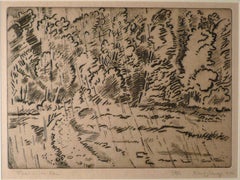
FOREST IN THE RAIN
By Karl Schrag
Located in Portland, ME
Schrag, Karl. FOREST IN THE RAIN. Syracuse 169. Etching and
engraving, 1970. Edition of 50, titled, numbered, dated, and signed,
all in pencil. 9 x 15 inches (plate), with full marg...
Category
1970s Landscape Prints
Materials
Engraving, Etching
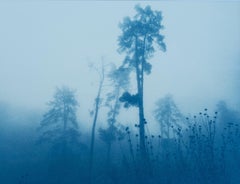
Thistles and Pines (Hand-printed cyanotype, 18 x 24 inches)
Located in Oakland, CA
Scotch thistles bloom in the foreground while from the fog emerge towering Monterey pines behind them. These are the woods across the bay from San Francisco in early summer when this...
Category
2010s Realist Landscape Photography
Materials
Photogram
$200 Sale Price
20% Off
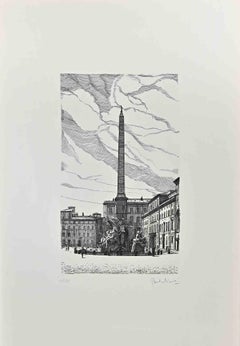
Fountain of the Four Rivers - Etching by Giuseppe Malandrino - 1970s
Located in Roma, IT
Fountain of the Four Rivers is a contemporary artwork realized in 1970 by the Italian artist Giuseppe Malandrino (Modica, 1910 - Rome, 1979).
Etching on cardboard. Hand-signed in pe...
Category
1970s Contemporary Landscape Prints
Materials
Etching
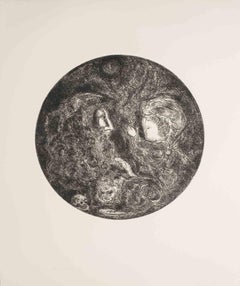
Moses - Etching by Gianpaolo Berto - 1974
Located in Roma, IT
Moses is an artwork realized by Gianpaolo Berto, 1974.
Etching, 60 x 50 cm.
Edition 18/40, Dated 74' in the lower left part.
Very good conditions
Gian Paolo Berto was born an...
Category
1970s Contemporary Figurative Prints
Materials
Etching
$185 Sale Price
35% Off
Death in Venice - Etching by Gianpaolo Berto - 1974
Located in Roma, IT
Death in Venice is an artwork realized by Gianpaolo Berto, 1974.
Etching, 60 x 50 cm.
Edition 28/40, Dated 74' in the lower left part.
Very good condition.
Gian Paolo Berto w...
Category
1970s Contemporary Figurative Prints
Materials
Etching
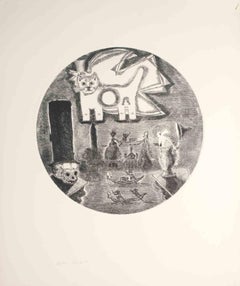
$231 Sale Price
35% Off
The Vision - Etching by Gianpaolo Berto - 1974
Located in Roma, IT
The vision is an artwork realized by Gianpaolo Berto, 1974.
Etching, 60 x 50 cm.
Edition 38/40, Dated 74' in the lower left part.
Very good condition.
Gian Paolo Berto was bo...
Category
1970s Contemporary Figurative Prints
Materials
Etching
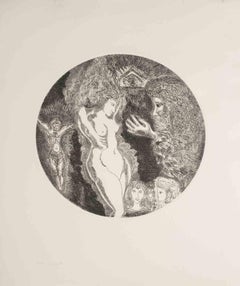
$231 Sale Price
35% Off
Death in Venice - Etching by Gianpaolo Berto - 1974
Located in Roma, IT
Death in Venice is an artwork realized by Gianpaolo Berto, 1974.
Etching, 60 x 50 cm.
Edition 34/40, Dated 74' in the lower left part.
Very good conditions
Gian Paolo Berto was ...
Category
1970s Contemporary Figurative Prints
Materials
Etching
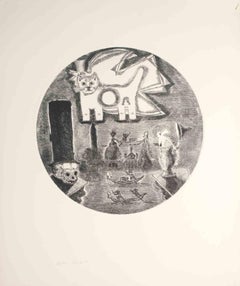
$231 Sale Price
35% Off
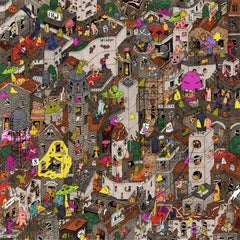
Haunted Favela, fantastic illustration by Guillaume Cornet white framed
Located in Dallas, TX
This beautiful intricate, Rotring pen and markers on paper, on 350gsm Colorset white paper. This piece is framed on a white wood frame, uv glass and all archival materials.
GUILLAUM...
Category
2010s Pop Art Landscape Prints
Materials
Watercolor, Pen, Permanent Marker
$1,760 Sale Price
20% Off
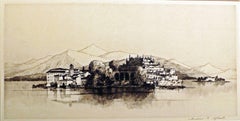
ISOLA BELLA
By Andrew Affleck
Located in Portland, ME
Affleck, Andrew. ISOLA BELLA.
Etching, not dated.
Signed in pencil.
Edition size not known.
9 3/4 x 17 3/8 inches (image), 13 5/8 x 22 1/4 inches (shee...
Category
Early 20th Century Landscape Prints
Materials
Etching
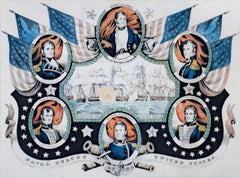
19th century color lithograph portraits ship seascape patriotic flags military
Located in Milwaukee, WI
The present hand-colored lithograph is an excellent example of patriotic mid-nineteenth century American imagery. The print shows the battle and several of the major figures involved in the Battle of Lake Erie: At the center is a view of several frigates on the lake, embroiled in conflict. Above the battle is the quotation: "We have met the enemy and they are ours." Surrounding are laurel-lined roundels with portraits of Oliver Hazard Perry (1785-1819), Stephen Dicateur (1779-1820), Johnston Blakeley (1871-1814), William Bainbridge (1774-1833), David Porter (1780-1843), and James Lawrence (1781-1813) - all of these framed by American flags, banners and cannons. This print shows that the Battle of Lake Erie, part of the War of 1812, still held resonance for American audiences several decades later and was part of the larger narrative of the founding of the country.
9.5 x 13.5 inches, artwork
20 x 23.38 inches, frame
Entitled in the image
Signed in the stone, lower left "Lith. and Pub. by N. Currier"
Inscribed lower right "2 Spruce N.Y." and "No. 1"
Copyrighted lower center "Entered according to Act of Congress in the year 1846 by N. Currier in the Clerk's office of the Southern District of N.Y."
Framed to conservation standards using 100 percent rag matting and housed in a gold gilded moulding.
Nathaniel Currier was a tall introspective man with a melancholy nature. He could captivate people with his piercing stare or charm them with his sparkling blue eyes. Nathaniel was born in Roxbury, Massachusetts on March 27th, 1813, the second of four children. His parents, Nathaniel and Hannah Currier, were distant cousins who lived a humble yet spartan life. When Nathaniel was eight years old, tragedy struck. Nathaniel’s father unexpectedly passed away leaving Nathaniel and his eleven-year-old brother Lorenzo to provide for the family. In addition to their mother, Nathaniel and Lorenzo had to care for six-year-old sister Elizabeth and two-year-old brother Charles. Nathaniel worked a series of odd jobs to support the family, and at fifteen, he started what would become a life-long career when he apprenticed in the Boston lithography shop of William and John Pendleton.
A Bavarian gentleman named Alois Senefelder invented lithography just 30 years prior to young Nat Currier’s apprenticeship. While under the employ of the brothers Pendleton, Nat was taught the art of lithography by the firm’s chief printer, a French national named Dubois, who brought the lithography trade to America.
Lithography involves grinding a piece of limestone flat and smooth then drawing in mirror image on the stone with a special grease pencil. After the image is completed, the stone is etched with a solution of aqua fortis leaving the greased areas in slight relief. Water is then used to wet the stone and greased-ink is rolled onto the raised areas. Since grease and water do not mix, the greased-ink is repelled by the moisture on the stone and clings to the original grease pencil lines. The stone is then placed in a press and used as a printing block to impart black on white images to paper.
In 1833, now twenty-years old and an accomplished lithographer, Nat Currier left Boston and moved to Philadelphia to do contract work for M.E.D. Brown, a noted engraver and printer. With the promise of good money, Currier hired on to help Brown prepare lithographic stones of scientific images for the American Journal of Sciences and Arts. When Nat completed the contract work in 1834, he traveled to New York City to work once again for his mentor John Pendleton, who was now operating his own shop located at 137 Broadway. Soon after the reunion, Pendleton expressed an interest in returning to Boston and offered to sell his print shop to Currier. Young Nat did not have the financial resources to buy the shop, but being the resourceful type he found another local printer by the name of Stodart. Together they bought Pendleton’s business.
The firm ‘Currier & Stodart’ specialized in "job" printing. They produced many different types of printed items, most notably music manuscripts for local publishers. By 1835, Stodart was frustrated that the business was not making enough money and he ended the partnership, taking his investment with him. With little more than some lithographic stones, and a talent for his trade, twenty-two year old Nat Currier set up shop in a temporary office at 1 Wall Street in New York City. He named his new enterprise ‘N. Currier, Lithographer’
Nathaniel continued as a job printer and duplicated everything from music sheets to architectural plans. He experimented with portraits, disaster scenes and memorial prints, and any thing that he could sell to the public from tables in front of his shop. During 1835 he produced a disaster print Ruins of the Planter's Hotel, New Orleans, which fell at two O’clock on the Morning of the 15th of May 1835, burying 50 persons, 40 of whom Escaped with their Lives. The public had a thirst for newsworthy events, and newspapers of the day did not include pictures. By producing this print, Nat gave the public a new way to “see” the news. The print sold reasonably well, an important fact that was not lost on Currier.
Nat met and married Eliza Farnsworth in 1840. He also produced a print that same year titled Awful Conflagration of the Steamboat Lexington in Long Island Sound on Monday Evening, January 18, 1840, by which melancholy occurrence over One Hundred Persons Perished. This print sold out very quickly, and Currier was approached by an enterprising publication who contracted him to print a single sheet addition of their paper, the New York Sun. This single page paper is presumed to be the first illustrated newspaper ever published.
The success of the Lexington print launched his career nationally and put him in a position to finally lift his family up. In 1841, Nat and Eliza had their first child, a son they named Edward West Currier. That same year Nat hired his twenty-one year old brother Charles and taught him the lithography trade, he also hired his artistically inclined brother Lorenzo to travel out west and make sketches of the new frontier as material for future prints. Charles worked for the firm on and off over the years, and invented a new type of lithographic crayon which he patented and named the Crayola. Lorenzo continued selling sketches to Nat for the next few years.
In 1843, Nat and Eliza had a daughter, Eliza West Currier, but tragedy struck in early 1847 when their young daughter died from a prolonged illness. Nat and Eliza were grief stricken, and Eliza, driven by despair, gave up on life and passed away just four months after her daughter’s death.
The subject of Nat Currier’s artwork changed following the death of his wife and daughter, and he produced many memorial prints and sentimental prints during the late 1840s. The memorial prints generally depicted grief stricken families posed by gravestones (the stones were left blank so the purchasers could fill in the names of the dearly departed). The sentimental prints usually depicted idealized portraits of women and children, titled with popular Christian names of the day.
Late in 1847, Nat Currier married Lura Ormsbee, a friend of the family. Lura was a self-sufficient woman, and she immediately set out to help Nat raise six-year-old Edward and get their house in order. In 1849, Lura delivered a son, Walter Black Currier, but fate dealt them a blow when young Walter died one year later. While Nat and Lura were grieving the loss of their new son, word came from San Francisco that Nat’s brother Lorenzo had also passed away from a brief illness. Nat sank deeper into his natural quiet melancholy. Friends stopped by to console the couple, and Lura began to set an extra place at their table for these unexpected guests. She continued this tradition throughout their lives.
In 1852, Charles introduced a friend, James Merritt Ives, to Nat and suggested he hire him as a bookkeeper. Jim Ives was a native New Yorker born in 1824 and raised on the grounds of Bellevue Hospital where his father was employed as superintendent. Jim was a self-trained artist and professional bookkeeper. He was also a plump and jovial man, presenting the exact opposite image of his new boss.
Jim Ives met Charles Currier through Caroline Clark, the object of Jim’s affection. Caroline’s sister Elizabeth was married to Charles, and Caroline was a close friend of the Currier family. Jim eventually proposed marriage to Caroline and solicited an introduction to Nat Currier, through Charles, in hopes of securing a more stable income to support his future wife.
Ives quickly set out to improve and modernize his new employer’s bookkeeping methods. He reorganized the firm’s sizable inventory, and used his artistic skills to streamline the firm’s production methods. By 1857, Nathaniel had become so dependent on Jims’ skills and initiative that he offered him a full partnership in the firm and appointed him general manager. The two men chose the name ‘Currier & Ives’ for the new partnership, and became close friends.
Currier & Ives produced their prints in a building at 33 Spruce Street where they occupied the third, fourth and fifth floors. The third floor was devoted to the hand operated printing presses that were built by Nat's cousin, Cyrus Currier, at his shop Cyrus Currier & Sons in Newark, NJ. The fourth floor found the artists, lithographers and the stone grinders at work. The fifth floor housed the coloring department, and was one of the earliest production lines in the country. The colorists were generally immigrant girls, mostly German, who came to America with some formal artistic training. Each colorist was responsible for adding a single color to a print. As a colorist finished applying their color, the print was passed down the line to the next colorist to add their color. The colorists worked from a master print displayed above their table, which showed where the proper colors were to be placed. At the end of the table was a touch up artist who checked the prints for quality, touching-in areas that may have been missed as it passed down the line. During the Civil War, demand for prints became so great that coloring stencils were developed to speed up production.
Although most Currier & Ives prints were colored in house, some were sent out to contract artists. The rate Currier & Ives paid these artists for coloring work was one dollar per one hundred small folios (a penny a print) and one dollar per one dozen large folios. Currier & Ives also offered uncolored prints to dealers, with instructions (included on the price list) on how to 'prepare the prints for coloring.' In addition, schools could order uncolored prints from the firm’s catalogue to use in their painting classes.
Nathaniel Currier and James Merritt Ives attracted a wide circle of friends during their years in business. Some of their more famous acquaintances included Horace Greeley, Phineas T. Barnum, and the outspoken abolitionists Rev. Henry Ward, and John Greenleaf Whittier (the latter being a cousin of Mr. Currier).
Nat Currier and Jim Ives described their business as "Publishers of Cheap and Popular Pictures" and produced many categories of prints. These included Disaster Scenes, Sentimental Images, Sports, Humor, Hunting Scenes, Politics, Religion, City and Rural Scenes, Trains, Ships, Fire Fighters, Famous Race Horses, Historical Portraits, and just about any other topic that satisfied the general public's taste. In all, the firm produced in excess of 7500 different titles, totaling over one million prints produced from 1835 to 1907.
Nat Currier retired in 1880, and signed over his share of the firm to his son Edward. Nat died eight years later at his summer home 'Lion’s Gate' in Amesbury, Massachusetts. Jim Ives remained active in the firm until his death in 1895, when his share of the firm passed to his eldest son, Chauncey.
In 1902, faced will failing health from the ravages of Tuberculosis, Edward Currier sold his share of the firm to Chauncey Ives...
Category
1850s Victorian Landscape Prints
Materials
Watercolor, Lithograph
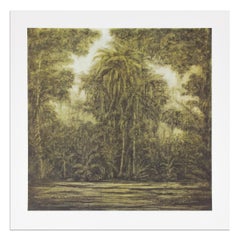
Untitled (from the Deserto-Modelo series), Limited Edition Print
Located in Hamburg, DE
Lucas Arruda Brazilian, b. 1983)
Untitled (from the Deserto-Modelo series), 2018
Medium: Hybrid print on paper
Dimensions: 23 3/5 × 23 3/5 in 60 × 60 cm
Edition of 500: Not signed, ...
Category
21st Century and Contemporary Contemporary Figurative Prints
Materials
Offset
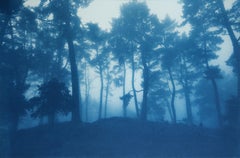
Sunrise Ridge, edition 1 of 10 (Hand-printed cyanotype, 16 x 24 inches)
Located in Oakland, CA
This is the larger hand-printed version of the same blue and white landscape also available in a 12 x 18 inch size. New as of July 2024. This is a hand-printed contact photograph us...
Category
2010s Realist Landscape Photography
Materials
Paper, Archival Paper, Rag Paper, Photogram
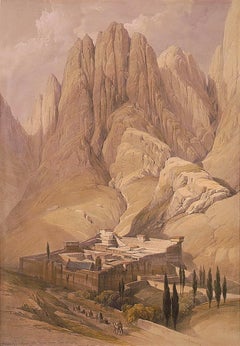
Convent of St. Catherine, Mt. Horeb
Located in London, GB
First edition lithographs in stock
Full plate: 118
Presented in a acid free mount
Category
19th Century Victorian Landscape Prints
Materials
Lithograph
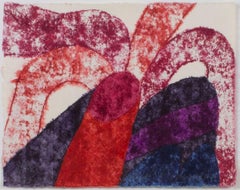
"Paricutin (Volcano in Michoacan, Mexico)" Woodcut
Monotype signed by Summers
Located in Milwaukee, WI
"Paricutin (Volcano in Michoacan, Mexico)" is a woodcut and monotype signed by Carol Summers. In the image, an abstracted volcano erupts in a joyous burst of purples and oranges. The playfulness of the image is enhanced by Summers' signature printmaking technique, which allows the ink from the woodblock to seep through the paper, blurring the edges of each form.
Art: 8 x 11 in
Frame: 17 x 19 in
Carol Summers (1925-2016) has worked as an artist throughout the second half of the 20th century and into the first years of the next, outliving most of his mid-century modernist peers. Initially trained as a painter, Summers was drawn to color woodcuts around 1950 and it became his specialty thereafter. Over the years he has developed a process and style that is both innovative and readily recognizable. His art is known for it’s large scale, saturated fields of bold color, semi-abstract treatment of landscapes from around the world and a luminescent quality achieved through a printmaking process he invented.
In a career that has extended over half a century, Summers has hand-pulled approximately 245 woodcuts in editions that have typically run from 25 to 100 in number. His talent was both inherited and learned. Born in 1925 in Kingston, a small town in upstate New York, Summers was raised in nearby Woodstock with his older sister, Mary. His parents were both artists who had met in art school in St. Louis. During the Great Depression, when Carol was growing up, his father supported the family as a medical illustrator until he could return to painting. His mother was a watercolorist and also quite knowledgeable about the different kinds of papers used for various kinds of painting. Many years later, Summers would paint or print on thinly textured paper originally collected by his mother.
From 1948 to 1951, Carol Summers trained in the classical fine and studio arts at Bard College and at the Art Students League of New York. He studied painting with Steven Hirsh and printmaking with Louis Schanker. He admired the shapes and colors favored by early modernists Paul Klee (Sw: 1879-1940) and Matt Phillips (Am: b.1927- ). After graduating, Summers quit working as a part-time carpenter and cabinetmaker (which had supported his schooling and living expenses) to focus fulltime on art. That same year, an early abstract, Bridge No. 1 was selected for a Purchase Prize in a competition sponsored by the Brooklyn Museum.
In 1952, his work (Cathedral, Construction and Icarus) was shown the first time at the Museum of Modern Art in New York City in an exhibition of American woodcuts. In 1954, Summers received a grant from the Italian government to study for a year in Italy. Woodcuts completed soon after his arrival there were almost all editions of only 8 to 25 prints, small in size, architectural in content and black and white in color. The most well-known are Siennese Landscape and Little Landscape, which depicted the area near where he resided. Summers extended this trip three more years, a decision which would have significant impact on choices of subject matter and color in the coming decade.
After returning from Europe, Summers’ images continued to feature historical landmarks and events from Italy as well as from France, Spain and Greece. However, as evidenced in Aetna’s Dream, Worldwind and Arch of Triumph, a new look prevailed. These woodcuts were larger in size and in color. Some incorporated metal leaf in the creation of a collage and Summers even experimented with silkscreening. Editions were now between 20 and 50 prints in number. Most importantly, Summers employed his rubbing technique for the first time in the creation of Fantastic Garden in late 1957.
Dark Vision of Xerxes, a benchmark for Summers, was the first woodcut where Summers experimented using mineral spirits as part of his printmaking process. A Fulbright Grant as well as Fellowships from the Louis Comfort Tiffany Foundation and the Guggenheim Foundation followed soon thereafter, as did faculty positions at colleges and universities primarily in New York and Pennsylvania. During this period he married a dancer named Elaine Smithers with whom he had one son, Kyle. Around this same time, along with fellow artist Leonard Baskin, Summers pioneered what is now referred to as the “monumental” woodcut. This term was coined in the early 1960s to denote woodcuts that were dramatically bigger than those previously created in earlier years, ones that were limited in size mostly by the size of small hand-presses. While Baskin chose figurative subject matter, serious in nature and rendered with thick, striated lines, Summers rendered much less somber images preferring to emphasize shape and color; his subject matter approached abstraction but was always firmly rooted in the landscape.
In addition to working in this new, larger scale, Summers simultaneously refined a printmaking process which would eventually be called the “Carol Summers Method” or the “ Carol Summers Technique”. Summers produces his woodcuts by hand, usually from one or more blocks of quarter-inch pine, using oil-based printing inks and porous mulberry papers. His woodcuts reveal a sensitivity to wood especially its absorptive qualities and the subtleties of the grain. In several of his woodcuts throughout his career he has used the undulating, grainy patterns of a large wood plank to portray a flowing river or tumbling waterfall. The best examples of this are Dream, done in 1965 and the later Flash Flood Escalante, in 2003. In the majority of his woodcuts, Summers makes the blocks slightly larger than the paper so the image and color will bleed off the edge.
Before printing, he centers a dry sheet of paper over the top of the cut wood block or blocks, securing it with giant clips. Then he rolls the ink directly on the front of the sheet of paper and pressing down onto the dry wood block or reassembled group of blocks. Summers is technically very proficient; the inks are thoroughly saturated onto the surface of the paper but they do not run into each other. The precision of the color inking in Constantine’s Dream in 1969 and Rainbow Glacier in 1970 has been referred to in various studio handbooks. Summers refers to his own printing technique as “rubbing”. In traditional woodcut printing, including the Japanese method, the ink is applied directly onto the block. However, by following his own method, Summers has avoided the mirror-reversed image of a conventional print and it has given him the control over the precise amount of ink that he wants on the paper. After the ink is applied to the front of the paper, Summers sprays it with mineral spirits, which act as a thinning agent. The absorptive fibers of the paper draw the thinned ink away from the surface softening the shapes and diffusing and muting the colors. This produces a unique glow that is a hallmark of the Summers printmaking technique. Unlike the works of other color field artists or modernists of the time, this new technique made Summers’ extreme simplification and flat color areas anything but hard-edged or coldly impersonal.
By the 1960s, Summers had developed a personal way of coloring and printing and was not afraid of hard work, doing the cutting, inking and pulling himself. In 1964, at the age of 38, Summers’ work was exhibited for a second time at the Museum of Modern Art. This time his work was featured in a one-man show and then as one of MoMA’s two-year traveling exhibitions which toured throughout the United States. In subsequent years, Summers’ works would be exhibited and acquired for the permanent collections of multiple museums throughout the United States, Europe and Asia. Summers’ familiarity with landscapes throughout the world is firsthand. As a navigator-bombardier in the Marines in World War II, he toured the South Pacific and Asia.
Following college, travel in Europe and subsequent teaching positions, in 1972, after 47 years on the East Coast, Carol Summers moved permanently to Bonny Doon in the Santa Cruz Mountains in Northern California. There met his second wife, Joan Ward Toth, a textile artist who died in 1998; and it was here his second son, Ethan was born. During the years that followed this relocation, Summers’ choice of subject matter became more diverse although it retained the positive, mostly life-affirming quality that had existed from the beginning. Images now included moons, comets, both sunny and starry skies, hearts and flowers, all of which, in one way or another, remained tied to the landscape.
In the 1980s, from his home and studio in the Santa Cruz mountains, Summers continued to work as an artist supplementing his income by conducting classes and workshops at universities in California and Oregon as well as throughout the Mid and Southwest. He also traveled extensively during this period hiking and camping, often for weeks at a time, throughout the western United States and Canada. Throughout the decade it was not unusual for Summers to backpack alone or with a fellow artist into mountains or back country for six weeks or more at a time. Not surprisingly, the artwork created during this period rarely departed from images of the land, sea and sky. Summers rendered these landscapes in a more representational style than before, however he always kept them somewhat abstract by mixing geometric shapes with organic shapes, irregular in outline. Some of his most critically acknowledged work was created during this period including First Rain, 1985 and The Rolling Sea, 1989. Summers received an honorary doctorate from his alma mater, Bard College in 1979 and was selected by the United States Information Agency to spend a year conducting painting and printmaking workshops at universities throughout India. Since that original sabbatical, he has returned every year, spending four to eight weeks traveling throughout that country.
In the 1990s, interspersed with these journeys to India have been additional treks to the back roads and high country areas of Mexico, Central America, Nepal, China and Japan. Travel to these exotic and faraway places had a profound influence on Summers’ art. Subject matter became more worldly and non-western as with From Humla to Dolpo, 1991 or A Former Life of Budha, 1996, for example. Architectural images, such as The Pillars of Hercules, 1990 or The Raja’s Aviary, 1992 became more common. Still life images made a reappearance with Jungle Bouquet in 1997. This was also a period when Summers began using odd-sized paper to further the impact of an image.
The 1996 Night, a view of the earth and horizon as it might be seen by an astronaut, is over six feet long and only slightly more than a foot-and-a-half high. From 1999, Revuelta A Vida (Spanish for “Return to Life”) is pie-shaped and covers nearly 18 cubic feet. It was also at this juncture that Summers began to experiment with a somewhat different palette although he retained his love of saturated colors. The 2003 Far Side of Time is a superb example of the new direction taken by this colorist.
At the turn of the millennium in 1999, “Carol Summers Woodcuts...
Category
Early 2000s Contemporary Landscape Prints
Materials
Monotype, Woodcut
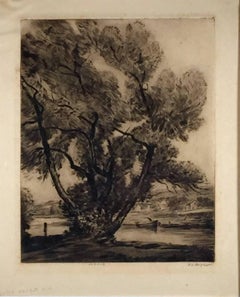
CENTER HARBOR, NH
By Ralph L. Boyer
Located in Portland, ME
Boyer, Ralph L. (American, 1879-1952).
CENTRE HARBOR, N.H. Etching, not dated.
Number 12 of the edition of 60. Signed in pencil and inscribed "imp rlb" just below the image.
Further inscribed in the lower margin with the Title, the edition size and number, and the artist's name and "Westport, Conn." where he lived and worked.
9 7/8 x 7 3/4 inches (plate), 13 x 10 1/2 inches (sheet).
Tape residue at the upper corners, else in very good condition.
Boyer was well known as a sporting artist. Derrydale...
Category
Early 20th Century Landscape Prints
Materials
Etching
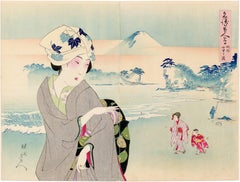
Beauties on the Beach with view of Mount Fuji
Located in Burbank, CA
Shichirigahama, Sagami Province. A beauty in the foreground waves to her young companions, who run towards her on the beach. The beauty at left wears a western-style golden ring. We ...
Category
1890s Edo Landscape Prints
Materials
Handmade Paper, Mulberry Paper, Woodcut
Pink - Sydell Lewis - Digital Pigment Prints
Located in Carmel, CA
** Larger prints are available for purchase. Please feel free to contact us if you're interested.
Enchanted by the intricate symphony of nature's rhythms, the alluring dance of urba...
Category
2010s Contemporary Abstract Prints
Materials
Panel, Pigment
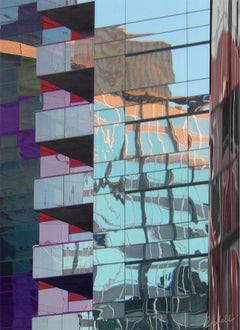
St. Peter
s Square - Etching by Giuseppe Malandrino - 1970s
Located in Roma, IT
St. Peter's Square is an etching realized by the Italian artist Giuseppe Malandrino.
hand-signed by the artist on the lower right in pencil.
Numbered in Roman numerals, edition o...
Category
1970s Contemporary Landscape Prints
Materials
Etching
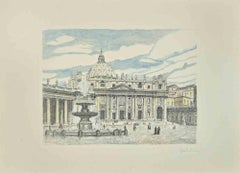
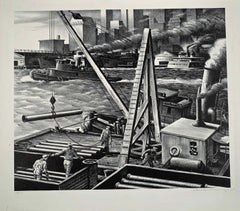
THE HARBOR WORKHORSE
By Woldemar Neufeld
Located in Portland, ME
Neufeld, Woldemar. THE HARBOR WORKHORSE. Woodcut in colors, not dated (c.1940s-50s). Edition size not known, but likely 50 or fewer. 17 1/2 x 12 inches, plu...
Category
Mid-20th Century American Modern Landscape Prints
Materials
Woodcut
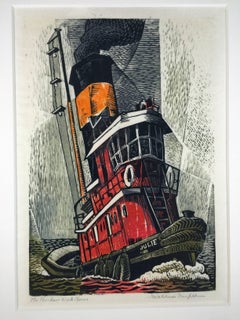
(Title Unknown) Limited Edition Print, Signed by Artist (signature is illegible)
Located in Chesterfield, MI
Limited Edition Print, Signed by Artist (signature is illegible). The piece measures 16.5 x 24 inches and is unframed. The date of creation is unknown, but is believed to be within t...
Category
Late 20th Century Landscape Prints
Materials
Lithograph
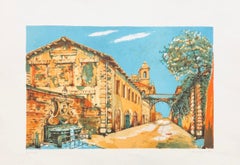
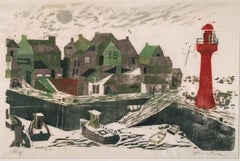
UNTITLED (LIGHTHOUSE, HOUSES AND BOATS).
By John T. Ross
Located in Portland, ME
Ross, John T. UNTITLED (LIGHTHOUSE, HOUSES AND BOATS). Color woodcut, not dated. Inscribed "proof," lower left, and signed lower right, in pencil. 9 x 14 7/8 inches (image), on a lar...
Category
Mid-20th Century Landscape Prints
Materials
Color, Woodcut
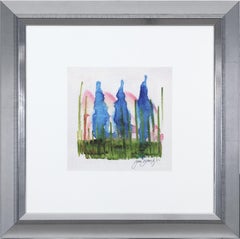
Three Trees
Giclee Print on Watercolor paper After Acrylic Painting
By Joan Dvorsky
Located in Milwaukee, WI
8" x 8" art
18.25" x 18.25" frame
In this artwork, Milwaukee-based artist Joan Dvorsky presents the viewer with an image of three blue trees that almost appear to glow in their envi...
Category
2010s Prints and Multiples
Materials
Giclée
St. Peter and Tiber - Etching by Nazareno Gattamelata - 1970s
Located in Roma, IT
St. Peter and Tiber is a Contemporary artwork realized by Nazareno Gattamelata in the 1970s.
Hand-signed on the lower right and numbered on the lower left, edition of 10/30 prints.
...
Category
1970s Contemporary Figurative Prints
Materials
Etching
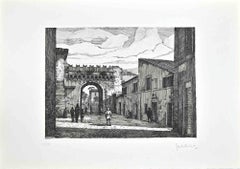
$154 Sale Price
35% Off
Roman View - Etching by Giuseppe Malandrino - 1970s
Located in Roma, IT
Roman View is an artwork realized by Giuseppe Malandrino.
Print in etching technique and hand watercolored.
Hand-signed by the artist in pencil on the lower right corner.
Numbered...
Category
1970s Modern Landscape Prints
Materials
Etching
$193 Sale Price
35% Off
Roman Forum - Etching by Giuseppe Malandrino - 1970s
Located in Roma, IT
Roman Forum is an artwork realized by Giuseppe Malandrino.
Print in etching technique and hand watercolored.
Hand-signed by the artist in pencil on the lower right corner.
Numbere...
Category
1970s Contemporary Landscape Prints
Materials
Etching
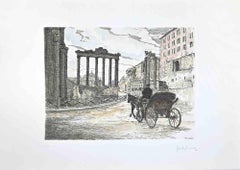
Colosseum - Etching by Giuseppe Malandrino - 1970s
Located in Roma, IT
Colosseum is an artwork realized by Giuseppe Malandrino.
Print in etching technique.
Hand-signed by the artist in pencil on the lower right corner.
Numbered edition of 199 copies....
Category
1970s Contemporary Landscape Prints
Materials
Etching
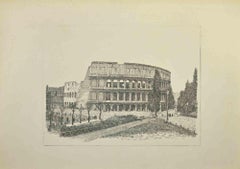
Gate - Tunis - Photolithograph by Bettino Craxi - 1996
Located in Roma, IT
Gate - Tunis is a photolithograph realized in 1996 by the Italian politician Bettino Craxi.
Hand-signed in on the lower right "Craxi d'après Lumieère", Numbered, edition of 120 prin...
Category
1990s Contemporary Figurative Prints
Materials
Lithograph
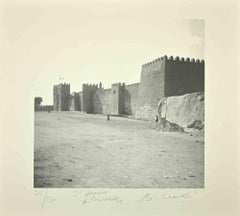
Roman Forum - Etching by Giuseppe Malandrino - 1970s
Located in Roma, IT
Roman Forum is an artwork realized by Giuseppe Malandrino.
Original print in etching technique and hand watercolored.
Hand-signed by the artist in pencil on the lower right corner....
Category
1970s Contemporary Landscape Prints
Materials
Etching
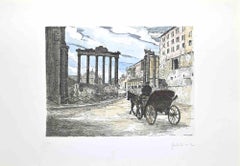
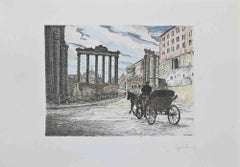
Roman Forum - Etching by Giuseppe Malandrino - 1970s
Located in Roma, IT
Roman Forum is an artwork realized by Giuseppe Malandrino.
Print in etching technique and hand watercolored.
Hand-signed by the artist in pencil on the lower right corner.
Numbere...
Category
1970s Contemporary Landscape Prints
Materials
Etching
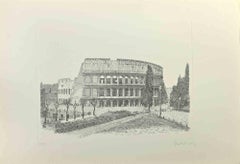
Colosseum - Etching by Giuseppe Malandrino - 1970s
Located in Roma, IT
Colosseum is an artwork realized by Giuseppe Malandrino.
Original print in etching technique.
Hand-signed by the artist in pencil on the lower right corner.
Numbered edition of 19...
Category
1970s Contemporary Landscape Prints
Materials
Etching
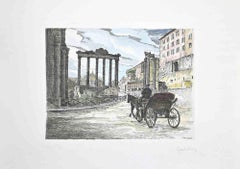
Roman Forum - Etching by Giuseppe Malandrino - 1970s
Located in Roma, IT
Roman Forum is an artwork realized by Giuseppe Malandrino.
Print in etching technique and hand watercolored.
Hand-signed by the artist in pencil on the lower right corner.
Numbere...
Category
1970s Contemporary Landscape Prints
Materials
Etching
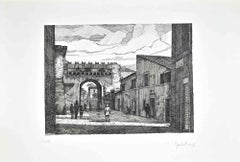
Borgo Pio - Rome - Etching by Giuseppe Malandrino - 1970
Located in Roma, IT
Borgo Pio - Rome is an artwork realized by Giuseppe Malandrino.
Original print in etching technique.
Hand-signed by the artist in pencil on the lower right corner.
Numbered n. 52/...
Category
1970s Contemporary Landscape Prints
Materials
Etching
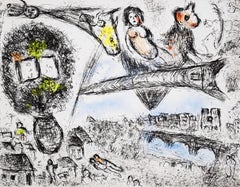
The Village and Paris, from: Dreams - French Russian Paris
By Marc Chagall
Located in London, GB
This original etching and aquatint in colours is hand signed in pencil by the artist "Marc Chagall" at the lower right margin.
It is also hand numbered in pencil 21 from the edition ...
Category
1980s Surrealist Landscape Prints
Materials
Etching, Aquatint
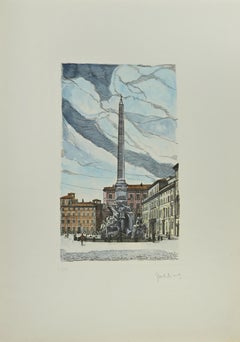
Fontana dei Quattro Fiumi - Etching by Giuseppe Malandrino - 1970s
Located in Roma, IT
Fontana dei Quattro Fiumi is an artwork realized by Giuseppe Malandrino.
Original print in etching technique.
Hand-signed by the artist in pencil on the lower right corner.
Number...
Category
1970s Contemporary Landscape Prints
Materials
Etching
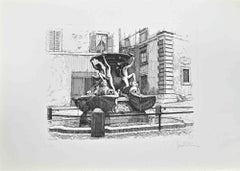
Fountain of the Turtles - Etching by Giuseppe Malandrino - 1970s
Located in Roma, IT
Turtle Fountain - Rome is an artwork realized by Giuseppe Malandrino.
Original print in etching technique.
Hand-signed by the artist in pencil on the lower right corner.
Numbered ...
Category
1970s Contemporary Landscape Prints
Materials
Etching
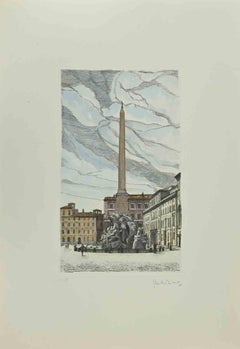
Fontana dei Quattro Fiumi - Etching by Giuseppe Malandrino - 1970s
Located in Roma, IT
Fontana dei Quattro Fiumi is an artwork realized by Giuseppe Malandrino.
Original print in etching technique.
Hand-signed by the artist in pencil on the lower right corner.
Number...
Category
1970s Contemporary Landscape Prints
Materials
Etching
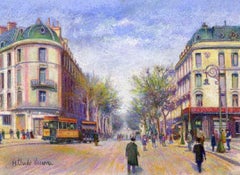
Le Café Georges à Cannes by H. Claude Pissarro - Pastel
Located in London, GB
Le Café Georges à Cannes by H. Claude Pissarro (b. 1935)
Pastel on card
37 x 51 cm (14 ⁵/₈ x 20 ¹/₈ inches)
Signed lower left, H. Claude Pissarro
This work is accompanied by a certi...
Category
21st Century and Contemporary Post-Impressionist Landscape Prints
Materials
Pastel
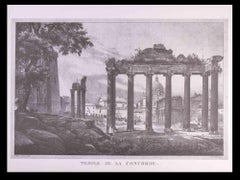
Roman Temples and Ruins - Offset After G. Engelmann - Late 20th Century
Located in Roma, IT
Roman Temples and Ruins is a vintage offset print artwork on paper, realized after G. Engelmann (1788-1839), in the late 20th century.
The artwork is signed on the plate. In very go...
Category
Late 20th Century Modern Figurative Prints
Materials
Offset
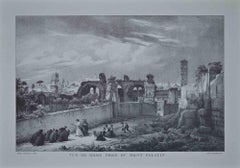
Roman Temples - Offset After G. Engelmann - Late 20th Century
Located in Roma, IT
Roman Temple is an offset print artwork on paper, realized after G. Engelmann(1788-1839), in the late 20th century.
The artwork is signed on the plate. I...
Category
Late 20th Century Modern Figurative Prints
Materials
Offset
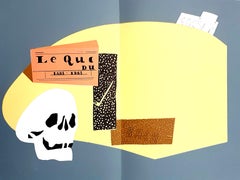
Eduardo Arroyo - Homage to Braque - Original Lithograph
Located in Collonge Bellerive, Geneve, CH
Eduardo Arroyo - Homage to Braque - Original Lithograph
1984
Conditions: excellent
Edition: 495
Dimensions: 37,3 x 58 cm
Editions: Trinckvel
Category
1980s Modern Landscape Prints
Materials
Lithograph
Fountain of the Turtles - Etching by Giuseppe Malandrino - 1970
Located in Roma, IT
Fountain of the Turtles - Rome is an original artwork realized by Giuseppe Malandrino.
Original print in etching technique.
Hand-signed by the artist in pencil on the lower right c...
Category
1970s Contemporary Landscape Prints
Materials
Etching
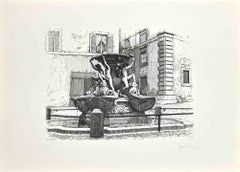
FONDAMENTA DELLE ZATTERE (VIEW IN VENICE).
Located in Portland, ME
Bacher, Otto. FONDAMENTA DELLE ZATTERE (VIEW IN VENICE). Etching, 1880. #17 of the "Venice Set." Signed, titled, and dated in the plate. Framed. In excellent condition. Etching on pa...
Category
1880s Landscape Prints
Materials
Etching
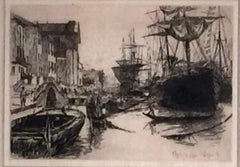
17th century etching black and white landscape forest trees satyr goats
Located in Milwaukee, WI
"Mythological Scene--Satyr & Goat Herder" is an etching by Italian artist Giovanni Benedetto Castiglione. It depicts a satyr lounging on the left and an approaching goat herder on th...
Category
Mid-17th Century Old Masters Landscape Prints
Materials
Etching
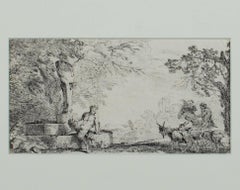
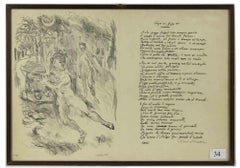
Fuga si, Fuga no - Original Lithograph By A. Scordia and M. Maccari - 1945
By Mino Maccari
Located in Roma, IT
Black and white lithograph realized by Antonio Scordia, with a text by Mino Maccari.
Good conditions except for some folds, foxings and yellowing of paper.
The text is hand signed ...
Category
1940s Modern Figurative Prints
Materials
Lithograph