Want more images or videos?
Request additional images or videos from the seller
1 of 9
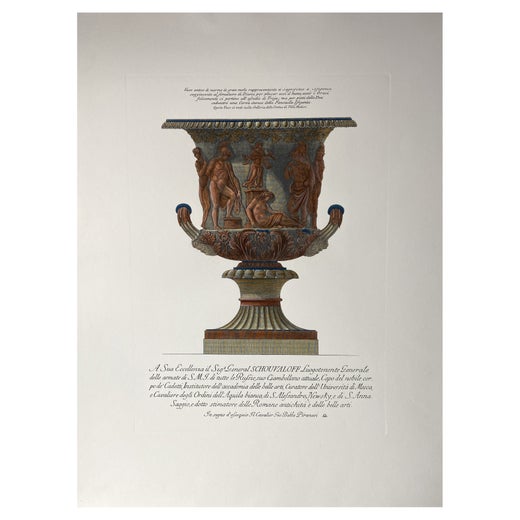
Giovanni Battista PiranesiGalleria grande di Statue1743
1743
Price:$1,750
About the Item
- Creator:Giovanni Battista Piranesi (1720-1778, Italian)
- Creation Year:1743
- Dimensions:Height: 14.63 in (37.17 cm)Width: 9.75 in (24.77 cm)
- Medium:
- Movement Style:
- Period:
- Condition:
- Gallery Location:Fairlawn, OH
- Reference Number:Seller: FA126321stDibs: LU14015514372
Giovanni Battista Piranesi
Piranesi was born in Venice in 1720 and died in Rome in 1778. He was the son of a stone mason and was trained as an architect. After a slow start he eventually achieved great success as an architect, archaeologist, artist, designer, collector, and antiquities dealer. His mission was to glorify the architecture of ancient Rome through his engravings and etchings. His highly dramatized prints often depict imaginary interiors and frequently include figures in mysterious activities, who are dwarfed by the magnitude of their monumental surroundings. Piranesi's style greatly influenced the neoclassical art movement of the late 18th century. His dramatic scenes inspired generations of set designers, as well as artists, architects and writers. His prints have continued to increase in value to institutions and collectors.
About the Seller
5.0
Recognized Seller
These prestigious sellers are industry leaders and represent the highest echelon for item quality and design.
Platinum Seller
Premium sellers with a 4.7+ rating and 24-hour response times
Established in 1978
1stDibs seller since 2013
839 sales on 1stDibs
Associations
International Fine Print Dealers Association
Authenticity Guarantee
In the unlikely event there’s an issue with an item’s authenticity, contact us within 1 year for a full refund. DetailsMoney-Back Guarantee
If your item is not as described, is damaged in transit, or does not arrive, contact us within 7 days for a full refund. Details24-Hour Cancellation
You have a 24-hour grace period in which to reconsider your purchase, with no questions asked.Vetted Professional Sellers
Our world-class sellers must adhere to strict standards for service and quality, maintaining the integrity of our listings.Price-Match Guarantee
If you find that a seller listed the same item for a lower price elsewhere, we’ll match it.Trusted Global Delivery
Our best-in-class carrier network provides specialized shipping options worldwide, including custom delivery.You May Also Like
Shere Mill Pond
By Sir Francis Seymour Haden, R.A.
Located in Missouri, MO
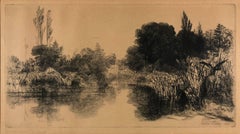
Shere Mill Pond, No. II (large plate). 1860. Etching and drypoint. Schneiderman 37.v/ix. 7 x 13 1/8 (sheet 10 3/4 x 16 3/8). This state is prior to publication in Études à l'Eau-Forte. Illustrated: Keppel The Golden Age of Engraving; Print Collector's Quarterly 1 (1911): 18; : Guichard, British Etchers, 1850-1940. A rich, brilliant proof with drypoint burr printed on white laid paper. Signed in pencil.
-------------------------------------------------------------------------------------------
Shere Mill Pond, No. II was one of the most highly praised landscape prints of the etching revival. An impression was exhibited at the Royal Academy in 1861 under Haden’s pseudonym, H. Dean. Francis Seymour Haden used this anagram of his own name early in his career as an artist, in order to retain his anonymity and preserve his professional reputation as a surgeon.
Biography:
Sir Francis Seymour Haden (16 September 1818 - 1 June 1910), was an English surgeon, best known as an etcher.
He was born in London, his father, Charles Thomas Haden, being a well-known doctor and lover of music. He was educated at Derby School, Christ's Hospital, and University College, London, and also studied at the Sorbonne, Paris, where he took his degree in 1840. He was admitted as a member of the College of Surgeons in London in 1842.
In 1843-1844, with his friends Duval, Le Cannes and Colonel Guibout, he travelled in Italy and made his first sketches from nature. Haden attended no art school and had no art teachers, but between 1845 and 1848 he studied portfolios of prints belonging to a second-hand dealer named Love, who had a shop in Bunhill Row, the old Quaker quarter of London. Arranging the prints in chronological order, he studied the works of the great original engravers, Albrecht Dürer, Lucas van Leyden and Rembrandt. These studies, besides influencing his original work, led to his important monograph on the etched work of Rembrandt. By lecture and book, and with the aid of the memorable exhibition at the Burlington Fine Arts Club in 1877, he tried to give a true reflection of Rembrandt's work, giving a nobler idea of the master's mind by taking away from the list of his works many dull and unseemly plates that had long been included in the lists. His reasons were founded upon the results of a study of the master's works in chronological order, and are clearly expressed in his monograph, The Etched Work of Rembrandt critically reconsidered, privately printed in 1877, and in The Etched Work of Rembrandt True and False (1895).
Haden's printmaking was invigorated by his much younger brother-in-law, James Whistler, at the Haden home in Sloane Street in 1855. A press was installed there and for a while Haden and Whistler collaborated on a series of etchings of the Thames. The relationship and project did not last.
Haden followed the art of original etching with such vigour that he became not only the foremost British exponent of that art but brought about its revival in England. His strenuous efforts and perseverance, aided by the secretarial ability of Sir WR Drake, resulted in the foundation of the Royal Society of Painter-Etchers and Engravers. As president he ruled the society with a strong hand from its first beginnings in 1880.
Notwithstanding his study of the old masters of his art, Haden's own plates were very individual, and are particularly noticeable for a fine original treatment of landscape subjects, free and open in line, clear and well divided in mass, and full of a noble and dignified style of his own. Even when working from a picture his personality dominates the plate, as for example in the large plate he etched after J.M.W. Turner's "Calais Pier," which is a classical example of what interpretative work can do in black and white. Of his original plates, more than 250 in number, one of the most notable was the large "Breaking up of the Agamemnon."
An early plate, rare and most beautiful, is "Thames Fisherman". "Mytton Hall" is broad in treatment, and a fine rendering of a shady avenue of yew trees leading to an old manor-house in sunlight. "Sub Tegmine" was etched in Greenwich Park in 1859; and "Early Morning--Richmond", full of the poetry and freshness of the hour, was done, according to Haden, actually at sunrise. One of the rarest and most beautiful of his plates is "A By-Road in Tipperary"; "Combe Bottom" is another; and "Shere Mill Pond" (both the small study and the larger plate), "Sunset in Ireland," "Penton Hook," "Grim Spain" and "Evening Fishing, Longparish," are also notable examples of his genius. A catalogue of his works was begun by Sir William Drake and completed by Harrington in 1880. During later years Haden began to practise the sister art...
Category
Late 19th Century Old Masters Landscape Prints
Materials
Drypoint, Etching
Assassinat de Basseville à Rome - Original Etching by P.G. Berthault - 1793
By Pierre Gabriel Berthault
Located in Roma, IT
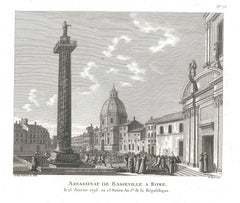
Assassinat De Basseville à Rome is an original black and white etching realized by Pierre Gabriel Berthault, after Jacques François Joseph Swebach-Desfontaines in 1793.
Title with caption on plate on the lower center: "Assassinat de Basseville, à Rome/ le 13 Janvier 1793, ou 23 Nivose An Ier de la République".
Below the image on the lower margin, "Swebach Desfontaines onv. et del. / Berthault sculp." is etched on plate. This modern artwork is numbered "N. 76", because it is from the series Les Tableaux historiques de la Révolution française.
As a matter of fact, Pierre-Gabriel Berthault is well-known for having engraved plates from this collection with the collaboration of the engraver Jean Duplessis-Bertaux. A work - hanging in the balance between news and history - with illustrations of salient or minimal events occurred during the French Revolution. As a celebration of the new ideals of brotherhood, justice, and equality, Les Tableaux immediately became a point of reference for journalism at the time. Of traditional cut, namely showing a view with many human figures, the engraving simplified the lines to be immediately readable for the general public.
In our specific case, this original print represents the murder of Hugou de Bassville or Basseville (7 February, 1743 – 13 January, 1793), a French journalist and diplomatist, and protector of the radical Jacobins in Rome.
In excellent conditions, except for a usual yellowing of the paper on the edges and a light trace of oxidations on the lower and right margins, beyond the marginal line of the matrix.
Pierre-Gabriel Berthault (Saint-Maur-des-Fossés, 1737 - Paris, 1831) was a French master who made engravings from drawings by Jean-Claude Richard de Saint-Non (known as the Abbot of Saint-Non) and from paintings by Louis François Cassas. He depicted many views of Italy and created the collections Voyage à Naples and Voyage pittoresque de la Syrie, de la Palestine et de la basse-Egypte. Before the French Revolution, he was famous for being the author of the Vues intérieures de Paris and for tables with architectural elevations.
Category
1790s Old Masters Landscape Prints
Materials
Etching
$416
H 12.05 in W 15.79 in D 0.04 in
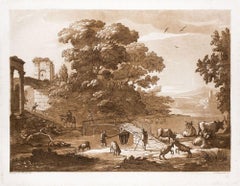
Liber Veritatis - B/W Etching after Claude Lorrain - 1815
By Ludovico Caracciolo
Located in Roma, IT
Image dimensions: 21 x 27 cm.
Liber Veritatis - Plate 61 is a beautiful black and white etching and aquatint on paper realized by the Italian artist Ludovico Caracciolo, after Claud...
Category
1810s Old Masters Figurative Prints
Materials
Etching, Aquatint
$416
H 13 in W 18.71 in D 0.04 in
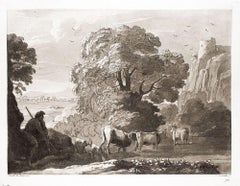
Liber Veritatis - B/W Etching after Claude Lorrain - 1815
By Ludovico Caracciolo
Located in Roma, IT
Image dimensions: 21 x 27 cm.
Liber Veritatis - Plate 98 is a beautiful black and white etching and aquatint on paper realized by the Italian artist L...
Category
1810s Old Masters Figurative Prints
Materials
Etching, Aquatint
$416
H 13 in W 18.71 in D 0.04 in
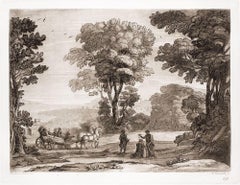
Liber Veritatis - Original B/W Etching after Claude Lorrain - 1815
By Ludovico Caracciolo
Located in Roma, IT
Image dimensions: 21 x 27 cm.
Liber Veritatis - Plate 191 is a beautiful black and white etching and aquatint on paper realized by the Italian artist ...
Category
1810s Old Masters Figurative Prints
Materials
Etching, Aquatint
$416
H 13 in W 18.71 in D 0.04 in
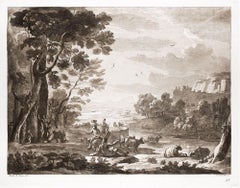
Liber Veritatis - Original B/W Etching after Claude Lorrain - 1815
By Ludovico Caracciolo
Located in Roma, IT
Image dimensions: 21 x 27 cm.
Liber Veritatis - Plate 95 is a beautiful black and white etching and aquatint on paper realized by the Italian artist Ludovico Caracciolo, after Claud...
Category
1810s Old Masters Figurative Prints
Materials
Etching, Aquatint
$416
H 13 in W 18.71 in D 0.04 in
Liber Veritatis - B/W Etching after Claude Lorrain - 1815
By Ludovico Caracciolo
Located in Roma, IT
Image dimensions: 21 x 27 cm.
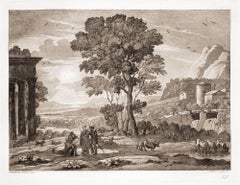
Liber Veritatis - Plate 177 is a beautiful black and white etching and aquatint on paper realized by the Italian artist ...
Category
1810s Old Masters Figurative Prints
Materials
Etching, Aquatint
$416
H 13 in W 18.71 in D 0.04 in
Liber Veritatis - B/W Etching after Claude Lorrain - 1815
By Ludovico Caracciolo
Located in Roma, IT
Image dimensions: 21 x 27 cm.
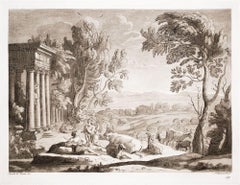
Liber Veritatis - Plate 150 is a beautiful black and white etching and aquatint on paper realized by the Italian artist ...
Category
1810s Old Masters Figurative Prints
Materials
Etching, Aquatint
$416
H 13 in W 18.71 in D 0.04 in
Liber Veritatis - Original B/W Etching after Claude Lorrain - 1815
By Ludovico Caracciolo
Located in Roma, IT
Image dimensions: 21 x 27 cm.
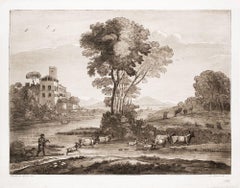
Liber Veritatis - Plate 189 is a beautiful black and white etching and aquatint on paper realized by the Italian artist ...
Category
1810s Old Masters Figurative Prints
Materials
Etching, Aquatint
$416
H 13 in W 18.71 in D 0.04 in
Liber Veritatis - Original B/W Etching after Claude Lorrain - 1815
By Ludovico Caracciolo
Located in Roma, IT
Image dimensions: 21 x 27 cm.
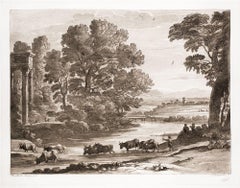
Liber Veritatis - Plate 176 is a beautiful black and white etching and aquatint on paper realized by the Italian artist ...
Category
1810s Old Masters Figurative Prints
Materials
Etching, Aquatint
$416
H 13 in W 18.71 in D 0.04 in
More From This Seller
View AllScene II, Le Nozze Degli Dei
By Stefano Della Bella
Located in Fairlawn, OH
Scene II, Le Nozze Degli Dei
Etching, 1637
Signed in the plate lower left
The scene depicts the initial moment when Diana is revealed, surrounded by her nymphs, celebrating a success...
Category
1630s Old Masters Landscape Prints
Materials
Etching

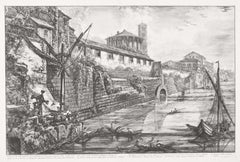
View of the Ancient Structure built by Tarquinius Superbus called the Bel Lido
By Giovanni Battista Piranesi
Located in Fairlawn, OH
View of the Ancient Structure built by Tarquinius Superbus called the Bel Lido, and like others built by Marcus Agrippa in the time of Augustus when he cleaned all the sewers leading...
Category
1750s Old Masters Landscape Prints
Materials
Etching
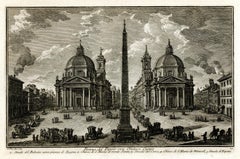
Piazza del Popolo con Obelisco Egizio
By Giuseppe Vasi
Located in Fairlawn, OH
Piazza del Popolo con Obelisco Egizio
Etching, 1752
Signed in the plate lower left (see photo)
From: Della Magnificenze di Roma Antica e Moderna ( The Magnificense of Ancient and Modern Rome) , (1747-1761)
Volume II, The Main Squares and Obelisks, columns and other ornaments, 1752, Plate No. 21
Della Magnificenze di Roma Antica e Moderna_ (1747-61), a collection of 238 plates that was published in ten volumes. Vasi recorded all types of architecture and organized these images of contemporary Rome by subject, with each volume representing a different category of architecture. This comprehensive project provides one of the most complete views of eighteenth-century Rome
Condition: Excellent
Image/Plate size: 8.25 x 12.63 inches
Sheet size: 11 x 15 7/8 inches
Vasi was Giovanni Battista Piranesi’s teacher. Piranesi (1720-1778) entered Vasi’s studio as an apprentice at age 20 c. 1740. Piranesi left Vasi’s employment after stabbing Vasi over the perception that Vasi was withholding secrets of the etching process.
Giuseppe Vasi was an Italian engraver and painter born and trained in Sicily. He received a classical education in his hometown of Corleone and trained as a printmaker in nearby Palermo, perhaps under the tutelage of the etchers Antonino Bova and Francesco Cichè. He moved to Rome in 1736, already an established printmaker, and spent most of his career documenting the urban landscape of the city in engravings. Through his patron, the politically and culturally influential Cardinal Troiano Acquaviva d’Aragona, Vasi met other artists working in Rome, such as Sebastiano Conca, Ferdinando Fuga, and Luigi Vanvitelli. He was also influenced by his predecessors, including Giovanni Paolo Panini, Giovanni Battista Falda...
Category
1750s Old Masters Landscape Prints
Materials
Etching
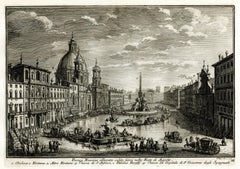
Piazza Navona allagata solito farsi nelle Feste di Agosto
By Giuseppe Vasi
Located in Fairlawn, OH
Piazza Navona allagata solito farsi nelle Feste di Agosto
Etching, 1752
Signed in the plate lower right (see photo)
From: Della Magnificenze di Roma Antica e Moderna ( The Magnificense of Ancient and Modern Rome) , (1747-1761)
Volume II, The Main Squares and Obelisks, columns and other ornaments, 1752, Plate No. 26
Della Magnificenze di Roma Antica e Moderna_ (1747-61), a collection of 238 plates that was published in ten volumes. Vasi recorded all types of architecture and organized these images of contemporary Rome by subject, with each volume representing a different category of architecture. This comprehensive project provides one of the most complete views of eighteenth-century Rome
Condition: Excellent
Image/Plate size: 8 .25 x 12.63 inches
Sheet size: 11 x 15 7/8 inches
Vasi was Giovanni Battista Piranesi’s teacher. Piranesi (1720-1778) entered Vasi’s studio as an apprentice at age 20 c. 1740. Piranesi left Vasi’s employment after stabbing Vasi over the perception that Vasi was withholding secrets of the etching process.
Giuseppe Vasi was an Italian engraver and painter born and trained in Sicily. He received a classical education in his hometown of Corleone and trained as a printmaker in nearby Palermo, perhaps under the tutelage of the etchers Antonino Bova and Francesco Cichè. He moved to Rome in 1736, already an established printmaker, and spent most of his career documenting the urban landscape of the city in engravings. Through his patron, the politically and culturally influential Cardinal Troiano Acquaviva d’Aragona, Vasi met other artists working in Rome, such as Sebastiano Conca, Ferdinando Fuga, and Luigi Vanvitelli. He was also influenced by his predecessors, including Giovanni Paolo Panini, Giovanni Battista Falda...
Category
1750s Old Masters Landscape Prints
Materials
Etching
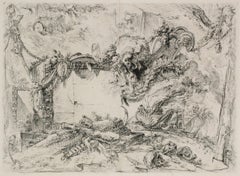
The Monumental Tablet
By Giovanni Battista Piranesi
Located in Fairlawn, OH
The Monumental Tablet
Etching, engraving, drypoint and burnishing, c. 1748
Series: Grotteschi (Grotesques, 4 plates)
Original, unwashed condition. Excellent.
Second edition first is...
Category
1740s Old Masters Prints and Multiples
Materials
Etching
Veduta dell
esterno della gran Basilica di S. Pietro in Vaticano
By Giovanni Battista Piranesi
Located in Fairlawn, OH
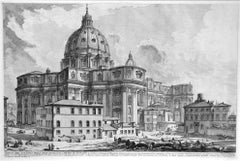
Veduta dell'esterno della gran Basilica di S. Pietro in Vaticano (View of the Exterior of St. Peter's Basilica in the Vatican)
Etching, 1748
From the first printing of the "Vedute di Roma"
An early impression with strong contrasts
Before the price and the addition of numbers in the later states.
A view of Michelangelo's done from behind the Piazza, redesigned in 1547
Condition: Excellent
Plate size: 15 3/4 x 24 3/4 inches
Reference: Robison 5 a/g
Hind 5 i/VII
Focillon 54.789
Designed principally by Donato Bramante, Michelangelo, Carlo Maderno and Gian Lorenzo Bernini, St. Peter's is the most renowned work of Renaissance architecture and the largest church in the world. While it is neither the mother church of the Catholic Church nor the cathedral of the Diocese of Rome (these equivalent titles being held by the Archbasilica of Saint John Lateran in Rome), St. Peter's is regarded as one of the holiest Catholic shrines...
Category
1740s Old Masters Landscape Prints
Materials
Etching