Items Similar to
Navajo Horse Race
— Southwest Regionalism, Native American Subject
Want more images or videos?
Request additional images or videos from the seller
1 of 6
Ira Moskowitz
Navajo Horse Race
— Southwest Regionalism, Native American Subject1946
1946
$1,100
£835.73
€960.43
CA$1,545.08
A$1,681.79
CHF 891.12
MX$20,226.02
NOK 11,330.34
SEK 10,383
DKK 7,174.34
About the Item
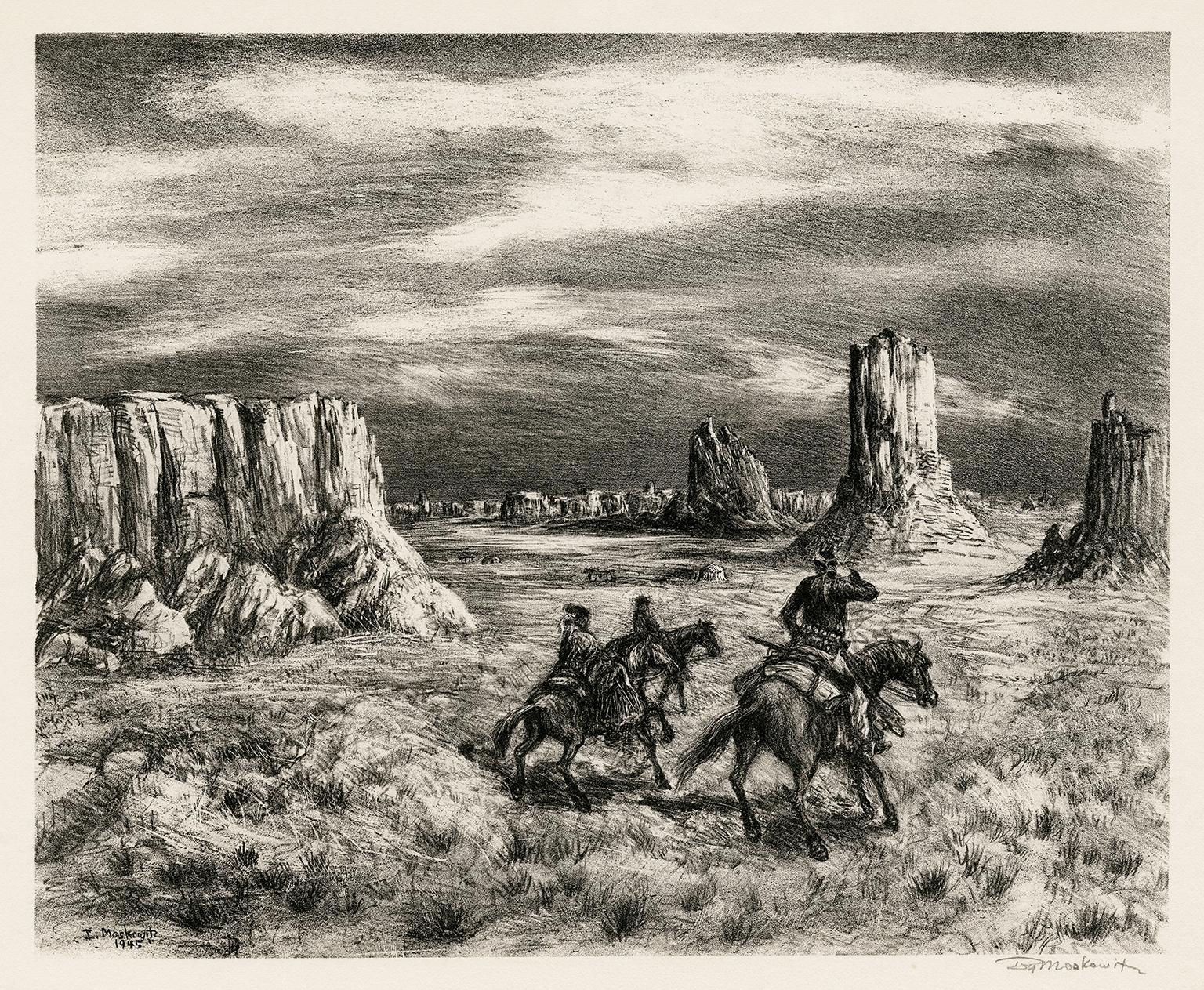
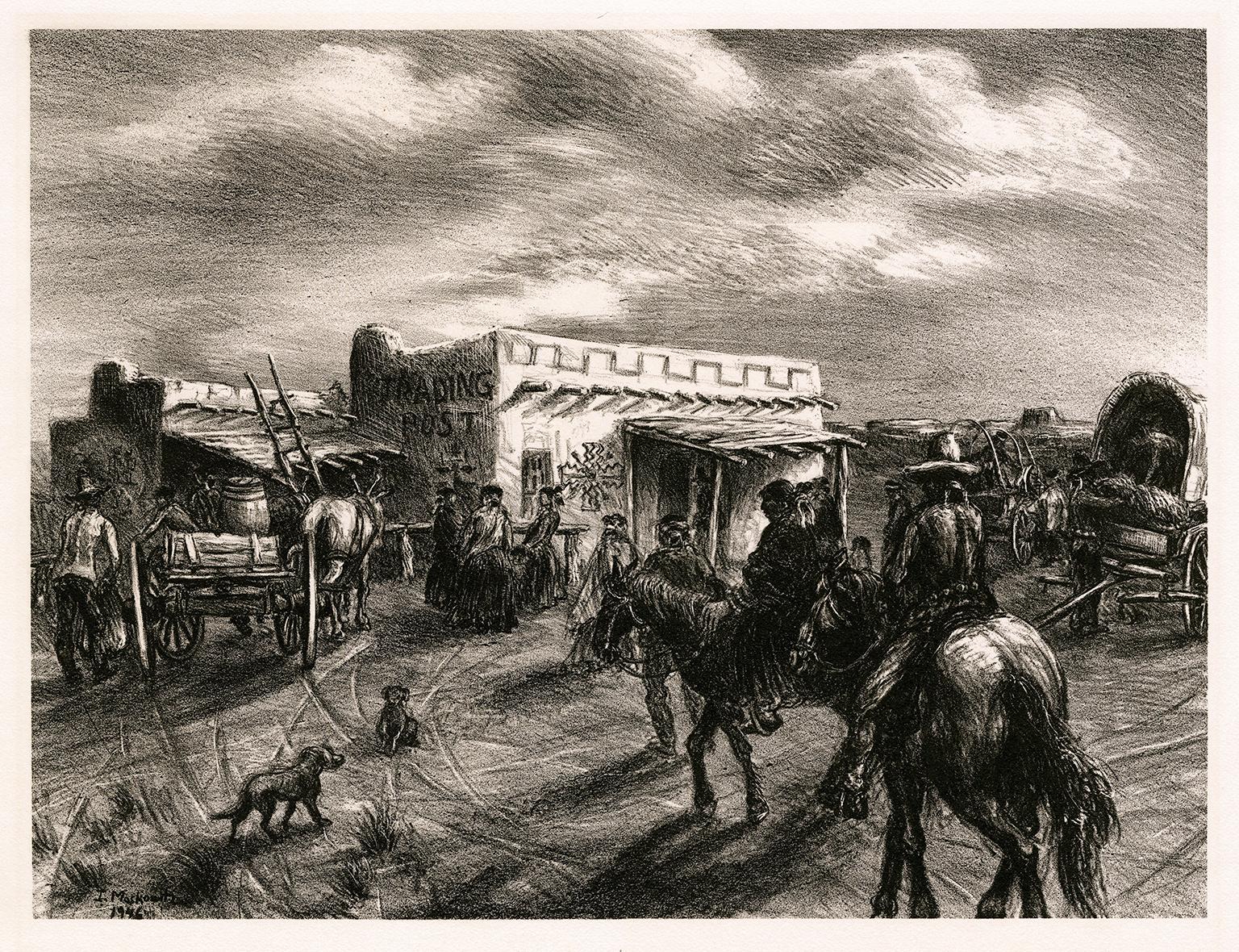
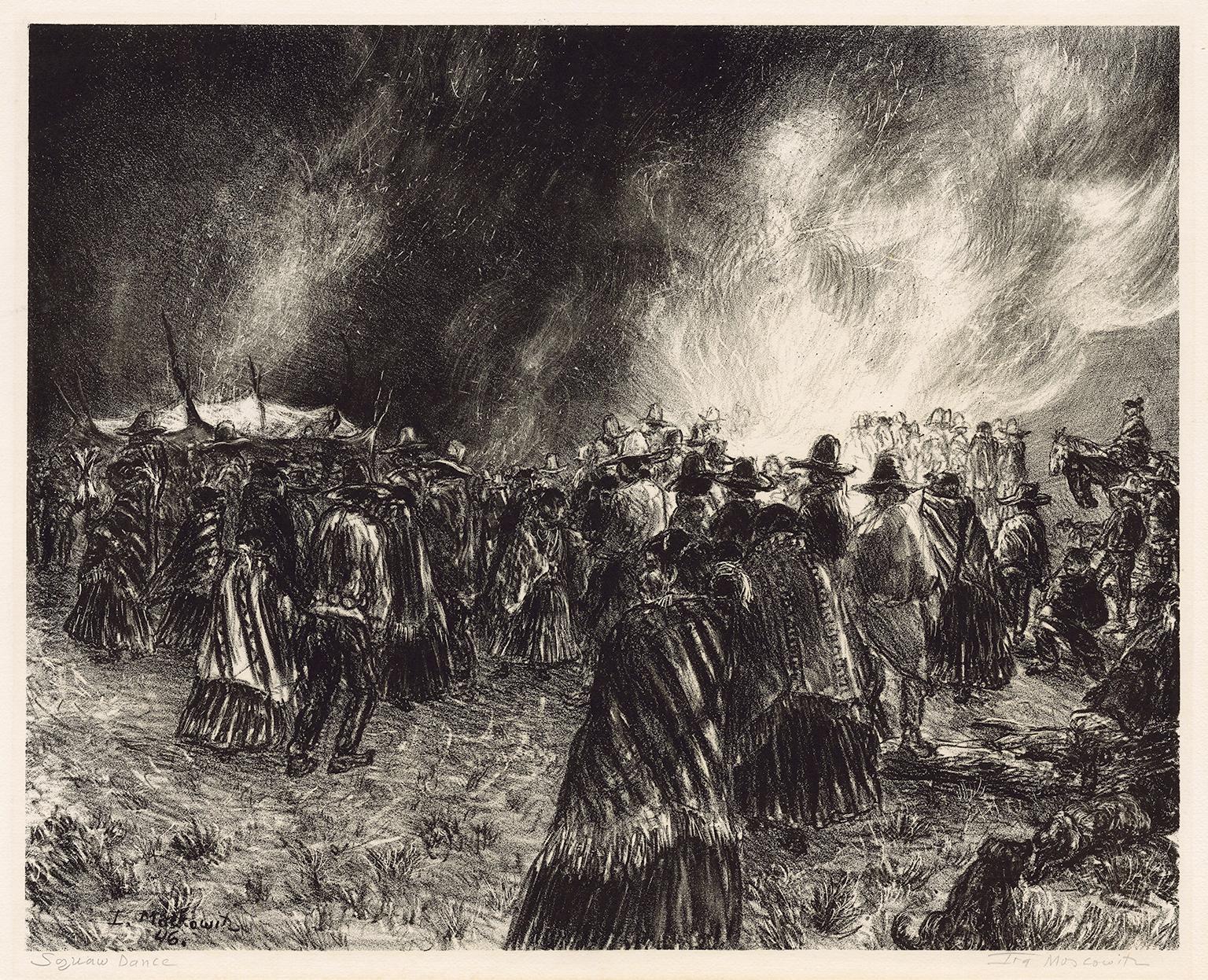
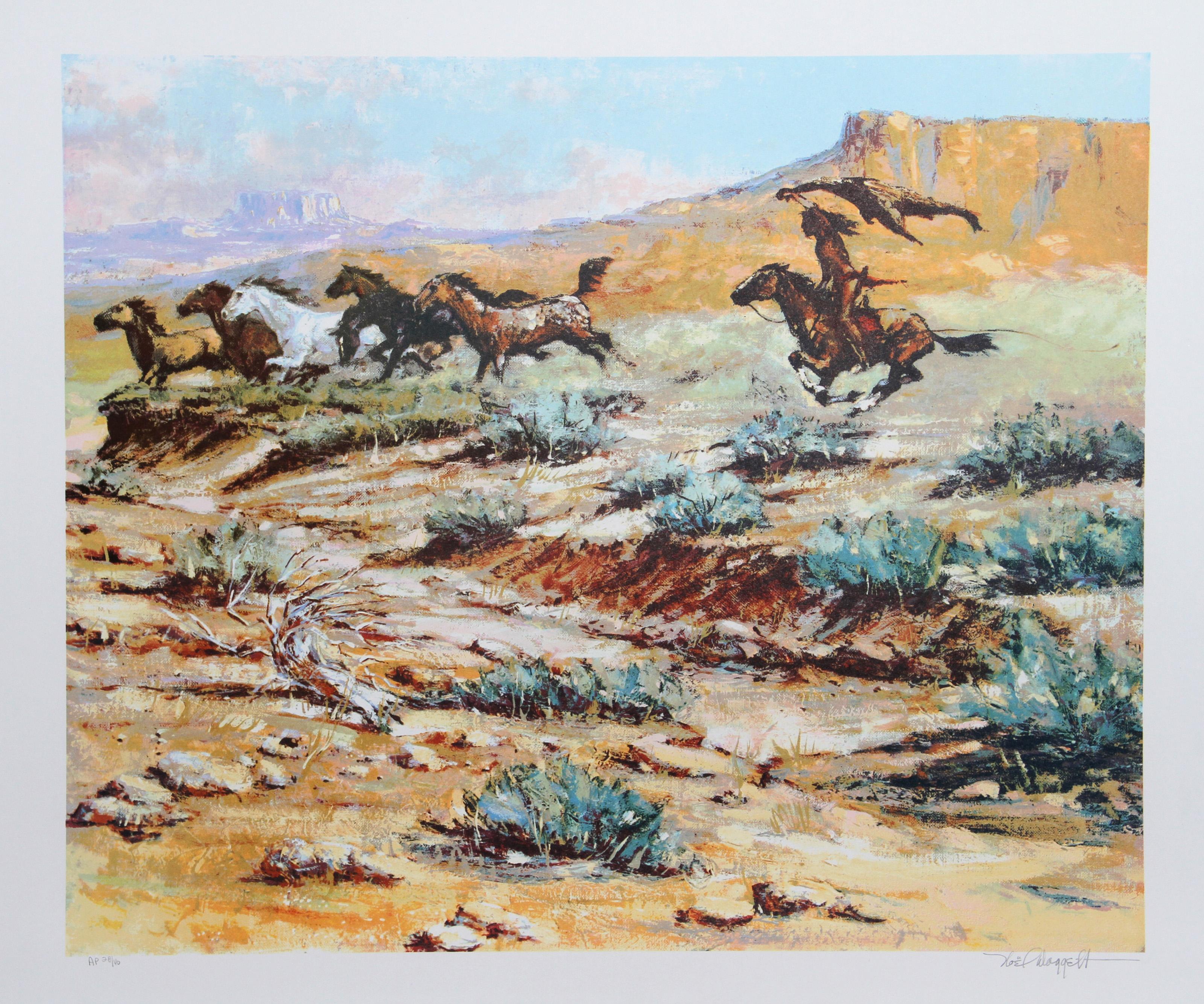
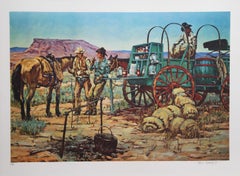
Ira Moskowitz, 'Navajo Horse Race', lithograph, 1946, edition 30, Czestochowski 204. Signed and titled in pencil. Signed and dated in the stone, lower left. A fine, richly-inked impression, on cream wove paper, with full margins (7/16 to 2 inches), in excellent condition. Matted to museum standards, unframed.
Image size 11 3/8 x 15 1/8 inches (289 x 384 mm); sheet size 12 5/8 x 18 3/4 inches (321 x 476 mm).
Collection: Memphis Brooks Museum of Art
ABOUT THE ARTIST
Ira Moskowitz was born in Galicia in 1912 and emigrated with his family to New York in 1927. He enrolled at the Art Students League, where he studied from 1928 to 1931. In 1935, Moskowitz traveled to Paris and subsequently lived in what is now Israel until 1937. He returned to the United States in 1938 to marry fellow artist Anna Barry in New York.
Soon after, the couple began traveling to Taos and Santa Fe, New Mexico, returning for extended periods until 1944, when they settled there permanently. They remained in New Mexico until 1949, a particularly productive phase in Moskowitz’s career during which he received a Guggenheim Fellowship. Deeply influenced by the landscape and cultural complexity of the region, his work engaged the interwoven traditions of the American Southwest, Native American communities, and Mexican culture. He focused especially on Pueblo and Navajo communities, developing a substantial body of work depicting Indigenous cultural life. Moskowitz and Barry also traveled extensively in Old Mexico, where they sketched and gathered material that further informed their work. While in the Southwest, Moskowitz flourished as a printmaker, alongside continued work in oil and watercolor.
More than one hundred of Moskowitz’s works depicting Indigenous ceremonial traditions were used to illustrate American Indian Ceremonial Dances by John Collier (Crown Publishers, New York, 1972), underscoring the historical and cultural significance of this aspect of his production.
After leaving the Southwest, printmaking remained central to Moskowitz’s practice, though his subject matter shifted toward Jewish religious life and customs. These works were well received and became a sustained focus for the remainder of his career. From 1963 to 1966, Moskowitz lived in Paris before returning to New York City in 1967, where he remained until his death in 2001.
Shortly before his death, the Zaplin-Lampert Gallery in Santa Fe presented a retrospective exhibition of Moskowitz’s work (December 2000–January 2001). Earlier one-person exhibitions included the 8th Street Playhouse, New York (1934), the Houston Museum (1941), and the San Antonio Museum (1941). His work was also included in exhibitions at the Art Students League, the Art Institute of Chicago, the Philadelphia Print Club, the College Art Association, and the International Exhibition of Graphic Arts at the Museum of Modern Art (1955).
Moskowitz’s lithographs are represented in the permanent collections of the Albany Institute of History and Art, the Bibliothèque nationale de France (Paris), the Carnegie Institute (Pittsburgh), the Museum of Fine Arts, Houston, the Library of Congress, the McNay Art Museum, the Metropolitan Museum of Art, the New Mexico Museum of Art, the New York Public Library, the Museum of Modern Art, the Smithsonian American Art Museum, and the Whitney Museum of American Art.
- Creator:Ira Moskowitz (1912, American)
- Creation Year:1946
- Dimensions:Height: 11.38 in (28.91 cm)Width: 15.13 in (38.44 cm)
- Medium:
- Movement Style:
- Period:
- Condition:
- Gallery Location:Myrtle Beach, SC
- Reference Number:Seller: 998311stDibs: LU532312905112
About the Seller
5.0
Recognized Seller
These prestigious sellers are industry leaders and represent the highest echelon for item quality and design.
Platinum Seller
Premium sellers with a 4.7+ rating and 24-hour response times
Established in 1995
1stDibs seller since 2016
336 sales on 1stDibs
Typical response time: 1 hour
Associations
International Fine Print Dealers Association
- ShippingRetrieving quote...Shipping from: Myrtle Beach, SC
- Return Policy
More From This Seller
View All
Navajo Country
— Southwest Regionalism, Native American Subject
By Ira Moskowitz
Located in Myrtle Beach, SC
Ira Moskowitz, 'Navajo Reservation Landscape', lithograph, 1945, edition c. 30. Signed and titled in pencil. Signed and dated in the stone, lower left. A fine, richly-inked impressio...
Category
1940s Landscape Prints
Materials
Lithograph
Navajo Trading Post
— Southwest Regionalism, Native American Subject
By Ira Moskowitz
Located in Myrtle Beach, SC
Ira Moskowitz, 'Navajo Trading Post', lithograph, 1946, edition 30, Czestochowski 161. Signed and dated in the stone, lower left. A fine, richly-inked impression, on cream wove paper...
Category
1940s American Modern Landscape Prints
Materials
Lithograph
Navajo Courtship Dance
— Southwest Regionalism, Native American Subject
By Ira Moskowitz
Located in Myrtle Beach, SC
Ira Moskowitz, 'Navajo Courtship Dance (Squaw Dance)', lithograph, 1946, edition 30, Czestochowski 161. Signed and titled in pencil. Signed and dated in the stone, lower left. A fine...
Category
1940s American Modern Landscape Prints
Materials
Lithograph
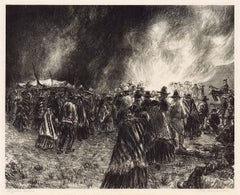
Navajo Medicine Ceremony of the Night Chant
— Native American Subject
By Ira Moskowitz
Located in Myrtle Beach, SC
Ira Moskowitz, 'The Three Gods of Healing (Navajo Medicine Ceremony of the Night Chant)', lithograph, 1945, edition 30, Czestochowski 148. Signed and titled in pencil. Signed and dat...
Category
1940s American Modern Landscape Prints
Materials
Lithograph
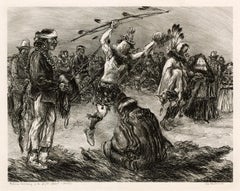
Foul Rope (Left)
— Early American Southwest Rodeo
By William Robinson Leigh
Located in Myrtle Beach, SC
William Robinson Leigh, 'Foul Rope (Left)', etching, c. 1920, edition unknown but small. Signed in pencil and signed in the plate, lower left. A superb, richly-inked impression, in dark brown ink, on buff wove Umbria paper, the full sheet with margins (1 1/2 to 2 3/4 inches); slight toning at the sheet edges, otherwise in excellent condition. Very scarce. Archivally matted to museum standards, unframed.
Image size 14 7/8 x 11 15/16 inches (378 x 303 mm); sheet size 20 3/8 x 15 3/8 inches (518 x 391 mm).
ABOUT THE ARTIST
Born near Falling Waters, West Virginia, on a plantation a year after the Civil War and raised in Baltimore, William Robinson Leigh (1866 - 1955) became one of the foremost painters of the American West. His career spanning some seventy-five years, Leigh created some of the most iconic depictions of the Western landscape, with admirers referring to him as ‘The Sagebrush Rembrandt.’
The son of impoverished Southern aristocrats, Leigh received his first art training at age 14 from Hugh Newell at the Maryland Institute, where he was regarded as the best student in his class. From 1883 to 1895, he studied in Europe, mainly at the Royal Academy in Munich with Ludwig Loefftz. From 1891 to 1896, he painted six cycloramas or murals in the round, a giant German panorama.
In 1896, Leigh began working as a magazine illustrator for Scribner's and Collier's Weekly Magazine in New York City. He also painted portraits, landscapes, and genre scenes.
Leigh's trips to the Southwest began in 1906 when he agreed to paint the Grand Canyon with William Simpson, Santa Fe Railway advertising manager, in exchange for free transportation West. In 1907, he completed his Grand Canyon painting, which led to more commissions and an extensive painting trip through Arizona and New Mexico. These travels inspired him to paint western subjects for the next 50 years, and his primary interests were the Hopi and Navajo Indians.
In 1910, he traveled to Wyoming, where he painted in Yellowstone Park and created sketches, many of which he later converted into large canvases such as ‘Lower Falls of the Yellowstone’ (1915) and ‘Grand Canyon of the Yellowstone’ (1911).
In 1926, he traveled to Africa at the invitation of Carl Akeley for the American Museum of Natural History, and from this experience, wrote and illustrated 'Frontiers of Enchantment: An Artist's Adventures in Africa'. In 1933, he wrote and illustrated 'The Western Pony'. His adventures were chronicled in several popular magazines, including Life, the Saturday Evening Post, and Colliers.
For many years, Grand Central Art Galleries at the Biltmore Hotel handled his work exclusively in New York. In 1953, Leigh was elected an associate member of the National Academy of Design and became a full Academician in 1955.
In March 1999, the Historical Center of Cody, Wyoming, held an exhibition of his field sketches and finished works depicting his experiences near Cody early in the century. Between 1910 and 1921, when he often painted in the Carter Mountain vicinity, these years were considered pivotal to his artistic development and devotion to the Western landscape.
Leigh's work is held in many museum collections of American Western art...
Category
1920s Realist Animal Prints
Materials
Etching
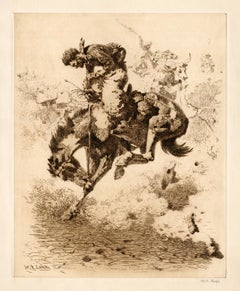
Riders at Sundown
— Mid-Century Southwest Regionalism
By Gene Kloss
Located in Myrtle Beach, SC
'Riders at Sundown', aquatint and drypoint, edition 75, 1953, Kloss 451. Signed, titled, and annotated 'Artist's Proof' in pencil. A superb, richly-inked, atmospheric impression, in ...
Category
1950s American Modern Landscape Prints
Materials
Drypoint, Aquatint
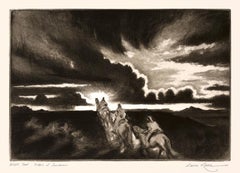
You May Also Like
Mustangs on the Run, American Western Art Lithograph by Noel Daggett
By Noel Daggett
Located in Long Island City, NY
Noel Daggett, American (1925 - 2005) - Mustangs on the Run, Year: circa 1979, Medium: Lithograph, signed and numbered in pencil, Edition: 300, AP 40, Image Size: 19 x 23.5 inches...
Category
1970s American Realist Animal Prints
Materials
Lithograph

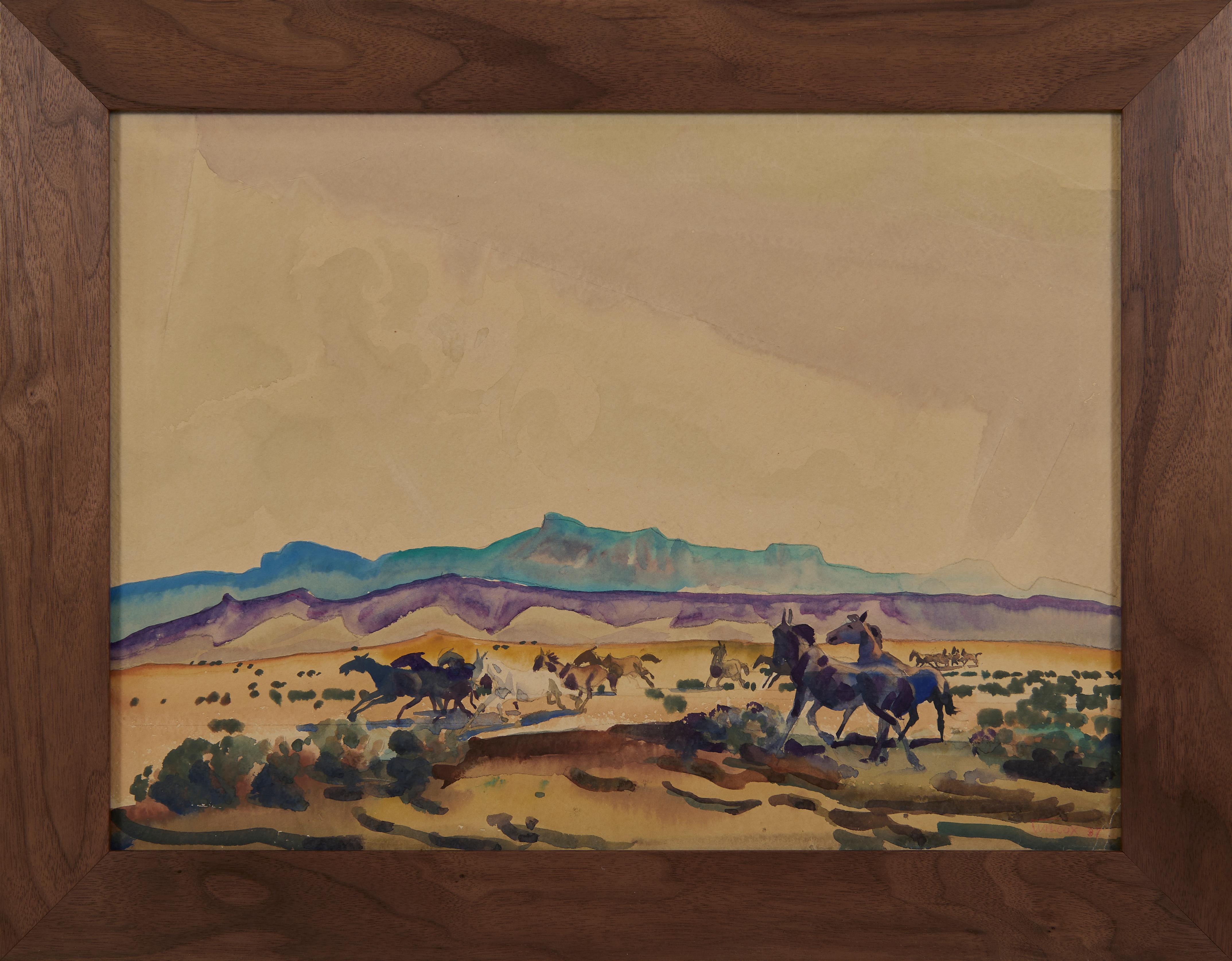
Wild Horses, Arizona, Early 20th Century Western Landscape, Cleveland School
By Frank Wilcox
Located in Beachwood, OH
Frank Nelson Wilcox (American, 1887–1964)
Wild Horses, Arizona, 1937
Watercolor on paper
Signed and dated lower right, titled verso
15 x 20 inches
18 x 24 inches framed
Frank Nelso...
Category
1930s American Modern Landscape Drawings and Watercolors
Materials
Watercolor
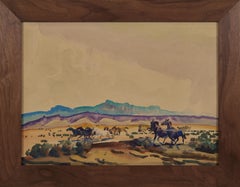
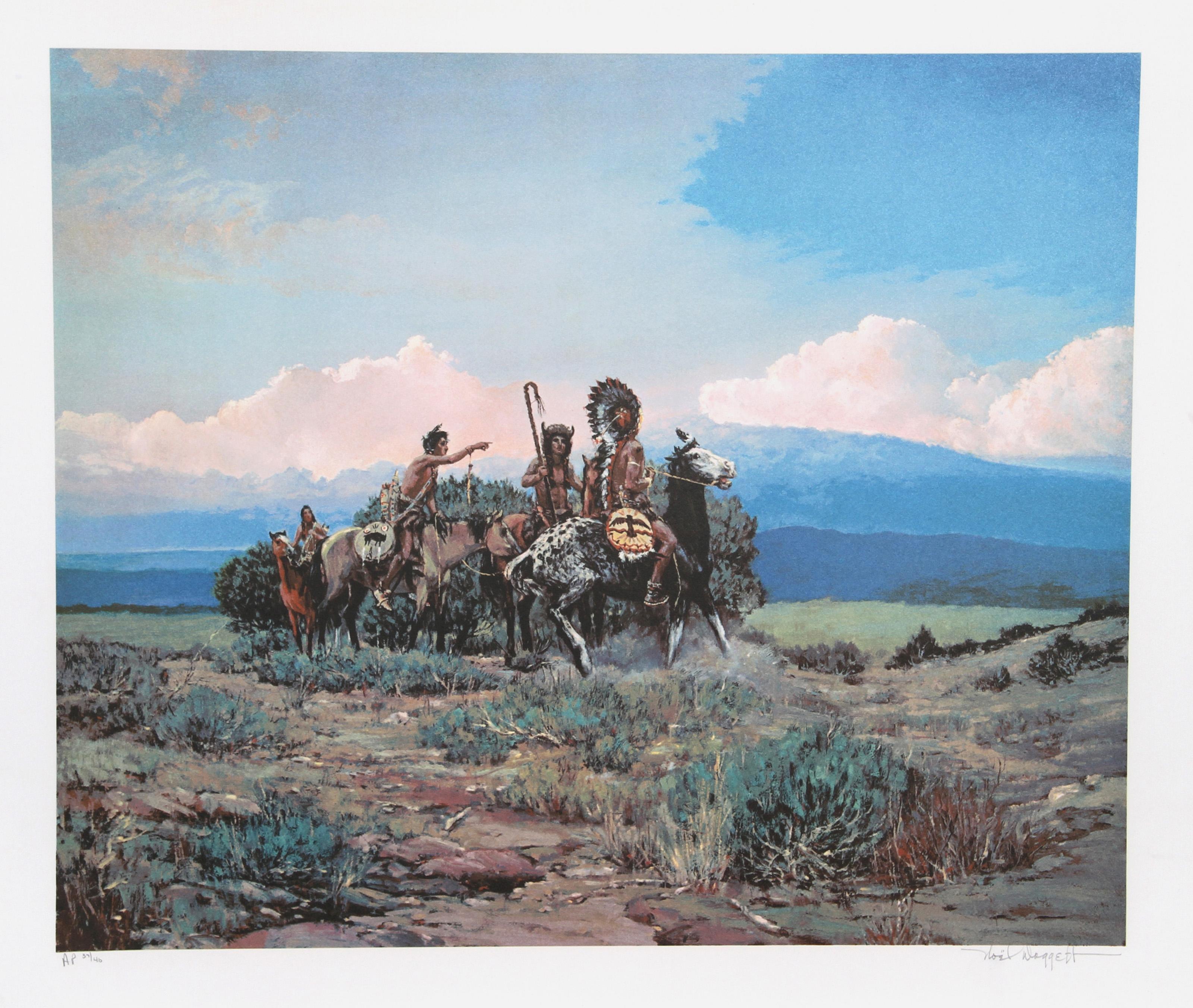
Approach of a Rider, American Western Art Lithograph by Noel Daggett
By Noel Daggett
Located in Long Island City, NY
Noel Daggett, American (1925 - 2005) - Approach of a Rider, Year: circa 1979, Medium: Lithograph, signed and numbered in pencil, Edition: 300, AP 40, Image Size: 19 x 23 inches, ...
Category
1970s American Realist Figurative Prints
Materials
Lithograph
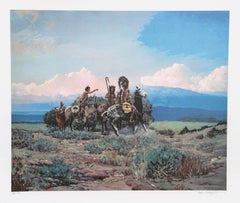
Apache Hunter, limited edition lithograph by Allan Houser, horseback hunter
By Allan Houser
Located in Santa Fe, NM
Apache Hunter, limited edition lithograph by Allan Houser, horseback hunter
hand-pulled black and white lithograph
printed in Santa Fe, New Mexico
unframed edition of 75
Allan Houser (Haozous), Chiricahua Apache (1914-1994)
Selected Collections
Centre Georges Pompidou, Paris, France * “They’re Coming”, bronze
Dahlem Museum, Berlin, Germany
Japanese Royal Collection, Tokyo, Japan “The Eagle”, black marble commissioned by President William J. Clinton
United States Mission to the United Nations, New York City, NY *"Offering of the Sacred Pipe”, monumental bronze by Allan Houser © 1979 Presented to the United States Mission to the United Nations as a symbol of World Peace honoring the native people of all tribes in these United States of America on February 27, 1985 by the families of Allan and Anna Marie Houser, George and Thelma Green and Glenn and Sandy Green in New York City.
National Portrait Gallery, Smithsonian, Washington, DC * Portrait of Geronimo, bronze
National Museum of American Art, Smithsonian, Washington, D.C. * “Buffalo Dance Relief”, Indiana limestone
National Museum of the American Indian, Smithsonian, Washington, D.C. *Sacred Rain Arrow, (Originally dedicated at the US Senate Committee on Indian Affairs, US Senate Building) “Goat”, “To The Great Spirit” - dedicated in 1994 at the Vice President’s Residence in Washington, D.C.. Ceremony officiated by Hillary Rodham Clinton and Tipper Gore.
Oklahoma State Capitol, Oklahoma City, Ok * “As Long As the Waters Flow”, bronze
Gilcrease Museum, Tulsa, OK *Sacred Rain Arrow, bronze
Fort Sill, Oklahoma *”Chiricahua Apache Family”, bronze Donated and dedicated to Allan Houser’s parents Sam and Blossom Haozous by Allan Houser and Glenn and Sandy Green
The Heard Museum, Phoenix, Arizona *Earth Song, marble donated by Glenn and Sandy Green
The Clinton Presidential Library, Arkansas * “May We Have Peace”, bronze
The George H.W. Bush Presidential Library, College Station, Texas *"Offering to the Great Spirit", bronze
The British Royal Collection, London, England *Princess Anne received "Proud Mother", bronze in Santa Fe
Allan Houser’s father Sam Haozous, surrendered at the age of 14 with Geronimo and his band of Warm Springs Chiricahua Apache people in 1886 in Southern Arizona. This was the last active war party in the United States.
This group of Apache people was imprisoned for 27 years starting in Fort Marion, Florida and finally living in captivity in Fort Sill, Oklahoma.
Allan Houser was born in 1914.
His artwork is an ongoing testimony to Native life in America – its beauty, strength and poignancy. Allan Houser is from the culture and portrayed his people in an insightful and authentic way. Because of the era in which he lived, he had a rare understanding of American Indian life. Allan was the first child born after the Chiricahua Apaches were released from 27 years of captivity. Allan grew up speaking the Chiricahua dialect. Allan heard his father’s stories of being on the warpath with Geronimo and almost nightly heard his parents singing traditional Apache music. Allan’s father knew all of Geronimo’s medicine songs.
Allan had an early inclination to be artistic. He was exposed to many Apache ceremonial art forms: music, musical instruments, special dress, beadwork, body painting and dynamic dance that are integral aspects of his culture. His neighbors were members of many different tribes who lived in Oklahoma. Allan eagerly gained information about them and their cultures. Allan gathered this information and mentally stored images until he brought them back to life, years later, as a mature artist.
Allan Houser was represented by Glenn Green Galleries (formerly known as The Gallery Wall, Inc.) from 1973 until his death in 1994. The gallery served as agents, advocates, and investors during this time.
In 1973 the Greens responded enthusiastically to the abstraction and creativity in Houser’s work. They were impressed, not only with his versatility and talent but with the number of mediums he employed. His subject matter was portrayed in styles ranging from realism, stylized form to abstraction.
With encouragement from the Greens, Houser at the age of 61, retired from his post as the head of the sculpture department at the Institute of American Indian Arts in Santa Fe, New Mexico in 1975 to begin working full-time creating his art. The next 20-year period was an exciting time for Allan, the gallery, and for the Green family. He created a large body of sculpture in stone, wood and bronze. For many years Glenn Green Galleries co-sponsored many editions of his bronzes and acted as quality control for the bronze sculptures according to Houser’s wishes.
As both agents and gallery representatives, the Greens promoted and sold his art in their galleries in Phoenix and Scottsdale, Arizona and in Santa Fe, New Mexico. They had bi-annual exhibits in their galleries to feature Houser’s newest work and sponsored and arranged international museum shows in America, Europe and Asia. They travelled for these events including a trip to Carrara, Italy to the famed quarries of Michelangelo and together co-financed and arranged the purchase of 20 tons of marble.
A watershed event for Allan Houser’s career occurred in the early 1980’s when Glenn Green Galleries arranged with the US Information Agency a touring exhibit of his sculpture through Europe. This series of exhibits drew record attendance for these museums and exposed Houser’s work to an enthusiastic art audience. This resulted in changing the perception of contemporary Native art in the United States where Houser and Glenn Green Galleries initially faced resistance from institutions who wanted to categorize him in a regional way. The credits from the European exhibits helped open doors and minds of the mainstream art community in the United States and beyond.
Senator Daniel Inouye of Hawaii was a supporter of Allan Houser’s artwork. We worked with Senator Inouye on many occasions hosting events at our gallery and in Washington D.C in support of the formation of the Smithsonian’s National Museum of the American Indian in Washington, D.C. and other causes supporting Native Americans.
Allan Houser is shown below presenting his sculpture “Swift Messenger” to Senator Inouye in Washington, D.C.. This sculpture was eventually given to the National Museum of the American Indian, Smithsonian’s permanent collection. It is now currently on loan and on display in the Oval Office. President Biden’s selection of artwork continues our gallery’s and Allan’s connection to the White House from our time working with Allan Houser from 1974 until his passing in 1994.
“It was important for President Biden to walk into an Oval that looked like America and started to show the landscape of who he is going to be as president,” Ashley Williams...
Category
1970s Contemporary Figurative Prints
Materials
Lithograph
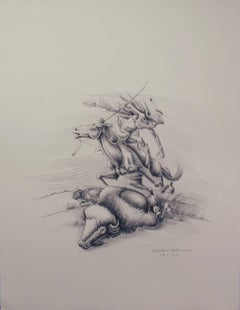
We Shall Not Talk of War, American Western Art Lithograph by Noel Daggett
By Noel Daggett
Located in Long Island City, NY
Noel Daggett, American (1925 - 2005) - We Shall Not Talk of War, Year: circa 1979, Medium: Lithograph, signed and numbered in pencil, Edition: 300, AP 40, Image Size: 19 x 25 inc...
Category
1970s American Realist Animal Prints
Materials
Lithograph
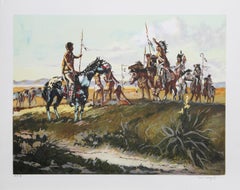
Let
s Move
Em, American Western Art Lithograph by Noel Daggett
By Noel Daggett
Located in Long Island City, NY
Noel Daggett, American (1925 - 2005) - Let's Move 'Em, Year: circa 1979, Medium: Lithograph, signed and numbered in pencil, Edition: 300, AP 40, Image Size: 18.5 x 27 inches, Siz...
Category
1970s American Realist Animal Prints
Materials
Lithograph
More Ways To Browse
American Indian Vintage
Horse 1940
Indian Horses
Southwest Indian Art
John Collier
African American Vintage Posters
Alex Katz Pink
Bernard Buffet Lithograph Paris
Bernard Buffet Notre Dame
California Wine Country Art
Chanel Lithograph
Dali French Railway
David Roberts Jerusalem
Ella Fort On Sale
Etchings Brooklyn Bridge
Foll Art
Giovanni Battista Piranesi On Sale
Gonville Caius