Items Similar to
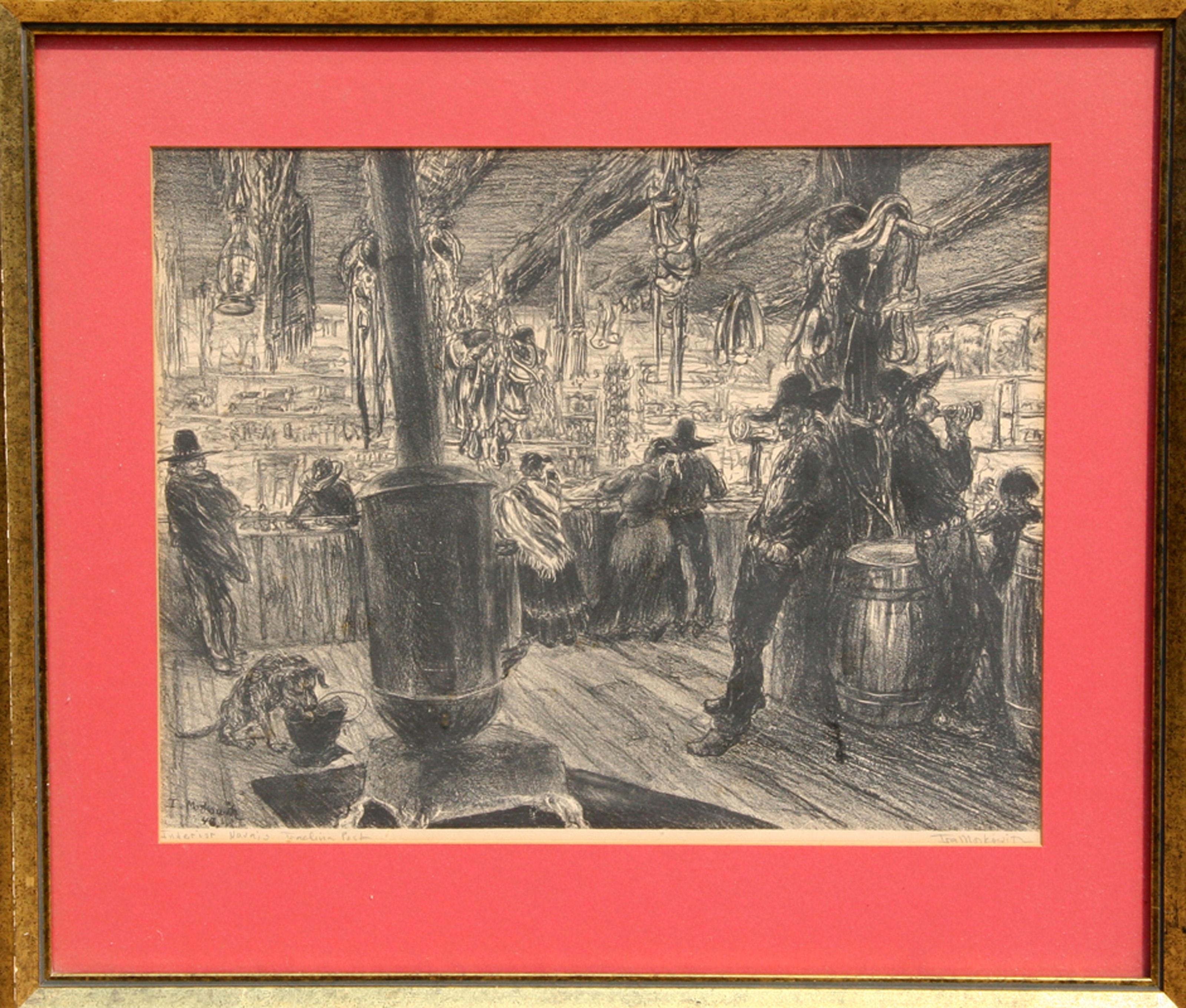
Navajo Trading Post
— Southwest Regionalism, Native American Subject
Want more images or videos?
Request additional images or videos from the seller
1 of 6
Ira Moskowitz
Navajo Trading Post
— Southwest Regionalism, Native American Subject1946
1946
$550
£419.11
€483.35
CA$781.16
A$839.32
CHF 450.29
MX$9,888.13
About the Item
Ira Moskowitz, 'Navajo Trading Post', lithograph, 1946, edition 30, Czestochowski 161. Signed and dated in the stone, lower left. A fine, richly-inked impression, on cream wove paper, with full margins (1 1/2 to 3 1/8 inches). Pale mat line, otherwise in excellent condition. Matted to museum standards, unframed.
Image size 11 11/16 x 15 1/2 inches (297 x 395 mm); sheet size 16 5/16 x 191/8 inches (414 x 486 mm).
Collection: Memphis Brooks Museum of Art.
ABOUT THE ARTIST
Ira Moskowitz was born in Galicia in 1912 and emigrated with his family to New York in 1927. He enrolled at the Art Students League, where he studied from 1928 to 1931. In 1935, Moskowitz traveled to Paris and subsequently lived in what is now Israel until 1937. He returned to the United States in 1938 to marry fellow artist Anna Barry in New York.
Soon after, the couple began traveling to Taos and Santa Fe, New Mexico, returning for extended periods until 1944, when they settled there permanently. They remained in New Mexico until 1949, a particularly productive phase in Moskowitz’s career during which he received a Guggenheim Fellowship. Deeply influenced by the landscape and cultural complexity of the region, his work engaged the interwoven traditions of the American Southwest, Native American communities, and Mexican culture. He focused especially on Pueblo and Navajo communities, developing a substantial body of work depicting Indigenous cultural life. Moskowitz and Barry also traveled extensively in Old Mexico, where they sketched and gathered material that further informed their work. While in the Southwest, Moskowitz flourished as a printmaker, alongside continued work in oil and watercolor.
More than one hundred of Moskowitz’s works depicting Indigenous ceremonial traditions were used to illustrate American Indian Ceremonial Dances by John Collier (Crown Publishers, New York, 1972), underscoring the historical and cultural significance of this aspect of his production.
After leaving the Southwest, printmaking remained central to Moskowitz’s practice, though his subject matter shifted toward Jewish religious life and customs. These works were well received and became a sustained focus for the remainder of his career. From 1963 to 1966, Moskowitz lived in Paris before returning to New York City in 1967, where he remained until his death in 2001.
Shortly before his death, the Zaplin-Lampert Gallery in Santa Fe presented a retrospective exhibition of Moskowitz’s work (December 2000–January 2001). Earlier one-person exhibitions included the 8th Street Playhouse, New York (1934), the Houston Museum (1941), and the San Antonio Museum (1941). His work was also included in exhibitions at the Art Students League, the Art Institute of Chicago, the Philadelphia Print Club, the College Art Association, and the International Exhibition of Graphic Arts at the Museum of Modern Art (1955).
Moskowitz’s lithographs are represented in the permanent collections of the Albany Institute of History and Art, the Bibliothèque nationale de France (Paris), the Carnegie Institute (Pittsburgh), the Museum of Fine Arts, Houston, the Library of Congress, the McNay Art Museum, the Metropolitan Museum of Art, the New Mexico Museum of Art, the New York Public Library, the Museum of Modern Art, the Smithsonian American Art Museum, and the Whitney Museum of American Art.
- Creator:Ira Moskowitz (1912, American)
- Creation Year:1946
- Dimensions:Height: 11.69 in (29.7 cm)Width: 15.5 in (39.37 cm)
- Medium:
- Movement Style:
- Period:
- Condition:
- Gallery Location:Myrtle Beach, SC
- Reference Number:Seller: 998321stDibs: LU532312905132
About the Seller
5.0
Recognized Seller
These prestigious sellers are industry leaders and represent the highest echelon for item quality and design.
Platinum Seller
Premium sellers with a 4.7+ rating and 24-hour response times
Established in 1995
1stDibs seller since 2016
336 sales on 1stDibs
Typical response time: 1 hour
Associations
International Fine Print Dealers Association
- ShippingRetrieving quote...Shipping from: Myrtle Beach, SC
- Return Policy
More From This Seller
View All
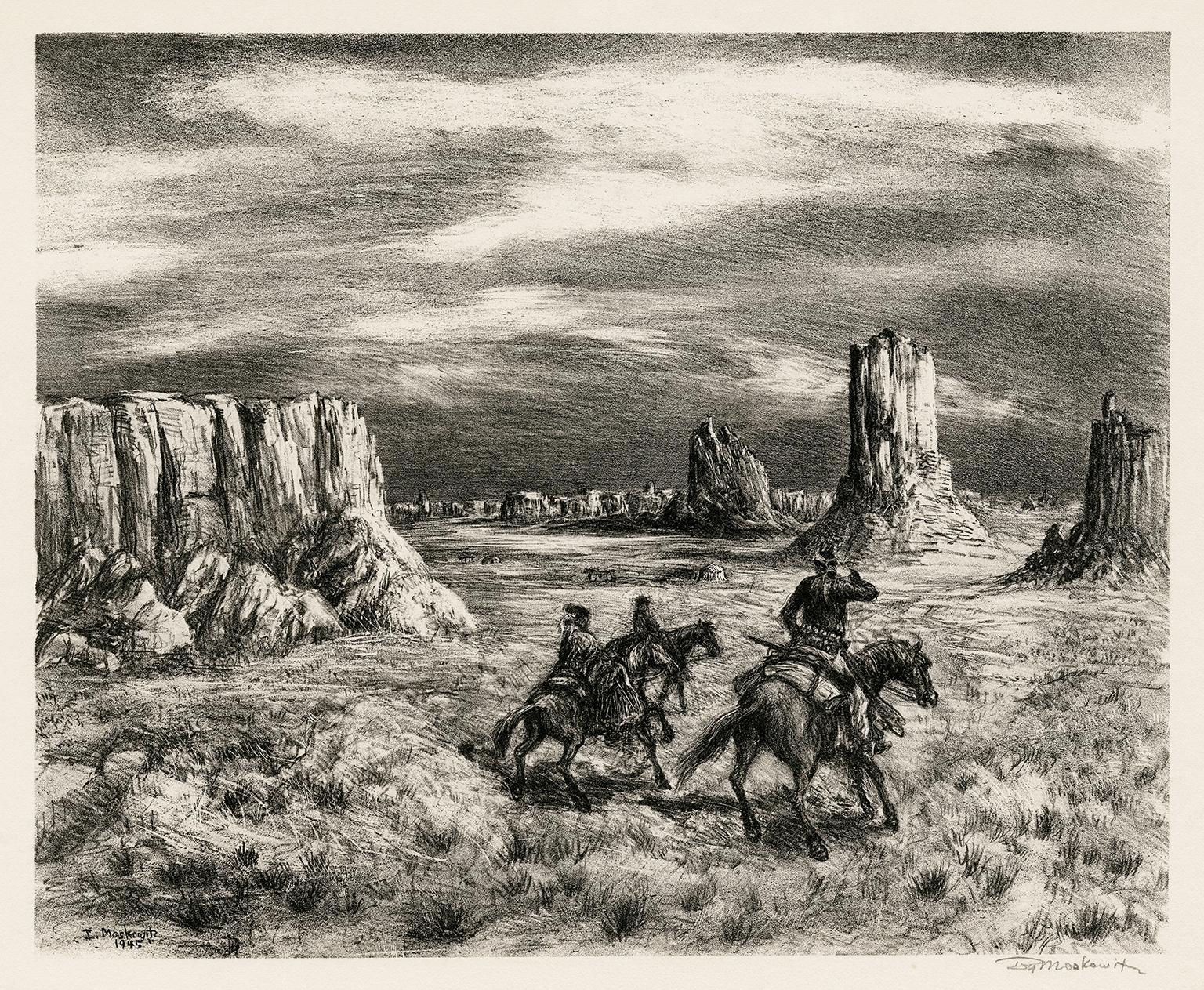
Navajo Country
— Southwest Regionalism, Native American Subject
By Ira Moskowitz
Located in Myrtle Beach, SC
Ira Moskowitz, 'Navajo Reservation Landscape', lithograph, 1945, edition c. 30. Signed and titled in pencil. Signed and dated in the stone, lower left. A fine, richly-inked impressio...
Category
1940s Landscape Prints
Materials
Lithograph
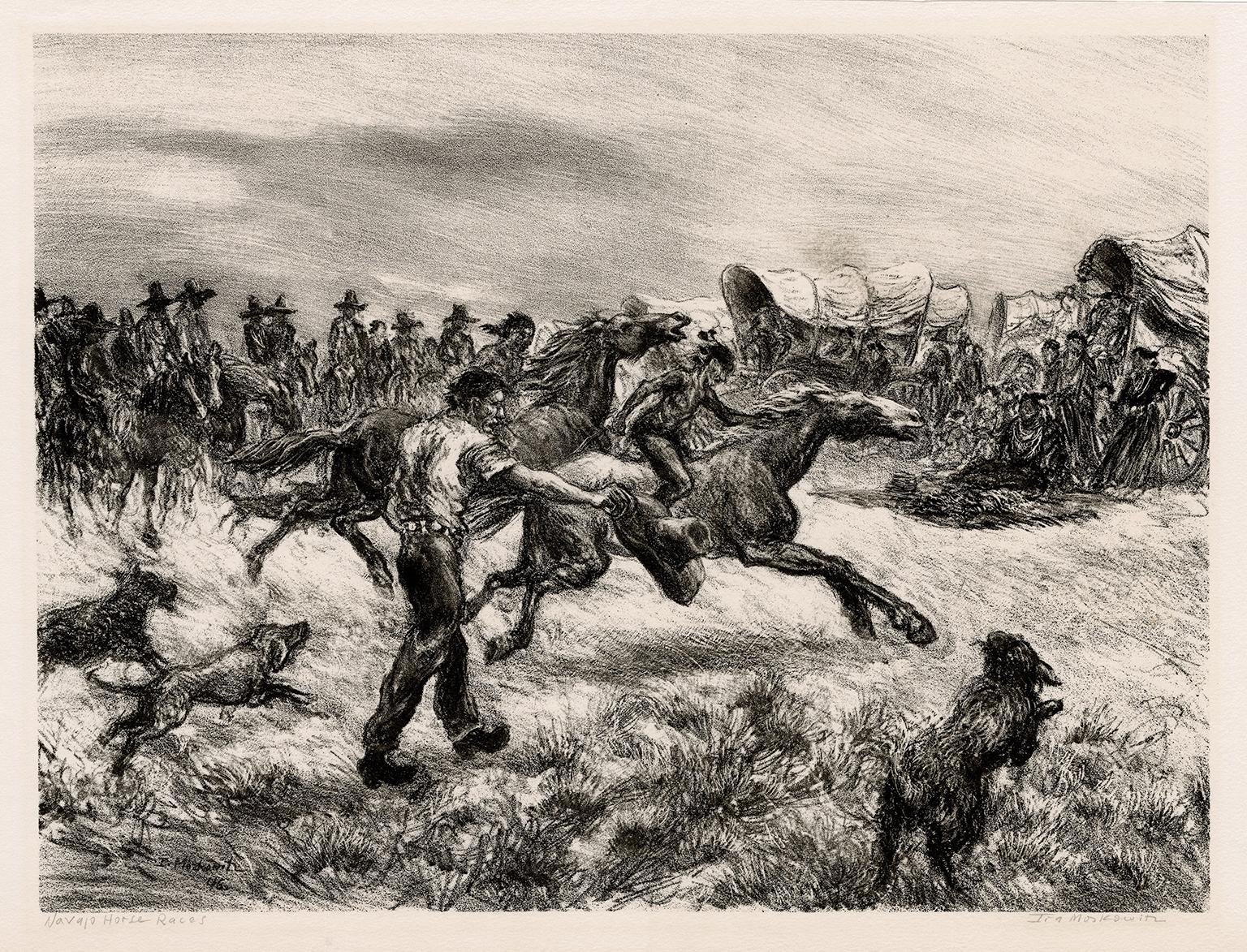
Navajo Horse Race
— Southwest Regionalism, Native American Subject
By Ira Moskowitz
Located in Myrtle Beach, SC
Ira Moskowitz, 'Navajo Horse Race', lithograph, 1946, edition 30, Czestochowski 204. Signed and titled in pencil. Signed and dated in the stone, lower le...
Category
1940s American Modern Landscape Prints
Materials
Lithograph
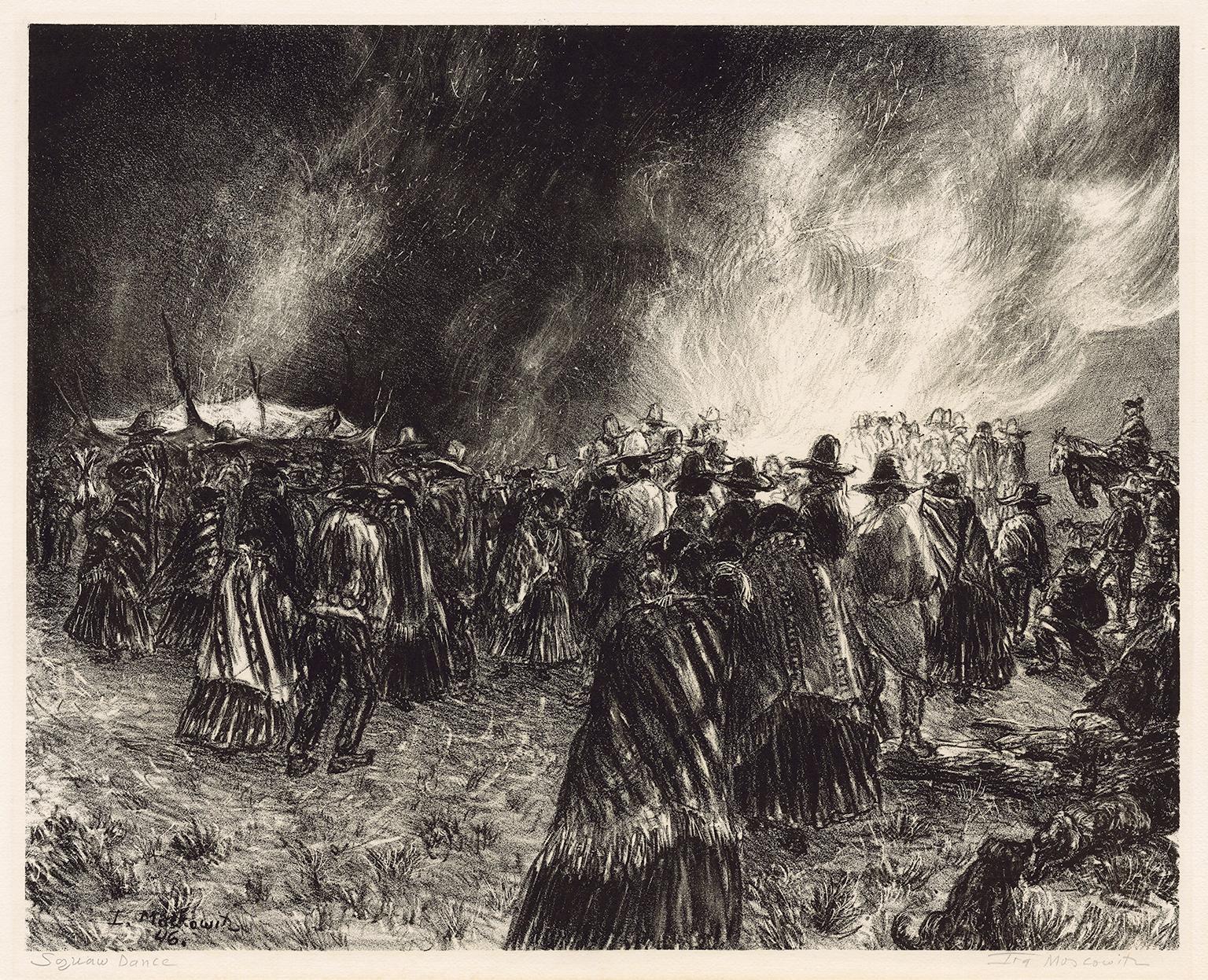
Navajo Courtship Dance
— Southwest Regionalism, Native American Subject
By Ira Moskowitz
Located in Myrtle Beach, SC
Ira Moskowitz, 'Navajo Courtship Dance (Squaw Dance)', lithograph, 1946, edition 30, Czestochowski 161. Signed and titled in pencil. Signed and dated in the stone, lower left. A fine...
Category
1940s American Modern Landscape Prints
Materials
Lithograph
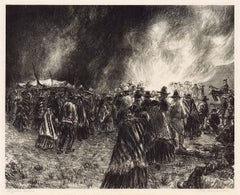
Navajo Medicine Ceremony of the Night Chant
— Native American Subject
By Ira Moskowitz
Located in Myrtle Beach, SC
Ira Moskowitz, 'The Three Gods of Healing (Navajo Medicine Ceremony of the Night Chant)', lithograph, 1945, edition 30, Czestochowski 148. Signed and titled in pencil. Signed and dat...
Category
1940s American Modern Landscape Prints
Materials
Lithograph
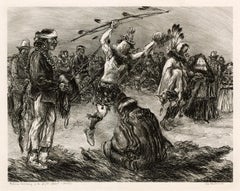
Taos - Relic of the Insurrection of 1845
— Native American Subject
By Ira Moskowitz
Located in Myrtle Beach, SC
Ira Moskowitz, 'Relic of the Insurrection of 1845' also 'Taos Pueblo with Ruin)', lithograph, 1944, edition 30, Czestochowski 121. Signed and titled in pencil. Signed and dated in th...
Category
1940s American Modern Landscape Prints
Materials
Lithograph
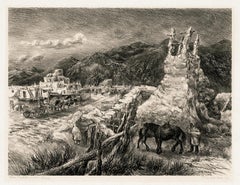
Preparing the Sand Painting
— Southwest Regionalism, Native American Subject
By Ira Moskowitz
Located in Myrtle Beach, SC
Ira Moskowitz, 'Preparing the Sand Painting', lithograph, 1946, edition 30, Czestochowski 205. Signed and titled in pencil. Signed and dated in the stone...
Category
1940s American Modern Landscape Prints
Materials
Lithograph
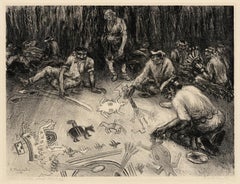
You May Also Like
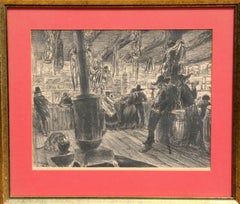
Interior Navajo Trading Post, Modern Lithograph by Ira Moskowitz
By Ira Moskowitz
Located in Long Island City, NY
Ira Moskowitz, Polish/American (1912 - 2001) - Interior Navajo Trading Post, Year: 1946, Medium: Lithograph, Signed in Pencil, Size: 12 in. x 15 in. (30.48 cm x 38.1 cm), Frame Size: 18 x 21 inches, Description: This greyscale depiction of the interior space of a Navajo trading post features an Old Western...
Category
1940s Modern Figurative Drawings and Watercolors
Materials
Lithograph
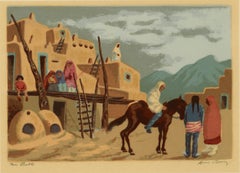
Taos Pueblo
By Anna Barry
Located in Fairlawn, OH
Taos Pueblo
Screen print in colors, c. 1945
Signed and titled in pencil by the artist
Printed in Taos
Taos is the oldest continually inhabited city/village in North America.
How old ...
Category
1940s American Modern Landscape Prints
Materials
Screen
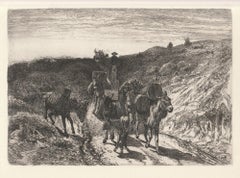
A Burro Train, New Mexico
By Peter Moran
Located in Middletown, NY
Etching with aquatint on heavy laid paper, 7 x 9 1/4 inches (172 x 233 mm), full margins. Signed in the plate, lower right image area. Minor corner loss, top right, and a 1/4 inch ed...
Category
Late 19th Century American Realist Animal Prints
Materials
Laid Paper, Etching
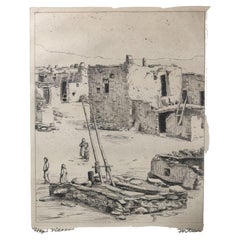
Vintage Etching of Hopi Village by Kiva H. Fortier
Located in Van Nuys, CA
Original signed artwork print etching of Hopi Village Signed in pencil by Kiva H. Fortier.
Frame measures 8 1/2 x 12, actual print measures approx. 4 x 5.
Circa 1900, Signed
Category
Antique Early 1900s American Prints
Materials
Paper
$422 Sale Price
35% Off
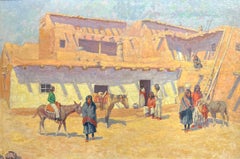
Mid-day, Zuni Village
By Frank Reed Whiteside
Located in Missouri, MO
Mid-day, Zuni Village, 1897
By. Frank Reed Whiteside (American, 1866-1929)
Unframed: 20" x 30"
Framed: 28" x 38"
Frank Reed Whiteside, born in Philadelphia on 20 August 1867, became a student of Thomas Anshutz at the Pennsylvania Academy of the Fine Arts (1888-92). He already began exhibiting there during his student years (1887-98). In 1893, he enrolled in the Académie Julian in Paris where he received instruction from Jean-Paul Laurens and Benjamin Constant. After his French academic training, Whiteside taught art in Philadelphia high schools. He took frequent trips to the Southwest between 1890 and 1928 to live with and paint the Zuni Indians. Whiteside depicted ceremonial dances, Zuni buildings, and other genre scenes, usually in blinding afternoon sunlight. He carefully observed the effects of light on vibrant color, using a finely crafted impressionist technique. He was fond of broad areas of color, subtle combinations of hues, and simplified shapes and silhouettes. Whiteside continued to exhibit at the PAFA (1905-15), at the Art Institute of Chicago (1896-1916), at the Carnegie International (1905 and 1907) and at the Corcoran Gallery (1907). He was a member of Philadelphia art societies and beginning in 1909 had a summer studio in Ogunquit, Maine, where he took part in Hamilton Easter Field's discussion groups. Frank's wife, Clara Walker Whiteside, who published Touring New England in 1926, was active in the Ogunquit Art Association.
Like Stanford White, Frank Reed Whiteside was the victim of murder, on 19 September 1929, but Whiteside's case remains unsolved. One night, the sixty-three year-old painter answered the doorbell. Two witnesses...
Category
Late 19th Century Other Art Style Figurative Paintings
Materials
Canvas, Oil
Price Upon Request
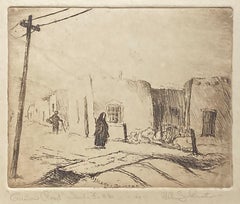
Canyon Road, Sante Fe
By Will (William Howard) Shuster
Located in Missouri, MO
Canyon Road, Santa Fe
By. William Howard Shuster (American, 1893-1969)
Signed Lower Right
Edition of 100 Lower Center
Titled Lower Left
Unframed: 4" x 4.75"
Framed: 15.75" x 15.25"
A realist and early modernist painter, graphic artist, illustrator, and sculptor, Will Shuster became known primarily for his work in New Mexico where in 1920, he settled in Santa Fe, having been encouraged to come there by John Sloan. He had studied electrical engineering at the Drexel Institute in Philadelphia and later was a student of Sloan's in Santa Fe in both etching and painting.
He was in World War I, where he suffered a gas attack. On his return, he studied with J William Server in Philadelphia but was advised to go West for his health.
In Santa Fe in 1921, he became one of the founding members of Los Cinco Pintores...
Category
20th Century American Modern Landscape Prints
Materials
Etching
Price Upon Request
More Ways To Browse
American Indian Vintage
Southwest Indian Art
John Collier
African American Vintage Posters
Alex Katz Pink
Bernard Buffet Lithograph Paris
Bernard Buffet Notre Dame
California Wine Country Art
Chanel Lithograph
Dali French Railway
David Roberts Jerusalem
Ella Fort On Sale
Etchings Brooklyn Bridge
Foll Art
Giovanni Battista Piranesi On Sale
Gonville Caius
Hockney Sun
James Swann