Want more images or videos?
Request additional images or videos from the seller
1 of 4
Ito TakashiAkeyuku Takegawa (Takegawa River at Dawn) — Japanese woodblock print1932
1932
Price:$800
About the Item
About the Seller
5.0
Recognized Seller
These prestigious sellers are industry leaders and represent the highest echelon for item quality and design.
Platinum Seller
Premium sellers with a 4.7+ rating and 24-hour response times
Established in 1995
1stDibs seller since 2016
336 sales on 1stDibs
Typical response time: 1 hour
Associations
International Fine Print Dealers Association
Authenticity Guarantee
In the unlikely event there’s an issue with an item’s authenticity, contact us within 1 year for a full refund. DetailsMoney-Back Guarantee
If your item is not as described, is damaged in transit, or does not arrive, contact us within 7 days for a full refund. Details24-Hour Cancellation
You have a 24-hour grace period in which to reconsider your purchase, with no questions asked.Vetted Professional Sellers
Our world-class sellers must adhere to strict standards for service and quality, maintaining the integrity of our listings.Price-Match Guarantee
If you find that a seller listed the same item for a lower price elsewhere, we’ll match it.Trusted Global Delivery
Our best-in-class carrier network provides specialized shipping options worldwide, including custom delivery.You May Also Like
Kamezaki Bishu (First Edition)
By Kawase Hasui
Located in Burbank, CA
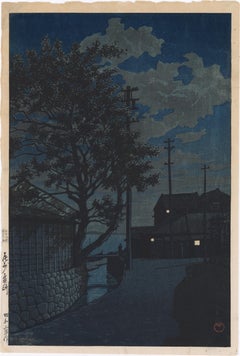
Three soft yellow lights shine from windows, beacons from the homes at the end of our path, middle right. At left a canal flows into the sea, and textured clouds float in an early ev...
Category
Early 20th Century Showa Landscape Prints
Materials
Handmade Paper, Woodcut
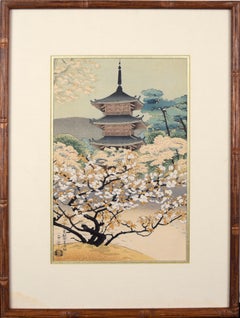
The Pagoda of Ninnaji Temple in Kyoto with Cherry Blossoms - Woodblock Print
Located in Soquel, CA
The Pagoda of Ninnaji Temple in Kyoto with Cherry Blossoms - Woodblock Print
Beautifully executed Showa-era print by Japanese artist Benji Asada (b. 1899 d. 1984.) This print shows ...
Category
1950s Showa Landscape Prints
Materials
Paper, Ink, Woodcut
$950
H 22.38 in W 16.63 in D 1 in
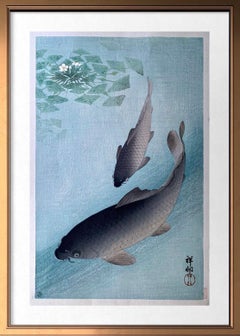
Authentic Life Time Edition Woodblock Print-Two Carps and Water Chestnut-Mint
By Ohara Koson
Located in London, GB
This is an authentic Japanese woodblock print by Ohara Koson (Shoson), titled Two (koi) Carp or Carp and Water Chestnut; originally created in the early 20th century, depicts two car...
Category
1940s Edo Landscape Prints
Materials
Ink, Washi Paper, Woodcut
$1,750
H 15.48 in W 10.36 in D 0.04 in
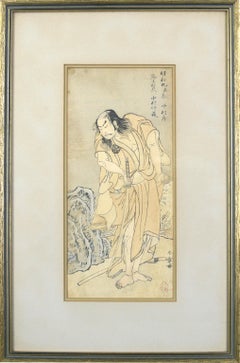
Actor as Samurai - 18th Century Japanese Woodblock Print
By Katsukawa Shunshō
Located in Soquel, CA
Actor as Samurai - 18th Century Japanese Woodblock Print
Woodblock print depicting an actor, possibly Nakamura Denkuro II, as a samurai. The actor stands with his sword unsheathed a...
Category
Late 18th Century Edo Figurative Prints
Materials
Woodcut, Rice Paper
$750
H 19 in W 12.5 in D 0.63 in
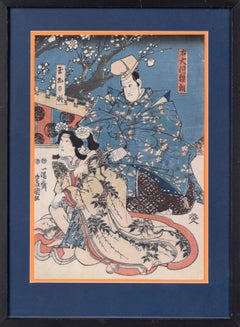
Two Actors - Japanese Woodblock by Chikanobu Yoshu
By Toyohara Chikanobu
Located in Soquel, CA
Two Actors - Japanese Woodblock by Toyohara Chikanobu (豊原周延, 1838–1912), better known to his contemporaries as Yōshū Chikanobu (楊洲周延).
Colorful and expressive court scene. Two actors...
Category
1890s Edo Landscape Prints
Materials
Ink, Rice Paper, Woodcut
$875
H 18.5 in W 13.5 in D 1 in
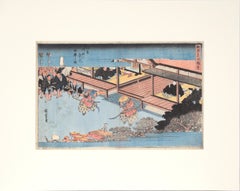
Sumiyoshi: Dengaku dance performed during an Onda ceremony - Woodblock Print
By Utagawa Hiroshige
Located in Soquel, CA
Sumiyoshi: Dengaku dance performed during an Onda ceremony - Woodblock Print
Bright woodblock print by Utagawa Hiroshige (Japanese, 1797-1858). In this scene, two dancers with swords and fans are facing each other, in the center of a courtyard. There are spectators surrounding them, including nobles in black clothing on a balcony.
Presented in a new off-white mat with foamcore backing.
Mat size: 16"H x 20"W
Paper size: 9.63"H x 14.5W"
Utagawa Hiroshige (1797-1858, sometimes called Ando Hiroshige) was the second of the two great masters of the Japanese landscape woodblock print...
Category
1830s Edo Figurative Prints
Materials
Ink, Rice Paper, Woodcut
$850
H 16 in W 20 in D 0.25 in
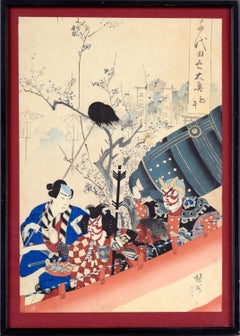
"First Horse Day, 1896" - Chiyoda Palace - Japanese Woodblock by Chikanobu Yoshu
By Toyohara Chikanobu
Located in Soquel, CA
"First Horse Day, 1896" - Chiyoda Palace - Japanese Woodblock by Chikanobu Yoshu
Colorful and expressive court scne by Toyohara Chikanobu,"Yoshu" (Japanese, 1838-1912).
This is the r...
Category
1890s French School Figurative Prints
Materials
Ink, Rice Paper, Woodcut
$875
H 15 in W 10.5 in D 0.5 in
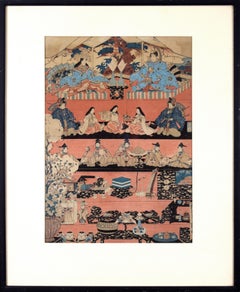
"Various Himochi" Wagashi Festival Japanese Woodblock Print by Utagawa Toyokuni
By Utagawa Toyokuni
Located in Soquel, CA
"Various Himochi" Wagashi Festival Japanese Woodblock Print by Utagawa Toyokuni
Rare oversized early 19th century 5-tiered woodblock by Utagawa Ichiyosai Toyokuni, (Japan, 1769-1825), a Japanese lord and wife oversee a sekku festival of food, music, and dolls or toys. '"oshi" is the first day of “Mi (Snake)” in the third month of the lunar calendar. This day, known in modern Japan as the Girls' Festival, originated in China as a form of purification ceremony in which water and drinking peach blossom wine were used to drive away evil. Many kinds of hishi-mochi appear in this picture of hina ningyo (dolls associated with Hinamatsuri, or the Girl’s Day) from Omochae.
The custom of eating special dishes at events throughout the year and at milestones in people's lives has existed since ancient times. This paragraph specifically focuses on the annual event called sekku, and life events that involve eating sweets. Joshi is the first day of “Mi (Snake)” in the third month of the lunar calendar. This day, known in modern Japan as the Girls' Festival, originated in China as a form of purification ceremony in which water and drinking peach blossom wine were used to drive away evil. According to the Keiso saijiki, in ancient China, on the third day of the third lunar month, people ate “ryuzetsuhan,” which is the juice of gogyo (Jersey cudweed) mixed with rice flour and nectar. In Japan, there is a record in the Heian period history book Nihon Montoku tenno jitsuroku [839-5] that it was an annual event to make kusamochi using gogyo on the third day of the third month of the lunar calendar, which may have been influenced by Chinese customs.
The tradition of eating kusamochi on the third day of the third month of the lunar calendar continued after that. By the Edo period, however, hishimochi had come to be used as a sweet to serve on the third day of the third month. A picture of a hishimochi is included in the Morisada manko , which we mentioned in Part 1. According to it, hishimochi in the Edo period were often three layers of green-white-green instead of the now common red-white-green. However, it is possible to see from our collection that not all hishimochi were made in this way. Omochae published in 1857, is a good example. Omochae is a type of ukiyoe print...
Category
1820s Edo Figurative Prints
Materials
Ink, Rice Paper, Woodcut
$1,850
H 26.75 in W 21.75 in D 0.25 in
Irving Amen" Venice Recalled " Hand-Signed
Numbered Color Woodcut Print
By Irving Amen
Located in Plainview, NY
Irving Amen (American, 1918–2011) Venice Recalled
Hand-Signed
Numbered Color Woodcut print
Edition: 26/75
Radiant and architecturally expressive, Venice Recalled showcases Ir...
Category
20th Century Expressionist Landscape Prints
Materials
Woodcut
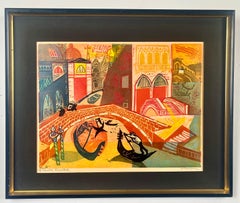
$800
H 24 in W 29 in D 1 in
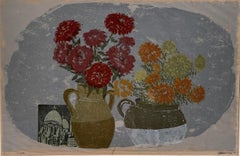
LA SALUTE
By Antonio Frasconi
Located in Portland, ME
Frasconi, Antonio (American, born Uruguay, 1919-2013). LA SALUTE. Color Woodcut, 1967. Edition of 20, Titiled, inscribed 10/20, signed, and dated, all in pencil. 22 1/4 x 34 1/2 inch...
Category
1960s Landscape Prints
Materials
Woodcut
More From This Seller
View All
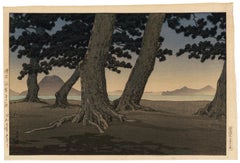
The Beach at Kaiganji in Sanuki Province
— Lifetime Impression
By Kawase Hasui
Located in Myrtle Beach, SC
Kawase Hasui, 'The Beach at Kaiganji in Sanuki Province (Sanuki Kaiganji no hama),' from the series Collected Views of Japan II, Kansai Edition (Nihon fûkei shû II Kansai hen), woodblock print, 1934. A very fine, atmospheric impression, with fresh colors; the full sheet, in excellent condition. Signed 'Hasui' with the artist’s seal 'Kawase', lower left. Published by Watanabe Shozaburo with the Watanabe ‘D’ seal indicating an early impression printed between 1931 - 1941. Stamped faintly 'Made in Japan' in the bottom center margin, verso.
Horizontal ôban; image size 9 3/8 x 14 1/4 inches (238 x 362 mm); sheet size approximately 10 5/16 x 15 1/2 inches ( 262 x 394 mm).
Collections: Art Institute of Chicago; Austrian Museum of Applied Arts (Vienna); Honolulu Museum of Art; Museum of Fine Arts, Boston; National Museum in Warsaw; University of Wisconsin-Madison.
ABOUT THE ARTIST
“I do not paint subjective impressions. My work is based on reality...I can not falsify...(but) I can simplify…I make mental impressions of the light and color at the time of sketching. While coloring the sketch, I am already imagining the effects in a woodblock print.” — Kawase Hasui
Hasui Kawase...
Category
1930s Showa Landscape Prints
Materials
Woodcut
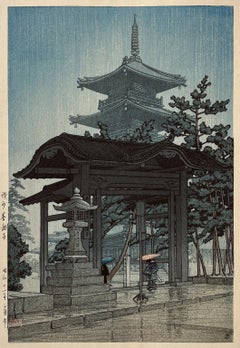
Zentsuji Temple in the Rain — from the series Collected Views of Japan II
By Kawase Hasui
Located in Myrtle Beach, SC
Kawase Hasui, 'Zentsuji Temple in the Rain' from the seres 'Collected Views of Japan II', color woodblock print, 1937. Signed Hasui in black ink, with the artist’s red seal Kawase, ...
Category
1930s Showa Landscape Prints
Materials
Woodcut
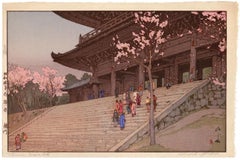
Chion-in Temple Gate
from
Eight Scenes of Cherry Blossoms
— Jizuri Seal
By Hiroshi Yoshida
Located in Myrtle Beach, SC
Hiroshi Yoshida, 'Chion-in Temple Gate (Sunset)' from the series 'Eight Scenes of Cherry Blossoms (Sakura hachi dai: Sakura mon)', color woodblock print, 1935. Signed in brush 'Yoshida' and in pencil 'Hiroshi Yoshida'. A superb, early impression, with fresh colors; the full sheet with margins, on cream Japan paper; an area of slight toning in the top right sheet corner, not affecting the image, otherwise in excellent condition. Marked with a jizuri (self-printed) seal, upper left margin. Self-published by the artist.
Image size 9 5/8 x 14 3/4 inches (444 x 375 mm); sheet size 10 7/8 x 16 inches (276 x 406 mm). Archivally sleeved, unmatted.
Provenance: M. Nakazawa, Tokyo.
Literature: Japanese Landscapes of the 20th Century (Hotei Publishing calendar), 2001, May.
Collections: Honolulu Museum of Art, Museum of Fine Arts, Boston.
ABOUT THE IMAGE
Located in Kyoto, Chionin is the main temple of the Jodo sect of Japanese Buddhism, one of the most popular Buddhist sects in Japan, having millions of followers. The Sanmon Gate, Chionin's entrance gate, standing 24 meters tall and 50 meters wide, it is the largest wooden temple gate in Japan and dates back to the early 1600s. Behind the gate, a broad set of stairs leads to the main temple grounds.
ABOUT THE ARTIST
Painter and printmaker Yoshida Hiroshi (1876-1950) is regarded as one of the greatest artists of the Japanese 'shin hanga' (New Print) movement.
Yoshida was born as the second son of Ueda Tsukane in Kurume, Fukuoka Prefecture, a schoolteacher from an old samurai family. In 1891 he was adopted by his art teacher Yoshida Kasaburo in Fukuoka and took his surname. In 1893 he went to Kyoto to study painting, and the following year to Tokyo to join Koyama Shotaro's Fudosha private school; he also became a member of the Meiji Fine Arts Society. These institutions taught and advocated Western-style painting, greatly influencing Yoshida’s artistic development.
In 1899 Yoshida had his first American exhibition at Detroit Museum of Art (now Detroit Institute of Art), making the first of many visits to the US and Europe. In 1902 he helped reorganize the Meiji Fine Arts Society, renaming it the Taiheiyo-Gakai (Pacific Painting...
Category
1930s Showa Figurative Prints
Materials
Woodcut
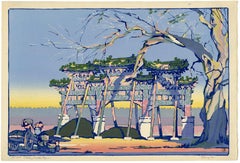
Peking - Paifang Gate
— Mid-Century Watanabe Color Woodcut
By Cyrus Le Roy Baldridge
Located in Myrtle Beach, SC
Cyrus Le Roy Baldridge, 'Peking '25', woodblock print, published 1926. Signed, titled, dated, and annotated 'No 124' in pencil. A fine impression, with fresh, undiminished colors; the full sheet, in excellent condition. Watanabe 6 mm seal, lower right, indicating an impression printed between 1945 and 1957. Archivally sleeved, unmatted.
Image size 9 5/8 x 14 5/16 inches; sheet size 10 7/16 x 15 3/8 inches.
ABOUT THE IMAGE
A 'paifang', also known as a 'pailou', is a traditional style of Chinese architectural arch or gateway structure. It has been theorized that the paifang gate architecture was influenced by Buddhist torana temple gates. Paifang are designed with traditional Chinese architectural motifs including multi-tiered roofs, prominent supporting posts, and gracefully arched openings.
This is an unusual ukiyo-e or 'floating world' woodcut published by Watanabe Shozaburo, Tokyo, in that the subject is of an early 20th-century scene in Peking, China.
ABOUT THE ARTIST
Cyrus Leroy Baldridge...
Category
1920s Showa Landscape Prints
Materials
Woodcut
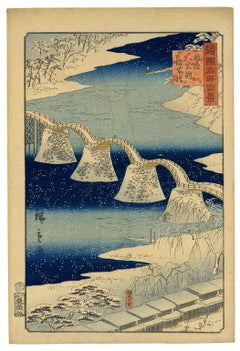
Kintai Bridge at Iwakuni in Suo Province (Suo iwakuni kintai-bashi), 1859
By Hiroshige II
Located in Myrtle Beach, SC
Utagawa Hiroshige II (1829-1869), 'Kintai Bridge at Iwakuni in Suo Province' (Suo iwakuni kintai-bashi), from the series 'One Hundred Views of Famous Pla...
Category
1850s Edo Landscape Prints
Materials
Woodcut
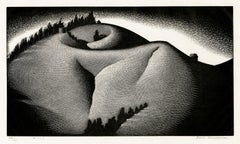
Hill
— American Modernism, California
By Paul Landacre
Located in Myrtle Beach, SC
Paul Landacre, 'Hill', wood engraving, 1936, edition 60 (only 54 printed); only 2 impressions printed in a second edition of 150. Signed, titled, and numbered '49/60' in pencil. Wien...
Category
1930s American Modern Landscape Prints
Materials
Woodcut
Still Thinking About These?
All Recently ViewedMore Ways To Browse
1950 Fashion Illustrations
Antique Poster Food
Arman Resin
Baroque Painting Angel
Botanical Print Rose
Bronze Hippo
Charles Cary Rumsey
Club 57
Colleen Browning
Communist Propaganda Poster
Crazy Watch
David Abelson
Dichroic Glass Sculpture
Dichroic Sculpture Art
Dick Van Dyke
Ferdinando Codognotto
Gay Bar
German U Boat