Want more images or videos?
Request additional images or videos from the seller
1 of 9
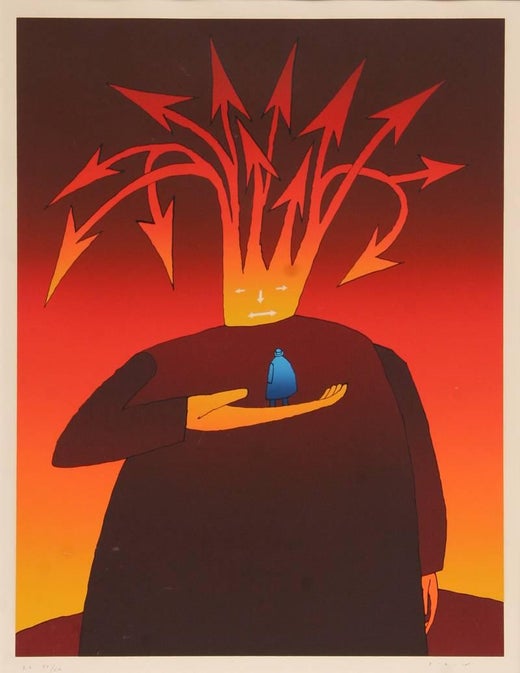
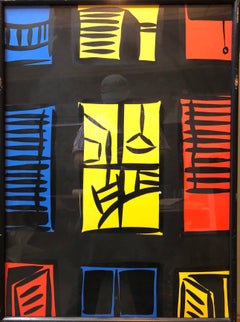
Jean Michel FolonMountains, Large Pencil Signed Modernist Silkscreen Belgian Illustrator
$1,600List Price
About the Item
- Creator:Jean Michel Folon (1934-2005, Belgian)
- Dimensions:Height: 35.5 in (90.17 cm)Width: 39.5 in (100.33 cm)
- Medium:
- Period:
- Condition:edition 130/200 actual size: 26.5 x 21.5.
- Gallery Location:Surfside, FL
- Reference Number:1stDibs: LU382628122
Jean Michel Folon
Jean-Michel Folon was a Belgian artist, illustrator, painter, and sculptor. He was born on 1 March 1934 in Uccle, Brussels, Belgium in 1934. He studied architecture at the Institut Saint-Luc. Jean-Michel Folon became internationally known in the 1960s for his illustrations of works by famous artists such as Franz Kafka and Boris Vian, and for his poster and advertisement designs. Among other things, the Olivetti (typewriter) advertising campaigns of the 1950s and 1960s are marked by his signature and have been included in numerous poster collections. In addition, he sketched a wide variety of newspaper and magazine articles (including Time magazine) with his illustrations accompanying the topics, which were often used as covers. His pictures are often laid out in a light and subtle as well as surrealistic-melancholic watercolour and pen technique. Folon's works, watercolours, sculptures and paintings have been exhibited in all the world's renowned museums.
About the Seller
4.9
Platinum Seller
Premium sellers with a 4.7+ rating and 24-hour response times
Established in 1995
1stDibs seller since 2014
1,843 sales on 1stDibs
Typical response time: 1 hour
Authenticity Guarantee
In the unlikely event there’s an issue with an item’s authenticity, contact us within 1 year for a full refund. DetailsMoney-Back Guarantee
If your item is not as described, is damaged in transit, or does not arrive, contact us within 7 days for a full refund. Details24-Hour Cancellation
You have a 24-hour grace period in which to reconsider your purchase, with no questions asked.Vetted Professional Sellers
Our world-class sellers must adhere to strict standards for service and quality, maintaining the integrity of our listings.Price-Match Guarantee
If you find that a seller listed the same item for a lower price elsewhere, we’ll match it.Trusted Global Delivery
Our best-in-class carrier network provides specialized shipping options worldwide, including custom delivery.You May Also Like
Nature Scene Art Reading travellers in Antalya’s forests Screenprint Figurative
Located in Winterswijk, NL
Dive into the fascinating world of art with this exceptional screen print by Engeln. In her artistic work, Engeln explores multifaceted themes inspired by travel observations that sh...
Category
21st Century and Contemporary Contemporary Landscape Prints
Materials
Paper, Screen
$534
H 16.54 in W 23.39 in
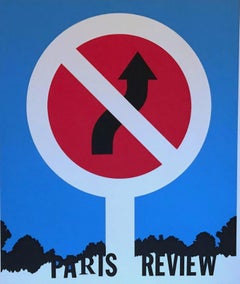
Paris Review (Lt. Ed. S/N) 1960s print by renowned Pop Artist abstract landscape
Located in New York, NY
Allan D'Arcangelo
Paris Review, 1964-5
Silkscreen
32 × 26 inches
Signed and numbered from the limited Edition of 150
pencil signed, numbered and dated on the front
Unframed
Published by the Paris Review, Printed by Steven Poleskie at Chiron Press, New York
Allan D'Arcangelo created this work in 1964 as a benefit print for the eponymous Paris Review magazine which invited some of the most famous artists of the era to contribute. Over the next decade, D'Arcangelo would continue to receive significant recognition in the art world - exhibiting at Fischbach and then Marlborough Galleries in Manhattan. He was well known for his paintings of the iconic American highway, along with his depictions of desolate, industrial landscapes. In her essay "Ghost on the Highway: Allan D'arcangelo's Haunting Americana", Alice Bucknell writes, "A born-and-bred New Yorker, D’Arcangelo spent his due time trawling through the Bible Belt of the Deep South and the dizzying expanse of the Southwest desert as well as the more expected outposts of New York and L.A. Taking a particular favor to the way acrylic interacts with light — how it avoids the glistening sheen of oil, and how the flatness of the medium masks the presence of the artist’s hand — D’Arcangelo teases out complex ideas of the highway’s reality and representation, its rampant commercialization and maddening isolation, as well as escapism and entrapment as two split personalities of American infrastructure space through his signature flattening one-point perspective. “My most profound experiences of landscape were looking through the windshield,” D’Arcangelo explained to Marco Livingstone in the spring of 1988 while the two drove from New York City to the artist’s studio in upstate New York: an idiosyncratic interview included in the exhibition catalogue. “The sky, the tree line and the pavement all have the same quality, and it has to do with our separation from the natural world.” Far from the sugar...
Category
1960s Pop Art Abstract Prints
Materials
Pencil, Screen
Cincinnati Contemporary Arts Center
By Shepard Fairey
Located in Palm Desert, CA
A print by Shepard Fairey. “Cincinnati Contemporary Arts Center” is a contemporary, popular culture offset print on paper in black, red, and white by American street artist Shepard F...
Category
21st Century and Contemporary Contemporary Landscape Prints
Materials
Screen
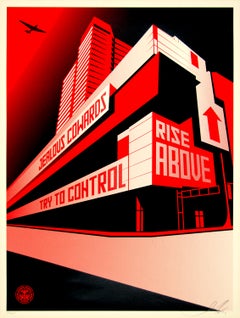
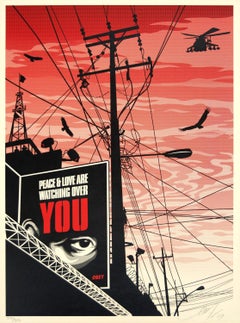
Big Brother City
By Shepard Fairey
Located in Palm Desert, CA
A print by Shepard Fairey. “Big Brother City” is a contemporary, popular culture offset print on paper in black, red, and white by American street artist Shepard Fairey. The artwork ...
Category
21st Century and Contemporary Contemporary Landscape Prints
Materials
Screen
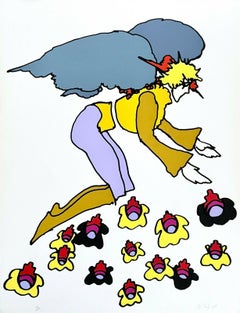
Flowering Angel, Peter Max
By Peter Max
Located in Fairfield, CT
Artist: Peter Max (1937)
Title: Flowering Angel
Year: 1973
Edition: 19/100, plus proofs
Medium: Silkscreen on Arches paper
Size: 30 x 23 inches
Condition: Good
Inscription: Signed an...
Category
1970s Pop Art Figurative Prints
Materials
Screen
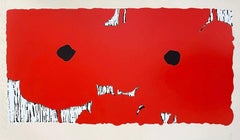
Red Poppies, Donald Sultan
By Donald Sultan
Located in Fairfield, CT
Artist: Donald Sultan (1951)
Title: Red Poppies
Year: 2012
Medium: Silkscreen with Tar & Flocking on Museum Board
Edition: 10/75, plus proofs
Size: 23 x 39 inches
Condition: Excellen...
Category
2010s Pop Art Still-life Prints
Materials
Tar, Screen
Flower Lady, Peter Max
By Peter Max
Located in Fairfield, CT
Artist: Peter Max (1937)
Title: Flower Lady
Year: 1989
Edition: 6/150, plus proofs
Medium: Silkscreen on Arches paper
Size: 31.5 x 40.5 inches
Condition: Excellent
Inscription: Signe...
Category
1980s Pop Art Figurative Prints
Materials
Screen
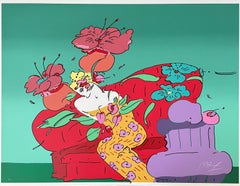
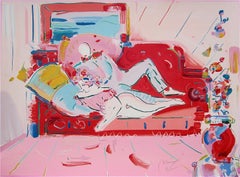
Degas
Woman, Peter Max
By Peter Max
Located in Fairfield, CT
Artist: Peter Max (1937)
Title: Degas & Woman
Year: 1990
Edition: 31/300, plus proofs
Medium: Silkscreen on Arches paper
Size: 26 x 36 inches
Condition: Excellent
Inscription: Signed...
Category
1990s Pop Art Figurative Prints
Materials
Screen
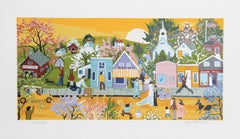
Blair
s Corner, Folk Art Screenprint by Kay Ameche
By Kay Ameche
Located in Long Island City, NY
Kay Ameche, American (1904 - 2005) - Blair's Corner, Year: 1981, Medium: Screenprint, signed and numbered in pencil, Edition: 200, AP 40, Image Size: 11.5 x 24 inches, Size: 17....
Category
1980s Folk Art Landscape Prints
Materials
Screen
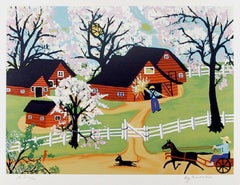
Apple Blossom Time, Folk Art Screenprint by Kay Ameche
By Kay Ameche
Located in Long Island City, NY
Kay Ameche, American (1904 - 2005) - Apple Blossom Time, Year: 1981, Medium: Screenprint, signed and numbered in pencil, Edition: 200, AP 40, Size: 22 in. x 26 in. (55.88 cm x 66...
Category
1980s Folk Art Landscape Prints
Materials
Screen
More From This Seller
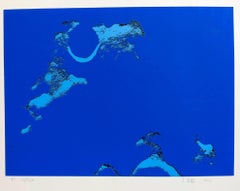
View AllLunar Landscape Abstract Signed Numbered Screenprint Blue
By Len Gittleman
Located in Surfside, FL
Gittleman’s Lunar Transformation is a series of ten vividly colored serigraphs created from black and white photographs taken during the Apollo 15 mission to the moon in 1971. Gittleman uses bright color to transform the craters and crevices of the lunar surface into vibrant abstractions which recall Abstract Expressionist painting. The strong graphic prints reflect the awe-inspiring nature of their source material. photographer, film maker, video producer, graphic designer, multimedia developer, clock maker and teacher. Guggenheim fellowship (graphics), Cannes Film festival, Academy Award Nomination. Work in permanent collections: MFA Boston, MOMA NY, Smithsonian Institution and Fogg Museum, Harvard. He exhibited with Gyorgi Kepes
Solo shows:
Lunar Transformations: 10 Serigraphs by Len Gittleman - Institute of Contemporary Arts, London
Group shows:
Integrated Vision: Science, Nature, and Abstraction in the Art of Len Gittleman and György Kepes - DeCordova Sculpture Park and Museum, Lincoln, MA
Abstract Photography in the Permanent Collection - DeCordova Sculpture Park and Museum, Lincoln, MA
Photography in Boston - 1955-1985 - DeCordova Sculpture Park and Museum, Lincoln, MA
Some Photographic Use of Color: Fred Berman...
Category
1970s Pop Art Abstract Prints
Materials
Screen
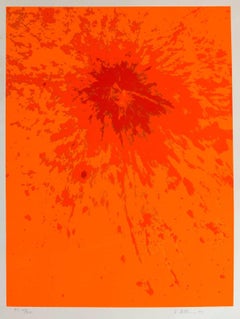
Lunar Landscape Abstract Signed Numbered Screenprint Orange
By Len Gittleman
Located in Surfside, FL
Handsigned edition of 250. Gittleman’s Lunar Transformation is a series of ten vividly colored serigraphs created from black and white photographs taken during the Apollo 15 mission to the moon in 1971. Gittleman uses bright color to transform the craters and crevices of the lunar surface into vibrant abstractions which recall Abstract Expressionist painting. The strong graphic prints reflect the awe-inspiring nature of their source material. photographer, film maker, video producer, graphic designer, multimedia developer, clock maker and teacher. Guggenheim fellowship (graphics), Cannes Film festival, Academy Award Nomination. Work in permanent collections: MFA Boston, MOMA NY, Smithsonian Institution and Fogg Museum, Harvard. He exhibited with Gyorgi Kepes
Solo shows:
Lunar Transformations: 10 Serigraphs by Len Gittleman - Institute of Contemporary Arts, London
Group shows:
Integrated Vision: Science, Nature, and Abstraction in the Art of Len Gittleman and György Kepes - DeCordova Sculpture Park and Museum, Lincoln, MA
Abstract Photography in the Permanent Collection - DeCordova Sculpture Park and Museum, Lincoln, MA
Photography in Boston - 1955-1985 - DeCordova Sculpture Park and Museum, Lincoln, MA
Some Photographic Use of Color: Fred Berman...
Category
1970s Pop Art Abstract Prints
Materials
Screen
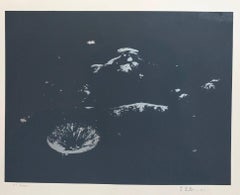
Lunar Landscape Abstract Signed Numbered Screenprint Black
By Len Gittleman
Located in Surfside, FL
Handsigned edition of 250. Gittleman’s Lunar Transformation is a series of ten vividly colored serigraphs created from black and white photographs taken during the Apollo 15 mission to the moon in 1971. Gittleman uses bright color to transform the craters and crevices of the lunar surface into vibrant abstractions which recall Abstract Expressionist painting. The strong graphic prints reflect the awe-inspiring nature of their source material. photographer, film maker, video producer, graphic designer, multimedia developer, clock maker and teacher. Guggenheim fellowship (graphics), Cannes Film festival, Academy Award Nomination. Work in permanent collections: MFA Boston, MOMA NY, Smithsonian Institution and Fogg Museum, Harvard. He exhibited with Gyorgi Kepes
Solo shows:
Lunar Transformations: 10 Serigraphs by Len Gittleman - Institute of Contemporary Arts, London
Group shows:
Integrated Vision: Science, Nature, and Abstraction in the Art of Len Gittleman and György Kepes - DeCordova Sculpture Park and Museum, Lincoln, MA
Abstract Photography in the Permanent Collection - DeCordova Sculpture Park and Museum, Lincoln, MA
Photography in Boston - 1955-1985 - DeCordova Sculpture Park and Museum, Lincoln, MA
Some Photographic Use of Color: Fred Berman...
Category
1970s Pop Art Abstract Prints
Materials
Screen
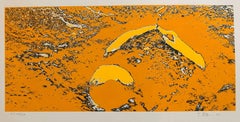
Lunar Landscape Abstract Signed Numbered Screenprint Yellow
By Len Gittleman
Located in Surfside, FL
Handsigned edition of 250. Gittleman’s Lunar Transformation is a series of ten vividly colored serigraphs created from black and white photographs taken during the Apollo 15 mission to the moon in 1971. Gittleman uses bright color to transform the craters and crevices of the lunar surface into vibrant abstractions which recall Abstract Expressionist painting. The strong graphic prints reflect the awe-inspiring nature of their source material. photographer, film maker, video producer, graphic designer, multimedia developer, clock maker and teacher. Guggenheim fellowship (graphics), Cannes Film festival, Academy Award Nomination. Work in permanent collections: MFA Boston, MOMA NY, Smithsonian Institution and Fogg Museum, Harvard. He exhibited with Gyorgi Kepes
Solo shows:
Lunar Transformations: 10 Serigraphs by Len Gittleman - Institute of Contemporary Arts, London
Group shows:
Integrated Vision: Science, Nature, and Abstraction in the Art of Len Gittleman and György Kepes - DeCordova Sculpture Park and Museum, Lincoln, MA
Abstract Photography in the Permanent Collection - DeCordova Sculpture Park and Museum, Lincoln, MA
Photography in Boston - 1955-1985 - DeCordova Sculpture Park and Museum, Lincoln, MA
Some Photographic Use of Color: Fred Berman...
Category
1970s Pop Art Abstract Prints
Materials
Screen
New York Night, Vintage Large Modernist Pop Art Sllkscreen
By Tom Slaughter
Located in Surfside, FL
5-color silkscreen on 2-ply museum board. edition of 60 hand signed and numbered.
American, 1955-2014
Born in 1955, Tom Slaughter’s career began in 1983 with his first exhibition at the Drawing Center in New York City. Since, he has had more than 20 solo shows in cities including San Francisco, Miami, London, Vancouver, Cologne and Fukuoka, Japan. Slaughter had worked extensively with master printer, Jean Russell at Durham Press, creating numerous limited edition prints using his signature bold primary colors. He worked as a printmaker in collaboration with Durham Press for 25 years, and his editions are included in the permanent collections of MoMA and the Whitney Museum of American Art.
He illustrated twelve children’s books, including “Boat Works,” “Do You Know Which Ones will Grow? ” – a 2011 Notable American Library Association book of the year – and collaborations with Marthe Jocelyn such as “ABC x 3,” “Same Same,” and “123.” These books have been translated into six languages. Slaughter also worked for the last ten seasons as the Art Director for the New Victory Theater. As a designer, he created everything from t-shirts to skateboard decks, beach towels as well as a line of wallpaper for Cavern Home. Tom Slaughter, an artist, designer, and illustrator, passed away on October 24, 2014. In his Pop-inflected prints, drawings, illustrations, paintings, and design work Tom Slaughter exudes a love of life. He makes few distinctions between his various artistic endeavors; “I paint, draw, cut paper, use a computer, and even an iPhone—it’s all the same hand,” he says. In a 2001 print...
Category
1990s Pop Art Figurative Prints
Materials
Screen
Modernist Silkscreen Screenprint
El Station, Interior
NYC Subway, WPA Artist
By Anthony Velonis
Located in Surfside, FL
screenprint printed in color ink on wove paper. New York City subway station interior.
Anthony Velonis (1911 – 1997) was an American painter and designer born in New York City who helped introduce the public to silkscreen printing in the early 20th century.
While employed under the federal Works Progress Administration, WPA during the Great Depression, Velonis brought the use of silkscreen printing as a fine art form, referred to as the "serigraph," into the mainstream. By his own request, he was not publicly credited for coining the term.
He experimented and mastered techniques to print on a wide variety of materials, such as glass, plastics, and metal, thereby expanding the field. In the mid to late 20th century, the silkscreen technique became popular among other artists such as Robert Rauschenberg and Andy Warhol.
Velonis was born into a relatively poor background of a Greek immigrant family and grew up in the tenements of New York City. Early on, he took creative inspiration from figures in his life such as his grandfather, an immigrant from the mountains in Greece, who was "an ecclesiastical painter, on Byzantine style." Velonis attended James Monroe High School in The Bronx, where he took on minor artistic roles such as the illustration of his high school yearbook. He eventually received a scholarship to the NYU College of Fine Arts, into which he was both surprised and ecstatic to have been admitted. Around this time he took to painting, watercolor, and sculpture, as well as various other art forms, hoping to find a niche that fit. He attended NYU until 1929, when the Great Depression started in the United States after the stock market crash.
Around the year 1932, Velonis became interested in silk screen, together with fellow artist Fritz Brosius, and decided to investigate the practice. Working in his brother's sign shop, Velonis was able to master the silkscreen process. He reminisced in an interview three decades later that doing so was "plenty of fun," and that a lot of technology can be discovered through hard work, more so if it is worked on "little by little."
Velonis was hired by Mayor LaGuardia in 1934 to promote the work of New York's city government via posters publicizing city projects. One such project required him to go on a commercial fishing trip to locations including New Bedford and Nantucket for a fortnight, where he primarily took photographs and notes, and made sketches. Afterward, for a period of roughly six months, he was occupied with creating paintings from these records. During this trip, Velonis developed true respect and affinity for the fishermen with whom he traveled, "the relatively uneducated person," in his words.
Following this, Velonis began work with the Public Works of Art Project (PWAP), an offshoot of the Civil Works Administration (CWA), where he was assigned to serve the different city departments of New York. After the formation of the federal Works Progress Administration, which hired artists and sponsored projects in the arts, he also worked in theater.
Velonis began working for the federal WPA in 1935. He kept this position until 1936 or 1938, at which point he began working in the graphic art division of the Federal Art Project, which he ultimately led. Under various elements of the WPA program, many young artists, writers and actors gained employment that helped them survive during the Depression, as well as contributing works that created an artistic legacy for the country.
When interviewed in December 1994 by the Library of Congress about his time in the WPA, Velonis reflected that he had greatly enjoyed that period, saying that he liked the "excitement" and "meeting all the other artists with different points of view." He also said in a later interview that "the contact and the dialogue with all those artists and the work that took place was just invaluable." Among the young artists he hired was Edmond Casarella, who later developed an innovative technique using layered cardboard for woodcuts.
Velonis introduced silkscreen printing to the Poster Division of the WPA. As he recalled in a 1965 interview: "I suggested that the Poster division would be a lot more productive and useful if they had an auxiliary screen printing project that worked along with them. And apparently this was very favorably received..."
As a member of the Federal Art Project, a subdivision of the WPA, Velonis later approached the Public Use of Arts Committee (PUAC) for help in "propagandizing for art in the parks, in the subways, et cetera." Since the Federal Art Project could not be "self-promoting," an outside organization was required to advertise their art more extensively. During his employment with the Federal Art Project, Velonis created nine silkscreen posters for the federal government.
Around 1937-1939 Velonis wrote a pamphlet titled "Technical Problems of the Artist: Technique of the Silkscreen Process," which was distributed to art centers run by the WPA around the country. It was considered very influential in encouraging artists to try this relatively inexpensive technique and stimulated printmaking across the country.
In 1939, Velonis founded the Creative Printmakers Group, along with three others, including Hyman Warsager. They printed both their own works and those of other artists in their facility. This was considered the most important silkscreen shop of the period.
The next year, Velonis founded the National Serigraph Society. It started out with relatively small commercial projects, such as "rather fancy" Christmas cards that were sold to many of the upscale Fifth Avenue shops...
Category
1980s American Modern Figurative Prints
Materials
Screen