Mezzotint Landscape Prints
to
4
10
8
Overall Width
to
Overall Height
to
10
2
1
13
19
18
16
11
3
9
6
2
1
2
9
5
4
5
3
2
1
1
1
1
1
1
1
1
1
18
18
4
2
18
Artist: Sir Frank Short
Artist: Christine Ravaux
Medium: Mezzotint
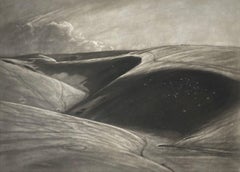
The Shadowed Valley.
Located in Plano, TX
Sir Frank Short, R.A., P.R.E. 1857-1945. The Shadowed Valley. 1927. Mezzotint. Hardie 128. 14 3/8 x 19 3/8 (sheet 19 x 24). A rich, glowing impression p...
Category
1920s Modern Mezzotint Landscape Prints
Materials
Mezzotint

$2,750 Sale Price
38% Off
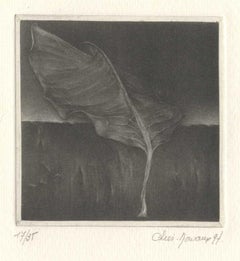
Leaf
Located in New Orleans, LA
This image is #17 of an edition of 35
Born in Charleroi, Belgium, Ravaux is an artist who mirrors her surroundings in the mezzotints she creates. She has portrayed the black hills t...
Category
1990s Contemporary Mezzotint Landscape Prints
Materials
Mezzotint
$90 Sale Price
25% Off
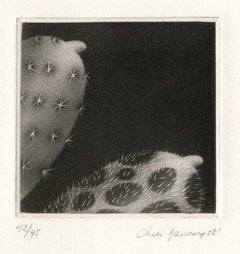
Prickles and Hairs - In Celebration of Pride Month
Located in New Orleans, LA
This is impression #12 from an edition of 45
Born in Charleroi, Belgium, Ravaux is an artist who mirrors her surroundings in the mezzotints she creates. She has portrayed the black ...
Category
Early 2000s Modern Mezzotint Landscape Prints
Materials
Mezzotint
$75 Sale Price
25% Off
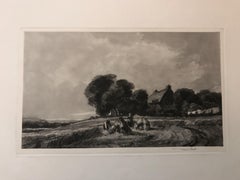
Cottage and Harvesters
Located in Plano, TX
Cottage and Harvesters (after a watercolor by Peter De Wint, 1784-1849). 1907. Mezzotint. Hardie 88. 6 5/8 x 10 11/16 (sheet 14 x 19 1/4). Edition 100. Housed in a 16 x 20 mat. A ver...
Category
Early 1900s Romantic Mezzotint Landscape Prints
Materials
Mezzotint
Une Fois Rien (Once Again / No Action)
Located in New Orleans, LA
Christine Ravaux created Une Fois Rien which is signed by pencil. This impression is #12 of 30
Shades of blacks and grays on a fallen branch create a pleasing pattern contrasted wi...
Category
Early 2000s Modern Mezzotint Landscape Prints
Materials
Mezzotint
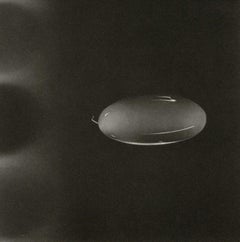
Bois Dormant
Located in New Orleans, LA
Shades of blacks and grays on a fallen branch create a pleasing pattern contrasted with grasses and ferns that lie beneath. Christine Ravaux is a Belgian artist who uses nature in m...
Category
Late 20th Century Modern Mezzotint Landscape Prints
Materials
Mezzotint
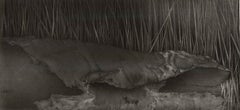
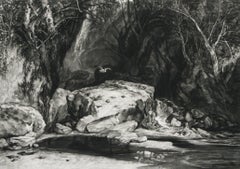
A Yorkshire Dell or The Heron’s Pool.
Located in Plano, TX
A Yorkshire Dell or The Heron’s Pool. (after J.M.W. Turner, R.A., 1775-1851.) Soft-ground etching and mezzotint. Hardie 85. mezzotint over etching on India paper printed on chine-co...
Category
Early 20th Century Romantic Mezzotint Landscape Prints
Materials
Mezzotint, Etching
$1,000 Sale Price
20% Off
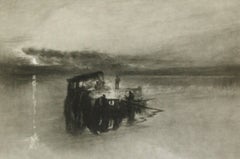
Timber Raft on the Rhine
Located in Plano, TX
Timber Raft on the Rhine (after the watercolor by J.M.W. Turner in the National Gallery). 1898. Mezzotint. Hardie 66. 8 1/4 x 11 11/16 (sheet 10 5/16 x 13 1/2). Edition 100. A rich, ...
Category
1890s Romantic Mezzotint Landscape Prints
Materials
Mezzotint
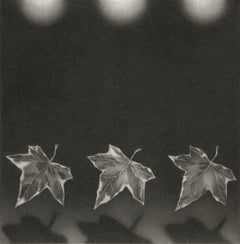
Three Leaves
Located in New Orleans, LA
Ravaux used the rule of threes to show 3 pieces of Christmas ivy floating below three sources of light. Christine Ravaux is a Belgian artist who uses nature in much of her work whic...
Category
Early 2000s Modern Mezzotint Landscape Prints
Materials
Mezzotint
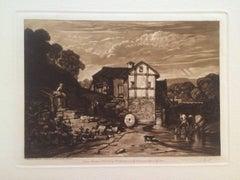
Water Mill
Located in Plano, TX
Water Mill (after the drawing by J.M.W. Turner, R.A., 1775-1851). 1885. Mezzotint. Hardie 3.ii. With the publication line. 7 x 10 1/8 (sheet 12 1/4 x 16 5/8...
Category
1880s Mezzotint Landscape Prints
Materials
Mezzotint
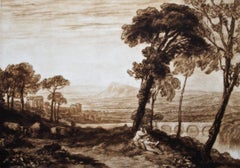
Scene in the Campagna
Located in Plano, TX
Scene in the Campagna, also known as Woman at a Tank and Hindu Ablutions. (after the drawing by J.M.W. Turner, R.A., 1775-1851.) 1886. Hardie 4.ii. Mezzotint. 8 1/2 x 11 3/8 (sheet 1...
Category
1880s Mezzotint Landscape Prints
Materials
Mezzotint
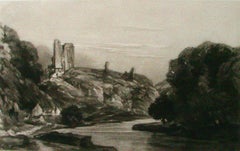
Knaresborough
Located in Plano, TX
Knaresborough (after a watercolor by Peter De Wint, 1784-1849). c. 1904. Mezzotint. Hardie catalog 80 state ii. 7 7/16 x 11 3/8 (sheet 13 3/8 x 18). A very rich impression, printed o...
Category
Early 1900s Impressionist Mezzotint Landscape Prints
Materials
Mezzotint
Mont et Mervale (Mountains and Wonder)
Located in New Orleans, LA
Born in Charleroi, Belgium, Christine Ravaux is an artist who mirrors her surroundings in the mezzotints she creates. She has portrayed the black hills that dot the landscape of the ...
Category
1990s Contemporary Mezzotint Landscape Prints
Materials
Mezzotint, Aquatint
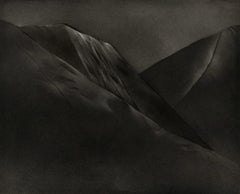
Deux Fois Rien (double or nothing)
Located in New Orleans, LA
Christine Ravaux created Deux Fois Rien which is signed by pencil. This impression is #12 of 30
Shades of blacks and grays on a fallen branch create a pleasing pattern contrasted w...
Category
Early 2000s Modern Mezzotint Landscape Prints
Materials
Mezzotint
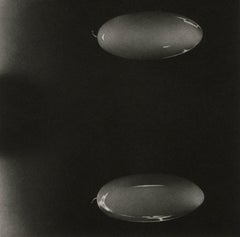
Peau d
Ame ( Body and Soul) - In Celebration of Pride Month
Located in New Orleans, LA
Stone and Press Gallery is excited to offer several works in celebration of the LGBTQ community.
Christine Ravaux created Peau d' Are which is signed by pencil. This impression is ...
Category
Early 2000s Modern Mezzotint Landscape Prints
Materials
Mezzotint
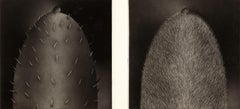
Contre Sens (against the Grain)
Located in New Orleans, LA
Christine Ravaux created this mezzotint which translates to the phase "against sense". This impression is #7 of 20
Shades of blacks and grays on a fallen branch create a pleasing p...
Category
Late 20th Century Modern Mezzotint Landscape Prints
Materials
Mezzotint
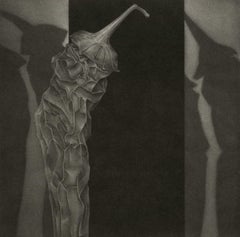
Branche Horizontale (horizontal branch lying on patterns of grass and leaves)
Located in New Orleans, LA
Shades of blacks and grays on a fallen branch create a pleasing pattern contrasted with grasses and ferns that lie beneath. Christine Ravaux is a Belgian artist who uses nature in m...
Category
Late 20th Century Modern Mezzotint Landscape Prints
Materials
Mezzotint
Bout a Bout (Translation: From End to End) - In Celebration of Pride Month
Located in New Orleans, LA
Stone and Press Gallery is excited to offer several works in celebration of the LGBTQ community.
Christine Ravaux created Bout a Bout which is signed by pencil. This impression is...
Category
Early 2000s Modern Mezzotint Landscape Prints
Materials
Mezzotint

Related Items
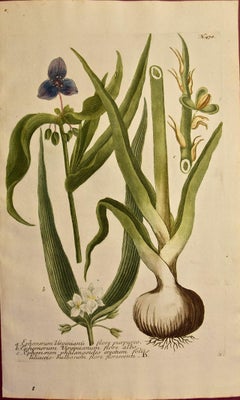
Spider Lily: An Original 18th C. Hand-colored Botanical Engraving by J. Weinmann
Located in Alamo, CA
This colored botanical mezzotint and line engraving finished with hand coloring by Johann Wilhelm Weinmann (1683-1741) is entitled "A. Ephemerum Virginianu flore Purpureo, B. Ephemer...
Category
Mid-18th Century Naturalistic Mezzotint Landscape Prints
Materials
Engraving, Mezzotint
19th century color lithograph figures cemetery willow tree memorial headstone
Located in Milwaukee, WI
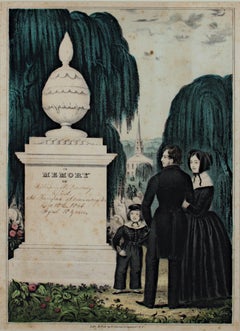
The present hand-colored lithograph was produced as part of the funeral and mourning culture in the United States during the 19th century. Images like this were popular as ways of remembering loved ones, an alternative to portraiture of the deceased. This lithograph shows a man, woman and child in morning clothes next to an urn-topped stone monument. Behind are additional putto-topped headstones beneath weeping willows, with a steepled church beyond. The monument contains a space where a family could inscribe the name and death dates of a deceased loved one. In this case, it has been inscribed to a young Civil War soldier:
William W. Peabody
Died at Fairfax Seminary, VA
December 18th, 1864
Aged 18 years
The young Mr. Peabody probably died in service for the Union during the American Civil War. Farifax Seminary was a Union hospital and military headquarters in Alexandria, Virginia. The hospital served nearly two thousand soldiers during the war time. Five hundred were also buried on the Seminary's grounds.
13.75 x 9.5 inches, artwork
23 x 19 inches, frame
Published before 1864
Inscribed bottom center "Lith. & Pub. by N. Currier. 2 Spruce St. N.Y."
Framed to conservation standards using 100 percent rag matting and TruVue Conservation Clear glass, housed in a gold gilded moulding.
Nathaniel Currier was a tall introspective man with a melancholy nature. He could captivate people with his piercing stare or charm them with his sparkling blue eyes. Nathaniel was born in Roxbury, Massachusetts on March 27th, 1813, the second of four children. His parents, Nathaniel and Hannah Currier, were distant cousins who lived a humble yet spartan life. When Nathaniel was eight years old, tragedy struck. Nathaniel’s father unexpectedly passed away leaving Nathaniel and his eleven-year-old brother Lorenzo to provide for the family. In addition to their mother, Nathaniel and Lorenzo had to care for six-year-old sister Elizabeth and two-year-old brother Charles. Nathaniel worked a series of odd jobs to support the family, and at fifteen, he started what would become a life-long career when he apprenticed in the Boston lithography shop of William and John Pendleton.
A Bavarian gentleman named Alois Senefelder invented lithography just 30 years prior to young Nat Currier’s apprenticeship. While under the employ of the brothers Pendleton, Nat was taught the art of lithography by the firm’s chief printer, a French national named Dubois, who brought the lithography trade to America.
Lithography involves grinding a piece of limestone flat and smooth then drawing in mirror image on the stone with a special grease pencil. After the image is completed, the stone is etched with a solution of aqua fortis leaving the greased areas in slight relief. Water is then used to wet the stone and greased-ink is rolled onto the raised areas. Since grease and water do not mix, the greased-ink is repelled by the moisture on the stone and clings to the original grease pencil lines. The stone is then placed in a press and used as a printing block to impart black on white images to paper.
In 1833, now twenty-years old and an accomplished lithographer, Nat Currier left Boston and moved to Philadelphia to do contract work for M.E.D. Brown, a noted engraver and printer. With the promise of good money, Currier hired on to help Brown prepare lithographic stones of scientific images for the American Journal of Sciences and Arts. When Nat completed the contract work in 1834, he traveled to New York City to work once again for his mentor John Pendleton, who was now operating his own shop located at 137 Broadway. Soon after the reunion, Pendleton expressed an interest in returning to Boston and offered to sell his print shop to Currier. Young Nat did not have the financial resources to buy the shop, but being the resourceful type he found another local printer by the name of Stodart. Together they bought Pendleton’s business.
The firm ‘Currier & Stodart’ specialized in "job" printing. They produced many different types of printed items, most notably music manuscripts for local publishers. By 1835, Stodart was frustrated that the business was not making enough money and he ended the partnership, taking his investment with him. With little more than some lithographic stones, and a talent for his trade, twenty-two year old Nat Currier set up shop in a temporary office at 1 Wall Street in New York City. He named his new enterprise ‘N. Currier, Lithographer’
Nathaniel continued as a job printer and duplicated everything from music sheets to architectural plans. He experimented with portraits, disaster scenes and memorial prints, and any thing that he could sell to the public from tables in front of his shop. During 1835 he produced a disaster print Ruins of the Planter's Hotel, New Orleans, which fell at two O’clock on the Morning of the 15th of May 1835, burying 50 persons, 40 of whom Escaped with their Lives. The public had a thirst for newsworthy events, and newspapers of the day did not include pictures. By producing this print, Nat gave the public a new way to “see” the news. The print sold reasonably well, an important fact that was not lost on Currier.
Nat met and married Eliza Farnsworth in 1840. He also produced a print that same year titled Awful Conflagration of the Steamboat Lexington in Long Island Sound on Monday Evening, January 18, 1840, by which melancholy occurrence over One Hundred Persons Perished. This print sold out very quickly, and Currier was approached by an enterprising publication who contracted him to print a single sheet addition of their paper, the New York Sun. This single page paper is presumed to be the first illustrated newspaper ever published.
The success of the Lexington print launched his career nationally and put him in a position to finally lift his family up. In 1841, Nat and Eliza had their first child, a son they named Edward West Currier. That same year Nat hired his twenty-one year old brother Charles and taught him the lithography trade, he also hired his artistically inclined brother Lorenzo to travel out west and make sketches of the new frontier as material for future prints. Charles worked for the firm on and off over the years, and invented a new type of lithographic crayon which he patented and named the Crayola. Lorenzo continued selling sketches to Nat for the next few years.
In 1843, Nat and Eliza had a daughter, Eliza West Currier, but tragedy struck in early 1847 when their young daughter died from a prolonged illness. Nat and Eliza were grief stricken, and Eliza, driven by despair, gave up on life and passed away just four months after her daughter’s death.
The subject of Nat Currier’s artwork changed following the death of his wife and daughter, and he produced many memorial prints and sentimental prints during the late 1840s. The memorial prints generally depicted grief stricken families posed by gravestones (the stones were left blank so the purchasers could fill in the names of the dearly departed). The sentimental prints usually depicted idealized portraits of women and children, titled with popular Christian names of the day.
Late in 1847, Nat Currier married Lura Ormsbee, a friend of the family. Lura was a self-sufficient woman, and she immediately set out to help Nat raise six-year-old Edward and get their house in order. In 1849, Lura delivered a son, Walter Black Currier, but fate dealt them a blow when young Walter died one year later. While Nat and Lura were grieving the loss of their new son, word came from San Francisco that Nat’s brother Lorenzo had also passed away from a brief illness. Nat sank deeper into his natural quiet melancholy. Friends stopped by to console the couple, and Lura began to set an extra place at their table for these unexpected guests. She continued this tradition throughout their lives.
In 1852, Charles introduced a friend, James Merritt Ives, to Nat and suggested he hire him as a bookkeeper. Jim Ives was a native New Yorker born in 1824 and raised on the grounds of Bellevue Hospital where his father was employed as superintendent. Jim was a self-trained artist and professional bookkeeper. He was also a plump and jovial man, presenting the exact opposite image of his new boss.
Jim Ives met Charles Currier through Caroline Clark, the object of Jim’s affection. Caroline’s sister Elizabeth was married to Charles, and Caroline was a close friend of the Currier family. Jim eventually proposed marriage to Caroline and solicited an introduction to Nat Currier, through Charles, in hopes of securing a more stable income to support his future wife.
Ives quickly set out to improve and modernize his new employer’s bookkeeping methods. He reorganized the firm’s sizable inventory, and used his artistic skills to streamline the firm’s production methods. By 1857, Nathaniel had become so dependent on Jims’ skills and initiative that he offered him a full partnership in the firm and appointed him general manager. The two men chose the name ‘Currier & Ives’ for the new partnership, and became close friends.
Currier & Ives produced their prints in a building at 33 Spruce Street where they occupied the third, fourth and fifth floors. The third floor was devoted to the hand operated printing presses that were built by Nat's cousin, Cyrus Currier, at his shop Cyrus Currier & Sons in Newark, NJ. The fourth floor found the artists, lithographers and the stone grinders at work. The fifth floor housed the coloring department, and was one of the earliest production lines in the country. The colorists were generally immigrant girls, mostly German, who came to America with some formal artistic training. Each colorist was responsible for adding a single color to a print. As a colorist finished applying their color, the print was passed down the line to the next colorist to add their color. The colorists worked from a master print displayed above their table, which showed where the proper colors were to be placed. At the end of the table was a touch up artist who checked the prints for quality, touching-in areas that may have been missed as it passed down the line. During the Civil War, demand for prints became so great that coloring stencils were developed to speed up production.
Although most Currier & Ives prints were colored in house, some were sent out to contract artists. The rate Currier & Ives paid these artists for coloring work was one dollar per one hundred small folios (a penny a print) and one dollar per one dozen large folios. Currier & Ives also offered uncolored prints to dealers, with instructions (included on the price list) on how to 'prepare the prints for coloring.' In addition, schools could order uncolored prints from the firm’s catalogue to use in their painting classes.
Nathaniel Currier and James Merritt Ives attracted a wide circle of friends during their years in business. Some of their more famous acquaintances included Horace Greeley, Phineas T. Barnum, and the outspoken abolitionists Rev. Henry Ward, and John Greenleaf Whittier (the latter being a cousin of Mr. Currier).
Nat Currier and Jim Ives described their business as "Publishers of Cheap and Popular Pictures" and produced many categories of prints. These included Disaster Scenes, Sentimental Images, Sports, Humor, Hunting Scenes, Politics, Religion, City and Rural Scenes, Trains, Ships, Fire Fighters, Famous Race Horses, Historical Portraits, and just about any other topic that satisfied the general public's taste. In all, the firm produced in excess of 7500 different titles, totaling over one million prints produced from 1835 to 1907.
Nat Currier retired in 1880, and signed over his share of the firm to his son Edward. Nat died eight years later at his summer home 'Lion’s Gate' in Amesbury, Massachusetts. Jim Ives remained active in the firm until his death in 1895, when his share of the firm passed to his eldest son, Chauncey.
In 1902, faced will failing health from the ravages of Tuberculosis, Edward Currier sold his share of the firm to Chauncey Ives...
Category
Mid-19th Century Romantic Mezzotint Landscape Prints
Materials
Watercolor, Lithograph
19th century color lithograph watercolor landscape figurative animal print
Located in Milwaukee, WI
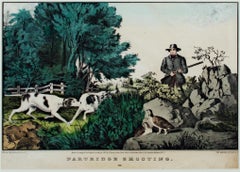
The present hand-colored lithograph presents the viewer with a hunting scene in a picturesque landscape. In the foreground, a man approaches two partridges as his two pointers prepare to flush them out. Beyond, a white fence draws our eyes to the homestead in the distance. Images like this one show how people in the United States were trying to identify themselves as a new nation in the North American landscape - as separate from their European counterparts but with similar similar and specific wildlife and magesties of nature. It also identifies hunting in this landscape as an American pastime.
9.25 x 12.5 inches, artwork
18.38 x 22 inches, frame
Entitled bottom center "Partridge Shooting...
Category
Mid-19th Century Romantic Mezzotint Landscape Prints
Materials
Watercolor, Lithograph
Delayed (Bus is late, the umbrella up and the long walk home thru rain begins)
By Art Werger
Located in New Orleans, LA
The bus is delayed and the night is cold and rainy as a lone woman raises her umbrella to brave the shadowy walk home after giving up on her ride She has just left the bus shelter a...
Category
21st Century and Contemporary American Modern Mezzotint Landscape Prints
Materials
Mezzotint

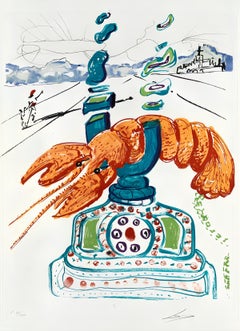
Téléphone-homard cybernétique (Michler/Löpsinger 822-831; Field 75-13)
Located in Fairfield, CT
Artist: Salvador Dali (1904-1989)
Title: Téléphone-homard cybernétique (Michler/Löpsinger 822-831; Field 75-13), Imaginations et Objets du Futur (Cybernetic lobster phone, Imaginatio...
Category
1970s Surrealist Mezzotint Landscape Prints
Materials
Mixed Media, Drypoint, Lithograph, Screen
$22,800 Sale Price
20% Off
H 28.5 in W 21 in
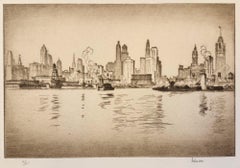
Chicago Skyline
Located in Middletown, NY
A beautiful turn-of-the-century lake view of Chicago by an American artist known for his Texas landscapes.
Etching with drypoint on watermarked Umbria laid paper with deckle edges, 7 1/4 x 10 7/8 inches (182 x 275 mm), full margins. Signed and numbered 4/25 in pencil, lower margin. In good condition with adhesive residue at the sheet edges on the verso, does not show through to the recto. A lovely Lake Michigan landscape...
Category
Early 20th Century American Modern Mezzotint Landscape Prints
Materials
Handmade Paper, Etching, Drypoint
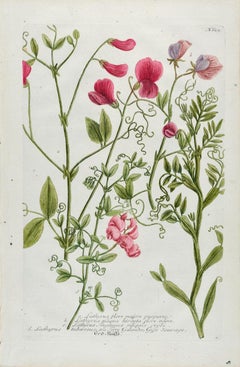
Flowering Sweet Pea: 18th Century Hand-colored Botanical Engraving by Weinmann
Located in Alamo, CA
This is an original antique colored botanical mezzotint and line engraving of flowering Red Sweet Peas which is finished with hand-coloring. It is entitled "Lathyrus Flore Majore Pur...
Category
Mid-18th Century Naturalistic Mezzotint Landscape Prints
Materials
Engraving, Mezzotint
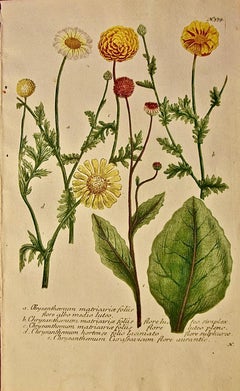
Chrysanthemum: An 18th Century Hand-colored Botanical Engraving by J. Weinmann
Located in Alamo, CA
This is an original antique hand-colored botanical mezzotint and line engraving of flowering Chrysanthemum matricaria plants. It is entitled "A. Chrysanthemum Matricarice Folus Flore...
Category
Mid-18th Century Naturalistic Mezzotint Landscape Prints
Materials
Engraving, Mezzotint
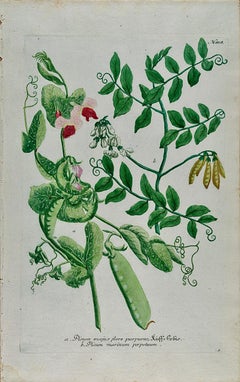
Flowering Garden Pea Plant: 18th C. Hand-colored Botanical Engraving by Weinmann
Located in Alamo, CA
This hand-colored botanical mezzotint and line engraving by Johann Wilhelm Weinmann (1683-1741) is entitled "Pisum Mapis flore pupureo". It is plate 818 in Weinmann's monumental publ...
Category
Mid-18th Century Naturalistic Mezzotint Landscape Prints
Materials
Engraving, Mezzotint
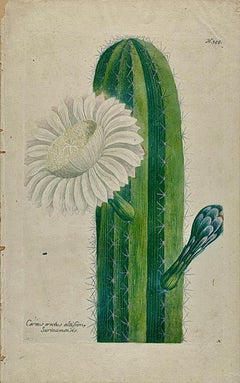
A Flowering Cactus Plant: 18th C. Hand-colored Botanical Engraving by Weinmann
Located in Alamo, CA
This hand-colored botanical mezzotint and line engraving by Johann Wilhelm Weinmann (1683-1741) is entitled "Cereus Erectus Altissimo Surinamensis (Cereus Cactus Plant)". It is plate...
Category
Mid-18th Century Naturalistic Mezzotint Landscape Prints
Materials
Engraving, Mezzotint
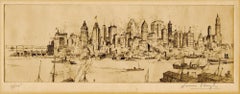
New York Skyline
By Louis H. Ruyl
Located in Middletown, NY
Etching with drypoint on cream wove paper with deckle edges, 4 3/8 x 12 3/4 inches (233 x 323 mm); sheet 9 1/2 x 15 3/4 inches (240 x 338 mm), full margins. Signed and numbered 4/75 ...
Category
Early 20th Century American Modern Mezzotint Landscape Prints
Materials
Handmade Paper, Etching, Drypoint
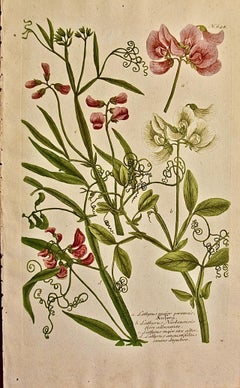
Flowering Pea Plant: An 18th C. Hand-colored Botanical Engraving by J. Weinmann
Located in Alamo, CA
This hand-colored botanical mezzotint and line engraving by Johann Wilhelm Weinmann (1683-1741) is entitled "A. Lathyrus Major Peremis Richern B. Lathyrus Narbonensis Flore Albescen...
Category
Mid-18th Century Naturalistic Mezzotint Landscape Prints
Materials
Engraving, Mezzotint
Previously Available Items
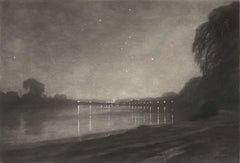
Orion over the Thames at Ranelagh
Located in Plano, TX
Orion over the Thames at Ranelagh. 1914. Mezzotint. Hardie 124. mage 11 x 16 (sheet 13 1/2 x 18 3/4). A rich, atmospheric impression printed on white wove paper with wide margins. This is one of Short's finest original mezzotints. Signed in pencil. Housed in a 20 x 24-inch archival mat
Hardie writes, page 41: "A bend of the river, with massive trees on the right; a star-lit sky with the constellation Orion to the right; Putney Bridge and Church, with lights on the bridge and riverbank reflecting in the still water. Signed in pencil. Housed in a 20 x 24-inch archival mat.
Orion is clearly visible in the night sky from November to February. Orion is in the southwestern sky if you are in the Northern Hemisphere or the northwestern sky if you are in the Southern Hemisphere. It is best seen between latitudes 85 and minus 75 degrees. Its right ascension is 5 hours, and its declination is 5 degrees.
Alnilam, Mintaka and Alnitak, which form Orion’s belt, are the most prominent stars in the Orion constellation. Betelgeuse, the second brightest star in Orion, establishes the right shoulder of the hunter. Bellatrix serves as Orion's left shoulder.
The Orion Nebula...
Category
Early 20th Century Modern Mezzotint Landscape Prints
Materials
18k Gold
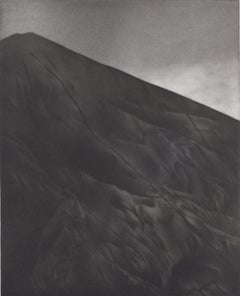
Mountain
Located in New Orleans, LA
Born in Charleroi, Belgium, Ravaux is an artist who mirrors her surroundings in the mezzotints she creates. She has portrayed see more . . .
the black hills that dot the landscape of...
Category
1990s Modern Mezzotint Landscape Prints
Materials
Mezzotint
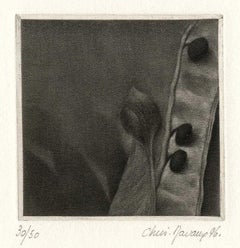
Pod
Located in New Orleans, LA
This is #30 from an edition of 50
Born in Charleroi, Belgium, Ravaux is an artist who mirrors her surroundings in the mezzotints she creates. She has portrayed see more . . .
the bl...
Category
1990s Mezzotint Landscape Prints
Materials
Mezzotint
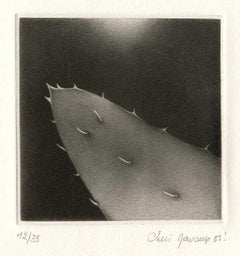
Thorns - In Celebration of Pride Month
Located in New Orleans, LA
Stone and Press Gallery is excited to offer several works in celebration of the LGBTQ community.
This is impression #12 of 35 impressions
Born in Charleroi, Belgium, Ravaux is an ...
Category
Early 2000s Modern Mezzotint Landscape Prints
Materials
Mezzotint
Surf II
Located in New Orleans, LA
Shades of blacks and grays to suggest the power of the surf. Christine Ravaux is a Belgian artist who uses nature in much of her work which is both hyper-realistic and abstract in p...
Category
Late 20th Century Modern Mezzotint Landscape Prints
Materials
Mezzotint
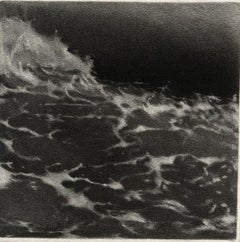
Trois Fois Rien (next to nothing or dirt cheap)
Located in New Orleans, LA
Christine Ravaux created Trois Fois Rien which is signed by pencil. This impression is #16 of 30
Shades of blacks and grays on a fallen branch create a pleasing pattern contrasted ...
Category
Early 2000s Modern Mezzotint Landscape Prints
Materials
Mezzotint
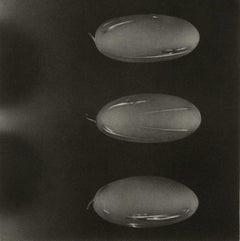
#95
Located in New Orleans, LA
Christine Ravaux created this mezzotint titled #95 which is signed by pencil. This impression is #3 of 30
Shades of blacks and grays on a fallen branch create a pleasing pattern co...
Category
Late 20th Century Modern Mezzotint Landscape Prints
Materials
Mezzotint
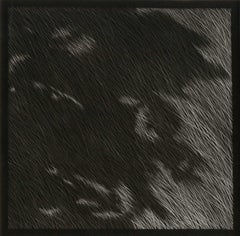
Vertical Branch
Located in New Orleans, LA
A single tree branch dominates the composition with grasses on either side.. Christine Ravaux is a Belgian artist who uses nature in much of her work which is both hyper-realistic a...
Category
Late 20th Century Modern Mezzotint Landscape Prints
Materials
Mezzotint
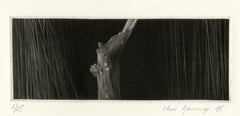
Surf I
Located in New Orleans, LA
Shades of blacks and grays to suggest the power of the surf. Christine Ravaux is a Belgian artist who uses nature in much of her work which is both hyper-realistic and abstract in p...
Category
Late 20th Century Modern Mezzotint Landscape Prints
Materials
Mezzotint
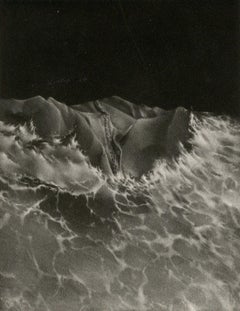
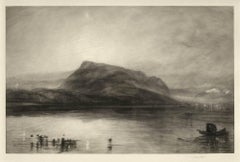
Mount Rigi at Dawn (The Alps in Central Switzerland. Boat and flock of birds)
Located in New Orleans, LA
A flock of birds and a small boat appear in the foreground of this dramatic landscape of Mount Rigi near Lake Lucerne. Considered by many to be Sir Frank Short...
Category
Early 20th Century Modern Mezzotint Landscape Prints
Materials
Mezzotint
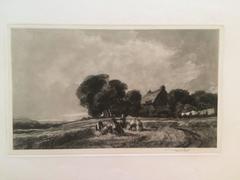
Cottage and Harvesters
Located in Plano, TX
Cottage and Harvesters (after a watercolor by Peter De Wint, 1784-1849). 1907. Mezzotint. Hardie 88. 6 5/8 x 10 11/16 (sheet 14 x 19 1/4). Edition 100. A very rich impression, printe...
Category
Early 1900s Impressionist Mezzotint Landscape Prints
Materials
Mezzotint
Mezzotint landscape prints for sale on 1stDibs.
Find a wide variety of authentic Mezzotint landscape prints available on 1stDibs. While artists have worked in this medium across a range of time periods, art made with this material during the 20th Century is especially popular. There are many well-known artists whose body of work includes ceramic sculptures. Popular artists on 1stDibs associated with pieces like this include David Lucas, Frederick Mershimer, Art Werger, and Christine Ravaux. Frequently made by artists working in the Modern, Impressionist, all of these pieces for sale are unique and many will draw the attention of guests in your home. Not every interior allows for large Mezzotint landscape prints, so small editions measuring 10 inches across are also available Prices for landscape prints made by famous or emerging artists can differ depending on medium, time period and other attributes. On 1stDibs, the price for these items starts at $200 and tops out at $2,750, while the average work can sell for $375.