Paper Landscape Prints
to
25
196
23
23
24
39
Overall Width
to
Overall Height
to
1,060
305
133
124
66
41
39
35
26
18
10
5
4
3
73
34
5
3
3
2
32
218
53
2
1
15
10
4
11
15
13
24
2
1
163
137
5
125
86
85
40
40
38
33
29
27
27
26
25
25
23
19
17
17
15
15
14
2,549
1,206
305
288
257
21
107
205
76
Style: Modern
Medium: Paper
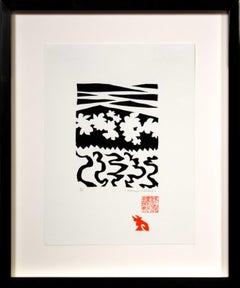
Field
original abstract linocut in black by Wisconsin artist Schomer Lichtner
Located in Milwaukee, WI
'Field' is an original linocut by Wisconsin-based artist Schomer Lichtner. The composition presents fields of flowers, trees and grasses below a cloudy sky, but rendered with Lichtner's quintessential abstract sensibilities. This print is one from a series that each depict abstracted subjects in black silhouette, taking pleasure in the materiality of the linocut technique. The free forms of the plants resemble the lyrical mid-century works of the French artist Henri Matisse, which combined with these material concerns demonstrate Lichter's modern sensibilities. The prints from this series are unusual because of how below the image, Lichtner also includes his Chinese seal and a linocut remarque of a cow, each of which act as an additional signature of the artist on the artwork.
Linocut in black and red on Permalife white wove paper
4.5 x 6 inches, image
11.5 x 8.75 inches, sheet
16.5 x 13.63 inches, frame
Signed in pencil, below image, lower right.
Edition 1/100 in pencil, below image, lower left.
Chinese signature stamp in red, below image, lower right.
Remaque of a cow in red, below image, lower right.
Permalife watermark to paper.
Framed to conservation standards in a shadow-box style mounting, using 100 percent rag matting, museum glass, and housed in a silver-finish wood moulding.
Overall excellent condition with no creases or discoloration.
Milwaukee artist Schomer Lichtner was well known for his whimsical cows and ballerinas and abstract imagery. He and his late wife Ruth Grotenrath, both well-known Wisconsin artists, began their prolific careers as muralists for WPA projects, primarily post offices.
Lichtner also painted murals for industry and private clients. Schomer was a printmaker and produced block prints, lithographs, and serigraph prints. His casein (paint made from dairy products) and acrylic paintings are of the rural Wisconsin landscape and farm animals. He became interested in cows when he and Ruth spent summers near Holy Hill in Washington County. According to David Gordon, director of the Milwaukee Art Museum, Schomer Lichtner had a tremendous joie de vivre and expressed it in his art.
Schomer Lichtner was nationally known for his whimsical paintings and sculptures of black- and white-patterned Holstein cows...
Category
Late 20th Century American Modern Paper Landscape Prints
Materials
Black and White, Paper, Linocut
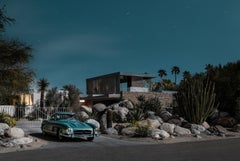
Mid Century Mercedes Benz SL, Midnight Modern Series Contemporary Photography
Located in Brooklyn, NY
Palm Springs Mid Century Modern Architecture, Vintage Classic Mercedes Benz SL, Palm Desert, Limited Series.
Archival Inkjet Print on ...
Category
2010s American Modern Paper Landscape Prints
Materials
Cotton, Archival Ink, Photographic Paper
Nagakin Capsule Tower Japan - A Modern Architecture Noir Photograph
Located in Brooklyn, NY
"Nihon Noir arose from my fascination with Tokyo and my desire to translate the feeling that struck me on my first visit, that somehow you have been transported to a parallel future ...
Category
2010s Modern Paper Landscape Prints
Materials
Archival Ink, Archival Paper, Photographic Paper, Color, Archival Pigment

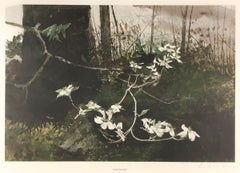
Dogwood
By Andrew Wyeth
Located in Missouri, MO
Andrew Wyeth
"Dogwood" 1983
Collotype
Ed. 115/300
Signed and Numbered Lower Right
Image Size: 21 x 28 3/4 inches
Framed Size: approx. 29 x 36.5 inches
A painter of landscape and figure subjects in Pennsylvania and Maine, Andrew Wyeth became one of the best-known American painters of the 20th century. His style is both realistic and abstract, and he works primarily in tempera and watercolor, often using the drybrush technique.
He is the son of Newell Convers and Carolyn Bockius Wyeth of Chadds Ford, Pennsylvania, and was home-schooled because of delicate health. His art instruction came from his famous-illustrator father, who preached the tying of painting to life--to mood and to essences and to capturing the subtleties of changing light and shadows.
The Wyeth household was a lively place with much intellectual and social stimulation. Because of the prominence of N.C. Wyeth, persons including many dignitaries came from all over the country to visit the family. Andrew's sisters Carolyn and Henriette became noted artists as did his brother-in-law, Peter Hurd. The non-art oriented brother, Nathaniel Wyeth...
Category
1980s American Modern Paper Landscape Prints
Materials
Paper, Lithograph

Price Upon Request
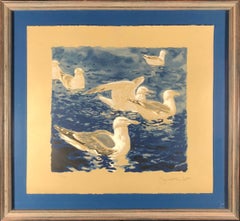
Herring Gulls
By Jamie Wyeth
Located in Missouri, MO
Jamie Wyeth
"Herring Gulls" 1978
Color Lithograph
Signed Lower Right
Numbered Lower Left 149/300
Born in 1946, James Browning Wyeth came of age when the meaning of patriotism was clouded by the traumas of the Vietnam War and the scandals of Watergate. Working in an era of turmoil and questioning of governmental authority, he did art that encompassed both marching off to war and marching in protest.
One of James's early masterworks, Draft Age (1965) depicts a childhood friend as a defiant Vietnam-era teenager resplendent in dark sunglasses and black leather jacket in a suitably insouciant pose.
Two years later Wyeth painstakingly composed a haunting, posthumous Portrait of President John F. Kennedy (1967) that seems to catch the martyred Chief Executive in a moment of agonized indecision. As Wyeth Center curator Lauren Raye Smith points out, Wyeth "did not deify the slain president, [but] on the contrary made him seem almost too human."
Based on hours of study and sketching of JFK's brothers Robert and Edward -
documented by insightful studies in the exhibition - the final, pensive portrait seemed too realistic to family members and friends. "His brother Robert," writes Smith in the exhibition catalogue, "reportedly felt uneasy about this depiction, and said it reminded him of the President during the Bay of Pigs invasion."
In spite of these misgivings, James's JFK likeness has been reproduced frequently and is one of the highlights of this show. The poignancy, appeal and perceptiveness of this portrait, painted when the youngest Wyeth was 21 years old, makes one wish he would do more portraits of important public figures.
James himself feels he is at his best painting people he knows well, as exemplified by his vibrant Portrait of Jean Kennedy Smith (1972), which captures the vitality of the slain President's handsome sister.
He did paint a portrait of Jimmy Carter for the January 1977 man-of-the-year cover of Time magazine, showing the casually dressed President-elect as a straightforward character posed under a flag-draped water tower next to the family peanut plant in Plains, Ga. James recalls that Carter had one Secret Service agent guarding him as he posed outdoors, a far cry from the protection our Chief Executives require today.
As a participating artist in the "Eyewitness to Space" program organized by the National Aeronautics and Space Administration in collaboration with the National Gallery of Art in the late 1960s, Wyeth deftly recorded in a series of watercolors his eyewitness observations of dramatic spacecraft launchings and more mundane scenes associated with the space program.
Commissioned by Harper's Magazine to cover the 1974 congressional hearings and trials of Watergate figures, James Wyeth executed a series of perceptive and now evocative sketches that recall those dark chapters in our history. Memorable images include a scowling John Ehrlichman, a hollow-eyed Bob Haldeman, an owlish Charles Colson, a focused Congressman Peter Rodino, a grim visaged Father/ Congressman Robert Drinan, and vignettes of the press and various courtroom activities. An 11-by-14-inch pencil sketch of the unflappable Judge John Sirica is especially well done. These "images are powerful as historical records," observes Smith, "and as lyrically journalistic impressions of events that changed the nation forever."
Wyeth's sketch of early-morning crowds lined up outside the Supreme Court
building hoping to hear the Watergate case, with the ubiquitous TV cameramen looking on, is reminiscent of recent scenes as the high court grappled with the Bush-Gore contest.
The Wyeth family penchant for whimsy and enigmatic images is evident in Islanders (1990), showing two of James's friends, wearing goofy hats, sitting on the porch of a small Monhegan Island (Me.) cottage draped with a large American flag. Mixing the serious symbolism of Old Glory with the irreverent appearance of the two men, James has created a puzzling but interesting composition.
Painting White House...
Category
1970s American Modern Paper Landscape Prints
Materials
Lithograph, Paper
Price Upon Request
Paper landscape prints for sale on 1stDibs.
Find a wide variety of authentic Paper landscape prints available on 1stDibs. While artists have worked in this medium across a range of time periods, art made with this material during the 21st Century is especially popular. If you’re looking to add landscape prints created with this material to introduce a provocative pop of color and texture to an otherwise neutral space in your home, the works available on 1stDibs include elements of blue, purple, orange, green and other colors. There are many well-known artists whose body of work includes ceramic sculptures. Popular artists on 1stDibs associated with pieces like this include Frank Schott, Kind of Cyan, Addison Jones, and Clare Halifax. Frequently made by artists working in the Contemporary, Modern, all of these pieces for sale are unique and many will draw the attention of guests in your home. Not every interior allows for large Paper landscape prints, so small editions measuring 0.01 inches across are also available