Parchment Paper Landscape Prints
to
1
Overall Width
to
Overall Height
to
1
1
1
1
1
1,008
6,569
3,732
2,729
1,444
1
Medium: Parchment Paper
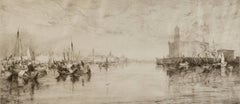
19th century etching black and white seascape print boats water buildings signed
By Thomas Moran
Located in Milwaukee, WI
This black and white etching by American painter and print maker of the Hudson River School in New York: Thomas Moran, is a rare Klackner #53 of the catalogue raisonné, depicting "The Harbor of Vera...
Category
1880s Hudson River School Parchment Paper Landscape Prints
Materials
Parchment Paper, Etching
Related Items
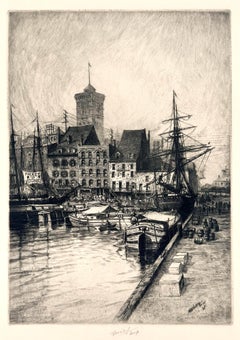
Coenties Slip
Located in Middletown, NY
Lower Manhattan and the Seaport as the artist imagined it would have appeared before 1835.
New York: 1907.
Etching with drypoint on Japon paper, 13 7/8 x 9 3/4 inches (353 x 248 mm...
Category
Late 19th Century American Modern Parchment Paper Landscape Prints
Materials
Etching, Drypoint, Handmade Paper

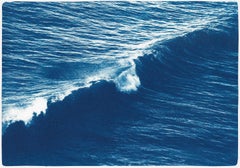
Venice Beach Seascape, Long Wave, Nautical Scene in Blue Tones, Limited Edition
By Kind of Cyan
Located in Barcelona, ES
This is an exclusive handprinted limited edition cyanotype.
This beautiful cyanotype is titled "Long Wave in Venice Beach" and it shows an outstanding wave in one of the most iconic ...
Category
2010s Realist Parchment Paper Landscape Prints
Materials
Paper, Emulsion, Watercolor, Engraving, Etching, Monotype
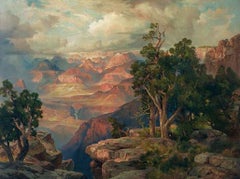
THOMAS MORAN Grand Canyon of Arizona from Hermit Rim Road 1912 Chromolithograph
By Thomas Moran
Located in Rancho Santa Fe, CA
IN PRISTINE CONDITION.
A color Chromolithograph published by the Atchison, Topeka and Santa Fe Railroad in 1912 after the original oil painting, “Gr...
Category
1910s Hudson River School Parchment Paper Landscape Prints
Materials
Paper, Lithograph
Ceignac (Aveyron)
Located in Middletown, NY
Etching on antique cream laid paper with a deckle edge and an unidentified round watermark with an arm holding a torch, 3 1/2 x 5 5/8 inches (89 x 144 mm); sheet 5 3/4 x 8 3/8 inches...
Category
Mid-20th Century American Modern Parchment Paper Landscape Prints
Materials
Handmade Paper, Laid Paper, Etching
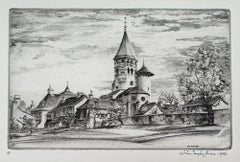
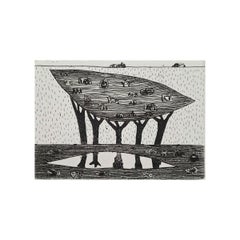
Childhood sky - 21st Century, Contemporary Etching, Black and White
Located in Warsaw, PL
JERZY DMITRUK (born in 1960) He studied at the Academy of Fine Arts at the Faculty of Paintings and Graphics. Dmitruk graduated in 1986 from the atelier of professor Juliusz Joniak a...
Category
21st Century and Contemporary Other Art Style Parchment Paper Landscape Prints
Materials
Paper, Etching
$356
H 3.55 in W 4.93 in
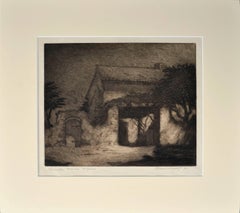
Sherman Rose House, Monterey California - Signed 1920
s Landscape Etching
Located in Soquel, CA
Beautiful early 20th Century etching on vellum of the Monterey Bonifacio Adobe known as The Old Sherman Rose House, with climbing roses, by Ferdinand Burgdorff (American, (1881 - 1975), 1923. As in many of the artist's works, this piece conveys a mysterious and dark mood.
Artwork has been professionally conserved.
Titled, signed and dated lower edge.
Archival mat and backing.
Image size: 9.75"H x 11.75"W.
Born in Cleveland, Ohio, Ferdinand Burgdorff studied at the Cleveland School of Art and in Paris with Rene Menard and Florence Este...
Category
1920s American Realist Parchment Paper Landscape Prints
Materials
Paper, Etching
$1,500
H 17 in W 18.75 in D 0.25 in
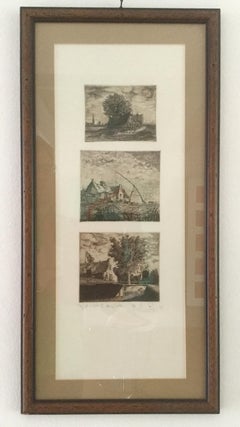
Village Triptych - XX century, Figurative Etching Print, very small edition 2/X
Located in Salzburg, AT
The graphic is already framed.
About Andrzej Juchniewicz - 1967–1972 Secondary School of Fine Arts in Gdynia-Orłowo. 1978–1983 studies at the Acad...
Category
1990s Contemporary Parchment Paper Landscape Prints
Materials
Paper, Etching
$892
H 21.66 in W 10.63 in D 0.79 in
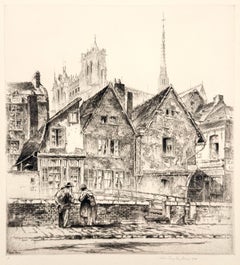
Amiens; The Cathedral of Notre Dame, from the Lower Town
Located in Middletown, NY
A superb impression from the artist's own collection.
Etching with drypoint on watermarked FJ Head & Co. handmade laid paper, 10 3/4 x 9 7/8 inches (272 x 252 mm); sheet 18 1/8 x 14 ...
Category
Early 20th Century American Modern Parchment Paper Landscape Prints
Materials
Handmade Paper, Laid Paper, Etching, Drypoint
$1,700
H 10.71 in W 9.93 in
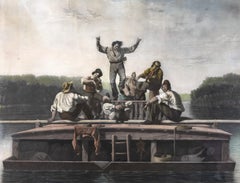
The Jolly Flat Boat Men
By George Caleb Bingham
Located in Missouri, MO
The Jolly Flat Boat Men, 1847
After George Caleb Bingham (American, 1811-1879)
Engraved by Thomas Doney (French, active New York 1844-1849)
Engraving with Hand-Coloring
Published by The American Art-Union, New York (1838-1851)
Printed by Powell and Co.
18 x 24 inches
32 x 38 inches with frame
In 1847, the American Art-Union purchased Bingham’s painting "The Jolly Flat Boat Men" (1846; National Gallery of Art) directly from the artist. The subscription-based organization, founded in 1838 as the Apollo Association, boasted nearly ten-thousand members at this date. For an annual fee of five dollars, each received a large reproductive engraving and was entered in a lottery to win original artworks exhibited at the Art-Union’s Free Gallery. Aimed at educating the public about contemporary American art, the organization developed an impressive distribution network that reached members in every state. The broad circulation of the Art-Union's print helped to establish Bingham's reputation and made his river scene famous.
Born in Augusta County, Virginia in the Shenandoah River Valley, George Caleb Bingham became known for classically rendered western genre, especially Missouri and Mississippi River scenes of boatmen bringing cargo to the American West and politicians seeking to influence frontier life. One of his most famous river genre paintings was The Jolly Flatboatmen completed in several versions in 1846. This first version of this painting is in the Manoogian Collection at the National Gallery of Art. Fame resulted for this work when it was exhibited in New York at the American Art Union whose organizers made an engraving of 10,000 copies and distributed it to all of their members. Paintings such as Country Politician (1849) and County Election (1852) and Stump Speaking (1854) reflected Bingham's political interests.
In 1819, as an eight-year old, he moved to Boon's Lick, Missouri with his parents and grandfather who had been farmers and inn keepers in the Shenandoah Valley near Rockingham, Virginia. Reportedly as a child there, he took every opportunity to escape supervision to travel the River and watch the marine activity.
His father died in 1827, when his son was sixteen years old. His mother had encouraged his art talent, but art lessons were not easily obtainable. In order to earn money, he apprenticed to a cabinet maker but determined to become an artist. By 1835, he had a modest reputation as a frontier painter and successfully charged twenty dollars per portrait in St. Louis. "His portraits had become standard decorations in prosperous Missouri homes." (Samuels 46). In 1836, he moved to Natchez, Mississippi and there had the same kind of career, only was able to charge forty dollars per portrait.
He remained largely self taught until 1837, when he, age 26 and using the proceeds from his portraiture, studied several months at the Pennsylvania Academy of the Fine Arts. He later said that he learned much of his atmospheric style and classically balanced composition by copying paintings in collections in St. Louis and Philadelphia and that among his most admired painters were Thomas Cole, John Vanderlyn, and William Sidney Mount. Between 1856 and 1859, Bingham traveled back and forth to Dusseldorf, Germany, where he studied the work of genre painters. Some critics think these influences were negative on his work because during that time period, he abandoned his luminist style that had brought him so much public affirmation.
Bingham credited Chester Harding (1792-1866) as being the earliest and one of the most lasting influences on his work. Harding,a leading portraitists when Bingham was a young man, had a studio in Franklin, near Bingham's home town. In 1822, when Bingham was ten years old, he watched Harding finish a portrait of Daniel Boone. Bingham recalled that watching Harding with the Boone portrait was a lasting inspiration and that it was the first time he had ever seen a painting in progress. Harding suggested to Bingham that he begin doing portraiture by finding subjects in the river men, which, of course, opened the subject matter that established fame and financial success for Bingham. Harding also encouraged Bingham to copy with paint engravings. He later painted two portraits of Boone but, contrary to the assertions of some scholars, he did not do Boone portraits in the company of Harding.
Bingham's portraits of Boone are not located, but one of them, a wood signboard for a hotel in Boonville circa 1828 to 1830, showed a likeness of Boone in buckskin dress...
Category
1840s Hudson River School Parchment Paper Landscape Prints
Materials
Engraving
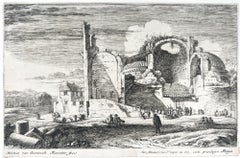
A Distribution of Bread to the Poor
Located in Middletown, NY
Utrecht: Herman van Swanevelt, c1650. Etching on cream laid paper, 6 3/4 x 10 3/4 (172 x 273 mm); sheet 7 1/4 x 11 inches (185 x 280 mm), margins. In good condition with some minor s...
Category
Early 17th Century Old Masters Parchment Paper Landscape Prints
Materials
Laid Paper, Etching
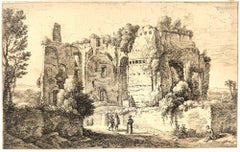
Landscape with a Cardinal
Located in Middletown, NY
Utrecht: Herman van Swanevelt, c1650.
Etching on cream laid paper, 6 3/4 x 10 3/4 (172 x 273 mm), the full sheet, thread margins (trimmed at the platemark). In good condition with s...
Category
Early 17th Century Old Masters Parchment Paper Landscape Prints
Materials
Laid Paper, Etching
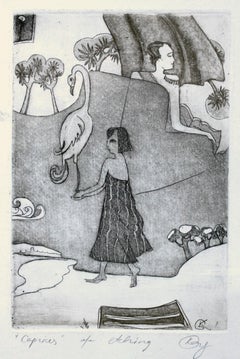
Caprices. Paper, etching, 15.5x10.5 cm
Located in Riga, LV
Caprices. Paper, etching, 15.5x10.5 cm
"Caprices" is an etching artwork on paper that presents a series of whimsical and imaginative scenes or subjects. Through the intricate lines...
Category
Early 2000s Surrealist Parchment Paper Landscape Prints
Materials
Paper, Etching
$228 Sale Price
20% Off
H 6.11 in W 4.14 in D 0.04 in
Parchment Paper landscape prints for sale on 1stDibs.
Find a wide variety of authentic Parchment Paper landscape prints available on 1stDibs. While artists have worked in this medium across a range of time periods, art made with this material during the 19th Century is especially popular. There are many well-known artists whose body of work includes ceramic sculptures. Popular artists on 1stDibs associated with pieces like this include and Thomas Moran. Not every interior allows for large Parchment Paper landscape prints, so small editions measuring 0.01 inches across are also available