Want more images or videos?
Request additional images or videos from the seller
1 of 2
Max PollakBohemia1925
1925
$450
£342.67
€394.57
CA$637.69
A$685.93
CHF 366.58
MX$8,085.12
NOK 4,621.70
SEK 4,225.11
DKK 2,948.11
About the Item
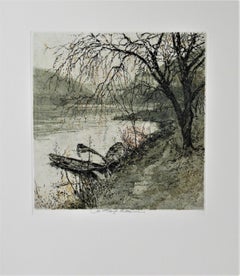
Max Pollak (1886-1970), Bohemia, drypoint with wash and pencil additions, c. 1925, signed in pencil lower right and titled lower left. In very good condition, printed on a chine colle with wove backing, the full sheet with deckle edges, 4 1/2 x 5 1/4, the sheet 11 1/2 x 9 3/8 inches.
A fine impression, printed in a blue/black ink on a white background, rich burr from the drypoint work, with extensive pencil additions particularly as shading for the houses and added trees in the background, and a darker grey wash with pencil additions at the top. The coloration and pencil additions create a snowy landscape, with a dark wintry sky above the horizon.
Pollak was an inventive printmaker, who often added color etching to his plates; here he creates a unique work with the additions to the drypoint composition. Although the added work may have been in contemplation of a later state of the print, it is an aesthetic gem as it stands.
- Creator:Max Pollak (1886 - 1970, Austrian)
- Creation Year:1925
- Medium:
- Movement Style:
- Period:
- Condition:
- Gallery Location:New York, NY
- Reference Number:1stDibs: LU51531742943
Max Pollak
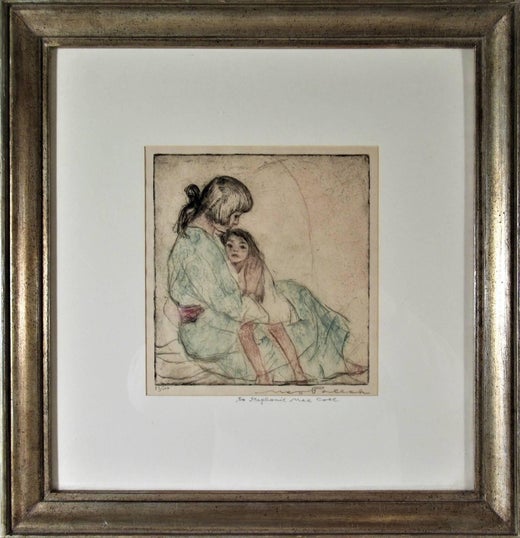
Max Pollak, painter and printmaker, was born in Prague, Czechoslovakia on February 2, 1886, but his family moved to Vienna, Austria when he was six months old. He was raised in Vienna and, in 1902, at sixteen years of age he entered the Vienna Academy of Art. He studied painting and printmaking under William Unger and Ferdinand Schmutzer. In 1912, he traveled to Italy, France, and Holland to study and paint. During the First World War, he was appointed painter of the Austrian Army. He immigrated to the U.S. in 1927, living for a time on the East Coast where he traveled about and produced an amazing series of color aquatints of New York, Cincinnati, and Detroit. His first exhibition at the 57th Street Art Gallery in New York was a commercial success and he was commissioned by Theodore Dreiser in 1929 to illustrate his book, My City, and eight of Pollak's color aquatints are reproduced in the book. In 1938, Pollak and his wife, Friedl, moved to San Francisco, California. Pollak was inspired by his new city and its environs and produced beautiful views of San Francisco, the Golden Gate Bridge, and Sausalito. Later travels were to Mexico and Guatemala. Pollak was equally facile working in drypoint, aquatint, and soft ground etching. One of his specialties was portraiture and he produced a number of drypoints of noteworthy people and dancers. Some of his color aquatints of San Francisco and Sausalito were derived from views from his homes in those cities. His graphic oeuvre is comprised of over 500 prints for which he won numerous awards including the Chicago Society of Etchers prize in 1942, and the California Society of Etchers awards in 1942, 1944, and 1945. Pollak exhibited at the Golden Gate International Exposition in 1939 and had numerous solo exhibitions, including a 1928 show in New York, a 1940 show at the California Palace of the Legion of Honor, and a 1973 exhibition at the Triton Museum in Santa Clara. He was a member of the Chicago Society of Etchers and the California Society of Etchers and his work is represented in the Oakland Museum of California Art, the Metropolitan Museum of Art, the New York Public Library, the Smithsonian American Art Museum, the de Young Memorial Museum, the Achenbach Foundation for Graphic Arts, and the British Museum, the Judah L. Magnes Museum, and Princeton University. Max Pollak died in Sausalito, California on May 29, 1970.

About the Seller
4.9
Recognized Seller
These prestigious sellers are industry leaders and represent the highest echelon for item quality and design.
Established in 2000
1stDibs seller since 2016
108 sales on 1stDibs
Typical response time: 15 hours
Associations
International Fine Print Dealers Association
- ShippingRetrieving quote...Shipping from: New York, NY
- Return Policy
More From This Seller
View AllLe Ferveur
By Jean-Emile Laboureur
Located in New York, NY
Jean-Emile Laboureur (1877-1943), Le Ferveur, etching, engraving, roulette, drypoint, 1928, signed in pencil lower left, numbered lower right, and annotated “imp.” Reference: Laboure...
Category
1920s Realist Landscape Prints
Materials
Engraving, Etching
Mountain Scene
By Ira Moskowitz
Located in New York, NY
Ira Moskowitz (1912-1985), [Mountain Scene], 1943, lithograph, signed in pencil lower right, numbered lower left (27/50) [also signed and dated 1943 in ...
Category
1940s American Realist Landscape Prints
Materials
Lithograph
Paysages (Landscapes)
By Franz Edmund Weirotter
Located in New York, NY
Franz Edmund Weirotter (1730-1771), Paysages (Landscapes), 1759, complete set of 6 (5 are illustrated on this site), [signed in the plates lower right Weirotter sc, and also signed a...
Category
1750s Realist Landscape Prints
Materials
Etching
A Douelan
By Adolphe Beaufrère
Located in New York, NY
Adolphe-Marie Beaufrère (1876-1960)
A Douelan, etching, 1923, signed in pencil and numbered (21/50) [also initials and date in the plate]. Reference: Morane 23-07, BN Laran 175. Seco...
Category
1920s Realist Landscape Prints
Materials
Etching
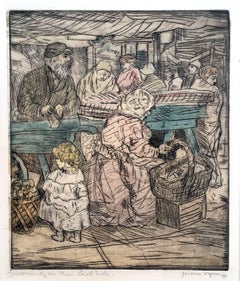
Morning on the East Side
By Jerome Myers
Located in New York, NY
Jerome Myers (1867-1940), Morning on the East Side, c. 1910, colored etching, signed in pencil lower right and annotated “imp.”; numbered and titled (twice) lower left. In very good ...
Category
1910s Figurative Prints
Materials
Color, Etching
Printemps Breton
By Jean-Emile Laboureur
Located in New York, NY
Jean-Emile Laboureur (1877-1943), Printemps Breton, 1926, drypoint, roulette, aquatint, etching; signed in pencil lower left and numbered lower right (37/50) with the imp inscription...
Category
1920s Realist Landscape Prints
Materials
Engraving, Drypoint, Etching, Aquatint
You May Also Like
Nevel
Located in Columbia, MO
Abe Gerlsma
Category
Early 20th Century Realist Landscape Prints
Materials
Etching
Cross Road II
By Peter Poskas
Located in Greenwich, CT
A house on a hill during winter.
Category
2010s Realist Landscape Paintings
Materials
Oil, Panel
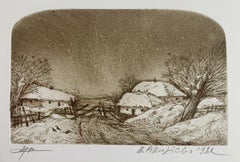
Landscape. Contemporary print, Monochromatic, Rural view, European artist
Located in Warsaw, PL
20th century monochromatic brown print with by Ukrainian artist Bogdan Pikulicki. Artwork depicts rural landscape with a cottage.
BOGDAN PIKULICKI (born in 1948)
He is a graduate ...
Category
2010s Figurative Prints
Materials
Paper, Intaglio, Pigment
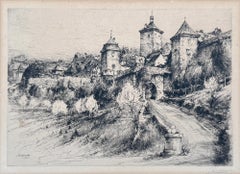
Rothenberg
Located in Middletown, NY
Etching with aquatint on cream wove paper, 6 11/16 x 9 15/16 inches (170 x 252 mm), full margins. Signed in pencil in the lower right margin. With significant toning and moderate mat...
Category
Early 20th Century Naturalistic Landscape Prints
Materials
Handmade Paper, Etching, Aquatint
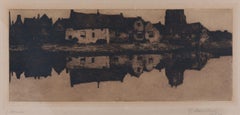
Evening - The depth of the visible -
Located in Berlin, DE
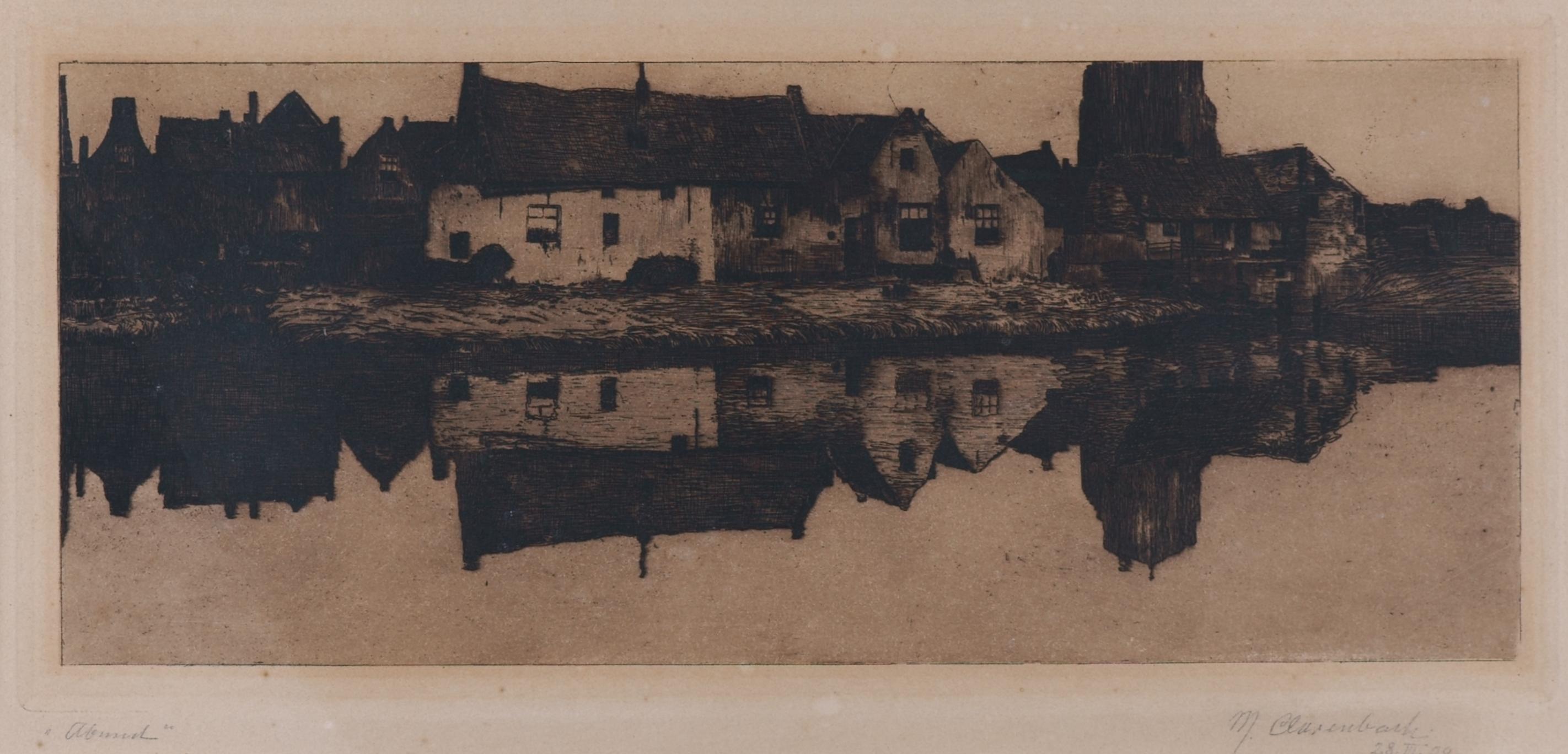
Max Clarenbach (1880 Neuss - Cologne 1952), Evening. Etching, 18 x 41 cm (platemark), 33.5 x 57 cm (frame), inscribed "Abend" in pencil at lower left, signed and dated "M. Clarenbach. 28.III.[19]09". Framed and mounted under glass.
- Somewhat browned and slightly foxed.
About the artwork
The horizontally elongated etching depicts the panoramic view of a small town as seen from the other side of the river. There are gabled houses on the left and a mighty church spire on the right. The bourgeois houses and the large religious building indicate the urban character. These buildings are rendered in dark tones to emphasise the lighter row of houses in the centre of the picture, closer to the water. The chiaroscuro contrast creates two parallel planes that open up a space for the imagination of what the city could be. The imagination is stimulated by the almost entirely dark, barely recognisable buildings, while the arm of the river leading into the city further stimulates the imagination.
However, as the silhouette of the city as a whole is reflected in the water, the parallel planes are perceived as a band of houses that stretches across the entire horizontality of the etching and seems to continue beyond the borders of the picture. The reflection has almost the same intensity as the houses themselves, so that the band of buildings merges with their reflection to form the dominant formal unit of the picture. Only the parallel horizontal hatching creates the convincing impression of seeing water, demonstrating Max Clarenbach's mastery of the etching needle.
The water is completely motionless, the reflection unclouded by the slightest movement of the waves, creating a symmetry within the formal unity of the cityscape and its reflection that goes beyond the motif of a mere cityscape. A pictorial order is established that integrates everything in the picture and has a metaphysical character as a structure of order that transcends the individual things. This pictorial order is not only relevant in the pictorial world, but the picture itself reveals the order of the reality it depicts. Revealing the metaphysical order of reality in the structures of its visibility is what drives Clarenbach as an artist and motivates him to return to the same circle of motifs.
The symmetry described is at the same time inherent an asymmetry that is a reflection on art: While the real cityscape is cut off at the top of the picture, two chimneys and above all the church tower are not visible, the reflection illustrates reality in its entirety. The reflection occupies a much larger space in the picture than reality itself. Since antiquity, art has been understood primarily as a reflection of reality, but here Clarenbach makes it clear that art is not a mere appearance, which can at best be a reflection of reality, but that art has the potential to reveal reality itself.
The revealed structure of order is by no means purely formalistic; it appears at the same time as the mood of the landscape. The picture is filled with an almost sacred silence. Nothing in the picture evokes a sound, and there is complete stillness. There are no people in Clarenbach's landscape paintings to bring action into the picture. Not even we ourselves are assigned a viewing position in the picture, so that we do not become thematic subjects of action. Clarenbach also refrains from depicting technical achievements. The absence of man and technology creates an atmosphere of timelessness. Even if the specific date proves that Clarenbach is depicting something that happened before his eyes, without the date we would not be able to say which decade, or even which century, we are in. The motionless stillness, then, does not result in time being frozen in the picture, but rather in a timeless eternity that is nevertheless, as the title "Abend" (evening), added by Clarenbach himself, makes clear, a phenomenon of transition. The landscape of the stalls is about to be completely plunged into darkness, the buildings behind it only faintly discernible. The slightly darkened state of the sheet is in keeping with this transitional quality, which also lends the scene a sepia quality that underlines its timelessness. And yet the depiction is tied to a very specific time. Clarenbach dates the picture to the evening of 28 March 1909, which does not refer to the making of the etching, but to the capture of the landscape's essence in the landscape itself.
If the real landscape is thus in a state of transition, and therefore something ephemeral, art reveals its true nature in that reality, subject to the flow of phenomena, is transferred to an eternal moment, subject to a supra-temporal structure of order - revealed by art. Despite this supratemporality, the picture also shows the harbingers of night as the coming darkening of the world, which gives the picture a deeply melancholy quality, enhanced by the browning of the leaf.
It is the philosophical content and the lyrical-melancholic effect of the graphic that give it its enchanting power. Once we are immersed in the image, it literally takes a jerk to disengage from it.
This etching, so characteristic of Max Clarenbach's art, is - not least because of its dimensions - a major work in his graphic oeuvre.
About the artist
Born into poverty and orphaned at an early age, the artistically gifted young Max Clarenbach was discovered by Andreas Achenbach and admitted to the Düsseldorf Art Academy at the age of 13.
"Completely penniless, I worked for an uncle in a cardboard factory in the evenings to pay for my studies.”
- Max Clarenbach
At the academy he studied under Arthur Kampf, among others, and in 1897 was accepted into Eugen Dücker...
Category
Early 1900s Realist Landscape Prints
Materials
Etching
Danube
By Luigi Kasimir
Located in San Francisco, CA
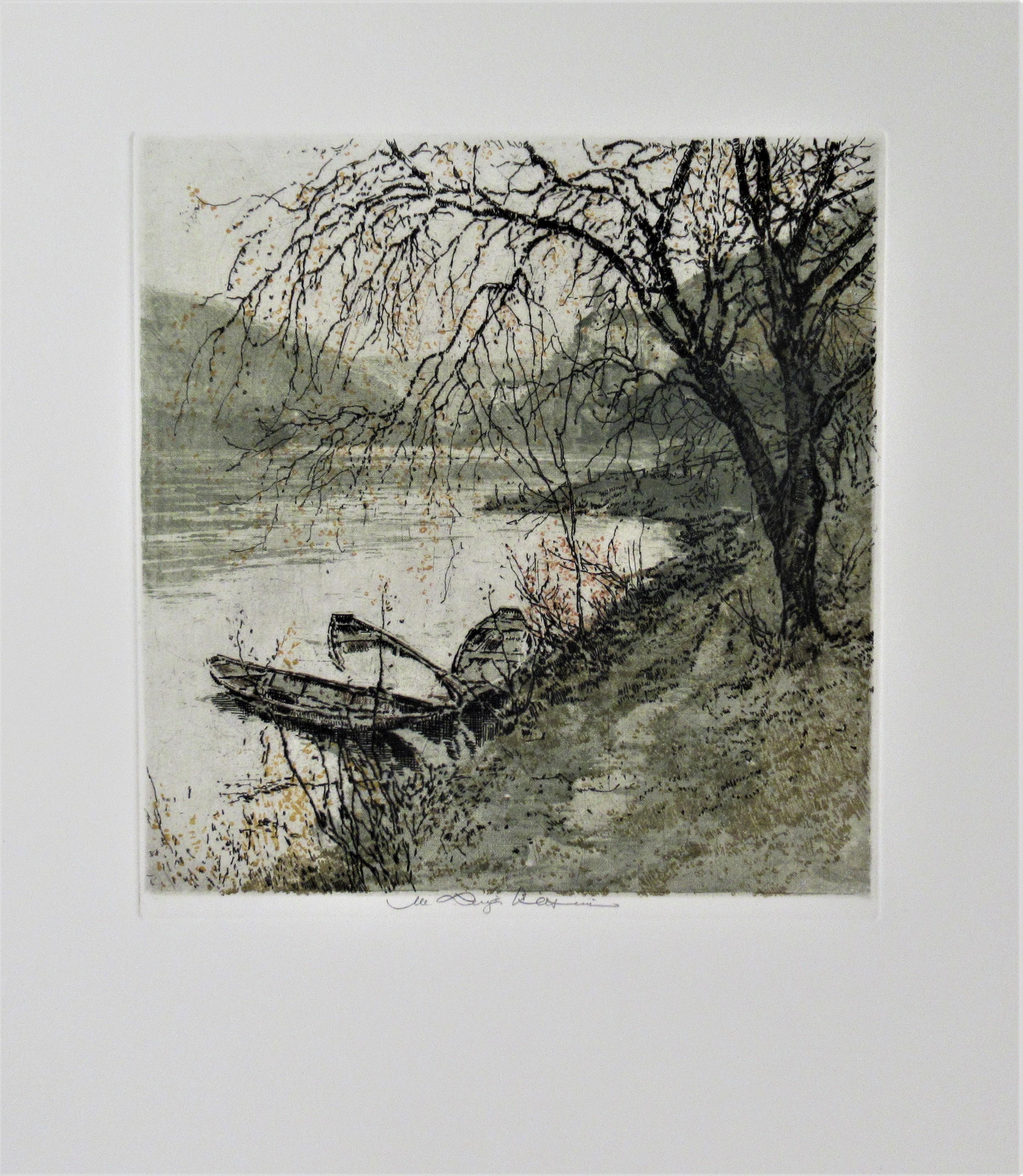
This artwork titled "Danube" c.1940 is a color etching by Austrian artist Luigi Kasimir 1881-1962. It is hand signed by the artist's estate in pencil at the lower center. The plate mark (image) size is 9.5 x 9 inches, the sheet size is 17.5 x 14.85 inches. It is in excellent condition, has never been framed.
About the artist.
Luigi Kasimir was born in 1881 at Pettau, today Ptuj, Slovenia, then a part of the Austro-Hungarian monarchy. He inherited his talent from his ancestors; his grandfather was a painter and a poet, and his father an officer in the Habsburg army, who later became a professional painter. Kasimir attended the Vienna Academy of Art where he studied under Wilhelm Unger, who introduced him to the technique of the coloured etching, and also to his future wife, the artist Tanna Hoernes.[1] He died in 1962 in Grinzing, a suburb of Vienna.Kasimir was among the first to develop the technique of the coloured etching. Before this, prints were usually hand-coloured with the colour being applied in a casual, haphazard manner. Kasimir would first create a sketch usually in pastel, he then transferred the design on as many as four to six plates, printing one after the other and applying the colour on the plate, all done by hand.
Kasimir is mainly famous for his etchings, but he also produced some oil painting, as well as some pastels. One of his favourite genres was the landscape, or veduta. He demonstrated a predisposition street scenes, and tourist landmarks. He depicted places from all over Europe, mainly Italy, Austria, and Germany. He also travelled to the United States to do a series of etchings of famous sights ranging from urban landmarks such as New York City skyscrapers, to natural wonders like Yosemite Valley. Luigi Kasimir’s etchings...
Category
Early 20th Century Realist Figurative Prints
Materials
Etching