Items Similar to
Komyō-ji Temple at Autumn in Kyoto
— Sōsaku-hanga Woodblock Masterwork
Want more images or videos?
Request additional images or videos from the seller
1 of 6
Ohtsu Kazuyuki
Komyō-ji Temple at Autumn in Kyoto
— Sōsaku-hanga Woodblock Masterwork2012
2012
$1,200
£913.77
€1,052.19
CA$1,700.51
A$1,829.14
CHF 977.54
MX$21,560.31
NOK 12,324.54
SEK 11,266.97
DKK 7,861.61
About the Item
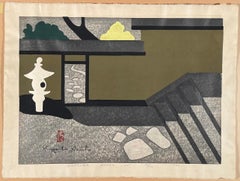
Ohtsu Kazuyuki, 'Kyo no Aki - Komyō-ji' (Komyō-ji temple at Autumn in Kyoto), large-scale color woodblock print, ed. 100, 2012. Signed, titled in Japanese, numbered 78/100, and dated in pencil. A superb, richly-inked impression, with fresh colors, on heavy Japanese washi paper; the full sheet with margins (approx. 1 1/2 inches) and deckle edges all around, in excellent condition. Self-printed and self-published by the artist. Archivally sleeved, unmatted.
Image size 15 x 20 13/16 inches (381 x 529 mm); sheet size 17 3/4 x 24 inches (451 x 610 mm).
ABOUT THE IMAGE
Komyo-ji Temple (光明寺) is a historic Buddhist temple in Kyoto, closely associated with the origins of the Jōdo (Pure Land) sect and the teachings of the Buddhist monk Hōnen. Komyō-ji was founded in 1175, during the late Heian period (794–1185), a time of political instability, natural disasters, and widespread belief in mappō—the Latter Age of the Dharma. In this context, Pure Land Buddhism gained prominence for its emphasis on faith and accessible practice over scholastic learning..
Traditionally regarded as the first temple formally established to propagate Hōnen’s doctrine of exclusive devotion to Amida Buddha through the nembutsu (Namu Amida Butsu), Komyō-ji played a formative role in the institutional development of Jōdo Buddhism at the close of the Heian era.
Architecturally and spatially, the temple reflects the Jōdo tradition’s contemplative ethos. Its wooded grounds and long approach encourage processional movement and awareness of seasonal change. Komyō-ji is especially renowned for its autumn maple foliage, which aligns with the temple’s emphasis on quiet reflection.
Historically and today, Komyō-ji has served as both a religious center and a place of retreat, reinforcing core Jōdo principles of humility, accessibility, and reliance on faith.
ABOUT THE ARTIST
Ohtsu Kazuyuki (b. 1935, Gunma Prefecture) is a Japanese woodblock printmaker whose career bridges postwar modernism and a sustained commitment to traditional technique. In 1958, he became an assistant to Saitō Kiyoshi, one of the most influential figures in modern Japanese woodblock printmaking. During his years with Saitō, Ohtsu participated in major exhibitions and refined his technical command through close collaboration, an experience that proved formative to his artistic outlook.
Ohtsu’s work bears an evident affinity with Saitō’s quiet, pared-down sensibility—particularly in its emphasis on rural settings and seasonal atmosphere—yet it evolved into a distinctly personal mode of expression. His prints typically depict tranquil countryside scenes, often in winter or transitional seasons, rendered with restrained yet distinct color, minimal line, and carefully balanced compositions. His imagery favors stillness, equipoise, and a resonant sense of place.
Technically, Ohtsu works confidently within the woodblock tradition, maintaining close control over carving and printing. The physical qualities of the block—grain, pressure, and surface—remain integral to the image, reinforcing the handmade character of his work. Editions are generally modest, reflecting a studio-based practice grounded in craft.
Following Saitō Kiyoshi’s death in 1997, Ohtsu emerged as a fully independent artist and has since held numerous solo exhibitions throughout Japan. Over several decades, he has established a reputation for consistency, technical assurance, and quiet authority. His prints are held in Japanese public and private collections and are increasingly appreciated by international collectors drawn to postwar Japanese woodblock printmaking that values restraint, atmosphere, and enduring craftsmanship.
About the Seller
5.0
Recognized Seller
These prestigious sellers are industry leaders and represent the highest echelon for item quality and design.
Platinum Seller
Premium sellers with a 4.7+ rating and 24-hour response times
Established in 1995
1stDibs seller since 2016
336 sales on 1stDibs
Typical response time: 1 hour
Associations
International Fine Print Dealers Association
- ShippingRetrieving quote...Shipping from: Myrtle Beach, SC
- Return Policy
More From This Seller
View All
Chion-in Temple Gate
from
Eight Scenes of Cherry Blossoms
— Jizuri Seal
By Hiroshi Yoshida
Located in Myrtle Beach, SC
Hiroshi Yoshida, 'Chion-in Temple Gate (Sunset)' from the series 'Eight Scenes of Cherry Blossoms (Sakura hachi dai: Sakura mon)', color woodblock print, 1935. Signed in brush 'Yoshida' and in pencil 'Hiroshi Yoshida'. A superb, early impression, with fresh colors; the full sheet with margins, on cream Japan paper; an area of slight toning in the top right sheet corner, not affecting the image, otherwise in excellent condition. Marked with a jizuri (self-printed) seal, upper left margin. Self-published by the artist.
Image size 9 5/8 x 14 3/4 inches (444 x 375 mm); sheet size 10 7/8 x 16 inches (276 x 406 mm). Archivally sleeved, unmatted.
Provenance: M. Nakazawa, Tokyo.
Literature: Japanese Landscapes of the 20th Century (Hotei Publishing calendar), 2001, May.
Collections: Honolulu Museum of Art, Museum of Fine Arts, Boston.
ABOUT THE IMAGE
Located in Kyoto, Chionin is the main temple of the Jodo sect of Japanese Buddhism, one of the most popular Buddhist sects in Japan, having millions of followers. The Sanmon Gate, Chionin's entrance gate, standing 24 meters tall and 50 meters wide, it is the largest wooden temple gate in Japan and dates back to the early 1600s. Behind the gate, a broad set of stairs leads to the main temple grounds.
ABOUT THE ARTIST
Painter and printmaker Yoshida Hiroshi (1876-1950) is regarded as one of the greatest artists of the Japanese 'shin hanga' (New Print) movement.
Yoshida was born as the second son of Ueda Tsukane in Kurume, Fukuoka Prefecture, a schoolteacher from an old samurai family. In 1891 he was adopted by his art teacher Yoshida Kasaburo in Fukuoka and took his surname. In 1893 he went to Kyoto to study painting, and the following year to Tokyo to join Koyama Shotaro's Fudosha private school; he also became a member of the Meiji Fine Arts Society. These institutions taught and advocated Western-style painting, greatly influencing Yoshida’s artistic development.
In 1899 Yoshida had his first American exhibition at Detroit Museum of Art (now Detroit Institute of Art), making the first of many visits to the US and Europe. In 1902 he helped reorganize the Meiji Fine Arts Society, renaming it the Taiheiyo-Gakai (Pacific Painting...
Category
1930s Showa Figurative Prints
Materials
Woodcut
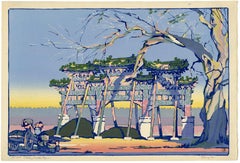
Peking - Paifang Gate
— Mid-Century Watanabe Color Woodcut
By Cyrus Le Roy Baldridge
Located in Myrtle Beach, SC
Cyrus Le Roy Baldridge, 'Peking '25', woodblock print, published 1926. Signed, titled, dated, and annotated 'No 124' in pencil. A fine impression, with fresh, undiminished colors; the full sheet, in excellent condition. Watanabe 6 mm seal, lower right, indicating an impression printed between 1945 and 1957. Archivally sleeved, unmatted.
Image size 9 5/8 x 14 5/16 inches; sheet size 10 7/16 x 15 3/8 inches.
ABOUT THE IMAGE
A 'paifang', also known as a 'pailou', is a traditional style of Chinese architectural arch or gateway structure. It has been theorized that the paifang gate architecture was influenced by Buddhist torana temple gates. Paifang are designed with traditional Chinese architectural motifs including multi-tiered roofs, prominent supporting posts, and gracefully arched openings.
This is an unusual ukiyo-e or 'floating world' woodcut published by Watanabe Shozaburo, Tokyo, in that the subject is of an early 20th-century scene in Peking, China.
ABOUT THE ARTIST
Cyrus Leroy Baldridge...
Category
1920s Showa Landscape Prints
Materials
Woodcut
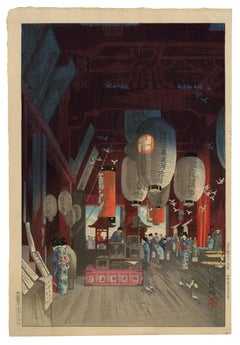
Interior of the Kannon Temple at Asakusa
— Tokyo Landmark, Early Edition
Located in Myrtle Beach, SC
NARAZAKI EISHO (1864-1936), 'Asakusa Kannon-do no naido' (Interior of the Kannon Temple at Asakusa), color woodblock print, 1932. Signed Eisho lower right, with the artist’s red seal beneath. A fine impression with fresh colors; the full sheet with slight overall age toning, a drying tack...
Category
1930s Interior Prints
Materials
Woodcut
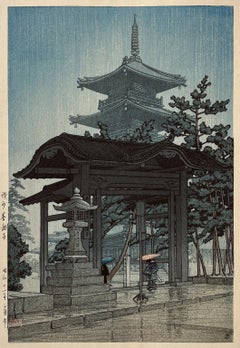
Zentsuji Temple in the Rain — from the series Collected Views of Japan II
By Kawase Hasui
Located in Myrtle Beach, SC
Kawase Hasui, 'Zentsuji Temple in the Rain' from the seres 'Collected Views of Japan II', color woodblock print, 1937. Signed Hasui in black ink, with the artist’s red seal Kawase, ...
Category
1930s Showa Landscape Prints
Materials
Woodcut
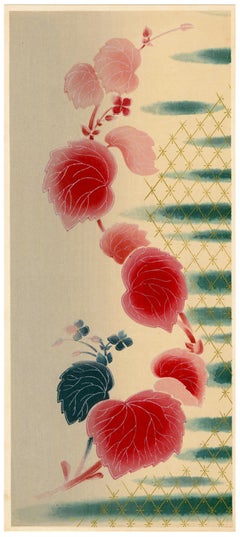
Japanese Kimono Fabric Design — Vintage Color Woodblock Print
Located in Myrtle Beach, SC
Anonymous, Japanese Kimono Fabric Design, color woodcut, c. 1930. A superb impression, with fresh colors, fine graduations, and metallic gold motifs, on ...
Category
Early 1900s Showa Figurative Prints
Materials
Woodcut
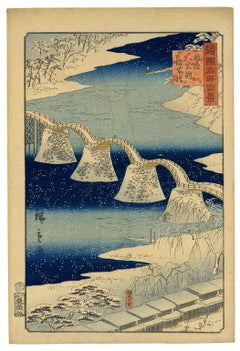
Kintai Bridge at Iwakuni in Suo Province (Suo iwakuni kintai-bashi), 1859
By Hiroshige II
Located in Myrtle Beach, SC
Utagawa Hiroshige II (1829-1869), 'Kintai Bridge at Iwakuni in Suo Province' (Suo iwakuni kintai-bashi), from the series 'One Hundred Views of Famous Pla...
Category
1850s Edo Landscape Prints
Materials
Woodcut
You May Also Like
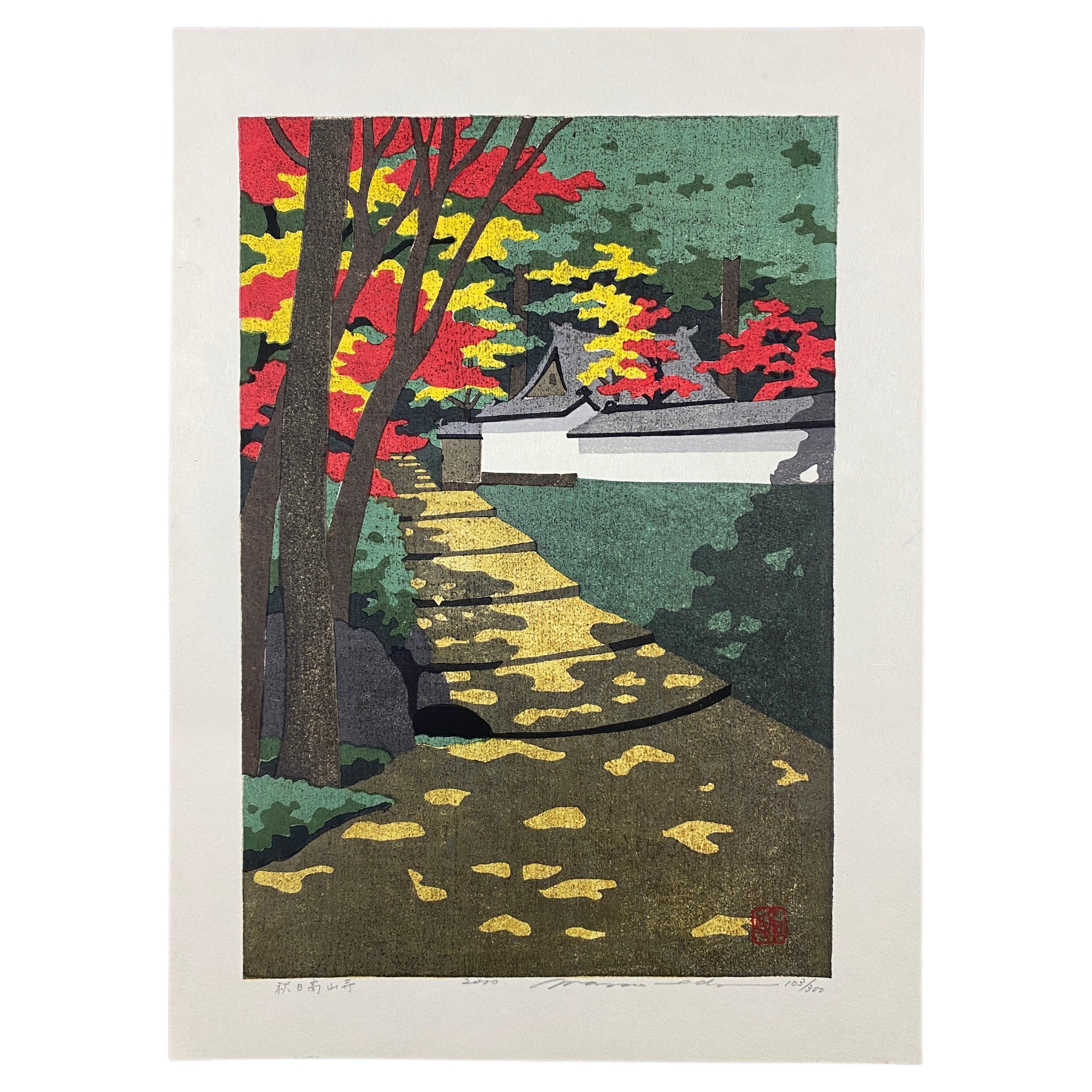
Ido Masao –
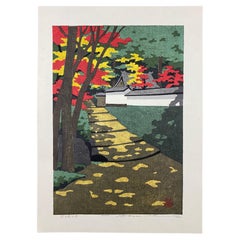
秋日高山寺 Autumn Day, Kozanji Temple, Kyoto
Located in Weesp, NL
Ido Masao (b. 1945) – '秋日高山寺 Autumn Day, Kozanji Temple, Kyoto
Original Japanese Woodblock Print 26.5 × 36.5 cm (10.43 × 14.37 in)
Edition: 103/300 Signed, titled & numbered in p...
Category
Early 2000s Japanese Anglo-Japanese Prints
Materials
Paper
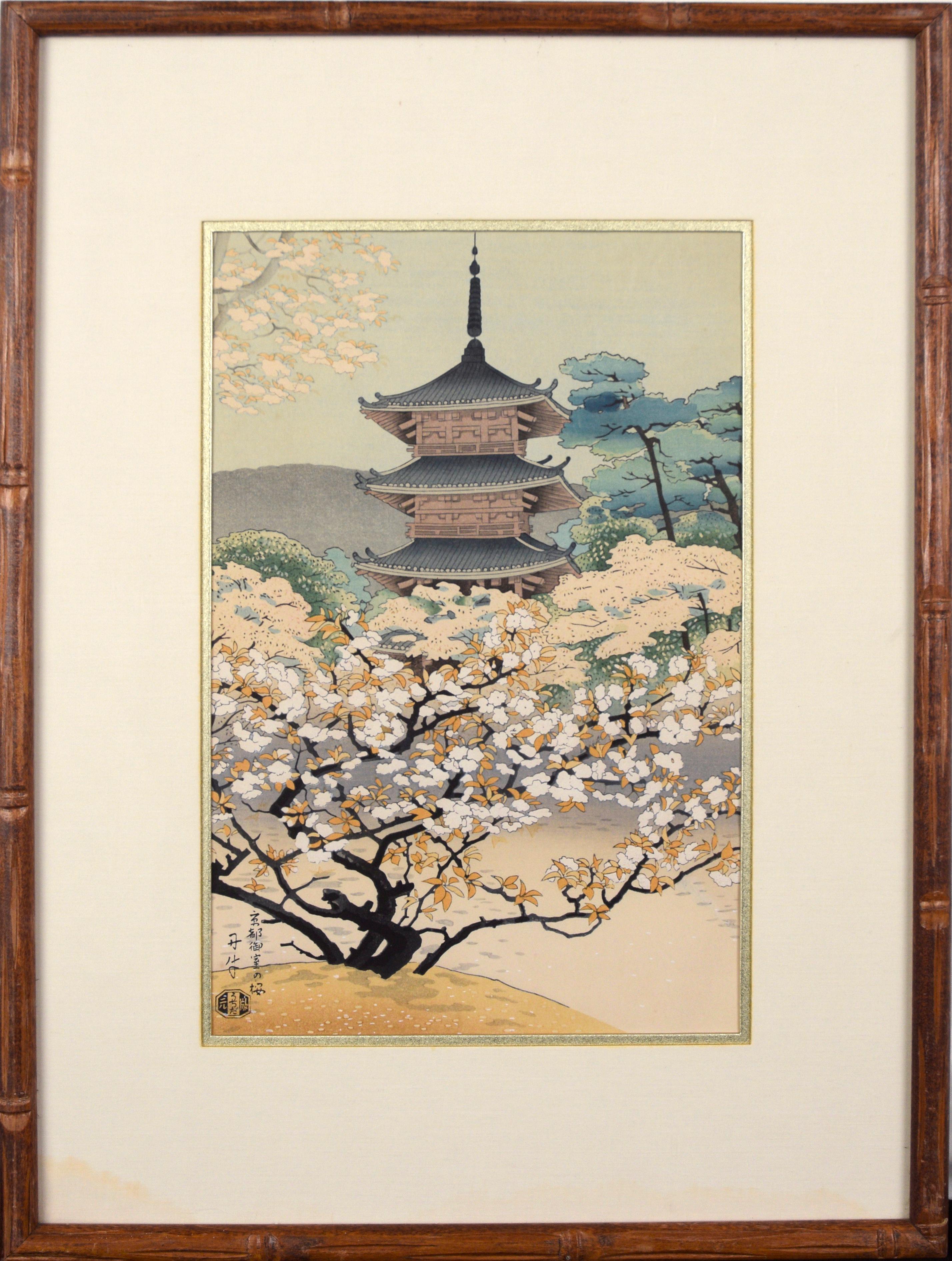
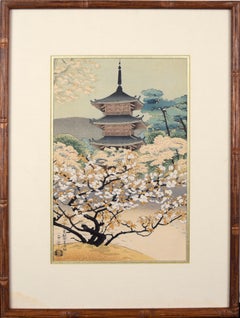
The Pagoda of Ninnaji Temple in Kyoto with Cherry Blossoms - Woodblock Print
Located in Soquel, CA
The Pagoda of Ninnaji Temple in Kyoto with Cherry Blossoms - Woodblock Print
Beautifully executed Showa-era print by Japanese artist Benji Asada (b. 1899 d. 1984.) This print shows ...
Category
1950s Showa Landscape Prints
Materials
Paper, Ink, Woodcut
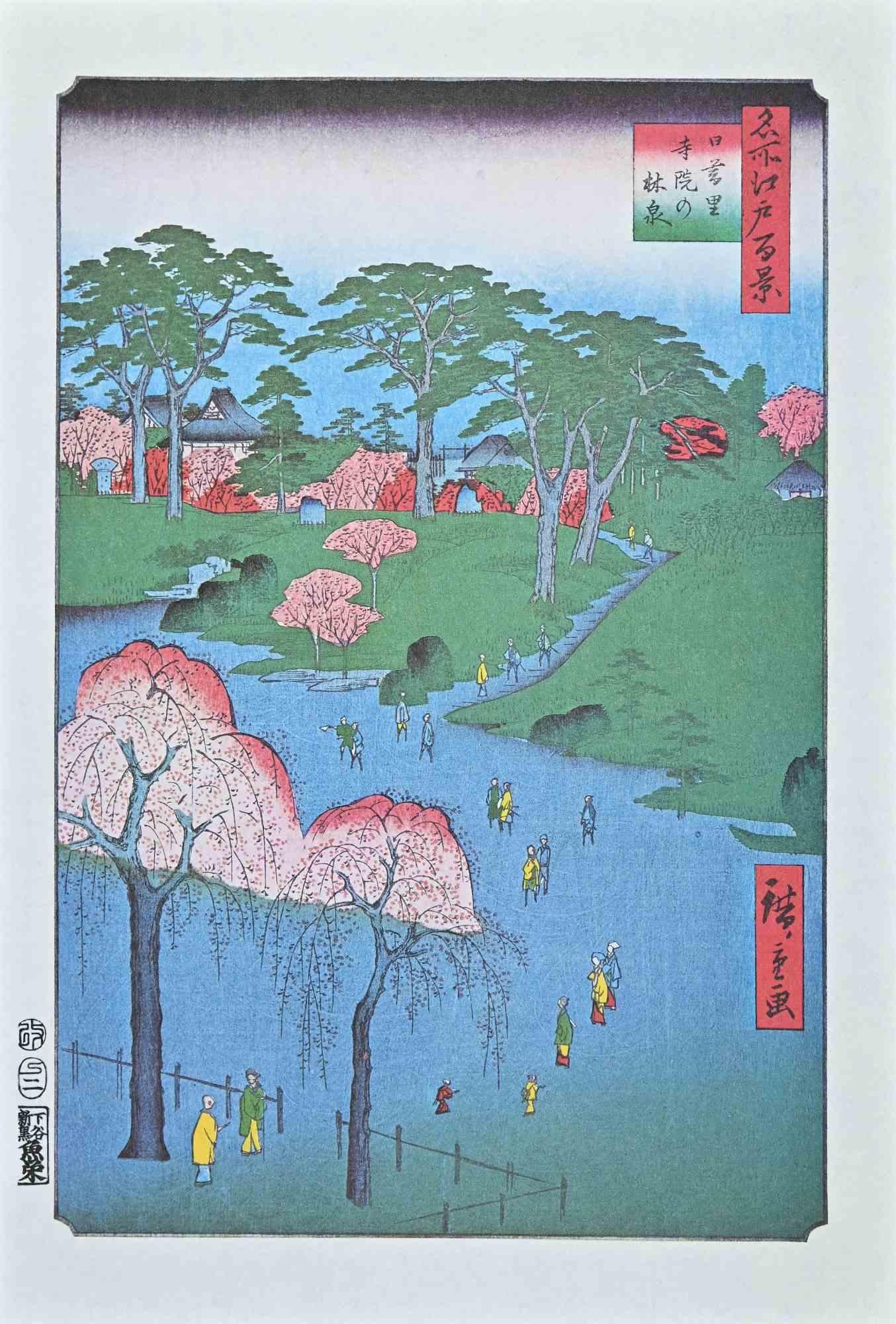
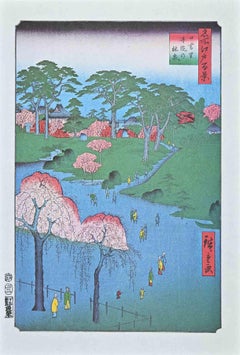
Temple Gardens in Nippori - Lithograph after Utagawa Hiroshige -1950s
By Utagawa Hiroshige
Located in Roma, IT
Temple Gardens in Nippori is a modern artwork realized in the mid-20th century after Utagawa Hiroshige.
Mixed colored lithograph after a woodcut realized by Utagawa Hiroshige in 185...
Category
Mid-20th Century Modern Figurative Prints
Materials
Lithograph
KATSURA KYOTO I
By Kiyoshi Saitō
Located in Portland, ME
Saito, Kiyoshi. KATSURA KYOTO I. Color Woodblock, 1962. Edition of 200. Titled, dated and numbered 84/200 in pencil. Signed in the block (prints from thi...
Category
1960s Landscape Prints
Materials
Adhesive, Woodcut
Kiyomizu Temple, Scenes of Famous Places along Tôkaidô Road - Woodblock on Paper
By Utagawa Hiroshige II
Located in Soquel, CA
Kiyomizu Temple, Scenes of Famous Places along Tôkaidô Road - Woodblock on Paper
Full Title:
Kyoto: Kiyomizu Temple (Kyô Kiyomizudera), from the series Scenes of Famous Places along...
Category
1860s Edo Landscape Prints
Materials
Ink, Rice Paper, Woodcut
Japan, Suijin Shrine and Masaki on the Sumida River - Lithograph (Mourlot)
By Utagawa Hiroshige
Located in Paris, IDF
Utagawa HIROSHIGE (1797-1858, after)
Japan, Suijin Shrine and Masaki on the Sumida River
Lithograph after a woodcut (Mourlot workshop)
Printed signature in the plate
Numbered / 150 ...
Category
Mid-20th Century Edo Landscape Prints
Materials
Lithograph