Want more images or videos?
Request additional images or videos from the seller
1 of 10
Picasso, Le Chat, Histoire naturelle (after)1970
1970
Price:$550
$716List Price
About the Item
- Creation Year:1970
- Dimensions:Height: 13 in (33.02 cm)Width: 9.25 in (23.5 cm)
- Medium:
- Movement Style:
- After:Pablo Picasso (1881-1973, Spanish)
- Period:
- Condition:
- Gallery Location:Southampton, NY
- Reference Number:1stDibs: LU1465216234002
About the Seller
4.9
Platinum Seller
Premium sellers with a 4.7+ rating and 24-hour response times
Established in 1978
1stDibs seller since 2021
1,254 sales on 1stDibs
Authenticity Guarantee
In the unlikely event there’s an issue with an item’s authenticity, contact us within 1 year for a full refund. DetailsMoney-Back Guarantee
If your item is not as described, is damaged in transit, or does not arrive, contact us within 7 days for a full refund. Details24-Hour Cancellation
You have a 24-hour grace period in which to reconsider your purchase, with no questions asked.Vetted Professional Sellers
Our world-class sellers must adhere to strict standards for service and quality, maintaining the integrity of our listings.Price-Match Guarantee
If you find that a seller listed the same item for a lower price elsewhere, we’ll match it.Trusted Global Delivery
Our best-in-class carrier network provides specialized shipping options worldwide, including custom delivery.You May Also Like
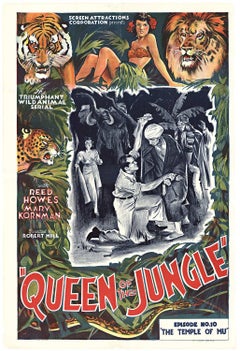
Original "Queen of the Jungle" US 1-sheet vintage (1935) movie poster
Located in Spokane, WA
Original Queen of the Jungle vintage lithograph movie poster, archival linen backed. US 1-sheet.
"The Temple of Mu." Serial. Episode No 10. St...
Category
1930s American Modern Animal Prints
Materials
Lithograph
$760 Sale Price
20% Off
H 41 in W 27.5 in D 0.05 in
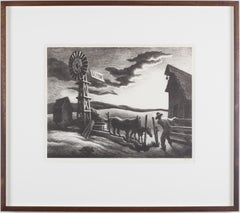
Nebraska Evening
By Thomas Hart Benton
Located in London, GB
A fine impression with good margins published by Associated American Artists.
Category
1940s American Modern Landscape Prints
Materials
Lithograph
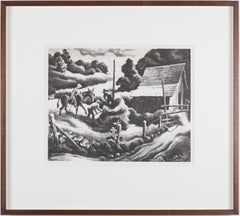
Haystack
By Thomas Hart Benton
Located in London, GB
A fine impression of this very popular image with full margins (smaller on top and bottom) published by Associated American Artists.
Category
1930s American Modern Landscape Prints
Materials
Lithograph
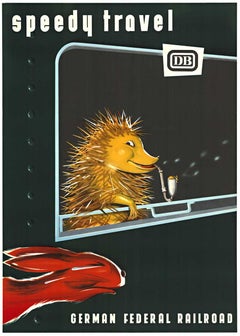
Original "Speedy Travel, German Federal Railroad" vintage travel poster, train
Located in Spokane, WA
Original “Speedy Travel, German Federal Railroad” vintage travel poster. The DB stands for the Deutsche Bundesbahn. Archivally linen-backed in very good condition and ready to fra...
Category
1950s American Modern Animal Prints
Materials
Lithograph
$549
H 33 in W 23.5 in D 0.05 in
Landscape with Deer Herds
By Hoi Lebadang
Located in San Francisco, CA
This artwork "Landscape with Deer Herds" c.1970 is an original color lithograph by French/Vietnamese artist Hoi Lebadang, 1922-2015. It is hand sig...
Category
Late 20th Century Modern Animal Prints
Materials
Lithograph
Bolebroke Beagles hunting lithograph after Peter Biegel
Located in London, GB
To see our other hunting pictures, scroll down to "More from this Seller" and below it click on "See all from this Seller" and then search.
Peter Biegel ...
Category
20th Century Modern Animal Prints
Materials
Lithograph
Prehistoric Sighting Pacific Ocean (Goblin Sharks?)
Located in New Orleans, LA
This is a single color lithograph created by Matthew Roath as part of Tamarind Institute PTP. The Collaborating printer isAndreea Cristina Mateescu....
Category
21st Century and Contemporary American Modern Landscape Prints
Materials
Lithograph

$83 Sale Price
58% Off
H 20 in W 15 in
Herring Gulls
By Jamie Wyeth
Located in Missouri, MO
Jamie Wyeth
"Herring Gulls" 1978
Color Lithograph
Signed Lower Right
Numbered Lower Left 149/300
Born in 1946, James Browning Wyeth came of age when the meaning of patriotism was clouded by the traumas of the Vietnam War and the scandals of Watergate. Working in an era of turmoil and questioning of governmental authority, he did art that encompassed both marching off to war and marching in protest.
One of James's early masterworks, Draft Age (1965) depicts a childhood friend as a defiant Vietnam-era teenager resplendent in dark sunglasses and black leather jacket in a suitably insouciant pose.
Two years later Wyeth painstakingly composed a haunting, posthumous Portrait of President John F. Kennedy (1967) that seems to catch the martyred Chief Executive in a moment of agonized indecision. As Wyeth Center curator Lauren Raye Smith points out, Wyeth "did not deify the slain president, [but] on the contrary made him seem almost too human."
Based on hours of study and sketching of JFK's brothers Robert and Edward -
documented by insightful studies in the exhibition - the final, pensive portrait seemed too realistic to family members and friends. "His brother Robert," writes Smith in the exhibition catalogue, "reportedly felt uneasy about this depiction, and said it reminded him of the President during the Bay of Pigs invasion."
In spite of these misgivings, James's JFK likeness has been reproduced frequently and is one of the highlights of this show. The poignancy, appeal and perceptiveness of this portrait, painted when the youngest Wyeth was 21 years old, makes one wish he would do more portraits of important public figures.
James himself feels he is at his best painting people he knows well, as exemplified by his vibrant Portrait of Jean Kennedy Smith (1972), which captures the vitality of the slain President's handsome sister.
He did paint a portrait of Jimmy Carter for the January 1977 man-of-the-year cover of Time magazine, showing the casually dressed President-elect as a straightforward character posed under a flag-draped water tower next to the family peanut plant in Plains, Ga. James recalls that Carter had one Secret Service agent guarding him as he posed outdoors, a far cry from the protection our Chief Executives require today.
As a participating artist in the "Eyewitness to Space" program organized by the National Aeronautics and Space Administration in collaboration with the National Gallery of Art in the late 1960s, Wyeth deftly recorded in a series of watercolors his eyewitness observations of dramatic spacecraft launchings and more mundane scenes associated with the space program.
Commissioned by Harper's Magazine to cover the 1974 congressional hearings and trials of Watergate figures, James Wyeth executed a series of perceptive and now evocative sketches that recall those dark chapters in our history. Memorable images include a scowling John Ehrlichman, a hollow-eyed Bob Haldeman, an owlish Charles Colson, a focused Congressman Peter Rodino, a grim visaged Father/ Congressman Robert Drinan, and vignettes of the press and various courtroom activities. An 11-by-14-inch pencil sketch of the unflappable Judge John Sirica is especially well done. These "images are powerful as historical records," observes Smith, "and as lyrically journalistic impressions of events that changed the nation forever."
Wyeth's sketch of early-morning crowds lined up outside the Supreme Court
building hoping to hear the Watergate case, with the ubiquitous TV cameramen looking on, is reminiscent of recent scenes as the high court grappled with the Bush-Gore contest.
The Wyeth family penchant for whimsy and enigmatic images is evident in Islanders (1990), showing two of James's friends, wearing goofy hats, sitting on the porch of a small Monhegan Island (Me.) cottage draped with a large American flag. Mixing the serious symbolism of Old Glory with the irreverent appearance of the two men, James has created a puzzling but interesting composition.
Painting White House...
Category
1970s American Modern Animal Prints
Materials
Lithograph, Paper
Origiinal FRANCE, Paese dei Casstelli, vintage French travel poster on linen
By Jean Picart Le Doux
Located in Spokane, WA
Original 1950 “France, Paese dei Castelli” Vintage Poster Artist Jean Picart Le Doux Linen-Backed French Castles Travel Art Rare Mid-Century Collectible
Add a touch of French el...
Category
1950s American Modern Landscape Prints
Materials
Lithograph
$975
H 39.5 in W 24.5 in D 0.3 in
Original 1945 Paris (France) vintage travel poster travel by train
By Paul Colin
Located in Spokane, WA
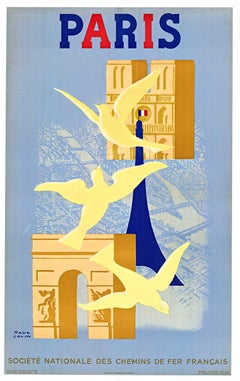
Original PARIS linen-backed 1946 vintage travel poster, preservation linen-backed and ready to frame. Very good condition, Grade A-
Original 1946 Paul Colin Paris Vintage Poster ...
Category
1940s American Modern Landscape Prints
Materials
Lithograph
$1,200
H 39.5 in W 24.5 in D 0.3 in
More From This Seller
View AllThe Bird, School Prints, Georges Braque
By Georges Braque
Located in Southampton, NY
Lithograph on English cartridge paper. Inscription: Unsigned and unnumbered, as issued. Good Condition; never framed or matted. Notes: Published by School Prints Ltd., London; Printe...
Category
1940s Modern Landscape Prints
Materials
Lithograph
Georges Braque, The Flying Bird, from Carnets intimes, 1955 (after)
By Georges Braque
Located in Southampton, NY
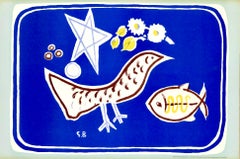
This exquisite lithograph after Georges Braque (1882–1963), titled L’Oiseau volant (The Flying Bird), from Carnets intimes (Private Sketchbooks), Verve, Vol. VIII, No. 31–32, origina...
Category
1950s Modern Landscape Prints
Materials
Lithograph
$716 Sale Price
44% Off
Free Shipping
Georges Braque, Birds on a Blue Background, from Carnets intimes, 1955 (after)
By Georges Braque
Located in Southampton, NY
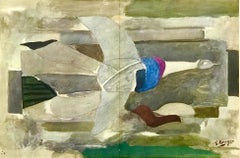
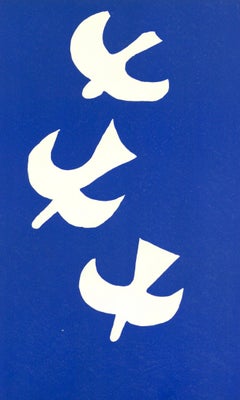
This exquisite lithograph after Georges Braque (1882–1963), titled Oiseaux sur fond bleu (Birds on a Blue Background), from Carnets intimes (Private Sketchbooks), Verve, Vol. VIII, No. 31–32, originates from the 1955 issue published by Editions de la revue Verve, Paris, under the direction of Teriade, Editeur, Paris, and printed by Mourlot Freres, Paris, 1955. This serene and evocative composition reflects Braque’s lifelong fascination with the motif of birds—symbols of freedom, transcendence, and spiritual equilibrium. Oiseaux sur fond bleu captures the artist’s delicate synthesis of abstraction and nature, where the silhouettes of birds emerge in lyrical harmony against a radiant blue field. The image embodies Braque’s mature artistic vision: a perfect balance between movement and stillness, light and shadow, emotion and intellect.
Executed as a lithograph on velin du Marais paper, this work measures 14 x 10.5 inches (35.56 x 26.67 cm). Unsigned and unnumbered as issued. The edition exemplifies the superior craftsmanship of the Mourlot Freres atelier, renowned for its collaborations with the foremost modern artists of the 20th century.
Artwork Details:
Artist: After Georges Braque (1882–1963)
Title: Oiseaux sur fond bleu (Birds on a Blue Background), from Carnets intimes (Private Sketchbooks), Verve, Vol. VIII, No. 31–32, 1955
Medium: Lithograph on velin du Marais paper
Dimensions: 14 x 10.5 inches (35.56 x 26.67 cm)
Inscription: Unsigned and unnumbered as issued
Date: 1955
Publisher: Editions de la revue Verve, Paris, under the direction of Teriade, Editeur, Paris
Printer: Mourlot Freres, Paris
Condition: Well preserved, consistent with age and medium
Provenance: From Carnets intimes (Private Sketchbooks), Verve, Vol. VIII, No. 31–32, published by Editions de la revue Verve, Paris, 1955
Notes:
Excerpted from the album (translated from French), The illustrations in this album are printed from the sketch-books—carnets de travail—which Georges Braque has been keeping up for thirty years and more, and which constitute a daily record of fragments of the visible world that have caught his attention and ideas for paintings that have occurred to him. In fact the only difference between these sketch-books and the diaries kept by so many writers is that here the entries are not written but take the form of gouache or watercolor sketches. Hitherto Braque has always refused to make public these albums, which he takes with him wherever he goes and which comprise the bulk of his work as a draftsman. Now at long last he has authorized the printing of a number of pages of these albums, selected by himself with our co-operation.
About the Publication:
Carnets intimes (Private Sketchbooks), Verve, Vol. VIII, No. 31–32, published in 1955, represents one of the most intimate and revealing projects in Georges Braque’s career and one of the final great achievements of the legendary Verve periodical. Under the direction of Teriade, Verve became a beacon of artistic collaboration, uniting the finest artists and writers of the modern age. This special issue departs from the grand thematic volumes of previous years to offer a rare glimpse into Braque’s personal creative process. The lithographs—printed by Mourlot Freres—faithfully reproduce pages from Braque’s private sketchbooks, which span three decades of his artistic evolution. Each image captures the immediacy of his thought, the fluidity of his brush, and the disciplined spontaneity that defined his practice. The 1955 issue of Carnets intimes stands as both an artistic document and a deeply human record of the artist’s inner vision, exemplifying Verve’s enduring mission to unite art, poetry, and philosophy in perfect harmony.
About the Artist:
Georges Braque (1882–1963) was a French painter, printmaker, sculptor, and collagist whose visionary innovations and lifelong pursuit of balance, structure, and poetic form made him one of the most influential figures in 20th-century art. Born in Argenteuil-sur-Seine and raised in Le Havre, Braque began as a decorative painter before studying at the Ecole des Beaux-Arts and the Academie Humbert in Paris, where he absorbed the vibrant colorism of the Fauves and the structural logic of Paul Cezanne. His encounter with Pablo Picasso in 1907 led to one of the most groundbreaking collaborations in art history—the invention of Cubism—a movement that redefined visual perception by fragmenting form, rejecting single-point perspective, and reconstructing reality into a multidimensional experience. Between 1908 and 1914, Braque and Picasso revolutionized painting through Analytical Cubism, a style characterized by muted palettes, overlapping planes, and a focus on underlying structure rather than surface appearance. In 1912, Braque pioneered papier colle, the first use of collage in fine art, incorporating wallpaper and printed paper into his compositions and forever changing the relationship between art and the material world. After World War I, he returned to painting with renewed sensitivity, developing a lyrical and introspective form of Synthetic Cubism distinguished by harmony, rhythm, and a meditative sense of stillness. His still lifes, musical instruments, and interior scenes became metaphors for balance and contemplation, uniting intellect and emotion in perfect equilibrium. Immersed in the Parisian avant-garde, Braque worked alongside and exchanged ideas with Pablo Picasso, Alexander Calder, Alberto Giacometti, Salvador Dali, Joan Miro, Wassily Kandinsky, Marcel Duchamp, and Man Ray, each of whom shared his passion for redefining the boundaries of modern art. His innovations in form, collage, and spatial construction deeply influenced later artists, including Jean Dubuffet, Nicolas de Stael, Henry Laurens, Ellsworth Kelly, Richard Diebenkorn, and Jasper Johns, shaping the course of postwar abstraction and modern design. In 1961, Braque became the first living artist to have a solo exhibition at the Louvre, a recognition of his monumental impact on modern aesthetics. His works are now housed in major museums worldwide, including the Museum of Modern Art in New York, the Tate Modern in London, and the Centre Pompidou in Paris, and remain sought after for their intellectual depth and timeless serenity. His highest auction record was achieved by Paysage a la Ciotat, which sold for $15.8 million at Sotheby’s, New York, in 2013, reaffirming Georges Braque’s legacy as one of the founding architects of Cubism and a master whose art continues to define the modern age.
Georges Braque Oiseaux...
Category
1950s Modern Landscape Prints
Materials
Lithograph
$716 Sale Price
40% Off
Free Shipping
Georges Braque, Three Birds on a Blue Background, Carnets intimes, 1955 (after)
By Georges Braque
Located in Southampton, NY
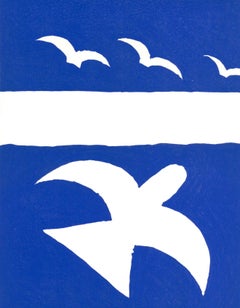
This exquisite lithograph after Georges Braque (1882–1963), titled Trois oiseaux sur fond bleu (Three Birds on a Blue Background), from Carnets intimes (Private Sketchbooks), Verve, ...
Category
1950s Modern Landscape Prints
Materials
Lithograph
$716 Sale Price
40% Off
Free Shipping
Georges Braque, Two Birds on a Blue Background, Carnets intimes, 1955 (after)
By Georges Braque
Located in Southampton, NY
This exquisite lithograph after Georges Braque (1882–1963), titled Deux oiseaux sur fond bleu (Two Birds on a Blue Background), from Carnets intime...
Category
1950s Modern Landscape Prints
Materials
Lithograph
$716 Sale Price
40% Off
Free Shipping
Bonnard, Composition (Terrasse 54), Pierre Bonnard Correspondences (after)
By Pierre Bonnard
Located in Southampton, NY
Lithograph on vélin d’Arches paper, mounted on vélin d’Arches backing sheet, as issued. Inscription: Unsigned and unnumbered, as issued. Good condition. Notes: From the album, Corres...
Category
1940s Modern Landscape Prints
Materials
Lithograph
$716 Sale Price
44% Off
Free Shipping