Want more images or videos?
Request additional images or videos from the seller
1 of 3
Rudolph RuzickaFountain of Sea Horses, Rome — Early 20th Centuryc. 1915
c. 1915
Price:$525
About the Item
- Creator:Rudolph Ruzicka (1883-1978, American)
- Creation Year:c. 1915
- Dimensions:Height: 5.38 in (13.67 cm)Width: 3.44 in (8.74 cm)
- Medium:
- Movement Style:
- Period:
- Condition:
- Gallery Location:Myrtle Beach, SC
- Reference Number:Seller: 1022841stDibs: LU53237128422
About the Seller
5.0
Recognized Seller
These prestigious sellers are industry leaders and represent the highest echelon for item quality and design.
Platinum Seller
Premium sellers with a 4.7+ rating and 24-hour response times
Established in 1995
1stDibs seller since 2016
336 sales on 1stDibs
Typical response time: 1 hour
Associations
International Fine Print Dealers Association
Authenticity Guarantee
In the unlikely event there’s an issue with an item’s authenticity, contact us within 1 year for a full refund. DetailsMoney-Back Guarantee
If your item is not as described, is damaged in transit, or does not arrive, contact us within 7 days for a full refund. Details24-Hour Cancellation
You have a 24-hour grace period in which to reconsider your purchase, with no questions asked.Vetted Professional Sellers
Our world-class sellers must adhere to strict standards for service and quality, maintaining the integrity of our listings.Price-Match Guarantee
If you find that a seller listed the same item for a lower price elsewhere, we’ll match it.Trusted Global Delivery
Our best-in-class carrier network provides specialized shipping options worldwide, including custom delivery.You May Also Like
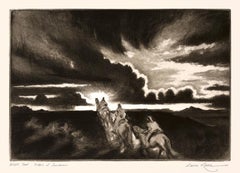
Elwood W. Bartlett, Turtle Creek (Wisconsin), about 1945, mid-century wood eng.
Located in New York, NY
Elwood Warren Bartlett is a Wisconsin native who also worked in Indiana. Turtle Creek (named of course for its many turtles,) is in the southeastern part of the Wisconsin. It is now ...
Category
1940s American Modern Landscape Prints
Materials
Woodcut
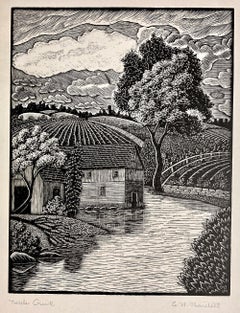
THE HARBOR WORKHORSE
By Woldemar Neufeld
Located in Portland, ME
Neufeld, Woldemar. THE HARBOR WORKHORSE. Woodcut in colors, not dated (c.1940s-50s). Edition size not known, but likely 50 or fewer. 17 1/2 x 12 inches, plu...
Category
Mid-20th Century American Modern Landscape Prints
Materials
Woodcut
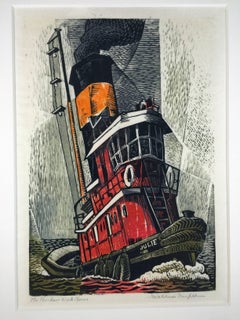
Chrysler Building (Chrysler Building in Construction)
By Howard Norton Cook
Located in New York, NY
Howard Cook (1901-1980), Chrysler Building (Chrysler Building in Construction) – –1930, Wood Engraving.
Duffy 122. Edition 75, only 50 printed. 19...
Category
1930s American Modern Landscape Prints
Materials
Woodcut
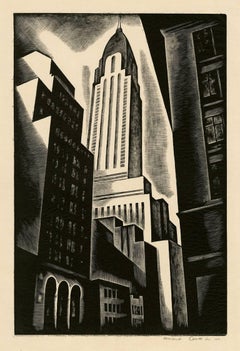
The Bridge
By Bror Julius Olsson Nordfeldt
Located in Santa Monica, CA
B. J. O. NORDFELDT (Bror Julius Olsson) 1878-1955)
THE BRIDGE, 1906
Color woodcut signed, dated 1906 and numbered 150 in pencil. Image 8 x 10 - small margins as issued. 4 corners tipped to acid free support board. Nordfelt is one of the most important early twentieth century American Masters of the Color woodcut. This 1906 work predates many of the other woodcut masters. Nordfeldt had a peculiar numbering system. The number is not necessarily the edition number.
Frances H. Gearhart, Blanche Lazzell, William S. Rice, Gustave Baumann, Margaret Patterson, Norma Basset Hall. Waldo Chase.
Category
Early 1900s American Modern Landscape Prints
Materials
Woodcut
"Trees, " Landscape Wood Engraving by Betsy Ritz Friebert
Located in Milwaukee, WI
"Trees" is an original wood engraving print by Betsy Ritz Friebert. It features a man walking down a large path underneath tall barren trees. Unsig...
Category
1930s American Modern Landscape Prints
Materials
Woodcut
$1,285
H 13.75 in W 14.75 in
"Squall, " Sailboat Maritime Scene Wood Engraving by Lowell Merritt Lee
By Lowell Merritt Lee
Located in Milwaukee, WI
"Squall is an original wood engraving by Lowell Merritt Lee. It features a rendition of a squall, a sudden violent gust of wind that often brings in rain, snow, or sleet.
Image: 6.1...
Category
1930s American Modern Landscape Prints
Materials
Woodcut
$1,285
H 14.25 in W 16.18 in
Jones Island
original woodcut engraving by Gerrit Sinclair
By Gerrit Sinclair
Located in Milwaukee, WI
The print 'Jones Island' is something of a self portrait. In the image, an artist stands before and easel, depicting the docks and buildings on the coast. The title indicates that this is Jones Island in Milwaukee, the peninsula along Lake Michigan that today is home to largely industrial buildings. The buildings and figures in the print suggest that this might be a view of the last of the Kashubian or German immigrant settlements on the peninsula before they were evicted in the 1940s to make way for the development of the harbor. The artist in the image thus acts as a documentarian of these peoples. The careful line-work of the woodblock engraving adds a sense of expressionism to the scene, leaving the figures and buildings looking distraught and dirty, though the image nonetheless falls into the Social Realist category that dominated American artists during the Great Depression.
This print was published in 1936 as part of the Wisconsin Artists' Calendar for the year 1937, which included 52 original, hand-made prints – one for each week of the year.
6 x 5 inches, image
10 x 7.13 inches, sheet
13.43 x 12.43 inches, frame
Signed "GS" in the print block,upper left
Entitled "Jones Island" lower left (covered by matting)
Inscribed "Wood Engraving" lower center (covered by matting)
Artist name "Gerrit V. Sinclair" lower right (covered by matting)
Framed to conservation standards using 100 percent rag matting and museum glass, all housed in a silver gilded moulding.
Gerrit Sinclair studied at the Art Institute of Chicago from 1910 - 1915, under Vanderpoel, Norton, and Walcott. In World War I, he served in the Army Ambulance Corps and later recorded his experiences in a series of oil paintings. He taught in Minneapolis before arriving in Milwaukee in 1920 to become a member of the original faculty of the Layton School of Art. He was also a member of the Wisconsin Painters & Sculptors.
Sinclair's paintings and drawings were executed in a lyrical, representational style, usually expressing a mood rather than a narrative. His paintings reveal a great sensitivity for color and atmosphere. His subject matter focused on cityscapes, industrial valleys, and working-class neighborhoods, captured from eye-level. A decade before the popularity of Regionalism, Sinclair's strong interest in the community was reflected not only in his paintings, but also in his encouragement to students to return to their communities as artists and teachers. Joseph Friebert...
Category
1930s American Modern Figurative Prints
Materials
Engraving, Woodcut
$1,300
H 13.43 in W 12.43 in
"Road to Cripple Creek, Colo., " Wood Engraving by Gerhard H. Bakker
Located in Milwaukee, WI
"Road to Cripple Creek, Colo." is an original woodcut print by Gerhardt H. Bakker. Lines full of expression and shape make up every bit of this print, fr...
Category
1930s American Modern Landscape Prints
Materials
Woodcut
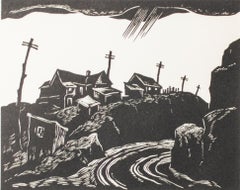
$1,283
H 12.37 in W 13.43 in
"Flood Waters, " Landscape Wood Engraving by Harold Wescott
By Harold Wescott
Located in Milwaukee, WI
"Flood Waters" is an original wood engraving by Harold Wescott, It features a tree in the center, with its roots wrapping languidly over a form. High waters rise up from the back. Un...
Category
1930s American Modern Landscape Prints
Materials
Woodcut
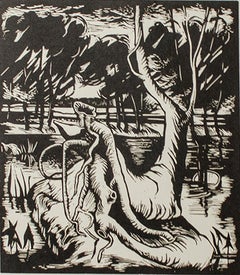
$1,285
H 16.37 in W 15.31 in
THE THAW
By William Seltzer Rice
Located in Santa Monica, CA
WILLIAM SELTZER RICE (1873 - 1963)
THE THAW c 1915-20
Color woodcut, signed and titled in pencil. Image 8 7/8 x 12 inches, sheet 10 3/4 x 14 3/8 inches. On textured fibrous paper. V...
Category
1910s American Modern Landscape Prints
Materials
Color, Woodcut
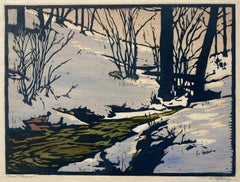
More From This Seller
View All
Sundown, Stonington, Maine
— Artist-printed Exhibition Proof
By Lawrence Wilbur
Located in Myrtle Beach, SC
Lawrence Nelson Wilbur (1897-1988), 'Sundown, Stonington, Maine', wood engraving, artist's proof, edition not stated but small, 1969. Signed and titled in pencil. Signed in the block...
Category
1940s American Modern Landscape Prints
Materials
Woodcut
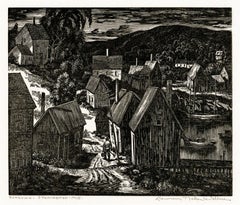
Tranquil Harbor (Gloucester, Massachusetts) — 1950s Cape Ann Regionalism
By Lawrence Wilbur
Located in Myrtle Beach, SC
Lawrence Nelson Wilbur (1897-1988), 'Tranquil Harbor' (Gloucester, Massachusetts), wood engraving, edition 55, 1958. Signed in pencil, and signe...
Category
1950s American Modern Landscape Prints
Materials
Woodcut
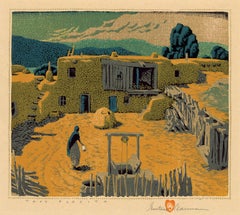
Taos Placita
— American Southwest Regionalist Masterwork
By Gustave Baumann
Located in Myrtle Beach, SC
Gustave Baumann, 'Taos Placita', color woodcut, 1947, edition 125. Baumann 132. Signed, titled, and numbered '20-125' in pencil; with the artist’s Hand-in-Heart chop. A superb, richly-inked impression, with fresh colors, on fibrous oatmeal wove paper; the full sheet with margins (2 to 3 1/8 inches); slight rippling at the left sheet edge, in excellent condition. Matted to museum standards, unframed.
Image size 9 5/8 x 11 1/4 inches (244 x 286 mm); sheet size 13 1/4 x 17 inches (337 x 432 mm).
Collections: Harwood Museum of Art, New Mexico Museum of Art, Phoenix Art Museum, Scottsdale Art Museum, Wichita Art Museum.
ABOUT THE ARTIST
Gustave Baumann (1881-1971) was a renowned printmaker and a leading figure of the American color woodcut revival whose exquisite craftsmanship and vibrant imagery captured the essence of the Southwest.
"A brilliant printmaker, Baumann brought to the medium a full mastery of the craft of woodworking that he acquired from his father, a German cabinetmaker. This craftsmanship was coupled with a strong artistic training that resulted in the handsome objects we see in the exhibition today. After discovering New Mexico in 1918, Baumann began to explore in his woodblock prints of this period the light. color, and architectural forms of that landscape. His prints of this period are among the most beautiful and poetic images of the American West."
—Lewis I. Sharp, Director, Denver Art Museum
Baumann, the son of a craftsman, immigrated to the United States from Germany with his family when he was ten, settling in Chicago. From 1897 to 1904, he studied in the evenings at the Art Institute of Chicago, working in a commercial printmaking shop during the day. In 1905, he returned to Germany to attend the Kunstwerbe Schule in Munich, where he decided on a career in printmaking. He returned to Chicago in 1906 and worked for a few years as a graphic designer of labels.
Baumann made his first prints in 1909 and exhibited them at the Art Institute of Chicago the following year. In 1910, he moved to the artists’ colony in Nashville, Indiana, where he explored the creative and commercial possibilities of a career as a printmaker. In 1915, he exhibited his color woodcuts at the Panama-Pacific International Exposition in San Francisco, winning the gold medal.
Among Baumann’s ongoing commercial activities was his work for the Packard Motor Car Company from 1914 to 1920 where he produced designs, illustrations, and color woodcuts until 1923.
In 1919, Baumann’s printmaking work dominated the important exhibition of American color woodcuts at the Detroit Institute of Arts. Twenty-six of his prints were included, far more than the works of any other artist. A set of his blocks, a preparatory drawing, and seven progressive proofs complemented the exhibition. That same year, Baumann worked in New York and, over the summer, in Provincetown, Massachusetts. His airy images of Cape Cod employed soft, pastel colors and occasionally showed the influence of the white-line woodcut technique.
Many of his Chicago artist friends had traveled to the southwest, and Baumann became intrigued by their paintings, souvenirs, and stories of an exotic place named Taos, New Mexico. In the summer of 1918, he spent the summer in Taos sketching and painting before visiting Santa Fe. Paul Walter, the director of the Museum of New Mexico, offered him a studio in the museum's basement. Inspired by the rugged beauty of the Southwest—the vibrant colors and dramatic landscapes of the region became a central theme in his work, influencing his artistic style and subject matter for the remainder of his career. Later in the decade, he traveled to the West Coast and made prints of California landscape.
Baumann's prints became synonymous with the Southwest, capturing the spirit of its place in America's identity with a unique sense of authenticity and reverence. His iconic images of desert vistas, pueblo villages, and indigenous cultures served as visual tributes to the region's rich cultural heritage, earning him a dedicated following among collectors and curators alike.
A true craftsman and artist, Baumann completed every step of the printmaking process himself, cutting each block, mixing the inks, and printing every impression on the handmade paper he selected. His dedication to true craftsmanship and his commitment to preserving the integrity of his artistic vision earned him widespread acclaim and recognition within the art world. About the vibrant colors he produced, Baumann stated, “A knowledge of color needs to be acquired since they don’t all behave the same way when ground or mixed...careful chemistry goes into the making of colors, with meticulous testing for permanence. While complicated formulae evolve new colors, those derived from Earth and metal bases are still the most reliable.”
In the 1930s, Baumann became interested in puppet theater. He designed and carved his own marionettes and established a little traveling company. From 1943 to 1945, the artist carved an altarpiece for the Episcopal Church of the Holy Faith in Santa Fe. In 1952, a retrospective exhibition of his prints was mounted at the New Mexico Museum of Fine Arts. Throughout his prolific career, Baumann executed nearly four hundred color woodcuts.
Baumann’s woodcuts...
Category
1940s American Modern Landscape Prints
Materials
Woodcut
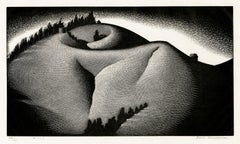
Hill
— American Modernism, California
By Paul Landacre
Located in Myrtle Beach, SC
Paul Landacre, 'Hill', wood engraving, 1936, edition 60 (only 54 printed); only 2 impressions printed in a second edition of 150. Signed, titled, and numbered '49/60' in pencil. Wien...
Category
1930s American Modern Landscape Prints
Materials
Woodcut
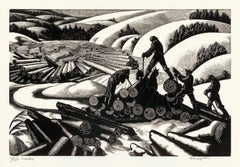
Landing
from the
Lumber Camp
series — American Modernism
By Clare Leighton
Located in Myrtle Beach, SC
Clare Leighton, 'Landing' from the series 'Lumber Camp', wood engraving, edition 100, 1931. Signed, titled, and numbered 75/100 in pencil. A fine, richly-inked impression, on off-whi...
Category
1930s American Modern Figurative Prints
Materials
Woodcut
Riders at Sundown
— Mid-Century Southwest Regionalism
By Gene Kloss
Located in Myrtle Beach, SC
'Riders at Sundown', aquatint and drypoint, edition 75, 1953, Kloss 451. Signed, titled, and annotated 'Artist's Proof' in pencil. A superb, richly-inked, atmospheric impression, in ...
Category
1950s American Modern Landscape Prints
Materials
Drypoint, Aquatint