Want more images or videos?
Request additional images or videos from the seller
1 of 8
Scott Kahn"Chrysler Building" Scott Kahn, New York City Skyscraper, Contemporary Print
$10,000List Price
About the Item
- Creator:Scott Kahn (1946, American)
- Dimensions:Height: 21 in (53.34 cm)Width: 18 in (45.72 cm)
- Medium:
- Movement Style:
- Period:
- Condition:
- Gallery Location:New York, NY
- Reference Number:1stDibs: LU1841212251552
About the Seller
5.0
Platinum Seller
Premium sellers with a 4.7+ rating and 24-hour response times
Established in 2022
1stDibs seller since 2022
132 sales on 1stDibs
Authenticity Guarantee
In the unlikely event there’s an issue with an item’s authenticity, contact us within 1 year for a full refund. DetailsMoney-Back Guarantee
If your item is not as described, is damaged in transit, or does not arrive, contact us within 7 days for a full refund. Details24-Hour Cancellation
You have a 24-hour grace period in which to reconsider your purchase, with no questions asked.Vetted Professional Sellers
Our world-class sellers must adhere to strict standards for service and quality, maintaining the integrity of our listings.Price-Match Guarantee
If you find that a seller listed the same item for a lower price elsewhere, we’ll match it.Trusted Global Delivery
Our best-in-class carrier network provides specialized shipping options worldwide, including custom delivery.You May Also Like
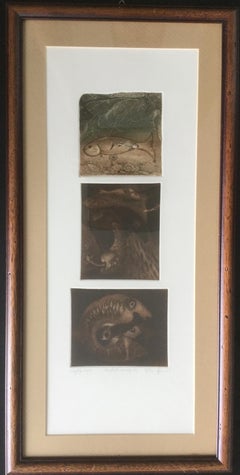
Fish Triptych - XX century, Figurative Etching Aquatint Print, small edition 7/X
By Andrzej Juchniewicz
Located in Salzburg, AT
The graphic is already framed.
About Andrzej Juchniewicz - 1967–1972 Secondary School of Fine Arts in Gdynia-Orłowo. 1978–1983 studies at the Acad...
Category
1990s Contemporary Landscape Prints
Materials
Paper, Etching, Aquatint
$890
H 21.66 in W 10.63 in D 0.79 in
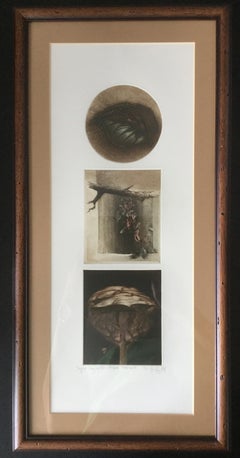
Leaves, Twigs and Trees Triptych - Figurative Mixed Med Print, small edition 2/X
By Andrzej Juchniewicz
Located in Salzburg, AT
The graphic is already framed.
About Andrzej Juchniewicz - 1967–1972 Secondary School of Fine Arts in Gdynia-Orłowo. 1978–1983 studies at the Acad...
Category
1990s Contemporary Landscape Prints
Materials
Paper, Mixed Media, Etching, Aquatint
$890
H 21.66 in W 10.63 in D 0.4 in
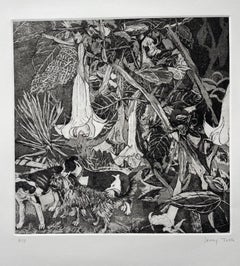
Trumpet Flowers and Playing Dogs, monochromatic black and white
By Jenny Toth
Located in Brooklyn, NY
This is a one of a kind aquatint printed in rich blacks. The image is 12 x 12 and is printed on a 20 x 20 piece of paper. The image depicts large trumpet flowers in a garden with d...
Category
2010s Contemporary Landscape Prints
Materials
Paper, Ink, Etching, Aquatint
$900
H 20 in W 20 in D 0.5 in
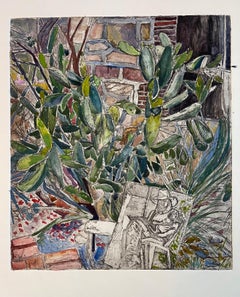
Mexican Garden Tangle
By Jenny Toth
Located in Brooklyn, NY
This is an artist proof (one of a kind) aquatint and watercolor depicting a cactus-filled Mexican garden, a mirror tilted up and an image of the artist s...
Category
2010s Contemporary Figurative Prints
Materials
Paper, Ink, Archival Ink, Aquatint, Watercolor
KCHO (Alexis Leyva Machado), ¨La Jungla 4¨, 2003, Aquatint, 24x29.1 in
By KCHO (Alexis Leyva Machado)
Located in Miami, FL
Alexis Kcho Leiva (Cuba, 1970)
'La Jungla 4', 2003
aquatint on paper Guarro Biblos 250g.
24.1 x 29.2 in. (61 x 74 cm.)
Edition of 50
Unframed
ID: KCH-105
Hand-signed by author
Category
Early 2000s Contemporary Landscape Prints
Materials
Paper, Etching, Aquatint, Screen
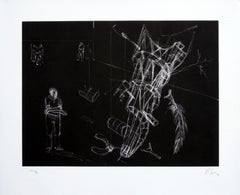
KCHO (Alexis Leyva Machado), ¨La Jungla 3¨, 2003, Aquatint, 24x29.1 in
By KCHO (Alexis Leyva Machado)
Located in Miami, FL
Alexis Kcho Leiva (Cuba, 1970)
'La Jungla 3', 2003
aquatint on paper Guarro Biblos 250g.
24.1 x 29.2 in. (61 x 74 cm.)
Edition of 50
Unframed
ID: KCH-104
Hand-signed by author
Category
Early 2000s Contemporary Landscape Prints
Materials
Paper, Etching, Aquatint, Screen
KCHO (Alexis Leyva Machado), ¨La Jungla 1¨, 2003, Aquatint, 24x29.1 in
By KCHO (Alexis Leyva Machado)
Located in Miami, FL
Alexis Kcho Leiva (Cuba, 1970)
'La Jungla 1', 2003
aquatint on paper Guarro Biblos 250g.
24.1 x 29.2 in. (61 x 74 cm.)
Edition of 50
Unframed
ID: KCH-102
Hand-signed by author
Category
Early 2000s Contemporary Landscape Prints
Materials
Paper, Etching, Aquatint
KCHO (Alexis Leyva Machado), ¨La Jungla 2¨, 2003, Aquatint, 24x29.1 in
By KCHO (Alexis Leyva Machado)
Located in Miami, FL
Alexis Kcho Leiva (Cuba, 1970)
'La Jungla 2', 2003
aquatint on paper Guarro Biblos 250g.
24.1 x 29.2 in. (61 x 74 cm.)
Edition of 50
Unframed
ID: KCH-103
Hand-signed by author
Category
Early 2000s Contemporary Landscape Prints
Materials
Paper, Etching, Aquatint
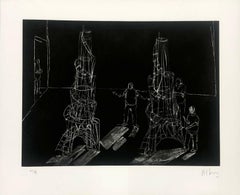
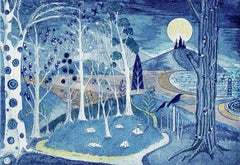
The Sacred Grove
By Kit Boyd
Located in Deddington, GB
Kit Boyd
The Sacred Grove
Unique hand-coloured etching and aquatint from the standard edition of 60.
Imaginary coastal landscape with birds and a figure.
hand printed on Hahnemuhle e...
Category
2010s Contemporary Figurative Prints
Materials
Paper, Etching, Aquatint
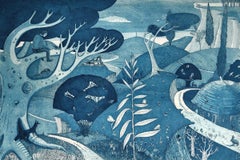
The Tree Climber
By Kit Boyd
Located in Deddington, GB
Kit Boyd
The Tree Climber
Etching and Aquatint on Hahnemuhle etching paper
Hand printed by the artist in Prussian Blue.
Edition of 50 signed copies.
Image size 45x30cm this work is s...
Category
2010s Contemporary Abstract Prints
Materials
Paper, Etching, Aquatint
More From This Seller
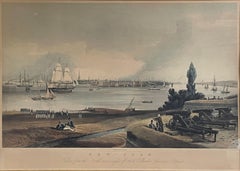
View All"New York - Taken from the Northwest angle of Fort Columbus, Governor
s Island"
Located in New York, NY
New York - Taken from the north west angle of Fort Columbus Governor's Island, 1846
Engraved by Henry Papprill after a sketch by F. Catherwood, published by Henry J. Megarey
Hand-colored engraving on paper
Image 16 x 26 1/2 inches
Henry A. Papprill (1816–1903) was a British engraver. Noted as an aquatint engraver from 1840. His plates were published from 1840 till 1883 mainly by Ackermann of the Strand.
Papprill was born in Holborn, London. Lived for much of his life at Wharton Street, Lloyd Square, London. Papprill is thought to have been based in New York City for brief period in the mid-1840s. His work in the USA appears to classify him as an American engraver but he was based and gained his reputation and bulk of his work in England.
He produced a series of works for Ackermann & Co from 1840 beginning with four plates called "The Jolly Squire", with verses, after James Pollard.
In the following years Papprill engraved a number of military plates for Ackermann as well a series of engravings of New York (1846-9) for H.I.Megarey (published in New York). The most notable of these are: "The North West Angle of Fort Columbus, Governor's Island" (the Catherwood-Papprill view) and New York from the Steeple of St. Paul's Church, Looking East, South & West." (The Hill-Papprill view) listed in the American Historical Prints - Early Views of American Cities, etc: I.N.Phelps Stokes & Daniel C. Haskell. New York Public Library 1932.
Papprill also produced for Ackermann a series of sporting prints after G. H. Laporte between 1860 and 1865. These were entitled: Racing, Hunting and Coursing. He also produced a series of shipping prints...
Category
1840s Landscape Prints
Materials
Paper, Engraving, Aquatint
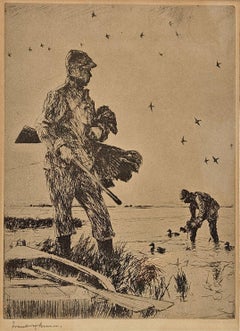
"Winter Wildfowling" Frank Weston Benson, Hunting Scene, Outdoors, Marshes
By Frank Weston Benson
Located in New York, NY
Frank Weston Benson
Winter Wildfowling, 1927
Signed lower left
Etching on paper
Image 8 1/2 x 7 inches
Born in Salem, Massachusetts, a descendant of a long line of sea captains, Benson first studied art at Boston’s Museum School where he became editor of the student magazine. In 1883, Benson enrolled at the Académie Julian in Paris where artists such as Bouguereau, Lefebvre, Constant, Doucet and Boulanger taught students from all over Europe and America. It was Boulanger who gave Benson his highest commendation. “Young man,” he said, “Your career is in your hands . . . you will do very well.” Benson’s parents gave him a present of one thousand dollars a twenty-first birthday and told him to return home when it ran out. The money lasted long enough to provide Benson with two years of schooling in Paris, a summer at the seaside village of Concarneau in Brittany and travel in England.
Upon returning to America, Benson opened a studio on Salem’s Chestnut Street and began painting portraits of family and friends. An oil of his wife, Ellen Perry Peirson, dressed in her wedding gown is representative of this period. It demonstrates not only the academic techniques he learned at the Academie Julian but also his own growing emphasis on the effects of light. And yet, despite all the technical mastery displayed in the work, the painting exudes the warmth that existed between model and artist. More than a likeness, it is a study in serenity. Perhaps it was of a work such as this that Benson was thinking when he said, “The more a painter knows about his subject, the more he studies and understands it, the more the true nature of it is perceived by whoever looks at it, even though it is extremely subtle and not easy to see or understand. A painter must search deeply into the aspects of a subject, must know and understand it thoroughly before he can represent it well.”
Following a brief stint as an instructor at the Portland, Maine, Society of Art, Benson was appointed as instructor of antique drawing at the Museum School in Boston in the spring of l889. Benson’s long association with the school was particularly fruitful. Under the leadership of Edmund Tarbell and Benson the Museum School became a national and internationally recognized institution. The students won numerous prizes, enrollment tripled, a new school building was erected and visiting delegations from other schools sought the secret of their success. Benson cherished his role as teacher and was held in high esteem by his students, many of whom called him “Cher Maitre.” Reminiscing about his long career with the school Benson once said, “I may have taught many students, but it was I who learned the most.”
In 1890, Benson won the Hallgarten Prize at the National Academy in New York. It was the first of a long series of awards, that earning for him the sobriquet “America’s Most Medalled Painter.” In the early years of his career, Benson’s studio works were mostly portraits or paintings of figures set in richly appointed interiors. Young women in white stretch their hands out towards the glow of an unseen fire; girls converse on an antique settee in a room full of objets d’arts; his first daughter, Eleanor, poses with her cat. Works of this sort, together with a steady influx of portrait commissions, earned Benson both renown and financial rewards, yet it was in his outdoor works that gave Benson his greatest pleasure.
In the latter half of the 1890s, Benson summered in Newcastle, on New Hampshire’s short stretch of seacoast. It was here, in 1899, that Benson made his first foray into impressionism with Children in the Woods and The Sisters, the latter a sun-dappled study of his two youngest daughters, Sylvia and Elisabeth.
This painting was one of the first works that Benson hung at an exhibition with nine friends. The resignation of these ten illustrious artists rocked the American art establishment but, the catalogue for their first exhibition was titled, simply, “Ten American Painters.” When, in 1898, the three Bostonians and seven New Yorkers began to exhibit their best work in exquisitely arranged small shows, the group (dubbed by newspapers, “The Ten” ) quickly became known as the American Impressionists, a bow to the style of their French predecessors. The Ten’s annual shows soon became an eagerly awaited part of the annual exhibition calendar and were always well reviewed. Held annually in New York City, the group’s yearly exhibitions usually traveled to Boston and were occasionally seen in other cities. Benson’s association with other members of the group such as Childe Hassam, Thomas Dewing, William Merrit Chase and J. Alden Weir, only reinforced his growing emphasis on the tenets of Impressionism. As he later said to his daughter Eleanor, “I follow the light, where it comes from, where it goes.”
The principles of Impressionism began to dominate Benson’s work by 1901, the year that the Bensons first summered on the island of North Haven in Maine’s Penobscot Bay. His summer home “Wooster Farm,” which they rented and finally bought in 1906, became the setting for some of Benson’s best known work and there, it seemed, he found endless inspiration. Benson’s sparkling plein-air paintings of his children–Eleanor, George, Elisabeth and Sylvia–capture the very essence of summer and have been widely reproduced: In The Hilltop, George and Eleanor watch the sailboat races from the headland near their house.
As a boy, Benson dreamed of being an ornithological illustrator. In mid-life, he returned to the wildfowl and sporting subjects that had remained his lifelong passion. Using etching and lithography, watercolor, oil and wash, Benson portrayed the birds observed since childhood and captured scenes of his hunting and fishing expeditions.
Together with his two brothers-in-law, Benson bought a small hunting retreat on a hill overlooking Cape Cod’s Nauset Marsh. Here, in the late 1890s, he began experimenting with black and white wash drawings. These paintings became so popular that Benson was not able to keep up with the demand. He turned to an art publishing company to have several made into it intaglio prints; twelve wash drawings are known to have been reproduced in this manner. At least two of them were given as gifts to associate members of the Boston Guild of artists, of which Benson was a founding member.
Benson was also an avid fisherman and his salmon fishing expeditions to Canada’s Gaspé Peninsula where one of the high points of his summer. There, in 1921, he began the first in a series of watercolors that would eventually over 500 works.
Benson’s watercolors conveyed the joy and beauty of a sportsman’s life whether in a painting of a hunter setting out decoys, a flock of ducks coming in for a landing or a grouse flushed from cover. The critics favorably compared Benson’s watercolors to those of Homer. “The love of the almost primitive wilderness which appears in many of Homer’s landscapes and the swift, sure touch with which he suggests rather than describes–these also characterize Benson’s work,” one critic wrote. “The solitude of the northern woods is very much like Homer’s.”
Like the wash drawings before them, Benson’s watercolors proved...
Category
1920s Academic Animal Prints
Materials
Paper, Etching
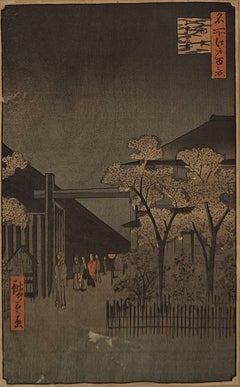
"Dawn Inside the Yoshiwara" Utagawa Hiroshige, Japanese Landscape, Ukiyo-e
By Utagawa Hiroshige
Located in New York, NY
Utagawa Hiroshige
Dawn Inside the Yoshiwara, circa 1857
Woodblock print
11 x 7 inches
Utagawa Hiroshige is recognized as a master of the ukiyo-e woodblock printing tradition, havin...
Category
1850s Naturalistic Figurative Prints
Materials
Paper, Ink, Woodcut
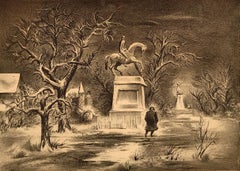
"City Park, Winter" Aaron Bohrod, Mid-Century, American Realist Nocturne
By Aaron Bohrod
Located in New York, NY
Aaron Bohrod
City Park, Winter, circa 1945
Signed in pencil lower right margin
Lithograph on wove paper
Image 9 1/2 x 13 1/2 inches
From the edition of 250
Aaron Bohrod's work has ...
Category
1940s American Realist Figurative Prints
Materials
Paper, Lithograph
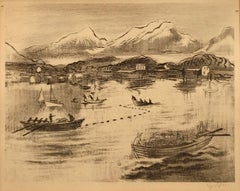
"Fishing Village" Joe Jones, Mid-Century, American Life, Small Town Scene
By Joe Jones
Located in New York, NY
Joe Jones
Fishing Village, 1949
Signed in pencil lower right margin
Lithograph on wove paper
Image 9 5/16 x 12 9/16 inches
Sheet 12 x 15 15/16 inches
From the edition of 250
The initial details of Jones' career are sparse, and this is intentional. The young artist was engaged in a process of self-reinvention, crafting a persona. When he submitted a work to the Sixteen Cities Exhibition at New York City's Museum of Modern Art in 1933, he briefly characterized himself: "Born St. Louis, 1909, self-taught. " Jones intentionally portrayed himself to the art community as an authentic working-class figure, backed by a compelling history. He was the youngest of five children in a family led by a one-armed house painter from St. Louis, a Welsh immigrant, and his German American spouse. At the age of ten, Jones found himself in a Missouri reformatory due to authorities' concerns over his graffiti activities. After completing elementary school, he traveled by freight car to California and back, even being arrested for vagrancy in Pueblo, Colorado. Returning to St. Louis, he attempted to settle down by working alongside his father. Yet, Jones felt a profound restlessness and was drawn toward a more elevated artistic pursuit in his late teenage years. He discovered a local collective of budding artists that formed St. Louis’s "Little Bohemia," sharing a studio and providing mutual support until he managed to secure his own modest workspace in a vacant garage.
Jones’s initial creations comprised still lifes, landscapes, and poignant portraits of those close to him. These subjects were not only accessible but also budget-friendly, as hiring models was beyond his means. He depicted himself, his father, mother, and eventually, his wife. In December 1930, at the age of 21, Jones wed Freda Sies, a modern dancer and political activist who was four years older than him.
By 1933, Jones had started gaining noteworthy local recognition through a solo exhibition at the Artists’ Guild of Saint Louis. Of the twenty-five paintings on display, one, titled River Front (private collection, previously with Hirschl and Adler Galleries), was selected to illustrate a feature article about his show in The Art Digest (February 15, 1933, p. 9). Shortly before this exhibition, a young surgeon named Dr. Robert Elman took an interest in Jones’s art, purchasing several pieces and forming a group of potential patrons committed to providing the emerging artist with a monthly stipend in exchange for art. This group was officially known as the "Co-operative Art Society," but it was informally dubbed the "Joe Jones Club. " Jones became an active participant in the St. Louis artistic scene, particularly within its bohemian segments. He embraced modernism and was a founding member of the "New Hat" movement in 1931, a playful rebellion against the conservative and traditional mainstream art establishment.
The summer of 1933 marked a significant shift in Jones’s journey. Sponsored by a dedicated ally, Mrs. Elizabeth Green, Jones, along with Freda and Green, embarked on an eastward road trip. In Washington, D. C., they explored the Corcoran Gallery of Art, the Freer Gallery (part of the Smithsonian Institution), the Library of Congress, and Mount Vernon. Following this whirlwind of art and American culture, they made their way to New York, where they visited various museums and galleries, including a stop at The New School for Social Research, which featured notable contemporary murals by fellow Missourian Thomas Hart Benton and the politically active Mexican artist, José Clemente Orozco. From June through August, Jones and Freda resided in the artist colony of Provincetown, Massachusetts, later returning home via Detroit to see Diego Rivera’s Detroit Industry mural housed at the Detroit Institute of Fine Arts.
While Elizabeth Green allegedly hoped that Jones would refine his artistic skills under the guidance of Charles Hawthorne or Richard Miller in Provincetown, Jones followed a different path. Rather than pursuing conservative mentors, he connected with an engaging network of leftist intellectuals, writers, and artists who dedicated their time to reading Marx and applying his theories to the American landscape. Jones's reaction to the traditional culture of New England was captured in his statement to a reporter from the St. Louis Post Dispatch: “Class consciousness . . . that’s what I got of my trip to New England. Those people [New Englanders] are like the Chinese—ancestor worshipers. They made me realize where I belong” (September 21, 1933). The stark social divisions he witnessed there prompted him to embrace his working-class identity even more fervently. Upon returning to St. Louis, he prominently identified himself as a Communist. This newfound political stance created friction with some of his local supporters. Many of his middle-class advocates withdrew their backing, likely influenced not only by Jones’s politics but also by his flamboyant and confrontational demeanor.
In December 1933, Jones initiated a complimentary art class for unemployed individuals in the Old Courthouse of St. Louis, the same location where the Dred Scott case was deliberated and where slave auctions formerly took place. Concurrently, the St. Louis Art League was offering paid courses. Emphasizing the theme of social activism, with a studio adorned with Soviet artwork, Jones’s institution operated for just over a year before being removed from the courthouse by local officials. The school’s political focus and unconventional teaching practices, along with its inclusion of a significant number of African American students during a period marked by rigid racial segregation, certainly contributed to its challenges. Under Jones’s guidance, the class created a large chalk pastel mural on board, measuring 16 by 37 feet, titled Social Unrest in St. Louis. Mural painting posed no challenge for the former housepainter, who was adept at handling large wall surfaces. His first significant commission in St. Louis in late 1931 was a mural that celebrated the city’s industrial and commercial fortitude for the local radio station, KMOX. This mural, aimed at conveying optimism amid severe economic hardship, showcased St. Louis's strengths in a modernist approach. When Jones resumed mural work in late 1933, his worldview had evolved considerably. The mural produced for the school in the courthouse, conceived by Jones, featured scenes of modern St. Louis selected to highlight political messages. Jones had observed the technique of utilizing self-contained scenes to craft visual narratives in the murals he encountered in the East. More locally, this compositional strategy was commonly employed by the renowned Missouri artist...
Category
1940s American Realist Landscape Prints
Materials
Paper, Lithograph
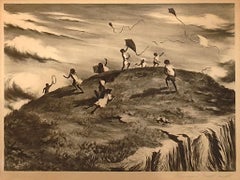
"Windy Hill" Lawrence Beall Smith, Mid-Century Realist Scene, American Life
By Lawrence Beall Smith
Located in New York, NY
Lawrence Beall Smith
Windy Hill, 1948
Signed in pencil lower right margin
Lithograph on wove paper
Image 10 3/8 x 13 1/16 inches
Sheet 11 15/16 x 16 inches
From the edition of 250
...
Category
1940s American Realist Figurative Prints
Materials
Paper, Lithograph
Recently Viewed
View AllMore Ways To Browse
Peter Blake Eiffel Tower
Ross Penhall
Roy Allison
Rudolph Stone Painting
Rudolph Wendelin
Russell Case Painting
Ruth Leialoha Kanahele Iversen
S C Yuan Painting
S C Yuan
S D Richelle
S Field Artist
Sadie Rosenblum
Safety Matches
Samir Rakhmanov
Sandu Liberman Sabbath Candles
Sandy Gravitch
Sannier Daniel
Santa Barbara Beach Paintings