Hudson River School Landscape Prints

HUDSON RIVER SCHOOL STYLE

Considered the first major American painting movement, the Hudson River School emerged in the first half of the 19th century with landscape paintings that celebrated the young country’s natural beauty. Most of its leading painters were based in New York City where they exchanged ideas and traveled to the nearby Hudson River Valley and Catskills Mountains to re-create their vistas. At a time when the city was increasingly dense, the Hudson River School artists extolled the vast and pristine qualities of the American landscape, a sentiment that would inform the conservation movement.

American art was dominated by portraiture and historical scenes before Thomas Cole, the founder of the Hudson River School, began painting the Catskill Mountains in 1825. While the Hudson River School was informed by European art aesthetics, particularly the British focus on the sublime in nature, it was a style imbued with nationalism. The landscape painters who followed and studied under Cole would expand their focus from the Northeastern United States to places across the country, their work shared through prints and portfolios promoting an appreciation for the American wilderness — Niagara Falls, the mountain ranges that dot the American West and more — as the style blossomed during the mid-19th century.

Cole’s student Frederic Edwin Church as well as painters such as Albert Bierstadt, John Frederick Kensett, Asher Brown Durand and others became prominent proponents of the Hudson River School. The American art movement also had close ties to the literary world, including to authors like William Cullen Bryant, Henry David Thoreau and James Fenimore Cooper who wrote on similar themes. Although by the early 1900s the style had waned, and modernism would soon guide the following decades of art in the United States, the Hudson River School received renewed interest in the late 20th century for the dramatic way its artists portrayed the world.

Find a collection of authentic Hudson River School paintings, drawings and watercolors and more art on 1stDibs.

to
2
2
Overall Width
to
Overall Height
to
4,675
3,194
812
808
745
656
649
442
370
89
83
78
28
15
2
1
2
2
1
4
2
1
1
1
1
1
1
1
1
1
1
2
2
1
1
1
1
4
Style: Hudson River School
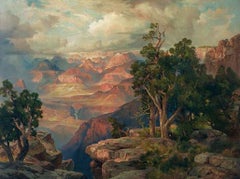
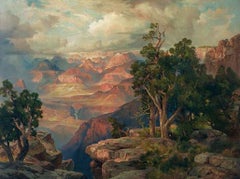
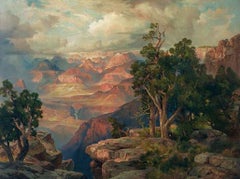
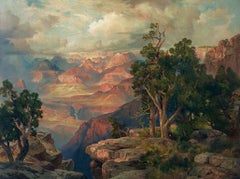
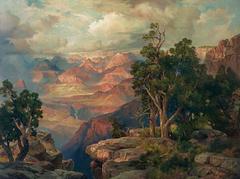
THOMAS MORAN Grand Canyon of Arizona from Hermit Rim Road 1912 Chromolithograph
Located in Rancho Santa Fe, CA
IN PRISTINE CONDITION. A color Chromolithograph published by the Atchison, Topeka and Santa Fe Railroad in 1912 after the original oil painting, “Gr...
Category

1910s Hudson River School Landscape Prints

Materials

Paper, Lithograph

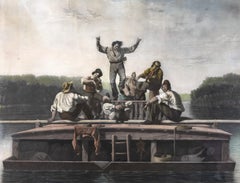
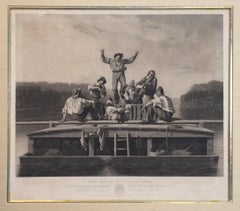
The Jolly Flat Boat Men
By George Caleb Bingham
Located in Missouri, MO
The Jolly Flat Boat Men, 1847 After George Caleb Bingham (American, 1811-1879) Engraved by Thomas Doney (French, active New York 1844-1849) Engraving with Hand-Coloring Published by The American Art-Union, New York (1838-1851) Printed by Powell and Co. 18 x 24 inches 32 x 38 inches with frame In 1847, the American Art-Union purchased Bingham’s painting "The Jolly Flat Boat Men" (1846; National Gallery of Art) directly from the artist. The subscription-based organization, founded in 1838 as the Apollo Association, boasted nearly ten-thousand members at this date. For an annual fee of five dollars, each received a large reproductive engraving and was entered in a lottery to win original artworks exhibited at the Art-Union’s Free Gallery. Aimed at educating the public about contemporary American art, the organization developed an impressive distribution network that reached members in every state. The broad circulation of the Art-Union's print helped to establish Bingham's reputation and made his river scene famous. Born in Augusta County, Virginia in the Shenandoah River Valley, George Caleb Bingham became known for classically rendered western genre, especially Missouri and Mississippi River scenes of boatmen bringing cargo to the American West and politicians seeking to influence frontier life. One of his most famous river genre paintings was The Jolly Flatboatmen completed in several versions in 1846. This first version of this painting is in the Manoogian Collection at the National Gallery of Art. Fame resulted for this work when it was exhibited in New York at the American Art Union whose organizers made an engraving of 10,000 copies and distributed it to all of their members. Paintings such as Country Politician (1849) and County Election (1852) and Stump Speaking (1854) reflected Bingham's political interests. In 1819, as an eight-year old, he moved to Boon's Lick, Missouri with his parents and grandfather who had been farmers and inn keepers in the Shenandoah Valley near Rockingham, Virginia. Reportedly as a child there, he took every opportunity to escape supervision to travel the River and watch the marine activity. His father died in 1827, when his son was sixteen years old. His mother had encouraged his art talent, but art lessons were not easily obtainable. In order to earn money, he apprenticed to a cabinet maker but determined to become an artist. By 1835, he had a modest reputation as a frontier painter and successfully charged twenty dollars per portrait in St. Louis. "His portraits had become standard decorations in prosperous Missouri homes." (Samuels 46). In 1836, he moved to Natchez, Mississippi and there had the same kind of career, only was able to charge forty dollars per portrait. He remained largely self taught until 1837, when he, age 26 and using the proceeds from his portraiture, studied several months at the Pennsylvania Academy of the Fine Arts. He later said that he learned much of his atmospheric style and classically balanced composition by copying paintings in collections in St. Louis and Philadelphia and that among his most admired painters were Thomas Cole, John Vanderlyn, and William Sidney Mount. Between 1856 and 1859, Bingham traveled back and forth to Dusseldorf, Germany, where he studied the work of genre painters. Some critics think these influences were negative on his work because during that time period, he abandoned his luminist style that had brought him so much public affirmation. Bingham credited Chester Harding (1792-1866) as being the earliest and one of the most lasting influences on his work. Harding,a leading portraitists when Bingham was a young man, had a studio in Franklin, near Bingham's home town. In 1822, when Bingham was ten years old, he watched Harding finish a portrait of Daniel Boone. Bingham recalled that watching Harding with the Boone portrait was a lasting inspiration and that it was the first time he had ever seen a painting in progress. Harding suggested to Bingham that he begin doing portraiture by finding subjects in the river men, which, of course, opened the subject matter that established fame and financial success for Bingham. Harding also encouraged Bingham to copy with paint engravings. He later painted two portraits of Boone but, contrary to the assertions of some scholars, he did not do Boone portraits in the company of Harding. Bingham's portraits of Boone are not located, but one of them, a wood signboard for a hotel in Boonville circa 1828 to 1830, showed a likeness of Boone in buckskin dress...
Category

1840s Hudson River School Landscape Prints

Materials

Engraving

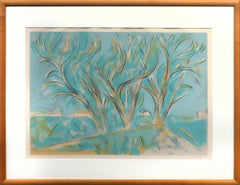
Trees and Fields, Print Club of Cleveland
Located in Berlin, MD
“Trees and Fields” lithograph commissioned for the Print Club of Cleveland by Peter Takal Peter Takal’s original lithograph “Trees and Fields” is an accomplished work of art created in 1957. This lithograph bears the stamp “The Print Club of Cleveland” on verso. This impression is signed by Takal in pencil. “Trees and Fields” is a fine example of the art created by the 20th century Romanian / German / American artist, Peter Takal. Peter Takal: Born in Romania in 1905, Peter Takal spent most of his youth in Berlin and was mainly self-taught. His first one-man exhibition took place in the Gurlitt Gallery, Berlin, in 1932. During the following seven years his art was frequently exhibited at galleries in Berlin, Munich, Paris and as well as Casablanca and Algiers. At the beginning of the Second World War (1939), Peter Takal came to the United States for an exhibition of his art at the Katherine Kuhe Gallery, Chicago. He decided to remain in the United States and became an American citizen in 1944. Living in New York, Peter Takal quickly established himself as a leading printmaker and a modern master of both lithography and drypoint engraving. One-man exhibitions of his art took place in New York City (1942), Chicago (1939 & 1941), Washington (1959) and Los Angeles (1966). International exhibitions of his art were held at the Galeria de Arte Mexicano, Mexico City (1959), the Palazzo Strozzi, Florence, Italy (1960) and at the Kestner-Museum in Germany (1962). Museums to date that include Peter Takal's original prints in their collections are, the Chicago Art Institute, the Library of Congress, Washington, the Los Angeles County Museum of Art, the United States State Department, UCLA, the Berlin National Museum and the Bibliotheque Nationale, Paris. Over the years, the Museum of Modern Art in New York and the Arkansas Arts Center have acquired a very extensive collection of Peter Takal's lithographs and drypoints. The artist died in 1995. The Print Club of Cleveland: The Print Club of Cleveland is a non-profit adjunct organization and the country's first museum-affiliated print club devoted to the promotion of art and printmaking as a fine art for printmakers and collectors alike. With its creation in 1919, it has helped to support the growth of the department of prints and drawings at the Cleveland Museum of Fine Arts and has also been a source of great enrichment for collectors of fine prints. During the organizations long history, the club has annually commissioned one original etching engraving, lithograph, woodcut and or other form of original graphic art from such fine American artists as John Taylor Arms, Suzanne Anker, Luigi Lucioni, Will Barnet, Mark Tobey, Lyonel Feininger, Henry George Keller, Louis Lozowick, Karl Schrag, David Jansheski, Deborah Remington, and Peter Takal, as well as from leading international artists such as Henri Matisse, Edmund Blampied, Jean-Emile Laboureur, Salvador Dali, Michael di Cerbo, Phyliss Sloane, Paolo Boni, Juvenal Sanso...
Category

Mid-20th Century Hudson River School Landscape Prints

Materials

Lithograph

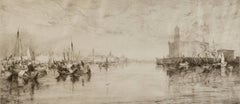
19th century etching black and white seascape print boats water buildings signed
Located in Milwaukee, WI
This black and white etching by American painter and print maker of the Hudson River School in New York: Thomas Moran, is a rare Klackner #53 of the catalogue raisonné, depicting "The Harbor of Vera...
Category

1880s Hudson River School Landscape Prints

Materials

Parchment Paper, Etching

Related Items
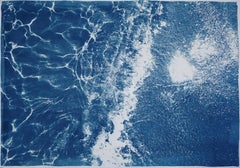
Realist Skyscape Triptych in Blue Tones of Serene Cloudy Sky, Handmade Cyanotype
Located in Barcelona, ES
This series of cyanotype triptychs showcases the beauty of nature scenes, including stunning beaches and oceans, as well as the intricate textures of water, forests, and skies. These...
Category

2010s Hudson River School Landscape Prints

Materials

Paper, Emulsion, Lithograph

"End of Day" Original Limited Edition Etching
Located in Soquel, CA
"End of Day" Original Limited Edition Etching by John McGrath (Irish/American b.1884 d.1942). This etching depicts a man with a tool slung over his shoulder walking along a path th...
Category

Early 20th Century Hudson River School Landscape Prints

Materials

Paper, Ink, Drypoint, Etching

Master American Contemporaries
Located in Wien, 9
The art work is signed in the print at the lower left and numbered in pencil: P.P. II/IV This special art piece "Master American Contemporaries" by Alex Katz (*1927) is a colour lit...
Category

1990s Hudson River School Landscape Prints

Materials

Lithograph, Paper

Vachère au Bord de l Eau
Located in Santa Monica, CA
CAMILLE PISSARRO (French 1830-1903) VACHERE au BORD de l’EAU 1890 (Delteil 93 viii/viii) Etching, unsigned as published in “Gazette des Beaux Arts”, Paris, 1890. On laid paper Very...
Category

1890s Hudson River School Landscape Prints

Materials

Drypoint, Etching

Vachère au Bord de l
Eau
Vachère au Bord de l
Eau
$1,463 Sale Price
24% Off
H 7.75 in W 5.25 in
The Lunar Cycle – 9 Phases of the Moon by Guy Allen. Prints with Wooden Frames
Located in Coltishall, GB
A set of nine prints. The Moon has had an importance in human culture since the dawn of history and likely before. Often revered as a feminine deit...
Category

21st Century and Contemporary Hudson River School Landscape Prints

Materials

Paper, Etching, Wood

Communipaw, NY; January Thaw
Located in Middletown, NY
A delicate composition of an industrial Hudson River town, seen from lower Manhattan; a view of what is now Liberty State Park. New York: 1884. Etching with aquatint on cream laid p...
Category

Late 19th Century Hudson River School Landscape Prints

Materials

Laid Paper, Etching, Aquatint

Jerusalem – The Church of the Purification
Located in Middletown, NY
An image of Jerusalem from the first comprehensive collection of documentary images of the Holy Land. London: Cassell, Petter & Galpin, circa 1850. Lithograph with hand coloring an...
Category

Mid-19th Century Hudson River School Landscape Prints

Materials

Watercolor, Handmade Paper, Lithograph

"Confidences" James Abbott McNeill Whistler Conversation with a Fellow Artist
Located in Soquel, CA
"Confidences" James Abbott McNeill Whistler Conversation with a Fellow Artist "Confidences" James Abbott McNeill Whistler Conversation with a Fellow Artist A Drypoint etching on Wove...
Category

Early 1900s Hudson River School Landscape Prints

Materials

Handmade Paper, Drypoint, Etching

Stardust
Located in Greenwich, CT
Stardust is a lithograph on paper with an image size of 2.5 x 3.25 inches, initialed 'FMB' lower right and annotated lower left, framed in a contemporary silver and dark gray frame. ...
Category

20th Century Hudson River School Landscape Prints

Materials

Paper, Lithograph

Stardust
Stardust
$395
H 15 in W 15.75 in
Illustrations From The Book of Job - "The Fire of God is Fallen From Heaven"
Located in Soquel, CA
"Illustrations of the Book of Job" Engraving "The Fire of God is Fallen From Heaven...And the Lord said unto Satan Behold All that he hath is in thy Power" Engraving, third printing...
Category

1870s Hudson River School Landscape Prints

Materials

Handmade Paper, Engraving

19th century woodcut engraving print figurative American forest trees scene
Located in Milwaukee, WI
The present woodcut engraving is an original print designed by Winslow Homer, originally published in Harper's Weekly on April 30, 1859. It is an excellent example of the many prints Homer produced of fashionable people engaged in leisurely activities, in this case along a picturesque countryside lane. The sign reading 'Belmont' on the left indicates this is probably near his home in Belmont Massachusetts. The image presents multiple figures, both men and women, riding horseback: Some in the distance gallop away, toward a town marked by a church steeple beyond. Three others in the foreground, including two equestrian women, gather around a group of children who have been gathering flowers and trapping birds...
Category

1850s Hudson River School Landscape Prints

Materials

Woodcut, Engraving

San Marino (Sketch)
Located in Middletown, NY
Ecthing in black ink on cream laid paper with a partial watermark, full margins. In excellent condition. A very scarce work from an edition of less than 20 impressions. Signed, date...
Category

Mid-20th Century Hudson River School Landscape Prints

Materials

Laid Paper, Etching

Previously Available Items
"The Jolly Flatboatmen" Missouri River Frontier Old West, Louisiana Purchase
By George Caleb Bingham
Located in New York, NY
George Caleb Bingham (1811 - 1879) The Jolly Flatboatmen, 1846 Engraving on paper Sheet 23 x 26 1/2 inches Inscription below image left and right corners reads: "Painted by G.C. Bingham, esq," "Engraved by T. Doney," "Printed by Powell and co." Published by the American Art Union, New York. Provenance: Saunders Fine Art, Stone Mountain, Geogia Dr. Mark C. Wood Thomasville Cultural Center, Thomasville, Georgia (gifted to from the above in 1991) Born in Augusta County, Virginia in the Shenandoah River Valley, George Caleb Bingham became known for classically rendered western genre, especially Missouri and Mississippi River scenes of boatmen bringing cargo to the American West and politicians seeking to influence frontier life. One of his most famous river genre paintings was The Jolly Flatboatmen, 1846. The first version of this painting is in the Manoogian Collection at the National Gallery of Art. Fame resulted for this work when it was exhibited in New York at the American Art Union, whose organizers made an engraving of 10,000 copies and distributed it to all of their members. Paintings such as Country Politician (1849) and County Election (1852) and Stump Speaking (1854) reflected Bingham's political interests. In 1819, as an eight-year old, he moved to Boon's Lick, Missouri with his parents and grandfather who had been farmers and millers in the Shenandoah Valley near Rockingham, Virginia. Reportedly as a child there, he took every opportunity to escape supervision to travel the River and watch the marine activity. His father died in 1823, when his son was 12 years old. His mother had encouraged his art talent, but art lessons were not easily obtainable. In order to earn money, he apprenticed to a cabinet maker but determined to become an artist. By 1835, he had a modest reputation as a frontier painter and successfully charged twenty dollars per portrait in St. Louis. "His portraits had become standard decorations in prosperous Missouri homes." (Samuels 46). In 1836, he moved to Natchez, Mississippi and there had the same kind of career, only was able to charge forty dollars per portrait. He remained largely self taught until 1837, when he, age 26 and using the proceeds from his portraiture, studied several months at the Pennsylvania Academy of the Fine Arts. He later said that he learned much of his atmospheric style and classically balanced composition by copying paintings in collections in St. Louis and Philadelphia and that among his most admired painters were Thomas Cole, John Vanderlyn, and William Sidney Mount. Between 1856 and 1859, Bingham traveled back and forth to Dusseldorf, Germany, where he studied the work of genre painters. Some critics think these influences were negative on his work because during that time period, he abandoned his luminist style that had brought him so much public affirmation. Bingham credited Chester Harding (1792-1866) as being the earliest and one of the most lasting influences on his work. Harding, a leading portraitist when Bingham was a young man, had a studio in Franklin, near Bingham's home town. In 1822, when Bingham was ten years old, he watched Harding finish a portrait of Daniel Boone...
Category

1840s Hudson River School Landscape Prints

Materials

Paper, Engraving

Grand Canyon of Arizona from Hermit Rim Road 1912 (Color Chromolithograph)
Located in Rancho Santa Fe, CA
A Chromolithograph published by the Atchison, Topeka and Santa Fe Railroad in 1912 after the original oil painting commissioned by the AT&SF railroad. According to Nancy K. Anderson,...
Category

1910s Hudson River School Landscape Prints

Materials

Paper, Lithograph

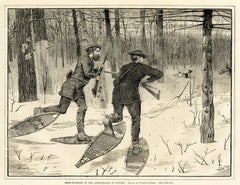
Deer Stalking in the Adirondacks in Winter
Located in Fairlawn, OH
Deer Stalking in the Adirondacks in Winter Wood engraving, 1871 Signed in the block (see photo) Published in: Every Saturday, Jan. 21, 1871 Engraved by G. A. Avery Exhibited: Indianapolis Museum of Art, Nov. 25 to Jan. 26, 1981 and later throughout Indiana on the S.T.E.P. traveling exhibition. (This impression) Reference: Beam 188 Goodrich 54 Provenance: Roman Radecki, Sr., South Bend...
Category

1870s Hudson River School Landscape Prints

Materials

Woodcut

Grand Canyon of Arizona from Hermit Rim Road 1912 (Color Chromolithograph)
Located in Rancho Santa Fe, CA
A Chromolithograph published by the Atchison, Topeka and Santa Fe Railroad in 1912 after the original oil painting commissioned by the AT&SF railroad. According to Nancy K. Anderson,...
Category

1910s Hudson River School Landscape Prints

Materials

Paper, Lithograph

Grand Canyon of Arizona from Hermit Rim Road
Located in Rancho Santa Fe, CA
A Chromolithograph published by the Atchison, Topeka and Santa Fe Railroad in 1912 after the original oil painting commissioned by the AT&SF railroad...
Category

1910s Hudson River School Landscape Prints

Materials

Paper, Lithograph

Grand Canyon of Arizona from Hermit Rim Road
Located in Rancho Santa Fe, CA
A Chromolithograph published by the Atchison, Topeka and Santa Fe Railroad in 1912 after the original oil painting commissioned by the AT&SF rail...
Category

1910s Hudson River School Landscape Prints

Materials

Paper, Lithograph

Hudson River School landscape prints for sale on 1stDibs.

Find a wide variety of authentic Hudson River School landscape prints available for sale on 1stDibs. Works in this style were very popular during the 20th Century, but contemporary artists have continued to produce works inspired by this movement. Many Pop art paintings were created by popular artists on 1stDibs, including Thomas Moran, and Peter Takal. Frequently made by artists working with Lithograph, and Paper and other materials, all of these pieces for sale are unique and have attracted attention over the years. Not every interior allows for large Hudson River School landscape prints, so small editions measuring 18.5 inches across are also available. Prices for landscape prints made by famous or emerging artists can differ depending on medium, time period and other attributes. On 1stDibs, the price for these items starts at $695 and tops out at $14,175, while the average work sells for $8,500.

Recently Viewed

View All