1830s More Prints
to
1
8
2
Overall Width
to
Overall Height
to
6
1
238
511
4,630
2,990
34
57
92
132
240
381
796
1,069
597
424
174
9
2
9
1
1
1
1
3
6
10
Period: 1830s
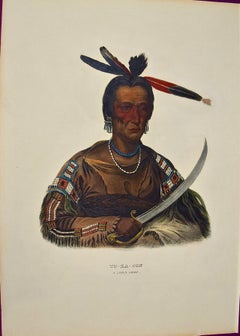
To-Ka-Con, A Sioux Chief: Hand-colored McKenney
Hall Folio-sized Lithograph
Located in Alamo, CA
This is an original 19th century hand-colored folio-size McKenney and Hall engraving of a Native American entitled "To-Ka-Con, A Sioux Chief", drawn ...
Category
Naturalistic 1830s More Prints
Materials
Engraving
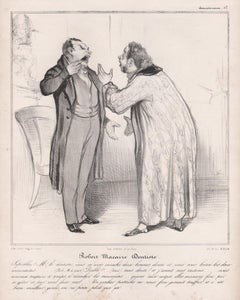
Robert Macaire Dentiste, French dentistry dentist caricature lithograph
Located in Melbourne, Victoria
'Robert Macaire Dentiste'
Lithograph by Honore Daumier after Charles Philipon. 1837. Plate 57 from the Robert Macaire 'Caricaturana' series.
Translation of the French text below th...
Category
French School 1830s More Prints
Materials
Lithograph
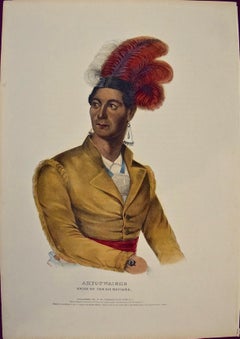
Ahyouwaighs, Chief of Six Nations: Hand-colored McKenney Folio-sized Lithograph
Located in Alamo, CA
This is an original 19th century hand-colored folio size McKenney and Hall engraving of a Native American entitled "Ahyouwaighs, Chief of the Six Nat...
Category
Naturalistic 1830s More Prints
Materials
Engraving
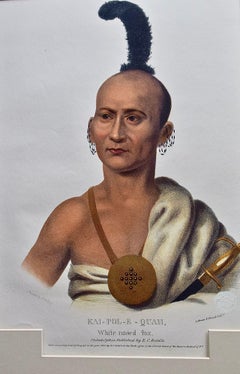
Kai-Pol-E-Quah: 19th C. Hand-colored McKenney
Hall Folio-sized Lithograph
Located in Alamo, CA
An original 19th century hand-colored folio-size McKenney and Hall lithograph of a Native American entitled "Kai Pol E Quah, White Nosed F...
Category
Naturalistic 1830s More Prints
Materials
Engraving
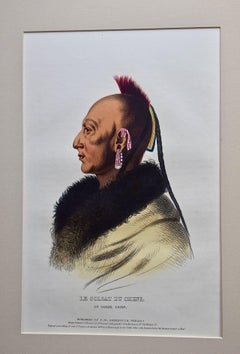
Le Soldat Du Chene, Osage Chief: Hand Colored McKenney Folio-sized Lithograph
Located in Alamo, CA
An original 19th century hand-colored folio-size McKenney and Hall lithograph of a Native American entitled "Le Soldat Du Chene, An Osage ...
Category
Naturalistic 1830s More Prints
Materials
Engraving
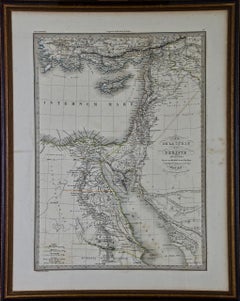
Map of the Holy Land "Carte de la Syrie et de l
Egypte" by Pierre Lapie
By Pierre M. Lapie
Located in Alamo, CA
This is an early 19th century map of ancient Syria and Egypt entitled "Carte de la Syrie et de l'Egypte anciennes/dressée par M. Lapie, Colonel d'Etat M...
Category
1830s More Prints
Materials
Engraving
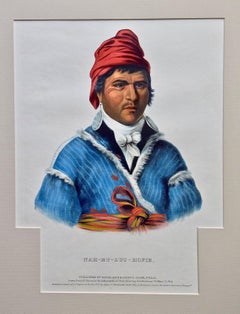
Nah-Et-Luc-Hopie: 19th C. Hand-colored McKenney
Hall Folio-sized Lithograph
Located in Alamo, CA
An original 19th century hand-colored folio-size McKenney and Hall lithograph of a Native American entitled "Nah-Et-Luc-Hopie", created by...
Category
Naturalistic 1830s More Prints
Materials
Engraving
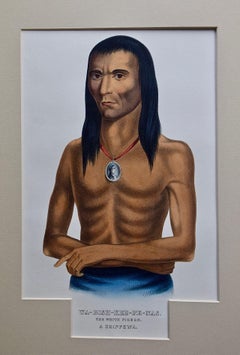
Wa-Bish-Kee-Pe-Na: 19th C. Hand-colored McKenney
Hall Folio-sized Lithograph
Located in Alamo, CA
An original 19th century hand-colored folio-size McKenney and Hall lithograph of a Native American entitled "Wa-Bish-Kee-Pe-Na, The White ...
Category
Naturalistic 1830s More Prints
Materials
Engraving
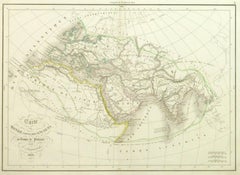
Ancient World Map
Located in Houston, TX
Over 150 year old engraved map of the world as it was known during the antiquities by cartographer Delamarche from 1838. Original hand color. Shows African, European and Asian cont...
Category
1830s More Prints
Materials
Ink, Watercolor, Handmade Paper
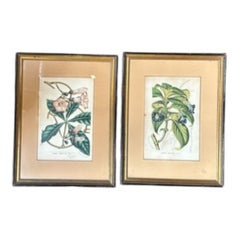
Pair of 19th Century Framed Botanical Prints Hooker
Gardner
Located in Jacksonville, FL
A stunning pair of original 19th-century hand-colored botanical engravings featuring Ipomoea horsfalliae and Chirita walkeria, attributed to renowned British botanists William Jackso...
Category
Victorian 1830s More Prints
Materials
Engraving
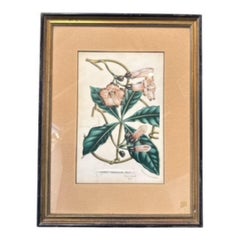
19th Century Botanical Engraving “Ipomoea Horsfalliae” by W. J. Hooker. Framed
Located in Jacksonville, FL
A striking 19th-century botanical engraving depicting Ipomoea horsfalliae, also known as Lady Doorly’s Morning Glory. This exquisite floral illustration is attributed to the renowned...
Category
Victorian 1830s More Prints
Materials
Engraving
Related Items
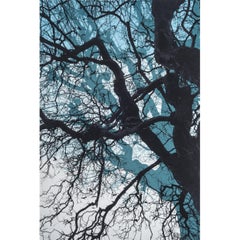
Branches Blue, Limited edition print, Landscape, Tree, Nature art
Located in Deddington, GB
This print is part of a small series of works to investigate the use of layering, colour blends and texture in screen print to elicit an ethereal, eerie and potentially dizzying sens...
Category
Contemporary 1830s More Prints
Materials
Drypoint, Etching

$102
H 22.05 in W 14.97 in D 0.4 in
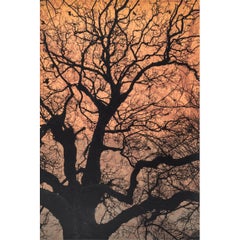
Branches Gold, Limited edition print, Landscape, Tree, Nature art
Located in Deddington, GB
Scots Pine drypoint etching printed onto Japanese gampi tissue and backed onto German Hahnemule printmaking paper. This print depicts a mature pine tree, standing proud from the rest...
Category
Contemporary 1830s More Prints
Materials
Drypoint, Etching
$102
H 22.05 in W 14.97 in D 0.4 in
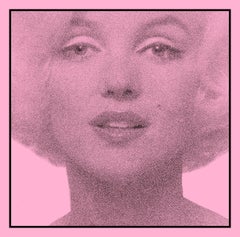
Forever Marilyn VI (Limited Edition Print)
Located in LOS ANGELES, CA
Celebrating Marilyn Monroe with this ultra sophisticated piece.
Limited edition of 30 museum quality Giclee prints on PAPER, signed and numbered by the artist. Print lead time 1 wee...
Category
Pop Art 1830s More Prints
Materials
Giclée
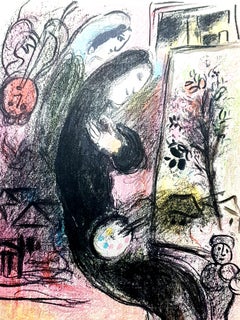
Marc Chagall - Inspiration - Original Lithograph from "Chagall Lithographe" v. 2
By Marc Chagall
Located in Collonge Bellerive, Geneve, CH
Marc Chagall
Original Lithograph from Chagall Lithographe 1957-1962. VOLUME II.
1963
Dimensions: 32 x 24 cm
From the unsigned edition of 10000 copies without margins
Reference: Mourlot 398
Condition : Excellent
Marc Chagall (born in 1887)
Marc Chagall was born in Belarus in 1887 and developed an early interest in art. After studying painting, in 1907 he left Russia for Paris, where he lived in an artist colony on the city’s outskirts. Fusing his own personal, dreamlike imagery with hints of the fauvism and cubism popular in France at the time, Chagall created his most lasting work—including I and the Village (1911)—some of which would be featured in the Salon des Indépendants exhibitions. After returning to Vitebsk for a visit in 1914, the outbreak of WWI trapped Chagall in Russia. He returned to France in 1923 but was forced to flee the country and Nazi persecution during WWII. Finding asylum in the U.S., Chagall became involved in set and costume design before returning to France in 1948. In his later years, he experimented with new art forms and was commissioned to produce numerous large-scale works. Chagall died in St.-Paul-de-Vence in 1985.
The Village
Marc Chagall was born in a small Hassidic community on the outskirts of Vitebsk, Belarus, on July 7, 1887. His father was a fishmonger, and his mother ran a small sundries shop in the village. As a child, Chagall attended the Jewish elementary school, where he studied Hebrew and the Bible, before later attending the Russian public school. He began to learn the fundamentals of drawing during this time, but perhaps more importantly, he absorbed the world around him, storing away the imagery and themes that would feature largely in most of his later work.
At age 19 Chagall enrolled at a private, all-Jewish art school and began his formal education in painting, studying briefly with portrait artist Yehuda Pen. However, he left the school after several months, moving to St. Petersburg in 1907 to study at the Imperial Society for the Protection of Fine Arts. The following year, he enrolled at the Svanseva School, studying with set designer Léon Bakst, whose work had been featured in Sergei Diaghilev's Ballets Russes. This early experience would prove important to Chagall’s later career as well.
Despite this formal instruction, and the widespread popularity of realism in Russia at the time, Chagall was already establishing his own personal style, which featured a more dreamlike unreality and the people, places and imagery that were close to his heart. Some examples from this period are his Window Vitebsk (1908) and My Fianceé with Black Gloves (1909), which pictured Bella Rosenfeld, to whom he had recently become engaged.
The Beehive
Despite his romance with Bella, in 1911 an allowance from Russian parliament member and art patron Maxim Binaver enabled Chagall to move to Paris, France. After settling briefly in the Montparnasse neighborhood, Chagall moved further afield to an artist colony known as La Ruche (“The Beehive”), where he began to work side by side with abstract painters such as Amedeo Modigliani and Fernand Léger as well as the avant-garde poet Guillaume Apollinaire. At their urging, and under the influence of the wildly popular fauvism and cubism, Chagall lightened his palette and pushed his style ever further from reality. I and the Village (1911) and Homage to Apollinaire (1912) are among his early Parisian works, widely considered to be his most successful and representative period.
Though his work stood stylistically apart from his cubist contemporaries, from 1912 to 1914 Chagall exhibited several paintings at the annual Salon des Indépendants exhibition, where works by the likes of Juan Gris, Marcel Duchamp and Robert Delaunay were causing a stir in the Paris art world. Chagall’s popularity began to spread beyond La Ruche, and in May 1914 he traveled to Berlin to help organize his first solo exhibition, at Der Sturm Gallery. Chagall remained in the city until the highly acclaimed show opened that June. He then returned to Vitebsk, unaware of the fateful events to come.
War, Peace and Revolution
In August 1914 the outbreak of World War I precluded Chagall’s plans to return to Paris. The conflict did little to stem the flow of his creative output, however, instead merely giving him direct access to the childhood scenes so essential to his work, as seen in paintings such as Jew in Green (1914) and Over Vitebsk (1914). His paintings from this period also occasionally featured images of the war’s impact on the region, as with Wounded Soldier (1914) and Marching (1915). But despite the hardships of life during wartime, this would also prove to be a joyful period for Chagall. In July 1915 he married Bella, and she gave birth to a daughter, Ida, the following year. Their appearance in works such as Birthday (1915), Bella and Ida by the Window (1917) and several of his “Lovers” paintings give a glimpse of the island of domestic bliss that was Chagall’s amidst the chaos.
To avoid military service and stay with his new family, Chagall took a position as a clerk in the Ministry of War Economy in St. Petersburg. While there he began work on his autobiography and also immersed himself in the local art scene, befriending novelist Boris Pasternak, among others. He also exhibited his work in the city and soon gained considerable recognition. That notoriety would prove important in the aftermath of the 1917 Russian Revolution when he was appointed as the Commissar of Fine Arts in Vitebsk. In his new post, Chagall undertook various projects in the region, including the 1919 founding of the Academy of the Arts. Despite these endeavors, differences among his colleagues eventually disillusioned Chagall. In 1920 he relinquished his position and moved his family to Moscow, the post-revolution capital of Russia.
In Moscow, Chagall was soon commissioned to create sets and costumes for various productions at the Moscow State Yiddish Theater...
Category
Surrealist 1830s More Prints
Materials
Lithograph
$1,494
H 9.45 in W 12.6 in D 0.04 in
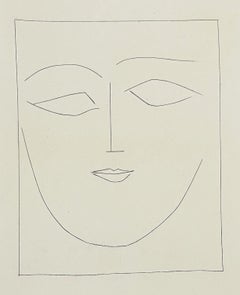
Square Head of a Woman with Full Lips, from Carmen
Located in Washington, DC
Artist: Pablo Picasso
Title: Square Head of a Woman with Full Lips
Portfolio: Carmen
Medium: Etching on Montval wove paper
Year: 1949
Edition Size: 289
Framed Size: 18 3/4" x 16 3/4"...
Category
1830s More Prints
Materials
Etching
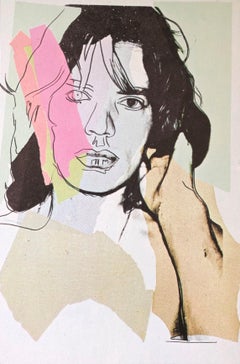
Mick Jagger V - Andy Warhol, Announcement card, Rolling Stones, Musician, Pop
Located in Knowle Lane, Cranleigh
Mick Jagger V - After Andy Warhol. The light green background contrasts with the abstract pink slashes on the image of this lithographic print. Mick Jagger is an iconic rock legend who was the frontman and one of the founders who sang lead in the British Rock and Roll Band, The Rolling Stones...
Category
Pop Art 1830s More Prints
Materials
Lithograph
$1,302
H 12.01 in W 8.67 in D 0.79 in
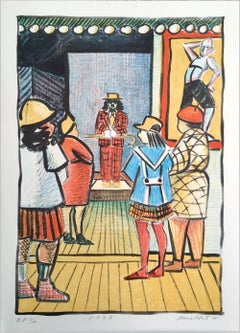
C F S I, Signed Lithograph, Coney Island, Comic Character Figures
By Marie Roberts
Located in Union City, NJ
C F S I is an original hand drawn lithograph by the New York woman artist Marie Roberts printed using hand lithography techniques on archival Arches paper 100% acid free. C F S I portrays a Coney Island Sideshow Performance with several onlookers standing by the stage watching the show. C F S I is a skillfully expressed comic character figure drawing printed in black ink shaded with colored crayon line textures in shades of red, yellow and blue. C F S I is a very fine impression exemplifying the magic and artistic mastery of hand crafted lithography with its nuanced tusche brush strokes and pencil crayon line textures and shading.
Print size - 29.5 x 21.25 in, unframed, excellent condition, hand signed in pencil by Marie Roberts
Image size - 26.25 x 18.25 in
Year published - 1995
Edition size - 25
Marie Roberts, a Coney Island native is best known for her banners for the Coney Island Circus Sideshow...
Category
Contemporary 1830s More Prints
Materials
Lithograph
$612 Sale Price
30% Off
H 29.5 in W 21.25 in
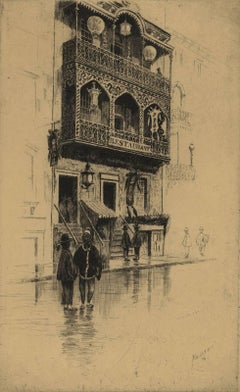
Restaurant in Mott Street
Located in New Orleans, LA
The image depicts a restaurant on New York's Mott Street with ornamental iron work on the balconies. There are six figures in the scene in various stages of contrast. Mott Street is considered the unofficial Main Street of New York's Chinatown. Ella Fitzgerald sang it best: “And tell me what street compares with Mott Street in July? Sweet pushcarts gently gliding by.”
CFW Mielatz was an early influence on the drypoints and etchings of Martin Lewis. This piece was created in 1906 and it is signed in pencil. It is part of the collection of New York's Metropolitan Museum of Art
C.F.W. Mielatz
American, 1860-1919
Born in Bredding, Germany in 1864, Mielatz emigrated to the United States as a young boy and studied at the Chicago School of Design. Mostly self-taught, his first prints were large New England landscapes reminiscent of the painter-etcher school of American Art. Around 1890 he started to produce prints of New York City and by the time of his death, the number totaled over ninety images. He was a master technician in the field of etching, reworking many of his plates to get the exact feeling he was seeking. Mielatz was a member of the New York Etching...
Category
American Modern 1830s More Prints
Materials
Drypoint, Etching
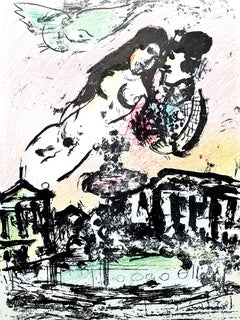
Marc Chagall - Original Lithograph
By Marc Chagall
Located in Collonge Bellerive, Geneve, CH
Marc Chagall
Original Lithograph
1963
Dimensions: 32 x 24 cm
Reference: Chagall Lithographe 1957-1962. VOLUME II.
Condition : Excellent
Marc Chagall (born in 1887)
Marc Chagall was born in Belarus in 1887 and developed an early interest in art. After studying painting, in 1907 he left Russia for Paris, where he lived in an artist colony on the city’s outskirts. Fusing his own personal, dreamlike imagery with hints of the fauvism and cubism popular in France at the time, Chagall created his most lasting work—including I and the Village (1911)—some of which would be featured in the Salon des Indépendants exhibitions. After returning to Vitebsk for a visit in 1914, the outbreak of WWI trapped Chagall in Russia. He returned to France in 1923 but was forced to flee the country and Nazi persecution during WWII. Finding asylum in the U.S., Chagall became involved in set and costume design before returning to France in 1948. In his later years, he experimented with new art forms and was commissioned to produce numerous large-scale works. Chagall died in St.-Paul-de-Vence in 1985.
The Village
Marc Chagall was born in a small Hassidic community on the outskirts of Vitebsk, Belarus, on July 7, 1887. His father was a fishmonger, and his mother ran a small sundries shop in the village. As a child, Chagall attended the Jewish elementary school, where he studied Hebrew and the Bible, before later attending the Russian public school. He began to learn the fundamentals of drawing during this time, but perhaps more importantly, he absorbed the world around him, storing away the imagery and themes that would feature largely in most of his later work.
At age 19 Chagall enrolled at a private, all-Jewish art school and began his formal education in painting, studying briefly with portrait artist Yehuda Pen. However, he left the school after several months, moving to St. Petersburg in 1907 to study at the Imperial Society for the Protection of Fine Arts. The following year, he enrolled at the Svanseva School, studying with set designer Léon Bakst, whose work had been featured in Sergei Diaghilev's Ballets Russes. This early experience would prove important to Chagall’s later career as well.
Despite this formal instruction, and the widespread popularity of realism in Russia at the time, Chagall was already establishing his own personal style, which featured a more dreamlike unreality and the people, places and imagery that were close to his heart. Some examples from this period are his Window Vitebsk (1908) and My Fianceé with Black Gloves (1909), which pictured Bella Rosenfeld, to whom he had recently become engaged.
The Beehive
Despite his romance with Bella, in 1911 an allowance from Russian parliament member and art patron Maxim Binaver enabled Chagall to move to Paris, France. After settling briefly in the Montparnasse neighborhood, Chagall moved further afield to an artist colony known as La Ruche (“The Beehive”), where he began to work side by side with abstract painters such as Amedeo Modigliani and Fernand Léger as well as the avant-garde poet Guillaume Apollinaire. At their urging, and under the influence of the wildly popular fauvism and cubism, Chagall lightened his palette and pushed his style ever further from reality. I and the Village (1911) and Homage to Apollinaire (1912) are among his early Parisian works, widely considered to be his most successful and representative period.
Though his work stood stylistically apart from his cubist contemporaries, from 1912 to 1914 Chagall exhibited several paintings at the annual Salon des Indépendants exhibition, where works by the likes of Juan Gris, Marcel Duchamp and Robert Delaunay were causing a stir in the Paris art world. Chagall’s popularity began to spread beyond La Ruche, and in May 1914 he traveled to Berlin to help organize his first solo exhibition, at Der Sturm Gallery. Chagall remained in the city until the highly acclaimed show opened that June. He then returned to Vitebsk, unaware of the fateful events to come.
War, Peace and Revolution
In August 1914 the outbreak of World War I precluded Chagall’s plans to return to Paris. The conflict did little to stem the flow of his creative output, however, instead merely giving him direct access to the childhood scenes so essential to his work, as seen in paintings such as Jew in Green (1914) and Over Vitebsk (1914). His paintings from this period also occasionally featured images of the war’s impact on the region, as with Wounded Soldier (1914) and Marching (1915). But despite the hardships of life during wartime, this would also prove to be a joyful period for Chagall. In July 1915 he married Bella, and she gave birth to a daughter, Ida, the following year. Their appearance in works such as Birthday (1915), Bella and Ida by the Window (1917) and several of his “Lovers” paintings give a glimpse of the island of domestic bliss that was Chagall’s amidst the chaos.
To avoid military service and stay with his new family, Chagall took a position as a clerk in the Ministry of War Economy in St. Petersburg. While there he began work on his autobiography and also immersed himself in the local art scene, befriending novelist Boris Pasternak, among others. He also exhibited his work in the city and soon gained considerable recognition. That notoriety would prove important in the aftermath of the 1917 Russian Revolution when he was appointed as the Commissar of Fine Arts in Vitebsk. In his new post, Chagall undertook various projects in the region, including the 1919 founding of the Academy of the Arts. Despite these endeavors, differences among his colleagues eventually disillusioned Chagall. In 1920 he relinquished his position and moved his family to Moscow, the post-revolution capital of Russia.
In Moscow, Chagall was soon commissioned to create sets and costumes for various productions at the Moscow State Yiddish Theater...
Category
Surrealist 1830s More Prints
Materials
Lithograph
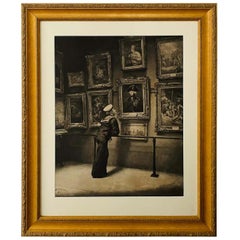
Albert W Holden "One Hundred Years Ago 1805-1905" Original Print Signed
Framed
Located in Plainview, NY
One hundred years ago 1805-1905 original print signed and dated 1905 by Albert w holden (British, 1848-1932) features a royal naval seaman admiring portraits and art wall in the form...
Category
American Impressionist 1830s More Prints
Materials
Paper
$1,400 Sale Price
20% Off
H 27.75 in W 22.75 in D 1.25 in
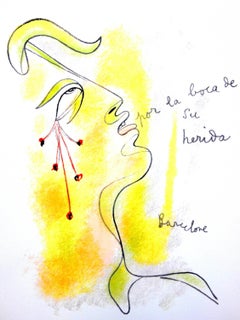
Jean Cocteau - Profile - Original Lithograph
By Jean Cocteau
Located in Collonge Bellerive, Geneve, CH
Original Lithograph by Jean Cocteau
Title: Taureaux
Signed in the plate
Dimensions: 40 x 30 cm
Edition: 200
Luxury print edition from the portfolio of Trinckvel
1965
Jean Cocteau
W...
Category
Modern 1830s More Prints
Materials
Lithograph
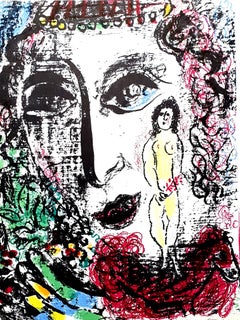
Marc Chagall - Original Lithograph
By Marc Chagall
Located in Collonge Bellerive, Geneve, CH
Marc Chagall
Original Lithograph
1963
Dimensions: 32 x 24 cm
Reference: Chagall Lithographe 1957-1962. VOLUME II.
Condition : Excellent
Marc Chagall (born in 1887)
Marc Chagall was born in Belarus in 1887 and developed an early interest in art. After studying painting, in 1907 he left Russia for Paris, where he lived in an artist colony on the city’s outskirts. Fusing his own personal, dreamlike imagery with hints of the fauvism and cubism popular in France at the time, Chagall created his most lasting work—including I and the Village (1911)—some of which would be featured in the Salon des Indépendants exhibitions. After returning to Vitebsk for a visit in 1914, the outbreak of WWI trapped Chagall in Russia. He returned to France in 1923 but was forced to flee the country and Nazi persecution during WWII. Finding asylum in the U.S., Chagall became involved in set and costume design before returning to France in 1948. In his later years, he experimented with new art forms and was commissioned to produce numerous large-scale works. Chagall died in St.-Paul-de-Vence in 1985.
The Village
Marc Chagall was born in a small Hassidic community on the outskirts of Vitebsk, Belarus, on July 7, 1887. His father was a fishmonger, and his mother ran a small sundries shop in the village. As a child, Chagall attended the Jewish elementary school, where he studied Hebrew and the Bible, before later attending the Russian public school. He began to learn the fundamentals of drawing during this time, but perhaps more importantly, he absorbed the world around him, storing away the imagery and themes that would feature largely in most of his later work.
At age 19 Chagall enrolled at a private, all-Jewish art school and began his formal education in painting, studying briefly with portrait artist Yehuda Pen. However, he left the school after several months, moving to St. Petersburg in 1907 to study at the Imperial Society for the Protection of Fine Arts. The following year, he enrolled at the Svanseva School, studying with set designer Léon Bakst, whose work had been featured in Sergei Diaghilev's Ballets Russes. This early experience would prove important to Chagall’s later career as well.
Despite this formal instruction, and the widespread popularity of realism in Russia at the time, Chagall was already establishing his own personal style, which featured a more dreamlike unreality and the people, places and imagery that were close to his heart. Some examples from this period are his Window Vitebsk (1908) and My Fianceé with Black Gloves (1909), which pictured Bella Rosenfeld, to whom he had recently become engaged.
The Beehive
Despite his romance with Bella, in 1911 an allowance from Russian parliament member and art patron Maxim Binaver enabled Chagall to move to Paris, France. After settling briefly in the Montparnasse neighborhood, Chagall moved further afield to an artist colony known as La Ruche (“The Beehive”), where he began to work side by side with abstract painters such as Amedeo Modigliani and Fernand Léger as well as the avant-garde poet Guillaume Apollinaire. At their urging, and under the influence of the wildly popular fauvism and cubism, Chagall lightened his palette and pushed his style ever further from reality. I and the Village (1911) and Homage to Apollinaire (1912) are among his early Parisian works, widely considered to be his most successful and representative period.
Though his work stood stylistically apart from his cubist contemporaries, from 1912 to 1914 Chagall exhibited several paintings at the annual Salon des Indépendants exhibition, where works by the likes of Juan Gris, Marcel Duchamp and Robert Delaunay were causing a stir in the Paris art world. Chagall’s popularity began to spread beyond La Ruche, and in May 1914 he traveled to Berlin to help organize his first solo exhibition, at Der Sturm Gallery. Chagall remained in the city until the highly acclaimed show opened that June. He then returned to Vitebsk, unaware of the fateful events to come.
War, Peace and Revolution
In August 1914 the outbreak of World War I precluded Chagall’s plans to return to Paris. The conflict did little to stem the flow of his creative output, however, instead merely giving him direct access to the childhood scenes so essential to his work, as seen in paintings such as Jew in Green (1914) and Over Vitebsk (1914). His paintings from this period also occasionally featured images of the war’s impact on the region, as with Wounded Soldier (1914) and Marching (1915). But despite the hardships of life during wartime, this would also prove to be a joyful period for Chagall. In July 1915 he married Bella, and she gave birth to a daughter, Ida, the following year. Their appearance in works such as Birthday (1915), Bella and Ida by the Window (1917) and several of his “Lovers” paintings give a glimpse of the island of domestic bliss that was Chagall’s amidst the chaos.
To avoid military service and stay with his new family, Chagall took a position as a clerk in the Ministry of War Economy in St. Petersburg. While there he began work on his autobiography and also immersed himself in the local art scene, befriending novelist Boris Pasternak, among others. He also exhibited his work in the city and soon gained considerable recognition. That notoriety would prove important in the aftermath of the 1917 Russian Revolution when he was appointed as the Commissar of Fine Arts in Vitebsk. In his new post, Chagall undertook various projects in the region, including the 1919 founding of the Academy of the Arts. Despite these endeavors, differences among his colleagues eventually disillusioned Chagall. In 1920 he relinquished his position and moved his family to Moscow, the post-revolution capital of Russia.
In Moscow, Chagall was soon commissioned to create sets and costumes for various productions at the Moscow State Yiddish Theater...
Category
Surrealist 1830s More Prints
Materials
Lithograph
Previously Available Items
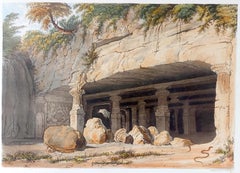
India Hand Coloured Aquatint Great Cave Temple of Elephanta Bombay 19th century
Located in Norfolk, GB
William Westall
Entrance of the great Cave Temple of Elephanta, near Bombay, drawn in 1803
Aquatint, coloured. Published 1830,
Image size 20.5 x 29 cm
Plate Size 32 x 41cm
This rare, hand-coloured aquatint is plate 29 of Robert Melville Grindlay's 'Scenery, Costumes and Architecture chiefly on the Western Side of India'. Grindlay (1786-1877) was only seventeen when he arrived in India. He served with the Bombay Native Infantry between 1804 and 1820, and during this period he made a large collection of...
Category
Other Art Style 1830s More Prints
Materials
Paper, Aquatint
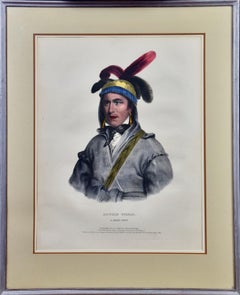
Opothe Yoholo, A Creek Chief: Hand-colored McKenney Folio-sized Lithograph
Located in Alamo, CA
This is an original 19th century hand-colored folio size McKenney and Hall lithograph portrait of a Native American entitled "Opothle Yoholo, A Creek Chief", drawn by J. T. Bowen aft...
Category
Naturalistic 1830s More Prints
Materials
Engraving
H 24.38 in W 20 in D 0.5 in
Hand Colored McKenney
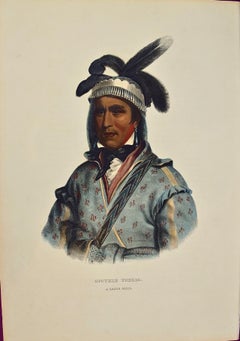
Hall Folio Lithograph "Opothle Yoholo, Creek Chief"
Located in Alamo, CA
An original 19th century hand-colored folio size McKenney and Hall engraving of a Native American entitled "Opothle Yoholo, A Creek Chief", drawn by J. T. Bowen after a painting by C...
Category
Naturalistic 1830s More Prints
Materials
Engraving
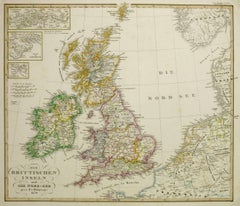
Map of British Isles
Located in Houston, TX
Over 150 year old engraved map of British Isles, titled "Die Brittischen Inseln" from 1839. Original hand color. Inset shows detail of London...
Category
1830s More Prints
Materials
Ink, Watercolor, Handmade Paper
More Ways To Browse
Gustav Klutsis
Ihap Hulusi
Ivan Navarro
James B Painter
James Bond Movie Posters
Jan V Roy Posters
John Lennon On Sale
Lait Pur Sterilize
Lake District Vintage Travel Poster
Land Rover Poster
Le Frou Frou Vintage Poster
Leon De Pas
Leon Wuidar
Lillian Snelling
Man Ray Electro Magie
Maurin Quina Print
Michael Schwab Posters
Miroslav Sutej