1860s More Prints
to
3
2
4
3
Overall Width
to
Overall Height
to
1
3
1
1
1
1
239
511
4,630
2,984
33
57
92
132
239
380
793
1,072
600
424
175
7
2
8
1
3
8
1
Period: 1860s
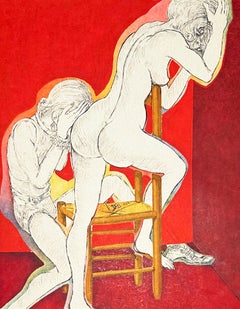
Without Hope, from The Marquis de Sade
Located in Washington, DC
Artist: Salvador Dali
Title: Without Hope, from The Marquis de Sade
Medium: Lithograph in colors on Japon paper
Date: 1969
Edition: 6/J
Frame Size: 31 5/8" x 25 1/8"
Sheet Size: 25 5...
Category
Surrealist 1860s More Prints
Materials
Lithograph
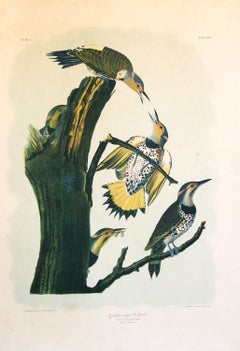
Golden Winged Woodpecker by J.J. Audubon Bien Edition 1860
Located in Paonia, CO
The Golden Winged Woodpecker, Plate 273 Picus auratus, Linn. The current name, Northern Flicker, Colaptes auratus. is in good condition. The edges are ragged from age with small areas of paper missing in two places but only on the very edge.
The ” Birds of America” by John James...
Category
Other Art Style 1860s More Prints
Materials
Lithograph
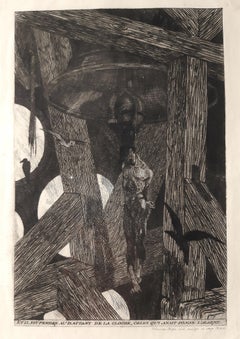
Le Pendu (The Hanged Man) - Etching by Félicien Rops - 1868
Located in Roma, IT
The Hanged Man is an original etching realized by Félicien Rops in 1868, – 3rd state on 4, plate from “Uylenspiegel”, title "Le pendu, ou la mère gran...
Category
Symbolist 1860s More Prints
Materials
Etching
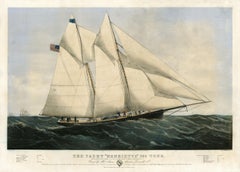
The Yacht "Henrietta" 205 Tons. Modelled by Mr. Wm. Tooker, N.Y. Built by Mr. ..
By Charles Parsons
Located in New York, NY
Title continues: Built by Mr. Henry Steers, Greenpoint, L. I. Owned by Mr. James Gordon Bennett, Jr. Winner of the Great Ocean Yacht Race, With the ...
Category
American Realist 1860s More Prints
Materials
Lithograph
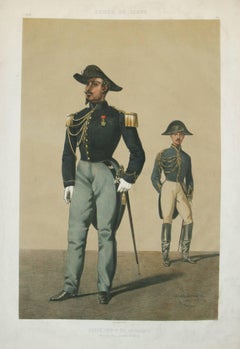
Ecole Imp.DE Cavalerie, Officier du Cadre Armee De Ligne pub. Lemercier 1861
Located in Paonia, CO
Ecole Imp.DE Cavalerie, Officier du Cadre shows two bearded French soldiers from the Armee De Ligne or the Line Army series. There is an officer in the foreground and a soldier...
Category
1860s More Prints
Materials
Lithograph
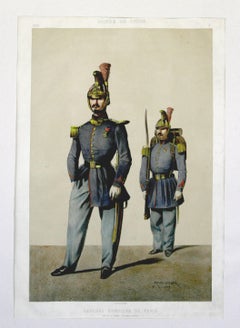
Sapeurs- Pompiers De Paris, Armee de Ligne pub. Lemercier lithograph 1861
Located in Paonia, CO
Sapeurs- Pompiers De Paris, Officier et Soldat ( Grandes Tenures).... Fire Brigade In Paris, Officer and Soldier (Large Tenure ) shows two mustachioed French soldiers from the A...
Category
1860s More Prints
Materials
Lithograph
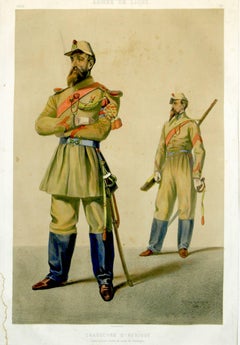
Chasseurs D
Afrique, Armee de Ligne lithograph pub. Lemercier 1861
Located in Paonia, CO
Chasseurs D’Afrique shows two bearded French soldiers from the Armee De Ligne or the Line Army series. There is an officer in the foreground with his arms across his chest and a...
Category
1860s More Prints
Materials
Lithograph
Union Pond, Williamsburgh, L. I. [sic].
Located in New York, NY
UNION POND, WILLIAMSBURGH, L. I. [sic] is a lithograph printed in color in circa 1862. It was published by Thomas & Eno, 37 Park Row, N.Y. The printed image size is 16 3/4 x 27 in...
Category
American Realist 1860s More Prints
Materials
Lithograph
![Union Pond, Williamsburgh, L. I. [sic].](https://a.1stdibscdn.com/winslow-homer-prints-works-on-paper-union-pond-williamsburgh-l-i-sic-for-sale/a_3312/1595513020620/Homer_Union_Pond_frame_IMG_8498_master.jpg?width=240 "homer pours water on console gif")
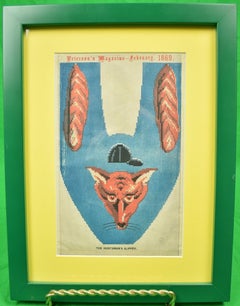
The Huntsman
s Slipper 1869
Located in Bristol, CT
Peter Son's Magazine -February, 1869.
Print Sz: 9 3/8"H x 5 7/8"W
Frame Sz: 13 3/4"H x 10 1/2"W
w/ yellow mat & hunter green wood frame
Category
1860s More Prints
Materials
Lithograph
Related Items
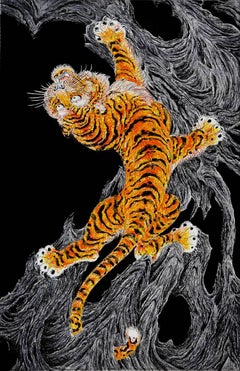
Climber
By Don Ed Hardy
Located in Lyons, CO
Color lithograph, Edition 30
Don Ed Hardy is a painter, printmaker and tattoo artist. Fascinated by tattoos since childhood, Hardy has become a master...
Category
Contemporary 1860s More Prints
Materials
Lithograph
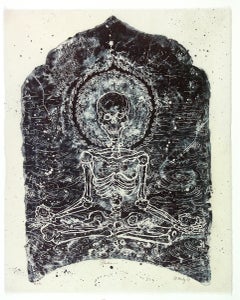
Floater
By Don Ed Hardy
Located in Lyons, CO
Color lithograph, Edition 20.
Don Ed Hardy’s lithographs, created in the spring of 2007, continue the “look” of his Ghost Writer painting series which has been developed over the past five years. They are evocative of ancient Chinese stone rubbings, or x-rays. Both prints refer to earlier images from Japanese art history.
Floater, a meditating skeleton poised above surging waves, was done from memory after a 19th century Japanese painting...
Category
Contemporary 1860s More Prints
Materials
Lithograph
Original
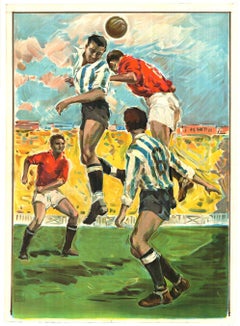
Soccer
vintage lithograph posters a.k.a. "Heads Up", Spain
Located in Spokane, WA
Original Soccer vintage sports poster. Linen backed in very good condition, ready to frame. Printed by Ortega Company in Valencia.
This type of untitled vintage poster was commonly printed and the date of an upcoming game and team would be added at the bottom of the poster. Soccer games were played quite often, allowing the local team to advertise their events without reprinting a new poster for each game or event. This poster was printed as a full lithograph, so it was expensive to produce. There is no specific designation of which two teams are being shown here in this antique poster
The poster has a nickname of ‘heads-up,” as two of the players are in the air as they position themselves to control the soccer ball.
Valencia two main clubs, FC València and Levante UD, attract hordes of fans to their matches. Both clubs play in the First Division of La Liga...
Category
Kinetic 1860s More Prints
Materials
Lithograph

$680 Sale Price
20% Off
H 42.5 in W 32 in D 0.05 in
Butterfly Roof and Inner Tube (Print) (edition of 75)
By Danny Heller
Located in Fairfield, CT
Represented by George Billis Gallery, NYC & LA --This is a limited edition print of Heller's original painting "Butterfly Roof and Inner Tube." Edition of 75. Print dimension 17 x 24...
Category
American Realist 1860s More Prints
Materials
Archival Ink, Archival Paper

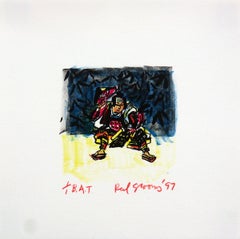
Samurai
By Red Grooms
Located in Lyons, CO
Color lithograph, Edition 40.
Red Grooms and Master printer Bud Shark began their many print collaborations in 1981 with “Mountaintime”, followed in 1982 by their first three-dimensional lithograph, “Ruckus...
Category
Contemporary 1860s More Prints
Materials
Lithograph
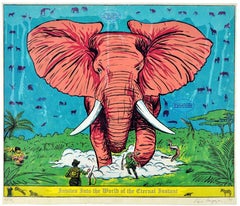
Invites Into the World of the Eternal Instant
Located in Lyons, CO
Color lithograph, Ed. 30
Chagoya's newest prints, "Invites Into the World of the Eternal Instant" and "Expresses Nothing but the Self", are concerned with the current unsustainabl...
Category
Contemporary 1860s More Prints
Materials
Lithograph
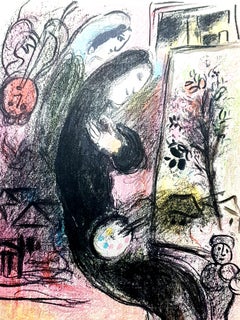
Marc Chagall - Inspiration - Original Lithograph from "Chagall Lithographe" v. 2
By Marc Chagall
Located in Collonge Bellerive, Geneve, CH
Marc Chagall
Original Lithograph from Chagall Lithographe 1957-1962. VOLUME II.
1963
Dimensions: 32 x 24 cm
From the unsigned edition of 10000 copies without margins
Reference: Mourlot 398
Condition : Excellent
Marc Chagall (born in 1887)
Marc Chagall was born in Belarus in 1887 and developed an early interest in art. After studying painting, in 1907 he left Russia for Paris, where he lived in an artist colony on the city’s outskirts. Fusing his own personal, dreamlike imagery with hints of the fauvism and cubism popular in France at the time, Chagall created his most lasting work—including I and the Village (1911)—some of which would be featured in the Salon des Indépendants exhibitions. After returning to Vitebsk for a visit in 1914, the outbreak of WWI trapped Chagall in Russia. He returned to France in 1923 but was forced to flee the country and Nazi persecution during WWII. Finding asylum in the U.S., Chagall became involved in set and costume design before returning to France in 1948. In his later years, he experimented with new art forms and was commissioned to produce numerous large-scale works. Chagall died in St.-Paul-de-Vence in 1985.
The Village
Marc Chagall was born in a small Hassidic community on the outskirts of Vitebsk, Belarus, on July 7, 1887. His father was a fishmonger, and his mother ran a small sundries shop in the village. As a child, Chagall attended the Jewish elementary school, where he studied Hebrew and the Bible, before later attending the Russian public school. He began to learn the fundamentals of drawing during this time, but perhaps more importantly, he absorbed the world around him, storing away the imagery and themes that would feature largely in most of his later work.
At age 19 Chagall enrolled at a private, all-Jewish art school and began his formal education in painting, studying briefly with portrait artist Yehuda Pen. However, he left the school after several months, moving to St. Petersburg in 1907 to study at the Imperial Society for the Protection of Fine Arts. The following year, he enrolled at the Svanseva School, studying with set designer Léon Bakst, whose work had been featured in Sergei Diaghilev's Ballets Russes. This early experience would prove important to Chagall’s later career as well.
Despite this formal instruction, and the widespread popularity of realism in Russia at the time, Chagall was already establishing his own personal style, which featured a more dreamlike unreality and the people, places and imagery that were close to his heart. Some examples from this period are his Window Vitebsk (1908) and My Fianceé with Black Gloves (1909), which pictured Bella Rosenfeld, to whom he had recently become engaged.
The Beehive
Despite his romance with Bella, in 1911 an allowance from Russian parliament member and art patron Maxim Binaver enabled Chagall to move to Paris, France. After settling briefly in the Montparnasse neighborhood, Chagall moved further afield to an artist colony known as La Ruche (“The Beehive”), where he began to work side by side with abstract painters such as Amedeo Modigliani and Fernand Léger as well as the avant-garde poet Guillaume Apollinaire. At their urging, and under the influence of the wildly popular fauvism and cubism, Chagall lightened his palette and pushed his style ever further from reality. I and the Village (1911) and Homage to Apollinaire (1912) are among his early Parisian works, widely considered to be his most successful and representative period.
Though his work stood stylistically apart from his cubist contemporaries, from 1912 to 1914 Chagall exhibited several paintings at the annual Salon des Indépendants exhibition, where works by the likes of Juan Gris, Marcel Duchamp and Robert Delaunay were causing a stir in the Paris art world. Chagall’s popularity began to spread beyond La Ruche, and in May 1914 he traveled to Berlin to help organize his first solo exhibition, at Der Sturm Gallery. Chagall remained in the city until the highly acclaimed show opened that June. He then returned to Vitebsk, unaware of the fateful events to come.
War, Peace and Revolution
In August 1914 the outbreak of World War I precluded Chagall’s plans to return to Paris. The conflict did little to stem the flow of his creative output, however, instead merely giving him direct access to the childhood scenes so essential to his work, as seen in paintings such as Jew in Green (1914) and Over Vitebsk (1914). His paintings from this period also occasionally featured images of the war’s impact on the region, as with Wounded Soldier (1914) and Marching (1915). But despite the hardships of life during wartime, this would also prove to be a joyful period for Chagall. In July 1915 he married Bella, and she gave birth to a daughter, Ida, the following year. Their appearance in works such as Birthday (1915), Bella and Ida by the Window (1917) and several of his “Lovers” paintings give a glimpse of the island of domestic bliss that was Chagall’s amidst the chaos.
To avoid military service and stay with his new family, Chagall took a position as a clerk in the Ministry of War Economy in St. Petersburg. While there he began work on his autobiography and also immersed himself in the local art scene, befriending novelist Boris Pasternak, among others. He also exhibited his work in the city and soon gained considerable recognition. That notoriety would prove important in the aftermath of the 1917 Russian Revolution when he was appointed as the Commissar of Fine Arts in Vitebsk. In his new post, Chagall undertook various projects in the region, including the 1919 founding of the Academy of the Arts. Despite these endeavors, differences among his colleagues eventually disillusioned Chagall. In 1920 he relinquished his position and moved his family to Moscow, the post-revolution capital of Russia.
In Moscow, Chagall was soon commissioned to create sets and costumes for various productions at the Moscow State Yiddish Theater...
Category
Surrealist 1860s More Prints
Materials
Lithograph
$1,487
H 9.45 in W 12.6 in D 0.04 in
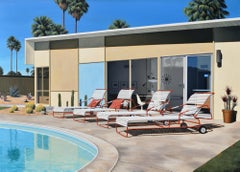
Racquet Club Estates Lounging (Print) (edition of 75)
By Danny Heller
Located in Fairfield, CT
Represented by George Billis Gallery, NYC & LA --This is a limited edition print of Heller's original painting "Butterfly Roof and Inner Tube." Edition of 75. Print dimension 17 x 24...
Category
American Realist 1860s More Prints
Materials
Archival Ink, Archival Paper
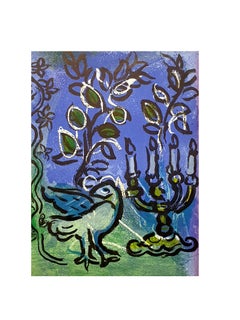
Marc Chagall - The Candlestick - Original Lithograph
By Marc Chagall
Located in Collonge Bellerive, Geneve, CH
The Candlestick, from Jean Leymarie, Vitraux pour Jérusalem (Jerusalem Windows), André Sauret, Monte Carlo, 1962 (see M. 366-72; see C. books 55). Unsigned and unnumbered, as issue...
Category
Surrealist 1860s More Prints
Materials
Lithograph
$2,498
H 12.8 in W 9.65 in D 0.04 in
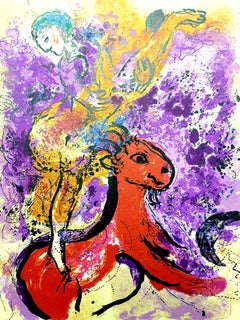
Marc Chagall - The Red Rider - Original Lithograph
By Marc Chagall
Located in Collonge Bellerive, Geneve, CH
Marc Chagall - Original Lithograph
The Red Rider
From the unsigned, unnumbered lithograph printed in the literary review XXe Siecle
1957
See Mourlot 191
Dimensions: 32 x 24 cm
Publisher: G. di San Lazzaro.
Marc Chagall (born in 1887)
Marc Chagall was born in Belarus in 1887 and developed an early interest in art. After studying painting, in 1907 he left Russia for Paris, where he lived in an artist colony on the city’s outskirts. Fusing his own personal, dreamlike imagery with hints of the fauvism and cubism popular in France at the time, Chagall created his most lasting work—including I and the Village (1911)—some of which would be featured in the Salon des Indépendants exhibitions. After returning to Vitebsk for a visit in 1914, the outbreak of WWI trapped Chagall in Russia. He returned to France in 1923 but was forced to flee the country and Nazi persecution during WWII. Finding asylum in the U.S., Chagall became involved in set and costume design before returning to France in 1948. In his later years, he experimented with new art forms and was commissioned to produce numerous large-scale works. Chagall died in St.-Paul-de-Vence in 1985.
The Village
Marc Chagall was born in a small Hassidic community on the outskirts of Vitebsk, Belarus, on July 7, 1887. His father was a fishmonger, and his mother ran a small sundries shop in the village. As a child, Chagall attended the Jewish elementary school, where he studied Hebrew and the Bible, before later attending the Russian public school. He began to learn the fundamentals of drawing during this time, but perhaps more importantly, he absorbed the world around him, storing away the imagery and themes that would feature largely in most of his later work.
At age 19 Chagall enrolled at a private, all-Jewish art school and began his formal education in painting, studying briefly with portrait artist Yehuda Pen. However, he left the school after several months, moving to St. Petersburg in 1907 to study at the Imperial Society for the Protection of Fine Arts. The following year, he enrolled at the Svanseva School, studying with set designer Léon Bakst, whose work had been featured in Sergei Diaghilev's Ballets Russes. This early experience would prove important to Chagall’s later career as well.
Despite this formal instruction, and the widespread popularity of realism in Russia at the time, Chagall was already establishing his own personal style, which featured a more dreamlike unreality and the people, places and imagery that were close to his heart. Some examples from this period are his Window Vitebsk (1908) and My Fianceé with Black Gloves (1909), which pictured Bella Rosenfeld, to whom he had recently become engaged.
The Beehive
Despite his romance with Bella, in 1911 an allowance from Russian parliament member and art patron Maxim Binaver enabled Chagall to move to Paris, France. After settling briefly in the Montparnasse neighborhood, Chagall moved further afield to an artist colony known as La Ruche (“The Beehive”), where he began to work side by side with abstract painters such as Amedeo Modigliani and Fernand Léger as well as the avant-garde poet Guillaume Apollinaire. At their urging, and under the influence of the wildly popular fauvism and cubism, Chagall lightened his palette and pushed his style ever further from reality. I and the Village (1911) and Homage to Apollinaire (1912) are among his early Parisian works, widely considered to be his most successful and representative period.
Though his work stood stylistically apart from his cubist contemporaries, from 1912 to 1914 Chagall exhibited several paintings at the annual Salon des Indépendants exhibition, where works by the likes of Juan Gris, Marcel Duchamp and Robert Delaunay were causing a stir in the Paris art world. Chagall’s popularity began to spread beyond La Ruche, and in May 1914 he traveled to Berlin to help organize his first solo exhibition, at Der Sturm Gallery. Chagall remained in the city until the highly acclaimed show opened that June. He then returned to Vitebsk, unaware of the fateful events to come.
War, Peace and Revolution
In August 1914 the outbreak of World War I precluded Chagall’s plans to return to Paris. The conflict did little to stem the flow of his creative output, however, instead merely giving him direct access to the childhood scenes so essential to his work, as seen in paintings such as Jew in Green (1914) and Over Vitebsk (1914). His paintings from this period also occasionally featured images of the war’s impact on the region, as with Wounded Soldier (1914) and Marching (1915). But despite the hardships of life during wartime, this would also prove to be a joyful period for Chagall. In July 1915 he married Bella, and she gave birth to a daughter, Ida, the following year. Their appearance in works such as Birthday (1915), Bella and Ida by the Window (1917) and several of his “Lovers” paintings give a glimpse of the island of domestic bliss that was Chagall’s amidst the chaos.
To avoid military service and stay with his new family, Chagall took a position as a clerk in the Ministry of War Economy in St. Petersburg. While there he began work on his autobiography and also immersed himself in the local art scene, befriending novelist Boris Pasternak, among others. He also exhibited his work in the city and soon gained considerable recognition. That notoriety would prove important in the aftermath of the 1917 Russian Revolution when he was appointed as the Commissar of Fine Arts in Vitebsk. In his new post, Chagall undertook various projects in the region, including the 1919 founding of the Academy of the Arts. Despite these endeavors, differences among his colleagues eventually disillusioned Chagall. In 1920 he relinquished his position and moved his family to Moscow, the post-revolution capital of Russia.
In Moscow, Chagall was soon commissioned to create sets and costumes for various productions at the Moscow State Yiddish Theater, where he would paint a series of murals titled Introduction to the Jewish Theater as well. In 1921, Chagall also found work as a teacher at a school for war orphans. By 1922, however, Chagall found that his art had fallen out of favor, and seeking new horizons he left Russia for good.
Flight
After a brief stay in Berlin, where he unsuccessfully sought to recover the work exhibited at Der Sturm before the war, Chagall moved his family to Paris in September 1923. Shortly after their arrival, he was commissioned by art dealer and publisher Ambroise Vollard to produce a series of etchings for a new edition of Nikolai Gogol's 1842 novel Dead Souls. Two years later Chagall began work on an illustrated edition of Jean de la Fontaine’s Fables, and in 1930 he created etchings for an illustrated edition of the Old Testament, for which he traveled to Palestine to conduct research.
Chagall’s work during this period brought him new success as an artist and enabled him to travel throughout Europe in the 1930s. He also published his autobiography, My Life (1931), and in 1933 received a retrospective at the Kunsthalle in Basel, Switzerland. But at the same time that Chagall’s popularity was spreading, so, too, was the threat of Fascism and Nazism. Singled out during the cultural "cleansing" undertaken by the Nazis in Germany, Chagall’s work was ordered removed from museums throughout the country. Several pieces were subsequently burned, and others were featured in a 1937 exhibition of “degenerate art” held in Munich. Chagall’s angst regarding these troubling events and the persecution of Jews in general can be seen in his 1938 painting White Crucifixion.
With the eruption of World War II, Chagall and his family moved to the Loire region before moving farther south to Marseilles following the invasion of France. They found a more certain refuge when, in 1941, Chagall’s name was added by the director of the Museum of Modern Art (MOMA) in New York City to a list of artists and intellectuals deemed most at risk from the Nazis’ anti-Jewish campaign. Chagall and his family would be among the more than 2,000 who received visas and escaped this way.
Haunted Harbors
Arriving in New York City in June 1941, Chagall discovered that he was already a well-known artist there and, despite a language barrier, soon became a part of the exiled European artist community. The following year he was commissioned by choreographer Léonide Massine to design sets and costumes for the ballet Aleko, based on Alexander Pushkin’s “The Gypsies” and set to the music of Pyotr Ilyich Tchaikovsky.
But even as he settled into the safety of his temporary home, Chagall’s thoughts were frequently consumed by the fate befalling the Jews of Europe and the destruction of Russia, as paintings such as The Yellow Crucifixion...
Category
Surrealist 1860s More Prints
Materials
Lithograph
$2,915
H 12.6 in W 9.45 in D 0.04 in
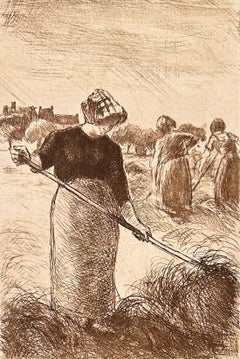
Les Faneuses
Located in Washington, DC
Artist: Camille Pissarro
Title: Les Faneuses
Portfolio: l'Histoire des Peintres Impressionistes
Medium: Etching on cream laid paper
Date: 1906
Edition: 1000
Frame Size: 19 1/2" x 17"...
Category
Modern 1860s More Prints
Materials
Etching
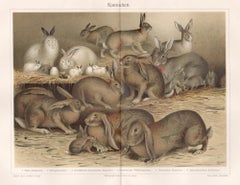
Rabbits, German antique animal chromolithograph print.
Located in Melbourne, Victoria
'Kaninchen'
(Rabbits)
German chromolithograph, circa 1910. Key in German to the types of rabbits at the bottom of the image. Central vertical fold as issued.
245mm by 305mm (shee...
Category
Naturalistic 1860s More Prints
Materials
Lithograph
Previously Available Items
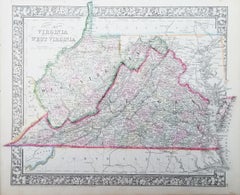
County Map of Virginia and West Virginia /// American Cartography Geography Art
Located in Saint Augustine, FL
Artist: Samuel Augustus Mitchell (American, 1790-1868)
Title: "County Map of Virginia and West Virginia" (Plate 27)
Portfolio: Mitchell's New General Atlas
Year: 1863
Medium: Origina...
Category
Academic 1860s More Prints
Materials
Watercolor, Engraving
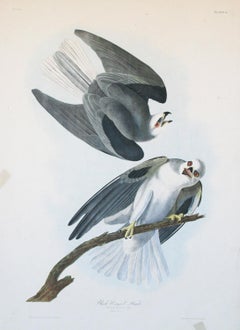
Black-Winged Hawk by J.J. Audubon Bien Edition 1860
Located in Paonia, CO
Plate 16 No. 4-2 Black-winged hawk. Falco Dispar, Temm. Male 1. Female 2. Drawn from nature by J.J. Audubon, Chromolithy, Julius Bien, lithographer New York 1860 from Audubon's Birds of America.
The “Birds of America” by John James...
Category
Other Art Style 1860s More Prints
Materials
Lithograph
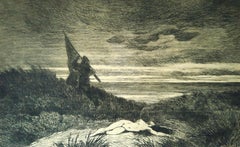
Le Werwolf - Etching by Félicien Rops - 1868
Located in Roma, IT
Le Werwolf is an original etching realized by Félicien Rops in 1868 on Japanese paper, 2nd state on 6 before the letter, plate from “Uylenspiegel”.
In v...
Category
Symbolist 1860s More Prints
Materials
Etching
More Ways To Browse
Gustav Klutsis
Ihap Hulusi
Ivan Navarro
James B Painter
James Bond Movie Posters
Jan V Roy Posters
John Lennon On Sale
Lait Pur Sterilize
Lake District Vintage Travel Poster
Land Rover Poster
Le Frou Frou Vintage Poster
Leon De Pas
Leon Wuidar
Lillian Snelling
Man Ray Electro Magie
Maurin Quina Print
Michael Schwab Posters
Miroslav Sutej