1870s More Prints
to
3
1
Overall Width
to
Overall Height
to
1
1
1
1
1
1
238
511
4,629
2,987
33
57
92
132
239
380
793
1,073
598
424
174
4
1
1
3
1
3
1
Period: 1870s
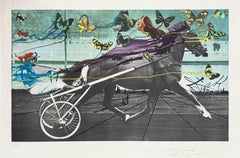
Une de Mai
Located in OPOLE, PL
Salvador Dali (1904-1989) - Une de Mai
Lithograph from 1972.
Th edition of 49/150.
Dimensions of work: 120.5 x 78 cm
Publisher: Edition Waintrop, Paris.
Reference: Michler/Löpsi...
Category
Surrealist 1870s More Prints
Materials
Lithograph
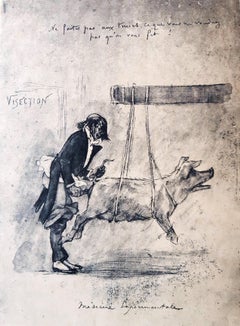
Médecine Expérimentale - Etching by Félicien Rops - 1854
Located in Roma, IT
Médecine Expérimentale (Experimental medicine), is an original etching, soft ground, on Japanese paper realized by Félicien Rops in 1854, signed in the ...
Category
Symbolist 1870s More Prints
Materials
Etching
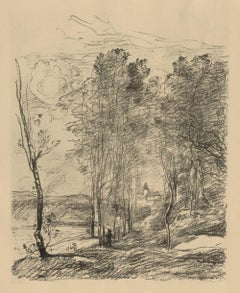
Le Clocher de St. Nicolas
Located in New York, NY
A very good impression of this scarce lithograph on wove paper. , Printed by Lemercier & Cie, Paris and published by Alfred Robaud. From "Douze Croquis et Dessins Originaux."
Catalo...
Category
Realist 1870s More Prints
Materials
Lithograph
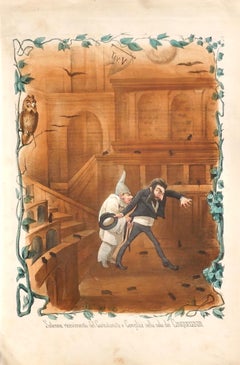
Solemn Receiving - Lithograph by Antonio Manganaro - 1872
Located in Roma, IT
Solemn Receiving is an original artwork realized in 1872 by Antonio Manganaro.
Original colored lithograph.
Good conditions, except for the yellowed paper due to the time.
This be...
Category
Modern 1870s More Prints
Materials
Lithograph
Related Items
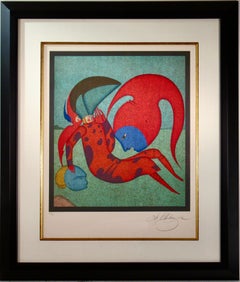
Flying Head
Located in San Francisco, CA
This artwork titled "Flying Head" c.1990, is an original colors lithograph by renown Russian artist Mihail Chemiakin, b.1943. It is hand signed and numbered 173/260 in pencil by the ...
Category
Modern 1870s More Prints
Materials
Lithograph

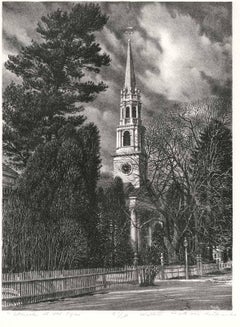
Congregational Church, Old Lyme, CT. (quintessential New England landmark)
Located in New Orleans, LA
The Old Lyme Congregational Church located on Ferry Road, a quintessentially New England landmark, was captured by Walter DuBois Richards. The church was a favorite subject of Old Ly...
Category
American Modern 1870s More Prints
Materials
Lithograph
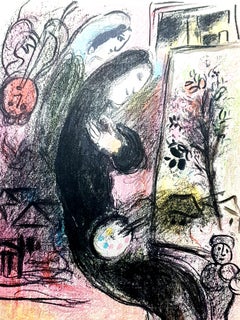
Marc Chagall - Inspiration - Original Lithograph from "Chagall Lithographe" v. 2
By Marc Chagall
Located in Collonge Bellerive, Geneve, CH
Marc Chagall
Original Lithograph from Chagall Lithographe 1957-1962. VOLUME II.
1963
Dimensions: 32 x 24 cm
From the unsigned edition of 10000 copies without margins
Reference: Mourlot 398
Condition : Excellent
Marc Chagall (born in 1887)
Marc Chagall was born in Belarus in 1887 and developed an early interest in art. After studying painting, in 1907 he left Russia for Paris, where he lived in an artist colony on the city’s outskirts. Fusing his own personal, dreamlike imagery with hints of the fauvism and cubism popular in France at the time, Chagall created his most lasting work—including I and the Village (1911)—some of which would be featured in the Salon des Indépendants exhibitions. After returning to Vitebsk for a visit in 1914, the outbreak of WWI trapped Chagall in Russia. He returned to France in 1923 but was forced to flee the country and Nazi persecution during WWII. Finding asylum in the U.S., Chagall became involved in set and costume design before returning to France in 1948. In his later years, he experimented with new art forms and was commissioned to produce numerous large-scale works. Chagall died in St.-Paul-de-Vence in 1985.
The Village
Marc Chagall was born in a small Hassidic community on the outskirts of Vitebsk, Belarus, on July 7, 1887. His father was a fishmonger, and his mother ran a small sundries shop in the village. As a child, Chagall attended the Jewish elementary school, where he studied Hebrew and the Bible, before later attending the Russian public school. He began to learn the fundamentals of drawing during this time, but perhaps more importantly, he absorbed the world around him, storing away the imagery and themes that would feature largely in most of his later work.
At age 19 Chagall enrolled at a private, all-Jewish art school and began his formal education in painting, studying briefly with portrait artist Yehuda Pen. However, he left the school after several months, moving to St. Petersburg in 1907 to study at the Imperial Society for the Protection of Fine Arts. The following year, he enrolled at the Svanseva School, studying with set designer Léon Bakst, whose work had been featured in Sergei Diaghilev's Ballets Russes. This early experience would prove important to Chagall’s later career as well.
Despite this formal instruction, and the widespread popularity of realism in Russia at the time, Chagall was already establishing his own personal style, which featured a more dreamlike unreality and the people, places and imagery that were close to his heart. Some examples from this period are his Window Vitebsk (1908) and My Fianceé with Black Gloves (1909), which pictured Bella Rosenfeld, to whom he had recently become engaged.
The Beehive
Despite his romance with Bella, in 1911 an allowance from Russian parliament member and art patron Maxim Binaver enabled Chagall to move to Paris, France. After settling briefly in the Montparnasse neighborhood, Chagall moved further afield to an artist colony known as La Ruche (“The Beehive”), where he began to work side by side with abstract painters such as Amedeo Modigliani and Fernand Léger as well as the avant-garde poet Guillaume Apollinaire. At their urging, and under the influence of the wildly popular fauvism and cubism, Chagall lightened his palette and pushed his style ever further from reality. I and the Village (1911) and Homage to Apollinaire (1912) are among his early Parisian works, widely considered to be his most successful and representative period.
Though his work stood stylistically apart from his cubist contemporaries, from 1912 to 1914 Chagall exhibited several paintings at the annual Salon des Indépendants exhibition, where works by the likes of Juan Gris, Marcel Duchamp and Robert Delaunay were causing a stir in the Paris art world. Chagall’s popularity began to spread beyond La Ruche, and in May 1914 he traveled to Berlin to help organize his first solo exhibition, at Der Sturm Gallery. Chagall remained in the city until the highly acclaimed show opened that June. He then returned to Vitebsk, unaware of the fateful events to come.
War, Peace and Revolution
In August 1914 the outbreak of World War I precluded Chagall’s plans to return to Paris. The conflict did little to stem the flow of his creative output, however, instead merely giving him direct access to the childhood scenes so essential to his work, as seen in paintings such as Jew in Green (1914) and Over Vitebsk (1914). His paintings from this period also occasionally featured images of the war’s impact on the region, as with Wounded Soldier (1914) and Marching (1915). But despite the hardships of life during wartime, this would also prove to be a joyful period for Chagall. In July 1915 he married Bella, and she gave birth to a daughter, Ida, the following year. Their appearance in works such as Birthday (1915), Bella and Ida by the Window (1917) and several of his “Lovers” paintings give a glimpse of the island of domestic bliss that was Chagall’s amidst the chaos.
To avoid military service and stay with his new family, Chagall took a position as a clerk in the Ministry of War Economy in St. Petersburg. While there he began work on his autobiography and also immersed himself in the local art scene, befriending novelist Boris Pasternak, among others. He also exhibited his work in the city and soon gained considerable recognition. That notoriety would prove important in the aftermath of the 1917 Russian Revolution when he was appointed as the Commissar of Fine Arts in Vitebsk. In his new post, Chagall undertook various projects in the region, including the 1919 founding of the Academy of the Arts. Despite these endeavors, differences among his colleagues eventually disillusioned Chagall. In 1920 he relinquished his position and moved his family to Moscow, the post-revolution capital of Russia.
In Moscow, Chagall was soon commissioned to create sets and costumes for various productions at the Moscow State Yiddish Theater...
Category
Surrealist 1870s More Prints
Materials
Lithograph
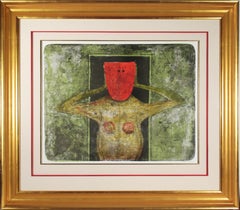
$1,487
H 9.45 in W 12.6 in D 0.04 in
Mascara Roja
Located in San Francisco, CA
This artwork titled "Mascara Roja" 1969 is an original colors lithograph on B.F.K. Rives paper by renown Mexican artist Rufino Tamayo, 1899-1991. It is hand signed and inscribed H.C. (Hors Commerce) in pencil by the artist. The image size is 21 x 27.25 inches, framed size is 37.25 x 42 inches. Published by Touchtone Publisher, New York, printed by Ateliers Desjobert, Paris. Referenced and pictured in the artist's catalogue raisonne by Pereda, plate #124. Custom framed in a wooden gold leaf frame, with gold and red spacer and fabric matting. It is in excellent condition.
About the artist:
A native of Oaxaca in Southern Mexico, Rufino Tamayo's father was a shoemaker, and his mother a seamstress. Some accounts state that he was descended from Zapotec Indians, but he was actually 'mestizo' - of mixed indigenous/European ancestry. (Santa Barbara Museum of Art). He began painting at age 11. Orphaned at the age of 12, Tamayo moved to Mexico City, where he was raised by his maternal aunt who owned a wholesale fruit business.
In 1917, he entered the San Carlos Academy of Fine Arts, but left soon after to pursue independent study. Four years later, Tamayo was appointed the head designer of the department of ethnographic drawings at the National Museum of Archaeology in Mexico City. There he was surrounded by pre-Colombian objects, an aesthetic inspiration that would play a pivotal role in his life. In his own work, Tamayo integrated the forms and tones of pre-Columbian ceramics into his early still lives and portraits of Mexican men and women.
In the early 1920s he also taught art classes in Mexico City's public schools. Despite his involvement in Mexican history, he did not subscribe to the idea of art as nationalistic propaganda. Modern Mexican art at that time was dominated by 'The Three Great Ones' : Diego Rivera, Jose Clemente Orozco, and David Alfaro Siqueros, but Tamayo began to be noted as someone 'new' and different' for his blending of the aesthetics of post Revolutionary Mexico with the vanguard artists of Europe and the United States.
After the Mexican Revolution, he focused on creating his own identity in his work, expressing what he thought was the traditional Mexico, and refusing to follow the political trends of his contemporary artists. This caused some to see him as a 'traitor' to the political cause, and he felt it difficult to freely express himself in his art. As a result, he decided to leave Mexico in 1926 and move to New York, along with his friend, the composer Carlos Chavez. The first exhibition of Tamayo's work in the United States was held at the Weyhe Gallery, New York, in that same year. The show was successful, and Tamayo was praised for his 'authentic' status as a Mexican of 'indigenous heritage', and for his internationally appealing Modernist aesthetic. (Santa Barbara Museum of Art).
Throughout the late thirties and early forties New York's Valentine Gallery gave him shows. For nine years, beginning in 1938, he taught at the Dalton School in New York.
In 1929, some health problems led him to return to Mexico for treatment. While there he took a series of teaching jobs. During this period he became romantically involved with the artist Maria Izquierdo...
Category
Modern 1870s More Prints
Materials
Lithograph
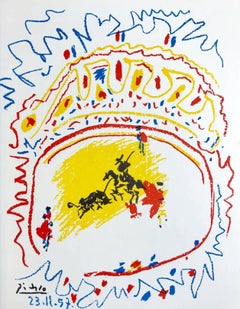
Pablo Picasso, La Petite Corrida, lithograph
Located in Chatsworth, CA
This piece is a lithograph in colors (after)Pablo Picasso, done in 1957. Picasso created this piece for the special issue of the art publication XXe Sicle Review No. 10, entitled "Ho...
Category
Modern 1870s More Prints
Materials
Lithograph
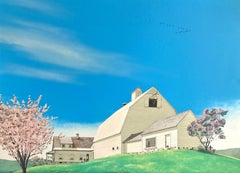
HARBINGER OF SPRING Signed Lithograph, Farm House Landscape Blue Sky White Barn
By Mel Hunter
Located in Union City, NJ
HARBINGER OF SPRING is an original limited edition, hand drawn lithograph(not a photo reproduction or digital print) by the American artist/illustrator Mel Hunter, printed using hand...
Category
Realist 1870s More Prints
Materials
Lithograph
$368 Sale Price
47% Off
H 21.75 in W 29.75 in
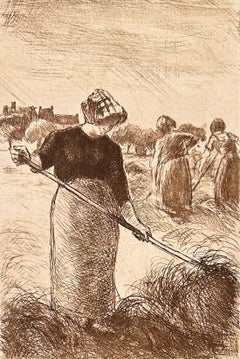
Camille Pissarro Etching on Paper, Modern, Unsigned, 1906, Framed, Les Faneuses
Located in Washington, DC
Artist: Camille Pissarro
Title: Les Faneuses
Portfolio: l'Histoire des Peintres Impressionistes
Medium: Etching on cream laid paper
Date: 1906
Edition: 1000
Frame Size: 19 1/2" x 17"...
Category
Modern 1870s More Prints
Materials
Etching
Acrobats
Located in San Francisco, CA
This artwork titled "Acrobats" c.1990, is an original colors lithograph by renown Russian artist Mihail Chemiakin, b.1943. It is hand signed and numbered 283/300 in pencil by the art...
Category
Modern 1870s More Prints
Materials
Lithograph
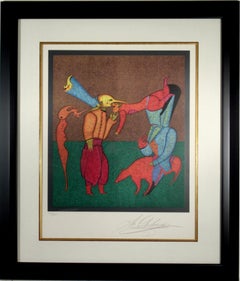
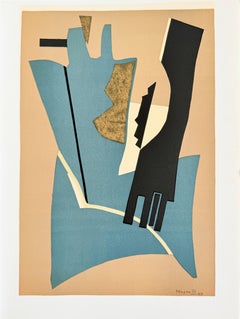
Hommage à San Lazzaro
Located in OPOLE, PL
Alberto Magnelli (1888-1971) - Hommage à San Lazzaro
Lithograph from 1975.
Edition 371/575 (Photocopy of the colophone is included).
Dimensions of work: 31 x 24 cm.
Plate signed....
Category
Modern 1870s More Prints
Materials
Lithograph
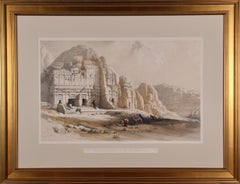
Petra, The Upper or Eastern Valley: 19th C. Hand-colored Roberts Lithograph
Located in Alamo, CA
This is an original 19th century hand-colored lithograph entitled "Petra, Shewing the Upper or Eastern End of the Valley" by David Roberts, from his Egypt, The Holy Land and Nubia volumes of the large folio edition, published in London by F. G. Moon in 1842. The lithographs were prepared by Louis Haghe (1806-1885) from drawings and paintings by Roberts. The resultant large folio editions of 'The Holy Land' and 'Egypt & Nubia' are considered the greatest lithographically illustrated works issued in the 19th century.
This is one of Roberts' most famous and collectible works. The scene captures a view of the magnificent ruins of Petra in what is Jordan today, as it appeared on March 8, 1839, on the day of Roberts' visit. Multiple Arab men are approaching Petra; some on foot and others riding camels. They are dressed in their colorful local costumes. Roberts' signature and hand written date are reproduced in the plate on the left.
This hand-colored lithograph is printed on wove paper with wide margins. There is some loss of color in the text in the title and a faint dark curvilinear area in the upper right. The print is otherwise in very good condition. It is presented in a gold-colored wood frame with a tan mat. It is glazed with UV protected conservation glass. All framing materials used are archival museum quality. The frame measures 23.5" high and 30.5" wide.
There are two additional iconic David Roberts hand-colored lithographs for sale on 1stdibs that are matted and framed in identical styles, although slightly different sizes. They are scenes of Approach of Simoon, Desert of Gizeh and the Citadel of Cairo. They can be viewed by typing their reference #'s, LU1173211955452 and LU1173211970142, into the 1stdibs search field or typing Timeless Intaglio in the search field and tapping on the drop down name to be taken to our storefront. Two or all three of these pieces would make for a striking display grouping. A discount is available for the purchase of multiple pieces.
David Roberts (1796-1864) was a Scottish painter who specialized in landscapes, architectural subjects, and scenes from the Middle East and Europe. Born in Edinburgh, Roberts began his career at age ten as an apprentice to a house painter and eventually became a scene painter for theater companies in Edinburgh and London. In the 1820s, J. M. W. Turner recognized his artistic talent and encouraged him to become a full-time artist. He began to focus on painting landscapes and architecture. In 1838 he traveled to Egypt and soon after to the Holy Land, concluding in Jerusalem. Roberts' travels in the Middle East had a profound impact on his art, and he produced a series of highly detailed and realistic paintings and sketches of the region's famous ruins and other landmarks, including the Pyramids of Giza, the Sphinx, the Temple of Abu Simbel...
Category
Realist 1870s More Prints
Materials
Lithograph
$3,575
H 23.5 in W 30.5 in
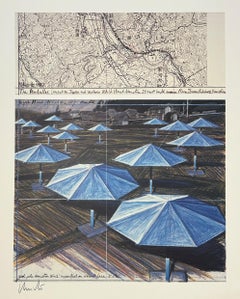
The Umbrellas, Joint Project for Japan and the U.S.A.
By Christo
Located in Washington, DC
Artist: Christo
Title: The Umbrellas, Joint Project for Japan and the U.S.A.
Medium: Offset lithograph in colors on wove paper
Date: 1987
Edition: Unnumbered
Sheet Size: 36 3/4" x 27...
Category
American Modern 1870s More Prints
Materials
Lithograph
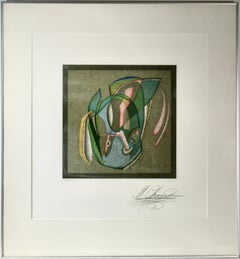
Head in the Evening
Located in San Francisco, CA
This artwork titled "Head in the Evening" 1980, is an original colors lithograph on Wove paper by renown Russian artist Mihail Chemiakin, b.1943. It is hand signed and numbered 81/20...
Category
Modern 1870s More Prints
Materials
Lithograph
Previously Available Items
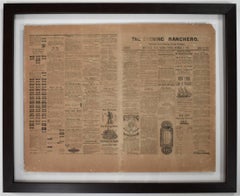
"KING RANCH NEWSPAPER ARTICLE 1875" THE EVENING RANCHERO
Located in San Antonio, TX
King Ranch Newspaper article from "The Evening Ranchero"
Dated November 11th 1875
Image Size: 18.5 x 24
Framed Size: 24 x 29
Category
New Media 1870s More Prints
Materials
Newsprint
H 18.5 in W 24 in D 2 in
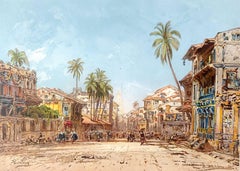
India Bombay Street Scene 19th Century Chromolithograph Makers Mark Stamp
By Eduard Hildebrandt
Located in Norfolk, GB
Eduard Hildebrandt
19th Century Chromolithograph on thick paper
Strasse in Bombay, c 1865
Signed and titled lower edge, makers stamp back
Sheet size 45.5cm x 55.5cm, Image size 24.2...
Category
Impressionist 1870s More Prints
Materials
Board, Lithograph
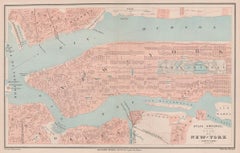
Plan of New York, engraving, 1877
Located in Melbourne, Victoria
'Plan de New-York' from the Atlas Universel. Steel-engraving with hand-colouring by R Hausermann. Published in Paris by A Fayard in 1877. Street map of New York showing street names,...
Category
Victorian 1870s More Prints
Materials
Engraving
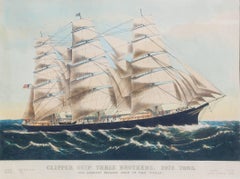
Clipper Ship THREE BROTHERS, 2972 tons. The Largest Sailing Ship in the World.
By Currier
Ives
Located in Missouri, MO
Currier & Ives (American, 1834-1907)
Clipper Ship THREE BROTHERS, 2972 tons. The Largest Sailing Ship in the World.
1875
Hand-colored lithograph
Sheet: ...
Category
American Realist 1870s More Prints
Materials
Lithograph
More Ways To Browse
Gustav Klutsis
Ihap Hulusi
Ivan Navarro
James B Painter
James Bond Movie Posters
Jan V Roy Posters
John Lennon On Sale
Lait Pur Sterilize
Lake District Vintage Travel Poster
Land Rover Poster
Le Frou Frou Vintage Poster
Leon De Pas
Leon Wuidar
Lillian Snelling
Man Ray Electro Magie
Maurin Quina Print
Michael Schwab Posters
Miroslav Sutej