Want more images or videos?
Request additional images or videos from the seller
1 of 8

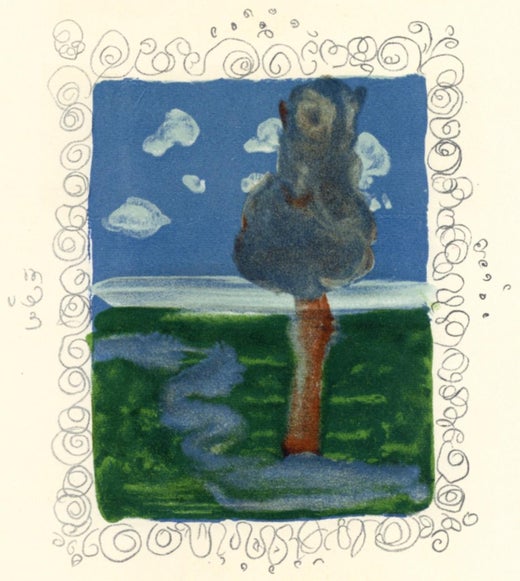
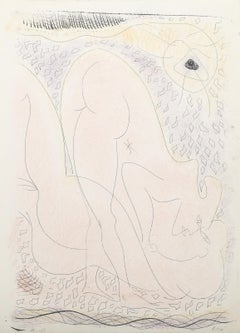
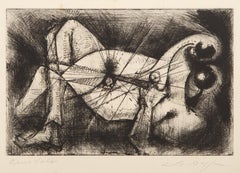
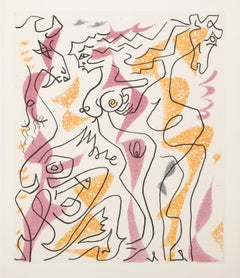
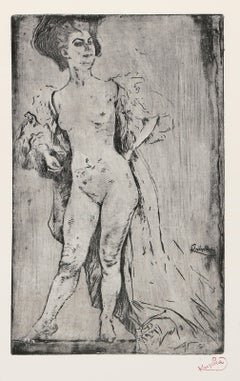
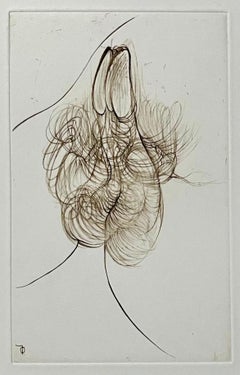
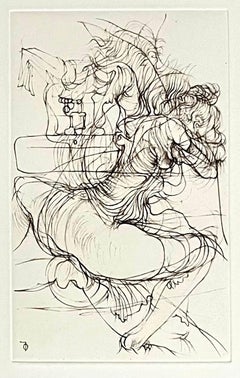
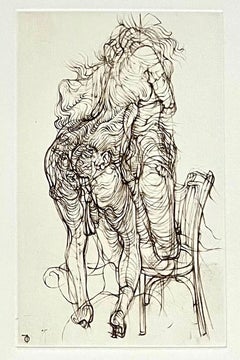
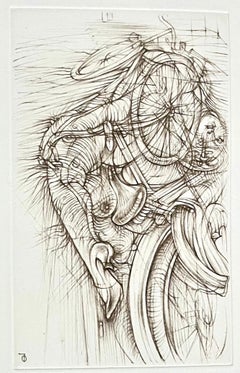
André Derain
Erotic Female Nude - Etching from Le Satyricon

$650List Price

You May Also Like

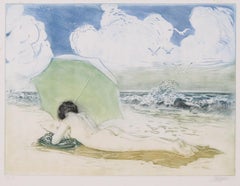
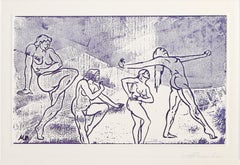
Sunbathing
By Louis Oscar Griffith
Located in Fairlawn, OH
Sunbathing Etching and color aquatint on watermarked Umbria Italy paper, c. 1915 Signed by the artist in pencil lower right (see photo) Annotated: "No. 6" in pencil lower left (see photo) An early color print by the artist Condition: Excellent Plate size: 11-3/4 x 15-7-8" (30 x 40.3 cm.) Frame size: 21 x 26 1/8 x 1 inches Provenance: Estate of the artist By decent Louis Oscar Griffith (1875-1956) Born in Greencastle, Indiana, Griffith grew up in Dallas, Texas where Texas artist and teacher Charles Franklin Reaugh recognized young “Griff’s” artistic talent. At age 18, Griffith moved to St. Louis where he attended the St. Louis School of Fine Arts. In 1895, he moved to Chicago where he worked making color prints for the firm Barnes and Crosby. He attended the Art Institute of Chicago and during a brief stay in New York, the National Academy of Design. A successful commercial artist with a studio in the Chicago Loop...
Category

1910s American Impressionist Nude Prints

Materials

Etching

Sunbathing
$2,500
H 11.75 in W 15.88 in
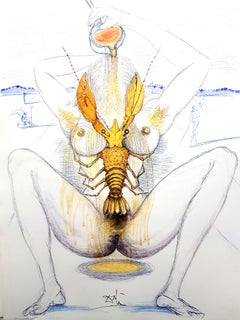
Salvador Dali - Nude and Lobster
By Salvador Dalí­
Located in Collonge Bellerive, Geneve, CH
Salvador Dali - Nude and Lobster - Original Etching Dimensions: 38 x 28 cm Edition: 390 1967 Editor : Au Cercle du Livre Précieux On Rives Vellum From the Serie Casanova Unsigned as ...
Category

1960s Surrealist Nude Prints

Materials

Etching

Salvador Dali - Nude and Lobster
$3,804
H 14.97 in W 11.03 in D 0.04 in
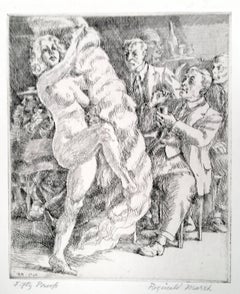
Fan Dance at Jimmy Kelly’s
By Reginald Marsh
Located in New York, NY
Reginald Marsh (1898-1954), Fan Dance at Jimmy Kelly’s, etching, 1936, signed and inscribed 50 proofs (only 24 known printed) [also with the initials and da...
Category

1930s American Realist Nude Prints

Materials

Etching

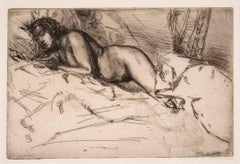
Venus
By James Abbott McNeill Whistler
Located in New York, NY
James Whistler (1834-1903), Venus, 1859. Etching and drypoint, printed in black ink on laid paper, an impression in the second (final) state: there was no published edition. 6 x 9 inches (15 x 22.6 cm) sheet 73/8 x 117/8 inches (18.8 x 30.3 cm) Reference: Kennedy 59; Glasgow 60 A very fine impression. A study of Héloïse, ‘Fumette’, asleep in bed, her head pressed into the pillow and the bedclothes covering her lower legs. This is one of three portraits Whistler made of Fumette in 1859: one of the others shows her standing and in the third only her head and shoulders are depicted. Venus is a work in the Realist tradition, and may be compared with Courbet’s nudes of the same period. The artist may also have had in mind Rembrandt’s study of Antiope in his etching Jupiter and Antiope. Venus was never published and there is no record of it being shown until 1898 when it was included in an Exhibition of Etchings, Drypoints and Lithographs by Whistler at H. Wunderlich & Co., New York. To have been overlooked for exhibition until so late in Whistler’s life might suggest that the subject was considered improper. Frederick Wedmore, whose catalogue of Whistler’s etchings...
Category

1850s Impressionist Nude Prints

Materials

Drypoint, Etching

Pour les Erophages, Surrealist Hand-Colored Etching by André Masson
By André Masson
Located in Long Island City, NY
André Masson, French (1896 -1987) - Pour les Erophages, Medium: Etching, Hand-colored in color pencil, initialed and numbered in pencil, Edition: Epreuve D'artiste, Image Size: 14...
Category

1950s Surrealist Nude Prints

Materials

Etching

Feminaire II, Surrealist Etching by André Masson
By André Masson
Located in Long Island City, NY
André Masson, French (1896 -1987) - Feminaire II, Year: 1951, Medium: Etching on wove paper, signed and numbered in pencil, Edition: 30, Image Size: 9.75 x 8 inches, Size: 14.25...
Category

1950s Surrealist Nude Prints

Materials

Etching

Etreinte, Surrealist Etching by André Masson
By André Masson
Located in Long Island City, NY
André Masson, French (1896 -1987) - Etreinte, Year: 1955, Medium: Etching, signed and numbered in pencil, Edition: Epreuve d'Artiste, Image Size: 7 x 10.75 inches, Size: 10 x 13...
Category

1950s Surrealist Nude Prints

Materials

Etching

Feuilles Épaisses, Surrealist Etching and Aquatint by André Masson
By André Masson
Located in Long Island City, NY
André Masson, French (1896 -1987) - Feuilles Épaisses, Year: 1958, Medium: Etching and Aquatint, Image Size: 8 x 6.75 inches, Size: 9.25 x 7.75 in. (23.5 x 19.69 cm), Description...
Category

1950s Surrealist Nude Prints

Materials

Etching, Aquatint

Femme Debout II, Surrealist Etching by Frantisek Kupka
By Frantisek Kupka
Located in Long Island City, NY
Frantisek Kupka, Czech (1871 -1957) - Femme Debout II, Year: circa 1912, Medium: Etching on Pur Fil du Marais, stamp signed, Image Size: 15.75 x 9.75 inches, Size: 25.75 x 19.5 i...
Category

1910s Surrealist Nude Prints

Materials

Etching

Nude Figure Study, Surrealist Etching and Aquatint by Martin Barooshian
By Martin Barooshian
Located in Long Island City, NY
Martin Barooshian, American (1929 - 2022) - Nude Figure Study, Year: circa 1979, Medium: Etching and Aquatint on Arches, signed in pencil, Image Size: 9.5 x 15.75 inches, Size: ...
Category

1970s Surrealist Nude Prints

Materials

Etching, Aquatint

More From This Seller

View All
German Surrealist Hans Bellmer Etching Engraving Print Cecile Reims Surrealism
By Hans Bellmer
Located in Surfside, FL
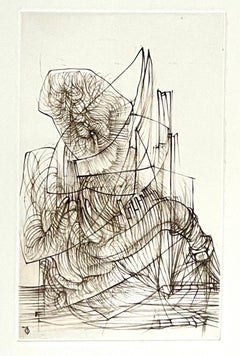
After Hans Bellmer (German, 1902-1975) Surrealist engraving, etching after drawings from a 1942 notebook, engraved in 1974-75 by Cecile Reims Printed by L'Atelier de Chalcographie du Louvre, Paris, Having printed monogram lower left in plate, pencil notations and #7/10 and 'Musee du Louvre' blindstamp verso Dimensions: Sheet 11 X 7.5, Plate size 6.5 X 4 Hans Bellmer ( 1902 – 1975) was a Polish born German artist, best known for his drawings, etchings that illustrates the 1940 edition of Histoire de l’œil, and the life-sized female sculpture mannequin dolls he produced in the mid-1930s. Historians of art and photography also consider him a Surrealist photographer. Bellmer was born in the city of Kattowitz, then part of the German Empire (now Katowice, Poland). Up until 1926, he worked as a draftsman for his own advertising company. Bellmer is most famous for the creation of a series of dolls as well as photographs of them. He was influenced in his choice of art form in part by reading the published letters of Oskar Kokoschka (Der Fetisch, 1925) and Surrealism. Bellmer's puppet doll project is also said to have been catalysed by a series of events in his personal life. Hans Bellmer takes credit for provoking a physical crisis in his father and brings his own artistic creativity into association with childhood insubordination and resentment toward a severe and humorless paternal authority. Perhaps this is one reason for the nearly universal, unquestioning acceptance in the literature of Bellmer's promotion of his art as a struggle against his father, the police, and ultimately, fascism and the state. Events of his personal life also including meeting a beautiful teenage cousin in 1932 (and perhaps other unattainable beauties), attending a performance of Jacques Offenbach's Tales of Hoffmann (in which a man falls tragically in love with an automaton), and receiving a box of his old toys. After these events, he began to actually construct his first dolls. In his works, Bellmer explicitly sexualized the doll as a young girl (his work bears connection to the works of Bathus). Hirschfeld has claimed (without further argumentation) that Bellmer initiated his doll project to oppose the fascism of the Nazi Party by declaring that he would make no work that would support the new German state. Represented by mutated forms and unconventional poses, his dolls (according to this view) were directed specifically at the cult of the perfect body then prominent in Germany. He visited Paris in 1935 and made contacts there, such as Paul Éluard, but returned to Berlin because his wife Margarete was dying of tuberculosis. He was part of the circle of Surrealist luminaries such as Man Ray, Marcel Duchamp, Max Ernst, Joan Miro, André Masson, René Magritte, Alberto Giacometti and Salvador Dali as well as women artists—such as Frida Kahlo, Dorothea Tanning and Leonora Carrington. Bellmer produced the first doll in Berlin in 1933. Long since lost, the assemblage can nevertheless be correctly described thanks to approximately two dozen photographs Bellmer took at the time of its construction. Standing about fifty-six inches tall, the doll consisted of a modeled torso made of flax fiber, glue, and plaster; a mask-like head of the same material with glass eyes and a long, unkempt wig; and a pair of legs made from broomsticks or dowel rods. One of these legs terminated in a wooden, club-like foot; the other was encased in a more naturalistic plaster shell, jointed at the knee and ankle. As the project progressed, Bellmer made a second set of hollow plaster legs, with wooden ball joints for the doll's hips and knees. There were no arms to the first sculpture, but Bellmer did fashion or find a single wooden hand, which appears among the assortment of doll parts the artist documented in an untitled photograph of 1934, as well as in several photographs of later work. Bellmer's 1934 anonymous book, The Doll (Die Puppe), produced and published privately in Germany, contains 10 black-and-white photographs of Bellmer's first doll arranged in a series of "tableaux vivants" (living pictures). The book was not credited to him, as he worked in isolation, and his photographs remained almost unknown in Germany. Yet Bellmer's work was eventually declared "degenerate" (entartete kunst) by the Nazi Party, and he was forced to flee Germany to France in 1938, where Bellmer's work was welcomed by the Surrealists around Andre Breton. He aided the French Resistance during the war by making fake passports. He was imprisoned in the Camp des Milles prison at Aix-en-Provence, a brickworks camp for German nationals, from September 1939 until the end of the Phoney War in May 1940. After the war, Bellmer lived the rest of his life in Paris. Bellmer gave up doll-making and spent the following decades creating erotic drawings, etchings, sexually explicit photographs, paintings, and prints of pubescent girls. In 1954, he met Unica Zürn...
Category

20th Century Abstract Prints

Materials

Etching

German Surrealist Hans Bellmer Etching Engraving Print Cecile Reims Surrealism
By Hans Bellmer
Located in Surfside, FL
After Hans Bellmer (German, 1902-1975) Surrealist engraving, etching after drawings from a 1942 notebook, engraved in 1974-75 by Cecile Reims Printed by L'Atelier de Chalcographie du Louvre, Paris, Having printed monogram lower left in plate, pencil notations and #7/10 and 'Musee du Louvre' blindstamp verso Dimensions: Sheet 11 X 7.5, Plate size 6.5 X 4 Hans Bellmer ( 1902 – 1975) was a Polish born German artist, best known for his drawings, etchings that illustrates the 1940 edition of Histoire de l’œil, and the life-sized female sculpture mannequin dolls he produced in the mid-1930s. Historians of art and photography also consider him a Surrealist photographer. Bellmer was born in the city of Kattowitz, then part of the German Empire (now Katowice, Poland). Up until 1926, he worked as a draftsman for his own advertising company. Bellmer is most famous for the creation of a series of dolls as well as photographs of them. He was influenced in his choice of art form in part by reading the published letters of Oskar Kokoschka (Der Fetisch, 1925) and Surrealism. Bellmer's puppet doll project is also said to have been catalysed by a series of events in his personal life. Hans Bellmer takes credit for provoking a physical crisis in his father and brings his own artistic creativity into association with childhood insubordination and resentment toward a severe and humorless paternal authority. Perhaps this is one reason for the nearly universal, unquestioning acceptance in the literature of Bellmer's promotion of his art as a struggle against his father, the police, and ultimately, fascism and the state. Events of his personal life also including meeting a beautiful teenage cousin in 1932 (and perhaps other unattainable beauties), attending a performance of Jacques Offenbach's Tales of Hoffmann (in which a man falls tragically in love with an automaton), and receiving a box of his old toys. After these events, he began to actually construct his first dolls. In his works, Bellmer explicitly sexualized the doll as a young girl (his work bears connection to the works of Bathus). Hirschfeld has claimed (without further argumentation) that Bellmer initiated his doll project to oppose the fascism of the Nazi Party by declaring that he would make no work that would support the new German state. Represented by mutated forms and unconventional poses, his dolls (according to this view) were directed specifically at the cult of the perfect body then prominent in Germany. He visited Paris in 1935 and made contacts there, such as Paul Éluard, but returned to Berlin because his wife Margarete was dying of tuberculosis. He was part of the circle of Surrealist luminaries such as Man Ray, Marcel Duchamp, Max Ernst, Joan Miro, André Masson, René Magritte, Alberto Giacometti and Salvador Dali as well as women artists—such as Frida Kahlo, Dorothea Tanning and Leonora Carrington. Bellmer produced the first doll in Berlin in 1933. Long since lost, the assemblage can nevertheless be correctly described thanks to approximately two dozen photographs Bellmer took at the time of its construction. Standing about fifty-six inches tall, the doll consisted of a modeled torso made of flax fiber, glue, and plaster; a mask-like head of the same material with glass eyes and a long, unkempt wig; and a pair of legs made from broomsticks or dowel rods. One of these legs terminated in a wooden, club-like foot; the other was encased in a more naturalistic plaster shell, jointed at the knee and ankle. As the project progressed, Bellmer made a second set of hollow plaster legs, with wooden ball joints for the doll's hips and knees. There were no arms to the first sculpture, but Bellmer did fashion or find a single wooden hand, which appears among the assortment of doll parts the artist documented in an untitled photograph of 1934, as well as in several photographs of later work. Bellmer's 1934 anonymous book, The Doll (Die Puppe), produced and published privately in Germany, contains 10 black-and-white photographs of Bellmer's first doll arranged in a series of "tableaux vivants" (living pictures). The book was not credited to him, as he worked in isolation, and his photographs remained almost unknown in Germany. Yet Bellmer's work was eventually declared "degenerate" (entartete kunst) by the Nazi Party, and he was forced to flee Germany to France in 1938, where Bellmer's work was welcomed by the Surrealists around Andre Breton. He aided the French Resistance during the war by making fake passports. He was imprisoned in the Camp des Milles prison at Aix-en-Provence, a brickworks camp for German nationals, from September 1939 until the end of the Phoney War in May 1940. After the war, Bellmer lived the rest of his life in Paris. Bellmer gave up doll-making and spent the following decades creating erotic drawings, etchings, sexually explicit photographs, paintings, and prints of pubescent girls. In 1954, he met Unica Zürn...
Category

20th Century Abstract Prints

Materials

Etching

German Surrealist Hans Bellmer Etching Engraving Print Cecile Reims Surrealism
By Hans Bellmer
Located in Surfside, FL
After Hans Bellmer (German, 1902-1975) Surrealist engraving, etching after drawings from a 1942 notebook, engraved in 1974-75 by Cecile Reims Printed by L'Atelier de Chalcographie du Louvre, Paris, Having printed monogram lower left in plate, pencil notations and #7/10 and 'Musee du Louvre' blindstamp verso Dimensions: Sheet 11 X 7.5, Plate size 6.5 X 4 Hans Bellmer ( 1902 – 1975) was a Polish born German artist, best known for his drawings, etchings that illustrates the 1940 edition of Histoire de l’œil, and the life-sized female sculpture mannequin dolls he produced in the mid-1930s. Historians of art and photography also consider him a Surrealist photographer. Bellmer was born in the city of Kattowitz, then part of the German Empire (now Katowice, Poland). Up until 1926, he worked as a draftsman for his own advertising company. Bellmer is most famous for the creation of a series of dolls as well as photographs of them. He was influenced in his choice of art form in part by reading the published letters of Oskar Kokoschka (Der Fetisch, 1925) and Surrealism. Bellmer's puppet doll project is also said to have been catalysed by a series of events in his personal life. Hans Bellmer takes credit for provoking a physical crisis in his father and brings his own artistic creativity into association with childhood insubordination and resentment toward a severe and humorless paternal authority. Perhaps this is one reason for the nearly universal, unquestioning acceptance in the literature of Bellmer's promotion of his art as a struggle against his father, the police, and ultimately, fascism and the state. Events of his personal life also including meeting a beautiful teenage cousin in 1932 (and perhaps other unattainable beauties), attending a performance of Jacques Offenbach's Tales of Hoffmann (in which a man falls tragically in love with an automaton), and receiving a box of his old toys. After these events, he began to actually construct his first dolls. In his works, Bellmer explicitly sexualized the doll as a young girl (his work bears connection to the works of Bathus). Hirschfeld has claimed (without further argumentation) that Bellmer initiated his doll project to oppose the fascism of the Nazi Party by declaring that he would make no work that would support the new German state. Represented by mutated forms and unconventional poses, his dolls (according to this view) were directed specifically at the cult of the perfect body then prominent in Germany. He visited Paris in 1935 and made contacts there, such as Paul Éluard, but returned to Berlin because his wife Margarete was dying of tuberculosis. He was part of the circle of Surrealist luminaries such as Man Ray, Marcel Duchamp, Max Ernst, Joan Miro, André Masson, René Magritte, Alberto Giacometti and Salvador Dali as well as women artists—such as Frida Kahlo, Dorothea Tanning and Leonora Carrington. Bellmer produced the first doll in Berlin in 1933. Long since lost, the assemblage can nevertheless be correctly described thanks to approximately two dozen photographs Bellmer took at the time of its construction. Standing about fifty-six inches tall, the doll consisted of a modeled torso made of flax fiber, glue, and plaster; a mask-like head of the same material with glass eyes and a long, unkempt wig; and a pair of legs made from broomsticks or dowel rods. One of these legs terminated in a wooden, club-like foot; the other was encased in a more naturalistic plaster shell, jointed at the knee and ankle. As the project progressed, Bellmer made a second set of hollow plaster legs, with wooden ball joints for the doll's hips and knees. There were no arms to the first sculpture, but Bellmer did fashion or find a single wooden hand, which appears among the assortment of doll parts the artist documented in an untitled photograph of 1934, as well as in several photographs of later work. Bellmer's 1934 anonymous book, The Doll (Die Puppe), produced and published privately in Germany, contains 10 black-and-white photographs of Bellmer's first doll arranged in a series of "tableaux vivants" (living pictures). The book was not credited to him, as he worked in isolation, and his photographs remained almost unknown in Germany. Yet Bellmer's work was eventually declared "degenerate" (entartete kunst) by the Nazi Party, and he was forced to flee Germany to France in 1938, where Bellmer's work was welcomed by the Surrealists around Andre Breton. He aided the French Resistance during the war by making fake passports. He was imprisoned in the Camp des Milles prison at Aix-en-Provence, a brickworks camp for German nationals, from September 1939 until the end of the Phoney War in May 1940. After the war, Bellmer lived the rest of his life in Paris. Bellmer gave up doll-making and spent the following decades creating erotic drawings, etchings, sexually explicit photographs, paintings, and prints of pubescent girls. In 1954, he met Unica Zürn...
Category

20th Century Abstract Prints

Materials

Etching

German Surrealist Hans Bellmer Etching Engraving Print Cecile Reims Surrealism
By Hans Bellmer
Located in Surfside, FL
After Hans Bellmer (German, 1902-1975) Surrealist engraving, etching after drawings from a 1942 notebook, engraved in 1974-75 by Cecile Reims Printed by L'Atelier de Chalcographie du Louvre, Paris, Having printed monogram lower left in plate, pencil notations and #7/10 and 'Musee du Louvre' blindstamp verso Dimensions: Sheet 11 X 7.5, Plate size 6.5 X 4 Hans Bellmer ( 1902 – 1975) was a Polish born German artist, best known for his drawings, etchings that illustrates the 1940 edition of Histoire de l’œil, and the life-sized female sculpture mannequin dolls he produced in the mid-1930s. Historians of art and photography also consider him a Surrealist photographer. Bellmer was born in the city of Kattowitz, then part of the German Empire (now Katowice, Poland). Up until 1926, he worked as a draftsman for his own advertising company. Bellmer is most famous for the creation of a series of dolls as well as photographs of them. He was influenced in his choice of art form in part by reading the published letters of Oskar Kokoschka (Der Fetisch, 1925) and Surrealism. Bellmer's puppet doll project is also said to have been catalysed by a series of events in his personal life. Hans Bellmer takes credit for provoking a physical crisis in his father and brings his own artistic creativity into association with childhood insubordination and resentment toward a severe and humorless paternal authority. Perhaps this is one reason for the nearly universal, unquestioning acceptance in the literature of Bellmer's promotion of his art as a struggle against his father, the police, and ultimately, fascism and the state. Events of his personal life also including meeting a beautiful teenage cousin in 1932 (and perhaps other unattainable beauties), attending a performance of Jacques Offenbach's Tales of Hoffmann (in which a man falls tragically in love with an automaton), and receiving a box of his old toys. After these events, he began to actually construct his first dolls. In his works, Bellmer explicitly sexualized the doll as a young girl (his work bears connection to the works of Bathus). Hirschfeld has claimed (without further argumentation) that Bellmer initiated his doll project to oppose the fascism of the Nazi Party by declaring that he would make no work that would support the new German state. Represented by mutated forms and unconventional poses, his dolls (according to this view) were directed specifically at the cult of the perfect body then prominent in Germany. He visited Paris in 1935 and made contacts there, such as Paul Éluard, but returned to Berlin because his wife Margarete was dying of tuberculosis. He was part of the circle of Surrealist luminaries such as Man Ray, Marcel Duchamp, Max Ernst, Joan Miro, André Masson, René Magritte, Alberto Giacometti and Salvador Dali as well as women artists—such as Frida Kahlo, Dorothea Tanning and Leonora Carrington. Bellmer produced the first doll in Berlin in 1933. Long since lost, the assemblage can nevertheless be correctly described thanks to approximately two dozen photographs Bellmer took at the time of its construction. Standing about fifty-six inches tall, the doll consisted of a modeled torso made of flax fiber, glue, and plaster; a mask-like head of the same material with glass eyes and a long, unkempt wig; and a pair of legs made from broomsticks or dowel rods. One of these legs terminated in a wooden, club-like foot; the other was encased in a more naturalistic plaster shell, jointed at the knee and ankle. As the project progressed, Bellmer made a second set of hollow plaster legs, with wooden ball joints for the doll's hips and knees. There were no arms to the first sculpture, but Bellmer did fashion or find a single wooden hand, which appears among the assortment of doll parts the artist documented in an untitled photograph of 1934, as well as in several photographs of later work. Bellmer's 1934 anonymous book, The Doll (Die Puppe), produced and published privately in Germany, contains 10 black-and-white photographs of Bellmer's first doll arranged in a series of "tableaux vivants" (living pictures). The book was not credited to him, as he worked in isolation, and his photographs remained almost unknown in Germany. Yet Bellmer's work was eventually declared "degenerate" (entartete kunst) by the Nazi Party, and he was forced to flee Germany to France in 1938, where Bellmer's work was welcomed by the Surrealists around Andre Breton. He aided the French Resistance during the war by making fake passports. He was imprisoned in the Camp des Milles prison at Aix-en-Provence, a brickworks camp for German nationals, from September 1939 until the end of the Phoney War in May 1940. After the war, Bellmer lived the rest of his life in Paris. Bellmer gave up doll-making and spent the following decades creating erotic drawings, etchings, sexually explicit photographs, paintings, and prints of pubescent girls. In 1954, he met Unica Zürn...
Category

20th Century Abstract Prints

Materials

Etching

German Surrealist Hans Bellmer Etching Engraving Print Cecile Reims Surrealism
By Hans Bellmer
Located in Surfside, FL
After Hans Bellmer (German, 1902-1975) Surrealist engraving, etching after drawings from a 1942 notebook, engraved in 1974-75 by Cecile Reims Printed by L'Atelier de Chalcographie du Louvre, Paris, Having printed monogram lower left in plate, pencil notations and #7/10 and 'Musee du Louvre' blindstamp verso Dimensions: Sheet 11 X 7.5, Plate size 6.5 X 4 Hans Bellmer ( 1902 – 1975) was a Polish born German artist, best known for his drawings, etchings that illustrates the 1940 edition of Histoire de l’œil, and the life-sized female sculpture mannequin dolls he produced in the mid-1930s. Historians of art and photography also consider him a Surrealist photographer. Bellmer was born in the city of Kattowitz, then part of the German Empire (now Katowice, Poland). Up until 1926, he worked as a draftsman for his own advertising company. Bellmer is most famous for the creation of a series of dolls as well as photographs of them. He was influenced in his choice of art form in part by reading the published letters of Oskar Kokoschka (Der Fetisch, 1925) and Surrealism. Bellmer's puppet doll project is also said to have been catalysed by a series of events in his personal life. Hans Bellmer takes credit for provoking a physical crisis in his father and brings his own artistic creativity into association with childhood insubordination and resentment toward a severe and humorless paternal authority. Perhaps this is one reason for the nearly universal, unquestioning acceptance in the literature of Bellmer's promotion of his art as a struggle against his father, the police, and ultimately, fascism and the state. Events of his personal life also including meeting a beautiful teenage cousin in 1932 (and perhaps other unattainable beauties), attending a performance of Jacques Offenbach's Tales of Hoffmann (in which a man falls tragically in love with an automaton), and receiving a box of his old toys. After these events, he began to actually construct his first dolls. In his works, Bellmer explicitly sexualized the doll as a young girl (his work bears connection to the works of Bathus). Hirschfeld has claimed (without further argumentation) that Bellmer initiated his doll project to oppose the fascism of the Nazi Party by declaring that he would make no work that would support the new German state. Represented by mutated forms and unconventional poses, his dolls (according to this view) were directed specifically at the cult of the perfect body then prominent in Germany. He visited Paris in 1935 and made contacts there, such as Paul Éluard, but returned to Berlin because his wife Margarete was dying of tuberculosis. He was part of the circle of Surrealist luminaries such as Man Ray, Marcel Duchamp, Max Ernst, Joan Miro, André Masson, René Magritte, Alberto Giacometti and Salvador Dali as well as women artists—such as Frida Kahlo, Dorothea Tanning and Leonora Carrington. Bellmer produced the first doll in Berlin in 1933. Long since lost, the assemblage can nevertheless be correctly described thanks to approximately two dozen photographs Bellmer took at the time of its construction. Standing about fifty-six inches tall, the doll consisted of a modeled torso made of flax fiber, glue, and plaster; a mask-like head of the same material with glass eyes and a long, unkempt wig; and a pair of legs made from broomsticks or dowel rods. One of these legs terminated in a wooden, club-like foot; the other was encased in a more naturalistic plaster shell, jointed at the knee and ankle. As the project progressed, Bellmer made a second set of hollow plaster legs, with wooden ball joints for the doll's hips and knees. There were no arms to the first sculpture, but Bellmer did fashion or find a single wooden hand, which appears among the assortment of doll parts the artist documented in an untitled photograph of 1934, as well as in several photographs of later work. Bellmer's 1934 anonymous book, The Doll (Die Puppe), produced and published privately in Germany, contains 10 black-and-white photographs of Bellmer's first doll arranged in a series of "tableaux vivants" (living pictures). The book was not credited to him, as he worked in isolation, and his photographs remained almost unknown in Germany. Yet Bellmer's work was eventually declared "degenerate" (entartete kunst) by the Nazi Party, and he was forced to flee Germany to France in 1938, where Bellmer's work was welcomed by the Surrealists around Andre Breton. He aided the French Resistance during the war by making fake passports. He was imprisoned in the Camp des Milles prison at Aix-en-Provence, a brickworks camp for German nationals, from September 1939 until the end of the Phoney War in May 1940. After the war, Bellmer lived the rest of his life in Paris. Bellmer gave up doll-making and spent the following decades creating erotic drawings, etchings, sexually explicit photographs, paintings, and prints of pubescent girls. In 1954, he met Unica Zürn...
Category

20th Century Abstract Prints

Materials

Etching

German Surrealist Hans Bellmer Etching Engraving Print Cecile Reims Surrealism
By Hans Bellmer
Located in Surfside, FL
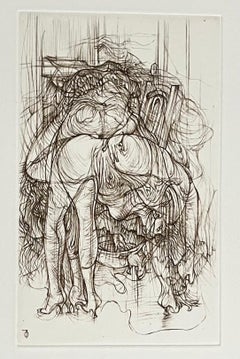
After Hans Bellmer (German, 1902-1975) Surrealist engraving, etching after drawings from a 1942 notebook, engraved in 1974-75 by Cecile Reims Printed by L'Atelier de Chalcographie du Louvre, Paris, Having printed monogram lower left in plate, pencil notations verso Editioned from a very small edition of #7/10 'Musee du Louvre' blindstamp. Dimensions: Sheet 11 X 7.5, Plate size 6.5 X 4 Hans Bellmer ( 1902 – 1975) was a Polish born German artist, best known for his drawings, etchings that illustrates the 1940 edition of Histoire de l’œil, and the life-sized female sculpture mannequin dolls he produced in the mid-1930s. Historians of art and photography also consider him a Surrealist photographer. Bellmer was born in the city of Kattowitz, then part of the German Empire (now Katowice, Poland). Up until 1926, he worked as a draftsman for his own advertising company. Bellmer is most famous for the creation of a series of dolls as well as photographs of them. He was influenced in his choice of art form in part by reading the published letters of Oskar Kokoschka (Der Fetisch, 1925) and Surrealism. Bellmer's puppet doll project is also said to have been catalysed by a series of events in his personal life. Hans Bellmer takes credit for provoking a physical crisis in his father and brings his own artistic creativity into association with childhood insubordination and resentment toward a severe and humorless paternal authority. Perhaps this is one reason for the nearly universal, unquestioning acceptance in the literature of Bellmer's promotion of his art as a struggle against his father, the police, and ultimately, fascism and the state. Events of his personal life also including meeting a beautiful teenage cousin in 1932 (and perhaps other unattainable beauties), attending a performance of Jacques Offenbach's Tales of Hoffmann (in which a man falls tragically in love with an automaton), and receiving a box of his old toys. After these events, he began to actually construct his first dolls. In his works, Bellmer explicitly sexualized the doll as a young girl (his work bears connection to the works of Bathus). Hirschfeld has claimed (without further argumentation) that Bellmer initiated his doll project to oppose the fascism of the Nazi Party by declaring that he would make no work that would support the new German state. Represented by mutated forms and unconventional poses, his dolls (according to this view) were directed specifically at the cult of the perfect body then prominent in Germany. He visited Paris in 1935 and made contacts there, such as Paul Éluard, but returned to Berlin because his wife Margarete was dying of tuberculosis. He was part of the circle of Surrealist luminaries such as Man Ray, Marcel Duchamp, Max Ernst, Joan Miro, André Masson, René Magritte, Alberto Giacometti and Salvador Dali as well as women artists—such as Frida Kahlo, Dorothea Tanning and Leonora Carrington. Bellmer produced the first doll in Berlin in 1933. Long since lost, the assemblage can nevertheless be correctly described thanks to approximately two dozen photographs Bellmer took at the time of its construction. Standing about fifty-six inches tall, the doll consisted of a modeled torso made of flax fiber, glue, and plaster; a mask-like head of the same material with glass eyes and a long, unkempt wig; and a pair of legs made from broomsticks or dowel rods. One of these legs terminated in a wooden, club-like foot; the other was encased in a more naturalistic plaster shell, jointed at the knee and ankle. As the project progressed, Bellmer made a second set of hollow plaster legs, with wooden ball joints for the doll's hips and knees. There were no arms to the first sculpture, but Bellmer did fashion or find a single wooden hand, which appears among the assortment of doll parts the artist documented in an untitled photograph of 1934, as well as in several photographs of later work. Bellmer's 1934 anonymous book, The Doll (Die Puppe), produced and published privately in Germany, contains 10 black-and-white photographs of Bellmer's first doll arranged in a series of "tableaux vivants" (living pictures). The book was not credited to him, as he worked in isolation, and his photographs remained almost unknown in Germany. Yet Bellmer's work was eventually declared "degenerate" (entartete kunst) by the Nazi Party, and he was forced to flee Germany to France in 1938, where Bellmer's work was welcomed by the Surrealists around Andre Breton. He aided the French Resistance during the war by making fake passports. He was imprisoned in the Camp des Milles prison at Aix-en-Provence, a brickworks camp for German nationals, from September 1939 until the end of the Phoney War in May 1940. After the war, Bellmer lived the rest of his life in Paris. Bellmer gave up doll-making and spent the following decades creating erotic drawings, etchings, sexually explicit photographs, paintings, and prints of pubescent girls. In 1954, he met Unica Zürn...
Category

20th Century Abstract Prints

Materials

Etching

Recently Viewed

View All