Items Similar to Woman kneeling on her left knee / - Birth of a new classic -
Want more images or videos?
Request additional images or videos from the seller
1 of 7
Aristide MaillolWoman kneeling on her left knee / - Birth of a new classic -
$897.48
£670.33
€750
CA$1,236.45
A$1,347.51
CHF 713.56
MX$16,184.99
NOK 9,033.87
SEK 8,305.76
DKK 5,713.70
About the Item
Aristide Maillol (1861 Banyuls-sur-Mer - 1944 ibid.), Woman kneeling on her left knee, with her elbow on her right knee (Femme agenouillée sur le genou gauche, le coude posé sur son genou droit), 1927. Etching, 21 x 27 cm (image), 42.5 cm x 53 cm (frame), monogram stamp on the right below the image, numbered 70/150 on the lower left, WVZ Guerin 327, framed under glass with passe-partout
- strong, clear print in excellent condition
- Birth of a new classic -
In the tradition of classicist outline engravings, Aristide Maillol shapes the female figure solely through a contour line. However, this does not result in a two-dimensional figure; rather, the figure gains a sculptural spatiality that testifies to Maillol's sculptural thinking. Precisely because no surrounding space is suggested, it unfolds its physical volume from within itself.
The posture of the figure forms a unified shape that encloses it, which is why an additional line connects the foot to the hand. This self-containedness makes the figure appear as an autonomous form and elevates it to a symbol of eternal beauty. The symbolic character is underlined by the fact that the figure has only contour lines and that the formation of a concrete individuality has been dispensed with. This gives the figure a universal validity, which was Maillol's aim with his ‘new classic’.
About the artist
Aristide Maillol, often referred to as the “Cézanne of sculpture,” is considered a pioneer of abstract sculpture. In 1895, he turned his attention to sculpture and developed his later monumental works from small wooden and terracotta figures. In 1902, he became known through an exhibition at Ambroise Vollard's gallery. The female nude became his central theme: In his harmoniously proportioned, calm, and minimalist figures, he sought a timeless, allegorical form of expression that clearly distinguished itself from Rodin's dynamic, dramatic imagery. A key work is La Méditerranée (1905), in which Maillol's Mediterranean roots and his pursuit of simple, clear forms come to the fore. Rodin himself admired Maillol's “purity, clarity, and craftsmanship” and saw him as a “genius of sculpture.”
His graphic work—drawings, etchings, lithographs, and especially woodcuts—also follows the same focus on clear lines and simple contours. His book illustrations, for example for Verlaine and ancient authors such as Virgil and Ovid, are significant. Maillol's influence on European sculpture was considerable; artists such as Lehmbruck, Kolbe, Breker, Brâncuși, and Henry Moore followed his renewal of the classical formal language. He also had a lifelong friendship with Henri Matisse.
GERMAN VERSION
Aristide Maillol (1861 Banyuls-sur-Mer - 1944 ebd.), Frau auf dem linken Knie knieend, mit dem Ellbogen auf ihrem rechten Knie (Femme agenouillée sur le genou gauche, le coude posé sur son genou droit), 1927. Radierung, 21 x 27 cm (Darstellung), 42,5 cm x 53 cm (Rahmen), Monogrammstempel rechts unter der Darstellung, links unten als Exemplar 70/150 nummeriert, WVZ Guerin 327, unter Passepartout hinter Glas gerahmt
- kräftiger, klarer Druck in ausgezeichnetem Zustand
- Geburt einer neuen Klassik -
In der Tradition der klassizistischen Umrissstiche formt Aristide Maillol die weibliche Figur einzig durch eine Konturlinie. Dabei entsteht aber keine Flächenfigur, vielmehr gewinnt die Figur eine skulpturale Räumlichkeit, die vom bildhauerischen Denken Maillols zeugt. Gerade indem keinerlei umgebende Räumlichkeit angedeutet ist, entfaltet sie ihr körperlichen Volumen aus sich selbst heraus.
Die Haltung der Figur bildet eine sie umschließende Einheitsform, weshalb eine zusätzliche Linie den Fuß mit der Hand verbindet. Das In-sich-selbst-geschlossen-Sein lässt die Figur als autonome Gestalt erscheinen und erhebt sie zum Sinnbild der ewigen Schönheit. Der sinnbildliche Charakter wird gerade dadurch unterstrichen, dass die Figur nur Konturlinien aufweist und auf die Ausformung einer konkreten Individualität verzichtet worden ist. Dadurch gewinnt die Gestalt eine Allgemeingültigkeit, auf die Maillol mit seiner ‚neuen Klassik‘ abzielte.
zum Künstler
Aristide Maillol, oft als „Cézanne der Bildhauerei“ bezeichnet, gilt als Wegbereiter der abstrakten Plastik. Ab 1895 wandte er sich der Bildhauerei zu und entwickelte aus kleinen Holz- und Terrakottafiguren seine später monumentalen Werke. 1902 wurde er mit einer Ausstellung bei Ambroise Vollard bekannt. Der weibliche Akt wurde zu seinem zentralen Thema: In seinen harmonisch proportionierten, ruhigen und detailreduzierten Figuren suchte er nach einer zeitlosen, allegorischen Ausdrucksform, die sich deutlich von Rodins bewegter, dramatischer Bildsprache abhob. Ein Schlüsselwerk ist La Méditerranée (1905), in dem Maillols mediterrane Verbundenheit und sein Streben nach schlichter, klarer Form zur Geltung kommen. Rodin selbst bewunderte Maillols „Reinheit, Klarheit und handwerkliche Weisheit“ und sah in ihm das „Genie der Skulptur“.
Auch sein grafisches Werk – Zeichnungen, Radierungen, Lithografien und besonders Holzschnitte – folgt derselben Konzentration auf klare Linien und einfache Konturen. Bedeutend sind seine Buchillustrationen, etwa zu Verlaine sowie zu antiken Autoren wie Vergil und Ovid. Maillols Einfluss auf die europäische Bildhauerei war erheblich; Künstler wie Lehmbruck, Kolbe, Breker, Brâncuși und Henry Moore knüpften an seine Erneuerung der klassischen Formensprache an. Zudem verband ihn eine lebenslange Freundschaft mit Henri Matisse.
- Creator:Aristide Maillol (1861-1944, French)
- Dimensions:Height: 42 in (106.68 cm)Width: 53 in (134.62 cm)Depth: 4 in (10.16 cm)
- Medium:
- Movement Style:
- Period:
- Condition:
- Gallery Location:Berlin, DE
- Reference Number:1stDibs: LU2438217343542
Aristide Maillol
Aristide Maillol is best known for his classic depictions of female figures created from abstracted, simplified forms and strong lines. He was born in Banyuls-sur-Mer, France, in 1861, and died there in 1944. Maillol began painting at the age of 14 and took drawing lessons at the Perpignan Museum. He was admitted to the Painting and Sculpture section of the École des Beaux-Arts in Paris in 1885. He received his first solo exhibition of sculptures in 1902 at Galerie Vollard in Paris, and his first international exhibitions in 1913 in Rotterdam, Netherlands, and the Armory Show in the United States. His work was the subject of a retrospective at the Kunsthalle in Basel, Switzerland, in 1933, while he was still alive, as well as posthumously in 1975 at the Solomon R. Guggenheim Museum in New York. His sculptures, paintings, drawings, terracotta works and tapestry can be found in the Maillol Museum in Paris, France. His work can also be found in the collections of the Art Institute of Chicago in Chicago, Illinois; the Museum of Fine Arts, Boston, in Boston, Massachusetts; the Museum of Modern Art, In New York; and the Musée d’Orsay in Paris, France. Three of his bronze sculptures are also displayed at the Metropolitan Opera House in New York.
About the Seller
5.0
Vetted Professional Seller
Every seller passes strict standards for authenticity and reliability
Established in 2014
1stDibs seller since 2023
23 sales on 1stDibs
- ShippingRetrieving quote...Shipping from: Berlin, Germany
- Return Policy
More From This Seller
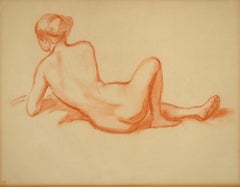
View AllFemale Nude from the Back, around 1900 / - The contour of the Art Nouveau -
By Ludwig von Hofmann
Located in Berlin, DE
Ludwig von Hofmann (1861 Darmstadt - 1945 Pillnitz), Female nude from the back, around 1900. Red chalk drawing on watermarked drawing paper, 36 cm x 44 cm (sheet size). Artist's liga...
Category
Early 1900s Art Nouveau Nude Drawings and Watercolors
Materials
Paper
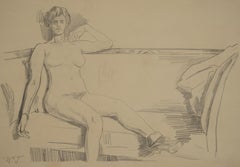
Female Nude Sitting on a Sofa
Located in Berlin, DE
Wilhelm Trübner (1851 Heidelberg - 1917 Karlsruhe), Female Nude Sitting on a Sofa, around 1900. Pencil drawing, 32.5 x 48.5 cm, monogrammed “W.T.” lower left and inscribed on the rev...
Category
Early 1900s Realist Nude Drawings and Watercolors
Materials
Paper
$1,723 Sale Price
20% Off
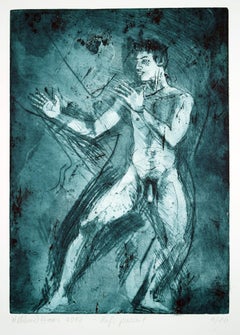
The completely naked prostration
Located in Berlin, DE
Willibrord Haas (*1936 Schramberg), The completely naked prostration, 1999. Etching, 32.5 cm x 23.5 cm (plate size), 54 cm x 37.5 cm (sheet size). Signed “Willibrord Haas” in lead by...
Category
1990s Realist Nude Prints
Materials
Paper

Kufi poses
Located in Berlin, DE
Willibrord Haas (*1936 Schramberg), Kufi poses, 2012. Etching, 44 cm x 32 cm (plate size), 54 cm x 37.5 cm (sheet size). Signed “Willibrord Haas” in lead by the artist, dated “2012”,...
Category
2010s Realist Nude Prints
Materials
Paper
Small Nude / - Abstract Figurativity -
Located in Berlin, DE
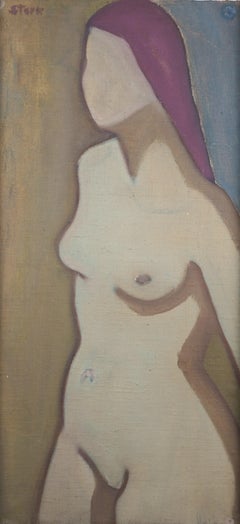
Gustl Stark (1917 Mainz - 2009 ibid.), Small Nude, 1946. Oil on canvas, marouflaged, 54 x 25 cm (picture), 30 x 60 cm (frame), signed "Stark" top left, verso twice signed "Gustav Stark", inscribed by hand as "Small Nude" and dated by hand "1946". With label of the exhibition of the Bundeshaus Bonn from 1956.
- Rubbed area in the lower third of the body, at the same level a retouch in the ochre background. I provisional frame.
- Abstract Figurativity -
About the artwork
During the war, Gustl Stark suffered a particularly severe blow for an artist: he lost his right arm. Nevertheless, he continued to devote himself to art, and the painting, created in 1946, immediately after the end of the Nazi reign of terror, testifies to the dawn of a new era. At the same time, the work is a rare example of the artist's early figurative work, as Stark turned entirely to abstract painting as early as 1950. And even this painting is by no means purely figurative; rather, it already illustrates Stark's turn toward abstraction.
We see a female nude, but one that remains faceless. This can be read symbolically and in relation to the immediate past epoch, which, in the face of horrors, silences and blinds - literally renders faceless. In this sense, the figure is positioned to 'look back'. But she does not look. While this meaning may resonate and make the painting an important work of the immediate postwar period, Gustl Stark is primarily concerned with something else here, namely art itself. The absence of the face leads to the body becoming something flat. Due to the de-individualization, we do not see a concrete person with his individual features, but a body surface. And indeed, the body is constructed through an extremely planar design. Even the contour lines that form the corporeality have a planar rather than a linear character, especially where they merge into shadow zones of almost the same color. And the surfaces themselves are not modeled. The incarnate parts do not show any plastic gradations; the corporeality is completely withdrawn into the plane, which is also true for the hair. In addition, there is no uniform background against which the figure could appear; rather, the area next to the hair is kept bluish, creating a succession of earth-toned colored areas, which again binds the figure to the surface.
Last but not least, the flatness is also forced by the painting technique. Gustl Stark paints directly, a la prima, onto the coarse canvas, whereby the structure of the painting support remains visible in the picture, and in places - around the hair, for example - the canvas itself can be seen. This structural all-over lends the picture a certain flatness.
Gustl Stark thus uses the very motif that stands for the corporeality of art par excellence - the female nude - to transform the spatiality of the traditional picture into a flatness characteristic of modern art. And yet, a strong impression of corporeality is created, without being produced by a painterly modeling of the body. The oscillation between flatness and corporeality creates the intense tension of this groundbreaking painting.
In Gustl Stark's oeuvre, as a consequence of the abstraction we see here, the figurative is completely stripped away in a further step, which is also a loss when looking at this early key work.
About the artist
Gustl Stark was the son of a woodcarver and, after an apprenticeship as a decorative painter, attended the State School of Arts and Crafts in Mainz from 1936 to 1937. Although he was severely wounded in the war and lost his right arm, he studied at the Würzburg School of Painting and Drawing from 1943-1944 and then at the Academy of Fine Arts in Nuremberg from 1944-1948.
He won a state scholarship at the state art competition in Bad Ischl. Numerous study trips to Sylt, Paris, Switzerland, Austria, Italy, Holland and Belgium followed.
Gustl Stark worked in Mainz and was the first artist there to focus on abstract painting. His work quickly gained international recognition, including the Salon Réaliés Nouvelles in Paris.
From 1963-1970 he taught at the State University Institute for Art and Work Education in Mainz and from 1970-1975 at the Johannes Gutenberg University. Gustl Stark became particularly famous for his color embossed prints, for which he invented his own technique.
Gustl Stark received numerous awards for his work. He received the Art Prize for Painting of the City of Mainz in 1962, the State Prize of Rhineland-Palatinate in 1984, and the Gutenberg Bust of the City of Mainz in 1987.
Selected Bibliography
Hans Vollmer (Hrsg.): Allgemeines Lexikon der bildenden Künstler des XX. Jahrhunderts, Vierter Band, Leipzig 1958, S. 344.
Hans H...
Category
1940s Realist Nude Paintings
Materials
Canvas
The Mother / - Violated Motherhood -
By Georg Tappert
Located in Berlin, DE
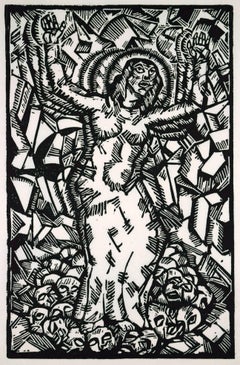
Georg Tappert (1880 Berlin - 1957 Berlin), The Mother, 1918 (1964). Estate print from 1964. Linocut on Japan, 31.5 cm x 20 cm (image), 44.5 cm x 28 cm (sheet size), marked lower left...
Category
1910s Expressionist Figurative Prints
Materials
Paper
You May Also Like
Seated Nude (version 1) from the portfolio Maillol: Sculpture and Lithography)
By Aristide Maillol
Located in New York, NY
Aristide Maillol
Seated Nude (version 1) from the portfolio Aristide Maillol: Sculpture and Lithography, 1925
Lithograph on watermarked paper
12 1/2 × 19 1/2 inches
Edition AP
Hand-s...
Category
1920s Realist Figurative Prints
Materials
Lithograph
“Standing Female Nude”
By Aristide Maillol
Located in Southampton, NY
Beautiful, original lithograph on handmade paper by the well known French artist, Aristide Maillol. Artist monogram “M” lower right. Condition is good. Early 20th century on artist...
Category
Early 20th Century Modern Nude Prints
Materials
Lithograph, Handmade Paper
$1,000 Sale Price
20% Off
Femme
By Aristide Maillol
Located in Santa Monica, CA
ARISTIDE MAILLOL (1861-1944)
FEMME ASSISE /
(WOMAN SEATED IN PROFILE, RIGHT, ONE LEG BENT. ONE LEG RAISED), 1926 (Gueirn 321)
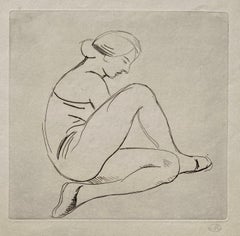
Etching signed with “M” monogram in pencil. Image 9 x 9...
Category
1920s French School Figurative Prints
Materials
Etching
Study for
The Thought
or
The Mediterranean
By Aristide Maillol
Located in London, GB
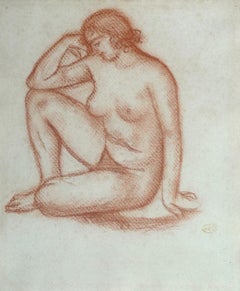
ARISTIDE MAILLOL 1861-1944
1861 Banyuls sur Mer - 1944 Paris (French)
Title: Study for 'The Thought' or 'The Mediterranean' / Etude pour 'la Pensee' ou ...
Category
Early 1900s Nude Drawings and Watercolors
Materials
Pastel
The Posing Nude - Drawing - Early 20th century
By Gaspard Maillol
Located in Roma, IT
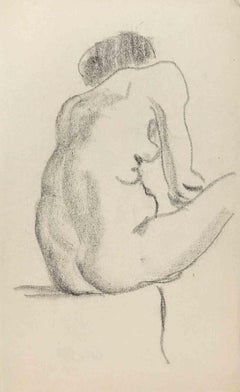
The Posing Nude is an original Drawing on ivory-colored paper realized by Gaspard Maillol in the early 20th century.
Good conditions.
The artwork is represented a nude woman throug...
Category
Early 20th Century Modern Figurative Drawings and Watercolors
Materials
Pencil
Nu de dos - Etching by Aristide Maillol - 1920s
By Aristide Maillol
Located in Roma, IT
Hand Monogrammed. Edition of 50 pieces.
Provenance: Galleria Prandi.
Very good condition.
Category
1920s Modern Figurative Prints
Materials
Etching