Want more images or videos?
Request additional images or videos from the seller
1 of 7

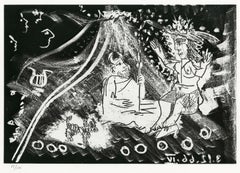
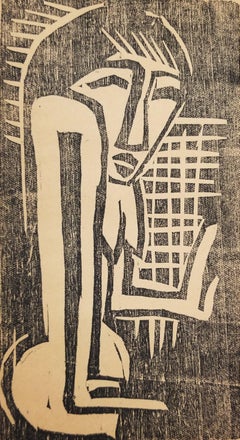
Werner Drewes
Ecce Homo Plate X

1921

$3,000List Price

You May Also Like

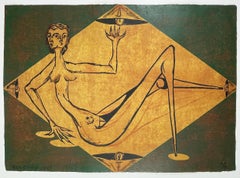
Sueño de un Boy Scout by Ray Smith surreal nude print in green and yellow
By Ray Smith
Located in New York, NY
Ray Smith elucidates the "Dream of a Boy Scout" in this surreal green, red, and yellow wood cut print. A woman with two faces sits nude within a diamond-shaped gold field of color, reaching up with her hand and out with her leg to touch the corners of the diamond, which each nestle a light fixture. Sueño de un Boy Scout, 1988-9 Woodcut in black, red and green, on oiled Japon, signed and dated in black ink, numbered 1/30 (there were also 3 artist's proofs) 25 x 39 in. Per the Broad: "Ray Smith’s paintings incorporate surrealistic and animistic tendencies informed by his Latin heritage as well as deep study of the history of modern art. Smith was born near the Texas/Mexico border...
Category

1980s Pop Art Nude Prints

Materials

Woodcut

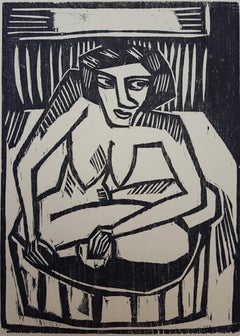
Frau in der Wanne (Woman in Tub) /// German Expressionism Schmidt-Rottluff Nude
By Karl Schmidt-Rottluff
Located in Saint Augustine, FL
Artist: Karl Schmidt-Rottluff (German, 1884-1976) Title: "Frau in der Wanne (Woman in Tub)" Series: Die Aktion *Unsigned edition Year: 1915 Medium: Original Woodcut Engraving on crea...
Category

1910s Expressionist Nude Prints

Materials

Engraving, Woodcut

Stehendes nacktes Mädchen im Profil (Standing Naked Girl in Profile) /// Woodcut
By Karl Schmidt-Rottluff
Located in Saint Augustine, FL
Artist: Karl Schmidt-Rottluff (German, 1884-1976) Title: "Stehendes nacktes Mädchen im Profil (Standing Naked Girl in Profile)" Portfolio: Das Spiel Christa vom Schmerz der Schönheit des Weibes (The Play Christa from the Pain of the Beauty of the Woman) *Issued unsigned Year: 1918 Medium: Original Woodcut Engraving on wove paper Limited edition: Unknown Printer: Fritz Voigt, Berlin, Germany Publisher: Verlag Die Aktion, Berlin, Germany Reference: Schapire No. 220, page 45; Jentsch No. 35. Rifkind No. 2563; Lang No. 300; Reed No. 118 Sheet size: 8.5" x 5.38" Image size: 6.5" x 3.57" Condition: Toning to sheet (as normal). In very good condition Very rare Notes: Provenance: private collection - Oxnard, CA. Comes from a complete originally bound 48 page folio with 9 original woodcut engravings by Schmidt-Rottluff. Text by Alfred Brust. The cover and title pages in pictures are not included, only for reference/provenance. There is an example of this work in the permanent collection of the Brücke Museum, Berlin, Germany. Biography: Karl Schmidt-Rottluff (born December 1, 1884, Rottluff, near Chemnitz, Germany—died...
Category

1910s Expressionist Nude Prints

Materials

Engraving, Woodcut

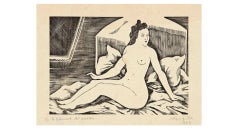
Femme nue sur un lit
By Tsuguharu Leonard Foujita
Located in New York, NY
Woodcut on thin Japan paper. Signed by the artist and dated in pencil, lower right. An artist's proof impression, inscribed "Epeuve [sic] d'essai" in pencil, lower left. This woo...
Category

1920s Modern Nude Prints

Materials

Woodcut

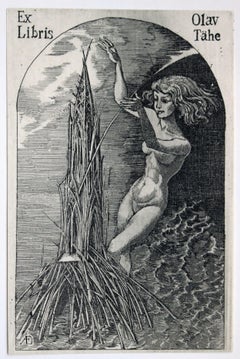
Ex libris. Paper, woodcut, 11x7cm
Located in Riga, LV
Ex libris Olav Tähe Paper, woodcut, 11x7cm
Category

1990s Jugendstil Nude Prints

Materials

Paper, Woodcut

Ex libris. Paper, woodcut, 11x7cm
$172 Sale Price
20% Off
H 4.34 in W 2.76 in D 0.04 in
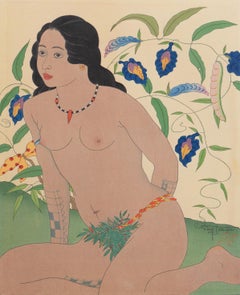
Jeune Fille de Polowat , Tokyo, Garbo, Queen Elizabeth II, Kyoto, Woodblock
By Paul Jacoulet
Located in Santa Cruz, CA
Signed lower right in pencil, 'Paul Jacoulet' (French-Japanese, 1902-1960) and stamped with peach seal; titled, lower right margin, 'Jeune Fille de Polowat. Est Carolines' (Young gir...
Category

1940s Post-Impressionist Nude Prints

Materials

Paper, Woodcut

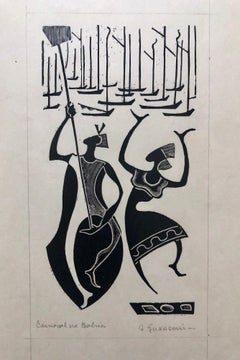
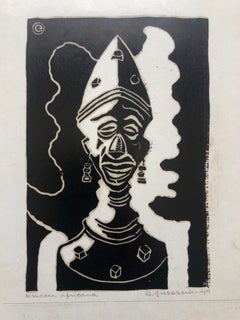
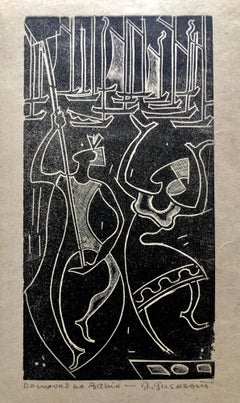
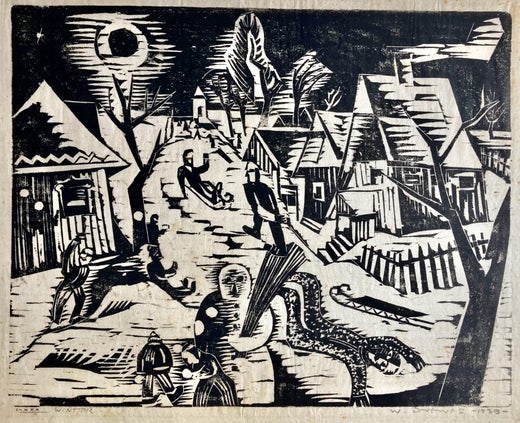
1945 Brazilian Master, Art Deco Nudes Serigraph Woodcut Carnaval Bahia
By Odetto Guersoni
Located in Surfside, FL
Genre: Brazilian Art Deco, African Diaspora Bahian Carnival Subject: Abstract Medium: Print Surface: Paper Country: Brazil Dimensions of overall paper are listed. This is from a series of work he did in the 1940's, we sold one called Ritmo Negro, they are about Afro-Brazilian jazz, dance and music. Odetto Guersoni was born in the city of Jaboticabal, State of São Paulo, in 1924. From 1936 to 1941 he attended the Liceu de Artes de Ofícios in São Paulo, beginning his artistic career in 1945, when he exhibited paintings in the Hall of the Plastic Artists Union . Two years later he was part of the collective group of 19, alongside Aldemir, Charoux, Otavio Araújo, Grassmann, Maria Leontina and several other artists that time would make famous. He then practiced a figurative painting of accentuated Expressionist lauds, characterized by deformation and coloring, raw and Satirical- as, moreover, so many of his fellow exhibitors at the time. As a French government scholar, Odette Guerzoni went to Paris in 1947 and the following year took part in the Peintres et Graveurs Etrangers and Art Libre exhibitions. Student of engraving by Renê Cottet, gradually transformed this expressive medium into his favorite, to the detriment of painting, which he practically abandoned soon after. In 1947, he participated in the 19 Painters exhibition at the Prestes Maia Gallery together with Lothar Charoux, Maria Leontina,Grassmann, Aldemir Martins, Luiz Sacilotto and hiró. Guersoni was awarded a scholarship by the French government, and traveled to Paris, where he began work in engraving. Back in Brazil, in 1951, he founded the Art Workshop, in São Paulo. In 1954, he returned to Europe for a year, financed by the International Labor Organization (ILO). In Geneva, he studied engraving with René Cottet (1902 - 1992) and worked in Stanley william Hayter's studio, Atelier 17, in Paris (1901 - 1988). From 1956 to 1957, he became director of the Union of Plastic Artists of São Paulo. From 1960, he attended, as a trainee, some art schools in the United States and Japan such as The New York School of Printing and Osaka University. In 1971, also in Japan, he attended the workshop of I. Jokuriti. Two years later, he was voted Best Recorder of the Year by the Paulista Association of Art Critics - APCA. He took part in a special room at the Ibero-American Biennial in Montevideo in 1983. The Pinacoteca do Estado de São Paulo - Pesp presents a retrospective of his work in 1994. Odetto Guersoni explores the wide spectrum of possibilities of the engraving. In addition to using techniques such as metal etching, lithograph, serigraph, linocut and, especially, woodcut he developed, in the 1950s, the philigraphy, in which the forms he developed gained points of embroidery made by Bonadei (1906 - 1974) . And, in the 1960s, the plastigraphy, in which he makes engravings on pasty surfaces, obtained from gypsum or other soft material. In the 1970s, technical investigations were associated with pictographic, ideographic, archaic symbol searches, Brazilian cave paintings and plant forms. The drawings are reduced to stylized, geometric shapes and transformed into abstract graphic elements. The artist works with few matrices, which, organized in rectangles, squares or circles, become modules to be combined. Guersoni juxtaposes them, adds, changes colors, and thereby composes colorful mandalas and structural geometries. Based on concise compositions, it produces color vibrations through optical illusions. In many of his woodcut works of the 1980s he uses smooth wood, knives, saws, gouges, punches, avoiding the natural textures of wood. In printing, it leaves the vibrant color and employs dosed inks with colorless masses, obtaining transparencies by superpositions. New journeys of study and specialization in engraving techniques took him in 1954 to Switzerland, 1960 to the United States, and in 1966 to Germany and Austria. Today, after having performed more than 40 individuals including 16 abroad and having participated in more than 50 collectives in several countries, Guersoni is considered one of the most notable Brazilian engravers. Conquered awards in several shows. CHRONOLOGY Individual exhibitions 1946 - Sao Paulo SP - 10th Salon of the Artists' Union, at the Prestes Maia Gallery 1947 - São Paulo SP - 19 Painters, at the Prestes Maia Gallery 1948 - Paris France - Peintres et Graveurs Etrangers at the École des Beaux-Arts 1949 - São Paulo SP - 13th Salon of the Artists' Union, at the Prestes Maia Gallery 1951 - São Paulo SP - 1st Paulista Salon of Modern Art, at Prestes Maia Gallery - silver medal 1953 - São Paulo SP - 2nd International Biennial of São Paulo, at MAM / SP 1954 - São Paulo SP - 3rd Paulista Salon of Modern Art, in the Prestes Maia Gallery 1955 - Rio de Janeiro RJ - 4th National Salon of Modern Art 1955 - Salvador BA - 5th Baiano Salon of Fine Arts, in Belvedere da Sé - honorable mention 1962 - São Paulo SP - Leirner Prize for Contemporary Art at the Folha Art Gallery - 1st printing award 1963 - Curitiba PR - 20th Salão Paranaense de Belas Artes, at the Public Library of Paraná 1963 - Rio de Janeiro RJ - Individual, no MAM / RJ 1968 - Bradford England - First International Print Biennale 1970 - São Paulo SP - Antonio Henrique Amaral, Odetto Guersoni, Tomie Ohtake, Pedro Tort and Gerda Brentani, in the Alberto Bonfiglioli Gallery 1971 - São Paulo SP - 11th International Biennial of São Paulo, at the Biennial Foundation - acquisition award 1973 - Punta del Este Uruguay - 1st Engraving Meeting of the Prata Basin Countries - International Prize 1977 - São Paulo SP - The Groups: the 40's, at the Lasar Segall Museum 1982 - São Paulo SP - Ismenia Coaracy, Odetto Guersoni and Alice Brill...
Category

1940s Art Deco Nude Prints

Materials

Woodcut

1945 Brazilian Master, Art Deco Clown Serigraph Woodcut
By Odetto Guersoni
Located in Surfside, FL
Genre: Brazilian Art Deco, African Diaspora Bahian Carnival Subject: harlequin clown Medium: Print Surface: Paper Country: Brazil Dimensions of overall paper are listed. This is from a series of work he did in the 1940's, we sold one called Ritmo Negro, they are about Afro-Brazilian jazz, dance and music. Odetto Guersoni was born in the city of Jaboticabal, State of São Paulo, in 1924. From 1936 to 1941 he attended the Liceu de Artes de Ofícios in São Paulo, beginning his artistic career in 1945, when he exhibited paintings in the Hall of the Plastic Artists Union . Two years later he was part of the collective group of 19, alongside Aldemir, Charoux, Otavio Araújo, Grassmann, Maria Leontina and several other artists that time would make famous. He then practiced a figurative painting of accentuated Expressionist lauds, characterized by deformation and coloring, raw and Satirical- as, moreover, so many of his fellow exhibitors at the time. As a French government scholar, Odette Guerzoni went to Paris in 1947 and the following year took part in the Peintres et Graveurs Etrangers and Art Libre exhibitions. Student of engraving by Renê Cottet, gradually transformed this expressive medium into his favorite, to the detriment of painting, which he practically abandoned soon after. In 1947, he participated in the 19 Painters exhibition at the Prestes Maia Gallery together with Lothar Charoux, Maria Leontina,Grassmann, Aldemir Martins, Luiz Sacilotto and hiró. Guersoni was awarded a scholarship by the French government, and traveled to Paris, where he began work in engraving. Back in Brazil, in 1951, he founded the Art Workshop, in São Paulo. In 1954, he returned to Europe for a year, financed by the International Labor Organization (ILO). In Geneva, he studied engraving with René Cottet (1902 - 1992) and worked in Stanley william Hayter's studio, Atelier 17, in Paris (1901 - 1988). From 1956 to 1957, he became director of the Union of Plastic Artists of São Paulo. From 1960, he attended, as a trainee, some art schools in the United States and Japan such as The New York School of Printing and Osaka University. In 1971, also in Japan, he attended the workshop of I. Jokuriti. Two years later, he was voted Best Recorder of the Year by the Paulista Association of Art Critics - APCA. He took part in a special room at the Ibero-American Biennial in Montevideo in 1983. The Pinacoteca do Estado de São Paulo - Pesp presents a retrospective of his work in 1994. Odetto Guersoni explores the wide spectrum of possibilities of the engraving. In addition to using techniques such as metal etching, lithograph, serigraph, linocut and, especially, woodcut he developed, in the 1950s, the philigraphy, in which the forms he developed gained points of embroidery made by Bonadei (1906 - 1974) . And, in the 1960s, the plastigraphy, in which he makes engravings on pasty surfaces, obtained from gypsum or other soft material. In the 1970s, technical investigations were associated with pictographic, ideographic, archaic symbol searches, Brazilian cave paintings and plant forms. The drawings are reduced to stylized, geometric shapes and transformed into abstract graphic elements. The artist works with few matrices, which, organized in rectangles, squares or circles, become modules to be combined. Guersoni juxtaposes them, adds, changes colors, and thereby composes colorful mandalas and structural geometries. Based on concise compositions, it produces color vibrations through optical illusions. In many of his woodcut works of the 1980s he uses smooth wood, knives, saws, gouges, punches, avoiding the natural textures of wood. In printing, it leaves the vibrant color and employs dosed inks with colorless masses, obtaining transparencies by superpositions. New journeys of study and specialization in engraving techniques took him in 1954 to Switzerland, 1960 to the United States, and in 1966 to Germany and Austria. Today, after having performed more than 40 individuals including 16 abroad and having participated in more than 50 collectives in several countries, Guersoni is considered one of the most notable Brazilian engravers. Conquered awards in several shows. CHRONOLOGY Individual exhibitions 1946 - Sao Paulo SP - 10th Salon of the Artists' Union, at the Prestes Maia Gallery 1947 - São Paulo SP - 19 Painters, at the Prestes Maia Gallery 1948 - Paris France - Peintres et Graveurs Etrangers at the École des Beaux-Arts 1949 - São Paulo SP - 13th Salon of the Artists' Union, at the Prestes Maia Gallery 1951 - São Paulo SP - 1st Paulista Salon of Modern Art, at Prestes Maia Gallery - silver medal 1953 - São Paulo SP - 2nd International Biennial of São Paulo, at MAM / SP 1954 - São Paulo SP - 3rd Paulista Salon of Modern Art, in the Prestes Maia Gallery 1955 - Rio de Janeiro RJ - 4th National Salon of Modern Art 1955 - Salvador BA - 5th Baiano Salon of Fine Arts, in Belvedere da Sé - honorable mention 1962 - São Paulo SP - Leirner Prize for Contemporary Art at the Folha Art Gallery - 1st printing award 1963 - Curitiba PR - 20th Salão Paranaense de Belas Artes, at the Public Library of Paraná 1963 - Rio de Janeiro RJ - Individual, no MAM / RJ 1968 - Bradford England - First International Print Biennale 1970 - São Paulo SP - Antonio Henrique Amaral, Odetto Guersoni, Tomie Ohtake, Pedro Tort and Gerda Brentani, in the Alberto Bonfiglioli Gallery 1971 - São Paulo SP - 11th International Biennial of São Paulo, at the Biennial Foundation - acquisition award 1973 - Punta del Este Uruguay - 1st Engraving Meeting of the Prata Basin Countries - International Prize 1977 - São Paulo SP - The Groups: the 40's, at the Lasar Segall Museum 1982 - São Paulo SP - Ismenia Coaracy, Odetto Guersoni and Alice Brill...
Category

1940s Art Deco Nude Prints

Materials

Woodcut

1945 Brazilian Master, Art Deco Nudes Serigraph Woodcut Carnaval Bahia
By Odetto Guersoni
Located in Surfside, FL
Genre: Brazilian Art Deco, African Diaspora Bahian Carnival Subject: Abstract Medium: Print Surface: Paper Country: Brazil Dimensions of overall paper are listed. This is from a series of work he did in the 1940's, we sold one called Ritmo Negro, they are about Afro-Brazilian jazz, dance and music. Odetto Guersoni was born in the city of Jaboticabal, State of São Paulo, in 1924. From 1936 to 1941 he attended the Liceu de Artes de Ofícios in São Paulo, beginning his artistic career in 1945, when he exhibited paintings in the Hall of the Plastic Artists Union . Two years later he was part of the collective group of 19, alongside Aldemir, Charoux, Otavio Araújo, Grassmann, Maria Leontina and several other artists that time would make famous. He then practiced a figurative painting of accentuated Expressionist lauds, characterized by deformation and coloring, raw and Satirical- as, moreover, so many of his fellow exhibitors at the time. As a French government scholar, Odette Guerzoni went to Paris in 1947 and the following year took part in the Peintres et Graveurs Etrangers and Art Libre exhibitions. Student of engraving by Renê Cottet, gradually transformed this expressive medium into his favorite, to the detriment of painting, which he practically abandoned soon after. In 1947, he participated in the 19 Painters exhibition at the Prestes Maia Gallery together with Lothar Charoux, Maria Leontina,Grassmann, Aldemir Martins, Luiz Sacilotto and hiró. Guersoni was awarded a scholarship by the French government, and traveled to Paris, where he began work in engraving. Back in Brazil, in 1951, he founded the Art Workshop, in São Paulo. In 1954, he returned to Europe for a year, financed by the International Labor Organization (ILO). In Geneva, he studied engraving with René Cottet (1902 - 1992) and worked in Stanley william Hayter's studio, Atelier 17, in Paris (1901 - 1988). From 1956 to 1957, he became director of the Union of Plastic Artists of São Paulo. From 1960, he attended, as a trainee, some art schools in the United States and Japan such as The New York School of Printing and Osaka University. In 1971, also in Japan, he attended the workshop of I. Jokuriti. Two years later, he was voted Best Recorder of the Year by the Paulista Association of Art Critics - APCA. He took part in a special room at the Ibero-American Biennial in Montevideo in 1983. The Pinacoteca do Estado de São Paulo - Pesp presents a retrospective of his work in 1994. Odetto Guersoni explores the wide spectrum of possibilities of the engraving. In addition to using techniques such as metal etching, lithograph, serigraph, linocut and, especially, woodcut he developed, in the 1950s, the philigraphy, in which the forms he developed gained points of embroidery made by Bonadei (1906 - 1974) . And, in the 1960s, the plastigraphy, in which he makes engravings on pasty surfaces, obtained from gypsum or other soft material. In the 1970s, technical investigations were associated with pictographic, ideographic, archaic symbol searches, Brazilian cave paintings and plant forms. The drawings are reduced to stylized, geometric shapes and transformed into abstract graphic elements. The artist works with few matrices, which, organized in rectangles, squares or circles, become modules to be combined. Guersoni juxtaposes them, adds, changes colors, and thereby composes colorful mandalas and structural geometries. Based on concise compositions, it produces color vibrations through optical illusions. In many of his woodcut works of the 1980s he uses smooth wood, knives, saws, gouges, punches, avoiding the natural textures of wood. In printing, it leaves the vibrant color and employs dosed inks with colorless masses, obtaining transparencies by superpositions. New journeys of study and specialization in engraving techniques took him in 1954 to Switzerland, 1960 to the United States, and in 1966 to Germany and Austria. Today, after having performed more than 40 individuals including 16 abroad and having participated in more than 50 collectives in several countries, Guersoni is considered one of the most notable Brazilian engravers. Conquered awards in several shows. CHRONOLOGY Individual exhibitions 1946 - Sao Paulo SP - 10th Salon of the Artists' Union, at the Prestes Maia Gallery 1947 - São Paulo SP - 19 Painters, at the Prestes Maia Gallery 1948 - Paris France - Peintres et Graveurs Etrangers at the École des Beaux-Arts 1949 - São Paulo SP - 13th Salon of the Artists' Union, at the Prestes Maia Gallery 1951 - São Paulo SP - 1st Paulista Salon of Modern Art, at Prestes Maia Gallery - silver medal 1953 - São Paulo SP - 2nd International Biennial of São Paulo, at MAM / SP 1954 - São Paulo SP - 3rd Paulista Salon of Modern Art, in the Prestes Maia Gallery 1955 - Rio de Janeiro RJ - 4th National Salon of Modern Art 1955 - Salvador BA - 5th Baiano Salon of Fine Arts, in Belvedere da Sé - honorable mention 1962 - São Paulo SP - Leirner Prize for Contemporary Art at the Folha Art Gallery - 1st printing award 1963 - Curitiba PR - 20th Salão Paranaense de Belas Artes, at the Public Library of Paraná 1963 - Rio de Janeiro RJ - Individual, no MAM / RJ 1968 - Bradford England - First International Print Biennale 1970 - São Paulo SP - Antonio Henrique Amaral, Odetto Guersoni, Tomie Ohtake, Pedro Tort and Gerda Brentani, in the Alberto Bonfiglioli Gallery 1971 - São Paulo SP - 11th International Biennial of São Paulo, at the Biennial Foundation - acquisition award 1973 - Punta del Este Uruguay - 1st Engraving Meeting of the Prata Basin Countries - International Prize 1977 - São Paulo SP - The Groups: the 40's, at the Lasar Segall Museum 1982 - São Paulo SP - Ismenia Coaracy, Odetto Guersoni and Alice Brill...
Category

1940s Art Deco Nude Prints

Materials

Woodcut

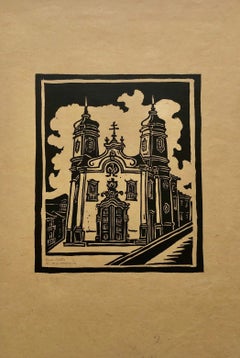
1945 Brazilian Master, Art Deco Serigraph Woodcut Colonial Architecture Mission
By Odetto Guersoni
Located in Surfside, FL
Genre: Brazilian Art Deco, African Diaspora Bahian Carnival Subject: Abstract Medium: Print Surface: Paper Country: Brazil Dimensions of overall paper are listed. This is from a series of work he did in the 1940's, we sold one called Ritmo Negro, they are about Afro-Brazilian jazz, dance and music. Odetto Guersoni was born in the city of Jaboticabal, State of São Paulo, in 1924. From 1936 to 1941 he attended the Liceu de Artes de Ofícios in São Paulo, beginning his artistic career in 1945, when he exhibited paintings in the Hall of the Plastic Artists Union . Two years later he was part of the collective group of 19, alongside Aldemir, Charoux, Otavio Araújo, Grassmann, Maria Leontina and several other artists that time would make famous. He then practiced a figurative painting of accentuated Expressionist lauds, characterized by deformation and coloring, raw and Satirical- as, moreover, so many of his fellow exhibitors at the time. As a French government scholar, Odette Guerzoni went to Paris in 1947 and the following year took part in the Peintres et Graveurs Etrangers and Art Libre exhibitions. Student of engraving by Renê Cottet, gradually transformed this expressive medium into his favorite, to the detriment of painting, which he practically abandoned soon after. In 1947, he participated in the 19 Painters exhibition at the Prestes Maia Gallery together with Lothar Charoux, Maria Leontina,Grassmann, Aldemir Martins, Luiz Sacilotto and hiró. Guersoni was awarded a scholarship by the French government, and traveled to Paris, where he began work in engraving. Back in Brazil, in 1951, he founded the Art Workshop, in São Paulo. In 1954, he returned to Europe for a year, financed by the International Labor Organization (ILO). In Geneva, he studied engraving with René Cottet (1902 - 1992) and worked in Stanley william Hayter's studio, Atelier 17, in Paris (1901 - 1988). From 1956 to 1957, he became director of the Union of Plastic Artists of São Paulo. From 1960, he attended, as a trainee, some art schools in the United States and Japan such as The New York School of Printing and Osaka University. In 1971, also in Japan, he attended the workshop of I. Jokuriti. Two years later, he was voted Best Recorder of the Year by the Paulista Association of Art Critics - APCA. He took part in a special room at the Ibero-American Biennial in Montevideo in 1983. The Pinacoteca do Estado de São Paulo - Pesp presents a retrospective of his work in 1994. Odetto Guersoni explores the wide spectrum of possibilities of the engraving. In addition to using techniques such as metal etching, lithograph, serigraph, linocut and, especially, woodcut he developed, in the 1950s, the philigraphy, in which the forms he developed gained points of embroidery made by Bonadei (1906 - 1974) . And, in the 1960s, the plastigraphy, in which he makes engravings on pasty surfaces, obtained from gypsum or other soft material. In the 1970s, technical investigations were associated with pictographic, ideographic, archaic symbol searches, Brazilian cave paintings and plant forms. The drawings are reduced to stylized, geometric shapes and transformed into abstract graphic elements. The artist works with few matrices, which, organized in rectangles, squares or circles, become modules to be combined. Guersoni juxtaposes them, adds, changes colors, and thereby composes colorful mandalas and structural geometries. Based on concise compositions, it produces color vibrations through optical illusions. In many of his woodcut works of the 1980s he uses smooth wood, knives, saws, gouges, punches, avoiding the natural textures of wood. In printing, it leaves the vibrant color and employs dosed inks with colorless masses, obtaining transparencies by superpositions. New journeys of study and specialization in engraving techniques took him in 1954 to Switzerland, 1960 to the United States, and in 1966 to Germany and Austria. Today, after having performed more than 40 individuals including 16 abroad and having participated in more than 50 collectives in several countries, Guersoni is considered one of the most notable Brazilian engravers. Conquered awards in several shows. CHRONOLOGY Individual exhibitions 1946 - Sao Paulo SP - 10th Salon of the Artists' Union, at the Prestes Maia Gallery 1947 - São Paulo SP - 19 Painters, at the Prestes Maia Gallery 1948 - Paris France - Peintres et Graveurs Etrangers at the École des Beaux-Arts 1949 - São Paulo SP - 13th Salon of the Artists' Union, at the Prestes Maia Gallery 1951 - São Paulo SP - 1st Paulista Salon of Modern Art, at Prestes Maia Gallery - silver medal 1953 - São Paulo SP - 2nd International Biennial of São Paulo, at MAM / SP 1954 - São Paulo SP - 3rd Paulista Salon of Modern Art, in the Prestes Maia Gallery 1955 - Rio de Janeiro RJ - 4th National Salon of Modern Art 1955 - Salvador BA - 5th Baiano Salon of Fine Arts, in Belvedere da Sé - honorable mention 1962 - São Paulo SP - Leirner Prize for Contemporary Art at the Folha Art Gallery - 1st printing award 1963 - Curitiba PR - 20th Salão Paranaense de Belas Artes, at the Public Library of Paraná 1963 - Rio de Janeiro RJ - Individual, no MAM / RJ 1968 - Bradford England - First International Print Biennale 1970 - São Paulo SP - Antonio Henrique Amaral, Odetto Guersoni, Tomie Ohtake, Pedro Tort and Gerda Brentani, in the Alberto Bonfiglioli Gallery 1971 - São Paulo SP - 11th International Biennial of São Paulo, at the Biennial Foundation - acquisition award 1973 - Punta del Este Uruguay - 1st Engraving Meeting of the Prata Basin Countries - International Prize 1977 - São Paulo SP - The Groups: the 40's, at the Lasar Segall Museum 1982 - São Paulo SP - Ismenia Coaracy, Odetto Guersoni and Alice Brill...
Category

1940s Art Deco Nude Prints

Materials

Woodcut

More From This Seller

View All
The Book of Ah!
By Julio de Diego
Located in Fairlawn, OH
String bound booklet (portfolio) with six hand colored woodcuts, signed in pencil by the artist, tipped in the book Provenance: Estate of the artist By descent to his daughter Kir...
Category

1960s American Modern Nude Prints

Materials

Woodcut

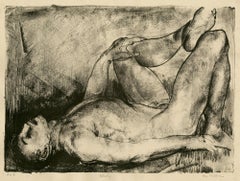
Man on His Back, Nude
By George Wesley Bellows
Located in Fairlawn, OH
Man on His Back, Nude Lithograph, c. 1916 Signed by the artist lower right: Geo Bellows (see photo) Annotated bottom left: No. 3 by the artist (see photo) An unredorded trial proof b...
Category

1910s Ashcan School Nude Prints

Materials

Lithograph

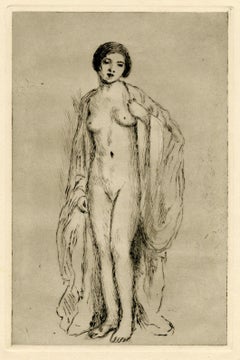
Standing Female Nude
By Frederick Carl Frieseke
Located in Fairlawn, OH
Standing Female Nude Drypoint, c. 1910 Unsigned Estate authentication on verso (see photo) Estate authentication verso by Frances Frieseke Kilmer (Mrs. Kenton Kilmer, 1914-1998) (see photo) Probably depicts the artist's wife, the artist's favorite model Extremely rare original drypoint by Frieseke Printed with selective inking to highlight the figure Condition: excellent Image/Plate size: 10 x 6 5/8 inches Frame size: 19 1/4 x 15 3/4 inches Provenance: Estate of the Artist By descent to his daughter Frances Hirschl & Adler Gallery, Stock No. APG 1106.3D-B (see photo) Biography Frederick Carl Frieseke was born on April 7, 1874, in Owosso, Michigan. After studying for a short while at the Art Institute of Chicago and the Art Students League in New York, Frieseke left for France in 1898, and almost all of his career was spent as an expatriate, with ties to the United States maintained through his New York dealer, William MacBeth, and by occasional visits to America. Following the pattern of innumerable young Americans, he enrolled at the Academie Julian where he studied with Benjamin Constant (1845-1902) and Jean-Paul Laurens (1838-1921). He appears to have had at least brief contact with and to have been influenced by James McNeill Whistler, who had recently opened his Academie Carmen in Paris. By 1900 Frieseke was spending summers in the town of Giverny, made famous by the residence of Monet and subsequently by other artists, among them many Americans. In 1906, the year after his marriage to Sarah O'Bryan, he leased a house once occupied by the American Impressionist Theodore Robinson. Although the property was adjacent to Monet's, Frieseke had only limited contact with the French master. Instead he apparently found Pierre Auguste Renoir the most influential of all the Impressionists. Frieseke's Giverny house and garden, as settings for a series of female models, provided nearly all of his subject matter for the next thirty years, although in 1930 he made a series of watercolors of Florida scenes remembered from his childhood and painted some Swiss landscapes. After World War I, the artist and his family settled in Normandy. Frieseke's career falls roughly into three stages. In the first, figures most clearly show his academic training and draughtsmanship. Gradually these evolve into the most common images of the next decade, comprised of loosely-applied blotches of bright color. The vast majority of these show their subjects in the garden, standing among the flowers, taking tea, or just basking in the sun. Others include models in colorful, light-filled interiors. In Frieseke's latest paintings, the figures very often appear indoors, their forms are given greater solidity, and the brushwork is less broken. At the height of his career, in the 1910s and early 1920s, Frieseke was perhaps the most popular of all living American artists. He received numerous awards and medals and saw his work purchased by private collectors and major museums. Decades after the initial introduction of Impressionism by Monet and his contemporaries, Frieseke assumed this style for his work, choosing to ignore the newer artistic movements of the early twentieth century. Nevertheless, his paintings were acclaimed in both the United States and in Europe. In 1904 he won a silver medal at the St. Louis Universal Exposition and a gold medal at Munich. He was elected a member of the Société National des Beaux Arts in 1908 and the National Academy of Design in 1912. Seventeen of his canvases were featured at the Venice Biennale in 1909 and he won the Grand Prize at the Panama-Pacific International Exposition in 1915. He was commissioned to execute several murals, including one for the New York store of John Wanamaker, one of his most loyal patrons. He died on August 28, 1939, at his home in Normandy, in the town of Le Mesnil sur Blangy. In the decades following his death, however, after artistic tastes had changed considerably, his work was nearly forgotten until it received renewed attention as interest in American Impressionism grew in the 1960s Courtesy National Gallery of Art, Washington Etchings by Frederick Carl Frieseke include The Balcony and Standing Female Nude. Frieseke was an American Impressionist painter who was popular in the 1910s and 1920s. Etchings by Frederick Carl Frieseke: The Balcony: An etching by Frieseke from 1904 Standing Female Nude Other paintings by Frederick Carl Frieseke: The Garden Parasol...
Category

1910s American Impressionist Nude Prints

Materials

Drypoint

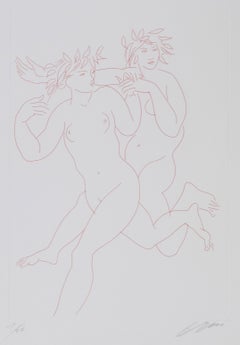
untitled
By Hans Erni
Located in Fairlawn, OH
Untitled Etching, 1960 Signed in pencil by the artist From: Les Bucoliques De Virgile Version Francais de Jacque Delille (25 plates) Published by Lausanne, André et Pierre...
Category

1960s Modern Nude Prints

Materials

Etching

Plate V, Le Cocu Magnifique
By Pablo Picasso
Located in Fairlawn, OH
Plate V, Le Cocu Magnifique Etching, 1968 Unsigned From the unsigned edition of 200 impressions printed on Rives BFK paper There is also a signed edition of 30 impressions The set of...
Category

1960s Modern Nude Prints

Materials

Etching

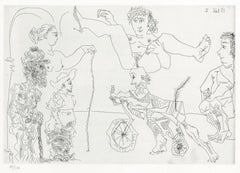
Plate IV, Le Cocu Magnifique
By Pablo Picasso
Located in Fairlawn, OH
Plate IV, Le Cocu Magnifique etching & aquatint, 1968 Unsigned on the print Signed on the portfolio justification page (see photo) From the unsigned edition of 200 impressions printe...
Category

1960s French School Nude Prints

Materials

Aquatint

Still Thinking About These?

All Recently Viewed