Items Similar to 18th C. Portrait of Edward Stanley from Henry VIII
s Court after Holbein Drawing
Want more images or videos?
Request additional images or videos from the seller
1 of 9
Hans Holbein18th C. Portrait of Edward Stanley from Henry VIII
s Court after Holbein Drawing1793
1793
$575
£436.37
€502.79
CA$812.38
A$870.46
CHF 466.94
MX$10,310.67
NOK 5,890.17
SEK 5,388.59
DKK 3,755.91
About the Item
This is an 18th century engraved portrait of "Edward Stanley" created by Francesco Bartolozzi (1728–1815), after a drawing by Hans Holbein the Younger (1497- 1543) in the 16th century. Holbein was the official artist in the court of King Henry VIII. Bartolozzi used both etching and stipple engraving techniques to create the work which was published by John Chamberlaine in London in 1793 in "The Book of Imitations of Original Drawings by Hans Holbein in the Collection of His Majesty".
Edward Stanley, 3rd Earl of Derby (1509-1572) was a prominent nobleman in King Henry VIII's royal court. When Edward was 13 years old Henry VIII took responsibility for raising him with the help of Cardinal Wolsey. Edward was involved in the petition of Pope Clement VII to allow the divorce of King Henry from his 1st wife, Katherine of Aragon, which would set the stage for Henry's marriage to Anne Boleyn. Edward was involved in several diplomatic missions with King Henry and military campaigns in Scotland with King Edward VI, Henry's son, who made him a Knight of the Garter. He served on the Privy Council of Queen Mary and subsequently Queen Elizabeth I.
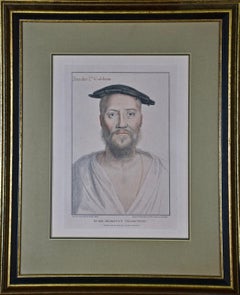
This historically important portrait is presented in an antiqued gold-colored and black wood frame with a tan color outer mat and a dark brown inner mat. The frame measures 23" high by 18.88" wide by 1.75" deep. There is faint staining of the lower left corner of the mat, but the engraving is in very good condition. There is another Bartolozzi/Holbein portrait of Sir George Brooke, Baron Cobham, another nobleman in King Henry VIII's court listed on 1stdibs, Reference # LU117326313422. It is framed and matted identically to this piece and the pair would make an attractive and interesting display. A discount is available for purchase of the pair.
- Creator:Hans Holbein (1497 - 1543, German)
- Creation Year:1793
- Dimensions:Height: 23 in (58.42 cm)Width: 18.88 in (47.96 cm)Depth: 1.75 in (4.45 cm)
- Medium:
- Movement Style:
- Period:
- Condition:
- Gallery Location:Alamo, CA
- Reference Number:Seller: #2781stDibs: LU117326313422
Hans Holbein
Hans Holbein the Younger c. 1497– between 7 October and 29 November 1543 was a German painter and printmaker who worked in a Northern Renaissance style, and is considered one of the greatest portraitists of the 16th century. He also produced religious art, satire, and Reformation propaganda, and he made a significant contribution to the history of book design. He is called "the Younger" to distinguish him from his father Hans Holbein the Elder, an accomplished painter of the Late Gothic school.
About the Seller
5.0
Platinum Seller
Premium sellers with a 4.7+ rating and 24-hour response times
Established in 2011
1stDibs seller since 2019
306 sales on 1stDibs
Typical response time: 1 hour
- ShippingRetrieving quote...Shipping from: Alamo, CA
- Return Policy
More From This Seller
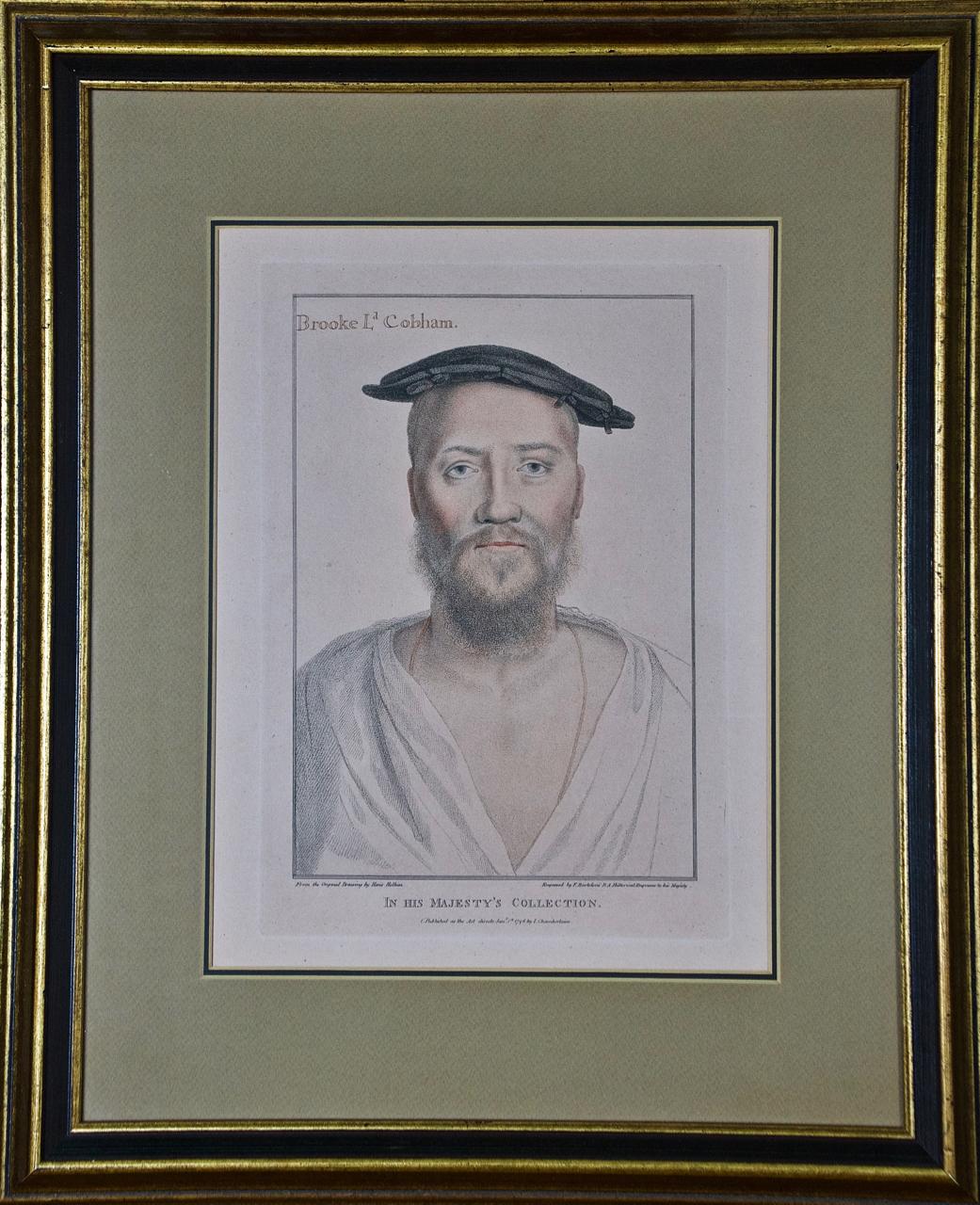
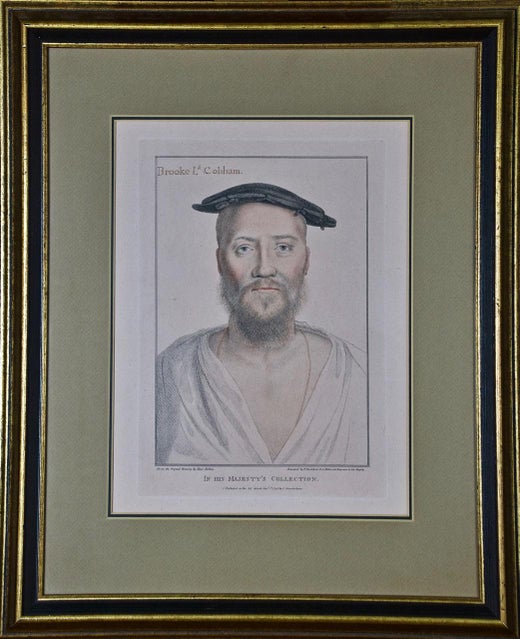
View All18th C. Bartolozzi Portrait of Brooke Cobham from a 16th Century Holbein Drawing
By Hans Holbein
Located in Alamo, CA
This is an 18th century engraved portrait of Brooke Cobham, a nobleman in King Henry VIII's court, created by Francesco Bartolozzi (1728–1815), after a drawing by Hans Holbein the Younger (1497- 1543) in the 16th century. Holbein was the official artist in the court of King Henry VIII. Bartolozzi used both etching and stipple engraving techniques to create the work which was then was printed in color on pink paper and hand finished with watercolor. It was published by John Chamberlaine in London in 1793 in "The Book of Imitations of Original Drawings by Hans Holbein in the Collection of His Majesty".
Sir George Brooke, Baron Cobham (1497-1558) was a prominent member of King Henry VIII's royal court. He became a member of parliament in 1529 and served as a peer in the trial of Queen Anne Boleyn, which resulted in her beheading. He was rewarded for his political and military service to King Henry and Britain with land, castles and former monasteries and was made a Knight of the Garter, a prestigious membership limited to the king and a very limited number of prominent British subjects. As a member of the Privy Council following the death of young King Edward VI (Henry VIII's son), he fell out of favor when he signed a ruling disinheriting both of Henry VIII's daughters, Mary and Elizabeth, in favor of Lady Jane Grey...
Category
Late 18th Century Old Masters Portrait Prints
Materials
Engraving, Etching
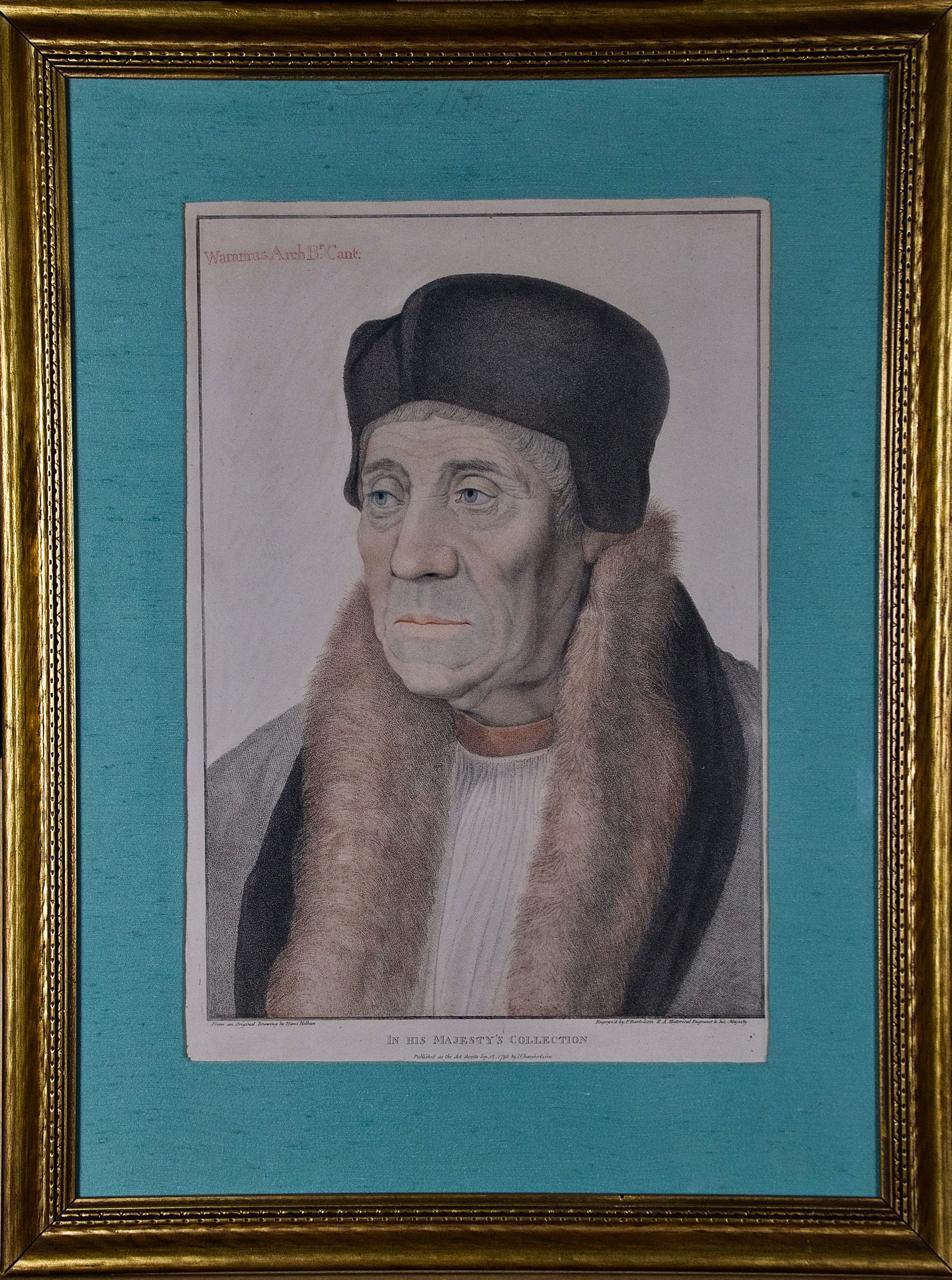
Holbein Hand-colored Portrait of Warham, Archbishop of Canterbury for Henry VIII
By (After) Hans Holbein The Younger
Located in Alamo, CA
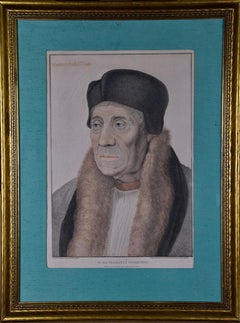
This framed hand colored stipple engraving and etching portrait of William Warham, Archbishop of Canterbury under King Henry VII and his son King Henry VIII was created by Francesco Bartolozzi (1728–1815) after a drawing and a painting by Hans Holbein (1497-1543), who was Henry VIII's court painter. The print was published in London by John Chamberlaine in 1795. The print was created utilizing stipple engraving and etching techniques by the Italian artist Francesco Bartolozzi, who was employed as the royal engraver by King George III of England. The publisher, John Chamberlaine, was Keeper of the King's Drawings and Medals. The inscription beneath the portrait reads" "In His Majesty's Collection", "Engraved by F. Bartolozzi R A Historical Engraver to His Majesty'' in the lower right, and ''From an original drawing by Hans Holbien'' in the lower left. The original painting by Holbein is displayed at Lambeth Castle and the original drawing is in the art collection at Windsor Castle. The engraving is held by many museums, including: The British Museum, The Metropolitan Museum of Art, The National Portrait Gallery, The Chicago Art Institute and The Fine Arts Museums of San Francisco.
This portrait depicts Archbishop William Warham facing to his right, wearing a black cap covering his ears and fur trimmed clerical robes. The print is presented in a decorative gold-colored wood frame with a blue-grey fabric mat. The frame measures 26.5" x 20.13" x 1". The print is in excellent condition.
William Warham (1450-1532) was the last of the pre-Reformation archbishops of Canterbury, serving under King Henry VII and then under King Henry VIII. He was a quiet, unassuming intellectual whose career ended with a strong and brave stance against the divorce of King Henry VIII and the king's resultant withdrawal of England from the Catholic church and his draconian actions against the clergy. As Lord Chancellor...
Category
Late 18th Century Portrait Prints
Materials
Engraving, Etching
Sir. John Powell, Knight: Early 18th C. Engraved Portrait After William Sherwin
Located in Alamo, CA
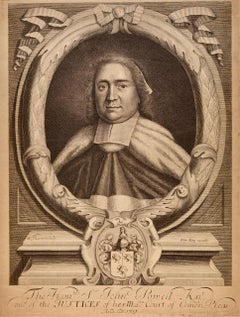
This is an early 18th century portrait of Sir John Powell entitled "The Honorable Sr. John Powell, Knight. one of the Justices of her Majesties' Court of Common Pleas. Ano. D 1711". It was engraved and published by John King in London in 1711, after an earlier work by William Sherwin. The engraving depicts a bust length portrait of Powell wearing an elaborate fir-trimmed robe and collar. The portrait is encompassed in an ornate oval frame, sitting on a pedestal with an impressive coat-of-arms below.
This engraved portrait is printed on laid, chain-linked watermarked cream-colored paper The sheet measures 15.25" high and 11.38" wide. It is adhered to an archival thick card at the upper corners, There is a 1/8" tear at the lower edge of the sheet, but the print is otherwise in very good condition. This engraving is held by museums and institutions, including the British Museum and the Harvard University Art Museum.
Sir John Powell (1632-1696) was an English lawyer and judge who served as a justice of the King's Bench from 1683 until his death. He was born in Glamorganshire, Wales, and studied at Jesus College, Oxford, before being called to the bar at the Middle Temple in 1656. Powell was known for his staunch support of the monarchy and the Church of England, and he played a prominent role in the trial of the Whig leader Lord William Russell in 1683, which resulted in Russell's execution for his alleged involvement in a plot to assassinate King Charles II. Powell was also involved in the trials of several other prominent Whig politicians, including Algernon Sidney and Titus Oates. In addition to his work as a judge, Powell was also a member of Parliament for various constituencies throughout his career, and he served as Solicitor General and Attorney General for Wales under King James II. However, he opposed James's efforts to promote Catholicism and supported the Glorious Revolution of 1688, which led to James's overthrow and the installation of William and Mary as joint monarchs.
Powell was known for his intellectual rigor and his legal expertise, and he authored several influential legal treatises during his lifetime. He was widely respected by his peers and by the legal community as a whole, and his legacy as a jurist and judge continues to be celebrated today.
William Sherwin (1645-1709) was an English engraver who worked during the late 17th and early 18th centuries. He was born in Chesterfield, Derbyshire, and is known for his high-quality engravings of various subjects, including portraits, landscapes, and architectural views. Sherwin was trained as an engraver and worked as an apprentice to the renowned engraver Robert White. After completing his training, he went on to establish his own studio in London, where he produced a significant body of work over the course of his career. One of Sherwin's most famous works is his engraving of the portrait of John Locke...
Category
Early 18th Century Old Masters Portrait Prints
Materials
Engraving
Sir Francis Drake: 18th C. Portrait of 16th C. Navigator, Privateer, Politician
By Jacobus Houbraken
Located in Alamo, CA
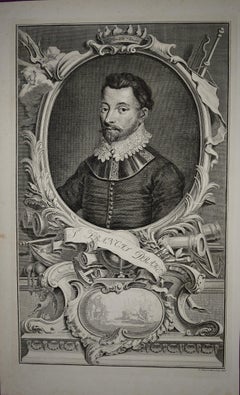
This an 18th century copper plate engraved portrait of Sir Francis Drake by Jacobus Houbraken, after a painting by Sir Godfrey Kneller, from "The Hea...
Category
1740s Portrait Prints
Materials
Engraving
Viscount Thomas Belasise: 17th Century Hand-colored Portrait by Robert White
Located in Alamo, CA
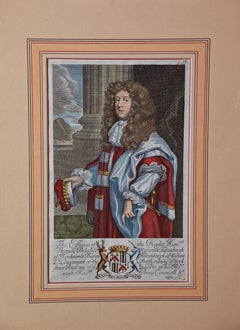
This is a hand-colored engraving by Robert White (1645-1703) after a painting by Abraham Blooteling (or Bloteling) (1634–1690) entitled "The Effigies of the Right honorable: Thomas B...
Category
Late 17th Century Other Art Style Portrait Prints
Materials
Engraving
N. Lambert Seigneur de Thorigny: 17th C. Engraved Portrait After Largillière
By Nicolas de Largillière
Located in Alamo, CA
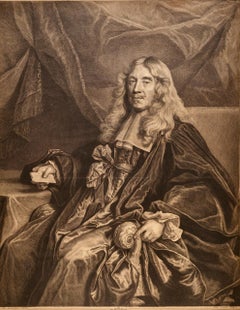
This is a 17th century engraving entitled "Messire Nicolas Lambert Seigneur de Thorigny, Conseiller du Roy" by Pierre Drevet after a painting by Noicolas de Largillière, published in Paris in 1698. This portrait depicts a three-quarter length view of Nicolas Lambert de Thorigny, who is dressed in elaborate robes and collar of a wealthy Parisian nobleman of the time. He is seated directed to the left and looking directly at the viewer. He is holding an inscribed note in his right hand. A magnificent billowing curtain is in the background. Lambert's coat of arms is shown in the center of the lower inscription area. In the inscription area is lettered with title, production detail: "Nic. Largilliere pinxit" and "Petr. Drevet sculpsit", and publication detail: "Se vend a Paris chez Drevet rüe du Foin au coin du College de Maître Gervais".
Nicolas Lambert, Seigneur de Thorigny (1600-1664), was a French nobleman and military commander who lived in the 17th century. He served in the French army during the Thirty Years' War, a conflict that took place from 1618 to 1648 and involved many European powers. Lambert fought in several battles during the war and rose to the rank of colonel. After the war, Lambert returned to France and became involved in politics. He served as a member of the Estates General, a legislative body that advised the king, and as a governor of several provinces. He was a counsellor and confidant of King Louis XIV. He had the title of Président de la Chambre des Comptes. He also became a member of the French Academy of Sciences, a prestigious institution that promotes scientific research and scholarship. Lambert was known for his military expertise, his intelligence, and his commitment to public service. He iInherited the Hôtel Lambert in Paris from his brother Jean Baptiste in 1644 and hired some of the most prominent artists of the time, including Charles Le Brun to decorate and furnish the building.
This beautiful old master engraving was created with impressive detailed technique. It is printed on laid, chain-linked paper. The sheet measures 18.5" high and 13.38" wide. The sheet is adhered to an archival backing paper at the top. There is a faint horizontal center fold and mild discoloration in the inscription area and in the upper margin on the right, with mild wrinkling here. The print is otherwise in very good condition, considering its age. This engraving is so rare, that no comparable prints could be identified for sale online. It is currently only listed in museum collections, including: The Metropolitan Museum of Art, The British Museum, The Louvre, The Riksmuseum, The Victoria & Albert Museum, The Fitzwilliam Museum at the U. of Cambridge, The Boston Museum of Fine Arts, Harvard Art Museums, The Finnish National Museum, The Philadelphia Museum. It is shown in the Metropolitan Museum's Cataloque of French paintings entitled: "French Paintings in The Metropolitan Museum of Art, published in 2018, page 36. The page is included in the photos.
Nicolas de Largillière (1656-1746) was a French portrait painter who achieved great success and acclaim during the late Baroque and Rococo periods. He was born in Paris and trained under the painter Antoine Goubeau. He studied in Antwerp and London before returning to France. While in England he was a favorite painter of King Charles II and King James II of England...
Category
Late 17th Century Portrait Prints
Materials
Engraving
You May Also Like
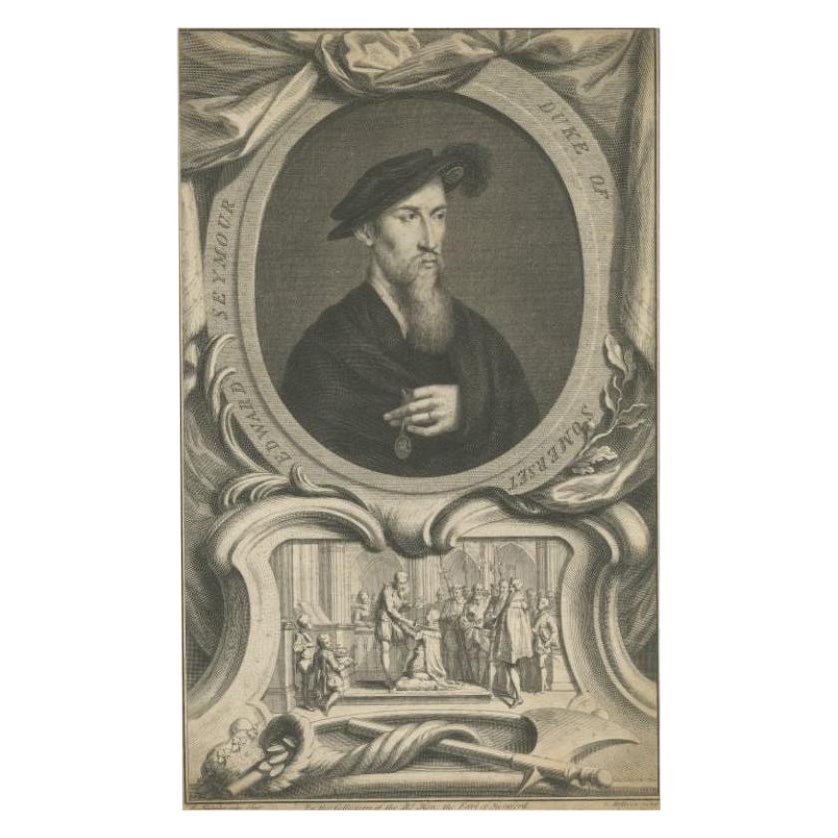
Antique Portrait of Edward Seymour, 1st Duke of Somerset KG
1500-1552
By Jacobus Houbraken
Located in Langweer, NL
Antique print titled 'Edward Seymour Duke of Somerset'. Portrait of Edward Seymour, 1st Duke of Somerset KG (1500-1552) was Lord Protector of England from 1547 until 1549 during the minority of his nephew, King Edward VI. He was the eldest brother of Queen Jane Seymour...
Category
Antique 18th Century Prints
Materials
Paper
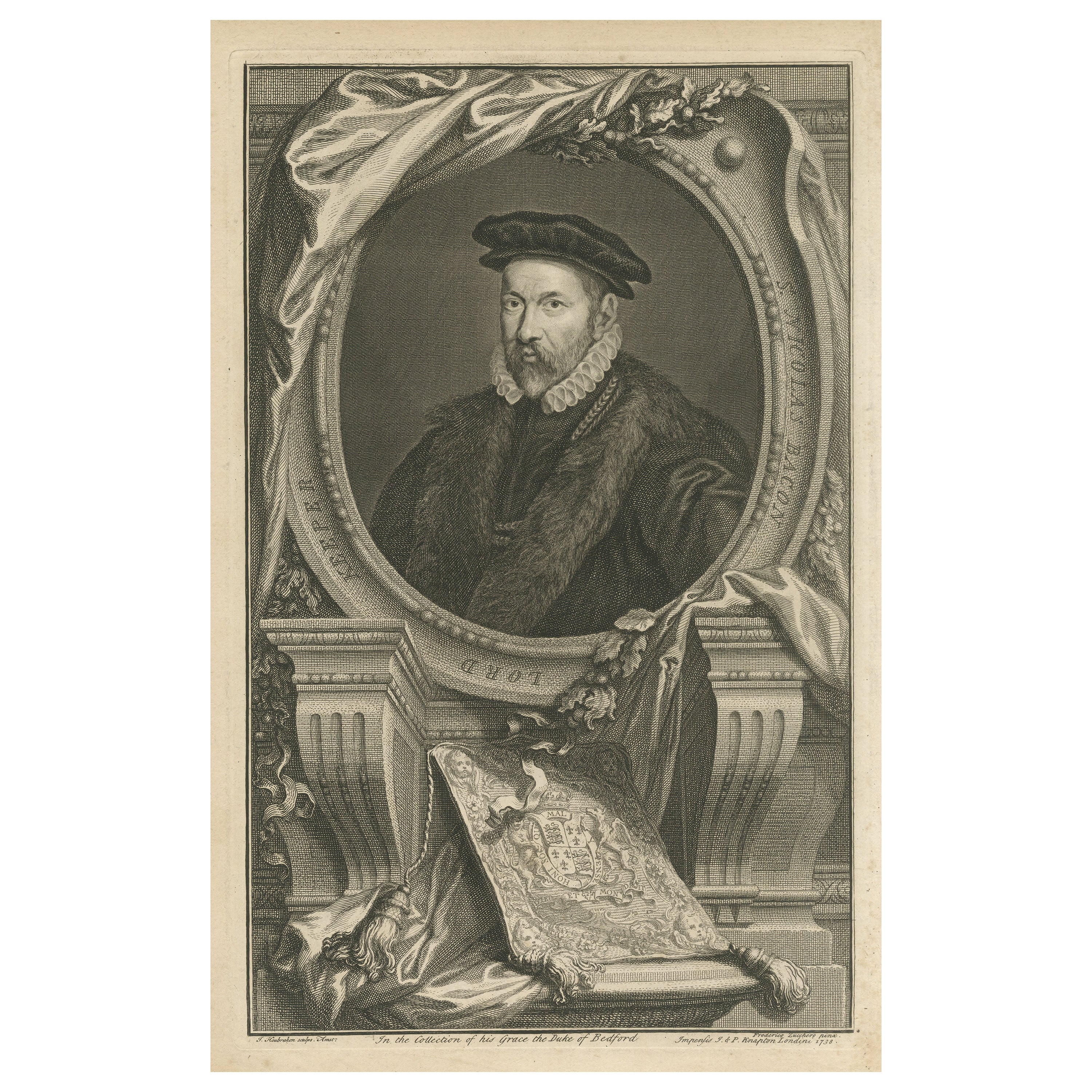
Antique Portrait of Sir Nicholas Bacon, Lord Keeper
By Jacobus Houbraken
Located in Langweer, NL
Antique portrait titled 'Sr. Nicolas Bacon Lord Keeper'. Sir Nicholas Bacon (28 December 1510 – 20 February 1579) was Lord Keeper of the Great Seal during the first half of the reign of Queen Elizabeth I of England. He was the father of the philosopher and statesman Sir Francis Bacon...
Category
Antique Mid-18th Century Prints
Materials
Paper
$339 Sale Price
25% Off
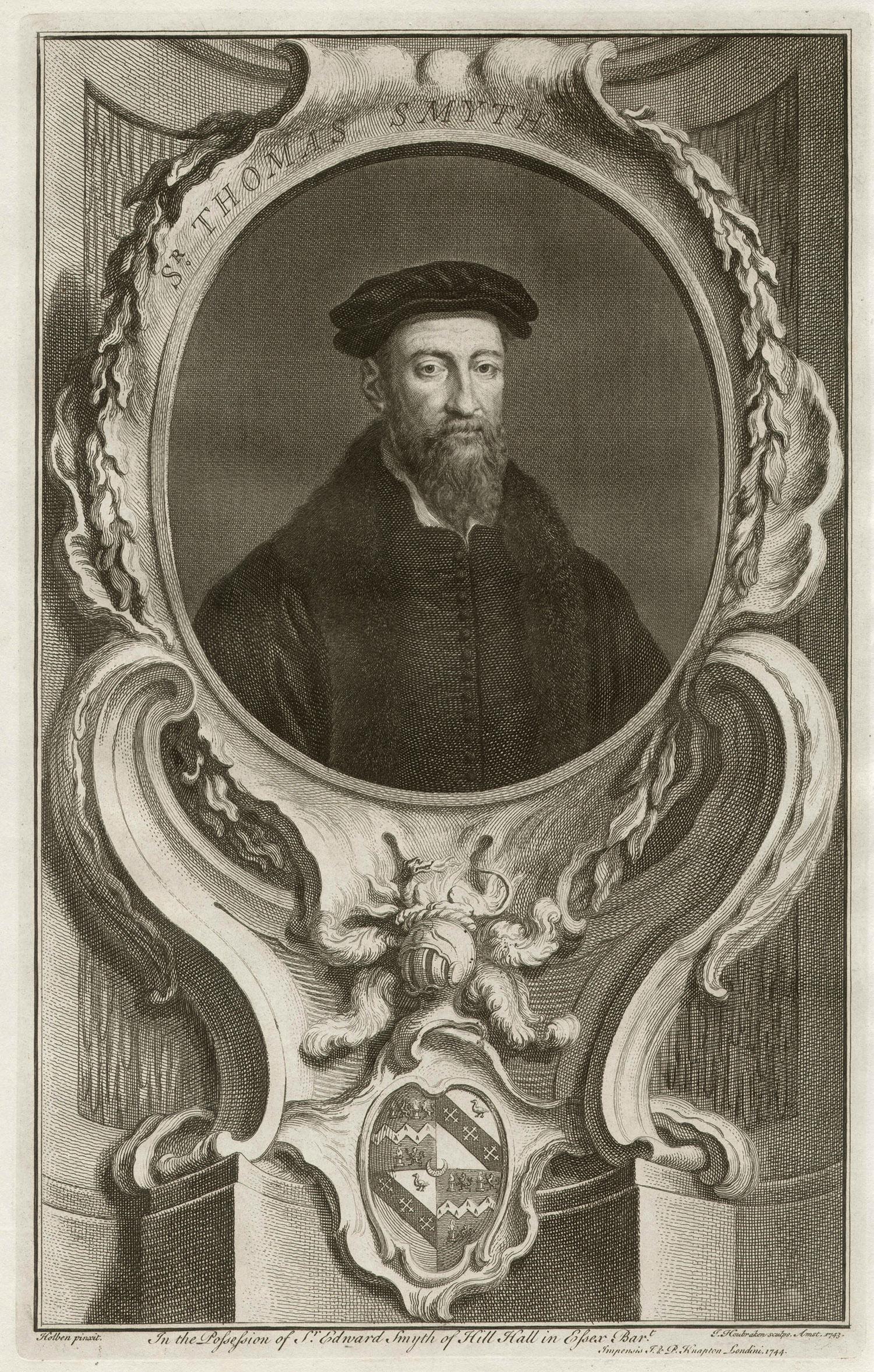
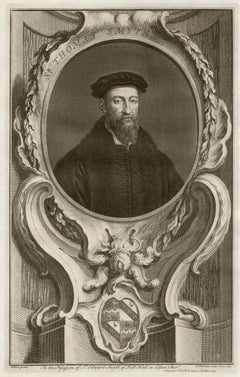
Sir Thomas Smyth, portrait engraving, c1820
By Jacobus Houbraken 1
Located in Melbourne, Victoria
Copper-line engraving by Jacobus Houbraken (1698-1780) after Holbein.
Houbraken was a Dutch engraver famous for his series of portraits of famous English historical figures with elaborate cartouches.
Originally published 1739, this impression c1820.
360mm by 230mm (platemark)
Sir Thomas Smythe...
Category
Early 19th Century Renaissance Portrait Prints
Materials
Engraving
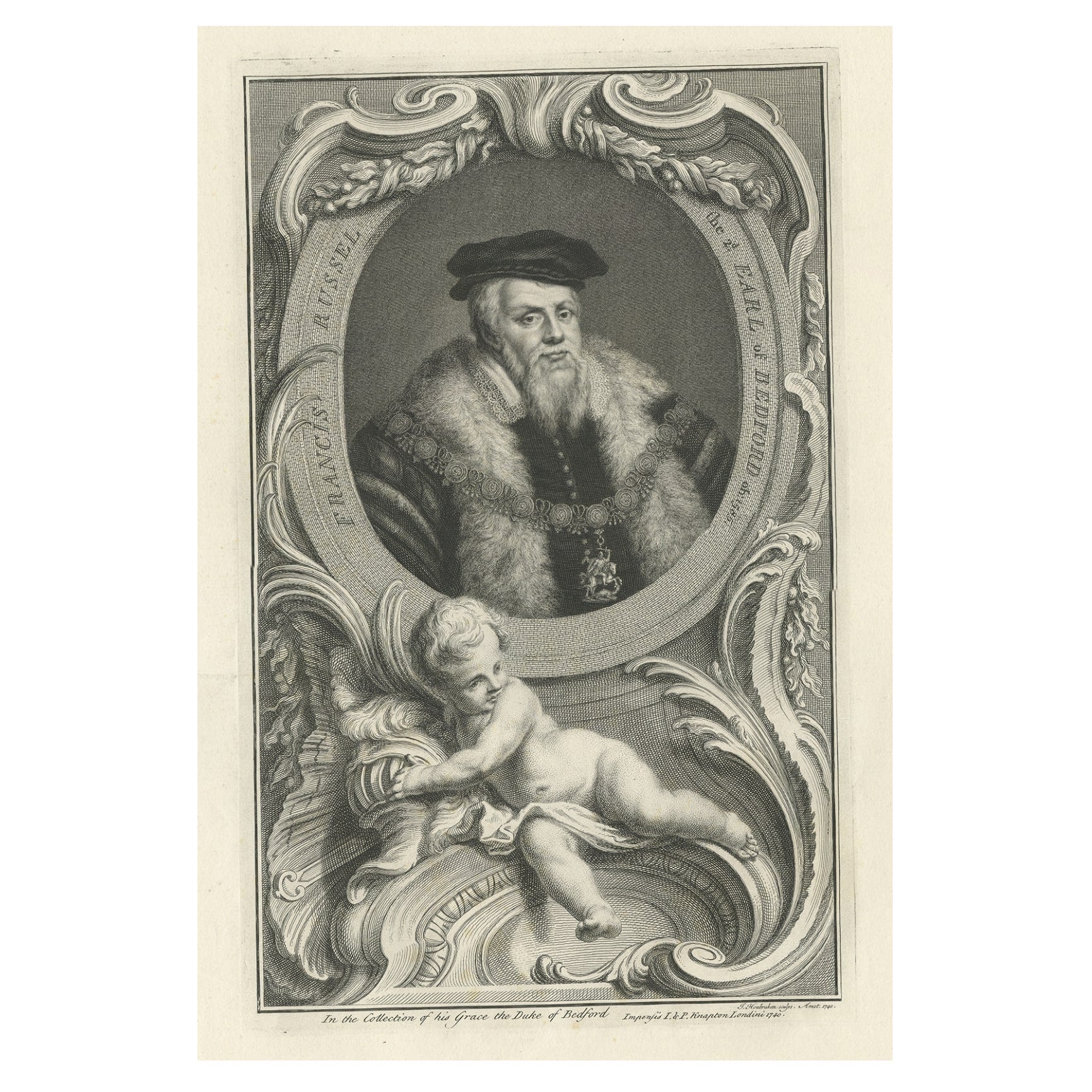
Portrait of Francis Russell, Earl of Bedford, English Nobleman and Politician
Located in Langweer, NL
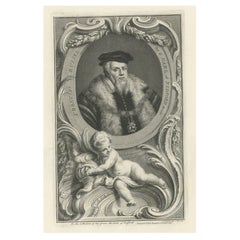
Antique portrait titled 'Francis Russel, the 2nd Earl of Bedford'. Francis Russell, 2nd Earl of Bedford, KG (c. 1527 – 28 July 1585) of Chenies in Buckinghamshire and of Bedford House...
Category
Antique 18th Century Prints
Materials
Paper
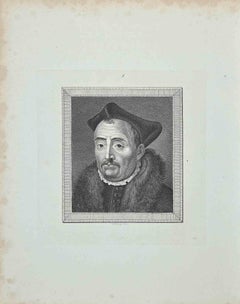
Portrait of Man - Original Etching by Thomas Holloway - 1810
By Thomas Holloway
Located in Roma, IT
Portrait of Man is an original etching artwork realized by Thomas Holloway for Johann Caspar Lavater's "Essays on Physiognomy, Designed to Promote the Knowledge and the Love of Manki...
Category
1810s Modern Figurative Prints
Materials
Etching
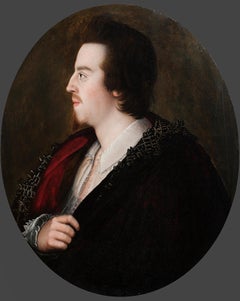
Portrait of William Herbert, 3rd Earl of Pembroke, Early 17th Century Portrait
Located in London, GB
English School, (circa 1600)
Portrait of William Herbert, 3rd Earl of Pembroke
Oil on panel, oval
Image size: 29¼ x 23⅞ inches
Painted wooden frame
Provenance:
176, Collection of Francis Greville, 1st Earl of Warwick.
The Trustees of the Lord Brooks’ Settlement, (removed from Warwick Castle).
Sotheby’s, London, 22nd March 1968, lot 81.
Painted onto wooden panel, this portrait shows a dark haired gentleman in profile sporting an open white shirt. On top of this garments is a richly detailed black cloak, decorated with gold thread and lined with a sumptuous crimson lining. With the red silk inside it’s all very expensive and would fall under sumptuary laws – so this is a nobleman of high degree.
It’s melancholic air conforms to the contemporary popularity of this very human condition, evident in fashionable poetry and music of the period. In comparison to our own modern prejudices, melancholy was associated with creativity in this period.
This portrait appeared in the earliest described list of pictures of Warwick castle dating to 1762. Compiled by collector and antiquary Sir William Musgrave ‘taken from the information of Lord & Lady Warwick’ (Add. MSS, 5726 fol. 3) is described;
‘8. Earl of Essex – an original by Zuccharo – seen in profile with black hair. Holding a black robe across his breast with his right hand.’
As tempting as it is to imagine that this is a portrait of Robert Devereux, the 2nd Earl Essex, we might take this with a pinch of salt. Its identification with this romantic and fatal Elizabethan might well have been an attempt to add romance to Warwick Castle’s walls. It doesn’t correspond all that well with Essex’s portraits around 1600 after his return from Cadiz. Notably, this picture was presumably hung not too far away from the castle’s two portraits of Queen Elizabeth I. The first, and undoubtedly the best, being the exquisite coronation portrait that was sold by Lord Brooke in the late 1970s and now hangs in the National Portrait Gallery. The second, described as being ‘a copy from the original at Ld Hydes’, has yet to resurface.
The portrait eventually ended up being hung in the State Bedroom of Warwick Castle.
Archival documents present one other interesting candidate. The Greville family’s earliest inventory of paintings, made in 1630 at their home Brooke House in Holborn, London, describes five portraits of identified figures. All five belonged to the courtier, politician and poet Sir Fulke Greville (1554-1628), 1st Baron Brooke, and were hung in the ‘Gallerie’ of Brooke House behind yellow curtains. One of them was described as being of ‘Lord of Pembrooke’, which is likely to have been William Herbert (1580-1630), 3rd Earl of Pembroke. William was the eldest son of Greville’s best friend’s sister Mary Sidney, and was brought up in the particularly literary and poetically orientated household which his mother had supported. Notably, the 3rd Earl was one of the figures that Shakespeare’s first folio was dedicated to in 1623.
The melancholic air to the portrait corresponds to William’s own pretensions as a learned and poetic figure. The richness of the robe in the painting, sporting golden thread and a spotted black fabric, is indicative of wealth beyond that of a simple poet or actor. The portrait’s dating to around the year 1600 might have coincided with William’s father death and his own rise to the Pembroke Earldom. This period of his life too was imbued with personal sadness, as an illicit affair with a Mary Fitton had resulted in a pregnancy and eventual banishment by Elizabeth I to Wilton after a short spell in Fleet Prison. His illegitimate son died shortly after being born. Despite being a close follower of the Earl of Essex, William had side-stepped supporting Devereux in the fatal uprising against the Queen and eventually regained favour at the court of the next monarch James I.
His linen shirt is edged with a delicate border of lace and his black cloak is lined on the inside with sumptuous scarlet and richly decorated on the outside with gold braid and a pattern of embroidered black spots.
Despite the richness of his clothes, William Herbert has been presented in a dishevelled state of semi-undress, his shirt unlaced far down his chest with the ties lying limply over his hand, indicating that he is in a state of distracted detachment. It has been suggested that the fashion for melancholy was rooted in an increase in self-consciousness and introspective reflection during the late 16th and early 17th centuries.
In contemporary literature melancholy was said to be caused by a plenitude of the melancholy humor, one of the four vital humors, which were thought to regulate the functions of the body. An abundance of the melancholia humor was associated with a heightened creativity and intellectual ability and hence melancholy was linked to the notion of genius, as reflected in the work of the Oxford scholar Robert Burton, who in his work ‘The Anatomy of Melancholy’, described the Malcontent as ‘of all others [the]… most witty, [who] causeth many times divine ravishment, and a kind of enthusiamus… which stirreth them up to be excellent Philosophers, Poets and Prophets.’ (R. Burton, The Anatomy of Melancholy, London, 1621 in R. Strong, ‘Elizabethan Malady: Melancholy in Elizabethan and Jacobean Portraits’, Apollo, LXXIX, 1964).
Melancholy was viewed as a highly fashionable affliction under Elizabeth I, and her successor James I, and a dejected demeanour was adopted by wealthy young men, often presenting themselves as scholars or despondent lovers, as reflected in the portraiture and literature from this period. Although the sitter in this portrait is, as yet, unidentified, it seems probable that he was a nobleman with literary or artistic ambitions, following in the same vain as such famous figures as the aristocratic poet and dramatist, Edward de Vere...
Category
Early 17th Century Old Masters Portrait Paintings
Materials
Oil, Wood Panel