1 of 8
Pierre Auguste RenoirPierre Auguste Renoir Original Le Chapeau Epingle Signed Authentic Framed Art1894
1894
$3,895List Price
About the Item
- Creator:Pierre Auguste Renoir (1841 - 1919, French)
- Creation Year:1894
- Dimensions:Height: 15 in (38.1 cm)Width: 13.25 in (33.66 cm)
- Medium:
- Movement Style:
- Period:
- Condition:
- Gallery Location:Bloomington, MN
- Reference Number:1stDibs: LU123016687602
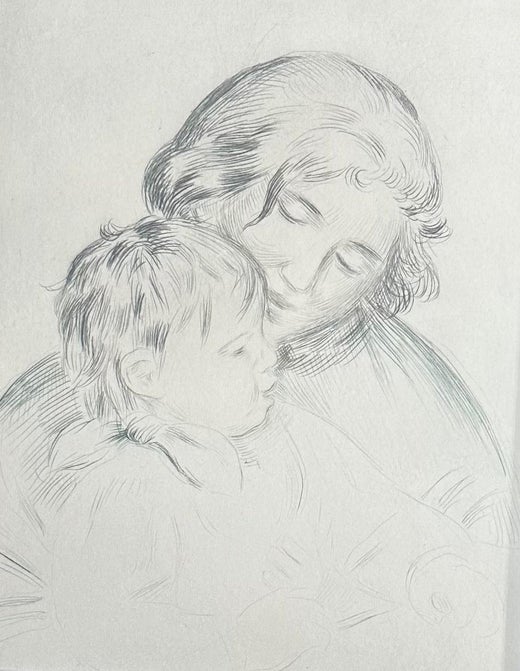
Pierre Auguste Renoir
Pierre-Auguste Renoir had his first experience with art in 1845 at the age of 4 when his family moved to Paris from Limoges and settled near the Louvre. By the age of 13, he had begun to seriously study and practice his work. Renoir started as an apprentice painter in a porcelain factory, where he spent five years. He then took drawing lessons from Charles Gleyre and in 1862, when he was 21; Renoir attended the Ecole des Beaux-Arts. It was at the National School of Fine Arts in Paris where Renoir met the future founders of Impressionism, Claude Monet, Alfred Sisley, and Frederic Bazille. Renoir paintings remained in the traditional style during the 1860s. His portrait of his mistress, Lise Trehot, was traditional enough to be accepted for the 1867 Salon. Pierre Auguste Renoir’s paintings began to change shortly after he moved in with Claude Monet and Frederic Bazille in 1869. Renoir updated his technique and color scheme. Renoir painted mostly outdoors and began to use vibrant, pure colors and little brush strokes. Renoir, along with Claude Monet, Camille Pissarro, and Alfred Sisley was part of the first exhibition of the Society of Independent Artists in 1874. It was at this exhibit that the term “Impressionism” was first used. The term was coined by a French art critic who took the name from a Monet painting. The term was meant to be derogatory and the show was a financial failure. Despite the failure, the artists continue to exhibit together and were joined by Edgar Degas and Georges Seurat. By the early 1880s, the public had begun to recognize the importance of the Impressionists’ work. In the early 1880s, Renoir traveled and painted extensively. He held his first one-man exhibition in 1883 in Paris. He received commissions from prominent Parisians and painted numerous group portraits of his friends, writers, and fellow artists. By 1887, Renoir was famous and donated several paintings to Queen Victoria for her Golden Jubilee. By the time he was 50, Renoir’s health began to decline. He suffered from cataracts, rheumatoid arthritis, and ankyloses, and spent the last twenty years of his life confined to a wheelchair. During this time he continued to paint and even took up sculpting.
Authenticity Guarantee
In the unlikely event there’s an issue with an item’s authenticity, contact us within 1 year for a full refund. DetailsMoney-Back Guarantee
If your item is not as described, is damaged in transit, or does not arrive, contact us within 7 days for a full refund. Details24-Hour Cancellation
You have a 24-hour grace period in which to reconsider your purchase, with no questions asked.Vetted Professional Sellers
Our world-class sellers must adhere to strict standards for service and quality, maintaining the integrity of our listings.Price-Match Guarantee
If you find that a seller listed the same item for a lower price elsewhere, we’ll match it.Trusted Global Delivery
Our best-in-class carrier network provides specialized shipping options worldwide, including custom delivery.You May Also Like
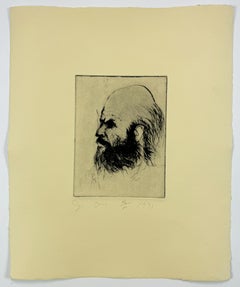
Self Portraits Jim Dine portfolio of nine self portrait etchings aquatint
By Jim Dine
Located in New York, NY
Jim Dine Self Portraits (1971)
Portfolio of nine drypoints, each from one 20.3 x 15.2 cm (8 x 6 inch) copper plate
Printed in brown-black on she...
Category
1970s Realist Portrait Prints
Materials
Etching, Aquatint
$9,500
H 20.5 in W 15.5 in
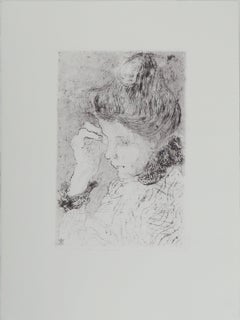
Thoughtful Woman - Etching from Louvre Museum
By Louis Valtat
Located in Paris, IDF
Louis VALTAT
Thoughtful Woman
Etching
Signed with the artist's monogram in the plate
On vellum 38 x 28.5 cm (c. 14.97 x 11.23 inch)
INFORMATION : Published by the Chalcographie du ...
Category
Mid-20th Century Realist Portrait Prints
Materials
Etching
Una (Portrait of a Creole Lady)
By Gerald Leslie Brockhurst
Located in New York, NY
Gerald Leslie Brockhurst (1891-1978), Una (Portrait of a Creole Lady), etching, 1929, signed in pencil lower right, and also inscribed by the artist: “2nd State, GB”. Reference: Flet...
Category
1920s Realist Portrait Prints
Materials
Etching
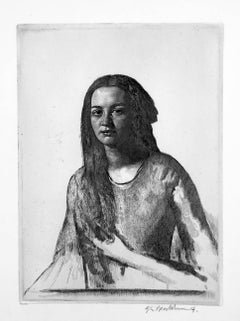
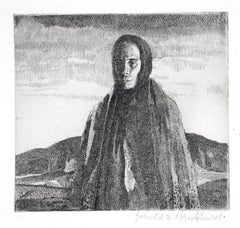
A Galway Peasant (also, An Irish Peasant)
By Gerald Leslie Brockhurst
Located in New York, NY
Gerald Brockhurst (1890-1978), A Galway Peasant (also, An Irish Peasant), etching, 1920, signed in pencil lower right. Reference: Fletcher 10, from the edition of 55, third state (of...
Category
1920s Realist Portrait Prints
Materials
Etching
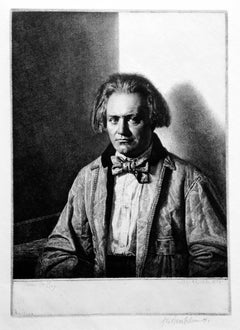
James McBey
By Gerald Leslie Brockhurst
Located in New York, NY
Gerald Leslie Brockhurst (1890-1978), James McBey, etching, 1931, signed in pencil lower right [also signed in the plate, in reverse, lower right just under the borderline, and title...
Category
1930s Realist Portrait Prints
Materials
Etching
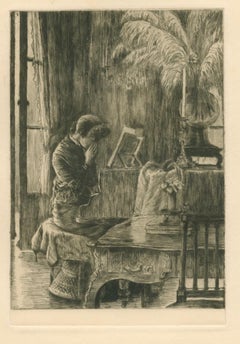
Renée Mauperin; Ten Etchings, Complete Set for novel by Goncourt Brothers
By James Jacques Joseph Tissot
Located in Middletown, NY
Renée Mauperin; Ten Etchings, Complete Set for the Illustrations to the Novel by Edmond and Jules de Goncourt 1882
Paris: G. Charpentier et Cie, 1882-1884.
The complete set of ten ...
Category
Late 19th Century Realist Interior Prints
Materials
Etching
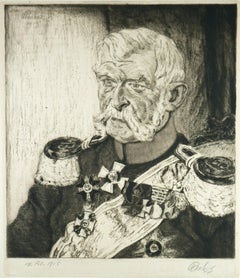
General Wilhelm von Blume - Visionary retrospective -
Located in Berlin, DE
Bernhard Pankok (1872 Münster - 1943 Baierbrunn), General Wilhelm von Blume, 1915, aquatint etching, 34 x 29.5 cm (sheet size), 26 x 22 cm (plate size), signed in the plate at upper left, in pencil at lower right and dated in pencil at lower left.
- At lower left old collection stamp, at the right broad margin with a small spot, otherwise very good condition.
About the artwork
The 1915 aquatint etching of General Wilhelm von Blume is based on a 1912 oil painting in the LWL-Museum für Kunst und Kultur in Münster. A second oil portrait of the general by Pankok is in the Staatsgalerie Stuttgart. When Pankok painted the first oil portrait in 1912, the general had already been retired for 16 years. It is therefore a retrospective portrait. Accordingly, the orientation of his head is such that he is looking back in both the oil painting and the etching. Without fixing on anything in particular, he looks thoughtfully inwards and reflects on his life. Uniformed and highly endowed, it is his military activities in particular that he is reviewing attentively and, as his gaze reveals, quite critically.
Pankok has literally written the sum of his experiences on Wilhelm von Blume's face: The physiognomy is a veritable landscape of folds, furrows, ridges and gullies, all the more striking against the flat background. It is clear that each of the medals was also won through suffering. However, by breaking the boundaries of the picture, his bust appears as an unshakable massif, which gives the general a stoic quality.
The fact that the design of the portrait was important to Pankok can be seen from the different versions, the present sheet being the third and probably final revision, which Pankok dates precisely to 18 February 1915. Compared with the previous state, the light background now has a dark area against which the sitter's face stands out, the dark background in turn combining with the uniform to create a new tension in the picture.
Pankok's taking up of the portrait of the high-ranking military veteran and its graphic reproduction can also be seen in relation to the First World War, which had broken out in the meantime. In the face of modern weapons of mass destruction, Wilhelm von Blume's warfare and military writings were relics of a bygone, more value-oriented era.
About the artist
After studying at the Düsseldorf Art Academy from 1889 to 1891 under Heinrich Lauenstein, Adolf Schill, Hugo Crola, and Peter Janssen the Elder, Bernhard Pankok went to Munich in 1892, where he worked primarily as a graphic artist for the two major Jugendstil magazines "Pan" and "Jugend," which established his artistic success. Through this work he met Emil Orlik, with whom he had a lifelong friendship.
In 1897, he exhibited his first furniture, and in 1898, together with Richard Riemerschmid, Bruno Paul and Hermann Obrist...
Category
1910s Realist Portrait Prints
Materials
Etching
$456 Sale Price
20% Off
H 13.39 in W 11.82 in D 0.4 in
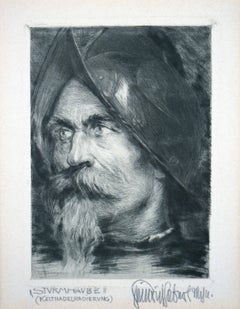
Balaclava - The target in sight -
Located in Berlin, DE
Heinrich Haberl (1869 Passau to 1934 Munich), Sturmhaube, c. 1900. drypoint, 14 x 10 cm (platemark), 28 x 21 cm (sheet size), 39 x 29 cm (passe-partout), titled "Sturmhaube" in lead at lower left and inscribed "Kaltnadelradierung", signed and locally inscribed "Heinrich Haberl Mchn. [Munich]" at lower right, inscribed again in lead on verso and with old collection stamp.
- slightly darkened, fixed and mounted
- The target in sight -
About the artwork
The theatrical "role-portrait" is to be seen against the background of the Rembrandt cult, which reached its climax at the end of the 19th century. The soldier seems to have stepped straight out of Rembrandt's Night Watch (1642) to fix something outside the picture with an alert and ready gaze. The steeply rising brim of the morion frames the gaze and thus perspectivises it as the actual 'pictorial action'. The gaze represents both the vigilant defence and the visionary goal of the battle.
Not only the subject, but also the style of the etching needle reflect Rembrandt's understanding of the times. Strong contrasts of light and dark are created in a virtuoso free stroke, without losing the effect of the reflections on the helmet and in the eyes. This shows a kinship with the early prints of Lovis Corinth, who also saw himself as an artist in the role of the knight. Against this background, Haberl's picture can also be seen as a representation of his artistic self-image.
About the artist
Heinrich Haberl first attended the art school in Nuremberg and from 1892 studied at the Munich Academy. There he was a master student of Johann Leonhard von Raab, Rudolf von Seitz, Franz von Defregger...
Category
Early 19th Century Realist Figurative Prints
Materials
Etching
$228 Sale Price
20% Off
H 15.36 in W 11.42 in D 0.4 in
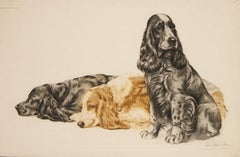
Three Cocker Spaniels original signed etching by Leon Danchin
By Leon Danchin
Located in Paonia, CO
Three Cocker Spaniels is an original color etching by well known French sports artist Leon Danchin. The three Spaniels are in waiting mode with two lying down and one sitting ...
Category
1930s Realist Animal Prints
Materials
Etching
$1,200
H 35 in W 22 in
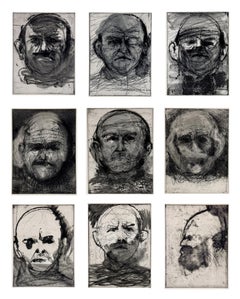
Dartmouth Portraits Jim Dine portfolio of nine self portrait etchings aquatint
By Jim Dine
Located in New York, NY
The Dartmouth Portraits aer reworked plates from an earlier drypoint self portrait series done in 1971. For the second set, Dine used the same plates, the same theme and, in most cas...
Category
1970s Realist Portrait Prints
Materials
Etching, Aquatint
$9,500
H 20.5 in W 15.5 in
Recently Viewed
View AllMore Ways To Browse
Sheldon Fink
Albert Davies
Albert Gabriel Rigolot On Sale
Albert Hencke Art
Albert Insley
Albott Bonhomme
Aldo Salvadori
Alex Katz Tapestry
Alex Katz Wedding Dress
Alexander Kellock Brown
Alexander Kruse
Alexander Sandro Antadze
Alfano Dardari
Alfred Elmore Painting
Alfred Harris Painting
Alfredo Lobos
Alice Patrick
American Kestrel