Want more images or videos?
Request additional images or videos from the seller
1 of 13

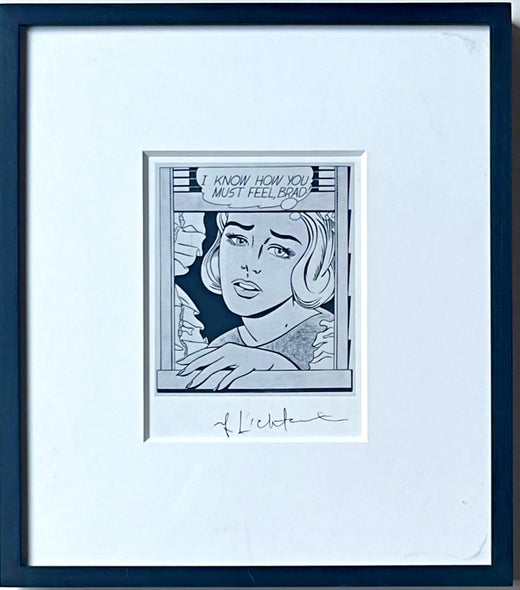
Roy Lichtenstein
Pop Art Limited Edition Lithograph of Mermaid, Miami Beach Sculpture Signed

1978

$24,000List Price

You May Also Like

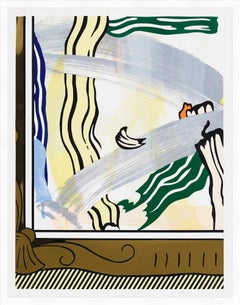
Painting in Gold Frame
By Roy Lichtenstein
Located in Aventura, FL
From the Paintings series. Woodcut, Lithograph, screen print and collage on Arches 88 paper. Hand signed, dated and numbered by Roy Lichtenst...
Category

1980s Pop Art Portrait Prints

Materials

Lithograph, Screen, Woodcut, Paper

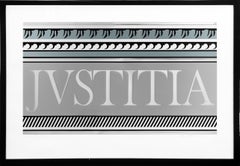
ENTABLATURE XA
By Roy Lichtenstein
Located in Aventura, FL
From the Entablature series. Screenprint, lithograph, and collage with embossing on Rives BFK paper. Hand signed and dated in pencil, lower right by Roy Lichtenstein. Numbered 17/1...
Category

1970s Pop Art Portrait Prints

Materials

Paper, Lithograph, Screen

ENTABLATURE XA
$39,500
H 29.25 in W 45 in
Talking to Karen
By Peter Max
Located in Buffalo, NY
A very rare serigraph by Peter Max, created in 1979 called "Talking to Karen". This is one of Max's most collectible periods and works.
Category

1970s Pop Art Figurative Prints

Materials

Lithograph, Paper, Screen

Talking to Karen
$2,400 Sale Price
20% Off
H 21 in W 27 in
Shepard Fairey Screen-prints: collection of 60 works (2009-2022)
By Shepard Fairey
Located in NEW YORK, NY
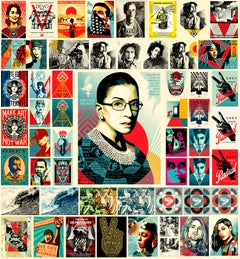
Shepard Fairey Screen-prints: collection of 60 works: 2009-2022: A rare assemblage of 60 hand-signed Shepard Fairey screen-prints; collected over a near 15 year period (2009-2022). Notable imagery includes: Bob Marley, Keith Haring, Ruth Bader Ginsburg, Kurt Cobain, as well as a series of vivid anti-war pieces defining the artist's practice (title list found further below). Each very well-preserved. Medium: Screen-prints on heavy paper. 2009-2022 (see below for a list of titles & years). Dimensions ranging from: 19.5 x 16 inches to 24x36 inches. Each work is hand-signed; works are either numbered from their respective main editions or notated 'AP' (see last listing image); a few or several works are signed, but not numbered. Excellent overall condition with the exception of perhaps some minor signs of handling on a few examples. Provenance: Private collection New York via Shepard Fairey. Listing images beginning with image 2 represent the actual works. These works will be shipped flat using protective materials. Please feel free to contact us with any additional questions. Titles & Years: OCEAN TODAY...
Category

2010s Pop Art Abstract Prints

Materials

Lithograph, Screen

Reflections on Minerva, from Reflections
By Roy Lichtenstein
Located in Palo Alto, CA
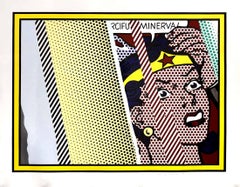
Framed in a bright yellow boarder, Roy Lichtenstein Reflections on Minerva, from Reflections, 1990 shows a distressed Minerva partially obscured by reflective lines. As if she is beh...
Category

1990s Pop Art Figurative Prints

Materials

Lithograph, Screen

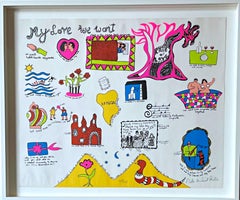
Niki de Saint Phalle, My Love We Wont, Rare whimsical 1960s silkscreen Signed/N
By Niki de Saint Phalle
Located in New York, NY
Niki de Saint Phalle My Love We Wont, 1968 Lithograph and silkscreen on wove paper Signed and numbered 51/75 in graphite pencil on the front Frame included: elegantly floated and framed in a museum quality white wood frame with UV plexiglass From the Brooklyn Museum, which has an edition of this work in its permanent collection: "Throughout her long and prolific career Niki de Saint Phalle, a former cover model for Life magazine and French Vogue, investigated feminine archetypes and women’s societal roles. Her Nanas, bold, sexy sculptures...
Category

1960s Pop Art Abstract Prints

Materials

Screen, Pencil, Lithograph, Mixed Media
Keith Haring 1990 memorial (Keith Haring crawling baby)
By (after) Keith Haring
Located in NEW YORK, NY
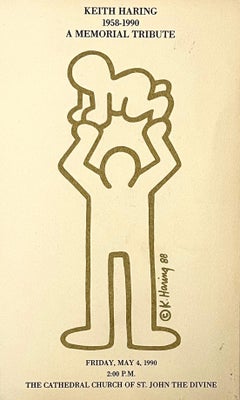
Keith Haring A Memorial Tribute 1990: Rare, historic silkscreened, folding invitation program featuring double-sided, gold-foiled artwork - published on the occasion of Keith Haring’...
Category

1980s Pop Art Prints and Multiples

Materials

Lithograph, Screen, Paper

Mudd Club New York 1979 street poster (framed)
By Fernando Natalici
Located in NEW YORK, NY
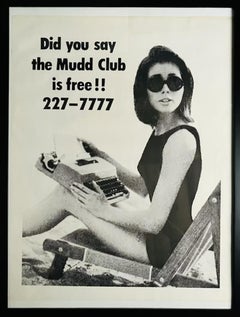
Original Mudd Club poster, New York 1979: A must have for any true Jean Michel Basquiat, Keith Haring collector - this piece is featured in the 2017 Jean-Michel Basquiat documentary, 'Boom For Real.' Promotional poster. 1979. Artwork Dimensions: 18x24 inches (19x25 inches). Very good overall vintage condition condition; some minor fading consistent with age. Minor wear to frame. Provenance: Obtained directly from the original art designer. The Mudd Club was founded by filmmaker Steve Mass, art curator Diego Cortez, and downtown punk scene figure Anya Phillips...
Category

1970s Pop Art Prints and Multiples

Materials

Lithograph, Screen

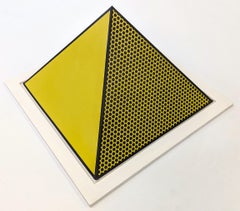
Pyramid (hand signed three dimensional screen print)
By Roy Lichtenstein
Located in Aventura, FL
Screen print in colors on lightweight board folded into a three-dimensional pyramid. Hand signed and numbered on interior edge by Roy Lichtenstein Numbered 41/300 (only approximate...
Category

1960s Pop Art Still-life Prints

Materials

Paper, Lithograph, Screen

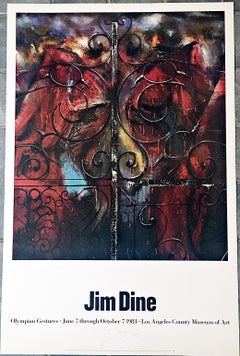
Olympian Gestures: Rare LACMA Exhibition offset print (Hand Signed by Jim Dine)
By Jim Dine
Located in New York, NY
Jim Dine Olympian Gestures (Hand Signed by Jim Dine), 1984 Limited Edition lithograph and offset lithograph poster Hand signed on the front 38 1/5 × 25 inches The limited edition, h...
Category

1980s Pop Art Abstract Prints

Materials

Screen, Lithograph, Offset

More From This Seller

View All
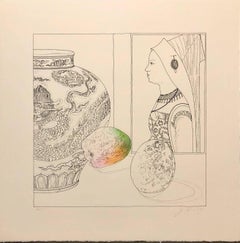
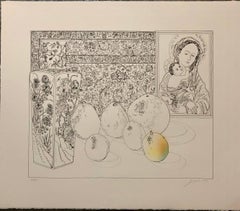
Still Life with Hans Maler Pop Art Serigraph Hand Signed
By Josef Levi
Located in Surfside, FL
On deckle edged watermarked Arches French paper. hand signed in pencil, dated and numbered. the edition size is 175. there are three states of the same image image each with increasing detail and color. This is just for the one in the photo. Josef Alan Levi (1938) is an American artist whose works range over a number of different styles, but which are unified by certain themes consistently present among them. Josef Levi began his artistic career in the 1960s and early '70s, producing highly abstract and very modernist pieces: these employing exotic materials such as light fixtures and metallic parts. By 1975, Levy had transitioned to painting and drawing still lifes. At first these were, traditionally, of mundane subjects. Later, he would depict images from art history, including figures originally created by the Old Masters. Around 1980, he made another important shift, this time toward creating highly precise, though subtly altered reproductions of pairs of female faces which were originally produced by other artists. It is perhaps this work for which he is most well known. Since around 2000, Josef Levi has changed the style of his work yet again: now he works entirely with computers, using digital techniques to abstract greatly from art history, and also from other sources. Levi's works of art in the collections of the Museum of Modern Art, NYC, the National Gallery of Art, and the Albright-Knox Museum, among many others. Levi's art has been featured on the cover of Harper's Magazine twice, once in June 1987, and once in May 1997. Josef Levi received a Bachelor of Arts degree in 1959 from the University of Connecticut, where he majored in fine arts and minored in literature. From 1959 to 1960, he served to a first lieutenant in the U.S. Army, and from 1960 through 1967 he was in the U.S. Army Reserves. In 1966, he received the Purchase Award from the University of Illinois in 1966, and he was featured in New Talent U.S.A. by Art in America. He was an artist in residence at Appalachian State University in 1969, taught at Farleigh Dickenson University in 1971 and was a visiting professor of art at Pennsylvania State University in 1977. From 1975 to 2007, Levi resided in New York City. He now lives in an apartment in Rome, where he is able to paint with natural light as he was unable in New York. From 1959 to 1960, Josef took some courses of Howard McParlin Davis and Meyer Schapiro at Columbia University which initiated him into the techniques of reproducing the works of the Old Masters. His first works, created in the 1960s, were wood and stone sculptures of women. His first mature works were abstract pieces, constructed of electric lights and steel. In 1970, Levi's materials included fluorescent light bulbs, Rust-Oleum and perforated metal in addition to paint and canvas. By 1980, Josef Levi's art had transformed into a very specific form: a combination of reproductions of female faces which were originally depicted by other artists. The faces which he reproduces may be derived from either portraits or from small portions of much larger works; they are taken from paintings of the Old Masters, Japanese ukiyo-e, and 20th-century art. Artists from whom he has borrowed include: Vermeer, Rembrandt, Piero della Francesca, Botero, Matisse, Utamaro, Correggio, Da Vinci, Picasso, Chuck Close, Max Beckmann, Pisanello, Lichtenstein. The creation of these works is informed by Levi's knowledge and study of art history. Josef Levi's paintings from this period are drawn, then painted on fine linen canvas on wooden stretchers. The canvas is coated with twenty-five layers of gesso in order to produce a smooth surface on which to work. The drawing phase takes at least one month. Levi seals the drawing with acrylic varnish, and then he may apply layers of transparent acrylic in order to approximate the look of old paintings. After the last paint is applied, another layer of acrylic varnish is sprayed on to protect the work. Most of the figures in his contemporary pieces are not paired with any others. SELECTED COLLECTIONS MUSEUM OF MODERN ART, NEW YORK, NY ALBRIGHT- KNOX GALLERY, BUFFALO, NY ALDRICH MUSEUM OF CONTEMPORARY ART, RIDGEFIELD, CT NATIONAL GALLERY OF ART, WASHINGTON, DC BROOKLYN MUSEUM OF ART, BROOKLYN, NY SMITHSONIAN NATIONAL MUSEUM OF AMERICAN HISTORY, WASHINGTON, DC CORCORAN GALLERY, WASHINGTON, DC UNIVERSITY OF NOTRE DAME ART...
Category

1970s Pop Art Figurative Prints

Materials

Lithograph, Screen

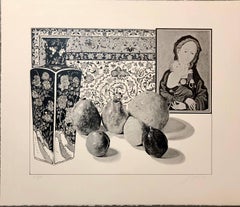
Still Life with Hans Maler Pop Art Serigraph Hand Signed
By Josef Levi
Located in Surfside, FL
On deckle edged watermarked Arches French paper. hand signed in pencil, dated and numbered. the edition size is 175. there are three states of the same image image each with increasing detail and color. This is just for the one in the photo. Josef Alan Levi (1938) is an American artist whose works range over a number of different styles, but which are unified by certain themes consistently present among them. Josef Levi began his artistic career in the 1960s and early '70s, producing highly abstract and very modernist pieces: these employing exotic materials such as light fixtures and metallic parts. By 1975, Levy had transitioned to painting and drawing still lifes. At first these were, traditionally, of mundane subjects. Later, he would depict images from art history, including figures originally created by the Old Masters. Around 1980, he made another important shift, this time toward creating highly precise, though subtly altered reproductions of pairs of female faces which were originally produced by other artists. It is perhaps this work for which he is most well known. Since around 2000, Josef Levi has changed the style of his work yet again: now he works entirely with computers, using digital techniques to abstract greatly from art history, and also from other sources. Levi's works of art in the collections of the Museum of Modern Art, NYC, the National Gallery of Art, and the Albright-Knox Museum, among many others. Levi's art has been featured on the cover of Harper's Magazine twice, once in June 1987, and once in May 1997. Josef Levi received a Bachelor of Arts degree in 1959 from the University of Connecticut, where he majored in fine arts and minored in literature. From 1959 to 1960, he served to a first lieutenant in the U.S. Army, and from 1960 through 1967 he was in the U.S. Army Reserves. In 1966, he received the Purchase Award from the University of Illinois in 1966, and he was featured in New Talent U.S.A. by Art in America. He was an artist in residence at Appalachian State University in 1969, taught at Farleigh Dickenson University in 1971 and was a visiting professor of art at Pennsylvania State University in 1977. From 1975 to 2007, Levi resided in New York City. He now lives in an apartment in Rome, where he is able to paint with natural light as he was unable in New York. From 1959 to 1960, Josef took some courses of Howard McParlin Davis and Meyer Schapiro at Columbia University which initiated him into the techniques of reproducing the works of the Old Masters. His first works, created in the 1960s, were wood and stone sculptures of women. His first mature works were abstract pieces, constructed of electric lights and steel. In 1970, Levi's materials included fluorescent light bulbs, Rust-Oleum and perforated metal in addition to paint and canvas. By 1980, Josef Levi's art had transformed into a very specific form: a combination of reproductions of female faces which were originally depicted by other artists. The faces which he reproduces may be derived from either portraits or from small portions of much larger works; they are taken from paintings of the Old Masters, Japanese ukiyo-e, and 20th-century art. Artists from whom he has borrowed include: Vermeer, Rembrandt, Piero della Francesca, Botero, Matisse, Utamaro, Correggio, Da Vinci, Picasso, Chuck Close, Max Beckmann, Pisanello, Lichtenstein. The creation of these works is informed by Levi's knowledge and study of art history. Josef Levi's paintings from this period are drawn, then painted on fine linen canvas on wooden stretchers. The canvas is coated with twenty-five layers of gesso in order to produce a smooth surface on which to work. The drawing phase takes at least one month. Levi seals the drawing with acrylic varnish, and then he may apply layers of transparent acrylic in order to approximate the look of old paintings. After the last paint is applied, another layer of acrylic varnish is sprayed on to protect the work. Most of the figures in his contemporary pieces are not paired with any others. SELECTED COLLECTIONS MUSEUM OF MODERN ART, NEW YORK, NY ALBRIGHT- KNOX GALLERY, BUFFALO, NY ALDRICH MUSEUM OF CONTEMPORARY ART, RIDGEFIELD, CT NATIONAL GALLERY OF ART, WASHINGTON, DC BROOKLYN MUSEUM OF ART, BROOKLYN, NY SMITHSONIAN NATIONAL MUSEUM OF AMERICAN HISTORY, WASHINGTON, DC CORCORAN GALLERY, WASHINGTON, DC UNIVERSITY OF NOTRE DAME ART...
Category

1970s Pop Art Figurative Prints

Materials

Lithograph, Screen

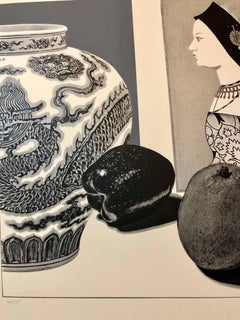
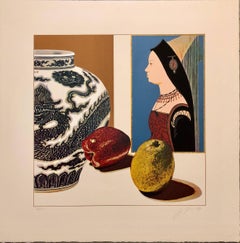
Still Life with German Master Pop Art Serigraph Hand Signed
By Josef Levi
Located in Surfside, FL
On deckle edged watermarked Arches French paper with publishers embossed blindstamp. hand signed in pencil, dated and numbered. the edition size is 175. there are three states of the same image image each with increasing detail and color. This auction is just for the one shown in the photos. Josef Alan Levi (1938) is an American artist whose works range over a number of different styles, but which are unified by certain themes consistently present among them. Josef Levi began his artistic career in the 1960s and early '70s, producing highly abstract and very modernist pieces: these employing exotic materials such as light fixtures and metallic parts. By 1975, Levy had transitioned to painting and drawing still lifes. At first these were, traditionally, of mundane subjects. Later, he would depict images from art history, including figures originally created by the Old Masters. Around 1980, he made another important shift, this time toward creating highly precise, though subtly altered reproductions of pairs of female faces which were originally produced by other artists. It is perhaps this work for which he is most well known. Since around 2000, Josef Levi has changed the style of his work yet again: now he works entirely with computers, using digital techniques to abstract greatly from art history, and also from other sources. Levi's works of art in the collections of the Museum of Modern Art, NYC, the National Gallery of Art, and the Albright-Knox Museum, among many others. Levi's art has been featured on the cover of Harper's Magazine twice, once in June 1987, and once in May 1997. Josef Levi received a Bachelor of Arts degree in 1959 from the University of Connecticut, where he majored in fine arts and minored in literature. From 1959 to 1960, he served to a first lieutenant in the U.S. Army, and from 1960 through 1967 he was in the U.S. Army Reserves. In 1966, he received the Purchase Award from the University of Illinois in 1966, and he was featured in New Talent U.S.A. by Art in America. He was an artist in residence at Appalachian State University in 1969, taught at Farleigh Dickenson University in 1971 and was a visiting professor of art at Pennsylvania State University in 1977. From 1975 to 2007, Levi resided in New York City. He now lives in an apartment in Rome, where he is able to paint with natural light as he was unable in New York. From 1959 to 1960, Josef took some courses of Howard McParlin Davis and Meyer Schapiro at Columbia University which initiated him into the techniques of reproducing the works of the Old Masters. His first works, created in the 1960s, were wood and stone sculptures of women. His first mature works were abstract pieces, constructed of electric lights and steel. In 1970, Levi's materials included fluorescent light bulbs, Rust-Oleum and perforated metal in addition to paint and canvas. By 1980, Josef Levi's art had transformed into a very specific form: a combination of reproductions of female faces which were originally depicted by other artists. The faces which he reproduces may be derived from either portraits or from small portions of much larger works; they are taken from paintings of the Old Masters, Japanese ukiyo-e, and 20th-century art. Artists from whom he has borrowed include: Vermeer, Rembrandt, Piero della Francesca, Botero, Matisse, Utamaro, Correggio, Da Vinci, Picasso, Chuck Close, Max Beckmann, Pisanello, Lichtenstein. The creation of these works is informed by Levi's knowledge and study of art history. Josef Levi's paintings from this period are drawn, then painted on fine linen canvas on wooden stretchers. The canvas is coated with twenty-five layers of gesso in order to produce a smooth surface on which to work. The drawing phase takes at least one month. Levi seals the drawing with acrylic varnish, and then he may apply layers of transparent acrylic in order to approximate the look of old paintings. After the last paint is applied, another layer of acrylic varnish is sprayed on to protect the work. Most of the figures in his contemporary pieces are not paired with any others. SELECTED COLLECTIONS MUSEUM OF MODERN ART, NEW YORK, NY ALBRIGHT- KNOX GALLERY, BUFFALO, NY ALDRICH MUSEUM OF CONTEMPORARY ART, RIDGEFIELD, CT NATIONAL GALLERY OF ART, WASHINGTON, DC BROOKLYN MUSEUM OF ART, BROOKLYN, NY SMITHSONIAN NATIONAL MUSEUM OF AMERICAN HISTORY, WASHINGTON, DC CORCORAN GALLERY, WASHINGTON, DC UNIVERSITY OF NOTRE DAME ART...
Category

1970s Pop Art Figurative Prints

Materials

Lithograph, Screen

Still Life with Hans Maler Pop Art Serigraph Hand Signed
By Josef Levi
Located in Surfside, FL
On deckle edged watermarked Arches French paper. hand signed in pencil, dated and numbered. the edition size is 175. there are three states of the same image image each with increasing detail and color. This is just for the one in the photo. Josef Alan Levi (1938) is an American artist whose works range over a number of different styles, but which are unified by certain themes consistently present among them. Josef Levi began his artistic career in the 1960s and early '70s, producing highly abstract and very modernist pieces: these employing exotic materials such as light fixtures and metallic parts. By 1975, Levy had transitioned to painting and drawing still lifes. At first these were, traditionally, of mundane subjects. Later, he would depict images from art history, including figures originally created by the Old Masters. Around 1980, he made another important shift, this time toward creating highly precise, though subtly altered reproductions of pairs of female faces which were originally produced by other artists. It is perhaps this work for which he is most well known. Since around 2000, Josef Levi has changed the style of his work yet again: now he works entirely with computers, using digital techniques to abstract greatly from art history, and also from other sources. Levi's works of art in the collections of the Museum of Modern Art, NYC, the National Gallery of Art, and the Albright-Knox Museum, among many others. Levi's art has been featured on the cover of Harper's Magazine twice, once in June 1987, and once in May 1997. Josef Levi received a Bachelor of Arts degree in 1959 from the University of Connecticut, where he majored in fine arts and minored in literature. From 1959 to 1960, he served to a first lieutenant in the U.S. Army, and from 1960 through 1967 he was in the U.S. Army Reserves. In 1966, he received the Purchase Award from the University of Illinois in 1966, and he was featured in New Talent U.S.A. by Art in America. He was an artist in residence at Appalachian State University in 1969, taught at Farleigh Dickenson University in 1971 and was a visiting professor of art at Pennsylvania State University in 1977. From 1975 to 2007, Levi resided in New York City. He now lives in an apartment in Rome, where he is able to paint with natural light as he was unable in New York. From 1959 to 1960, Josef took some courses of Howard McParlin Davis and Meyer Schapiro at Columbia University which initiated him into the techniques of reproducing the works of the Old Masters. His first works, created in the 1960s, were wood and stone sculptures of women. His first mature works were abstract pieces, constructed of electric lights and steel. In 1970, Levi's materials included fluorescent light bulbs, Rust-Oleum and perforated metal in addition to paint and canvas. By 1980, Josef Levi's art had transformed into a very specific form: a combination of reproductions of female faces which were originally depicted by other artists. The faces which he reproduces may be derived from either portraits or from small portions of much larger works; they are taken from paintings of the Old Masters, Japanese ukiyo-e, and 20th-century art. Artists from whom he has borrowed include: Vermeer, Rembrandt, Piero della Francesca, Botero, Matisse, Utamaro, Correggio, Da Vinci, Picasso, Chuck Close, Max Beckmann, Pisanello, Lichtenstein. The creation of these works is informed by Levi's knowledge and study of art history. Josef Levi's paintings from this period are drawn, then painted on fine linen canvas on wooden stretchers. The canvas is coated with twenty-five layers of gesso in order to produce a smooth surface on which to work. The drawing phase takes at least one month. Levi seals the drawing with acrylic varnish, and then he may apply layers of transparent acrylic in order to approximate the look of old paintings. After the last paint is applied, another layer of acrylic varnish is sprayed on to protect the work. Most of the figures in his contemporary pieces are not paired with any others. SELECTED COLLECTIONS MUSEUM OF MODERN ART, NEW YORK, NY ALBRIGHT- KNOX GALLERY, BUFFALO, NY ALDRICH MUSEUM OF CONTEMPORARY ART, RIDGEFIELD, CT NATIONAL GALLERY OF ART, WASHINGTON, DC BROOKLYN MUSEUM OF ART, BROOKLYN, NY SMITHSONIAN NATIONAL MUSEUM OF AMERICAN HISTORY, WASHINGTON, DC CORCORAN GALLERY, WASHINGTON, DC UNIVERSITY OF NOTRE DAME ART...
Category

1970s Pop Art Figurative Prints

Materials

Lithograph, Screen

Still Life with German Master Pop Art Serigraph Hand Signed
By Josef Levi
Located in Surfside, FL
On deckle edged watermarked Arches French paper with publishers embossed blindstamp. hand signed in pencil, dated and numbered. the edition size is 175. there are three states of the same image image each with increasing detail and color. This auction is just for the one shown in the photos. Josef Alan Levi (1938) is an American artist whose works range over a number of different styles, but which are unified by certain themes consistently present among them. Josef Levi began his artistic career in the 1960s and early '70s, producing highly abstract and very modernist pieces: these employing exotic materials such as light fixtures and metallic parts. By 1975, Levy had transitioned to painting and drawing still lifes. At first these were, traditionally, of mundane subjects. Later, he would depict images from art history, including figures originally created by the Old Masters. Around 1980, he made another important shift, this time toward creating highly precise, though subtly altered reproductions of pairs of female faces which were originally produced by other artists. It is perhaps this work for which he is most well known. Since around 2000, Josef Levi has changed the style of his work yet again: now he works entirely with computers, using digital techniques to abstract greatly from art history, and also from other sources. Levi's works of art in the collections of the Museum of Modern Art, NYC, the National Gallery of Art, and the Albright-Knox Museum, among many others. Levi's art has been featured on the cover of Harper's Magazine twice, once in June 1987, and once in May 1997. Josef Levi received a Bachelor of Arts degree in 1959 from the University of Connecticut, where he majored in fine arts and minored in literature. From 1959 to 1960, he served to a first lieutenant in the U.S. Army, and from 1960 through 1967 he was in the U.S. Army Reserves. In 1966, he received the Purchase Award from the University of Illinois in 1966, and he was featured in New Talent U.S.A. by Art in America. He was an artist in residence at Appalachian State University in 1969, taught at Farleigh Dickenson University in 1971 and was a visiting professor of art at Pennsylvania State University in 1977. From 1975 to 2007, Levi resided in New York City. He now lives in an apartment in Rome, where he is able to paint with natural light as he was unable in New York. From 1959 to 1960, Josef took some courses of Howard McParlin Davis and Meyer Schapiro at Columbia University which initiated him into the techniques of reproducing the works of the Old Masters. His first works, created in the 1960s, were wood and stone sculptures of women. His first mature works were abstract pieces, constructed of electric lights and steel. In 1970, Levi's materials included fluorescent light bulbs, Rust-Oleum and perforated metal in addition to paint and canvas. By 1980, Josef Levi's art had transformed into a very specific form: a combination of reproductions of female faces which were originally depicted by other artists. The faces which he reproduces may be derived from either portraits or from small portions of much larger works; they are taken from paintings of the Old Masters, Japanese ukiyo-e, and 20th-century art. Artists from whom he has borrowed include: Vermeer, Rembrandt, Piero della Francesca, Botero, Matisse, Utamaro, Correggio, Da Vinci, Picasso, Chuck Close, Max Beckmann, Pisanello, Lichtenstein. The creation of these works is informed by Levi's knowledge and study of art history. Josef Levi's paintings from this period are drawn, then painted on fine linen canvas on wooden stretchers. The canvas is coated with twenty-five layers of gesso in order to produce a smooth surface on which to work. The drawing phase takes at least one month. Levi seals the drawing with acrylic varnish, and then he may apply layers of transparent acrylic in order to approximate the look of old paintings. After the last paint is applied, another layer of acrylic varnish is sprayed on to protect the work. Most of the figures in his contemporary pieces are not paired with any others. SELECTED COLLECTIONS MUSEUM OF MODERN ART, NEW YORK, NY ALBRIGHT- KNOX GALLERY, BUFFALO, NY ALDRICH MUSEUM OF CONTEMPORARY ART, RIDGEFIELD, CT NATIONAL GALLERY OF ART, WASHINGTON, DC BROOKLYN MUSEUM OF ART, BROOKLYN, NY SMITHSONIAN NATIONAL MUSEUM OF AMERICAN HISTORY, WASHINGTON, DC CORCORAN GALLERY, WASHINGTON, DC UNIVERSITY OF NOTRE DAME ART...
Category

1970s Pop Art Figurative Prints

Materials

Lithograph, Screen

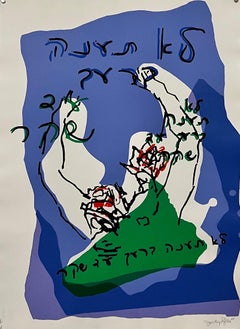
Judy Rifka Abstract Expressionist Contemporary Lithograph Hebrew 10 Commandment
By Judy Rifka
Located in Surfside, FL
Judy Rifka (American, b. 1945) 44/84 Lithograph on paper titled "Thou Shalt Not Bear False Witness against Thy Neighbor"; Depicting an abstract composition in blue, green, red and black tones with Hebrew script. Judaica interest. (I have seen this print described as a screenprint and as a lithograph) Hand signed in pencil and dated alongside an embossed pictorial blindstamp of a closed hand with one raised index finger. Solo Press. From The Ten Commandments Kenny Scharf; Joseph Nechvatal; Gretchen Bender; April Gornik; Robert Kushner; Nancy Spero; Vito Acconci; Jane Dickson; Judy Rifka; Richard Bosman and Lisa Liebmann. Judy Rifka (born 1945) is an American woman artist active since the 1970s as a painter and video artist. She works heavily in New York City's Tribeca and Lower East Side and has associated with movements coming out of the area in the 1970s and 1980s such as Colab and the East Village, Manhattan art scene. A video artist, book artist and abstract painter, Rifka is a multi-faceted artist who has worked in a variety of media in addition to her painting and printmaking. She was born in 1945 in New York City and studied art at Hunter College, the New York Studio School and the Skowhegan School of Painting and Sculpture in Maine. Rifka took part in the 1980 Times Square Show, (Organized by Collaborative Projects, Inc. in 1980 at what was once a massage parlor, with now-famous participants such as Jenny Holzer, Nan Goldin, Keith Haring, Kenny Scharf, Jean-Michel Basquiat, and Kiki Smith, the roster of the exhibition reads like a who’s who of the art world), two Whitney Museum Biennials (1975, 1983), Documenta 7, Just Another Asshole (1981), curated by Carlo McCormick and received the cover of Art in America in 1984 for her series, "Architecture," which employed the three-dimensional stretchers that she adopted in exhibitions dating to 1982; in a 1985 review in the New York Times, Vivien Raynor noted Rifka's shift to large paintings of the female nude, which also employed the three-dimensional stretchers. In a 1985 episode of Miami Vice, Bianca Jagger played a character attacked in front of Rifka's three-dimensional nude still-life, "Bacchanaal", which was on display at the Museum of Art Fort Lauderdale. Rene Ricard wrote about Rifka in his influential December 1987 Art Forum article about the iconic identity of artists from Van Gogh to Jean-Michel Basquiat and Keith Haring, The Radiant Child.The untitled acrylic painting on plywood, in the collection of the Honolulu Museum of Art, demonstrates the artist's use of plywood as a substrate for painting. Artist and writer Mark Bloch called her work "imaginative surfaces that support experimental laboratories for interferences in sensuous pigment." According to artist and curator Greg de la Haba, Judy Rifka's irregular polygons on plywood "are among the most important paintings of the decade". In 2013, Rifka's daily posts on Facebook garnered a large social media audience for her imaginative "selfies," erudite friendly comments, and widely attended solo and group exhibitions, Judy Rifka's pop art figuration is noted for its nervous line and frenetic pace. In the January 1998 issue of Art in America, Vincent Carducci echoed Masheck, “Rifka reworks the neo-classical and the pop, setting all sources in quotation for today’s art-world cognoscenti.” Rifka, along with artists like David Wojnarowicz, helped to take Pop sensibility into a milieu that incorporated politics and high art into Postmodernism; Robert Pincus-Witten stated in his 1988 essay, Corinthian Crackerjacks & Passing Go that "Rifka’s commitment to process and discovery, doctrine with Abstract Expressionist practice, is of paramount concern though there is nothing dogmatic or pious about Rifka’s use of method. Playful rapidity and delight in discovery is everywhere evident in her painting." In 2016, a large retrospective of Rifka's art was shown at the Jean-Paul Najar Foundation in Dubai. In 2017, Gregory de la Haba presented a Rifka retrospective at the Amstel Gallery in The Yard, a section of Manhattan described as "a labyrinth of small cubicles, conference rooms and small office spaces that are rented out to young entrepreneurs, professionals and hipsters". In 2019 her video Bubble Dancers New Space Ritual was selected for the International Istanbul Bienali. Alexandra Goldman Talks To Judy Rifka About Ionic Ironic: Mythos from the '80s at CORE:Club and the Inexistence of "Feminist Art" Whitehot Magazine of Contemporary Art. She was included in "50 Contemporary Women Artists", a book comprising a refined selection of current and impactful artists. The foreword is by Elizabeth Sackler of the Brooklyn Museum’s Sackler Center for Feminist Art. Additional names in the book include sculptor and carver Barbara Segal...
Category

1980s Pop Art Abstract Prints

Materials

Lithograph, Screen

Still Thinking About These?

All Recently Viewed