Want more images or videos?
Request additional images or videos from the seller
1 of 2
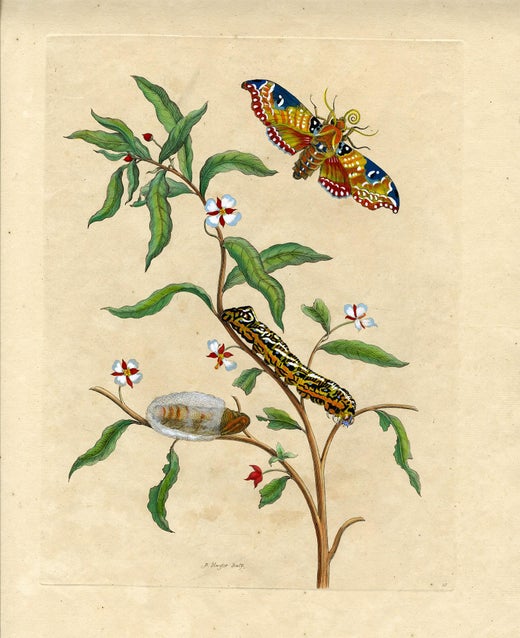
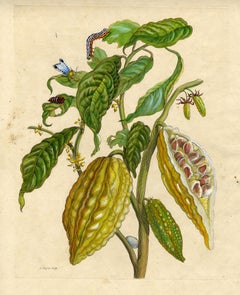
Maria Sibylla MerianIcecream Bean plant..., plate no. 58, Metamorphosis Insectorum Surinamensium1705
1705
Price:$4,900
$5,300List Price
About the Item
- Creator:Maria Sibylla Merian (1647 - 1717, Dutch)
- Creation Year:1705
- Dimensions:Height: 12.88 in (32.72 cm)Width: 9.63 in (24.47 cm)
- Medium:
- Movement Style:
- Period:
- Condition:
- Gallery Location:Middletown, NY
- Reference Number:Seller: BH10501stDibs: LU1979211940072
Maria Sibylla Merian
Maria Sibylla Merian (1647—1717) was a naturalist and artist. Her contributions to entomology were never appropriately recognized in her lifetime. She is now considered to be a pioneer in the fields of botany and zoology. She made detailed observations of live specimens, which was a departure from previous studies that used preserved specimens. She focused great detail on the processes of metamorphosis, which had not been studied so comprehensively before her work. The engravings for the publication were done by J. Mulder, P. Sluyter and A. Stopendaal, all after paintings on vellum by Merian. The work is considered to be one of the most beautiful, and famous illustrated natural history works of the 18th century. The work was the result of Merian's trip in 1699 with her daughter Dorothea to Surinam, a Dutch colony on the northeastern coast of South America. The pair studied and recorded plants and insects for two years under difficult conditions. They came back to Amsterdam with specimens, notes and drawings and there completed their astounding work. One naturalist proclaimed "Her portrayals of living insects and other animals were imbued with a charm, a minuteness of observation and an artistic sensibility that had not previously been seen in a natural history book; if Gould and Audubon have 'a spiritual ancestor, then it is difficult to think of a more worthy claimant to the title than Maria Sibylla Merian." On the day Maria Sibylla Merian died, Tsar Peter the Great purchased a two-volume collection of her unbound paintings, as well as her journal. Born in Frankfurt am Main, Maria Sibylla Merian was the daughter of Matthaus Merian the Elder (1593—1650), a famous German-Swiss painter, engraver and publisher. Her father died when she was three and her mother remarried Jacob Marrel (1614-1681), who was a still-life painter. From the time she was eleven, Marrel schooled Maria Sibylla Merian in the tradition of northern European still life painting, working directly from life. As her interests evolved toward the study of insects, she employed these artistic skills to create her outstanding scientific and esthetically beautiful works. She was truly at the crossroads of art and science.
About the Seller
5.0
Vetted Professional Seller
Every seller passes strict standards for authenticity and reliability
Established in 2004
1stDibs seller since 2022
80 sales on 1stDibs
Typical response time: 22 hours
Authenticity Guarantee
In the unlikely event there’s an issue with an item’s authenticity, contact us within 1 year for a full refund. DetailsMoney-Back Guarantee
If your item is not as described, is damaged in transit, or does not arrive, contact us within 7 days for a full refund. Details24-Hour Cancellation
You have a 24-hour grace period in which to reconsider your purchase, with no questions asked.Vetted Professional Sellers
Our world-class sellers must adhere to strict standards for service and quality, maintaining the integrity of our listings.Price-Match Guarantee
If you find that a seller listed the same item for a lower price elsewhere, we’ll match it.Trusted Global Delivery
Our best-in-class carrier network provides specialized shipping options worldwide, including custom delivery.You May Also Like
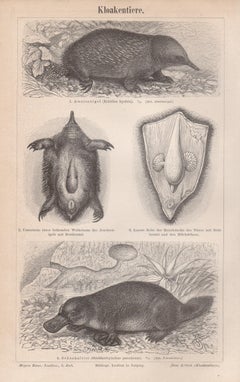
Echidna and Platypus, Australian animal monotreme antique engraving print
Located in Melbourne, Victoria
'Kloakentiere'
(Monotremes - echidna and platypus))
German wood-engraving, circa 1895.
240mm by 155mm (sheet)
Category
Late 19th Century Naturalistic Still-life Prints
Materials
Engraving
$65
H 9.45 in W 6.11 in
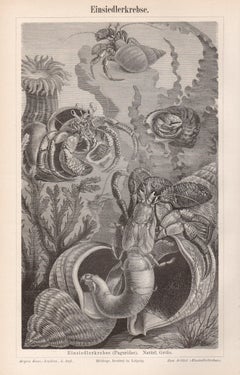
Hermit Crabs, German animal antique underwater crustacean engraving print
Located in Melbourne, Victoria
'Einsiedlerkrebse'
(Hermit crabs)
German wood-engraving, circa 1895.
240mm by 155mm (sheet)
Category
Late 19th Century Naturalistic Still-life Prints
Materials
Engraving
$50
H 9.45 in W 6.11 in
Green Painted Sea Shell Lithograph Edition 33 of 34
By Frances Nail
Located in Houston, TX
Green shell lithograph of a cone shell. Print is edition 33 of 34. Signed and dated by the artist along with titled. Print is framed in a golden frame...
Category
1970s Naturalistic Still-life Prints
Materials
Lithograph
Izzy with her Ball, Dog Art, Affordable Art, Contemporary Animal Art Print
Located in Deddington, GB
Izzy, a charming characterful terrier stands alert, holding her ball in her mouth. Colour etching hand made and printed by the artist.
Helen Fay's art for sale online and in our gall...
Category
2010s Contemporary Animal Prints
Materials
Paper, Drypoint, Etching
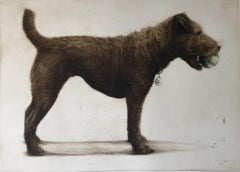
$545
H 25.2 in W 32.29 in D 0.06 in
Violin et Coquille (violin and shell / inscribed Happy New Year 2000)
By Laurent Schkolnyk
Located in New Orleans, LA
This black and white mezzotint of a shell next to a violin is an artist proof that was inscribed Happy New Year 2000 and signed by the artist. The regular e...
Category
1990s American Modern Still-life Prints
Materials
Mezzotint
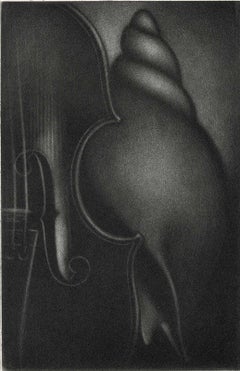
$131 Sale Price
25% Off
H 5.75 in W 3.75 in
Snail in a Bowl (Artist Proof inscribed to Fritz Eichenberg)
Located in New Orleans, LA
Leonard Merchant's mezzotint, "Snail in Cup" is inscribed for fellow artist, Fritz Eichenberg.
While a student at the Central School for Arts and Crafts in London, a young Leonard Marchant found an engraving rocker in a cupboard and proceeded to turn himself into a master of the painstaking art of mezzotinting.
Marchant, who has died in Shrewsbury aged 70, grew up in Simonstown, the Royal Navy's enclave in South Africa. Though his first job was as a parliamentary messenger, he taught himself to paint and, aged 19, was given a one-man show in Cape Town. Fired by this success, he left for England to study painting and, he claimed, to escape the stifling home atmosphere created by his Catholic mother and aunts. (His father was killed in the second world war.) Without contacts in London, he phoned Jacob Epstein, whose recommendation resulted in a grant to study briefly at the Central School. It was later, when studying full-time at the Central, that he saw the mezzotints of the Japanese master, Yozo Hamaguchi, in a London gallery. He was hooked.
Creating a mezzotint is tedious in the extreme. The copper plate must first be prepared with a "rocker" which roughens the surface. A plate may be "rocked" 30 or 40 times. The rough texture is then reduced with a burnisher and a scraper, allowing the print a range of tones from velvety black through the greys to white. Marchant's plates could be months in the making. But the technical demands were the least of his worries. In its 18th- and 19th-century heyday, mezzotint was solely a reproductive medium, for copying masters such as Reynolds and Turner. The development of photography rendered it unfashionable, and by the 1960s the technique, known as la manière anglaise, was a bygone medium.
Marchant, by now a teacher in printmaking at the Central, began to create original mezzotints with a colleague, Radavan Kraguly. A perfectionist, he seemed to revel in the straitjacket procedure. Perhaps it was the metaphor of bringing darkness out of light that appealed to this straight-talking, sometimes sombre, man, who would suddenly relax and light up like a gleaming hue on one of his prints. His work was of squares and triangles with the occasional cat, black and ominous, and carefully arranged still lifes, featuring plants, a seed pod, a pot he might have bought at auction to celebrate the sale of a print.
There were one-man shows, notably at the Bankside Gallery. He sold well at the Royal Academy summer exhibition, was a Florence Biennale prizewinner, spent a fellowship year at the British School in Rome, and was elected a Fellow of the Royal Society of Painter-Printmakers.
But making mezzotints was not a paying job. Marchant and his South African wife...
Category
1980s Modern Animal Prints
Materials
Mezzotint
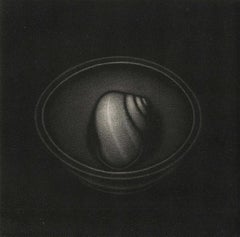
$138 Sale Price
25% Off
H 5.88 in W 5.88 in
[ Bird of Paradise] La Pie de paradise, vue par derriere, No.21
By Jacques Barraband
Located in Paonia, CO
[ Bird of Paradise] La Pie de paradise, vue par derriere , No.21, Paris 1801-1806 [Astrapia nigra]. Color-printed engraving with hand-coloring. French botanical and zoological illustrator Jacques Barraband (1767-1809) was known as one of the finest ornithological artists of his time .He is best known for his watercolors and engravings that were commissioned by François LeVaillant, French explorer, naturalist, zoological collector , noted ornithologist and author. Levaillant’s Histoire naturelle des perroquets (1801-05) and his Histoire naturelle des oiseaux de paradis (Birds of Paradise, 1801-06), both of which Barraband contributed to, are still considered some of the most beautiful bird books of all times because of their exceptional scientific accuracy, rich color and detail. The Astrapia nigra is a Bird of Paradise that inhabits the Vogelkop Peninsula of West Papua...
Category
Early 18th Century Other Art Style Animal Prints
Materials
Engraving
![[ Bird of Paradise] La Pie de paradise, vue par derriere, No.21](https://a.1stdibscdn.com/jacques-barraband-prints-works-on-paper--bird-of-paradise-la-pie-de-paradise-vue-par-derriere-no21-for-sale/a_7803/1543778408303/Bird_of_Paradise_master.jpg?width=240)
$5,200 Sale Price
20% Off
H 21 in W 28.5 in
"The Winner" - Etching on Paper (10/25)
Located in Soquel, CA
"The Winner" - Etching on Paper
Clean and modern drypoint etching of a horse skeleton by Maria Bennett (American, 20th Century). This etching has layer...
Category
1970s Modern Still-life Prints
Materials
Paper, Ink, Drypoint
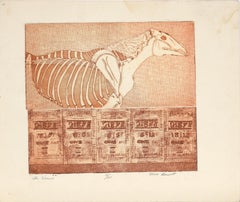
$460 Sale Price
20% Off
H 12 in W 14 in D 0.03 in
Snow Does (Doe, a deer - a female deer)
By Carol Wax
Located in New Orleans, LA
An exclusive publication for Stone and Press Gallery, "Snow Does" was created in an edition of 100. It is FIROS #66 in the catalogue raisonne.
Carol Wax originally trained to be a classical musician at the Manhattan School of Music but fell in love with printmaking. Soon after she began engraving mezzotints she was asked by the renowned print dealer Sylvan Cole to exhibit at Associated American Artists Gallery, launching her career as a professional artist/printmaker. With the publication of her book, The Mezzotint: History and Technique, published by Abrams, 1990 and 1996, Carol added author and teacher to her credits. In the ensuing years she has expanded her repertoire of mediums beyond printmaking into other works on paper and painting.
In compositions reflecting an appreciation for antiquated machinery and vintage textiles, Wax creates imagery that, in her own words, “… speaks to an inner life perceived in inanimate objects.” She uses stylization and imagination to reinvent subjects, transforming an ordinary typewriter into a monumental icon...
Category
1990s American Modern Still-life Prints
Materials
Mezzotint
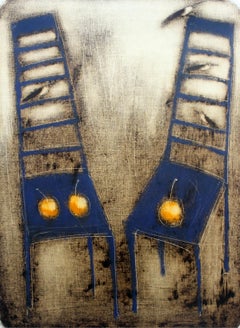
Still life with chairs and birds - XXI Century, Figurative Monotype Print
By Siergiej Timochow
Located in Warsaw, PL
Siergiej Timochow, a Belorussian artist, born in 1960.
He studied at an art school in Minsk in 1979 before continuing to study at the Fine Arts Academy in Belarus.
His acrylic and ...
Category
Early 2000s Contemporary Animal Prints
Materials
Cardboard, Color
$598
H 20.87 in W 15.36 in
More From This Seller
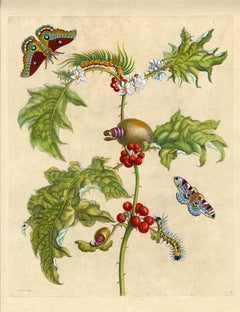
View AllThistle and Moths, plate no. 6, Metamorphosis Insectorum Surinamensium
By Maria Sibylla Merian
Located in Middletown, NY
Metamorphosis Insectorum Surinamensium, Plate No. 6; Thistle and Moths. The Netherlands: 1705. Engraving with hand coloring in w...
Category
Early 18th Century Naturalistic Still-life Prints
Materials
Watercolor, Engraving
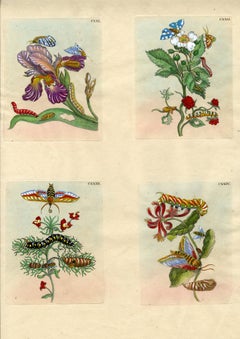
4 plates from The Wondrous Transformation of Caterpillars
their Strange Diet..
By Maria Sibylla Merian
Located in Middletown, NY
Four plates from The Wondrous Transformation of Caterpillars and their Strange Diet of Flowers. “Wolfsmelk Rupsen;" “Wolfsmilch, Raupe und Schmetterling" Amsterdam: J F Bernard, 1730. Each an engraving with hand coloring in watercolor and gouache printed on one sheet of watermarked Honig cream laid paper, each measures 6 1/4 x 5 inches (157 x 121 mm), sheet measures 20 5/8 x 14 inches (522 x 355 mm), full margins. With one 1.5 inch inch tear across the area of the top-left corner, well outside of image area. Handling creases in the lower right sheet quadrant, as well as minor, loose cockling, otherwise in very good condition. The colors are superb with exceptionally fresh and bright saturation. Engraved between 1679 and 1683, printed 1730. Plates included: CXXI, CXXII, CXXIII, & CXXIV.
MARIA SIBYLLA MERIAN was one of the most highly respected entomologists of the 17th century, and remains today one of the field's most significant figures. A German-born naturalist and scientific illustrator, she reared herself on the study of caterpillars, and made tremendous contributions to the knowledge of the life cycles of numerous species. Until her detailed and careful study of the process of metamorphosis it was thought that insects were "born of mud," through spontaneous generation.
Trained as a miniature painter by her stepfather, she published her first book of illustrations in 1675, at the age of 28. In 1679, Merian published the first volume of the two-volume series on caterpillars, The Wondrous Transformation of Caterpillars and their Strange Diet of Flowers; the second volume followed in 1683. Each volume contained 50 plates that she engraved and etched. In 1699, Merian traveled to Dutch Guiana...
Category
Early 18th Century Naturalistic Still-life Prints
Materials
Watercolor, Engraving
Cocoa plant, caterpillar, ..., Plate 26, Metamorphosis Insectorum Surinamensium
By Maria Sibylla Merian
Located in Middletown, NY
Metamorphosis Insectorum Surinamensium, Plate No. 26; Cocoa plant, caterpillar, pupa, and butterflies. The Netherlands: 1705. En...
Category
Early 18th Century Naturalistic Still-life Prints
Materials
Watercolor, Engraving
4 plates from The Wondrous Transformation of Caterpillars
their Strange Diet..
By Maria Sibylla Merian
Located in Middletown, NY
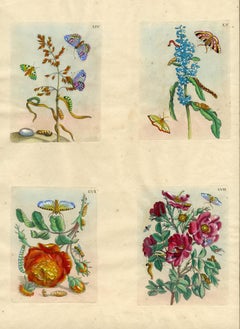
Four plates from The Wondrous Transformation of Caterpillars and their Strange Diet of Flowers. “Wolfsmelk Rupsen;" “Wolfsmilch, Raupe und Schmetterling" Amsterdam: J F Bernard, 1730. Each an engraving with hand coloring in watercolor and gouache printed on one sheet of watermarked Honig cream laid paper, each measures 6 1/4 x 5 inches (157 x 121 mm), sheet measures 20 5/8 x 14 inches (522 x 355 mm), full margins. With handling creases in the lower right sheet quadrant, as well as minor, loose cockling, otherwise in very good condition. The colors are superb with exceptionally fresh and bright saturation. Engraved between 1679 and 1683, printed 1730. Plates included: LIV, LV, LVI, & LVII.
MARIA SIBYLLA MERIAN was one of the most highly respected entomologists of the 17th century, and remains today one of the field's most significant figures. A German-born naturalist and scientific illustrator, she reared herself on the study of caterpillars, and made tremendous contributions to the knowledge of the life cycles of numerous species. Until her detailed and careful study of the process of metamorphosis it was thought that insects were "born of mud," through spontaneous generation.
Trained as a miniature painter by her stepfather, she published her first book of illustrations in 1675, at the age of 28. In 1679, Merian published the first volume of the two-volume series on caterpillars, The Wondrous Transformation of Caterpillars and their Strange Diet of Flowers; the second volume followed in 1683. Each volume contained 50 plates that she engraved and etched. In 1699, Merian traveled to Dutch Guiana...
Category
Early 18th Century Naturalistic Still-life Prints
Materials
Watercolor, Engraving
4 plates from The Wondrous Transformation of Caterpillars
their Strange Diet..
By Maria Sibylla Merian
Located in Middletown, NY
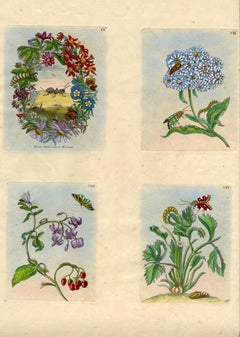
Four plates from The Wondrous Transformation of Caterpillars and their Strange Diet of Flowers. “Wolfsmelk Rupsen;" “Wolfsmilch, Raupe und Schmetterling" Amsterdam: J F Bernard, 1730. Each an engraving with hand coloring in watercolor and gouache printed on one sheet of watermarked Honig cream laid paper, each measures 6 1/4 x 5 inches (157 x 121 mm), sheet measures 20 5/8 x 14 inches (522 x 355 mm), full margins. With handling creases in the lower right sheet quadrant, as well as minor, loose cockling, otherwise in very good condition. The colors are superb with exceptionally fresh and bright saturation. Engraved between 1679 and 1683, printed 1730. Plates included: CI; CII; CIII & CIV.
MARIA SIBYLLA MERIAN was one of the most highly respected entomologists of the 17th century, and remains today one of the field's most significant figures. A German-born naturalist and scientific illustrator, she reared herself on the study of caterpillars, and made tremendous contributions to the knowledge of the life cycles of numerous species. Until her detailed and careful study of the process of metamorphosis it was thought that insects were "born of mud," through spontaneous generation.
Trained as a miniature painter by her stepfather, she published her first book of illustrations in 1675, at the age of 28. In 1679, Merian published the first volume of the two-volume series on caterpillars, The Wondrous Transformation of Caterpillars and their Strange Diet of Flowers; the second volume followed in 1683. Each volume contained 50 plates that she engraved and etched. In 1699, Merian traveled to Dutch Guiana...
Category
Early 18th Century Naturalistic Still-life Prints
Materials
Watercolor, Engraving
4 plates from The Wondrous Transformation of Caterpillars
their Strange Diet..
By Maria Sibylla Merian
Located in Middletown, NY
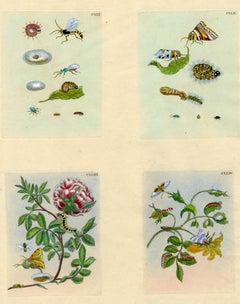
Four plates from The Wondrous Transformation of Caterpillars and their Strange Diet of Flowers. “Wolfsmelk Rupsen;" “Wolfsmilch, Raupe und Schmetterling" Amsterdam: JF Bernard, 1730. Each an engraving with hand coloring in watercolor and gouache printed on one sheet of watermarked Honig cream laid paper, each measures 6 1/4 x 5 inches (157 x 121 mm), sheet measures 20 5/8 x 14 inches (522 x 355 mm), full margins. With handling creases in the lower right sheet quadrant, as well as minor, loose cockling, otherwise in very good condition. The colors are superb with exceptionally fresh and bright saturation. Engraved between 1679 and 1683, printed 1730. Plates included: CXLI, CXLII, CXIII & CXLIV.
MARIA SIBYLLA MERIAN was one of the most highly respected entomologists of the 17th century, and remains today one of the field's most significant figures. A German-born naturalist and scientific illustrator, she reared herself on the study of caterpillars, and made tremendous contributions to the knowledge of the life cycles of numerous species. Until her detailed and careful study of the process of metamorphosis it was thought that insects were "born of mud," through spontaneous generation.
Trained as a miniature painter by her stepfather, she published her first book of illustrations in 1675, at the age of 28. In 1679, Merian published the first volume of the two-volume series on caterpillars, The Wondrous Transformation of Caterpillars and their Strange Diet of Flowers; the second volume followed in 1683. Each volume contained 50 plates that she engraved and etched. In 1699, Merian traveled to Dutch Guiana...
Category
Early 18th Century Naturalistic Still-life Prints
Materials
Watercolor, Engraving
Still Thinking About These?
All Recently ViewedMore Ways To Browse
Antique Flies
Antique Viola
Lowell Nesbitt Tulip
Antique Botanical Prints Australia
Hunt Slonem Serigraph
Jean Louis Prevost
Antique Garden Seeder
Kusama Flowers
Sunflower Botanical Print
Dick English
Ellen Gunn
Brooklyn Brownstone
Peter Blake I Love You
Physica Sacra
Still Life With Picasso
Unsigned Warhol
Vintage Daffodil Prints
Warhol Electric Chair Print