Want more images or videos?
Request additional images or videos from the seller
1 of 2
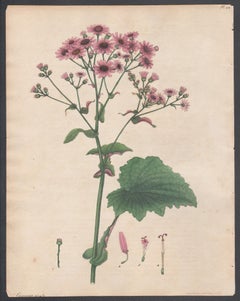
Zichya Villosa, 19th century Australian native botanical engraving1842
1842
Price:$85
About the Item
- Creation Year:1842
- Dimensions:Height: 9.85 in (25 cm)Width: 5.91 in (15 cm)
- Medium:
- Movement Style:
- After:Sarah Ann Drake (1803 - 1857, English)
- Period:
- Condition:Some very faint foxing lower left.
- Gallery Location:Melbourne, AU
- Reference Number:1stDibs: LU124428750552
About the Seller
5.0
Gold Seller
Premium sellers maintaining a 4.3+ rating and 24-hour response times
Established in 2005
1stDibs seller since 2019
633 sales on 1stDibs
Typical response time: 1 hour
Authenticity Guarantee
In the unlikely event there’s an issue with an item’s authenticity, contact us within 1 year for a full refund. DetailsMoney-Back Guarantee
If your item is not as described, is damaged in transit, or does not arrive, contact us within 7 days for a full refund. Details24-Hour Cancellation
You have a 24-hour grace period in which to reconsider your purchase, with no questions asked.Vetted Professional Sellers
Our world-class sellers must adhere to strict standards for service and quality, maintaining the integrity of our listings.Price-Match Guarantee
If you find that a seller listed the same item for a lower price elsewhere, we’ll match it.Trusted Global Delivery
Our best-in-class carrier network provides specialized shipping options worldwide, including custom delivery.You May Also Like
4 plates from The Wondrous Transformation of Caterpillars
their Strange Diet..
By Maria Sibylla Merian
Located in Middletown, NY
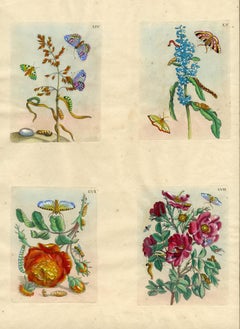
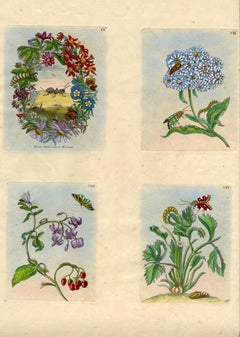
Four plates from The Wondrous Transformation of Caterpillars and their Strange Diet of Flowers. “Wolfsmelk Rupsen;" “Wolfsmilch, Raupe und Schmetterling" Amsterdam: J F Bernard, 1730. Each an engraving with hand coloring in watercolor and gouache printed on one sheet of watermarked Honig cream laid paper, each measures 6 1/4 x 5 inches (157 x 121 mm), sheet measures 20 5/8 x 14 inches (522 x 355 mm), full margins. With handling creases in the lower right sheet quadrant, as well as minor, loose cockling, otherwise in very good condition. The colors are superb with exceptionally fresh and bright saturation. Engraved between 1679 and 1683, printed 1730. Plates included: LIV, LV, LVI, & LVII.
MARIA SIBYLLA MERIAN was one of the most highly respected entomologists of the 17th century, and remains today one of the field's most significant figures. A German-born naturalist and scientific illustrator, she reared herself on the study of caterpillars, and made tremendous contributions to the knowledge of the life cycles of numerous species. Until her detailed and careful study of the process of metamorphosis it was thought that insects were "born of mud," through spontaneous generation.
Trained as a miniature painter by her stepfather, she published her first book of illustrations in 1675, at the age of 28. In 1679, Merian published the first volume of the two-volume series on caterpillars, The Wondrous Transformation of Caterpillars and their Strange Diet of Flowers; the second volume followed in 1683. Each volume contained 50 plates that she engraved and etched. In 1699, Merian traveled to Dutch Guiana...
Category
Early 18th Century Naturalistic Still-life Prints
Materials
Watercolor, Engraving
3 plates from The Wondrous Transformation of Caterpillars
their Strange Diet..
By Maria Sibylla Merian
Located in Middletown, NY
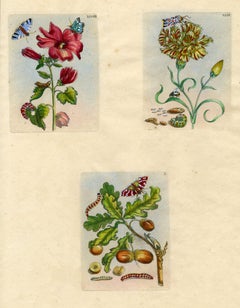
Three plates from The Wondrous Transformation of Caterpillars and their Strange Diet of Flowers. “Wolfsmelk Rupsen;" “Wolfsmilch, Raupe und Schmetterling" Amsterdam: J F Bernard, 1730. Each an engraving with hand coloring in watercolor and gouache printed on one sheet of watermarked Honig cream laid paper, each measures 6 1/4 x 5 inches (157 x 121 mm), sheet measures 20 5/8 x 14 inches (522 x 355 mm), full margins. With handling creases in the lower right sheet quadrant, as well as minor, loose cockling, otherwise in very good condition. The colors are superb with exceptionally fresh and bright saturation. Engraved between 1679 and 1683, printed 1730. Plates included: XLVIII; XLIX & L.
MARIA SIBYLLA MERIAN was one of the most highly respected entomologists of the 17th century, and remains today one of the field's most significant figures. A German-born naturalist and scientific illustrator, she reared herself on the study of caterpillars, and made tremendous contributions to the knowledge of the life cycles of numerous species. Until her detailed and careful study of the process of metamorphosis it was thought that insects were "born of mud," through spontaneous generation.
Trained as a miniature painter by her stepfather, she published her first book of illustrations in 1675, at the age of 28. In 1679, Merian published the first volume of the two-volume series on caterpillars, The Wondrous Transformation of Caterpillars and their Strange Diet of Flowers; the second volume followed in 1683. Each volume contained 50 plates that she engraved and etched. In 1699, Merian traveled to Dutch Guiana...
Category
Early 18th Century Naturalistic Still-life Prints
Materials
Watercolor, Engraving
Tree with moth, caterpillar..., Plate 39, Metamorphosis Insectorum Surinamensium
By Maria Sibylla Merian
Located in Middletown, NY
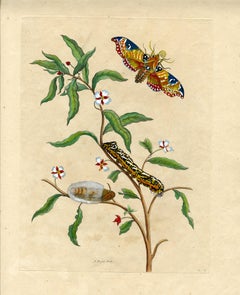
Metamorphosis Insectorum Surinamensium, Plate No. 39; Unidentified tree with moth, caterpillar and pupa.
The Netherlands: 1705....
Category
Early 18th Century Naturalistic Still-life Prints
Materials
Watercolor, Engraving
4 plates from The Wondrous Transformation of Caterpillars
their Strange Diet..
By Maria Sibylla Merian
Located in Middletown, NY
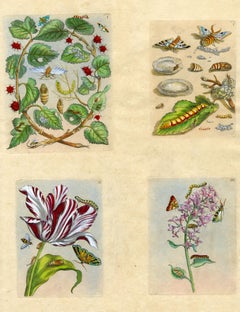
Four plates from The Wondrous Transformation of Caterpillars and their Strange Diet of Flowers. “Wolfsmelk Rupsen;" “Wolfsmilch, Raupe und Schmetterling" Amsterdam: J F Bernard, 1730. Each an engraving with hand coloring in watercolor and gouache printed on one sheet of watermarked Honig cream laid paper, each measures 6 1/4 x 5 inches (157 x 121 mm), sheet measures 20 5/8 x 14 inches (522 x 355 mm), full margins. With handling creases in the lower right sheet quadrant, as well as minor, loose cockling, otherwise in very good condition. The colors are superb with exceptionally fresh and bright saturation. Engraved between 1679 and 1683, printed 1730. Plates included: No.1:I; No. 2:1; II & III.
MARIA SIBYLLA MERIAN was one of the most highly respected entomologists of the 17th century, and remains today one of the field's most significant figures. A German-born naturalist and scientific illustrator, she reared herself on the study of caterpillars, and made tremendous contributions to the knowledge of the life cycles of numerous species. Until her detailed and careful study of the process of metamorphosis it was thought that insects were "born of mud," through spontaneous generation.
Trained as a miniature painter by her stepfather, she published her first book of illustrations in 1675, at the age of 28. In 1679, Merian published the first volume of the two-volume series on caterpillars, The Wondrous Transformation of Caterpillars and their Strange Diet of Flowers; the second volume followed in 1683. Each volume contained 50 plates that she engraved and etched. In 1699, Merian traveled to Dutch Guiana...
Category
Early 18th Century Naturalistic Still-life Prints
Materials
Watercolor, Engraving
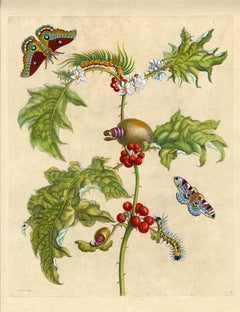
Thistle and Moths, plate no. 6, Metamorphosis Insectorum Surinamensium
By Maria Sibylla Merian
Located in Middletown, NY
Metamorphosis Insectorum Surinamensium, Plate No. 6; Thistle and Moths. The Netherlands: 1705. Engraving with hand coloring in w...
Category
Early 18th Century Naturalistic Still-life Prints
Materials
Watercolor, Engraving
$5,300
H 12.88 in W 9.63 in
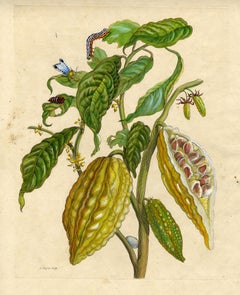
Cocoa plant, caterpillar, ..., Plate 26, Metamorphosis Insectorum Surinamensium
By Maria Sibylla Merian
Located in Middletown, NY
Metamorphosis Insectorum Surinamensium, Plate No. 26; Cocoa plant, caterpillar, pupa, and butterflies. The Netherlands: 1705. En...
Category
Early 18th Century Naturalistic Still-life Prints
Materials
Watercolor, Engraving
4 plates from The Wondrous Transformation of Caterpillars
their Strange Diet..
By Maria Sibylla Merian
Located in Middletown, NY
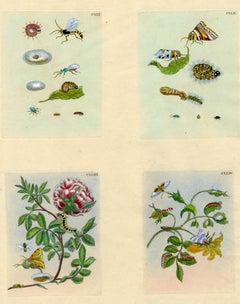
Four plates from The Wondrous Transformation of Caterpillars and their Strange Diet of Flowers. “Wolfsmelk Rupsen;" “Wolfsmilch, Raupe und Schmetterling" Amsterdam: JF Bernard, 1730. Each an engraving with hand coloring in watercolor and gouache printed on one sheet of watermarked Honig cream laid paper, each measures 6 1/4 x 5 inches (157 x 121 mm), sheet measures 20 5/8 x 14 inches (522 x 355 mm), full margins. With handling creases in the lower right sheet quadrant, as well as minor, loose cockling, otherwise in very good condition. The colors are superb with exceptionally fresh and bright saturation. Engraved between 1679 and 1683, printed 1730. Plates included: CXLI, CXLII, CXIII & CXLIV.
MARIA SIBYLLA MERIAN was one of the most highly respected entomologists of the 17th century, and remains today one of the field's most significant figures. A German-born naturalist and scientific illustrator, she reared herself on the study of caterpillars, and made tremendous contributions to the knowledge of the life cycles of numerous species. Until her detailed and careful study of the process of metamorphosis it was thought that insects were "born of mud," through spontaneous generation.
Trained as a miniature painter by her stepfather, she published her first book of illustrations in 1675, at the age of 28. In 1679, Merian published the first volume of the two-volume series on caterpillars, The Wondrous Transformation of Caterpillars and their Strange Diet of Flowers; the second volume followed in 1683. Each volume contained 50 plates that she engraved and etched. In 1699, Merian traveled to Dutch Guiana...
Category
Early 18th Century Naturalistic Still-life Prints
Materials
Watercolor, Engraving
4 plates from The Wondrous Transformation of Caterpillars
their Strange Diet..
By Maria Sibylla Merian
Located in Middletown, NY
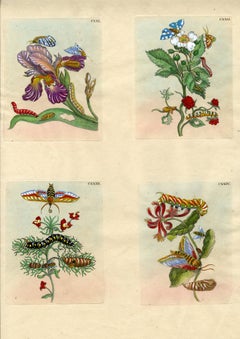
Four plates from The Wondrous Transformation of Caterpillars and their Strange Diet of Flowers. “Wolfsmelk Rupsen;" “Wolfsmilch, Raupe und Schmetterling" Amsterdam: J F Bernard, 1730. Each an engraving with hand coloring in watercolor and gouache printed on one sheet of watermarked Honig cream laid paper, each measures 6 1/4 x 5 inches (157 x 121 mm), sheet measures 20 5/8 x 14 inches (522 x 355 mm), full margins. With one 1.5 inch inch tear across the area of the top-left corner, well outside of image area. Handling creases in the lower right sheet quadrant, as well as minor, loose cockling, otherwise in very good condition. The colors are superb with exceptionally fresh and bright saturation. Engraved between 1679 and 1683, printed 1730. Plates included: CXXI, CXXII, CXXIII, & CXXIV.
MARIA SIBYLLA MERIAN was one of the most highly respected entomologists of the 17th century, and remains today one of the field's most significant figures. A German-born naturalist and scientific illustrator, she reared herself on the study of caterpillars, and made tremendous contributions to the knowledge of the life cycles of numerous species. Until her detailed and careful study of the process of metamorphosis it was thought that insects were "born of mud," through spontaneous generation.
Trained as a miniature painter by her stepfather, she published her first book of illustrations in 1675, at the age of 28. In 1679, Merian published the first volume of the two-volume series on caterpillars, The Wondrous Transformation of Caterpillars and their Strange Diet of Flowers; the second volume followed in 1683. Each volume contained 50 plates that she engraved and etched. In 1699, Merian traveled to Dutch Guiana...
Category
Early 18th Century Naturalistic Still-life Prints
Materials
Watercolor, Engraving
4 plates from The Wondrous Transformation of Caterpillars
their Strange Diet..
By Maria Sibylla Merian
Located in Middletown, NY
Four plates from The Wondrous Transformation of Caterpillars and their Strange Diet of Flowers. “Wolfsmelk Rupsen;" “Wolfsmilch, Raupe und Schmetterling" Amsterdam: J F Bernard, 1730. Each an engraving with hand coloring in watercolor and gouache printed on one sheet of watermarked Honig cream laid paper, each measures 6 1/4 x 5 inches (157 x 121 mm), sheet measures 20 5/8 x 14 inches (522 x 355 mm), full margins. With handling creases in the lower right sheet quadrant, as well as minor, loose cockling, otherwise in very good condition. The colors are superb with exceptionally fresh and bright saturation. Engraved between 1679 and 1683, printed 1730. Plates included: CI; CII; CIII & CIV.
MARIA SIBYLLA MERIAN was one of the most highly respected entomologists of the 17th century, and remains today one of the field's most significant figures. A German-born naturalist and scientific illustrator, she reared herself on the study of caterpillars, and made tremendous contributions to the knowledge of the life cycles of numerous species. Until her detailed and careful study of the process of metamorphosis it was thought that insects were "born of mud," through spontaneous generation.
Trained as a miniature painter by her stepfather, she published her first book of illustrations in 1675, at the age of 28. In 1679, Merian published the first volume of the two-volume series on caterpillars, The Wondrous Transformation of Caterpillars and their Strange Diet of Flowers; the second volume followed in 1683. Each volume contained 50 plates that she engraved and etched. In 1699, Merian traveled to Dutch Guiana...
Category
Early 18th Century Naturalistic Still-life Prints
Materials
Watercolor, Engraving
"February Bouquet" from
The Twelve Months of Flowers
series by Robert Furber
By Robert Furber
Located in Alamo, CA
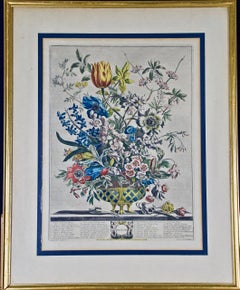
This framed hand-colored engraving entitled "February Bouquet" is from 'The Twelve Months of Flowers' by Henry Furber, published in London in 1730 by Robert Sayer and John King. Each of the twelve hand-colored engravings in the book were produced from paintings by Pieter Casteels (1684-1749) and engraved by Henry Fletcher (1710-1753). The book featured twelve detailed engravings of seasonal plants in bloom in the form of a bouquet. More than 400 different species of flowering plants were included with each plant numbered and accompanied by a list of the corresponding species names. Thirty-five species of flowers are depicted in this engraving in a bouquet sitting in an ornate attractive bowl. A few of the flowers lie loose on a table. The flower species are listed in a table in the lower portion of the plate, along with the month that these flowers are in bloom.
This colorful print is presented in a gold-colored wood frame with a cream-colored double mat with a heather green inner mat. The frame measures 23.5" High, 19" wide and 1.63" deep. There are a few small frame abrasions, but the print is in very good condition.
Robert Furber...
Category
Mid-18th Century Naturalistic Still-life Prints
Materials
Engraving
$1,775
H 23.5 in W 19 in D 1.63 in
More From This Seller
View AllYucca filamentosa - French botanical flower engraving by Bessa, c1830
By After Pancrace Bessa
Located in Melbourne, Victoria
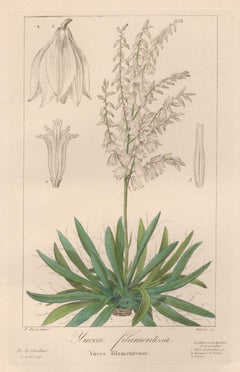
'Yucca filamentosa' (Adam's Needle)
Original copper-line engraving with original hand-colouring.
From 'Herbier general de l'amateur' by Jean Louis Auguste Loiseleur-Deslongchamps &...
Category
Early 19th Century Naturalistic Still-life Prints
Materials
Engraving
Albuca Minor - French botanical flower engraving by Bessa, c1830
By After Pancrace Bessa
Located in Melbourne, Victoria
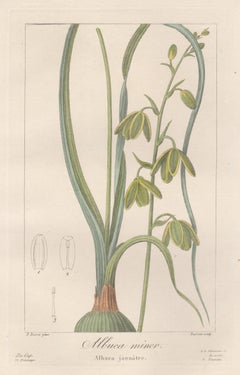
'Albuca Minor'
Original copper-line engraving with original hand-colouring.
From 'Herbier general de l'amateur' by Jean Louis Auguste Loiseleur-Deslongchamps & Jean Claude Michel M...
Category
Early 19th Century Naturalistic Still-life Prints
Materials
Engraving
Apocynum androsamifolium - French botanical flower engraving by Bessa, c1830
By After Pancrace Bessa
Located in Melbourne, Victoria
'Apocynum androsamifolium' (Fly-trap dogbane or spreading dogbane)
Original copper-line engraving with original hand-colouring.
From 'Herbier general de l'amateur' by Jean Louis A...
Category
Early 19th Century Naturalistic Still-life Prints
Materials
Engraving

Two-coloured-leaved Cineraria. Andrews antique botanical flower engraving print
By Henry C Andrews
Located in Melbourne, Victoria
'Cineraria Aurita - Two-coloured-leaved Cineraria'
Native of the Canary Islands.
Original copper-line engraving with original hand-colouring from Henry Andrews' 'The Botanist's Re...
Category
Early 19th Century Naturalistic Still-life Prints
Materials
Engraving
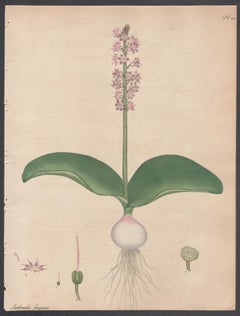
Sweet-scented Lachenalia. Henry Andrews antique botanical flower engraving print
By Henry C Andrews
Located in Melbourne, Victoria
'Lachenalia Fragrant - Sweet-scented Lachenalia'
Original copper-line engraving with original hand-colouring from Henry Andrews' 'The Botanist's Repository', 1797-1812. Accompanied...
Category
Early 19th Century Naturalistic Still-life Prints
Materials
Engraving
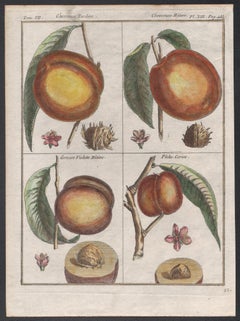
Peach varieties, fruit engraving with later hand-colouring, circa 1770
By HL Duhamel Du Monceau
Located in Melbourne, Victoria
Peaches, Copper-line engraving with later hand-colouring, from Duhamel du Monceau’s 'Traité des Arbres Fruitiers', circa 1770.
Duhamel du Monceau (1700-1782) was one of outstanding ...
Category
18th Century Naturalistic Still-life Prints
Materials
Engraving
Still Thinking About These?
All Recently ViewedMore Ways To Browse
Bronze Of Ballet Dancers
Bronze Round Sculptures
Bruno Helgen
Bry Paris
Camel Oil Painting
Cavalier King Charles Oil Painting
Dior Horse
French Quarter Painting
German Paintings Nude
Gumball Machine
Horse Portrait 19th Century
Hunt Slonem Blue Diamond
Hunt Slonem Chinensis
Joan Miro Bronze
John Ernst
Kaws Changbai
Kaws Holiday Taipei
Lois Mailou Jones