1 of 3

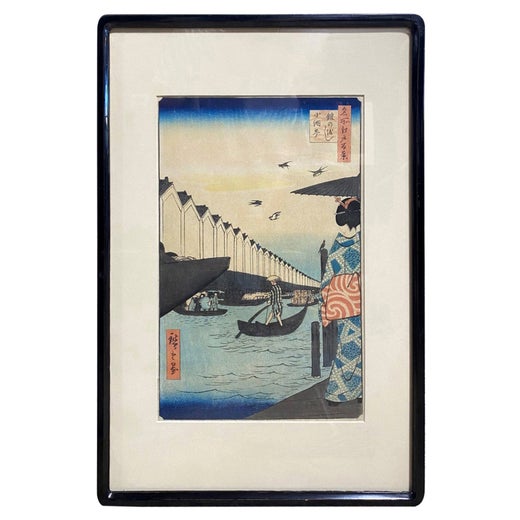
Utagawa Hiroshige (Ando Hiroshige)
Oji Fudo no taki (Fudo Falls, Oji)

1857

$2,000List Price

You May Also Like

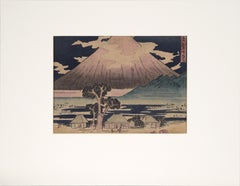
Study of Utagawa Hiroshige s "View of Hara-Juku" 53 Stations of the Tokaido Road
By Utagawa Hiroshige
Located in Soquel, CA
Study of Utagawa Hiroshige's "View of Hara-Juku" 53 Stations of the Tokaido Road Hand painted study of Utagawa Hiroshige's "View of Hara-Juku", (by unknown artist), from "53 Station...
Category

1920s Edo Landscape Prints

Materials

Paper, Ink, Woodcut

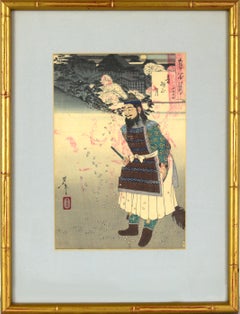
One Hundred Aspects of the Moon, Mt Otawa Moon - Bright God Tamura
By Tsukioka Yoshitoshi
Located in Soquel, CA
"Mount Otawa Moon: Bright God Tamura" - Woodblock on Paper by Tsukioka Yoshitoshi From the series "One Hundred Aspects of the Moon" This piece depicts the general Sakanoe no Tamura...
Category

1880s Edo Figurative Prints

Materials

Paper, Ink, Woodcut

Sunset
Located in Fort Lauderdale, FL
Hand colored etching on Japon paper 25 x 20 in (63.50 x 50.80 cm)
Category

2010s Contemporary Landscape Prints

Materials

Varnish, Archival Ink, Rag Paper

Sunset
Price Upon Request
H 42 in W 42 in
"Grave of Santa Anna s Leg" Original Woodblock Print, Signed Artist s Proof
By Carol Summers
Located in Soquel, CA
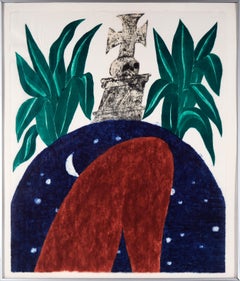
"Grave of Santa Anna's Leg" Original Woodblock Print, Signed Artist's Proof Boldly colored woodblock print by Carol Summers (American, 1925-2016). This piece is a segment of a grave, with a headstone that has a skull and cross. There are two bright green plants flanking the headstone. Below the headstone and plants, there is a large arched blue shape, with a crescent moon and stars. A red leg, bent at the knee, cuts across the blue arch. Signed "Carol Summers" along the right edge of the blue shape. Numbered and titled "A/P Grave of Sant Anna's Leg" along the left edge of the blue shape. Presented in a silver colored aluminum frame. Frame size: 32.245"H x 27.25"W Paper size: 29.75"H x 24.5"W Carol Summers (1925-2016) has worked as an artist throughout the second half of the 20th century and into the first years of the next, outliving most of his mid-century modernist peers. Initially trained as a painter, Summers was drawn to color woodcuts around 1950 and it became his specialty thereafter. Over the years he has developed a process and style that is both innovative and readily recognizable. His art is known for it’s large scale, saturated fields of bold color, semi-abstract treatment of landscapes from around the world and a luminescent quality achieved through a printmaking process he invented. In a career that has extended over half a century, Summers has hand-pulled approximately 245 woodcuts in editions that have typically run from 25 to 100 in number. His talent was both inherited and learned. Born in 1925 in Kingston, a small town in upstate New York, Summers was raised in nearby Woodstock with his older sister, Mary. His parents were both artists who had met in art school in St. Louis. During the Great Depression, when Carol was growing up, his father supported the family as a medical illustrator until he could return to painting. His mother was a watercolorist and also quite knowledgeable about the different kinds of papers used for various kinds of painting. Many years later, Summers would paint or print on thinly textured paper originally collected by his mother. From 1948 to 1951, Carol Summers trained in the classical fine and studio arts at Bard College and at the Art Students League of New York. He studied painting with Steven Hirsh and printmaking with Louis Schanker. He admired the shapes and colors favored by early modernists Paul Klee (Sw: 1879-1940) and Matt Phillips (Am: b.1927- ). After graduating, Summers quit working as a part-time carpenter and cabinetmaker (which had supported his schooling and living expenses) to focus fulltime on art. That same year, an early abstract, Bridge No. 1 was selected for a Purchase Prize in a competition sponsored by the Brooklyn Museum. In 1952, his work (Cathedral, Construction and Icarus) was shown the first time at the Museum of Modern Art in New York City in an exhibition of American woodcuts...
Category

1980s Contemporary Landscape Prints

Materials

Ink, Handmade Paper, Woodcut

"Pueblo Portals" - Intaglio Print in Ink on Archival paper, #3/15
Located in Soquel, CA
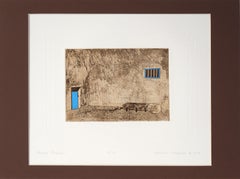
"Pueblo Portals" - Intaglio Print in Ink on Archival paper, #3/15 Tan interior intaglio print with blue accents by Marcia Pagels (American, 1930-2010). This piece shows a stark interior of a Pueblo building, with two bright blue accents - the window and the door. This piece also has an asymmetrical trapezoid border that is imprinted (but not printed) around the edge. Titled, numbered, signed, and dated along the bottom edge: Pueblo Portals 3/15 Marcia Pagels © 1989 Presented in a new brown mat Mat size: 12"H x 16"W Paper size: 11"H x 14"W Impression size: 7.5"H x 10"W Marcia Pagels (American, 1930-2010) was born in Taft, California, and moved to Glendale in her early teens. She attended Stanford University, where she earned her BA in Art, and then went on to study at the Sorbonne in Paris. She later moved to East Palo Alto with her husband and children, where she studied with Richard Bowman...
Category

1980s Contemporary Landscape Prints

Materials

Ink, Archival Paper, Intaglio

Farmhouse and the Wheat Field at Sunset - Landscape Lithograph in Ink on Paper
Located in Soquel, CA
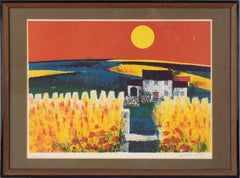
Farmhouse and the Wheat Field at Sunset - Landscape Lithograph in Ink on Paper Rich and saturated landscape by Edward Ripley (British, b. 1929). A vibrant yellow sun hangs over a farm landscape, set against a bold red sky. The foreground is made up of yellow and red wheat, with a few red poppies in the very front. A two story farmhouse stands...
Category

1960s Modern Landscape Prints

Materials

Paper, Ink, Lithograph

"Fisherman s Wharf - San Francisco" Multi Layer Screen Print on Paper - Signed
By Gordon Cope
Located in Soquel, CA
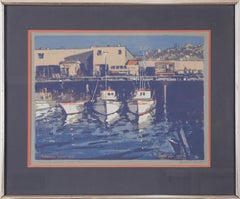
"Fisherman's Wharf - San Francisco" Multi Layer Screen Print on Paper - Signed Rare and bold Screen Print (Silk Screen) of Fisherman's Wharf 1957 by Gordon Cope (American, 1906-1999). Several boats are docked at Fisherman's Wharf, with buildings directly behind them. In the distance, the hills of San Francisco can be seen meeting a pale blue sky. Of particular note is the skillful representation of the reflections of the boats in the water, and the clever use of grey paper as negative space. Numbered and titled in pencil in the lower left corner "22/100 Fisherman's Wharf - San Francisco" Hand signed and dated in pencil in the lower right corner "Gordon Cope 1957" Titled, signed, and dated "in plate" Presented in a silver colored frame with a double mat. Frame size: 22.5"H x 27"W Image size: 15"H x 20"W Gordon N. Cope (American, 1906-1999) was an educator and painter. Trained in Utah and France, he exhibited his landscape paintings and portraits in the United States and Europe, and he believed music was related to painting. Cope was born on May 14, 1906, in Salt Lake City. He was trained by Utahn artists LeConte Stewart and Lawrence Squires, and at the Académie Julian in Paris, France in 1928. He also studied singing at the Opéra-Comique. Cope taught art at Latter-day Saints University, and he served as the chair of its Department of Art in 1930–1931. He taught at the Mountain School of Art from 1932 to 1938, and he was the director of the Art Barn School in Salt Lake City in 1939–1941. Cope painted Utahn landscapes as well as a portrait of Henry H. Blood, who served as the seventh governor of Utah from 1933 to 1941. Cope exhibited his work in the United States and Europe. According to the Deseret News, Cope "felt that music and painting are closely interrelated, and that the study of one form may be used to complement the appreciation and understanding of the other." Cope died on June 10, 1999, in San Francisco, California. Gordon Nicholson Cope studied with well-known Utah artists A.B. Wright and LeConte Stewart, and became recognized as a major Utah artist of the Great Depression. Cope was born in Salt Lake City in 1906 and spent much of his life in Utah. Cope gained much of his artistic training from diverse environments and influences. Following his training with the previously mentioned artists, Cope spent the next year, 1924, working with Lawrence Squires in Arizona. To expand his knowledge and training, Cope traveled to Europe, where he studied the "old masters" such as Da Vinci, Michelangelo, and Raphael. From 1924 to 1928, Cope studied in England, France, Italy, Switzerland, Belgium, Holland, and worked for a year at the Acadamie Julian, where many early Utah artists...
Category

1950s American Impressionist Landscape Prints

Materials

Paper, Ink, Screen

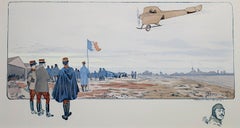
"French Air Show with Remarque of Head of Pilot, " Lithograph Stencil by GAMY
By Marguerite Montaut
Located in Milwaukee, WI
"French Air Show with Remarque of Head of Pilot" is an original lithograph and stencil print by Marguerite Montaut (GAMY). It depicts an early airplane flying above a crowd of specta...
Category

1910s American Realist Landscape Prints

Materials

Lithograph, Stencil, Ink

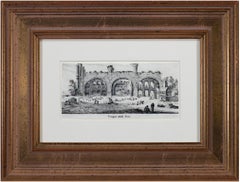
17th century engraving black and white landscape ancient building scene
By Israel Silvestre
Located in Milwaukee, WI
"Tempio Della Pace" is an original engraving by Israel Silvestre. The title is printed below the miniature image. It shows a frontal view of the remains of the Temple of Peace in Rom...
Category

1650s Old Masters Landscape Prints

Materials

Paper, Ink, Engraving

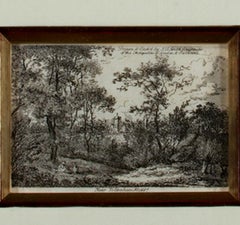
18th century landscape etching pastoral nature scene detailed ink trees
By John Thomas Smith
Located in Milwaukee, WI
"Near Tottenham Midd." is an original etching by John Thomas Smith at the top right of the image, reading "Drawn & Etch'd by J. T. Smith, Engraver of the Antiquities of London & Envi...
Category

1790s Old Masters Landscape Prints

Materials

Paper, Ink, Etching

Still Thinking About These?

All Recently Viewed