Items Similar to Vintage 1967 1970 Modernist Maquette Chicago Picasso Cubist Sculpture Head Metal
Want more images or videos?
Request additional images or videos from the seller
1 of 13
(after) Pablo PicassoVintage 1967 1970 Modernist Maquette Chicago Picasso Cubist Sculpture Head Metal1967 1970
1967 1970
$2,500
£1,893.52
€2,174.64
CA$3,503.32
A$3,808.81
CHF 2,019.44
MX$45,658.01
NOK 25,666.01
SEK 23,513.55
DKK 16,252.68
About the Item
This is a model of the large Picasso sculpture in Chicago it is a vintage piece. it is marked 1967 and was made for the Chicago Public Building Commission (it is also marked Handiguild inc. 1970)
there is a bronze colored patina to the piece. Mounted to a wood base.
with base it measures 7.5 height by 6 width aby 3.25 depth.
piece itself measures 6 height by 2.25 by 3.35 inches.
The Chicago Picasso (often just The Picasso) is an untitled monumental sculpture by Pablo Picasso in Daley Plaza in Chicago, Illinois. The 1967 installation of The Picasso, "precipitated an aesthetic shift in civic and urban planning, broadening the idea of public art beyond the commemorative."
The COR-TEN steel structure, dedicated on August 15, 1967, in the civic plaza in the Chicago Loop, is 50 feet (15.2 m) tall and weighs 162 short tons (147 t). The Cubist sculpture by Picasso, who later said that it represented the head of his Afghan Hound, was the first monumental abstract public artwork in Downtown Chicago, and has become a well-known landmark. Publicly accessible, it is known for its inviting jungle gym-like characteristics. Visitors to Daley Plaza can often be seen climbing on and sliding down the base of the sculpture.
The sculpture was commissioned in 1963 by the architects of the Chicago Civic Center (now known as the Richard J. Daley Center), a modernist government office building and courthouse (also clad in COR-TEN), with an open granite-paved plaza. The commission was facilitated by the architect William Hartmann of the architectural firm of Skidmore, Owings
Merrill. Picasso completed a maquette of the sculpture in 1965, and approved a final model of the sculpture in 1966. The cost of constructing the sculpture was $351,959.17 (equivalent to $3.2 million in 2022), paid mostly by three charitable foundations: the Woods Charitable Fund, the Chauncey and Marion Deering McCormick Foundation, and the Field Foundation of Illinois. Picasso himself was offered payment of $100,000 but refused, stating that he wanted to make his work a gift to the city.
There was speculation on the subject, which has ranged from an abstract bird, or aardvark to Picasso's pet Afghan Hound, a baboon head or Sylvette David, one of his models.
Some have speculated it may have been inspired by a French woman, Sylvette David, now known as Lydia Corbett, who posed for Picasso in 1954. Then 19 years old and living in Vallauris, France, Corbett would accompany her artist boyfriend as he delivered chairs made of metal, wood and rope. One of those deliveries was to Picasso, who was struck by her high ponytail and long neck. "He made many portraits of her. At the time, most people thought he was drawing the actress Brigitte Bardot. But in fact, he was inspired by [Corbett]", Picasso's grandson Olivier Widmaier Picasso told the Chicago Sun-Times in 2004.
"I think the Chicago Sculpture was inspired by her", said the grandson, author of Picasso, the Real Family Story. Picasso made 40 works inspired by her, said the grandson, including The Girl Who Said No, reflecting their platonic relationship. The quality of the Picasso sculpture inspired other artists such as Alexander Calder, Marc Chagall, Joan Miró, Claes Oldenburg and Henry Moore. There was an ongoing dialogue between Picasso's sculpture and his painting. A further possible influence could lie in his portraits of Jacqueline herself, made in the early 1960s, specifically Bust of a Woman (Jacqueline) from May 1962
The Picasso was the site of an August 23, 1968, press conference in which Yippies Jerry Rubin, Phil Ochs, and others were arrested after nominating a pig — Pigasus — for president of the United States. This event was held days before the opening of the 1968 Democratic National Convention, which became known for its anti-Vietnam war protests.
The sculpture was mentioned (and appears) in the 1980 film The Blues Brothers during the chase scene leading to the Richard J. Daley Center. It can also be seen briefly in the 1993 film The Fugitive, as Harrison Ford, playing Richard Kimble, and his pursuers run across the plaza, and in the 1986 film Ferris Bueller's Day Off as people in and under a reviewing stand dance to a song sung by Matthew Broderick, who plays Bueller. The sculpture also makes an appearance in the 1988 film Switching Channels starring Kathleen Turner, Burt Reynolds and Christopher Reeve.
The Chicago Picasso became and continues to be a well-known meeting spot for Chicagoans. Depending on the season and time of the month, there are musical performances, farmers' markets, a Christkindlmarkt, and other Chicago affairs which are held around the Picasso in Daley Plaza.
Pablo Ruiz Picasso (1881 – 1973) was a Spanish painter, sculptor, printmaker, ceramicist, stage designer, poet and playwright who spent most of his adult life in France. Regarded as one of the most influential artists of the 20th century, he is known for co-founding the Cubist movement, the invention of constructed sculpture, the co-invention of collage, and for the wide variety of styles that he helped develop and explore. Among his most famous works are the proto-Cubist Les Demoiselles d'Avignon (1907), and Guernica (1937), a dramatic portrayal of the bombing of Guernica by the German and Italian air forces during the Spanish Civil War.
Picasso demonstrated extraordinary artistic talent in his early years, painting in a naturalistic manner through his childhood and adolescence. During the first decade of the 20th century, his style changed as he experimented with different theories, techniques, and ideas. After 1906, the Fauvist work of the slightly older artist Henri Matisse motivated Picasso to explore more radical styles, beginning a fruitful rivalry between the two artists, who subsequently were often paired by critics as the leaders of modern art.
Picasso's work is often categorized into periods. While the names of many of his later periods are debated, the most commonly accepted periods in his work are the Blue Period (1901–1904), the Rose Period (1904–1906), the African-influenced Period (1907–1909), Analytic Cubism (1909–1912), and Synthetic Cubism (1912–1919), also referred to as the Crystal period. Much of Picasso's work of the late 1910s and early 1920s is in a neoclassical style, and his work in the mid-1920s often has characteristics of Surrealism. His later work often combines elements of his earlier styles.
In 1907, Picasso joined an art gallery that had recently been opened in Paris by Daniel-Henry Kahnweiler. Kahnweiler was a German art historian and art collector who became one of the premier French art dealers of the 20th century. He was among the first champions of Pablo Picasso, Georges Braque and the Cubism that they jointly developed. Kahnweiler promoted burgeoning artists such as André Derain, Kees van Dongen, Fernand Léger, Juan Gris, Maurice de Vlaminck and several others who had come from all over the globe to live and work in Montparnasse at the time.
- Creator:(after) Pablo Picasso (1881 - 1973, Spanish)
- Creation Year:1967 1970
- Dimensions:Height: 7.5 in (19.05 cm)Width: 6 in (15.24 cm)Depth: 3.25 in (8.26 cm)
- Medium:
- Movement Style:
- Period:
- Condition:minor wear. please see photos.
- Gallery Location:Surfside, FL
- Reference Number:1stDibs: LU38216834922
(after) Pablo Picasso
Pablo Picasso (1881 – 1973) was a Spanish painter, sculptor, printmaker, ceramicist, stage designer, poet and playwright who is regarded as one of the most influential artists of the 20th century. He is known for co-founding the Cubist movement, the invention of constructed sculpture, the co-invention of collage, and for the wide variety of styles that he helped develop and explore. Exceptionally prolific throughout the course of his long life, Picasso achieved universal renown and immense fortune for his revolutionary artistic accomplishments, and became one of the best-known figures in 20th-century art. The total number of artworks he produced has been estimated at around 50,000.
About the Seller
4.9
Platinum Seller
Premium sellers with a 4.7+ rating and 24-hour response times
Established in 1995
1stDibs seller since 2014
1,855 sales on 1stDibs
Typical response time: <1 hour
- ShippingRetrieving quote...Shipping from: Surfside, FL
- Return Policy
More From This Seller
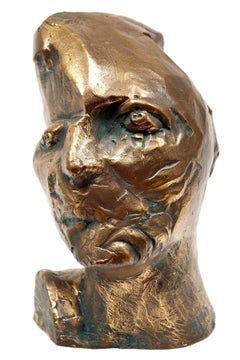
View AllUntitled, Head Of An Artist, Avant-Garde Bronze Sculpture
By Phillip Pavia
Located in Surfside, FL
This is a bronze cast sculpture by Philip Pavia is part of his series of "Imaginary Portraits from the Club" , a one-man exhibition at Max Protetch Gallery, New York in 1982. The approach at rendering the figure is grotesque, and the facial features have been severely distorted to the point were the portrait becomes an abstract interpretation of the subject.
As an artist and writer, Philip Pavia was a committed member of the Abstract Art community throughout his long, distinguished career. Pavia was active in the art world until his death in 2005 and received immense critical praise for his artistic and literary contributions. Recognized for his signature work The Ides of March...
Category
20th Century Abstract Expressionist Figurative Sculptures
Materials
Bronze
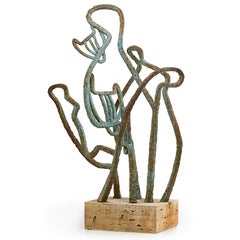
Abstract Signed Cubist Bronze Sculpture "Cats" Chicago Bauhaus Woman Modernist
Located in Surfside, FL
This listing is just for the sculpture. (the picture of the ad is for reference and is not included.)
Marie Zoe Greene-Mercier was an artist, writer and arts activist who worked in t...
Category
1960s Cubist Abstract Sculptures
Materials
Travertine, Bronze
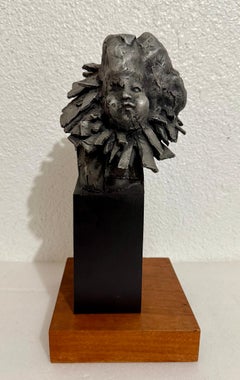
French Naif Modernist Sculpture In Metal Brutalist Head of Woman Valerie Hadida
Located in Surfside, FL
Cast metal on a wood plinth base
Signed in cast at side with illegible name or initials
This is being sold as attributed to her as that is how we acquired it.
Dimensions: including integral plinth base 15.5 X 7.75 X 7.25 inches.
Valérie Hadida...
Category
20th Century Modern Figurative Sculptures
Materials
Metal
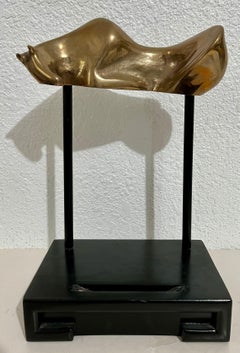
Bronze Modernist Biomorphic Sculpture Horse, Stand Colin Webster Watson Art Deco
Located in Surfside, FL
Colin Webster Watson (1926-2007, New Zealand), sleeping horse, sculpture, bronze, supported on wooden base, signed, AP
Sculpture Of A Suspended Horse
Colin Webster-Watson (1926, Pa...
Category
1970s Abstract Sculptures
Materials
Bronze
Mod Brutalist Abstract Metal
Painting Heavy Sculpture Bust George Nama
By George Nama
Located in Surfside, FL
George Nama
Genre: Avant-Garde
Subject: Abstract
Medium: Solid Metal Painted White and Black
This is very heavy and solid. I don't think it is bronze. it might be aluminum or steel. ...
Category
1970s Abstract Abstract Sculptures
Materials
Metal
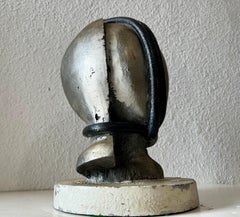
Argentine Modernist Brutalist Abstract Bronze Sculpture Jewish Latin American
By Naum Knop
Located in Surfside, FL
Naum Knop (Ukrainian-Argentinean, 1917-1993) Modernist Brutalist bronze figural sculpture with heavy verdigris green finish. Melted forms in the shape of an abstract pretzel like twist. Affixed to white stone plinth. Artist signature, "NK" side of base. Good condition, shows rich green patina and aged oxidation. Measures approximately 17.5 in. x 19.5 in. x 6.5 in.
Naum Knop, Argentine sculptor, was born in 1917 in Buenos Aires, into a Jewish family of Russian origin from Ukraine. His childhood was spent in the neighborhood of La Paternal where his father had a carpentry workshop, a space in which he made contact for the first time with the technique of wood carving. After finishing elementary school, he worked with the teacher Luis Fernández and soon after he dedicated himself to furniture design. Around 1935, he entered the Manuel Belgrano School of Fine Arts . Between 1941 and 1942 he attended the course for graduates taught by Alberto Lagos and Alfredo Bigatti at the National School of Fine Arts and continued his training between 1942-1945 at the Ernesto de la Cárcova High School with Soto Avedaño, Carlos de la Cárcova and José Fioravanti. At this time he put his works in dialogue with other young artists such as Libero Badii and Aurelio Macchi .
Around 1947 he made his study trip abroad. He goes to California, United States, where he enters the Art Institute of Los Angeles. At the same time visit museums and galleries. In January 1948 he organized his first exhibition abroad, held at the Hall of Arts in Beverly Hills in Los Angeles. During this period he toured Chicago and then New York. That year he traveled to Europe; his itinerary includes France, Italy, Switzerland and England. As a result, he came into contact with the work of Henry Moore, Hans Jean Arp, Jacques Lipchitz, Constantin Brancusi, Umberto Boccioni, Henry Laurens, Ossip Zadkine. Artists who have an impact on the young Knop and whom he honors in his subsequent production. He returned to Argentina in 1949 and installed his workshop where he worked on ornamental carving and on pieces in which he oscillated between a synthetic figuration and abstraction.
In 1956 he began his successful participation in salons , obtaining numerous awards at the national and municipal level. In 1959 he participated in the shipment to the 5th São Paulo Biennial and since then, to the success achieved at the local level, the multiple exhibitions carried out in the international field have been added. The exhibitions in Tel Aviv , Jerusalem and Rome (1966) stand out; Dusseldorf (1977); Los Angeles and Palm Spring (1981); New York (1986), San Pablo and Los Angeles(1989). During this period, his work matured, while he began to experiment with the direct wax technique, obtaining textured surfaces similar to welds that gave it a strong abstract expressionist feature. In parallel to his personal production and to the small models, the artist receives private and public commissions for which he works on large-scale sculptures and murals. Around 1967, the architect Mario R. Álvarez summons him to participate in a closed competition for the creation of a work to be located in the General San Martín Cultural Center . Libero Badii and Enio Iommi participate with the artist ; the bronze Reclining Figure Knop is chosen. Among the large-scale monuments it is worth remembering the piece Los tres soles temporarily located in Recoleta in 1984 and later installed in Maryland, United States; as well as Seated Figure (Reminiscence of Michelangelo) located in the shield of a private building in 1970. To these are added the numerous murals in which he experiments with various materials and techniques such as casting in bronze, openwork and reliefs in wood and work in cement.
He was included in the The 1962 International Prize for Sculpture the jury included Argan, Romero Brest and James Johnson Sweeney the former director of the Solomon R. Guggenheim Museum in New York. The participants included Louise Nevelson and John Chamberlain for the United States; Lygia Clark for Brazil; Pietro Consagra, Lucio Fontana, Nino Franchina, and Gió Pomodoro for Italy; Pablo Serrano for Spain; and Eduardo Paolozzi, William Turnbull, and Kenneth Armitage for England. Gyula Kosice, Noemí Gerstein, Julio Gero, Naum Knop, Aldo Paparella, Enrique Romano, Eduardo Sabelli, and Luis Alberto...
Category
Mid-20th Century Abstract Abstract Sculptures
Materials
Stone, Bronze

You May Also Like
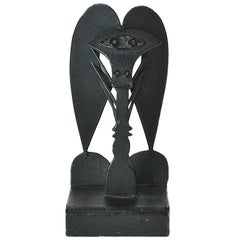
Pablo Picasso Womans Magical Head Cubist Chicago Sculpture Maquette Mid-Century
By Pablo Picasso
Located in Hyattsville, MD
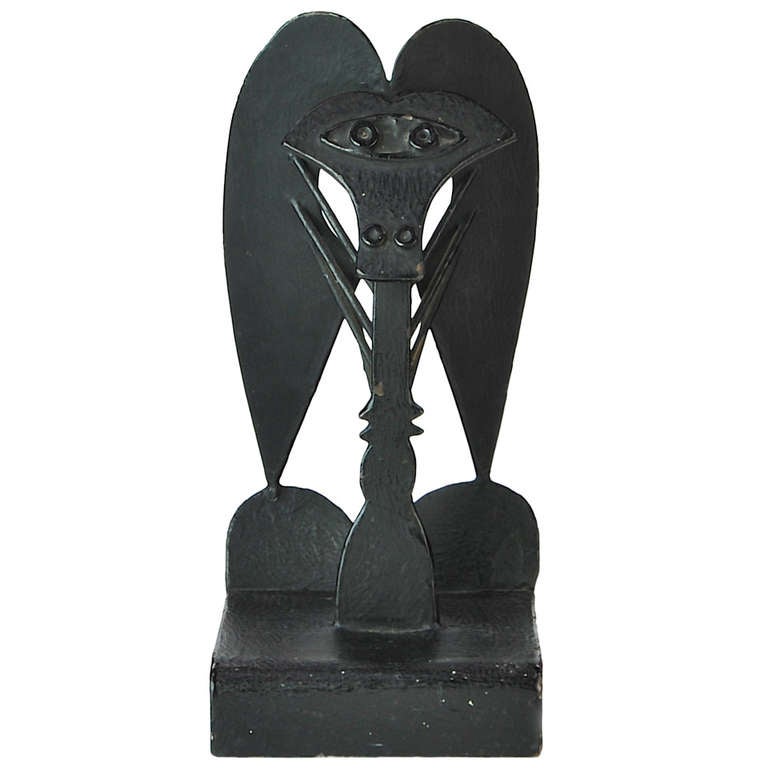
“Maquette” (after Pabloe Picasso) Very Old Maquette. Black enamel over different types of metal; steel, copper or brass. Unsigned.
Category
Vintage 1950s Unknown Modern Sculptures
Materials
Metal
$6,000 Sale Price
53% Off
Head of a Women Welded Steel Sculpture Carl Nesjar for Picasso
By (after) Pablo Picasso
Located in Los Angeles, CA
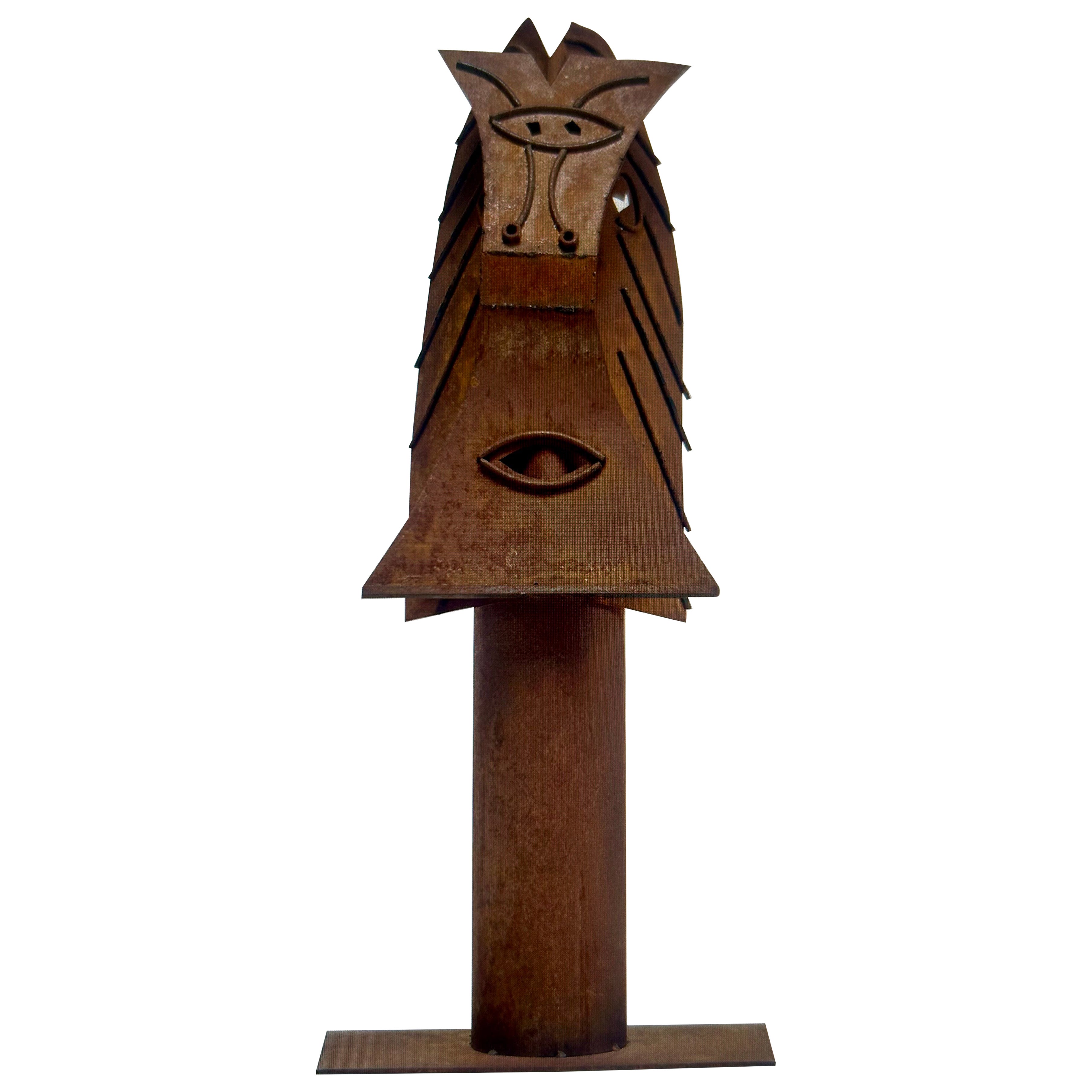
Original artwork.
Unique piece.
There is another example in the book "The Sculpture of Picasso" shown in the pics here and in his studio with the famous maquette done for Chicago.
P...
Category
Mid-20th Century French Mid-Century Modern Abstract Sculptures
Materials
Steel
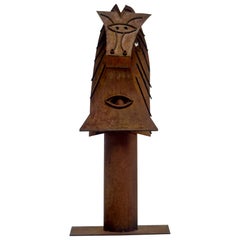
"Abstract head": Signed sculpture in bronze and patinated metal - 20th C.
Located in SAINT-OUEN-SUR-SEINE, FR
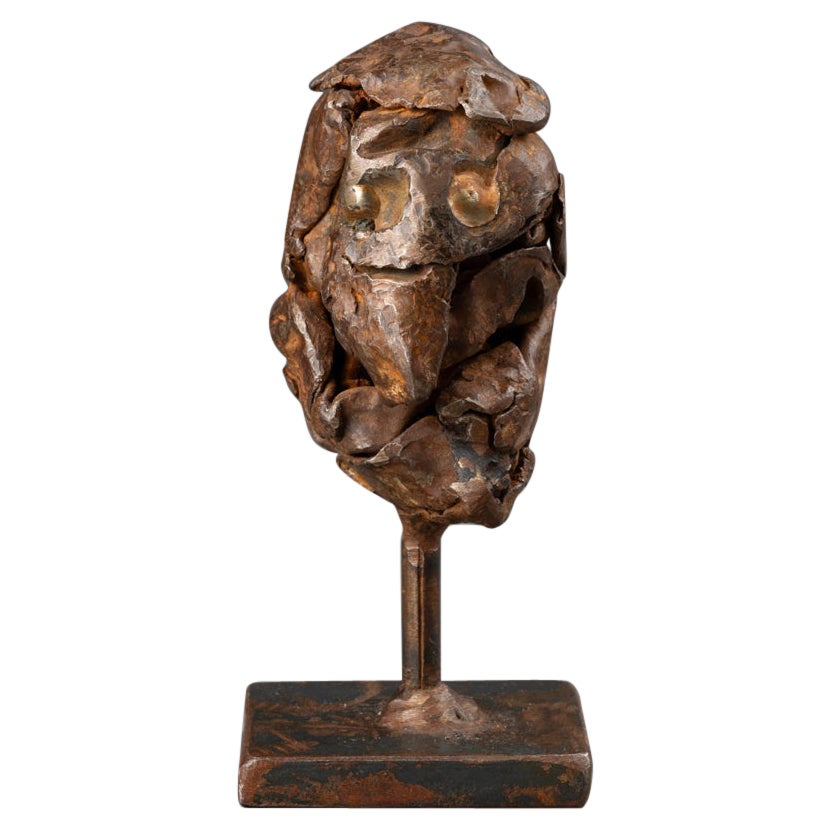
"Abstract Head": Bronze and patinated metal sculpture representing a head treated in an abstract style
Bearing a signature under the bronze base
Dimensions
Height = 12 cm
Widt...
Category
Vintage 1970s French Brutalist Abstract Sculptures
Materials
Brass, Bronze
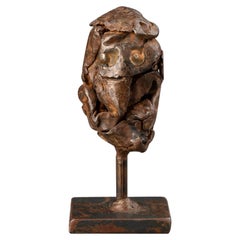
Emerson Woelffer Bonze Sculpture, Abstract Face, Signed, Dated, Numbered
By Emerson Woelffer
Located in Los Angeles, CA
Nice modern abstract Face, by the well known artist, Emerson Woelffer. Signed, numbered 1/4 and dated 1947.
Category
Vintage 1940s American Modern Abstract Sculptures
Materials
Bronze
Jean Mahie Bronze Cubist Head Sculpture Titled Veneration
By Jean Mahie
Located in St. Louis, MO
Artist and jewelry designer Jean Mahie signed and numbered bronze head titled" Veneration", circa 1987 from her collection I series of sculptures. Signed and numbered 3/8. An example...
Category
Vintage 1980s French Abstract Sculptures
Materials
Bronze
Abstract Head Sculpture by Pietro Cenedella, Italy, 1960s
Located in Brescia, Brescia
An extraordinary marble sculpture by Italian artist Pietro Cenedella, an abstract head-like form balancing between figuration and pure gesture. The piece is entirely carved from Carr...
Category
Vintage 1970s Italian Mid-Century Modern Abstract Sculptures
Materials
Marble, Carrara Marble