Items Similar to Mexican Art Abstract Brutalist Gilt Steel Geometric Sculpture Mathias Goeritz
Want more images or videos?
Request additional images or videos from the seller
1 of 15
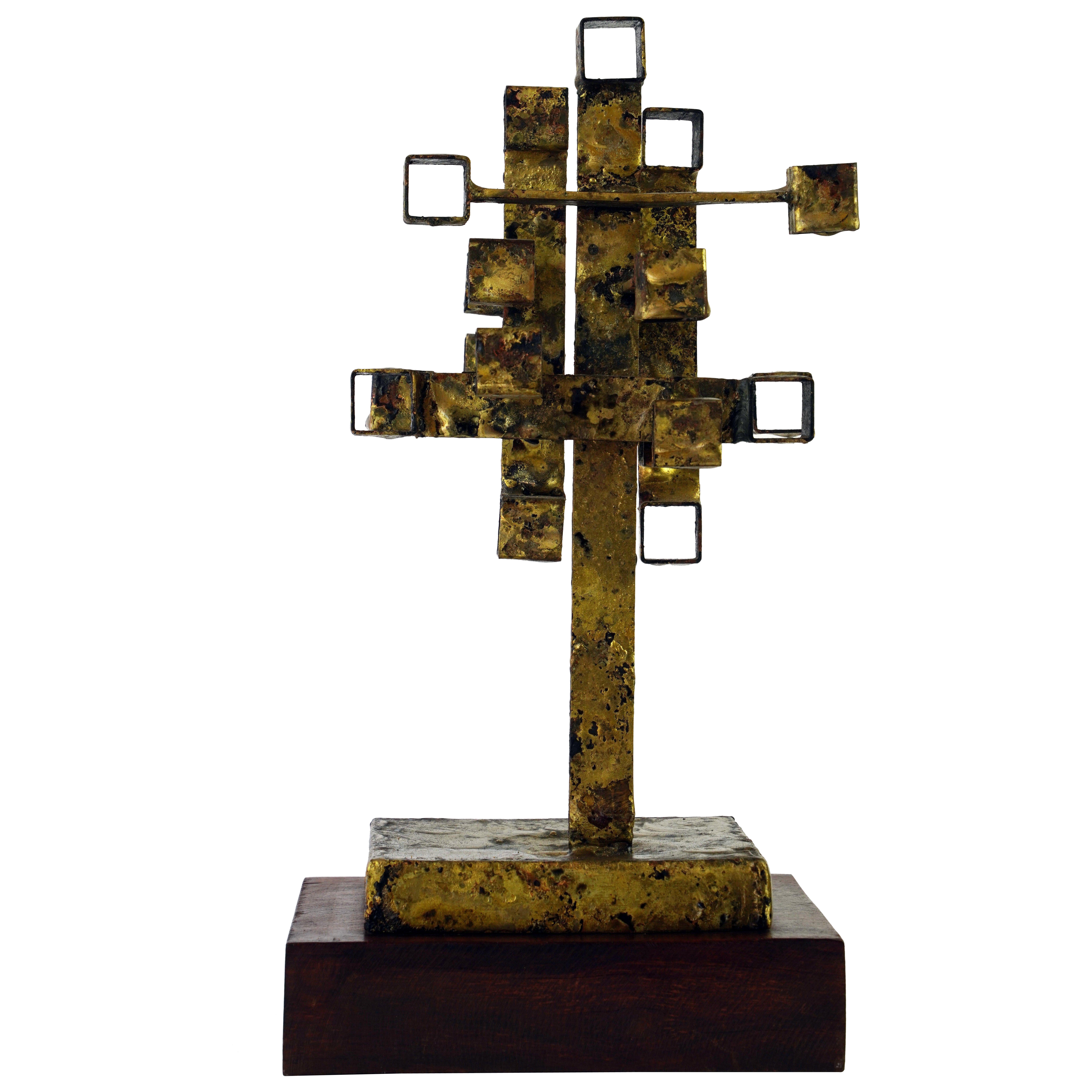
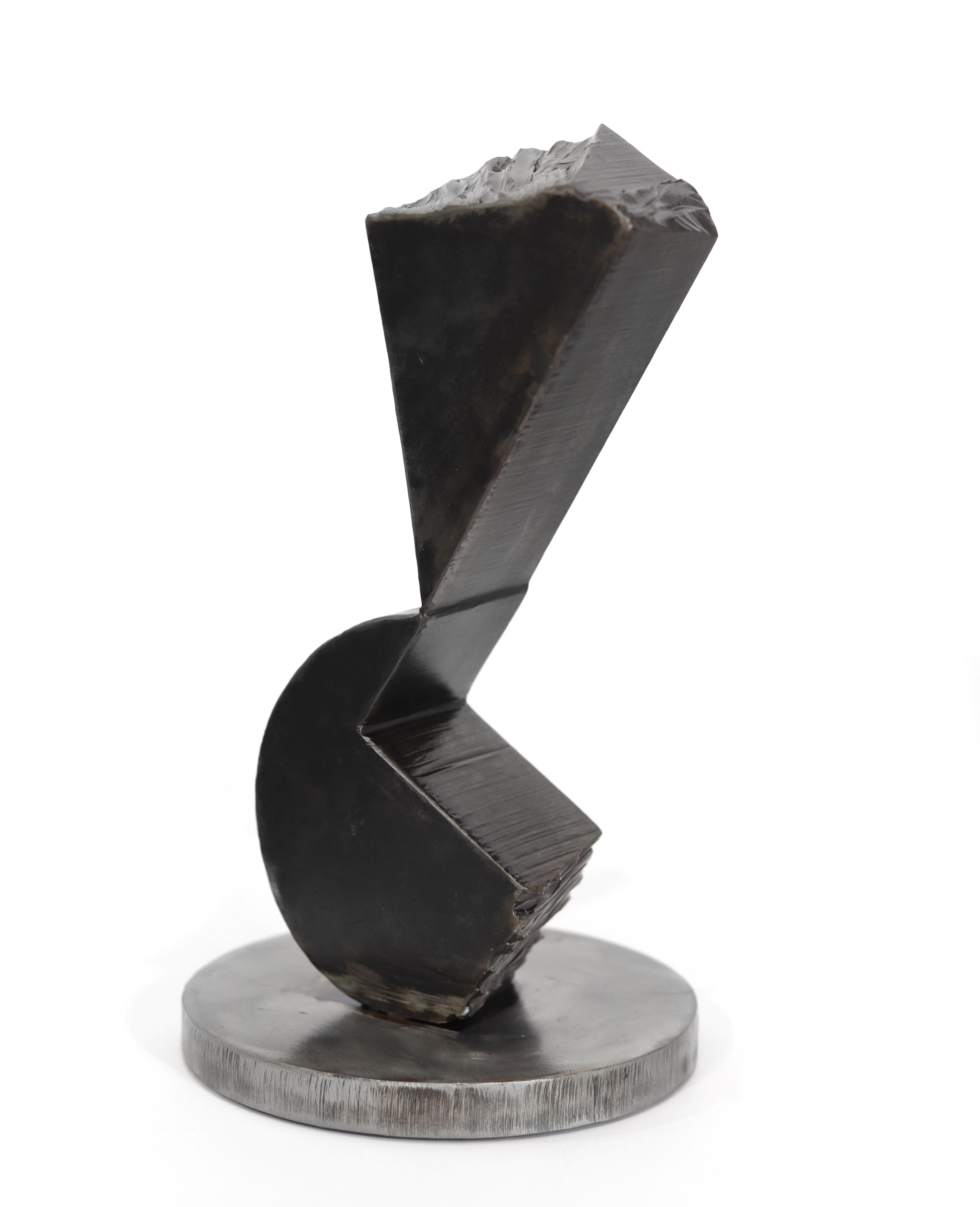
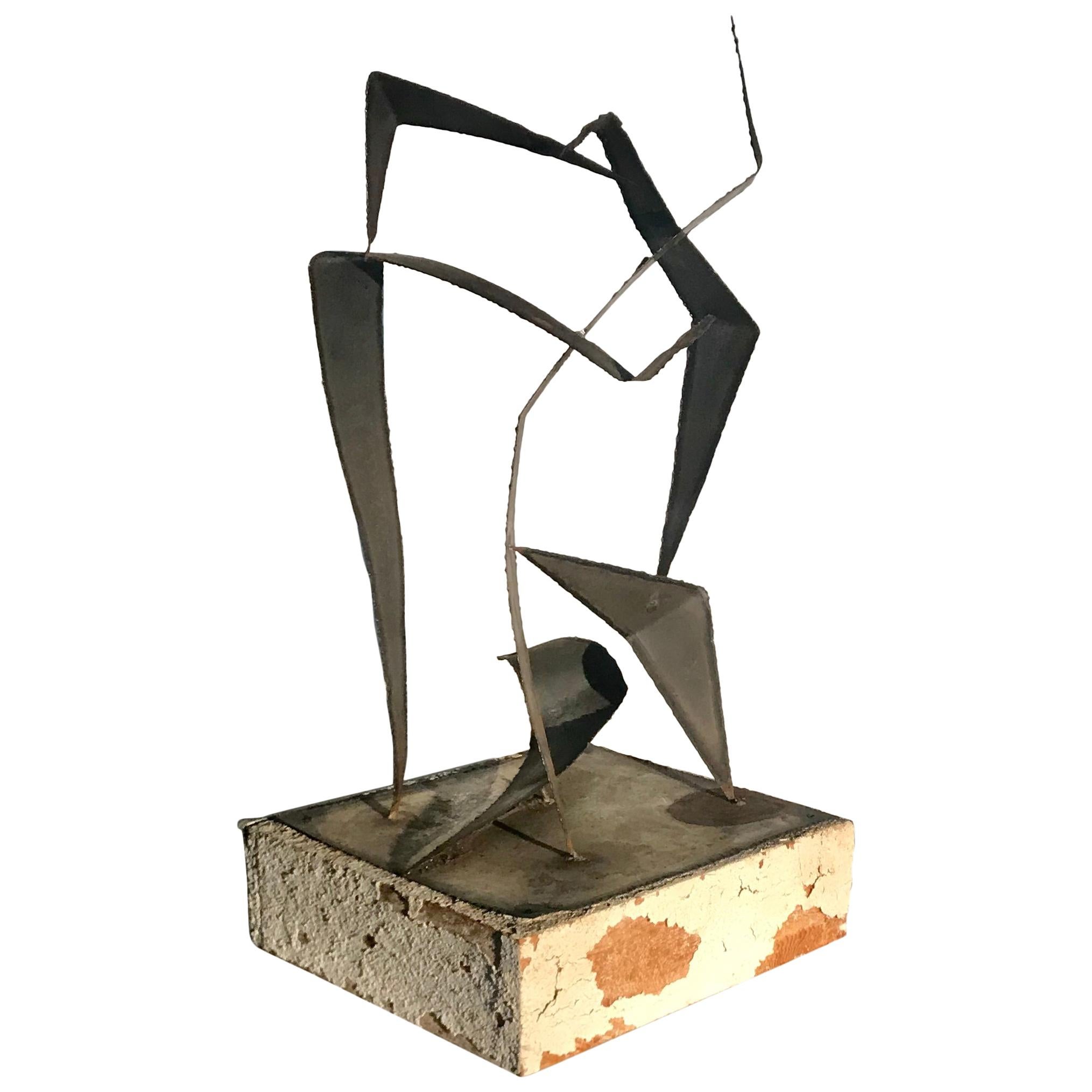
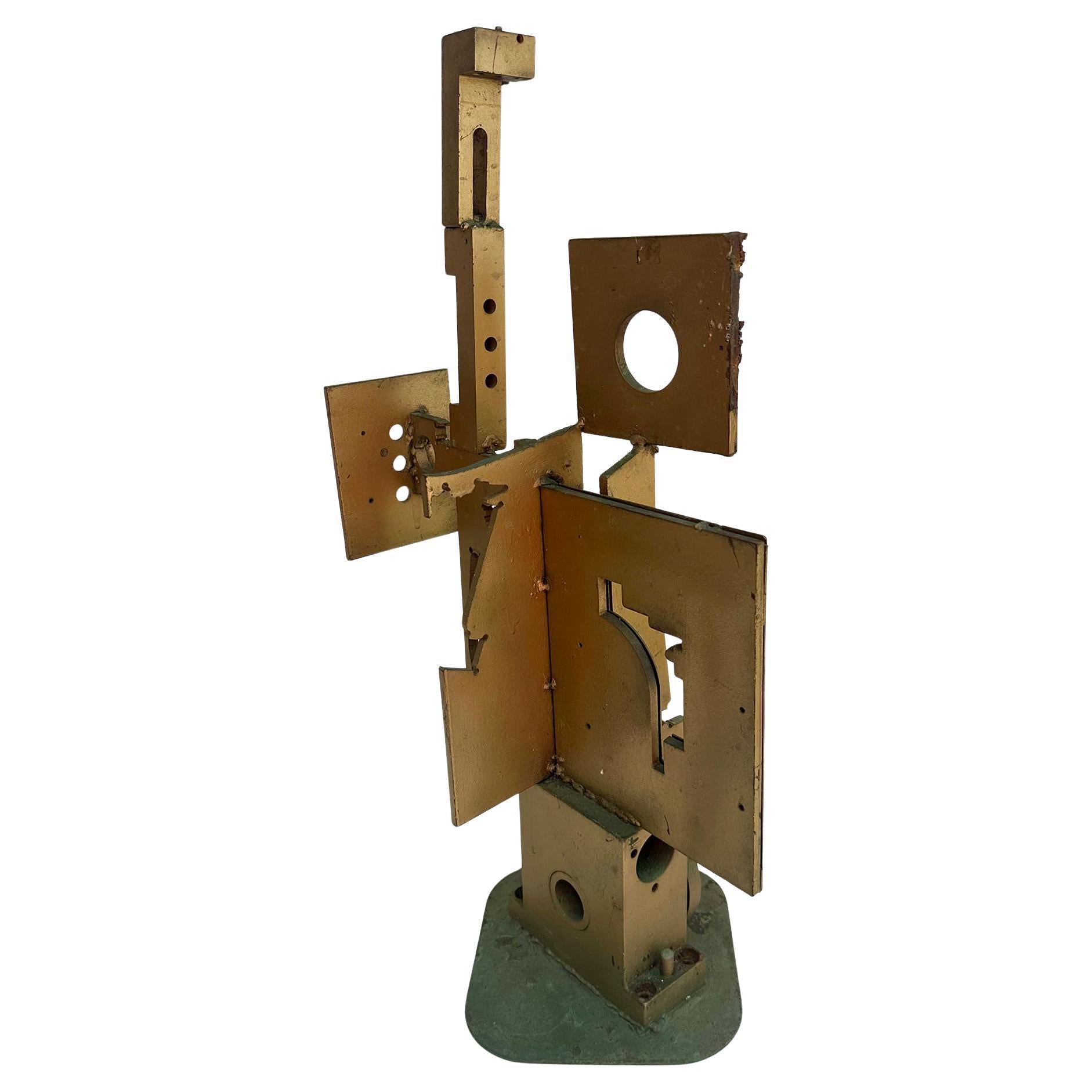
Mexican Art Abstract Brutalist Gilt Steel Geometric Sculpture Mathias Goeritz
$6,200
£4,730.77
€5,381.60
CA$8,706.81
A$9,528.55
CHF 5,035
MX$113,729.60
NOK 64,252.93
SEK 58,764.54
DKK 40,197.79
About the Item
Mathias Goeritz (German Mexican, 1915-1990)
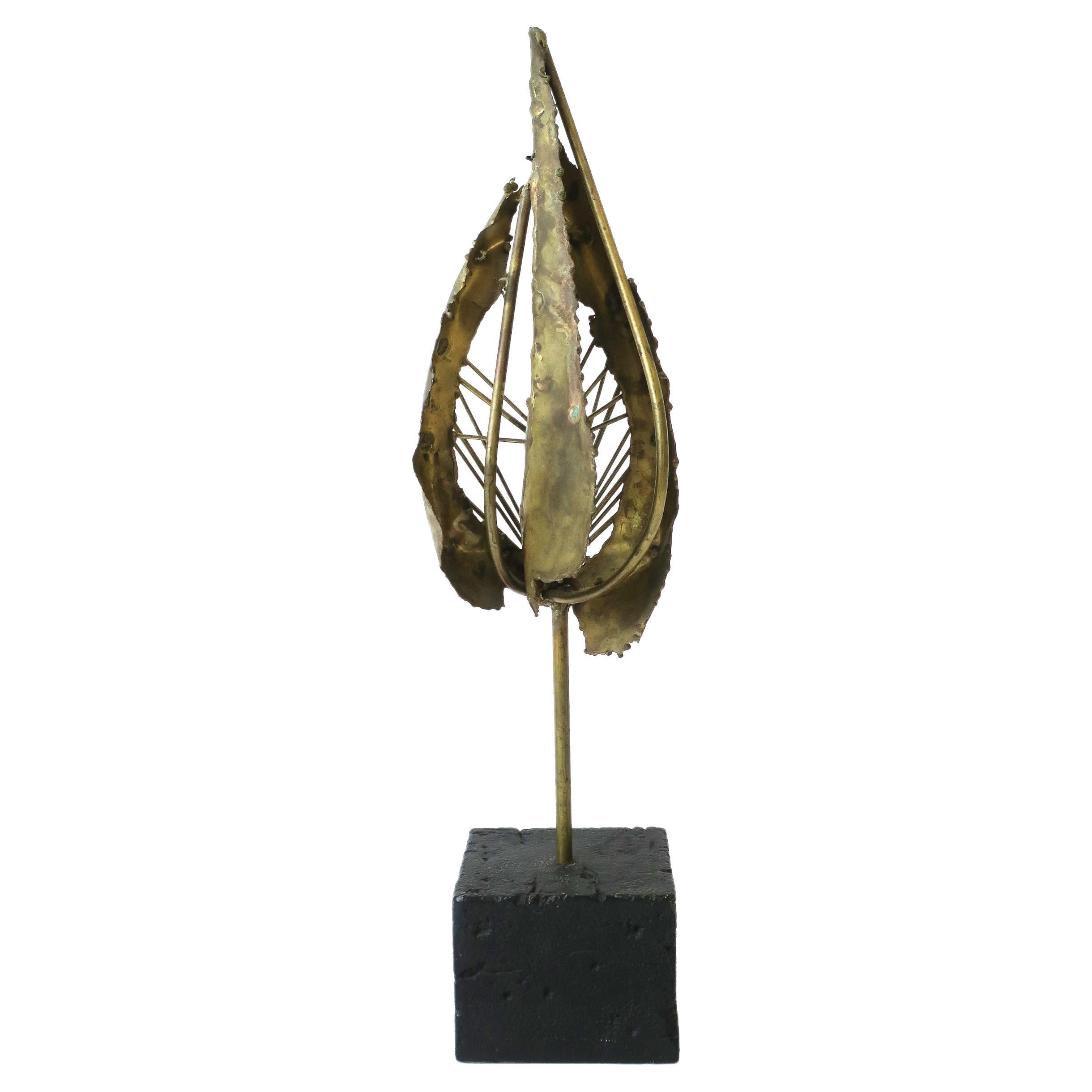
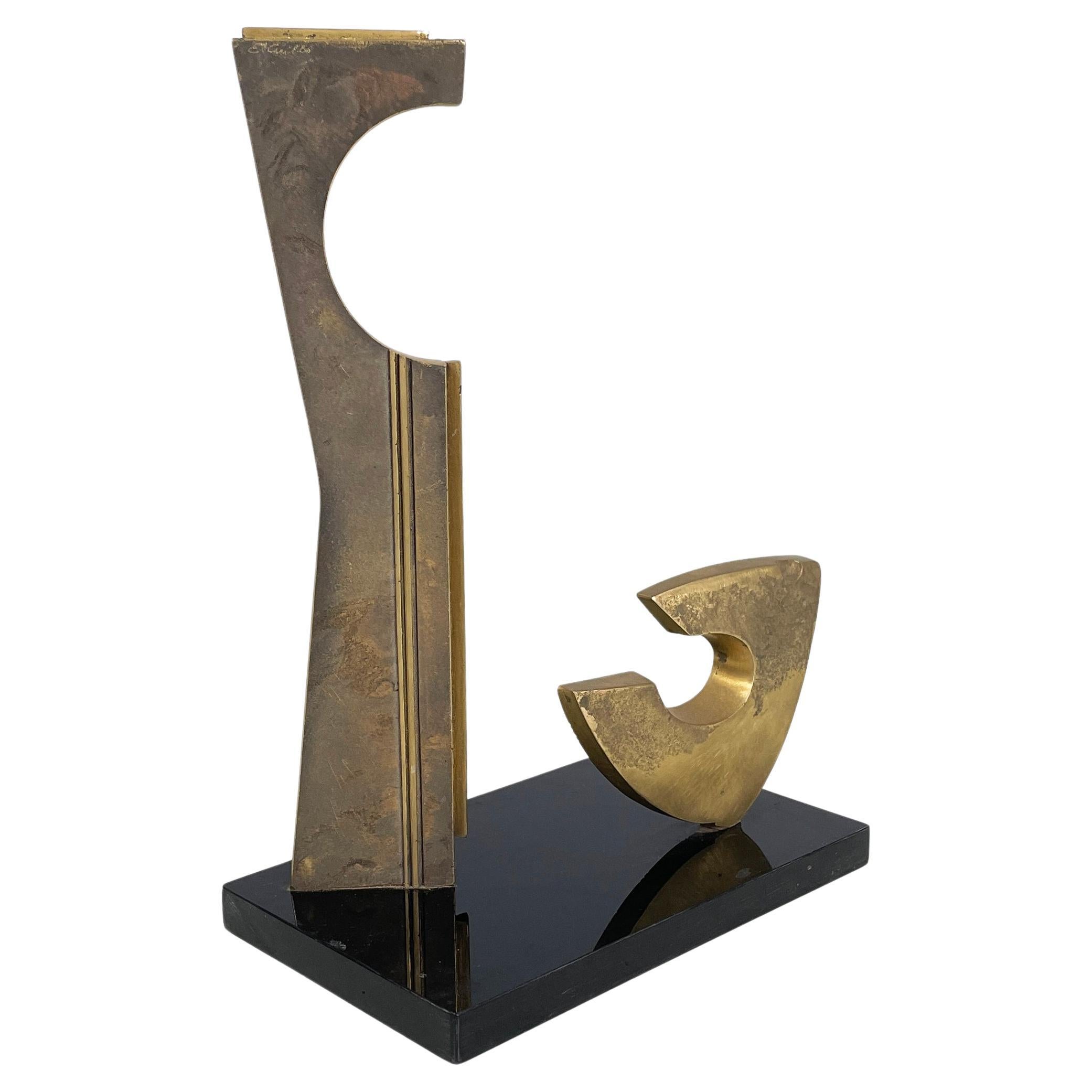
Geometric Torch-cut Steel or Iron Sculpture with gold leaf gilding. Welded signature, MG. This came from an estate and is signed with his initials. It is not dated.
Werner Mathias Goeritz Brunner (Danzig, Germany, April 4th, 1915/ now Gdansk, Poland – Mexico City, Mexico; August 4th, 1990).
Mathias Goeritz has had several gallery and museum exhibitions, including at the Museo Nacional Centro de Arte Reina Sofía and at the Museo Experimental El Eco. Numerous works by the artist have been sold at auction, including 'MENSAJE' sold at Sotheby's New York 'Latin American Modern Art' in 2015 for $466,000. There have been Several articles about Mathias Goeritz, including 'LACMA remaps Latin America' written by Suzanne Muchnic for the Los Angeles Times.
Painter, sculptor and Mexican architect associated with the trend of constructive abstraction. He studied medicine at the University of Berlin, but this only lasted a year. The concerns of the young student were aesthetic in nature so he he studied figurative drawing at the Berlin Charlottenburg School of Art. Some of his friends and colleagues were the sculptor Ernst Barlach, painter George Grosz and draughtsman Kaethe Kollwitz. Goeritz studied philosophy and history of art, discipline in which earned a doctorate. He travelled in France, Switzerland, Czechoslovakia, Poland, Austria and Italy, among other countries.
It is known that he left Germany to live in Tetuan, Morocco in 1941 and then Granada, Spain in 1945. In 1946 he had a large exhibition in the Sala Clan in Madrid under the pseudonym "Mago". Two years later, living in Santillana del Mar, Spain he was a founder of the Escuela de Altamira. The following year he married Marianne Gast, writer and his companion for more than fifteen years. In Spain followed his artistic work by important artists of the avant-garde such as Hans Jean Arp. Of Jewish descent, he found refuge from the Second World War in Mexico where in 1949 he was invited by Ignacio Diaz Morales to be a part of the faculty of the School of Architecture at the Universidad de Jalisco. In 1953 he wrote the "Manifiesto de la Arquitectura Emocional" (The Emotional Architecture Manifesto), where he points out that only achieving true emotions from architecture can it then be considered an art form. In Mexico he entered controversy with the artistic establishment of that country; in an open letter, Diego Rivera and David Alfaro Siqueiros described him as "an impostor without the most insignificant talent and preparation" to be an artist. Despite this, in 1957 he was elected director of visual design of the National School of architecture This same year he founded the Museo del Eco in Mexico City. In 1961 Goeritz participated at the Galería Antonio Souza in a group exhibition, Los hartos, for which he published another manifesto. Other participants included Jose Luis Cuevas and Pedro Friedeberg, with whom he was instrumental in establishing abstraction and other modern trends in Mexico.His work is included in the Gelman Collection of modern and contemporary Mexican art based in Cuernavaca, Mexico. Established by Jacques and Natasha Gelman in 1943 as a private collection. it includes many iconic works by major Mexican Modernists including Frida Kahlo, Diego Rivera, David Alfaro Siqueiros, Leonora Carrington, Rufino Tamayo and Francisco Toledo, Lola Alvarez Bravo, Manuel Alvarez Bravo, Leonora Carrington, Miguel Covarrubias, Hector Garcia, Gunther Gerzso, Mathias Goeritz, Maria Izquierdo, Carlos Merida, Tina Modotti. He was one of the artists who brought with him new vanguard ideas from Europe during the 50's. A Dadaist, constructivist and expressionist, Goeritz collaborated with Luis Barragan to make El Animal and the famous Torres de Satelite, also with the help of Chucho Reyes, in Mexico City. In 1968, Mathias Goeritz organized the Ruta de la Amistad for the Mexican Olympic Games held that year. His monuments and murals can be seen in numerous places in Mexico and the United States, and his work has been exhibited in countless cities around the world. he anticipated some of the ideas that, in the 1960s, the American minimalists would develop. His outstanding sculptures of this period include the Mixcoac Pyramid (1969) at the Unidad Habitacional Lomas de Plateros in Mexico City and his collaboration with Helen Escobedo, Manuel Felguérez, Hersúa, Sebastián and Federico Silva on the Espacio Escultórico (1979; Mexico City, U. N. Autónoma), a large outdoor sculptural complex at the Ciudad Universitaria on the outskirts of Mexico City.
- Attributed to:Mathias Goeritz (1915 - 1990, German)
- Dimensions:Height: 21.5 in (54.61 cm)Width: 12 in (30.48 cm)Depth: 6.5 in (16.51 cm)
- Medium:
- Movement Style:
- Period:
- Condition:6minor wear. please see photos.
- Gallery Location:Surfside, FL
- Reference Number:1stDibs: LU38216854552
About the Seller
4.9
Platinum Seller
Premium sellers with a 4.7+ rating and 24-hour response times
Established in 1995
1stDibs seller since 2014
1,846 sales on 1stDibs
Typical response time: 1 hour
- ShippingRetrieving quote...Shipping from: Surfside, FL
- Return Policy
More From This Seller
View All1965 Canadian Israeli Art Brutalist Abstract Welded Steel Sculpture Eli Ilan
Located in Surfside, FL
Eli Ilan (אלי אילן), 1928-1982 was an Israeli sculptor.
Abstract organic pod shape. in either steel or iron mounted on a wooden plinth.
Ilan was born in Winnipeg, Manitoba. He enrolled in a premedical curriculum at the University of British Columbia in Vancouver and emigrated to Israel in 1948. He then studied prehistoric archaeology and physical anthropology at the Hebrew University of Jerusalem. In 1956, he returned to Canada to study sculpture at the Ontario College of Art & Design. He lived in Kibbutz Sasa from 1959 to 1963. He died in 1982 in Caesarea, Israel.
Education
1955 Hebrew University, Jerusalem, pre-historic archaeology and physical anthropology
1956 Ontario College of Art, Toronto, Canada, sculpture under Thomas Bowie
1959 Training College, Ottawa, criminal identification techniques
1969 Art Festival, Painting & Sculpture in Israel. Ganei Hataarucha, Tel Aviv
Artists: Chana Orloff, Eli Ilan, Zvi Aldouby, Jacob El Hanani, Ludwig Blum, Aharon Bezalel, Koki Doktori, Israel Hadany, Marcel Janco, Dov Feigin, Abel Pann, Esther Peretz Arad, Reuven Rubin, Ivan Schwebel, Jakob Steinhardt, Boris Schatz, Bezalel (Lilik) Schatz, Louise Schatz...
Category
1960s Abstract Abstract Sculptures
Materials
Stainless Steel
Spanish Catalan Xavier Corbero Bronze Steel Architectural Abstract Sculpture
By Xavier Corberó i Olivella
Located in Surfside, FL
Xavier Corberó Olivella (1935 – 2017)
Estructuras Continual
Bronze sculpture. Comprised of four elements, independant, 1 spheric.
5 X 8 X 7 inches approximately. The pieces are kinetic and moveable so dimensions are a bit variable.
This is accompanied by a hand signed and dated photo certificate of the piece. A silver gelatin photograph. The photo is badly torn.
Xavier Corberó i Olivella (1935 – 2017) was a prominent Catalan artist, best known for monumental public sculpture and his palatial house complex in Esplugues de Llobregat near Barcelona. He has been described as "widely considered the most important Catalan artist since Antonio Gaudí," as "one of Spain’s most celebrated sculptors" and as having "perhaps influenced Barcelona more than any artist since Gaudí." Corberó's grandfather Pere Corberó i Casals (1875-1959) was an entrepreneur and artist whose works included the bronze memorial on the birthplace of Enrique Granados, also in Lleida. He was a cofounder of Barcelona's association for the promotion of decorative arts, a precursor to the Design Museum, now known as the Foment de les Arts i el Disseny. The Corberó foundry produced sculptures by prominent Catalan sculptors of the time such as Pablo Gargallo, Josep Viladomat and Frederic Marès. It was also an industrial and commercial business that sold bronze doors, chandeliers, fountains, and other decorative items, with a showroom in downtown Barcelona at Rambla de Catalunya 105, in a building designed by Arnau Calvet i Peyronill, and a workshop nearby at Carrer Aribau 103.
Pere's son and Corberó's father, Xavier Corberó i Trepat (1901-1981), also worked in the family bronze...
Category
1960s Post-Modern Abstract Sculptures
Materials
Bronze, Steel
Latin American Abstract Geometric Chrome Bronze Architectural Sculpture E. Tafur
Located in Surfside, FL
Edgar Tafur (Colombian, 1929 - 2007)
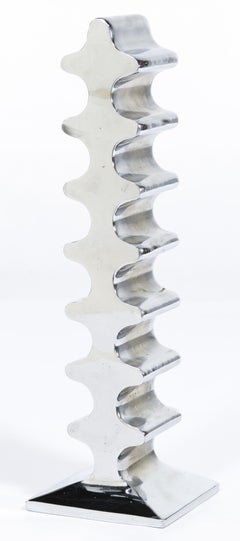
Chrome Over Bronze Sculpture
Undated, signed on side near bottom, abstract sculpture
Dimensions: Height: 12 3/4 inches, Width: 4 inches, Depth: 3 3/4 inches
Mod Space Age Chrome over Bronze Abstract Architectural Totem Cast Sculpture
Edgar Alonso Tafur, Latin American artist born and raised in Cali. Colombia, was first trained as an architect at the University of the Andes, but shortly thereafter switched his focus to sculpture. It is this work which brought Tafur to the United States, first to study at the University of Florida and then to Oklahoma where he was featured in a solo exhibition at the Oklahoma Art Center in 1966. Alluding his architectural roots, Tafurs sculptures possess a marked structural form, drawing on themes of positive and negative space. In addition to his work as a sculptor, Tafur was well known for his modernist concept designs, consisting of fountains and architectural murals commissioned by fellow architects. “Each of his works is an understatement of the principles of architecture, which is itself sculptural. Tafur’s sensitivity towards the play of light and shadow on the surfaces, his relationship of positive and negative spaces, and his fluid play of rhythms all lend themselves dramatically to an exciting visual statement. His simplicity and modernism evokes the opinion of the renowned architect, Mies Van der Rohe: ‘less is more.'” Patric Shannon, Director, Oklahoma Art Center
While some of his work has a brutalist quality to it it is generally more abstract geometric, masculine with polished chrome surfaces, enamel and some with great, strong colors. This has an abstract flora, cactus like shape to it. He is from the generation of Colombian artists who rose to prominence in the mid 20th century which included Fernando Botero, Doris Salcedo, Oscar Murillo, Antonio Caro...
Category
20th Century Post-Modern Abstract Sculptures
Materials
Metal
Italian Mid Century Mod Large Brutalist Welded Copper Enamel Sculpture Wood Base
Located in Surfside, FL
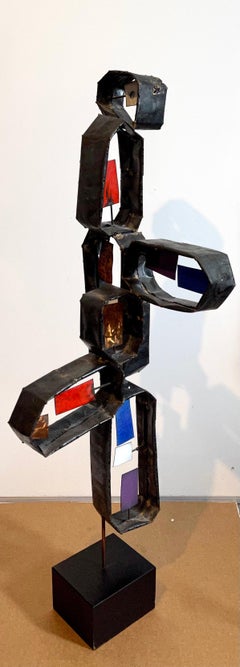
Welded, brazed, copper (based on the weight, this might be iron or bronze) with colorful inset enamel plaques on a painted wood base. A studio handmade Brutalist sculpture in a mann...
Category
Mid-20th Century Abstract Abstract Sculptures
Materials
Metal, Copper, Enamel
Argentine Modernist Brutalist Abstract Bronze Sculpture Jewish Latin American
By Naum Knop
Located in Surfside, FL
Naum Knop (Ukrainian-Argentinean, 1917-1993) Modernist Brutalist bronze figural sculpture with heavy verdigris green finish. Melted forms in the shape of an abstract pretzel like twist. Affixed to white stone plinth. Artist signature, "NK" side of base. Good condition, shows rich green patina and aged oxidation. Measures approximately 17.5 in. x 19.5 in. x 6.5 in.
Naum Knop, Argentine sculptor, was born in 1917 in Buenos Aires, into a Jewish family of Russian origin from Ukraine. His childhood was spent in the neighborhood of La Paternal where his father had a carpentry workshop, a space in which he made contact for the first time with the technique of wood carving. After finishing elementary school, he worked with the teacher Luis Fernández and soon after he dedicated himself to furniture design. Around 1935, he entered the Manuel Belgrano School of Fine Arts . Between 1941 and 1942 he attended the course for graduates taught by Alberto Lagos and Alfredo Bigatti at the National School of Fine Arts and continued his training between 1942-1945 at the Ernesto de la Cárcova High School with Soto Avedaño, Carlos de la Cárcova and José Fioravanti. At this time he put his works in dialogue with other young artists such as Libero Badii and Aurelio Macchi .
Around 1947 he made his study trip abroad. He goes to California, United States, where he enters the Art Institute of Los Angeles. At the same time visit museums and galleries. In January 1948 he organized his first exhibition abroad, held at the Hall of Arts in Beverly Hills in Los Angeles. During this period he toured Chicago and then New York. That year he traveled to Europe; his itinerary includes France, Italy, Switzerland and England. As a result, he came into contact with the work of Henry Moore, Hans Jean Arp, Jacques Lipchitz, Constantin Brancusi, Umberto Boccioni, Henry Laurens, Ossip Zadkine. Artists who have an impact on the young Knop and whom he honors in his subsequent production. He returned to Argentina in 1949 and installed his workshop where he worked on ornamental carving and on pieces in which he oscillated between a synthetic figuration and abstraction.
In 1956 he began his successful participation in salons , obtaining numerous awards at the national and municipal level. In 1959 he participated in the shipment to the 5th São Paulo Biennial and since then, to the success achieved at the local level, the multiple exhibitions carried out in the international field have been added. The exhibitions in Tel Aviv , Jerusalem and Rome (1966) stand out; Dusseldorf (1977); Los Angeles and Palm Spring (1981); New York (1986), San Pablo and Los Angeles(1989). During this period, his work matured, while he began to experiment with the direct wax technique, obtaining textured surfaces similar to welds that gave it a strong abstract expressionist feature. In parallel to his personal production and to the small models, the artist receives private and public commissions for which he works on large-scale sculptures and murals. Around 1967, the architect Mario R. Álvarez summons him to participate in a closed competition for the creation of a work to be located in the General San Martín Cultural Center . Libero Badii and Enio Iommi participate with the artist ; the bronze Reclining Figure Knop is chosen. Among the large-scale monuments it is worth remembering the piece Los tres soles temporarily located in Recoleta in 1984 and later installed in Maryland, United States; as well as Seated Figure (Reminiscence of Michelangelo) located in the shield of a private building in 1970. To these are added the numerous murals in which he experiments with various materials and techniques such as casting in bronze, openwork and reliefs in wood and work in cement.
He was included in the The 1962 International Prize for Sculpture the jury included Argan, Romero Brest and James Johnson Sweeney the former director of the Solomon R. Guggenheim Museum in New York. The participants included Louise Nevelson and John Chamberlain for the United States; Lygia Clark for Brazil; Pietro Consagra, Lucio Fontana, Nino Franchina, and Gió Pomodoro for Italy; Pablo Serrano for Spain; and Eduardo Paolozzi, William Turnbull, and Kenneth Armitage for England. Gyula Kosice, Noemí Gerstein, Julio Gero, Naum Knop, Aldo Paparella, Enrique Romano, Eduardo Sabelli, and Luis Alberto...
Category
Mid-20th Century Abstract Abstract Sculptures
Materials
Stone, Bronze

Mid Century Modern Brutalist Welded Expressionist Sculpture After Paul Evans
Located in Surfside, FL
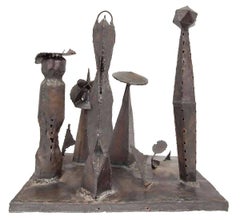
In this bronze sculpture the artist (unknown) has welded together a group of totems or monuments into a unified piece. T
Neo-Dada Abstract Sculpture: Assemblages
In contrast, abstra...
Category
Mid-20th Century Abstract Expressionist Abstract Sculptures
Materials
Metal
You May Also Like
Joseph A Burlini Brass Abstract Sculpture, Dated 1967
By Joseph A. Burlini
Located in Oceanside, US
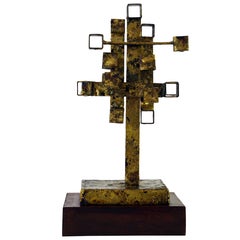
Joseph A. Burlini, born in 1937, is an American contemporary artist renowned for his large-scale sculptures. He graduated from the Art Institute of Chicago and has spent much of his ...
Category
Vintage 1960s American Industrial Abstract Sculptures
Materials
Brass
$1,040 Sale Price
20% Off
Noteworthy - Original Contemporary Expressive Geometric Abstract Metal Sculpture
By Granville Beals
Located in Los Angeles, CA
Inspired by dance and weightlessness, Granville Beals' industrial metal sculptures are primarily about relationships. Concerned with form and abstraction, he does not merely manipula...
Category
21st Century and Contemporary Abstract Abstract Sculptures
Materials
Metal, Steel
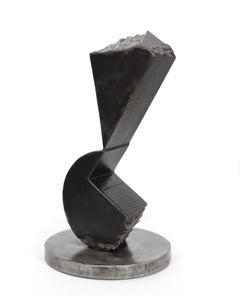
Signed Abstract Modernist Metal Sculpture Attributted to Early Curtis Jere
By Curtis Jeré
Located in Buffalo, NY
Signed abstract modernist metal sculpture. One off, original, stunning form, texture and design, apparently early work of Curtis Jere Company, long before they're sculptures and desi...
Category
Vintage 1950s American Mid-Century Modern Abstract Sculptures
Materials
Metal
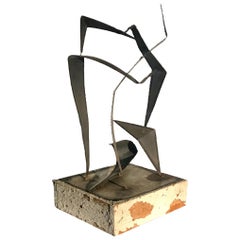
1960s Abstract Sculpture MCM Steel Brutalist Geometric Cubist Matthew Strumor
Located in Lake Worth, FL
1960s Abstract Sculpture believed to be by Matthew Strumor is a medium-sized metal artwork from the Post-War period. This handmade sculpture features a geometric cubist design in the...
Category
Mid-20th Century American Mid-Century Modern Sculptures and Carvings
Materials
Metal
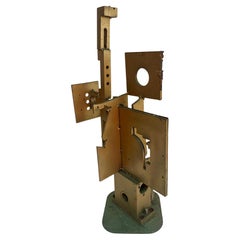
Midcentury Brutalist Brass Sculpture, circa 1960s
By Curtis Jeré, Paul Evans
Located in New York, NY
A beautiful hand-made brass sculpture, Midcentury Modern/Brutalist period, circa mid-20th century, 1960s. Piece is unsigned; In the style of designers Paul Evans, Curtis Jere. Piece is all brass with a square black composite base. Very good condition as shown in images. Dimensions: 22.75" Height.
Other items shown available separately, search 1stDibs ref. #:
Mackenzie-Childs vase, search ref. #: LU1314226933622 (SOLD.)
Agate dish...
Category
Mid-20th Century American Brutalist Abstract Sculptures
Materials
Composition, Brass
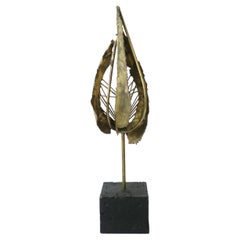
Italian modern Brutalist style Brass sculptures by Edmondo Cirillo, 1982
Located in MIlano, IT
Italian modern Brutalist style Brass sculptures by Edmondo Cirillo, 1982
Pair of sculptures with different dimensions in brass with reference to the brutalist style. The two artworks...
Category
Vintage 1980s Italian Modern Abstract Sculptures
Materials
Brass
