Items Similar to Large 1970
s Israeli Abstract Sculpture "Birth" Iron, Wood Menashe Kadishman
Want more images or videos?
Request additional images or videos from the seller
1 of 6
Menashe KadishmanLarge 1970
s Israeli Abstract Sculpture "Birth" Iron, Wood Menashe Kadishmanc.1990
s
c.1990 s
$12,500
£9,440.84
€10,905.64
CA$17,610.72
A$18,861.09
CHF 10,139.59
MX$229,078.93
NOK 128,118.67
SEK 117,302.17
DKK 81,485.03
About the Item
Menashe Kadishman (Israeli, 1932-2015)
Birth
Iron
17-1/2 inches (44.5 cm) high on a 6-1/4 inches (15.9 cm) high wood base
Hand signed and Inscribed on base
Sculpture with base measures 23.75 x 21.5 x 15 inches. Sculpture itself measures 17.5 x 14 x 15 inches.
"In the Birth Series, the winding line curves in and out, as if trying to express in iron the pangs of birth and the bursting forth of the new born into the world. The pain and anxiety of the mother inherent in the birth process, together with the life-force of the newborn infant, intertwine. Kadishman is perhaps the only artist to relate to the sentence "in sorrow shall you bear children",
-Mordechai Omer.
from Artnet (Hili Perlson): A strange custom has spread among the Orthodox Jewish community of Israel. Young women have been reportedly flocking to the Ramat-Gan National Park, in the suburb of Tel Aviv, where sculptures by Menashe Kadishman—one of Israel’s most notable artists, who passed away in May of last year—have been installed about two months ago.
One of the artworks in question is also titled Birth, and shows an abstract figure which appears to be pregnant. Another sculpture shows a round hollow in its center, where the womb would be. In recent weeks, visitors were stunned to see Orthodox women sitting on the sculptures or lying flat on their surfaces while citing psalms.
When questioned by passersby about their bizarre behavior, the religious women explained that the sculptures possess mystical qualities, and that women who come in contact with them will become more fertile and will be blessed with easy labor.
Such superstition is not uncommon within some Orthodox communities, but it is likely the first time that a contemporary art work has been declared a conduit of such qualities.
Menashe Kadishman was born in Tel-Aviv in 1932. He is a Graduate of St. Martin's School of Art, University of London. From 1947 to 1950, Kadishman studied with the Israeli sculptor Moshe Sternschuss at the Avni Institute of Art and Design in Tel Aviv, and in 1954 with the Israeli sculptor Rudi Lehmann in Jerusalem. In 1959, he moved to London, where he remained until 1972. He had his first one-man show there in 1965 at the Grosvenor Gallery. His sculptures of the 1960s were Minimalist in style and so designed as to appear to defy gravity. This was achieved either through careful balance and construction, as in Suspense (1966), or by using glass and metal so that the metal appeared unsupported, as in Segments (1968). In 1995, he began painting portraits of sheep. These instantly-recognizable sheep portraits soon became his artistic trademark. In 1990, Kadishman was awarded the Dizengoff Prize for Sculpture and in 1995 he was awarded the Israel Prize, for sculpture.Kadishman was an America-Israel Cultural Foundation scholarship recipient from 1960-1962.
Menashe Kadishman was born in Tel-Aviv in 1932. He is a Graduate of St. Martin's School of Art, University of London Studies with Anthony Caro, Reg Butler. From 1947 to 1950, Kadishman studied with the Israeli sculptor Moshe Sternschuss at the Avni Institute of Art and Design in Tel Aviv, and in 1954 with the Israeli sculptor Rudi Lehmann in Jerusalem. In 1959, he moved to London, where he remained until 1972. He had his first one-man show there in 1965 at the Grosvenor Gallery. His sculptures of the 1960s were Minimalist in style and so designed as to appear to defy gravity. This was achieved either through careful balance and construction, as in Suspense (1966), or by using glass and metal so that the metal appeared unsupported, as in Segments (1968). In 1995, he began painting portraits of sheep. These instantly-recognizable sheep portraits soon became his artistic trademark. Along with Reuven Rubin and Yaacov Agam he is one of Israel's most famous artists. In 1990, Kadishman was awarded the Dizengoff Prize for Sculpture and in 1995 he was awarded the Israel Prize, for sculpture. This was from a portfolio that included Ivan Schwebel, Michael Gross, Liliane Klapisch and Moshe Kupferman, five of Israel's leading contemporary artists who were each approached in May 1977 with a request to contribute a hand-printed screenprint for a portfolio to be titled "Jerusalem". The sole term of reference was the name "Jerusalem", with no qualifications at all. The five artists then spent time working completely independently and individually on the project at the Jerusalem Print Workshop. Each screenprint was hand-signed by their respective artist and numbered from the edition of 200, hand-printed on BFK Rives paper Published by Whartman and Sacks Art Publications
Kadishman was an America-Israel Cultural Foundation scholarship recipient from 1960-1962.
Selected one man exhibitions
1965 Kadishman, Sculptures - Grosvenor Gallery, London. Curator Charles Spencer
Harlow Arts Festival - Harlow, England
1967 Dunkelman Gallery, Toronto
1968 Edinburgh International Festival - Goldbergs
The Richard Demarco Gallery
1970 Menashe Kadishman / Yellow Forest - Jewish Museum, New York. Cur. Tejas Englesmith, asso. curator Edward Fry
1971 The J.L. Hudson Gallery, Detroit, Michigan
1972 Menashe Kadishman, Concepts and their realization - Mus. Haus Lange, Krefeld. Cur. Paul Wember
Yellow Square, Valley of the Cross, Jerusalem
1975 Canvas Forest/Laundry - Israel Museum, Jerusalem. Curator Yona Fisher
Menashe Kadishman : Glass - Julie M. Gallery, Tel Aviv
1976 M. Kadishman : Glass - Rina Gallery, New York
1977 Unicorn Gallery, Copenhagen
1978 The Venice Biennale, The Israeli Pavilion. Curator Amnon Barzel
Select Group Exhibitions
Genia Schreiber University Art Gallery, Tel Aviv
Abramson, Larry Avigdor Arikha, Dei Ben Shaul, David Michail Grobman, Michael Gross, Uri Lifschitz, Ofer Lellouche, Menashe Kadishman, Shaul Schatz and others.
Israel Pollak School of Art Kalisher Five, Art Sc, Tel Aviv
Abramson, Larry Menashe Kadishman, Pinchas Cohen Gan, David Reeb, Arnon Ben David, Moshe Gershuni and other.
Selected one man exhibitions
1965 Kadishman, Sculptures - Grosvenor Gallery, London. Curator Charles Spencer
Harlow Arts Festival - Harlow, England
1967 Dunkelman Gallery, Toronto
1968 Edinburgh International Festival - Goldbergs
The Richard Demarco Gallery
1970 Menashe Kadishman / Yellow Forest - Jewish Museum, New York. Cur. Tejas Englesmith, asso. curator Edward Fry
1971 The J.L. Hudson Gallery, Detroit, Michigan
1972 Menashe Kadishman, Concepts and their realization - Mus. Haus Lange, Krefeld. Cur. Paul Wember
Yellow Square, Valley of the Cross, Jerusalem
1975 Canvas Forest/Laundry - Israel Museum, Jerusalem. Curator Yona Fisher
Menashe Kadishman : Glass - Julie M. Gallery, Tel Aviv
1976 M. Kadishman : Glass - Rina Gallery, New York
1977 Unicorn Gallery, Copenhagen
1978 The Venice Biennale, The Israeli Pavilion. Curator Amnon Barzel
- Creator:Menashe Kadishman (1932, Israeli)
- Creation Year:c.1990 s
- Dimensions:Height: 23.75 in (60.33 cm)Width: 21.5 in (54.61 cm)Depth: 15 in (38.1 cm)
- Medium:
- Movement Style:
- Period:
- Condition:good, minor surface wear commensurate with its age and consistent with its estate condition.
- Gallery Location:Surfside, FL
- Reference Number:1stDibs: LU38214799662
Menashe Kadishman
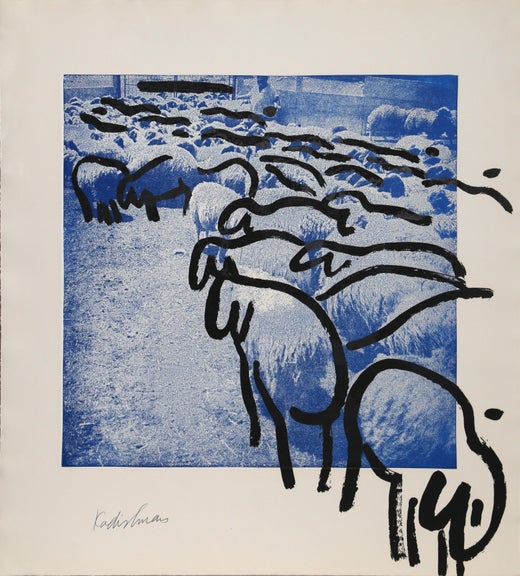
Menashe Kadishman was born in Mandate Palestine. His father died when he was 15 years old. He left school to help his mother and provide for the family.[1] From 1947 to 1950, Kadishman studied with the Israeli sculptor Moshe Sternschuss at the Avni Institute of Art and Design in Tel Aviv, and in 1954 with the Israeli sculptor Rudi Lehmann in Jerusalem. In 1950–1953, Kadishman worked as a shepherd on Kibbutz Ma'ayan Baruch. This experience with nature, sheep and shepherding had a significant impact on his later artistic work and career. In 1959, Kadishman moved to London to study at Saint Martin's School of Art and the Slade School of Art.[2] In 1959-1960 he also studied with Anthony Caro and Reg Butler.[2] He had his first one-man show there in 1965 at the Grosvenor Gallery. In 1972, he returned to Israel. In the 1960s, Kadishman's sculptures were Minimalist in style, and so designed as to appear to defy gravity. This was achieved either through careful balance and construction, as in Suspense (1966), or by using glass and metal so that the metal appeared unsupported, as in Segments (1968). The glass allowed the environment to be part of the work. The first major appearance of sheep in his work was at the 1978 Venice Biennale, where Kadishman presented a flock of colored live sheep as living art.[4] In 1995, he began painting portraits of sheep by the hundreds, and even thousands, each one different from the next. These instantly-recognizable sheep portraits soon became his artistic "trademark"
About the Seller
4.9
Platinum Seller
Premium sellers with a 4.7+ rating and 24-hour response times
Established in 1995
1stDibs seller since 2014
1,858 sales on 1stDibs
Typical response time: <1 hour
- ShippingRetrieving quote...Shipping from: Surfside, FL
- Return Policy
More From This Seller
View All1965 Canadian Israeli Art Brutalist Abstract Welded Steel Sculpture Eli Ilan
Located in Surfside, FL
Eli Ilan (אלי אילן), 1928-1982 was an Israeli sculptor.
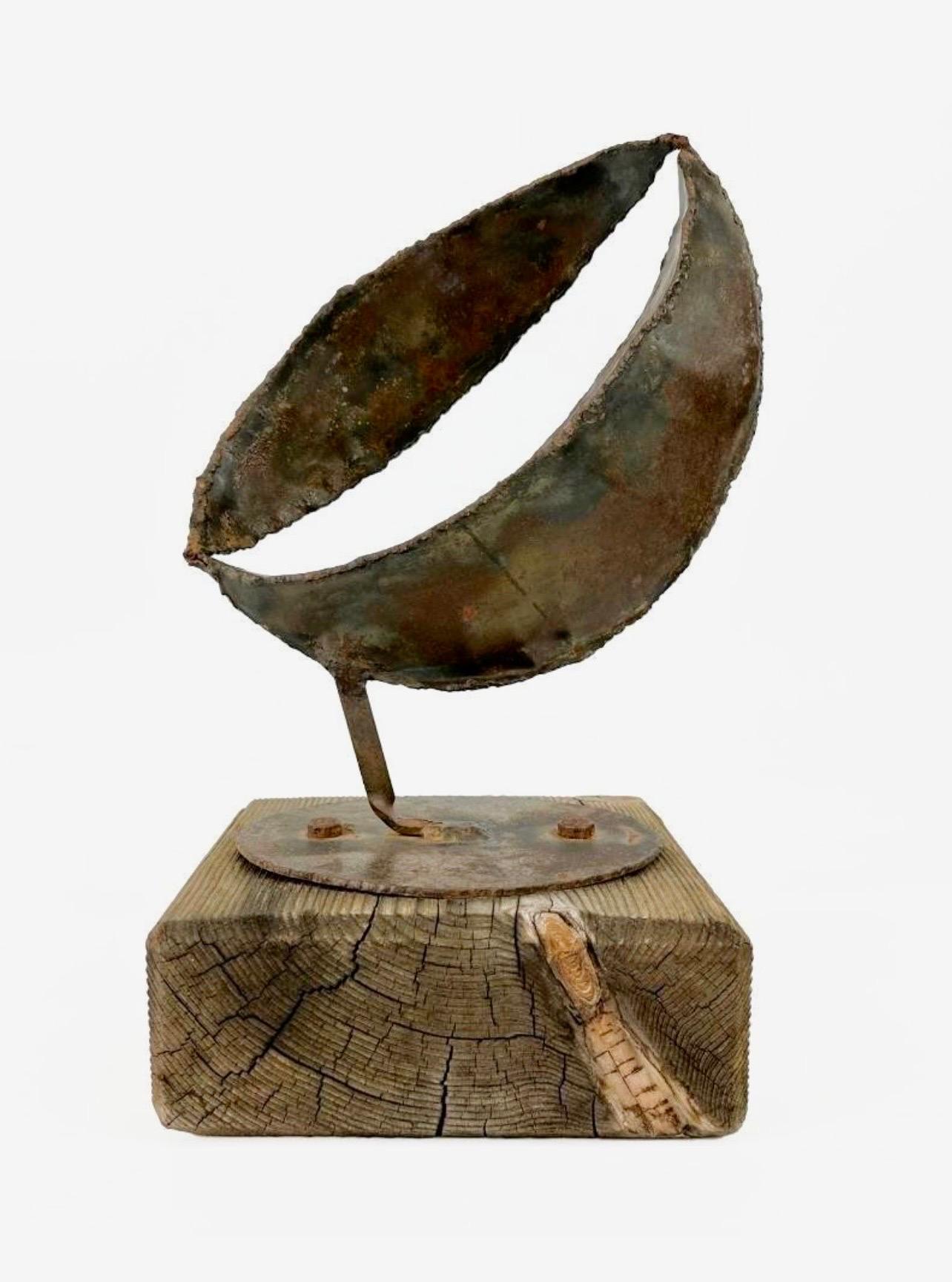
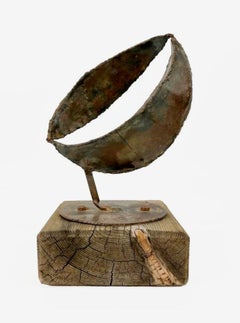
Abstract organic pod shape. in either steel or iron mounted on a wooden plinth.
Ilan was born in Winnipeg, Manitoba. He enrolled in a premedical curriculum at the University of British Columbia in Vancouver and emigrated to Israel in 1948. He then studied prehistoric archaeology and physical anthropology at the Hebrew University of Jerusalem. In 1956, he returned to Canada to study sculpture at the Ontario College of Art & Design. He lived in Kibbutz Sasa from 1959 to 1963. He died in 1982 in Caesarea, Israel.
Education
1955 Hebrew University, Jerusalem, pre-historic archaeology and physical anthropology
1956 Ontario College of Art, Toronto, Canada, sculpture under Thomas Bowie
1959 Training College, Ottawa, criminal identification techniques
1969 Art Festival, Painting & Sculpture in Israel. Ganei Hataarucha, Tel Aviv
Artists: Chana Orloff, Eli Ilan, Zvi Aldouby, Jacob El Hanani, Ludwig Blum, Aharon Bezalel, Koki Doktori, Israel Hadany, Marcel Janco, Dov Feigin, Abel Pann, Esther Peretz Arad, Reuven Rubin, Ivan Schwebel, Jakob Steinhardt, Boris Schatz, Bezalel (Lilik) Schatz, Louise Schatz...
Category
1960s Abstract Abstract Sculptures
Materials
Stainless Steel
Israeli Bronze Modernist Sculpture Pregnant Woman Abstract Figure Safed, Ein-Hod
By Victor Halvani
Located in Surfside, FL
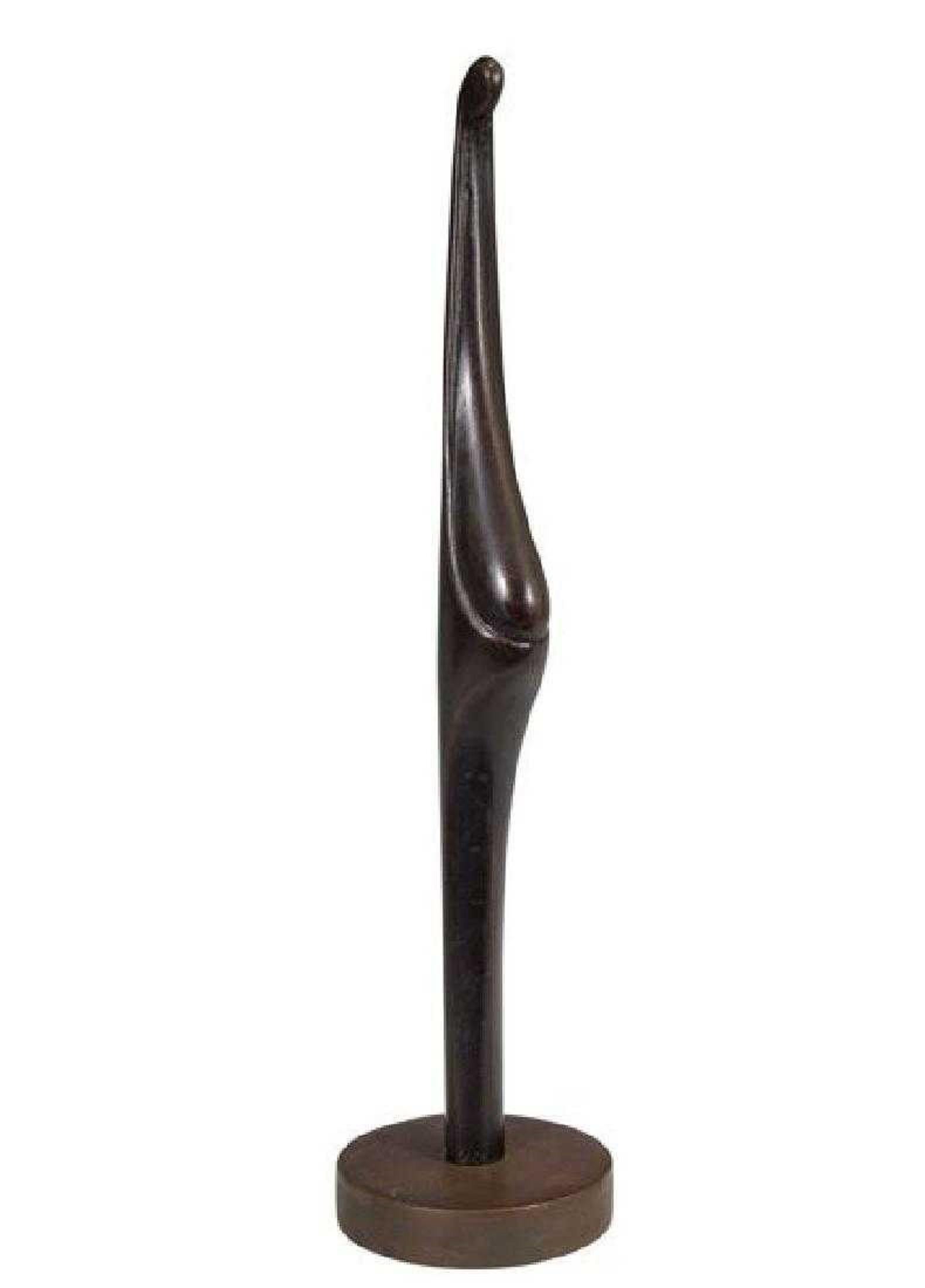
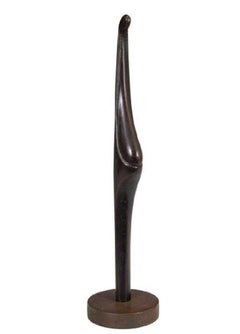
From a limited edition. an abstract elongated art deco form of a mother with child.
signed on bottom of wooden base and etched into bronze.
Victor Halvani no doubt had an enchanted childhood. A warm loving Jewish family. His father a judge, his mother, descendent from a rabbinic family, was a great storyteller who transformed the heroes of the Bible into her child’s best friends. A small village at the base of the pyramids of Giza, school trips to the Valley of the Kings in Aswan. Ancient Egyptian art looking at the dreamy child from every corner. Given the chance to look back, it becomes clear that Victor’s lifelong dream – to become an artist, had it’s beginnings right there – in the child dreaming at the Nile.
Victor Halvany was born in 1930 to Bella and Yitzchak (OBM). Soaked in that enchanted childhood atmosphere, Victor found himself spending hours and days in the Cairo museum of art, looking at the exhibits and drawing them with intensity and enthusiasm. His inspiration filled drawings caught the eye of his teachers and with there encouragement he entered a national competition in which he won first place. This lead to him winning a full scholarship at the art faculty in Zamalek and at the Cairo University. Full of hopes and dreams he began his studies, only to be interrupted after one year. The Israeli war of independence began and subsequently the pogroms, and the urgent need of Egyptian Jews to emigrate, going first to France and than to Israel. Victor’s first years in Israel were years of struggle for survival, but simultaneously years of activity and progress. In 1950, while serving in the army, Victor met Margalit, the women at his side, mother of his children and the most present character in his career of activity and art. With Margalit’s encouragement and support he not only raised a family, fathering two boys and a girl, but also fulfilled his dream and was fortunate to have a full and inspiring career- as a person, artist, and teacher. Today, in his advanced age, Victor continues his daily activities: creates, plans, exhibits, and as always – open-minded, curious, learning, getting updated.
1953 – Received scholarship and year of study at Bezalel School of art and design in Jerusalem.
1956 – Finished education studies and received BA in education. Tel Aviv art teachers college.
1969 – Scholarship to study abroad for a year at Hammersmith College of art & building in London, graduating cum laude.
1970 – Received MA in art education and sculpture.
2015 – Participation in the sculpture exhibit at the Mamilla mall promenade in Jerusalem. Sculptures exhibited:
“David with harp”, “Mother playing with child”, “Yuval father of harp players”
2014 – Participation in sculpture exhibit at the Mamilla Mall Promenade in Jerusalem, sculptures exhibited:
“Ruth and Naomi” “David playing harp”, “Girl with gazelle”
2013 – Ein Hod, Yemini sculpture garden, at main entrance to artist’s colony, sculpture exhibited “David playing the harp”.
2012 – Opening of “Art exhibit- Victor Halvani”. At the Halvani residence in Ein Hod, exhibits large collection of sculptures and prints. Visits by appointment.
2011 – Safed, “The Shofar” art project, exhibited at “Safed liberation square”, at main entrance to the city, in the presence of the mayor and representatives of U.S. donors.
2010 – Safed, “The Spies” art project placed, and square named Halvani, at southern entrance to the city of Safed, in presence of the Mayor, Ilan Shochet, and representatives of U.S. donors.
2001 – Participation in international exhibit in San Francisco, U.S.
2001 – Katzrin, Ramat Hagolan, Exhibit of sculptures “Mother playing with child”, “Hope for peace”, and “David with slingshot”, around the city.
2000 – New York, U.S. – International millennium art expo – exhibited “The Hope”.
1999 – Safed, completion of phase 2 of Victor Halvani sculpture garden in Oranim neighborhood.
1998 – Bennington, U.S. – Solo exhibit with collection of bronze sculptures at Bennington art center.
1997 – Stillwater, Oklahoma, U.S. – Placement of sculpture “David playing the harp” at the entrance to Seretean art center at the University of Oklahoma.
1996 – Miami, Florida, U.S., Center for international exhibits – solo exhibit, selection of bronze sculptures.
1995 – West Bloomfield, Michigan, U.S. – Placement of sculpture “David playing harp” at the Reform Jewish Cultural Center park.
1995 – Boston, U.S. – placement of sculpture “David playing harp” at Stanley & Barbara Young...
Category
20th Century Contemporary Figurative Sculptures
Materials
Bronze
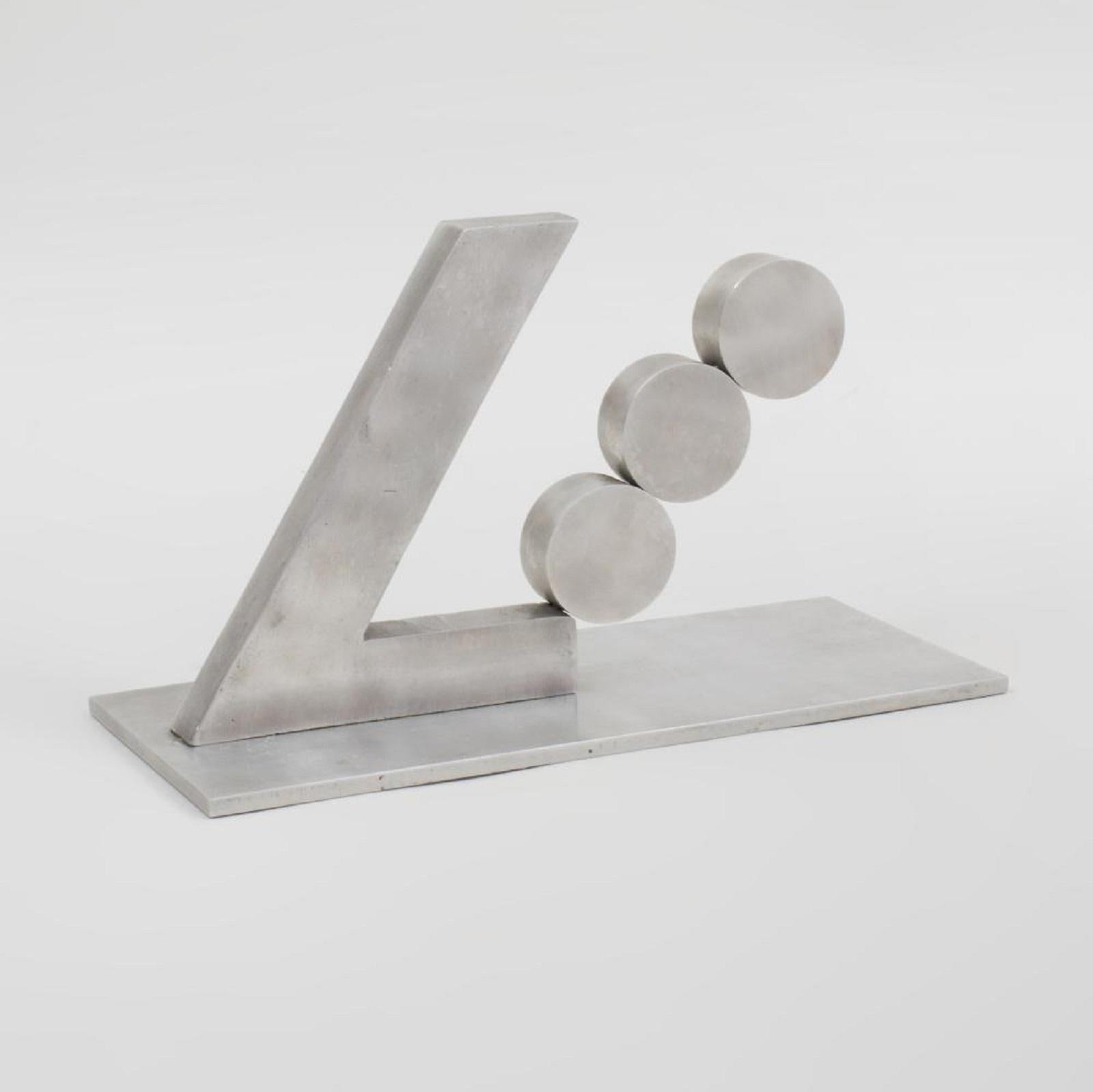
Rare 1970 Israeli Abstract Sculpture Steel Menashe Kadishman Suspension
By Menashe Kadishman
Located in Surfside, FL
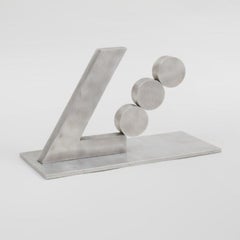
Beautiful table top sculpture by renowned Israeli sculptor Menashe Kadishman. Super quality, and visually stunning. There is a large sculpture of his in Rabin Square in the heart of ...
Category
1970s Abstract Geometric Abstract Sculptures
Materials
Stainless Steel
Abstract Signed Cubist Bronze Sculpture "Cats" Chicago Bauhaus Woman Modernist
Located in Surfside, FL
This listing is just for the sculpture. (the picture of the ad is for reference and is not included.)
Marie Zoe Greene-Mercier was an artist, writer and arts activist who worked in t...
Category
1960s Cubist Abstract Sculptures
Materials
Travertine, Bronze
Argentine Modernist Brutalist Abstract Bronze Sculpture Jewish Latin American
By Naum Knop
Located in Surfside, FL
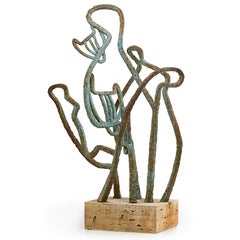
Naum Knop (Ukrainian-Argentinean, 1917-1993) Modernist Brutalist bronze figural sculpture with heavy verdigris green finish. Melted forms in the shape of an abstract pretzel like twist. Affixed to white stone plinth. Artist signature, "NK" side of base. Good condition, shows rich green patina and aged oxidation. Measures approximately 17.5 in. x 19.5 in. x 6.5 in.
Naum Knop, Argentine sculptor, was born in 1917 in Buenos Aires, into a Jewish family of Russian origin from Ukraine. His childhood was spent in the neighborhood of La Paternal where his father had a carpentry workshop, a space in which he made contact for the first time with the technique of wood carving. After finishing elementary school, he worked with the teacher Luis Fernández and soon after he dedicated himself to furniture design. Around 1935, he entered the Manuel Belgrano School of Fine Arts . Between 1941 and 1942 he attended the course for graduates taught by Alberto Lagos and Alfredo Bigatti at the National School of Fine Arts and continued his training between 1942-1945 at the Ernesto de la Cárcova High School with Soto Avedaño, Carlos de la Cárcova and José Fioravanti. At this time he put his works in dialogue with other young artists such as Libero Badii and Aurelio Macchi .
Around 1947 he made his study trip abroad. He goes to California, United States, where he enters the Art Institute of Los Angeles. At the same time visit museums and galleries. In January 1948 he organized his first exhibition abroad, held at the Hall of Arts in Beverly Hills in Los Angeles. During this period he toured Chicago and then New York. That year he traveled to Europe; his itinerary includes France, Italy, Switzerland and England. As a result, he came into contact with the work of Henry Moore, Hans Jean Arp, Jacques Lipchitz, Constantin Brancusi, Umberto Boccioni, Henry Laurens, Ossip Zadkine. Artists who have an impact on the young Knop and whom he honors in his subsequent production. He returned to Argentina in 1949 and installed his workshop where he worked on ornamental carving and on pieces in which he oscillated between a synthetic figuration and abstraction.
In 1956 he began his successful participation in salons , obtaining numerous awards at the national and municipal level. In 1959 he participated in the shipment to the 5th São Paulo Biennial and since then, to the success achieved at the local level, the multiple exhibitions carried out in the international field have been added. The exhibitions in Tel Aviv , Jerusalem and Rome (1966) stand out; Dusseldorf (1977); Los Angeles and Palm Spring (1981); New York (1986), San Pablo and Los Angeles(1989). During this period, his work matured, while he began to experiment with the direct wax technique, obtaining textured surfaces similar to welds that gave it a strong abstract expressionist feature. In parallel to his personal production and to the small models, the artist receives private and public commissions for which he works on large-scale sculptures and murals. Around 1967, the architect Mario R. Álvarez summons him to participate in a closed competition for the creation of a work to be located in the General San Martín Cultural Center . Libero Badii and Enio Iommi participate with the artist ; the bronze Reclining Figure Knop is chosen. Among the large-scale monuments it is worth remembering the piece Los tres soles temporarily located in Recoleta in 1984 and later installed in Maryland, United States; as well as Seated Figure (Reminiscence of Michelangelo) located in the shield of a private building in 1970. To these are added the numerous murals in which he experiments with various materials and techniques such as casting in bronze, openwork and reliefs in wood and work in cement.
He was included in the The 1962 International Prize for Sculpture the jury included Argan, Romero Brest and James Johnson Sweeney the former director of the Solomon R. Guggenheim Museum in New York. The participants included Louise Nevelson and John Chamberlain for the United States; Lygia Clark for Brazil; Pietro Consagra, Lucio Fontana, Nino Franchina, and Gió Pomodoro for Italy; Pablo Serrano for Spain; and Eduardo Paolozzi, William Turnbull, and Kenneth Armitage for England. Gyula Kosice, Noemí Gerstein, Julio Gero, Naum Knop, Aldo Paparella, Enrique Romano, Eduardo Sabelli, and Luis Alberto...
Category
Mid-20th Century Abstract Abstract Sculptures
Materials
Stone, Bronze

60s Kadishman Israeli sculpture in steel or aluminum Suspension
By Menashe Kadishman
Located in Surfside, FL
Beautiful table top sculpture by renowned Israeli sculptor Menashe Kadishman. Super quality, and visually stunning. it is signed and numbered and dedicated Janet love george
Menashe ...
Category
1960s Modern Abstract Sculptures
Materials
Stainless Steel
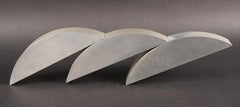
You May Also Like
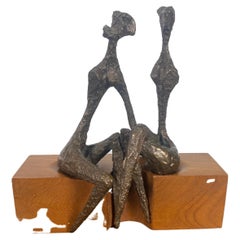
Aharon Bezalel Cast Bronze, Modernist, Brutalist, c 1969
By Aharon Bezalel
Located in Buffalo, NY
Aharon Bezalel Cast Bronze, modernist, brutalist. c 1969, Wonderful form and artistry.
Category
Antique 1660s Brutalist Figurative Sculptures
Materials
Bronze
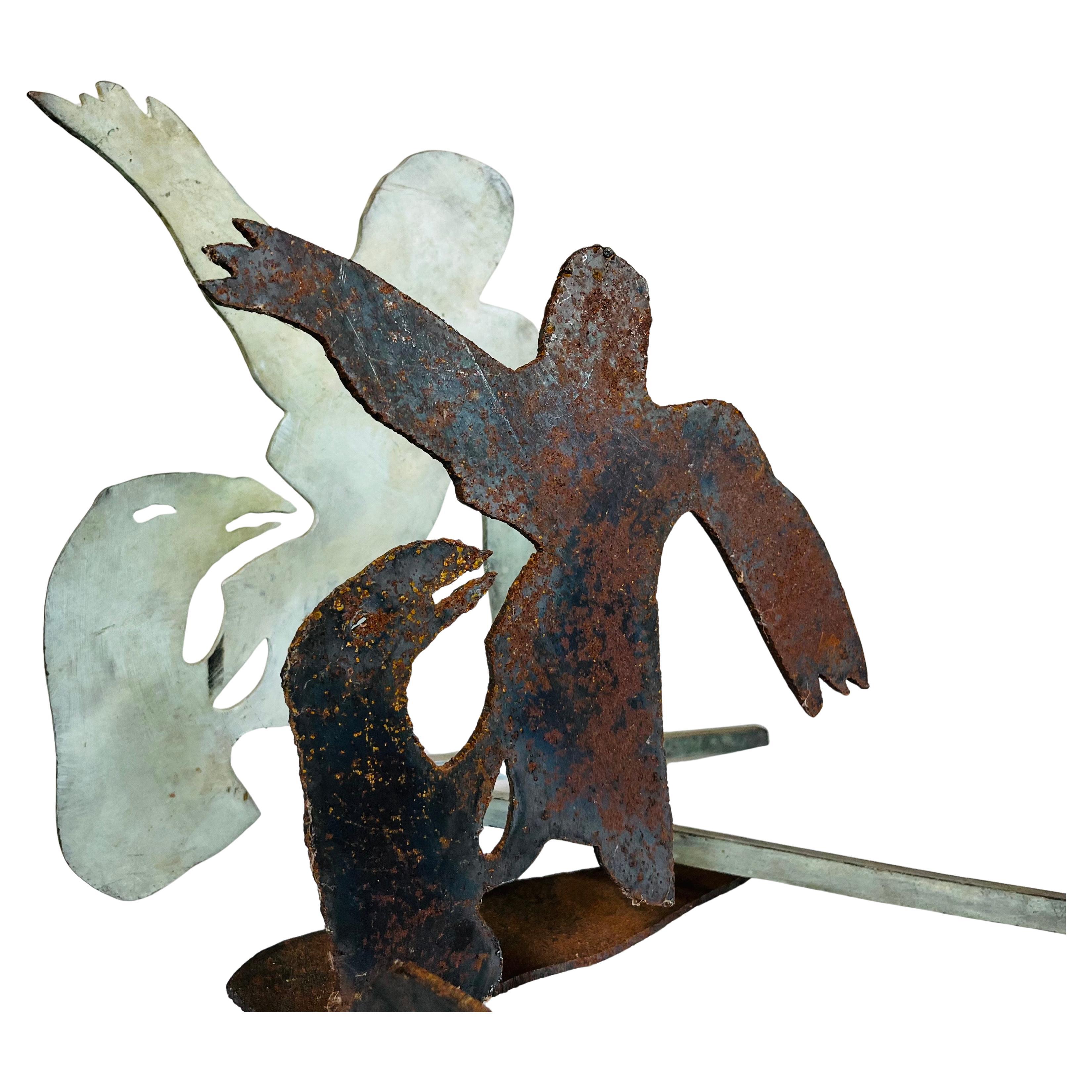
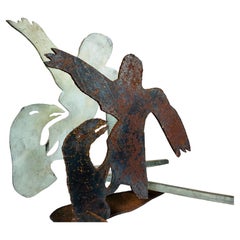
Menashe Kadishman Prototype Artist Proof Torch Cut Steel Sculpture Pair
By Menashe Kadishman
Located in Southampton, NJ
A pair of Menashe Kadishman small scale artist proof prototypes from the estate of Tamar and her husband renowned Princeton professor Ted (Theodore) Rabb who knew him personally. At ...
Category
Mid-20th Century American Mid-Century Modern Abstract Sculptures
Materials
Cut Steel
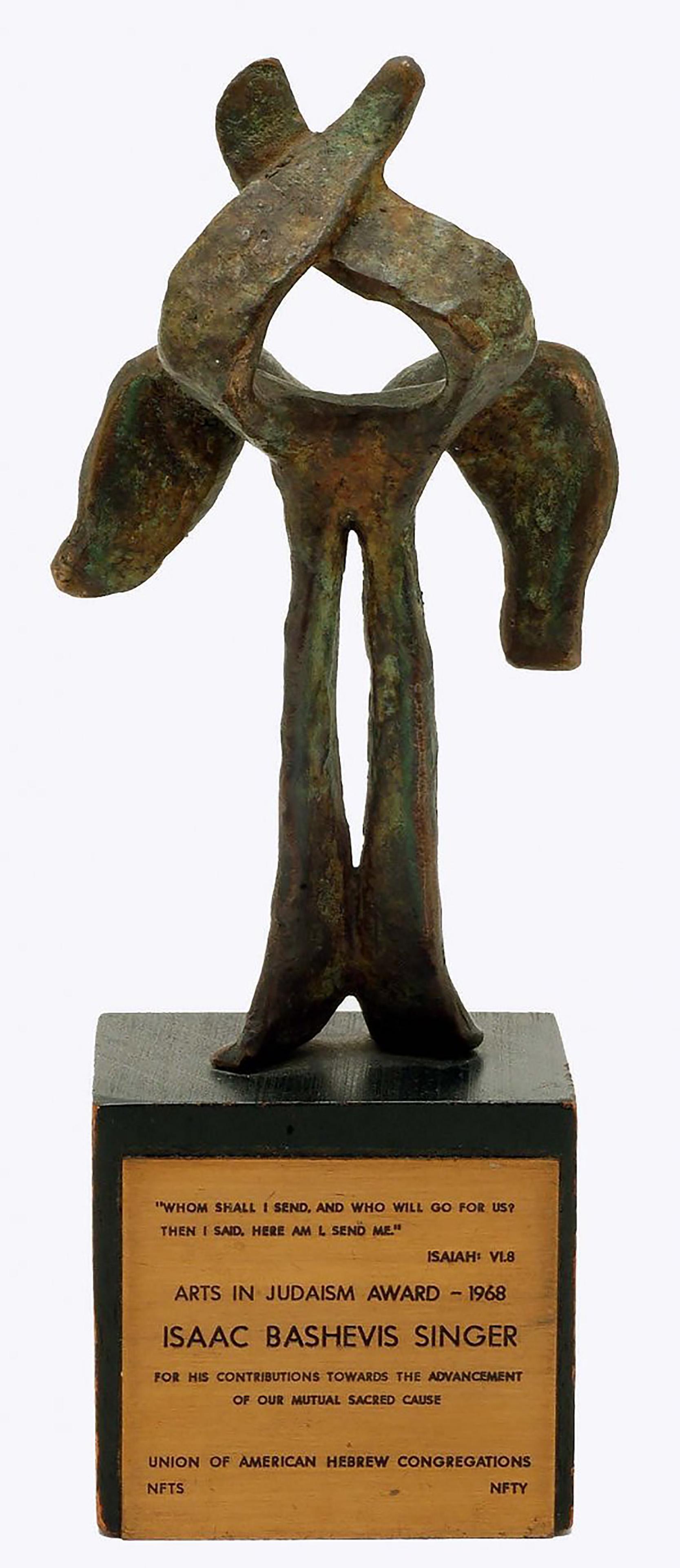
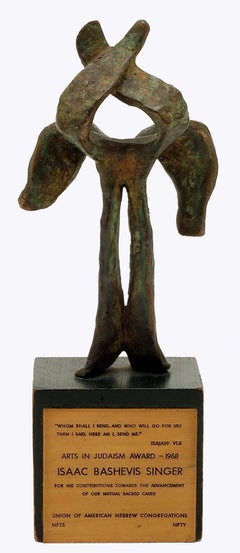
Bronze Sculpture to Isaac Bashevis Singer, Arts in Judaism Award signed Judaica
By Nathaniel Kaz
Located in New York, NY
Nathaniel Kaz
Bronze Sculpture to Isaac Bashevis Singer for Arts in Judaism Award, 1966
Bronze, Square wooden base, Metal tag
Signed and dated "66" to back of bronze portion of the w...
Category
1960s Abstract Expressionist Abstract Sculptures
Materials
Metal, Bronze
William C. Palmer Modern Abstract Sculpture C. 1945 Smithsonian Artist
By William Palmer
Located in Atlanta, GA
William Charles Palmer (American, 1906-1987), Modern Abstract constructed from forged Metal on Painted Wood base. Marked to underside. Circa 1945.
"Pa...
Category
Mid-20th Century American Abstract Sculptures
Materials
Iron
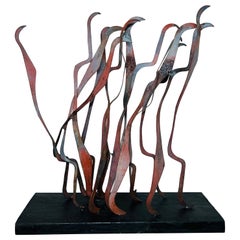
Shirley Mogilner (20th C) Century I, Bronze 1967
Located in Atlanta, GA
Overall dimensions including the marble base: 5" x 8" x 12"
Category
20th Century Abstract Sculptures
Materials
Bronze
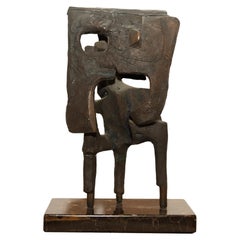
Aharon Bezalel Cast Bronze Sculpture
By Aharon Bezalel, Alberto Giacometti
Located in Los Angeles, CA
Cast bronze sculpture by Aharon Bezalel, 1967, Israel.
Aharon was born in Afghanistan and lived in Jerusalem where he created his works of art...
Category
Vintage 1960s American Mid-Century Modern Abstract Sculptures
Materials
Bronze