1 of 1
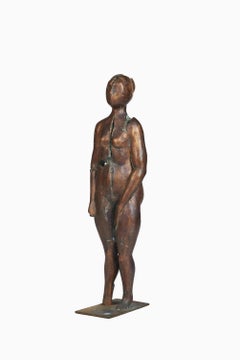
Edouard MartinetGrey Fish
- Creator:Edouard Martinet (French)
- Condition:
- Gallery Location:London, GB
- Reference Number:1stDibs: G14020430418
Authenticity Guarantee
In the unlikely event there’s an issue with an item’s authenticity, contact us within 1 year for a full refund. DetailsMoney-Back Guarantee
If your item is not as described, is damaged in transit, or does not arrive, contact us within 7 days for a full refund. Details24-Hour Cancellation
You have a 24-hour grace period in which to reconsider your purchase, with no questions asked.Vetted Professional Sellers
Our world-class sellers must adhere to strict standards for service and quality, maintaining the integrity of our listings.Price-Match Guarantee
If you find that a seller listed the same item for a lower price elsewhere, we’ll match it.Trusted Global Delivery
Our best-in-class carrier network provides specialized shipping options worldwide, including custom delivery.You May Also Like
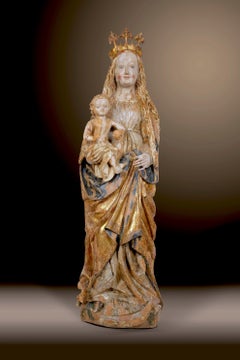
CRESCENT MOON MADONNA
Located in Wien, Wien
Master in the circle of Michael Pacher
(Mühlen ca. 1435 - 1498 Salzburg)
Salzburg
Around 1480
Carved limewood
Old polychrome version
Height 118 cm
This Madonna is an outstanding ex...
Category
15th Century and Earlier Gothic Figurative Sculptures
Materials
Wood
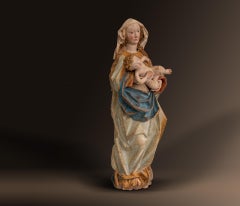
Madonna
Located in Wien, Wien
MUSEUM SCULPTURE
Master workshop
Hans Klocker
before 1474, possibly in Gais -
After 1500
"CRESCENT MOON"
Around 1480/90
Stone pine wood carved
Original version
Height 77 cm
This ext...
Category
15th Century and Earlier Figurative Sculptures
Materials
Wood
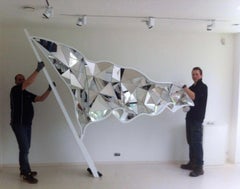
EveryThing (Flag) 2015
By Doug Aitken
Located in Beverly Hills, CA
Doug Aitken
EveryThing, 2015
Mirror, Fibreglass & resin
92.5 x 119.5 x 12.5 inches
Edition of 4 plus 2 AP's
Provenance:
NB: Available on sale
Category
2010s Contemporary Figurative Sculptures
Materials
Mirror, Resin, Fiberglass
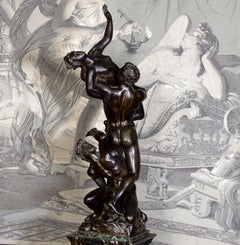
The Rape of Sabine Iconic Bronze Sculpture 1930
Located in Rome, IT
Fine Group of Sculptures in Bronze after Jean de Boulogne (Giambologna)
The torturously twisting Rape of the Sabine Women is one of the finest and most technically difficult sculpt...
Category
1920s Mannerist Figurative Sculptures
Materials
Bronze
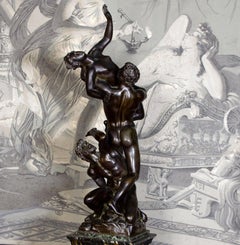
The Rape of Sabine Iconic Bronze Sculpture 1930
Located in Rome, IT
Fine Group of Sculptures in Bronze after Jean de Boulogne (Giambologna)
The torturously twisting Rape of the Sabine Women is one of the finest and most technically difficult sculpt...
Category
1920s Mannerist Figurative Sculptures
Materials
Bronze
$6,735 Sale Price
30% Off
H 35.44 in W 8.27 in D 8.27 in
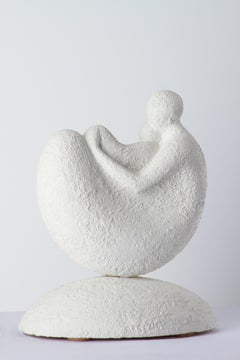
Mother
Child
Located in Knowle Lane, Cranleigh
The sculpture titled "Mother & Child" by Bettina Seitz beautifully captures the intimate bond between a caregiver and an infant through its elegant form. Crafted from a unique white ...
Category
2010s Contemporary Figurative Sculptures
Materials
Stone
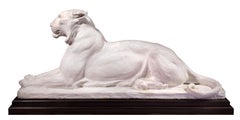
The Princeton Tiger
Located in New York, NY
Provenance: The artist; thence by descent to his granddaughter:
Rhoda Knight Kalt; from whom acquired by:
Private Collection, Pennsylvania, 1995–2025.
Literature: Richard Milner, Ch...
Category
1940s Figurative Sculptures
Materials
Plaster
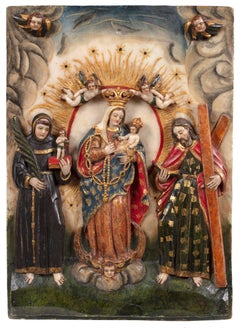
Virgin of the Rosary of Chiquinquirá with Saint Anthony of Padua and Saint Andre
Located in New York, NY
Provenance: Private Collection, Uruguay, for the last 90 years.
Dated 1673 on the reverse (Fig. 1), this exceptional relief is an early example of a distinctly Spanish American art...
Category
1670s Old Masters Figurative Sculptures
Materials
Alabaster
$32,500
H 11.5 in W 8.63 in D 0.88 in
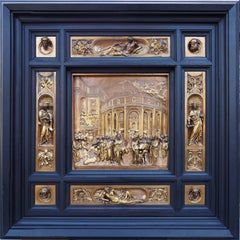
The Story of Joseph from the Second Baptistery Doors, Florence (“The Gates of Pa
By Ferdinand Barbedienne
Located in New York, NY
Ferdinand Barbedienne (Saint-Martin-de-Fresnay 1810 – 1892 Paris) after Lorenzo Ghiberti (Florence, 1378 – 1455)
Signed at the lower right of the principal relief: F. BARBEDIENNE
Provenance: Private Collection, USA.
Barbedienne’s “Gates of Paradise” reliefs are one of the triumphs of nineteenth-century bronze casting and patination. The nine panels that comprise our example are half-size reductions of the famous originals by Lorenzo Ghiberti, made for the Baptistery of Florence and now housed in the Museo del Opera del Duomo. Mounted in an impressive, mullioned frame surround, our work is an exceptional exemplar of the Renaissance Revival, the broadly influential style and movement that infused architecture, design, and artistic culture in the latter half of the nineteenth century.
The central scene, The Story of Joseph, is perhaps the most celebrated of the entire series depicting as it does seven episodes from the Biblical narrative integrated into a single composition: Joseph cast by his brethren into the well, Joseph sold to the merchants, the merchants delivering Joseph to the pharaoh, Joseph interpreting the pharaoh’s dream, the pharaoh paying him honor, Jacob sending his sons to Egypt, and Joseph recognizes his brothers and returns home. The surrounding reliefs—two vertical figures in niches, two recumbent figures, and four portrait heads in roundels—are as well faithful reductions of Ghiberti’s original bronzes on other parts of the doors.
The maker of these casts was the renowned 19th-century French fondeur Ferdinand Barbedienne. Gary Radke has recently written of this great enterprise:
“The Parisian bronze caster Ferdinand Barbedienne began making half-sized copies of ancient and Renaissance sculpture in the 1830s. His firm benefitted enormously from the collaboration of Achille Collas, whom Meredith Shedd has shown was one of numerous pioneers in the mechanical reproduction of sculpture. Their competitors largely devoted themselves to reproducing relief sculpture, but Collas devised a process for creating fully three-dimensional copies. A tracing needle, powered by a treadle, moved over the surface of a full-sized plaster cast or bronze of the original and triggered a complementary action in a cutting stylus set over a soft plaster blank…He signed an exclusive contract with Barbedienne on November 29, 1838, and won medals for his inventions in 1839 and 1844.
Barbedienne’s half-sized copies of the Gates of Paradise were famous not only for their fidelity to the original, but also for the way their gilding…suggested the glimmering surface that was hidden under centuries of dirt. Some critics even saw Collas’s and Barbedienne’s work as ‘philanthropic, an exemplary adaptation of industry to the requirements of art, the artist, the workers, and the public alike.’
At 25,000 francs, Collas’s and Barbedienne’s reduction of the Gates of Paradise was singularly more expensive than any other item for sale in their shop. All the reliefs, individual statuettes, and busts were cast separately and could be purchased either by the piece or as an ensemble. Fittingly, Barbedienne’s accomplishment earned him the Grand Prix at the 1878 Paris Exposition Universelle, along with numerous other medals.”
Three complete examples of the Barbedienne-Ghiberti doors are known. One, first installed in a chapel in the Villa Demidoff of San Donato near Pratolino, was later acquired by William Vanderbilt...
Category
Late 19th Century Figurative Sculptures
Materials
Bronze
Female Figure-Bronze Sculpture Ed. 1/6
Located in Zug, CH
Hermann Rastorfer was a draftsman, painter, sculptor, illustrator, ceramist, designer, poster artist, developer of advertising concepts and communication campaigns, inventor, and architect. He began as a typesetter in Salzburg. In the mid-1950s, he moved to Germany, where he soon founded his own studio for graphic design and advertising. His goal was always to give each product a distinctive, highly recognizable appearance. He designed his own design line for the German pharmaceutical company Boehringer Ingelheim, artistic cover images for numerous paperbacks from renowned publishers, and packaging for well-known products such as Ferrero Küsschen, Mon Chéri, Martell cognac...
Category
21st Century and Contemporary Modern Figurative Sculptures
Materials
Bronze