Want more images or videos?
Request additional images or videos from the seller
1 of 4
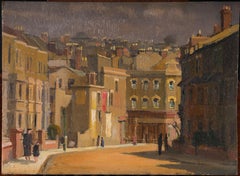
Catharni SternOn the London Tube
Price:$2,547.76
$3,924.93List Price
About the Item
About the Seller
5.0
Vetted Professional Seller
Every seller passes strict standards for authenticity and reliability
1stDibs seller since 2023
19 sales on 1stDibs
Typical response time: 7 hours
Authenticity Guarantee
In the unlikely event there’s an issue with an item’s authenticity, contact us within 1 year for a full refund. DetailsMoney-Back Guarantee
If your item is not as described, is damaged in transit, or does not arrive, contact us within 7 days for a full refund. Details24-Hour Cancellation
You have a 24-hour grace period in which to reconsider your purchase, with no questions asked.Vetted Professional Sellers
Our world-class sellers must adhere to strict standards for service and quality, maintaining the integrity of our listings.Price-Match Guarantee
If you find that a seller listed the same item for a lower price elsewhere, we’ll match it.Trusted Global Delivery
Our best-in-class carrier network provides specialized shipping options worldwide, including custom delivery.You May Also Like
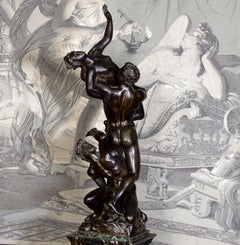
The Rape of Sabine Iconic Bronze Sculpture 1930
Located in Rome, IT
Fine Group of Sculptures in Bronze after Jean de Boulogne (Giambologna)
The torturously twisting Rape of the Sabine Women is one of the finest and most technically difficult sculpt...
Category
1920s Mannerist Figurative Sculptures
Materials
Bronze
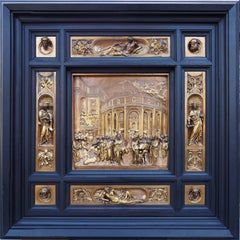
The Story of Joseph from the Second Baptistery Doors, Florence (“The Gates of Pa
By Ferdinand Barbedienne
Located in New York, NY
Ferdinand Barbedienne (Saint-Martin-de-Fresnay 1810 – 1892 Paris) after Lorenzo Ghiberti (Florence, 1378 – 1455)
Signed at the lower right of the principal relief: F. BARBEDIENNE
Provenance: Private Collection, USA.
Barbedienne’s “Gates of Paradise” reliefs are one of the triumphs of nineteenth-century bronze casting and patination. The nine panels that comprise our example are half-size reductions of the famous originals by Lorenzo Ghiberti, made for the Baptistery of Florence and now housed in the Museo del Opera del Duomo. Mounted in an impressive, mullioned frame surround, our work is an exceptional exemplar of the Renaissance Revival, the broadly influential style and movement that infused architecture, design, and artistic culture in the latter half of the nineteenth century.
The central scene, The Story of Joseph, is perhaps the most celebrated of the entire series depicting as it does seven episodes from the Biblical narrative integrated into a single composition: Joseph cast by his brethren into the well, Joseph sold to the merchants, the merchants delivering Joseph to the pharaoh, Joseph interpreting the pharaoh’s dream, the pharaoh paying him honor, Jacob sending his sons to Egypt, and Joseph recognizes his brothers and returns home. The surrounding reliefs—two vertical figures in niches, two recumbent figures, and four portrait heads in roundels—are as well faithful reductions of Ghiberti’s original bronzes on other parts of the doors.
The maker of these casts was the renowned 19th-century French fondeur Ferdinand Barbedienne. Gary Radke has recently written of this great enterprise:
“The Parisian bronze caster Ferdinand Barbedienne began making half-sized copies of ancient and Renaissance sculpture in the 1830s. His firm benefitted enormously from the collaboration of Achille Collas, whom Meredith Shedd has shown was one of numerous pioneers in the mechanical reproduction of sculpture. Their competitors largely devoted themselves to reproducing relief sculpture, but Collas devised a process for creating fully three-dimensional copies. A tracing needle, powered by a treadle, moved over the surface of a full-sized plaster cast or bronze of the original and triggered a complementary action in a cutting stylus set over a soft plaster blank…He signed an exclusive contract with Barbedienne on November 29, 1838, and won medals for his inventions in 1839 and 1844.
Barbedienne’s half-sized copies of the Gates of Paradise were famous not only for their fidelity to the original, but also for the way their gilding…suggested the glimmering surface that was hidden under centuries of dirt. Some critics even saw Collas’s and Barbedienne’s work as ‘philanthropic, an exemplary adaptation of industry to the requirements of art, the artist, the workers, and the public alike.’
At 25,000 francs, Collas’s and Barbedienne’s reduction of the Gates of Paradise was singularly more expensive than any other item for sale in their shop. All the reliefs, individual statuettes, and busts were cast separately and could be purchased either by the piece or as an ensemble. Fittingly, Barbedienne’s accomplishment earned him the Grand Prix at the 1878 Paris Exposition Universelle, along with numerous other medals.”
Three complete examples of the Barbedienne-Ghiberti doors are known. One, first installed in a chapel in the Villa Demidoff of San Donato near Pratolino, was later acquired by William Vanderbilt...
Category
Late 19th Century Figurative Sculptures
Materials
Bronze
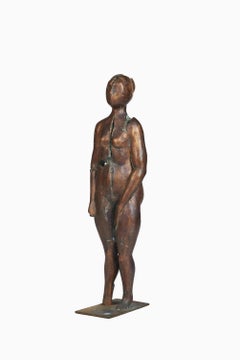
Female Figure-Bronze Sculpture Ed. 1/6
Located in Zug, CH
Hermann Rastorfer was a draftsman, painter, sculptor, illustrator, ceramist, designer, poster artist, developer of advertising concepts and communication campaigns, inventor, and architect. He began as a typesetter in Salzburg. In the mid-1950s, he moved to Germany, where he soon founded his own studio for graphic design and advertising. His goal was always to give each product a distinctive, highly recognizable appearance. He designed his own design line for the German pharmaceutical company Boehringer Ingelheim, artistic cover images for numerous paperbacks from renowned publishers, and packaging for well-known products such as Ferrero Küsschen, Mon Chéri, Martell cognac...
Category
21st Century and Contemporary Modern Figurative Sculptures
Materials
Bronze
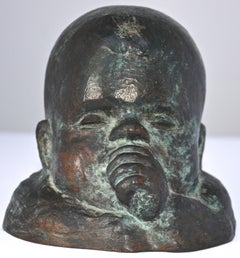
Victor Salmones Signed Bronze Bust of a Young Child
By Victor Salmones
Located in Los Angeles, CA
An untitled signed bronze sculpture by the Mexican artist, Victor Salmones (1937 - 1989) from an edition of 10. Numbered 1 of 10. Signature "Victor Salmones. 1/10" in cast. In excellent original condition.
Victor Salmones (1937-1989) was the most widely known sculptor living and working in Mexico during his lifetime. His sculptures won him universal acclaim and are held in the collections of museums, corporations, cities, universities and private collectors in some 30 countries. During his career, he was highly sought after and increasingly involved in the execution of commissions for major public works around the world.
Salmones developed his love and talent for creating sculpture by working with clay in high school. He attended the Instituto de Bellas Artes (Mexican National Institute of Fine Arts), where he was an apprentice to the Bauhaus master, Otto Hoffman. He was trained to use the exacting, age-old lost wax method of casting and worked principally in bronze. Hoffman's encouragement led to the opening of Victor's own sculpture workshop in Cuernavaca in 1966.
In 1967, Salmones’ fluid bronze “Adam” won first prize at the Biennale Exposition of the National Museum of Modern Art. His work continued to win the highest critical acclaim at subsequent Biennale expositions, and in 1971, over hundreds of entries, his life-size bronze Narcissus...
Category
1970s Modern Figurative Sculptures
Materials
Bronze
$3,500
H 4.94 in W 5 in D 5.5 in
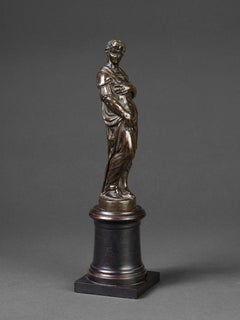
16th Century Venetian bronze sculpture of a Young Man in Armour
Located in Milan, IT
16th Century Venetian bronze sculpture of a Young Man in Armour attributed to the Florentine artist Andrea di Alessandri, called Il Bresciano (Fl...
Category
16th Century Figurative Sculptures
Materials
Bronze
$9,374
H 10.24 in W 1.97 in
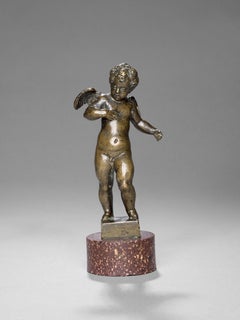
ITALIAN BRONZE FIGURE OF YOUNG CHERUB ON PORPHYRY BASE - ATT. TO ROCCATAGLIATA
Located in Milan, IT
Resting on a circular Egyptian porphyry base, this fascinating bronze figure of a young cherub is a striking example of the Venetian workmanship of the 16th Century. With the head tu...
Category
16th Century Figurative Sculptures
Materials
Bronze
$10,808
H 6.15 in W 1.58 in D 1.58 in
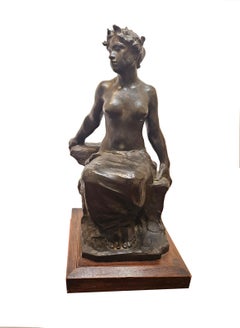
Dreams
Located in Roma, RM
Giovanni Nicolini (Palermo 1872 - Rome 1956), Dreams
Bronze sculpture 63 x 35 x 35 cm signed and located Rome on the back; in the wooden base is a ...
Category
Early 20th Century Symbolist Figurative Sculptures
Materials
Bronze
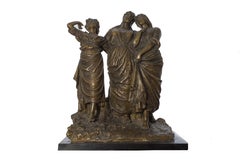
Love Song
Located in Roma, RM
Costantino Barbella (Chieti 1852 - Rome 1925), Love Song
Bronze sculpture 41 x 35 x 21 cm signed at bottom, on black marble base.
Provenance: Private Collection, Rome.
Category
Late 19th Century Other Art Style Figurative Sculptures
Materials
Bronze
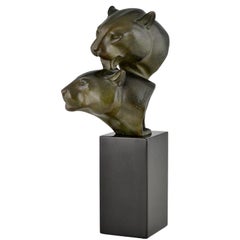
Art Deco bronze sculpture two panther heads.
By Irénée Rochard
Located in Antwerp, BE
Art Deco bronze sculpture two panther heads by Irenee Rochard, France 1930.
The bronze has a green patina and stands on a Belgian Black marble base.
Information on the artist:
Ani...
Category
1930s Art Deco Figurative Sculptures
Materials
Bronze
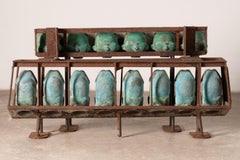
Set of Six Bronze Doll Head and set of Eight Bronze Doll Torso Molds
Located in Dallas, TX
Set of six doll head molds and set of eight bronze doll torsos constructed o f bronze. The molds were used in the manufacturing process in the 1920s for making plastic dolls, are mou...
Category
1920s Figurative Sculptures
Materials
Bronze, Iron
$4,800
H 12.75 in W 34 in D 5.5 in
More From This Seller
View AllArthur Miller
Located in Douglas, Isle of Man
Robert Winthrop White 1921-2002, was an American sculptor who lived most of his life in New York. He was the grandson of the architect Stanford White and his great grandfather was th...
Category
1950s Figurative Sculptures
Materials
Granite, Bronze
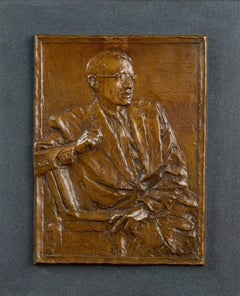
Marie de
Medici
By Mathurin Moreau
Located in Douglas, Isle of Man
Mathurin Moreau 1822-1912, was a French sculptor in the classic academic style. His father was also a sculptor and his siblings. Mathurin first received a medal at the Salon in 1848,...
Category
Late 19th Century Figurative Sculptures
Materials
Bronze
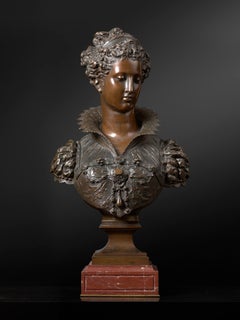
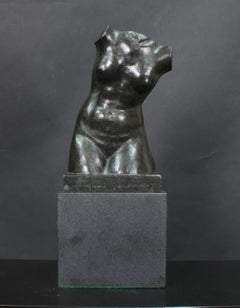
Female torso mask
By Aristide Maillol
Located in Douglas, Isle of Man
'In the manner of' Aristide Maillol 1861-1944, was a French sculptor, painter and print maker. Maillol predominantly was a painter and weaver of tapestry, however Gaugin advised him ...
Category
Mid-20th Century Nude Sculptures
Materials
Granite, Bronze
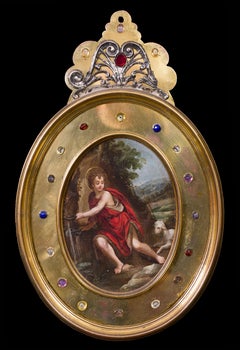
The Lamb of God
By (After) Bartolomé Esteban Murillo
Located in Douglas, Isle of Man
Bartolome Esteban Murillo 1617- 1682, was a Spanish Baroque painter best known for his Religious works. This painting of Christ giving water to a lamb is in the manner of Murillo and...
Category
18th Century Figurative Paintings
Materials
Brass
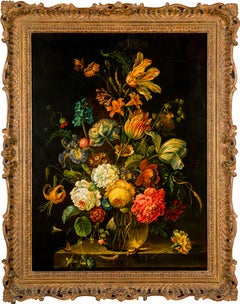
Still Life
By Jan Davidsz. de Heem
Located in Douglas, Isle of Man
In the manner of Jan Davidsz De Heem. This painting is in the Dutch Golden Age manner and is catalogued as such, however we believe the picture dates around the 18th Century and cou...
Category
18th Century Dutch School Still-life Paintings
Materials
Oil, Panel
Urban cityscape
Located in Douglas, Isle of Man
This urban landscape is certainly a British city possibly Bristol, the artist is believed to be John William Ashton, known as Will Ashton. The painting dates from around 1900, before WW1, there is a pillar box for post to the rear of the picture which displays certainly a British town or city and in our opinion almost certainly Bristol, England. This is a very small but well executed paining in oil by an accomplished artist, the painting itself measures 4.5 x 6.5 inches and has been mounted in a new and suitable frame by our professional framer who's decision to mount the picture as shown was clearly an admiral choice. I have enclosed a biography of Will Ashton. This painting is unsigned.
Sir John William Ashton, OBE, ROI (20 September 1881 – 1 September 1963) was a prolific Australian Impressionist artist and director of the Art Gallery of New South Wales from 1937 to 1943.
Early life
Ashton was born in Clifton, York, England, the only son of artist James Ashton, and his wife Mary Elizabeth Ashton. His father immigrated to Australia, arriving at Adelaide, South Australia in January 1884 and founding a school of painting in "unpretentious but commodious" premises on The Parade, Norwood in 1885. His wife and son arrived at a later date, but generally given as in 1884.
Ashton attended Prince Alfred College, where his father was art teacher, from 1889 to 1897. Neither academically nor athletically inclined. On leaving school, he received further training from his father; Hans Heysen was a fellow student.
He left for London in 1900, where he studied at the Olsson-Talmage studios, then in 1902 at the Académie Julian in Paris for a year. Ashton had several paintings accepted by the Royal Academy of Arts, London, and the Salon de la Société des Artistes Français, around which time he adopted the name "Will Ashton" to avoid confusion with his father or Julian Ashton (no relation). In 1905 he returned to Adelaide, where his "Boulevard Montparnasse, Paris" was hailed as a masterpiece, and purchased by the Art Gallery of South Australia. After holding exhibitions in Sydney, Melbourne, Perth and Adelaide, in 1908, he won the Wynne Prize for landscapes.
In the years 1912–1914 he painted in Britain, Europe, and Egypt. He returned to Australia for a year, but was back in London with his family 1915–1917. He made other trips in company with Lionel Lindsay...
Category
Early 20th Century Landscape Paintings
Materials
Oil, Board
Still Thinking About These?
All Recently ViewedMore Ways To Browse
Andrew Kazantsev
Anton Chotka
Baby Yoda
Bearbrick 1000 Haring
Bearbrick Kaws Dissected
Bearbrick Keith Haring 1000
Beto Gatti
Bill Mack Bronze Art
Bob Scriver
Bronze Sculpture Of Churchill
Bronze Sculptures Auction
Colonial Baule
Coyote Sculpture
Dali Daum
Dan Dykes
Dan Friday Glass
Daniele Fortuna
Dresden China Gold Leaf China