Want more images or videos?
Request additional images or videos from the seller
1 of 6
César BaldacciniPouce, Thumb, César, 1980
s, Crystal, Sculpture, Baccarat Edition, Postwar1989
1989
$33,358.99List Price
About the Item
- Creator:César Baldaccini (1921 - 1998, French)
- Creation Year:1989
- Dimensions:Height: 17.72 in (45 cm)Width: 5.91 in (15 cm)
- Movement Style:
- Period:
- Condition:
- Gallery Location:Geneva, CH
- Reference Number:1stDibs: LU150228427462
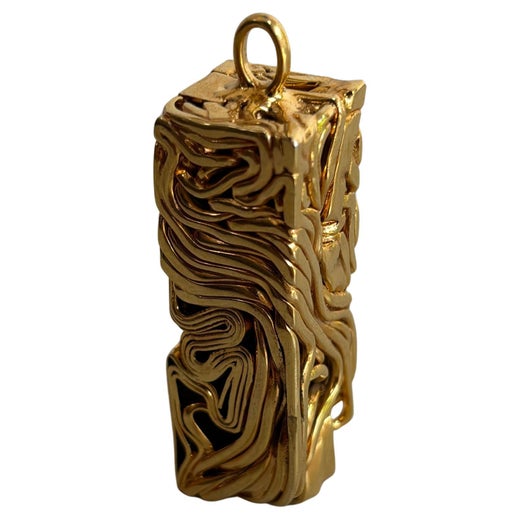
César Baldaccini
César Baldaccini was born to immigrant Italian parents in Marseille and his life span was from 1921–98. He was considered to be one of the most important French artists and sculptors of the 20th century. Much of his work involved the compression of junk material and automobile material. He became associated with the 1960s Paris based Nouveau réalisme movement. Most importantly, Baldaccini just had a major retrospective at the Pompidou Center in Paris. His work is very collectible and desirable.
About the Seller
5.0
Recognized Seller
These prestigious sellers are industry leaders and represent the highest echelon for item quality and design.
Established in 2007
1stDibs seller since 2021
13 sales on 1stDibs
Authenticity Guarantee
In the unlikely event there’s an issue with an item’s authenticity, contact us within 1 year for a full refund. DetailsMoney-Back Guarantee
If your item is not as described, is damaged in transit, or does not arrive, contact us within 7 days for a full refund. Details24-Hour Cancellation
You have a 24-hour grace period in which to reconsider your purchase, with no questions asked.Vetted Professional Sellers
Our world-class sellers must adhere to strict standards for service and quality, maintaining the integrity of our listings.Price-Match Guarantee
If you find that a seller listed the same item for a lower price elsewhere, we’ll match it.Trusted Global Delivery
Our best-in-class carrier network provides specialized shipping options worldwide, including custom delivery.You May Also Like
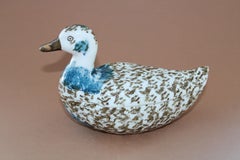
Kuznetsov porcelain - Butter dish duck, porcelain h 13 cm; L 19 cm; W 10 cm
Located in Riga, LV
Kuznetsov porcelain - Butter dish duck, porcelain h 13 cm; L 19 cm; W 10 cm
Kuznetsov Porcelain Factory in Riga was founded in 1841 as a factory ...
Category
Early 20th Century Realist More Art
Materials
Porcelain
$762 Sale Price
20% Off
Free Shipping
H 5.12 in W 7.49 in D 3.94 in
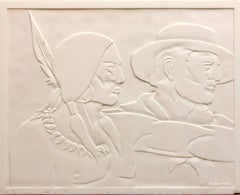
Rare Milk Glass Carved Sculpture Panel Cowboy Indian WPA Artist Americana
By Abraham Harriton
Located in Surfside, FL
This is a carved glass panel. I belive this is milk glass. it is a classic Americana scene of a cowboy or frontier trapper and an Indian or Native American with a feathered headdress...
Category
Mid-20th Century Realist Figurative Sculptures
Materials
Glass
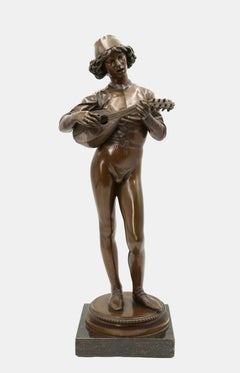
Florentine singer / - The Renaissance of the Renaissance -
By Paul Dubois
Located in Berlin, DE
Paul Dubois (1829 Nogent-sur-Seine - 1905 Paris), Florentine singer, 1865. Light brown patinated bronze with cast round plinth mounted on a square marble base (3.5 cm high). Total height 53 cm. Bronze dimensions: 49.5 cm (height) x 20 cm (length) x 10 cm (width), weight 5.6 kg. Inscribed on the plinth "P.[aul] DUBOIS", dated "1865", with the foundry's mark "F. BARBEDIENNE FONDEUR" and the signet "REDUCTION MECANIQUE A. COLLAS".
- Patina very occasionally darkened, lute with loss of one tuning peg, otherwise in excellent condition.
- The renaissance of the Renaissance -
The bronze is a precisely executed and masterfully cast contemporary reduction of Paul Dubois 155 cm tall masterpiece "Florentine Singer", which is exhibited in the Musée d'Orsay and for which the artist was awarded the Medal of Honor at the Paris Salon in 1865. The work acted as a beacon, and was followed by a plethora of depictions of juveniles.
Inspired by Donatello and Luca della Robbia, but also by painters such as Piero della Francesca, Benozzo Gozzoli, and Pinturicchio, the "Florentine Singer" is not an epigonal work that pays homage to a vanished era, but a successful attempt to draw vitality from the art of the past and thus give it new life.
The effect of vitality is the core of Italian Renaissance art theory. In order to fulfill itself as art, art had to appear like nature. This naturalism also characterizes the "Florentine Singer". The young man appears to have been taken from life, which is reinforced by the momentary nature of his action. He has just struck a now fading chord. In addition, the natural appearance is enhanced by the detailed shaping of the figurative details, such as the laces with the slightly curved leather of the shoes, the belt buckle, or the ornamentation on the body of the lute. Even the fingernails are clearly defined. Unlike the Renaissance, however, the effect of liveliness here is not based on the "discovery" of nature and the human body, but primarily on the rediscovery of the art of the Quattrocento. The liveliness of the artwork is therefore at the same time a revitalization of this art, so that we can speak of a Renaissance of the Renaissance, just as the Pre-Raphaelites in England at the same time transferred the Quattrocento to contemporary art.
Dubois takes on the most difficult of all subjects, the depiction of singing through silent sculpture. He was preceded in this by Luca della Robbia and Donatello with their pulpits of singers created in the 1430s in the Museo dell'Opera del Duomo in Florence. Compared to these works, the physiognomy of Dubois singer is far less animated, yet he also depicts singing in a convincing manner. He uses the whole body. He takes the ancient contrapposto, which was essential to Renaissance sculpture, and transforms the standing leg-playing posture into a late medieval S-swing, giving the body an elegant beauty and at the same time setting it in melodic motion. In the equally elegant finger position, the music is expressed in a much more literal way with the beating of the lute. Finally, the musicality of the sculpture culminates in the face with the mouth open to sing.
Through the act of singing, which is a great challenge to the artistic will to depict perfect beauty, the gracefulness of the classical face is not diminished, but enhanced. Starting from the face with the singing mouth and the gaze absorbed by the sounds, the inner vitality spreads, giving the bronze sculpture an intense aura, enhanced by the music. Dubois transfers the beauty of the Renaissance to the musical, sublimating the visible sculpture to the invisible of music.
He took up the challenge of transcending the Renaissance with the Renaissance, thus responding to the Querelle des Anciens et des Modernes, which arose at the end of the 17th century around the French Academy and remained virulent into the 19th century, in which antiquity was regarded either as an unattainable ideal or as a standard to be surpassed. With his work, Dubois proved that the Renaissance, which had championed the art of the ancients, could lead to a new renaissance of art.
About the artist
Paul Dubois' great-uncle was the famous French Baroque sculptor Jean-Baptiste Pigalle, in whose footsteps the talented great-nephew followed. When he debuted at the Paris Salon in 1858, he signed his work "Dubois-Pigalle". At his father's request, however, he first studied law before devoting himself to sculpture under the tutelage of François Christophe Armand Toussaint in 1856 and entering the École des Beaux-Arts in 1858. From 1859 to 1863, he lived in Rome and traveled to Naples and Florence. Inspired by Florentine art of the quattrocento, Dubois initiated a school-forming neo-Florentine style that combined the elegantly simple forms of youthful grace with a precise wealth of detail.Two purchases by the French state (“envois de Rome”) were made during his stay in Rome, which brought him recognition in Paris. After his return there, he quickly became an internationally sought-after artist.
Dubois was also active as a creator of monuments. His most famous work is the equestrian statue of Joan of Arc (1896) on the forecourt of Reims Cathedral. He was also a sought-after portraitist who produced around 50 busts and - Dubois was also a passionate painter - around 100 portraits in oil.
From 1873 to 1878 he was curator of the Museum du Luxembourg, in 1876 he became a member of the Institut de France and from 1878 to 1905 he was director of the École des Beaux-Arts.
In 1865, Dubois was awarded the Paris Salon Medal of Honor for his “Florentine Singer”. In 1867 he became Chevalier, in 1874 Officier, in 1886 Commandeur of the Légion d'honneur, which awarded Dubois the Grande Croix in 1896.
Selected Bibliography
Stole, Elmar: Paul Dubois. In: Saur. Allgemeines Künstlerlexikon, vol. 30, Munich - Leipzig 2001, pp. 677-678.
GERMAN VERSION
Paul Dubois (1829 Nogent-sur-Seine - 1905 Paris), Florentinischer Sänger, 1865. Hellbraun patinierte Bronze mit gegossener runder Plinthe auf quadratischem Marmorsockel montiert (3,5 cm Höhe). Gesamthöhe 53 cm. Maße der Bronze: 49,5 cm (Höhe) x 20 cm (Länge) x 10 cm (Breite), Gewicht 5,6 kg. Auf der Plinthe mit „P.[aul] DUBOIS“ bezeichnet, auf „1865“ datiert, mit dem Gießereistempel „F. BARBEDIENNE FONDEUR“ und dem Signet „REDUCTION MECANIQUE A. COLLAS“ versehen.
- Patina sehr vereinzelt nachgedunkelt, Laute mit Verlust eines Stimmwirbels, ansonsten ausgezeichnet erhalten.
- Die Renaissance...
Category
1860s Realist Figurative Sculptures
Materials
Bronze
$5,361
H 20.87 in W 7.88 in D 3.94 in
Pecheur / - Full of anticipation -
Located in Berlin, DE
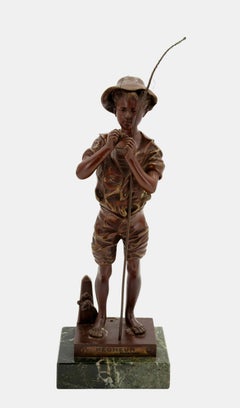
Adolphe Jean Lavergne (1863-1928), Pecheur, c. 1900. Brown patinated bronze with rectangular cast plinth on a green marble base (3 cm high), total height with hinge 37 cm, width 9 cm, depth 8 cm, weight 2.9 kg, signed “Lavergne” on the plinth.
- Base with old drilling and a few oxidized areas, patina occasionally rubbed, somewhat stained in the folds.
- Full of anticipation -
This bronze is the larger, highly detailed version of the fisherman that made Parisian artist Adolphe Jean Lavergne famous. In preparation for fishing, the boy prepares his rod before heading out to sea. The attachment of the iron ring and the rope behind him suggest a quay wall and a boat moored there. However, the depiction is entirely focused on the actual action of the young fisherman: With equal skill and concentration, he bends a hook to connect it to the fishing line. The contrast with his casual clothing, the loose-fitting trousers, the open shirt with its "wild" folds, and, last but not least, the sun hat boldly perched on his neck, reinforces the impression of the attentive care with which he goes about his work. His gaze makes him appear absorbed, as if he has forgotten the world around him and yet he is visibly filled with anticipation of fishing.
GERMAN VERSION
Adolphe Jean Lavergne (1863-1928), Pecheur, um 1890. Braun patinierte Bronze mit rechteckiger gegossener Plinthe auf grünem Marmorsockel (3 cm Höhe), Gesamthöhe mit Angel 37 cm, Breite 9 cm, Tiefe 8 cm, Gewicht 2,9 kg, auf der Plinthe mit „Lavergne“ signiert.
- Sockel mit alter Bohrung und wenigen oxidierten Stellen, Patina mitunter berieben, in den Falten vereinzelt etwas fleckig.
- Voller Vorfreude -
Die Bronzefigur ist die größere äußerst detaillierte Ausführung des Fischers, mit dem der Pariser Künstler Adolphe Jean Lavergne bekannt geworden ist. In Vorbereitung auf das Fischen präpariert der Junge die Angel...
Category
1890s Realist Figurative Sculptures
Materials
Bronze
Bust of a young woman / - Beauty of youth -
Located in Berlin, DE
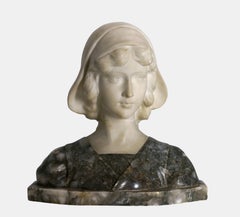
Anonymous, Bust of a young woman, c. 1900, artificial marble and gray onyx marble. 37 cm (height) x 37 cm (width) x 22 cm (depth), weight 17.2 kg. Signed “GURRINI” on the reverse.
-...
Category
Early 1900s Realist Figurative Sculptures
Materials
Marble
Figurative Ceramic Sculpture with Forged Iron Collar Woman Scarf, Women of Iron
By Óscar Aldonza Torres
Located in FISTERRA, ES
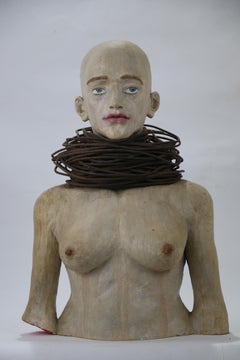
Figurative ceramic sculpture with forged iron elements and hand-painted polychromy, this female bust explores identity, tension and material presence. In this ceramic sculpture, Ósca...
Category
2010s Realist Figurative Sculptures
Materials
Iron
$2,859
H 23.63 in W 15.75 in D 9.06 in
Alfred Dubucand (1828-1894): Two hunting dogs
Located in Berlin, DE
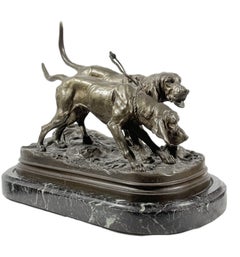
Dubucand Alfred 1828-1894
Two Hunting Dogs, Bronze on a Marble Base
The Bronze with the monogram 'E.V.' and the number '2958'
Two Hunting Dogs, Group Signed Alfred Dubucand, Fren...
Category
Late 19th Century Realist Figurative Sculptures
Materials
Bronze
$5,063
H 10.04 in W 7.76 in D 13.71 in
"Doubt" figurative sculpture bronze limited at 8 pieces 16x16x16cm 2009
By Emmanuelle Vroelant
Located in Saint Pol de Léon, Bretagne
"Doubt" bronze figurative sculpture limited at 8 pieces 16x16x16cm left n° 3/8 certificate emmanuelle vroelant
in 2009 Emmanuelle Vroelant decided to start scu...
Category
21st Century and Contemporary Realist Figurative Sculptures
Materials
Bronze
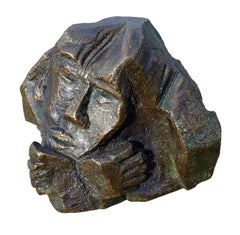
$1,620 Sale Price
20% Off
H 6.3 in W 6.3 in D 6.3 in
Afterlife
Located in Colorado Springs, CO
Edition 10/33. Inscribed by the artist Natalie Diedrick on the base of bronze sculpture.
Category
21st Century and Contemporary Realist Figurative Sculptures
Materials
Bronze
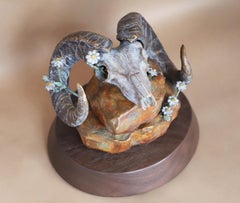
Another Drink
Located in Colorado Springs, CO
Edition 15/25. Original bronze sculpture by artist Greg Kelsey. Inscribed by artist at base.
Category
21st Century and Contemporary Realist Figurative Sculptures
Materials
Bronze
More From This Seller
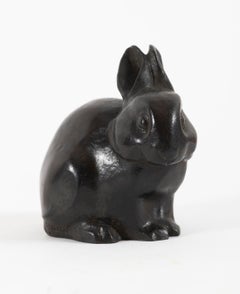
View AllLapin, by Sandoz, rabbit, animal, sculpture, bronze, 1910
s, swiss artist, cast
By Edouard-Marcel Sandoz
Located in Geneva, CH
Lapin, modèle 5, circa 1919-1921
Fondeur Susse
Bronze with brown patina
6.5 x 4.9 x 6.5 cm
Inscribed and foundry stamp : Ed.m.Sandoz, Susse Frères Editeurs
Certificate of authentici...
Category
1910s Modern Figurative Sculptures
Materials
Bronze
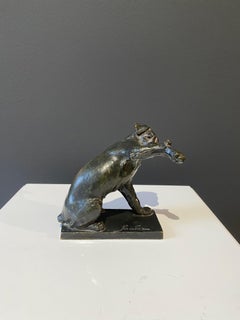
Chien à la sauterelle, Sandoz, Dog, Sculpture, Bronze, Animal, 1910
s
By Edouard-Marcel Sandoz
Located in Geneva, CH
Chien à la sauterelle, Sandoz, Dog, Sculpture, Bronze, Animal, 1910's
Chien à la sauterelle
Susse Fondeur
circa 1918-1930
Bronze with brown patina and shade of green
13 x 13 x 9 cm
Signed and seal of the foundry on the base : Sandoz, Susse Fondeur
Catalogue raisonné de l'oeuvre sculpté de Edouard Marcel Sandoz, sculpteur figuriste et animalier 1881-1971, by Félix Marcilhac, Les Editions de l'amateur, 1993...
Category
1910s Modern Figurative Sculptures
Materials
Bronze
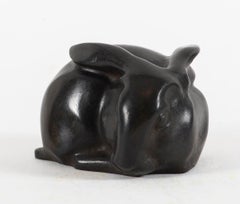
Lapin, by Sandoz, Rabbit, animal, sculpture, bronze, 1910
s, brown patina, cast
By Edouard-Marcel Sandoz
Located in Geneva, CH
Lapin couché, circa 1919-1925
Fondry Susse, Ed. 10 pcs
Bronze with a brown patina
H. 6 cm
Sandoz : Sculpteur Figuriste et Animalier 1881-1971, Catalogue Raisonné de l'Oeuvre Sculpté...
Category
1910s Modern Figurative Sculptures
Materials
Bronze
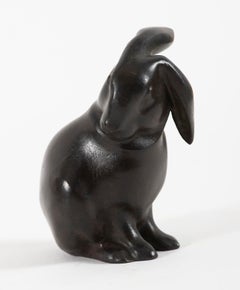
Lapin assis, tête tournée, Sandoz, 1910
s, bronze, animal, rabbits, rare proof
By Edouard-Marcel Sandoz
Located in Geneva, CH
Lapin assis, tête tournée, circa 1919-1921
Fondry Susse, Ed. 3/5 pcs
circa 1919-1921
Rare bronze proof with a brown patina
8.5 x 5.5 x 6.5 cm
Certificate of authenticity issued by th...
Category
1910s Modern Figurative Sculptures
Materials
Bronze
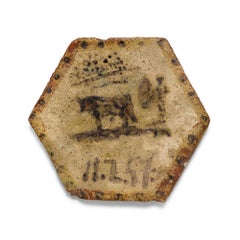
Taureau et Toreador, Picasso, Bull, Corrida, Design, Tile, Ceramic, 1950
s
By Pablo Picasso
Located in Geneva, CH
Taureau et Toreador, Picasso, Bull, Corrida, Design, Tile, Ceramic, 1950's
Taureau et Toreador
Unique work
11.2.1957
Painted and partially glazed ceramic, hexagonal tomette tile
15 ...
Category
1950s Post-War Figurative Sculptures
Materials
Ceramic
Scène de tauromachie, Picasso, 1950
s, edition, earthenware, terracotta, scene
By Pablo Picasso
Located in Geneva, CH
Scène de tauromachie, Picasso, 1950's, edition, earthenware, terracotta, scene
Scène de tauromachie
Ed.274/500 pcs
1957
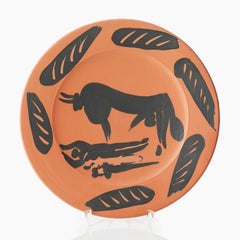
Red earthenware clay, eng...
Category
1950s Post-War Figurative Sculptures
Materials
Earthenware, Terracotta
Still Thinking About These?
All Recently ViewedMore Ways To Browse
Cesar Baldaccini
Baccarat Crystal Sculptures
Pantograph Used
Cherry Pickers
Chinese Watercolor Boat
Clara Deike
Cocaine Art
Cognac Pellisson
Colin Hunter
Contemporary Maine Landscape Paintings
Corneille 1948
Coronado Paintings
Corsica Poster
Cotton Pickers
Crane Bird Painting
Cunard Line Posters
Dali Watch
Dartmouth Winter Carnival