Items Similar to Antique Bronze Miniature Barnyard with a Bull, Sheep
Goat circa 1860, France
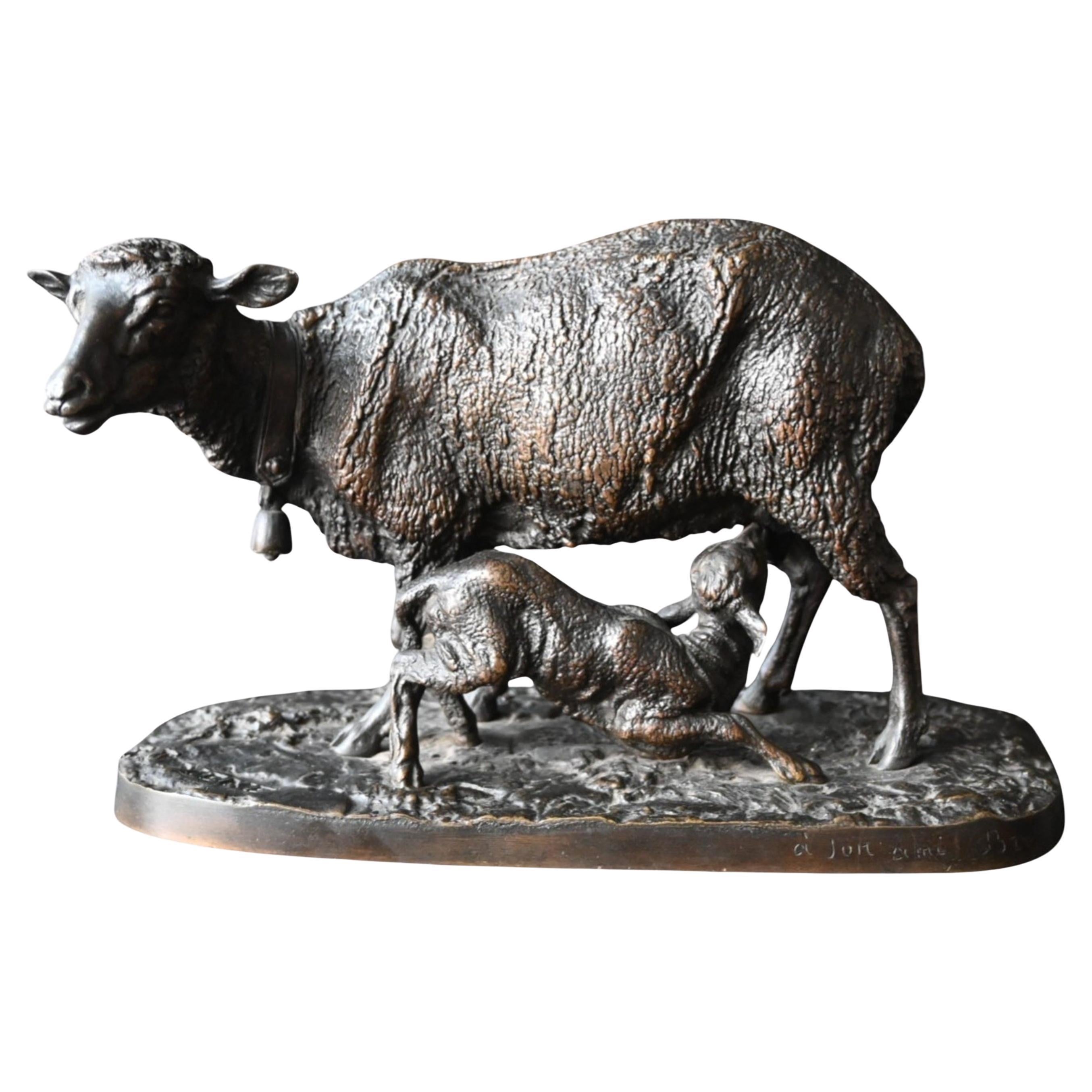
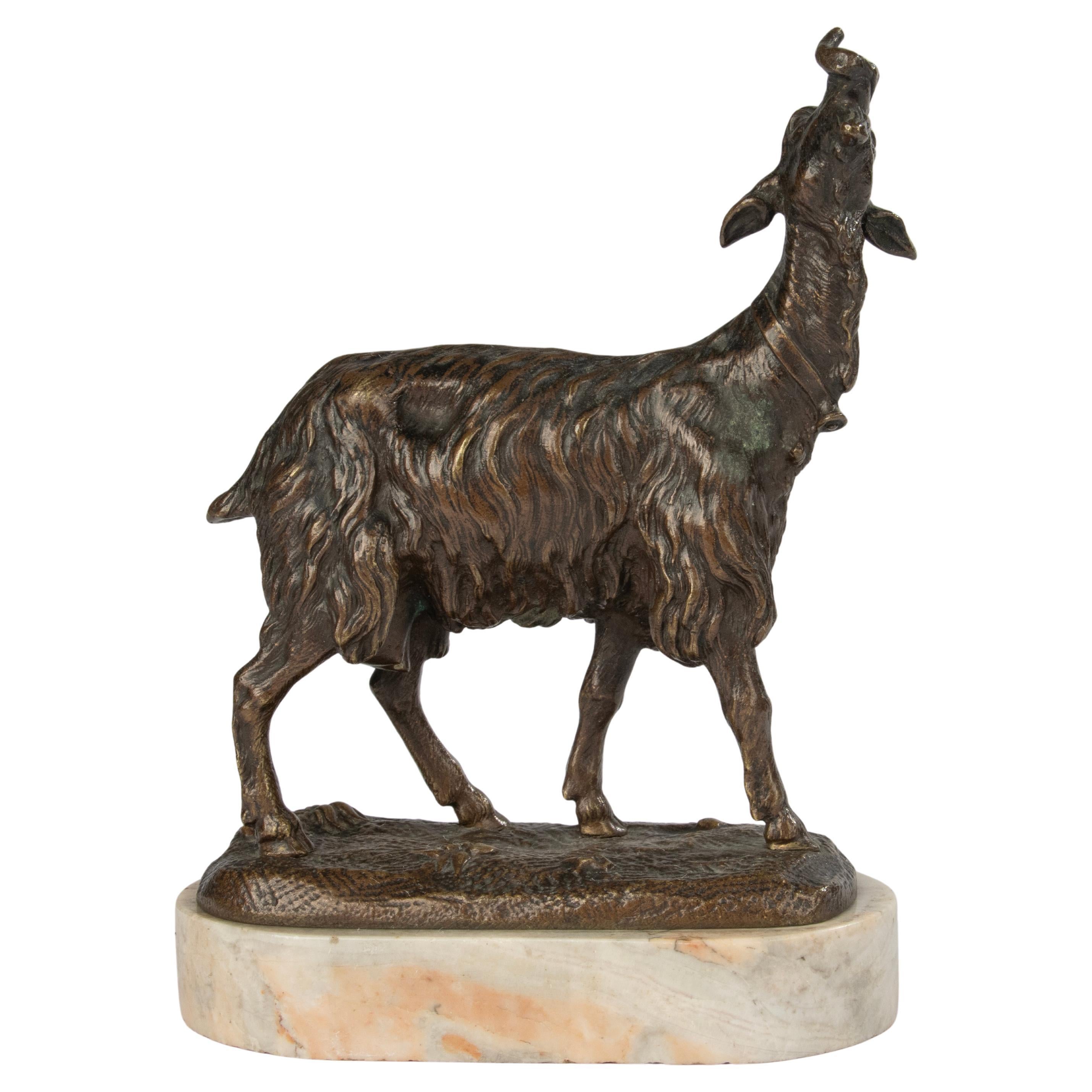
Want more images or videos?
Request additional images or videos from the seller
1 of 13
Christophe FratinAntique Bronze Miniature Barnyard with a Bull, Sheep
Goat circa 1860, FranceCirca 1860
Circa 1860
$6,600
£4,998.89
€5,741.05
CA$9,248.76
A$10,055.27
CHF 5,331.31
MX$120,537.13
NOK 67,758.25
SEK 62,075.77
DKK 42,907.08
About the Item
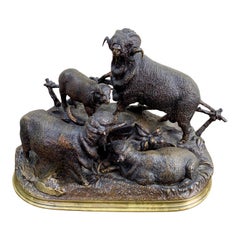
Antique Bronze Miniature Barnyard Scene (Cow, Sheep
Goat)
Christophe Fratin (France, 1801-1864)
Sand cast bronze
5 3/4 x 4 1/4 x 2 1/4 inches
Highly refined and sensitively modeled miniature bronze representing a small herd of cattle, sheep and cattle on the terrace. Despite its small size, this bronze offers a complete view of a small herd of livestock: a bull is lying in a landscape near a sheep and a goat climbing a tree above a rocky mound. Here we find the skillful hand of the animalier sculptor Christophe Fratin (French, 1801-1864), immensely famous in the 19th century for his thoughtfully crafted animal subjects as well as for his humorous anthropomorphic scenes. Resting on a small terrace, the artist with great mastery and realism describes a rural scene where the three animals have an attitude close to that in which we could meet them in nature. The sand cast fabrication and the carving are of very fine quality. Fratin has been able to render the texture of the animals' fur, the details are finely modeled in this miniature work. The superb patina is a warm dark to slightly golden brown. The bronze is signed on the terrace at the foot of the rocky mound with the famous signature of Fratin including his trademarked inverted "N."
Christophe Fratin, a native of Metz, first apprenticed with his taxidermist father until 1821, after which he shifted to a career in sculpture. Fratin was a highly skilled artist and one of the first of the French sculptors, along with Antoine Louis Barye, to successfully portray animals in bronze. His understanding of animal anatomy as well as their natural actions and poses infuse his bronzes with a life-like realism. Most of his animal subjects were modeled as what they would have looked like in their natural environment as opposed to the over-fed zoo animals that were created by so many other artists. Fratin's true understanding of animal anatomy and form came from his early experiences helping his father with his taxidermy business.
In Metz, he studied with sculptor Charles Augustin Pioche (1762-1839), until he tired of the Romantic style of the day. Afterwards, he went to Paris to work in the studio of Théodore Gericault, the only master he listed in the entries for his works in the Salon catalogues of the 1860s. In the Salon of 1831, he made his debut with wax models of a thoroughbred horse and several dogs, ushering in with another debutant, Antoine-Louis Barye, the golden age of animalier sculpture.
Though never as famous as Barye, Fratin enjoyed greater professional and commercial success than many of his fellow animalier sculptors during the nineteenth century. He received several commissions for public sculpture in Paris and in the United States; a bronze group of two eagles and their prey in Central Park since 1863, is the oldest sculpture in any park in New York City. The French government also commissioned small works that were deposited in numerous provincial museums.
Fratin's animal bronzes were very popular throughout Europe as well as America and England. Fratin's work was highly romantic without the dramatic and violent treatment that Barye could so successfully portray. Fratin executed his many subjects, always capturing their activities in flight or in motion with their flowing manes and tails. His ability to capture an animal in full flight, or at the exact moment a predator catches its prey, remains unmatched by any artist from any time. His small-scale sculptures were produced in bronze, terracotta, plaster, and even faience. Functional objects (platters and cane heads, for example) were produced as well as "pure" sculpture with the English market particularly favoring Fratin's work.
Fratin's public success and critical reputation owed much to his sales at public auction, a means of direct marketing that he used more frequently than most of his colleagues. Beginning in 1849, Fratin held at least one sale in Paris almost every year that was reviewed in the art journals.
Fratin achieved immense artistic acclaim through his very personal and very popular works of art due to their appeal to middle-class interests. His most lasting influence is due to his subtle expressiveness, vigorous rendering, and high-quality foundry work. His loose, free and sketchy modeling techniques ably illustrate his imaginative mind and sense of humor.
Fratin holds an important position amongst “Les Animaliers.” His style is unique and distinctive, with attention paid to the surface texture and less importance placed on anatomical detail. Above all Fratin was a romanticist, evoking mood through both style and subject.
Metz, France
Lyon, France
Nimes, France
Louvre Museum, Paris
The Wallace Collection, London, England
The National Gallery of Art, Washington, D.C.
The Peabody Institute, Baltimore, Maryland
The Eisler Collection, Vienna, Austria
- Creator:Christophe Fratin (1801-1864, French)
- Creation Year:Circa 1860
- Dimensions:Height: 4.25 in (10.8 cm)Width: 5.75 in (14.61 cm)Depth: 2.5 in (6.35 cm)
- Medium:
- Movement Style:
- Period:
- Condition:The condition is excellent.
- Gallery Location:SANTA FE, NM
- Reference Number:1stDibs: LU1408211241782
About the Seller
5.0
Platinum Seller
Premium sellers with a 4.7+ rating and 24-hour response times
Established in 1995
1stDibs seller since 2020
130 sales on 1stDibs
Typical response time: 2 hours
- ShippingRetrieving quote...Shipping from: Santa Fe, NM
- Return Policy
More From This Seller
View AllAntique Exceptional Bronze Draft Horse by Pierre Jules Mêne (French, 1810-1879)
Located in SANTA FE, NM
Antique Horse Bronze
Exceptional Bronze of a Draft Horse
Pierre Jules Mêne (French, 1810-1879)
Circa 1860s
4 3/4 (W) x 3.25 (H)
As Mêne personally ov...
Category
Mid-19th Century Romantic Figurative Sculptures
Materials
Bronze
Antique Bronze Dog "Whippet with a Butterfly" Arthur Waagen (1833-1898) 2 of 2
By Arthur Waagen
Located in SANTA FE, NM
Antique Bronze Dog Portrait
“La Levrette au Papillon” or “Whippet (Greyhound) with a Butterfly”
Arthur Waagen (Germany, France 1833-1898)
Circa 1860’s
11 x 8 x 4 inches
(2of 2. No...
Category
1860s Academic Figurative Sculptures
Materials
Bronze

Horse Playing with a Dog (The Good Companions) Pierre-Jules Mene (1810-1879)
By Pierre Jules Mêne
Located in SANTA FE, NM
Antique Horse Bronze
"Horse in the Stable Playing with a Dog (The Good Companions)"
Jument à l'écurie jouant avec un chien
Pierre-Jules Mene (French, 1810-1879)
Bronze
19 x 10 inc...
Category
1860s Realist Figurative Sculptures
Materials
Bronze
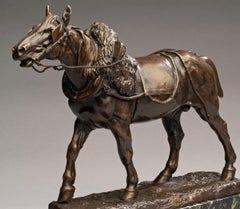
Antique Bronze Portrait Draft Horse by Isidore Jules Bonheur (France, 1827-1901)
By Isidore Jules Bonheur
Located in SANTA FE, NM
Antique Bronze Portrait of a Draft Horse
Isidore Jules Bonheur (France, 1827-1901)
Circa 1840s
Cast bronze mounted on a rectangular plinth atop a marble s...
Category
1870s Realist Figurative Sculptures
Materials
Bronze
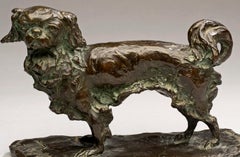
Antique Bronze Dog Portrait of a Cavalier King Charles "Thigley" circa 1905
Located in SANTA FE, NM
Antique Bronze Dog Portrait of a Cavalier King Charles
"Thigley"
French School (possibly Franck Burty Haviland)
Lost wax bronze casting
Circa 1910
5 7/8 x 9 x 3 1/4
A sophisticated bronze casting of a Cavalier King Charles spaniel made in lost wax casting (cire perdue) from the beginning of the 20th century by Valsuani Foundry. This an unusual bronze approached in its aesthetic that’s reminiscent of the work of great animal sculptors of the second half of the 19th century except in this presentation which is more avant-garde for the time with a much looser, more impressionistic execution. The patina is a superb bronze color, brown and slightly greenish, going in places towards a more antique green.
The attitude of the dog is extremely well and sensitively rendered with the placement of material unlike the renderings of a bronze by Barye...
Category
Early 1900s French School Figurative Sculptures
Materials
Bronze
$3,750 Sale Price
50% Off
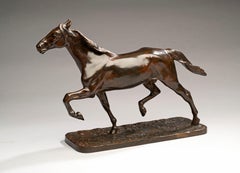
Antique Horse Bronze Trotting Stallion Isidore Jules Bonheur (France, 1827-1901)
By Isidore Jules Bonheur
Located in SANTA FE, NM
Antique Horse Bronze
Portrait of a Trotting Stallion
Isidore Jules Bonheur (France, 1827-1901)
Cast bronze mounted on a rectangular plinth with dark brown patina,
Signed: I. BONHEUR
17 x 11 3/4
A brilliant exploration of a stallion in full trot. The patina is a deep, warm walnut brown with honey-colored tones.
Isidore Bonheur was best known and the most distinguished of the 19th century French animalier sculptors. Isidore, the younger brother of Rosa Bonheur and older brother of Auguste, began his studies of painting initially with his father, who was friends with Francisco Goya. By 1848 he debuted at the Paris Salon having discontinued animal and landscape painting to concentrate on creating sculptures and in 1849, Bonheur enrolled at the Ecole des Beaux Arts. He won medals at the Paris Salon in 1859 and did so again in 1865 and in 1869. After entering the Exposition Universelle 1855, he won the Gold Medal in 1889. In the 1870s exhibited in the London at the Royal Academy of Arts where he earned great prestige and won the coveted Medaille d’Or. After winning numerous other medals and prizes, Bonheur was awarded the Legion d' Honneur in 1895 and he was Knighted in Portugal, Spain and France. Bonheur continued exhibiting at the Paris Salon until 1899.
Many of his bronzes were fabricated at the foundry owned by Hippolyte Peyrol, Bonheur's brother-in-law by marriage to Isidore’s youngest sister Juliette Bonheur. The Peyrol casts for both Rosa and Isidore are exceptionally well executed which suggests a strong working relationship between the founder and sculptor. There is little doubt that Isidore Bonheur was an acute observer of nature; his animals were not anthropomorphized but modelled to catch movement or posture characteristics of the particular species he was sculpting. He achieved this most successfully with his sculptures of horses which are usually depicted as relaxed rather than spirited. These figures are among his most renowned works and his equestrian models became very popular, particularly among the British aristocracy.
An acute observer of nature, his sculptures reflect his commitment to the Realist school - with precise detailing of the movements of animals in their natural habitats. Ultimately, His naturalistic studies of animals are now some of the most highly sought after works by any of the animalier. He was possibly inspired by his many visits to the Buffalo Bill Wild West Show...
Category
1870s Realist Figurative Sculptures
Materials
Bronze
You May Also Like
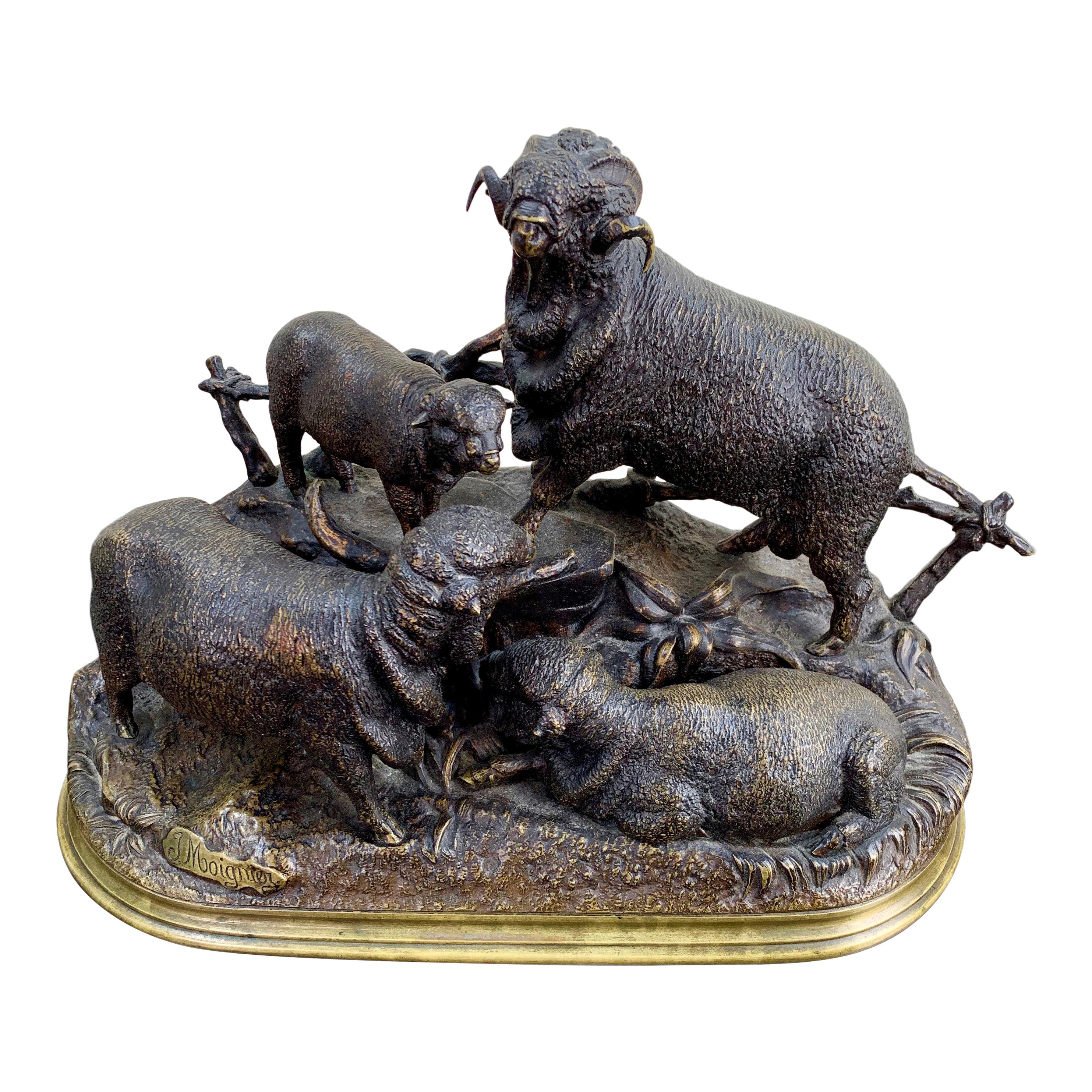
Jules Moigniez Bronze Sculpture of Three Sheep and a Lamb
By Jules Moigniez
Located in Philadelphia, PA
Bronze grouping of sheep with a nuanced brown patination. Moigniez' intricate work on the surface of the piece created a true-to-life rendering of the sheep's fleece. The group is se...
Category
Antique Mid-19th Century European Napoleon III Animal Sculptures
Materials
Bronze
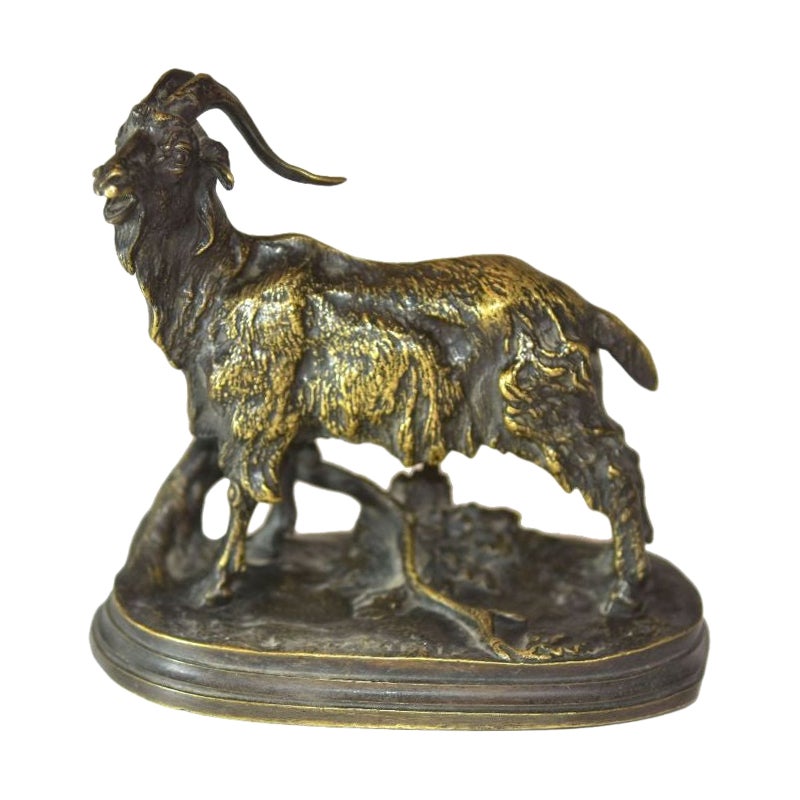
Animal Bronze with Goat by P. J Leads, Late 19th Century
Located in Marseille, FR
The animal bronze goat by P. J Mène. Medal patina. Period late nineteenth. Dimension 13.5 cm long 12.5 cm high and 8.5 cm deep.
Additional information:
Material: Bronze
Artist: ...
Category
Antique Late 19th Century Animal Sculptures
Materials
Bronze
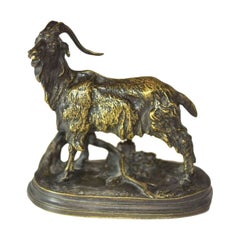
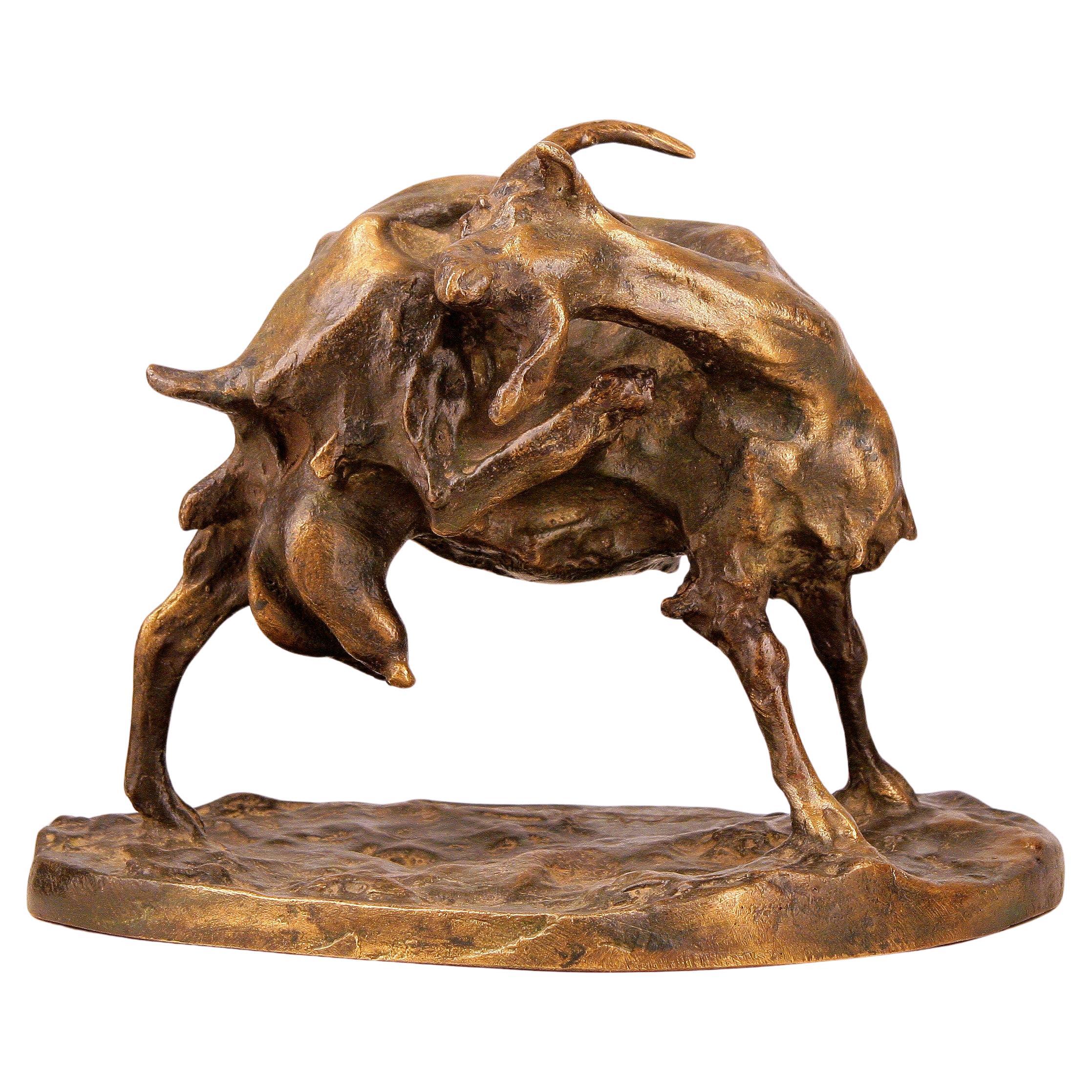
Patinated Bronze Early 20th Century Sculpture of Goat by Italian Ernesto Bazzaro
By Ernesto Bazzaro
Located in North Miami, FL
Patinated bronze early 20th century sculpture of goat by italian sculptor Ernesto Bazzaro
By: Ernesto Bazzaro
Material: bronze, copper, metal
Technique: cast, molded, polished, pati...
Category
Early 20th Century Italian Bohemian Animal Sculptures
Materials
Metal, Bronze, Copper
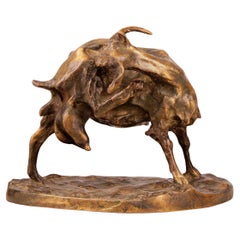
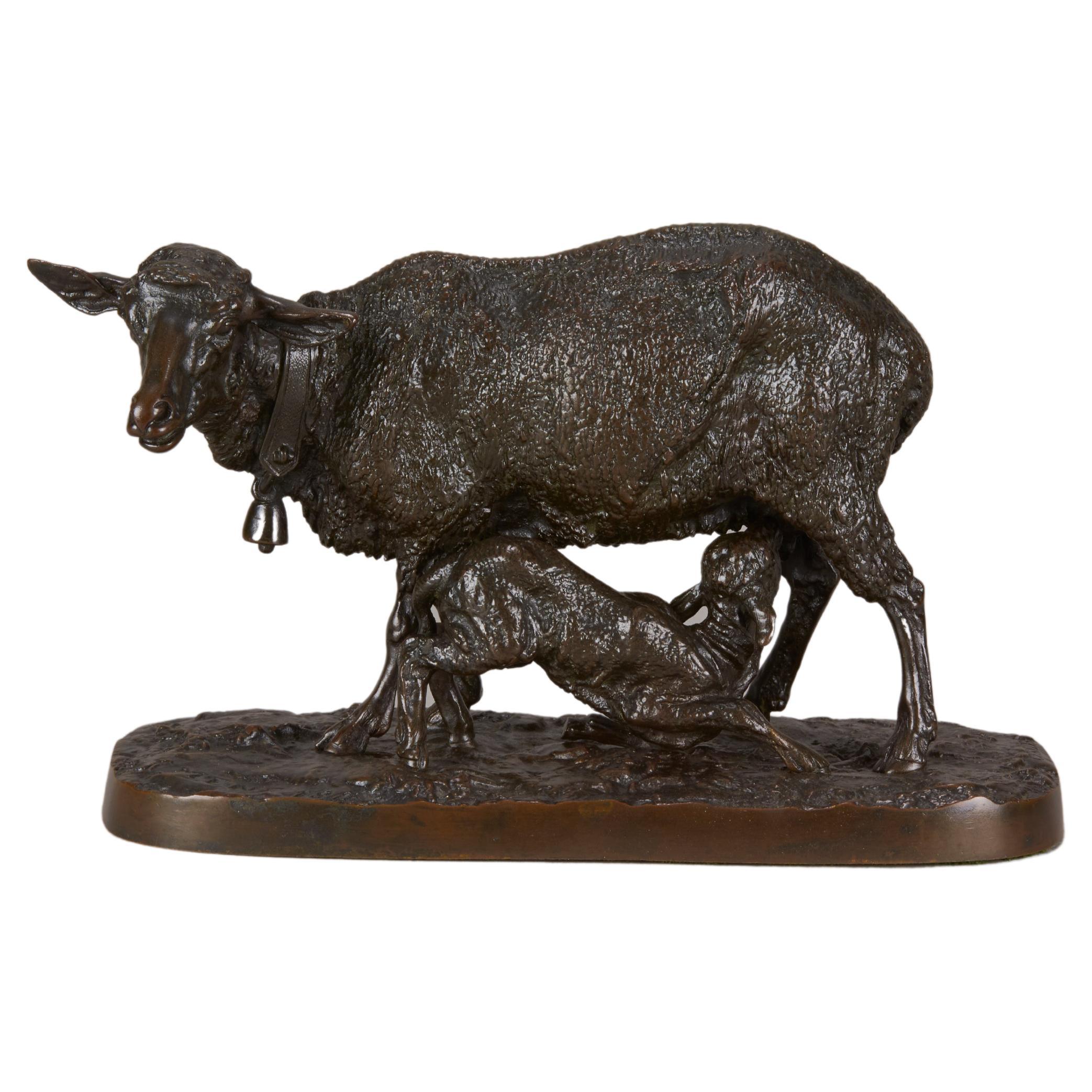
19th Century Anamilier Bronze Entitled "Ewe And Lamb" by Pierre Jules Mêne
By Pierre Jules Mêne
Located in London, GB
Wonderful 19th Century animalier bronze group of a standing ewe with her feeding lamb beneath her, the bronze with excellent rich brown patina and very fine hand chased surface detai...
Category
Antique 1870s Art Nouveau Animal Sculptures
Materials
Bronze
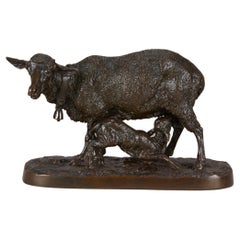
Pierre-jules Mêne, Bronze, The Sheep And Its Lamb, With Important Provenance
By Pierre Jules Mêne
Located in Bilzen, BE
"Pierre-jules Mêne (1810–1879) Bronze, The Sheep And Its Lamb, With Important Provenance"
Pierre-Jules Mêne (1810–1879)
La Brebis et son Agneau (The Ewe and Her Lamb)
Bronze with bro...
Category
Antique Mid-19th Century French Napoleon III Animal Sculptures
Materials
Bronze
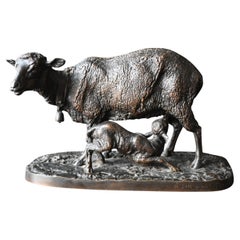
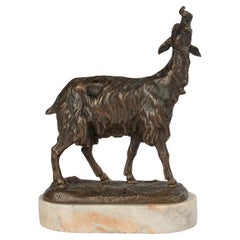
19th Century Bronze Sculpture of a Goat - Bronze Animal Sculpture
Located in Casteren, Noord-Brabant
A beautiful antique bronze sculpture of a goat.
The bronze sculpture stands on a marble plinth. The statue is not marked, maker unknown.
The statue is of a beautiful quality: refined...
Category
Antique 1890s French Belle Époque Animal Sculptures
Materials
Marble, Bronze
More Ways To Browse
Bronze Bull
French Bull
Miniature Scene
Goat Sculpture
19th Century Life Size Bronze Sculpture
Antique French Miniature
Sheep Herder
Sheep Sculpture
Sheep French
Bronze Sculpture Goat
Bronze Sheep
Bronze Cow
Sheep Sculpture Bronze
Antique Bronze Goat
Kaws What Party White
Last Rites
Lollipop Sculpture
Lovers Embrace Bronze