Want more images or videos?
Request additional images or videos from the seller
1 of 2

Ferdinand Barbedienne
The Story of Joseph from the Second Baptistery Doors, Florence (“The Gates of Pa

Circa 1880

$50,000
£38,074.97
€43,479.18
CA$70,256.17
A$77,084.41
CHF 40,604.36
MX$917,000.35
NOK 520,137.02
SEK 474,956.12
DKK 324,831.34

About the Item

Ferdinand Barbedienne (Saint-Martin-de-Fresnay 1810 – 1892 Paris) after Lorenzo Ghiberti (Florence, 1378 – 1455) Signed at the lower right of the principal relief: F. BARBEDIENNE Provenance: Private Collection, USA. Barbedienne’s “Gates of Paradise” reliefs are one of the triumphs of nineteenth-century bronze casting and patination. The nine panels that comprise our example are half-size reductions of the famous originals by Lorenzo Ghiberti, made for the Baptistery of Florence and now housed in the Museo del Opera del Duomo. Mounted in an impressive, mullioned frame surround, our work is an exceptional exemplar of the Renaissance Revival, the broadly influential style and movement that infused architecture, design, and artistic culture in the latter half of the nineteenth century. The central scene, The Story of Joseph, is perhaps the most celebrated of the entire series depicting as it does seven episodes from the Biblical narrative integrated into a single composition: Joseph cast by his brethren into the well, Joseph sold to the merchants, the merchants delivering Joseph to the pharaoh, Joseph interpreting the pharaoh’s dream, the pharaoh paying him honor, Jacob sending his sons to Egypt, and Joseph recognizes his brothers and returns home. The surrounding reliefs—two vertical figures in niches, two recumbent figures, and four portrait heads in roundels—are as well faithful reductions of Ghiberti’s original bronzes on other parts of the doors. The maker of these casts was the renowned 19th-century French fondeur Ferdinand Barbedienne. Gary Radke has recently written of this great enterprise: “The Parisian bronze caster Ferdinand Barbedienne began making half-sized copies of ancient and Renaissance sculpture in the 1830s. His firm benefitted enormously from the collaboration of Achille Collas, whom Meredith Shedd has shown was one of numerous pioneers in the mechanical reproduction of sculpture. Their competitors largely devoted themselves to reproducing relief sculpture, but Collas devised a process for creating fully three-dimensional copies. A tracing needle, powered by a treadle, moved over the surface of a full-sized plaster cast or bronze of the original and triggered a complementary action in a cutting stylus set over a soft plaster blank…He signed an exclusive contract with Barbedienne on November 29, 1838, and won medals for his inventions in 1839 and 1844. Barbedienne’s half-sized copies of the Gates of Paradise were famous not only for their fidelity to the original, but also for the way their gilding…suggested the glimmering surface that was hidden under centuries of dirt. Some critics even saw Collas’s and Barbedienne’s work as ‘philanthropic, an exemplary adaptation of industry to the requirements of art, the artist, the workers, and the public alike.’ At 25,000 francs, Collas’s and Barbedienne’s reduction of the Gates of Paradise was singularly more expensive than any other item for sale in their shop. All the reliefs, individual statuettes, and busts were cast separately and could be purchased either by the piece or as an ensemble. Fittingly, Barbedienne’s accomplishment earned him the Grand Prix at the 1878 Paris Exposition Universelle, along with numerous other medals.” Three complete examples of the Barbedienne-Ghiberti doors are known. One, first installed in a chapel in the Villa Demidoff of San Donato near Pratolino, was later acquired by William Vanderbilt and installed in his mansion on Fifth Avenue in New York (Fig. 1). Following the demolition of that house in 1946, the doors were gifted to the University of Nevada in Reno, where they now form the entrance to the Special Collections of the Mathewson-IGT Knowledge Center. A second set appeared at auction in London in 2017, while a third brought the extraordinary amount of €337,500 at a sale at the Hôtel Drouot sale in Paris in 2014. Individual scenes were cast to order directly from Barbedienne’s studio, but it would seem that few were actually made. Both the 1886 and 1893 editions of the Catalogue des Bronzes d’art of the Barbedienne Atelier list the “Histoire de Joseph” from the “Porte principale du Baptistère de Florence par Lorenzo Ghiberti” for sale at 700 francs. However, only two other examples are known today—one of which we were privileged to handle some years ago. Our cast is exceptionally preserved, with the brilliant gilding and patination for which Barbedienne was celebrated intact.
  • Creator:
    Ferdinand Barbedienne (1810 - 1892, French)
  • Creation Year:
    Circa 1880
  • Dimensions:
    Height: 27.56 in (70 cm)Width: 27.56 in (70 cm)
  • Medium:
  • Period:
  • Condition:
  • Gallery Location:
    New York, NY
  • Reference Number:
    1stDibs: LU10212114102

More From This Seller

View All
Seven Scenes from the Life of Apollo
By Jacopo Guarana
Located in New York, NY
Attributed to Jacopo Guarana (Verona 1720 – 1808 Venice) Canvas, unsigned The Deeds of Apollo Provenance: Suida-Manning Collection These seven scenes are brilliant evocations o...
Category

18th Century and Earlier Baroque Figurative Paintings

Materials

Oil

Baptism of Christ
Located in New York, NY
Provenance: Achillito Chiesa, Milan Luigi Albrighi, Florence, by 1 July 1955 with Marcello and Carlo Sestieri, Rome, 1969 Private Collection, Connecticut Exhibited: Mount Holyoke College Art Museum, South Hadley, Massachusetts (on loan, 2012) Literature: Carlo Volpe, “Alcune restituzioni al Maestro dei Santi Quirico e Giulitta,” in Quaderni di Emblema 2: Miscellanea di Bonsanti, Fahy, Francisci, Gardner, Mortari, Sestieri, Volpe, Zeri, Bergamo, 1973, pp. 19-20, fig. 18, as by the Master of Saints Quiricus and Julitta (now identified as Borghese di Piero). This fine predella panel depicting the Baptism...
Category

15th Century and Earlier Old Masters Figurative Paintings

Materials

Tempera, Wood Panel

Two Scenes of Diana and Actaeon (a pair)
By Giovanni Battista Viola
Located in New York, NY
Provenance: Robert L. and Bertina Suida Manning, New York, until 1996 Private Collection, USA Giovanni Battista Viola was born in Bologna a...
Category

17th Century Baroque Landscape Paintings

Materials

Copper

Joseph Holding the Christ Child
By Pietro Bardellino
Located in New York, NY
Provenance: Private Collection, Argentina. A work of great delicacy and intimacy, this small painting on copper by Pietro Bardellino treats a subject which grew in popularity during the Baroque period: Saint Joseph and the Christ child...
Category

18th Century Baroque Paintings

Materials

Copper

A Magnificent Gilt Wood Mirrored Frame
Located in New York, NY
Provenance: Private Collection, Argentina; there acquired by Mr. and Mrs. Ernest T. Harper, New York, by 1960; by descent to: Mr. and Mrs. Alan Harper, New York, until 2024. This extraordinary mirrored frame is an exuberant and nearly perfectly preserved example of Andean 18th-century decorative art. Pierced mirrored rosettes surrounding floral motifs are set against mirrored surrounds along a broad frieze bordered within and without by elaborate raised moldings, inlaid by small, shaped mirrors. Repeating ornamental motifs reflecting both Spanish and indigenous designs surround both the inside panel and the exterior perimeter, the four corners of which are punctuated by mirrored rosettes. Glass mirrors were unknown to the indigenous population of the Americas prior to the arrival of Europeans (obsidian mirrors...
Category

18th Century Old Masters Figurative Paintings

Materials

Canvas, Mirror, Wood, Oil

Virgin of the Rosary of Chiquinquirá with Saint Anthony of Padua and Saint Andre
Located in New York, NY
Provenance: Private Collection, Uruguay, for the last 90 years. Dated 1673 on the reverse (Fig. 1), this exceptional relief is an early example of a distinctly Spanish American art...
Category

1670s Old Masters Figurative Sculptures

Materials

Alabaster

You May Also Like

Bronze San Domenico di Camerino Altarpiece
By Carlo Crivelli
Located in New York, NY
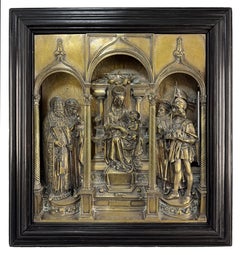
Representation of the San Domenico di Camerino Altarpiece, painted by Carlo Crivelli in 1482, and made by Antonio Pandiani in the 19th century.
Category

19th Century Renaissance Figurative Sculptures

Materials

Bronze

Large Terracotta Relief - Lombardy, First Half of 17th Century
Located in Bruxelles, BE
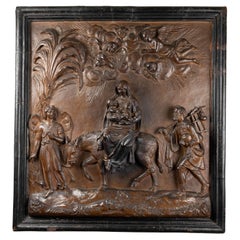
Large Terracotta relief of the flight into Egypt Lombardy, first half of 17th century Painted terracotta 91 x 85 x 11,5 cm This event in the early life of Christ is recounted i...
Category

Antique 17th Century Italian Baroque Figurative Sculptures

Materials

Terracotta

The Florence Baptistery - Vintage Photo Detail - Early 1900
Located in Roma, IT
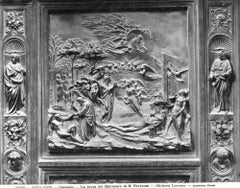
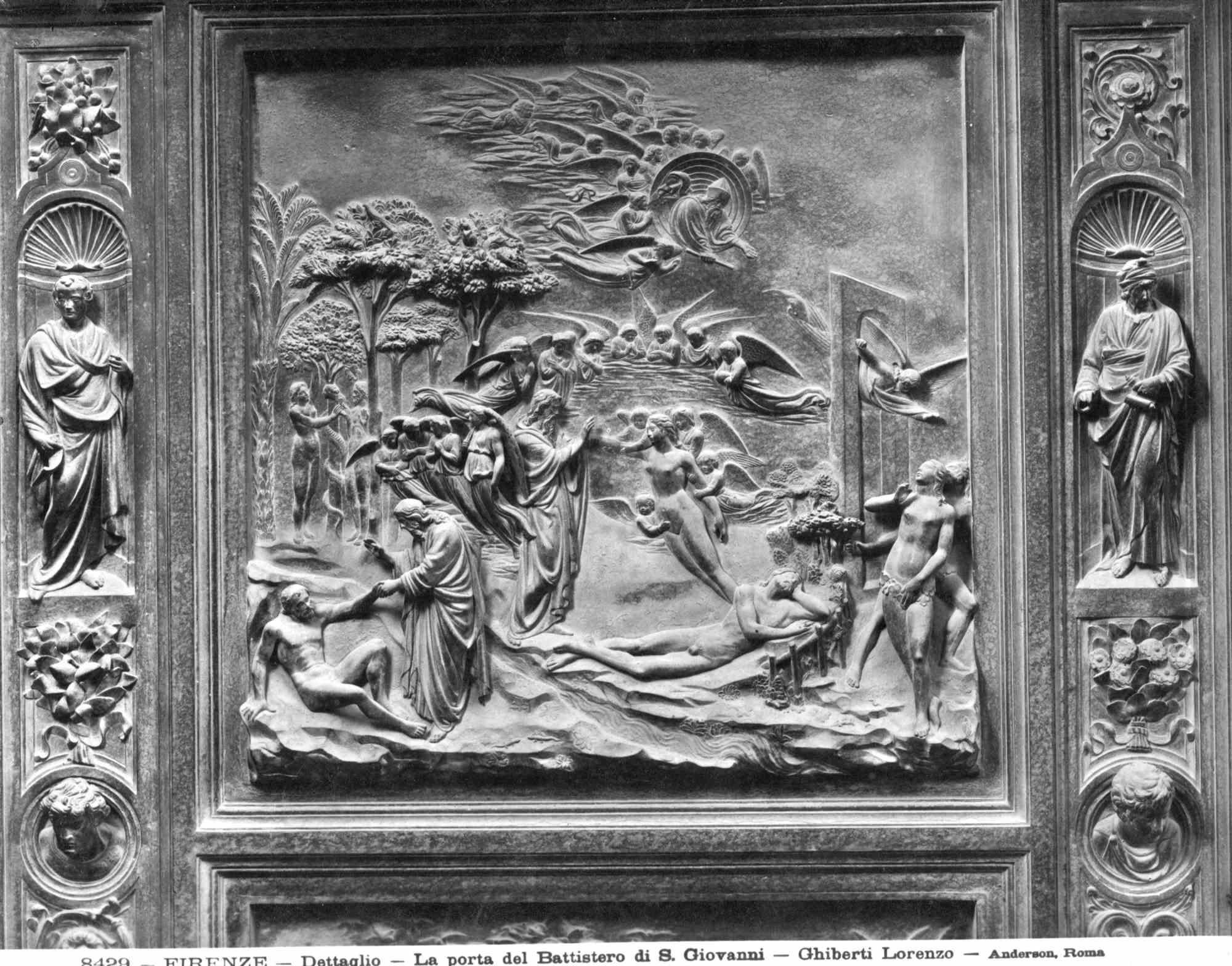
The Florence Baptistery is a b/w photographic print on paper. The artwork represents the detail of The Florence Baptistery. Good conditions. 8429- Florence - Gilberti Lorenzo- And...
Category

Early 20th Century Modern Black and White Photography

Materials

Photographic Paper

The Florence Baptistery - San Giovanni - Vintage Photo Detail - Early 1900
Located in Roma, IT
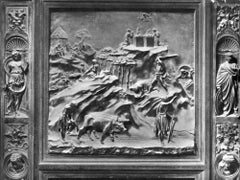
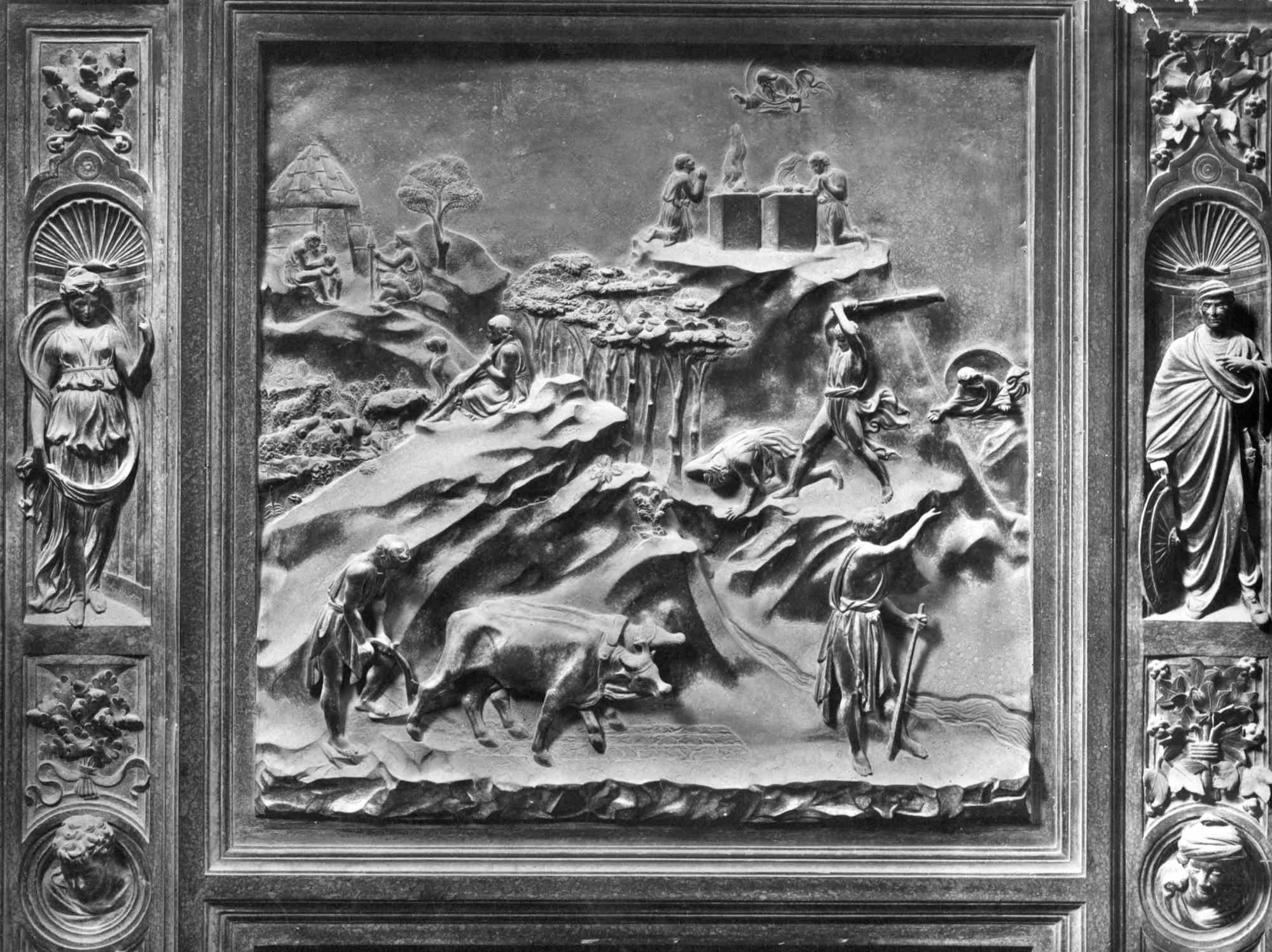
The Florence Baptistery is a b/w photographic print on paper, the artwork represents the detail of a door of Florence Baptistery. Gilberti Lorenzo- Anderson Roma is written at the ...
Category

Early 20th Century Modern Black and White Photography

Materials

Photographic Paper

The Florence Baptistery - Vintage B/w Photograph - Early 20th Century
Located in Roma, IT
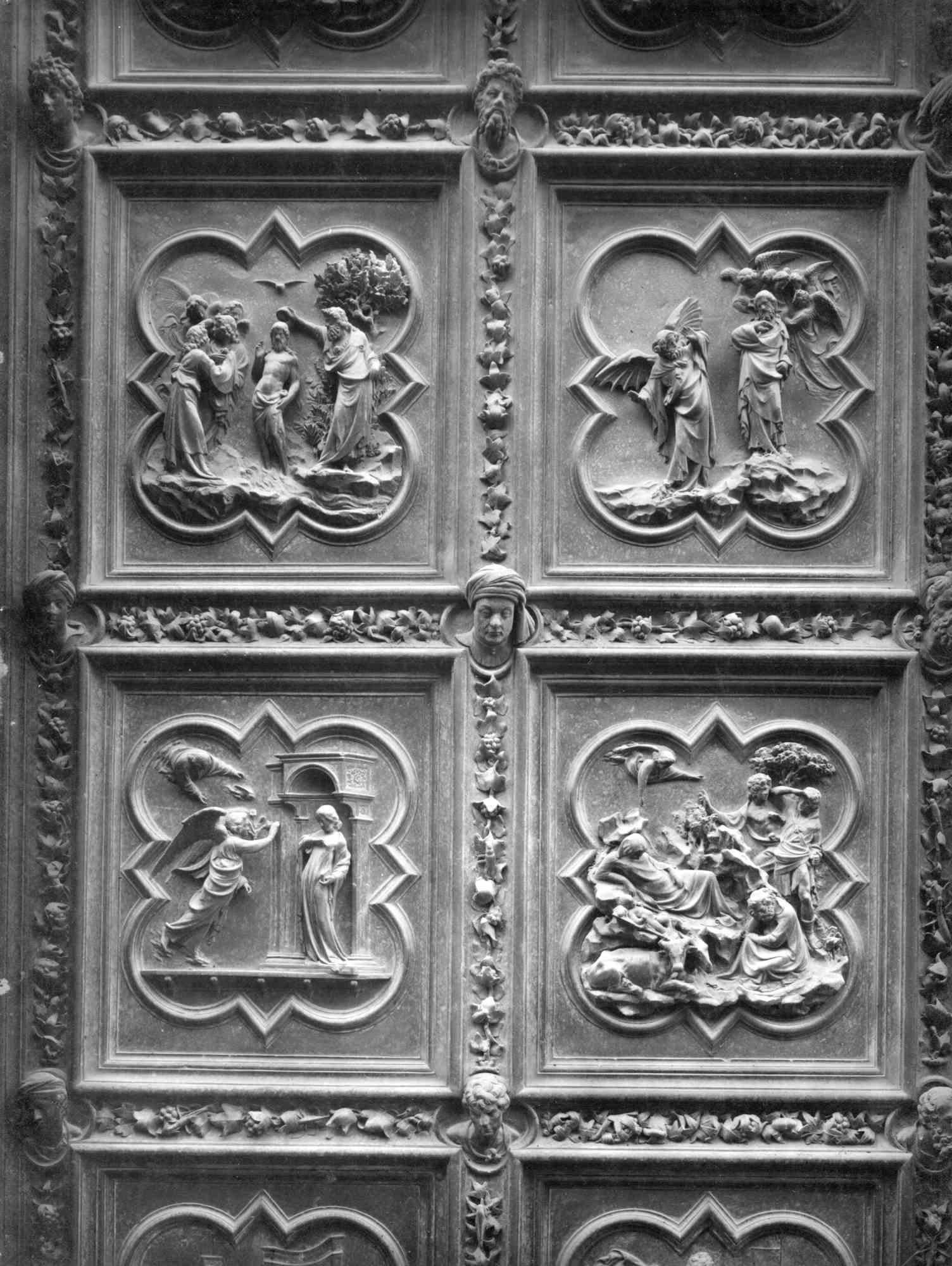
The Florence Baptistery is a b/w photographic print on paper, representing the door of The Church of Florence. Gilberti - Stab. D. Anderson is written at the bottom of the photo.
Category

Early 20th Century Modern Figurative Photography

Materials

Photographic Paper

Adoration of the shepherds - Large high-relief, Northern Italy Circa 1500
Located in PARIS, FR
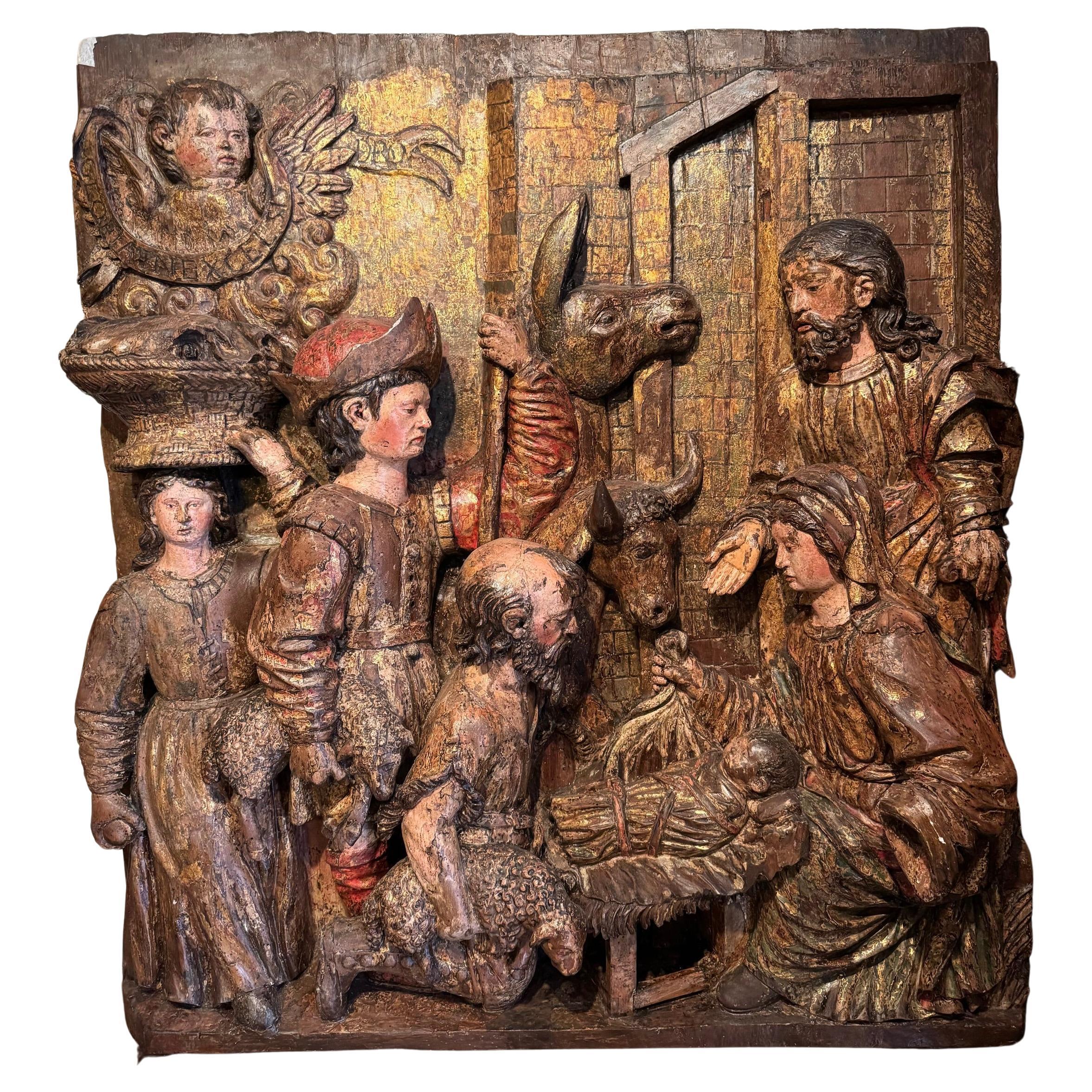
Large high relief in carved and gilt wood, with many traces of polychromy, representing the Adoration of the Shepherds. The evangelist Luke first mentions that the scene takes place at night. A sudden light, which frightens the shepherds, signals the arrival of an angel who announces "great joy". He gives them a sign: they will find "a newborn baby wrapped...
Category

Antique 16th Century Italian Renaissance Figurative Sculptures

Materials

Wood