Want more images or videos?
Request additional images or videos from the seller
1 of 5
Francis HarwoodEighteenth-century Grand Tour marble bust of Faustina the Younger1764
1764
$55,308.46List Price
About the Item
- Creator:Francis Harwood (1727 - 1783, English)
- Creation Year:1764
- Dimensions:Height: 20.5 in (52.07 cm)Width: 15 in (38.1 cm)
- Medium:
- Movement Style:
- Period:
- Condition:
- Gallery Location:London, GB
- Reference Number:1stDibs: LU150727994132
About the Seller
5.0
Recognized Seller
These prestigious sellers are industry leaders and represent the highest echelon for item quality and design.
1stDibs seller since 2021
5 sales on 1stDibs
Authenticity Guarantee
In the unlikely event there’s an issue with an item’s authenticity, contact us within 1 year for a full refund. DetailsMoney-Back Guarantee
If your item is not as described, is damaged in transit, or does not arrive, contact us within 7 days for a full refund. Details24-Hour Cancellation
You have a 24-hour grace period in which to reconsider your purchase, with no questions asked.Vetted Professional Sellers
Our world-class sellers must adhere to strict standards for service and quality, maintaining the integrity of our listings.Price-Match Guarantee
If you find that a seller listed the same item for a lower price elsewhere, we’ll match it.Trusted Global Delivery
Our best-in-class carrier network provides specialized shipping options worldwide, including custom delivery.You May Also Like
Erotic Sexual Mythological Marble Figural, Nude woman, Bacchante and Satyr Herm
Located in Miami, FL
Bacchic revelry. A sexy and nude curvaceous young Nymph/Bacchante makes amorous advances to a Herm - whose facial expression reflects her erotic touch. The Herm is stylized where his...
Category
Mid-19th Century Old Masters Nude Sculptures
Materials
Marble
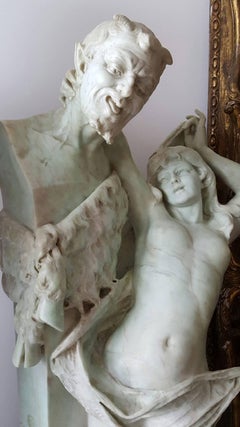
$21,750 Sale Price
25% Off
H 54.5 in W 24 in D 13.5 in
Early 19th century Empire figure bronze sculpture - woman
s bust
Located in Varmo, IT
Small bronze ornament - Bust of a woman. Italy, early 19th century.
8 x 8 x h 29 cm, without base h 23 cm.
Made entirely of patinated and gilded bronze. Depicting a female figure i...
Category
Early 19th Century Old Masters Figurative Sculptures
Materials
Marble, Bronze
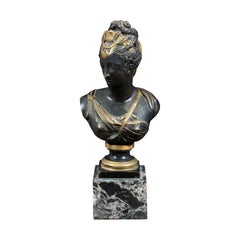
$1,436 Sale Price
33% Off
H 11.42 in W 3.15 in D 3.15 in
Virgin of the Rosary of Chiquinquirá with Saint Anthony of Padua and Saint Andre
Located in New York, NY
Provenance: Private Collection, Uruguay, for the last 90 years.
Dated 1673 on the reverse (Fig. 1), this exceptional relief is an early example of a distinctly Spanish American art...
Category
1670s Old Masters Figurative Sculptures
Materials
Alabaster
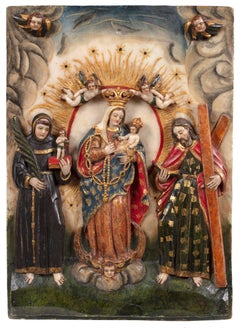
$32,500
H 11.5 in W 8.63 in D 0.88 in
Late 15th Century By Florentine School Madonna with Child Bas-relief
Located in Milano, Lombardia
Late 15th Century Florentine School
Madonna with Child Bas-relief
Pietra serena (a blue-gray sandstone) 85.5 x 60.5 cm
Provenance:
- via Stefano Bardini purchased in 1896 by
Prince ...
Category
15th Century and Earlier Old Masters Figurative Sculptures
Materials
Sandstone
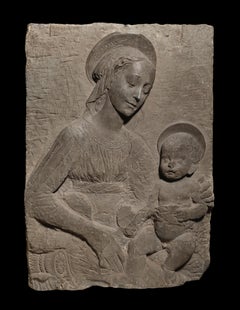
$31,883 Sale Price
20% Off
H 33.67 in W 23.82 in
Hercules and the Erymanthian Boar
By Nathaniel Choate
Located in Fresno, CA
Ashford Fine Art is the exclusive source for this limited edition bronze, entitled Hercules and the Erymanthian Boar, by the distinguished American sculptor, painter, and designer, ...
Category
1920s Old Masters Figurative Sculptures
Materials
Bronze
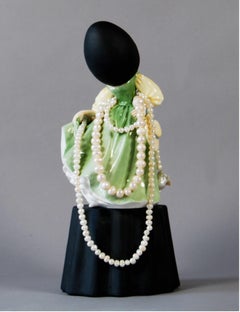
Study in Green with Pearls, 2021, Matt Smith
By Matt Smith
Located in London, GB
MATT SMITH (BRITISH)
Study in Green with Pearls, 2021
Black Parian, Found Ceramic, Freshwater Pearls
29 x 14 x 14 cm
11 1/2 x 5 1/2 x 5 1/2 in.
(MS206)
£ 4,000.00
UK-born Matt Smit...
Category
2010s Old Masters Figurative Sculptures
Materials
Ceramic, Found Objects
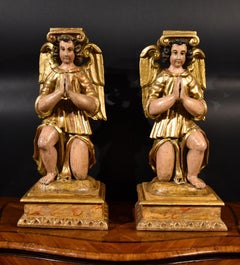
Pair Sculptures Winged Angels Wood Tuscany 17/18th Century Old master Gold Art
Located in Riva del Garda, IT
Pair of sculptures depicting two winged angels in carved wood
Tuscany, late 17th century
Carved, gilded and polychrome wood
Dimensions: Height 64 cm - ...
Category
17th Century Old Masters Sculptures
Materials
Wood
$11,700 Sale Price
20% Off
H 25.2 in W 11.42 in D 10.63 in
Wooden Sculptures Roman Soldiers Rome 18th Century Italy Art Gold
Located in Riva del Garda, IT
Wooden sculptures depicting a pair of full-length Roman soldiers
Rome, 18th century
Carved and gilded wood (walnut?)
Dimensions: Maximum height (at lance) 62 cm./ Maximum width: 28 ...
Category
18th Century Old Masters Sculptures
Materials
Gold

$6,496 Sale Price
20% Off
H 24.41 in W 11.03 in
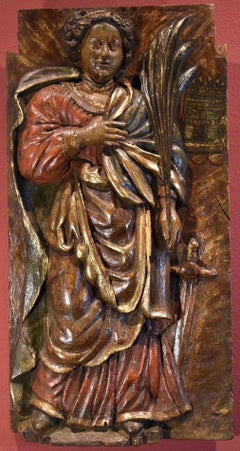
Saint Barbara France 16/17th Century Sculpture Wood Religious Old master Art
Located in Riva del Garda, IT
High relief panel depicting 'Saint Barbara'
Southern France, 16th-17th century
Polychrome carved wood with traces of gilding
64 x 32 cm.
(good condition, with minor missing and cra...
Category
16th Century Old Masters Sculptures
Materials
Wood, Wood Panel
$4,512
H 25.2 in W 12.6 in
Vanitas Vanitatum
Located in Villafranca Di Verona, IT
Numbered and limited to 8 copies
Signature: Hand-signed by artist
Authenticity: Sold with certificate of Authenticity from the gallery
Invoice from the gallery
Sculpture: bronze, me...
Category
Early 2000s Old Masters Figurative Sculptures
Materials
Metal, Bronze
More From This Seller
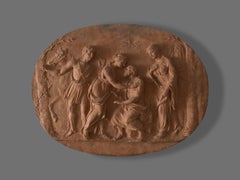
View AllOedipus before the Temple of the Furies at Colonus
Located in London, GB
Terracotta
19 x 25 ½ inches; 480 x 650 mm
Signed and dated: ‘W Tyler Excu. 1765’
Collections:
Cyril Humphris, London;
Humphris sale, Sotheby's, New York, 10-11 January 1995, lot 74...
Category
18th Century Old Masters Figurative Sculptures
Materials
Terracotta
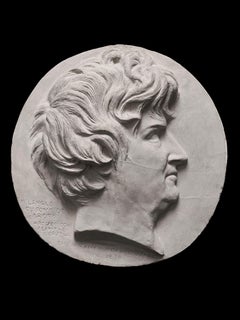
Eustace-Hyacinthe Langlois, called Langlois de L
Arche
Located in London, GB
Plaster
480 mm; 19 inches diameter
Inscribed: ‘H. Langlois du Pont de l’Arche Archeologue Peintre Graveur
par son ami P. J. David (D Angers) 1838’
Collections:
Sotheby’s, 22nd May...
Category
19th Century Old Masters Figurative Sculptures
Materials
Plaster
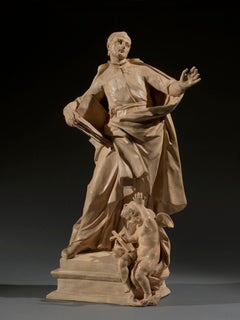
Roman 18th century terracotta model for the sculpture of San Camillo de Lellis
Located in London, GB
This remarkably fluid terracotta bozetto was made in preparation for Pietro Pacilli’s most important public commission, a large-scale marble statue of San Camillo de Lellis for the nave of St Peter’s Basilica in Rome. Expressively modelled, this terracotta sculpture is a rare and significant work made by a major Roman sculptor at a transformative moment of European sculpture. Pacilli began his working life on the great Baroque decorative projects initiated in the seventeenth century, but he found success as a restorer of ancient sculpture working to finish antiquities for a tourist market, becoming an important figure in the emergence of an archaeologically minded Neoclassicism. Pacilli trained Vincenzo Pacetti and provided important decorative work for the Museo Pio-Clementino, at the same time he is recorded restoring some of the most celebrated antiquities excavated and exported during the period.
Pacilli was born into a family of Roman craftsmen, his father Carlo was a wood carver, and Pacilli is recorded working with him on the Corsini Chapel in San Giovanni Laternao as early as 1735. In 1738 his terracotta model of Joseph and Potiphar’s Wife won the first prize in the second class of the sculpture concorso at the Accademia di San Luca, this is particularly notable as Bartolomeo Cavaceppi came third. He worked as a carver and stuccoist completing works for the churches of San Marco and SS. Trinita dei Domeniciani Spagnoli. Pacilli operated as a sculptor and restorer of antiquities from his studio at the top of the Spanish Steps, close to Santa Trinita dei Monti, where he is listed as a potential vendor to the Museo Pio-Clementino in 1770.
In 1763 Pacilli completed a silver figure of San Venanzio for the treasury of San Venanzio. He is recorded as Pacetti’s first master and it was evidently through Pacilli that he began to acquire his facility as a restorer of ancient sculpture. Pacilli, at his studio ‘poco prima dell’Arco della Regina alla Trinita dei Monti,’ exercised, what the nineteenth-century scholar, Adolf Michaelis called ‘rejuvenating arts’ on several important pieces of classical sculpture, including in 1760 the group of a Satyr with a Flute for the natural brother of George III, General Wallmoden, Hanovarian minister at Vienna. In 1765, Dallaway and Michaelis record that Pacilli was responsible for the restorations, including the addition of a new head, to the Barberini Venus which he had acquired from Gavin Hamilton. The Venus was then sold to Thomas Jenkins, who in turn passed it on to William Weddell at Newby Hall. In 1767 Pacilli exported a series of ancient busts ‘al naturale’ including portraits of Antinous, Julius Ceaser and Marus Aurelius, also a statue of a Muse and a Venus. As early as 1756 Pacilli seems to have been operating as an antiquarian, helping to disperse the collection of the Villa Borrioni. Pacilli supplied sculpture to notable British collectors, including Charles Townley, who on his first trip to Italy purchased the Palazzo Giustiniani statue of Hecate from Pacilli. Pacilli was involved with the Museo Pio Clementino from its conception, supplying busts of Julius Ceaser and a Roman Woman as well as completing stucco putti surmounting the arms of Pope Bendedict XIV to signal the entrance to the new Museo Critiano.
In 1750 Il Diario Ordinario del Chracas announced that Pacilli had begun work on a sculpture of San Camillo de Lellis for St Peter’s. Camillo de Lellis founded his congregation, the Camillians, with their distinctive red felt crosses stitched on black habits in 1591. Having served as a soldier in the Venetian army, Camillo de Lellis became a novitiate of the Capuchin friars, he moved to Rome and established a religious community for the purpose of caring for the sick. In 1586 Pope Sixtus V formerly recognised the Camillians and assigned them to the Church of Santa Maria Maddalena in Rome. Camillo de Lellis died in 1614 and was entombed at Santa Maria Maddalena, he was canonised by Benedict XIV on June 26, 1746. It was an occasion that prompted the Camillians to make a number of significant artistic commissions, including two canvases by Pierre Subleyras showing episodes from San Camillo’s life which they presented to Benedict XIV. In 1750 Pacilli was commissioned to fill one of the large niches on the north wall of the nave with a sculpture of San Camillo.
The present terracotta bozetto presumably had two important functions, to enable Pacilli to work out his ideas for the finished sculpture and at the same time to show his design to the various commissioning bodies. In this case it would have been Cardinal Alessandro Albani and Monsignor Giovan Francesco Olivieri, the ‘economo’ or treasurer of the fabric of St Peter’s. Previously unrecorded, this terracotta relates to a smaller, less finished model which has recently been identified as being Pacilli’s first idea for his statue of San Camillo. Preserved in Palazzo Venezia, in Rome, the terracotta shows San Camillo with his left hand clutching his vestments to his breast; the pose and action more deliberate and contained than the finished sculpture. In producing the present terracotta Pacilli has expanded and energised the figure. San Camillo is shown with his left hand extended, his head turned to the right, apparently in an attempt to look east down the nave of St Peter’s. The model shows Pacilli experimenting with San Camillo’s costume; prominently on his breast is the red cross of his order, whilst a sense of animation is injected into the figure through the billowing cloak which is pulled across the saint’s projecting right leg. The power of the restrained, axial contrapposto of bent right leg and outstretched left arm, is diminished in the final sculpture where a baroque fussiness is introduced to the drapery. What Pacilli’s terracotta demonstrates, is that he conceived the figure of San Camillo very much in line with the immediate tradition of depicting single figures in St Peter’s; the rhetorical gesture of dynamic saint, arm outstretched, book in hand, head pointed upwards was perhaps borrowed from Camillo Rusconi’s 1733 sculpture of St. Ignatius...
Category
18th Century Baroque Figurative Sculptures
Materials
Terracotta
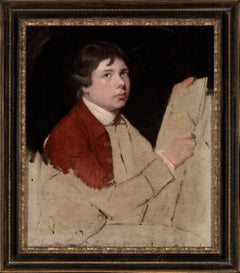
Self-Portrait
By John Hamilton Mortimer
Located in London, GB
Oil on canvas
30 x 25 ⅛ inches; 762 x 638 mm
Verso: after Sir Joshua Reynolds, a self-portrait
Not signed
Painted c. 1758
Collections:
Philip Gell (1775–1842), Hopton Hall, Derbyshire;
By inheritance at Hopton Hall to his daughter, Isabella, who married William Pole Thornhill, who renounced Hopton and its contents in favour of his kinsman, Henry Chandos-Pole-Gell (1829–1902);
By descent to his son, Brigadier General Harry Chandos-Pole-Gell (1872–1934), who sold Hopton Hall in 1918 and moved the family to Newnham Hall, Northamptonshire;
By descent to his son, Lt Colonel John Chandos-Pole (1909–1993), Newnham Hall;
Thence by descent until 2015, when acquired
By descent to 2015;
Lowell Libson
Jonny Yarker Ltd.
Literature:
Algernon Graves and Walter V. Cronin, A History of the works of Sir Joshua Reynolds P.R.A., London, 1901, IV, p. 1394.
David Manning...
Category
18th Century Old Masters Portrait Paintings
Materials
Canvas, Oil
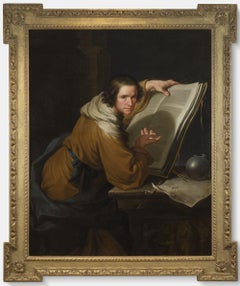
Sir Charles Frederick
Located in London, GB
Oil on canvas
50 x 40 inches; 127 x 101.6 cm
Framed dimensions: 151.5 x 127 cm
Inscribed on plinth: ‘VOTIS X ET XX’
Not signed
Painted c.1748
Collections:
Christie’s London, 23rd December 1954, lot.272;
J. Singer;
Somerville
Simpson Ltd, London, by 1985;
The Matthiesen Gallery, London;
Richard Feigen, New York;
Matthew Rutenberg, New York to 2019;
Lowell Libson and Jonny Yarker Ltd.
Literature:
Stella Rudolph, La Pittura del’ 700 a Roma, Milan, 1983, reproduced pl.133;
Jacob Simon, Handel, a celebration of his life and times 1685-1759, exh. cat. London, (National Portrait Gallery), 1985, no.196;
Catherine Whistler, Baroque
Later Paintings in the Ashmolean Museum, London, 2016, pp.102-105, reproduced p.104
Exhibited:
London, National Portrait Gallery, Handel, a celebration of his life and times 1685-1759, 1985-86, no.196, reproduced p.198
This powerful portrait of the antiquarian and courtier Sir Charles Frederick was completed in 1748 by the Roman painter Andrea Casali. Frederick, as comptroller of the royal laboratory, one of the ‘great officers’ of the Board of Ordinance at Woolwich, had just been responsible for the famed pyrotechnic display celebrating the Peace of Aix-la-Chapelle: the so-called ‘Royal Fireworks’ for which George Frederick Handel composed music. Casali’s portrait pays tribute to Frederick’s role as comptroller of the royal laboratory, showing him with a firing diagram and mortar, it also points to Frederick’s interests as an antiquarian with the inclusion of antique relief. Casali had first met Frederick in Rome in 1738, where he had painted his portrait, Frederick subsequently encouraged Casali to travel to London. This probably accounts for the unusual format; rather than a modern man of science, Casali casts Frederick as an alchemist bent on some mystic discovery, as such, it is one of the most unusual portraits of the period.
Andrea Casali was a pupil of Sebastiano Conca and then of Francesco Trevisani, who recommended him to the Spanish court in 1736. He enjoyed some success in Rome as a painter of frescoes and altarpieces, notably a large cycle of Scenes from the Life of St Dominic at the cloister of S. Sisto Vecchio, for which he was made a Knight of the Golden Spur in 1729. Casali began painting Grand Tourist portraits in Rome around 1738. His first portrait of Sir Charles Frederick is dated that year Ashmolean Museum, Oxford), it casts Frederick as a focused scholar, showing him seated at an elaborately carved console table, hard at work. In common with other Grand Tour portraiture of the period, Casali includes a famous Roman landmark in the background, in this case the façade of the Pantheon. Horace Walpole noted that it was thanks to the encouragement of ‘Mr Frederick and his Friends at Rome’ that Casali travelled to London in 1741.
Charles Frederick was a fascinating Augustan polymath. Born at Fort St George, Madras, where his father, Sir Thomas Frederick, was governor, he successively matriculated at New College, Oxford (1725), was called to the Middle Temple (1728), became a Fellow of the Royal Society (1731) and Director of the Society of Antiquaries (1735). His interests were wide ranging. Frederick was an amateur architect, he designed the monument to Lucy, Lady Lyttleton, in Hagley Church and the monument to Thomas Miller, bishop of Waterford, in Highclere church, Hampshire. He was a numismatist and collector of antiquities, as well as an amateur scientist. It was in the last capacity that he was appointed comptroller of the royal laboratory at Woolwich and clerk of the deliveries in 1746, this was the most junior of the ‘great officers’ who made up the membership of the royal Board of Ordnance. This appointment came through the good offices of the master-general of the Ordnance, a fellow antiquarian, John, 2nd Duke of Montagu. As comptroller, Frederick was responsible for the fireworks celebration of the treaty of Aix-la-Chapelle, for which Handel composed his celebrated music. As Horace Walpole wrote to his cousin, Henry Seymour Conway:
‘Charles Frederick has turned all his virtu into fireworks, and, by his influence with the Ordnance has prepared such a spectacle for the proclamation of Peace as is to surpass all its predecessors of bouncing memory. It is to open with a concert of fifteen hundred hands, and conclude with so many thousand crackers all set to music, that all the men killed in the war are to be wakened with a crash, as if it was the day of judgement, and fall a-dancing, like the troops in the Rehearsal. I wish you could see him making squibs of his papillotes, and bronzed over with a patina of gunpowder, and talking himself still hoarser on the superiority that his fireworks will have over the Roman naumachia.’
Performed in Green Park, the fireworks were mounted on a temporary structure designed by the architect Giovanni Niccolò Servandoni decorated by Adrea Soldi and Casali.
Casali’s second portrait of Frederick was completed following the success of the firework display. In this remarkable image, we discover Frederick at work, dressed in almost monastic garb, pouring over an impossibly large tome propped on an antique altar. The altar is identifiable as a Roman relief depicting Victory writing on a shield, the original is at Villa Medici in Rome, but was engraved by Pietro Santi Bartoli...
Category
18th Century Old Masters Portrait Paintings
Materials
Canvas, Oil
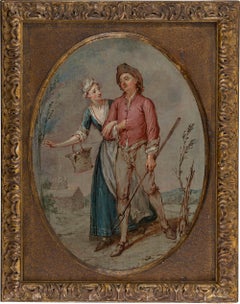
A young couple returning from the fields
Located in London, GB
Oil on panel
13 ⅜ x 9 ⅞ inches; 34 x 25 cm
Framed dimensions: 43.4 x 34.3 cm
Not signed
c. 1730s
Collections:
James Brydges, Duke of Chandos;
Chandos sale, Christopher Cock, Lond...
Category
18th Century Old Masters Figurative Paintings
Materials
Panel, Oil
Still Thinking About These?
All Recently ViewedMore Ways To Browse
Century Grand Tour
Grand Tour Marble
Antique Easter
18th Century Marble Sculpture
Ancient Bust
Antique Wrestling
Marble Busts Black
Medici Marble
18th Century Marble Bust
Interior Castles
Marcus Aurelius
Adam Brothers
Life Size Roman Marble Figure
Roman Marble Statue Of Venus
Antoninus Pius
Marcus Aurelius Bust
John Preston
John Neale