Items Similar to Diana The Huntress Plaster Sculpture, Art Deco, Circa 1920, Signed

Want more images or videos?
Request additional images or videos from the seller
1 of 17
Jens Jacob BregnoDiana The Huntress Plaster Sculpture, Art Deco, Circa 1920, Signedc. 1920
c. 1920
$8,139.07
£6,047.52
€6,800
CA$11,148.85
A$12,162.79
CHF 6,450.90
MX$146,534.16
NOK 81,874.39
SEK 74,958.22
DKK 51,801.55
About the Item
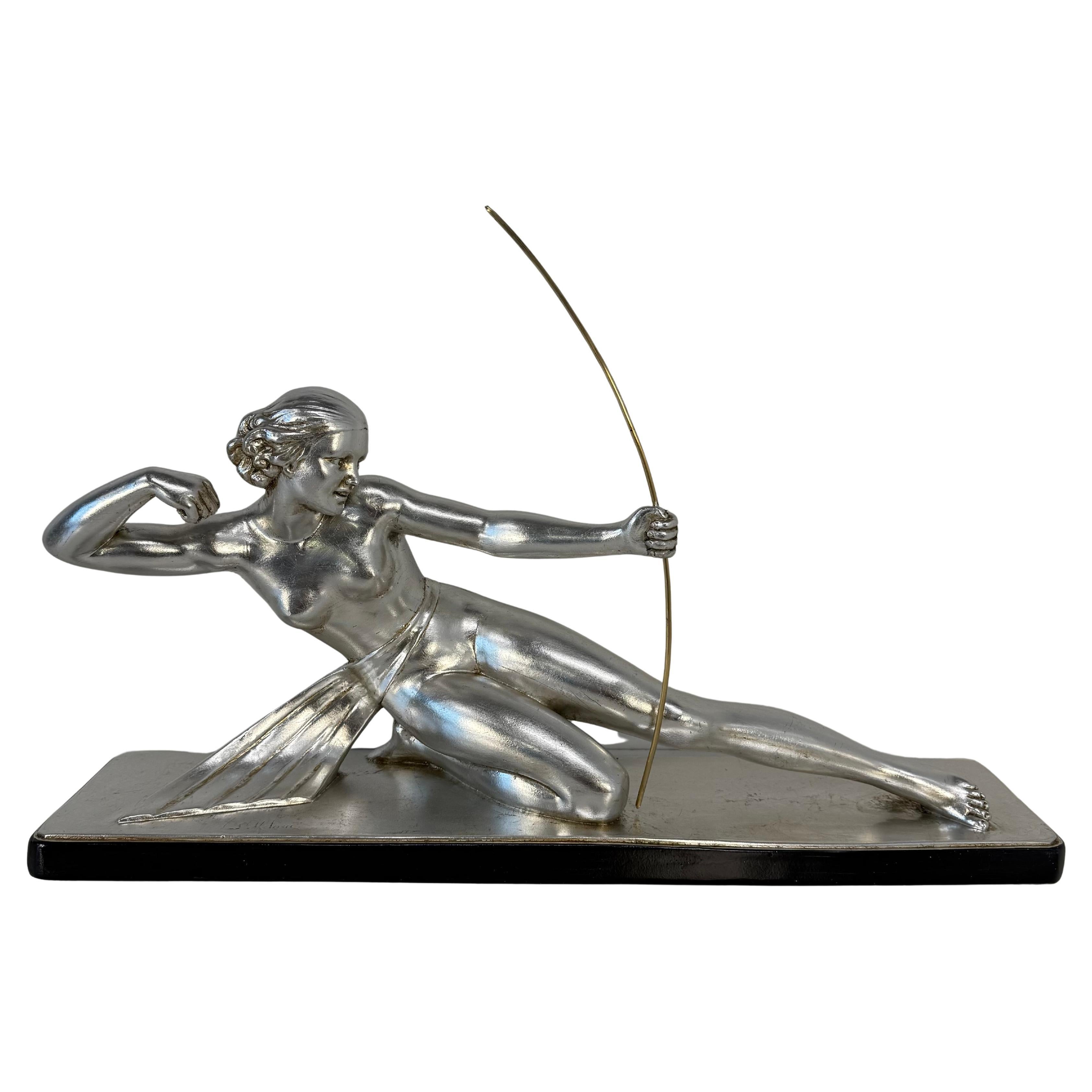
Sculpture representing the goddess Diana by Danish sculptor Jens Jacob Bregno (1877–1946), executed in plaster around 1920. This is a highly unusual model by the artist, and possibly a preparatory study for the same composition executed in bronze. The sculpture measures an impressive 103 cm in height, portraying a nude Diana kneeling with her left leg stretched behind her for support. Her body is fully extended, gaze lifted upward, while she holds the long bow in one arm, raised high and pointed toward the sky, a moment infused with tension and combat readiness. Possibly indistinctly signed with monogram JB on the base. Height with stand ca.180cm or 71 inches.
Jens Jacob Bregno was born in Copenhagen in 1877 into a family of established craftsmen and stone carvers. He trained in the traditional Danish sculptural milieu, initially within the studio practice of Copenhagen workshops before pursuing formal education at the Royal Danish Academy of Fine Arts. His early work shows strong influence from classical sculpture, with particular interest in human anatomy, mythological subjects, and historic portraiture.
Bregno gradually developed a style defined by clarity of form, dignified restraint, and precisely modeled surfaces. His sculptures often present figures in composed, timeless poses, reflecting the Nordic preference for sculptural serenity rather than dramatic expressionism. The artist spent his mature career in Denmark, where he became known both as an independent sculptor and as a skilled modeller for architectural ornamentation and public monuments.
Bregno exhibited his work intermittently throughout the early 1900s. Works by him were shown at Kunstnernes Efterårsudstilling (The Artists’ Autumn Exhibition) in Copenhagen, and he participated in exhibitions focusing on contemporary Danish figurative sculpture.
His sculptural output includes portrait busts, classical studies in plaster, sandstone, bronze, ceramics etc. and mythologically themed figures such as Diana, examples of which are believed to have been presented within or adjacent to early 20th-century exhibition contexts.
Examples of Bregno’s work can be found in Danish institutional collections, including sculpture holdings associated with the Royal Danish Academy of Fine Arts and regional museum collections dedicated to early-20th-century Danish sculpture.
In Roman mythology, Diana is the goddess of the hunt, wild animals, and the moon. Twin sister of Apollo, she is revered as a protector of nature, patroness of women, and a symbol of independence and purity. Often depicted with a bow, quiver, or accompanied by a deer, Diana embodies the balance between untamed wilderness and divine order, a quality mirrored in Bregno’s sculptural portrayal.
- Creator:Jens Jacob Bregno (1877 - 1946, Danish)
- Creation Year:c. 1920
- Dimensions:Height: 40.56 in (103 cm)Width: 25.2 in (64 cm)Depth: 7.88 in (20 cm)
- Medium:
- Movement Style:
- Period:
- Condition:In very nice condition. A couple of minor chips to the lower part of the base. The sculpture has been cleaned and the bow have had some restoration work done but presently not visible. The left arm holding the bow is detachable and lifts off.
- Gallery Location:Stockholm, SE
- Reference Number:1stDibs: LU2608217304092
About the Seller
5.0
Gold Seller
Premium sellers maintaining a 4.3+ rating and 24-hour response times
1stDibs seller since 2023
33 sales on 1stDibs
Typical response time: <1 hour
- ShippingRetrieving quote...Shipping from: Stockholm, Sweden
- Return Policy
More From This Seller
View AllArt Nouveau Relief Sculpture, Plaster, Signed, 1896, Woman in Mussel
Located in Stockholm, SE
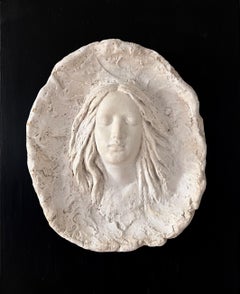
A wall-mounted Art Nouveau relief by the Swedish sculptor Johannes Collin, signed “JC 96”, represents one of his earliest known works. Executed in plaster, the oval composition features a stylistically mussel shaped base from which emerges the finely modelled face of a young woman with long flowing hair. Her eyes are closed, conveying a sense of calm introspection and timeless beauty. The softly curved forms and delicate modelling create a serene harmony between natural rhythm and sculptural precision. The work is mounted on a later black-painted wooden plaque (26 × 33 cm), while the sculpture itself measures 21 × 18.5 cm. It is an unusually early piece by the artist, displaying craftsmanship and sensitivity.
Born in Stockholm in 1873, Johannes Collin trained as a sculptor during the final years of the 19th century, a period marked by the transition from academic historicism to the organic, nature-inspired forms of Art Nouveau (Jugendstil). His early works, such as this 1896 relief, already reveal a refined awareness of contour, proportion, and the poetic interplay between human expression and natural form.
Collin studied at the Royal Swedish Academy of Fine Arts (Kungliga Akademien för de fria konsterna) in Stockholm, where he was influenced by sculptors such as John Börjeson and Christian Eriksson. Over the following decades, he developed a personal style that combined naturalistic modelling with decorative rhythm and symbolic depth. He participated in exhibitions at the Konstakademien in Stockholm, in shows organized by the Swedish Artists’ Association (Svenska konstnärernas förening), and at the Baltic Exhibition in Malmö (1914)—one of the era’s major showcases of Scandinavian art and design.
Throughout his career, Collin produced portraits, allegorical figures, and architectural sculpture in plaster, bronze, marble, and terracotta. His works are represented in several Swedish collections, including the Nationalmuseum in Stockholm and the Göteborgs konstmuseum, as well as in regional museums and private collections.
About Art Nouveau / Jugend
Art Nouveau, known in Sweden and Germany as Jugendstil, was an international artistic movement (c. 1890–1910) that sought to unite the arts under the guiding principle of nature’s harmony. Characterized by flowing lines, floral motifs, and organic rhythms, it aimed to dissolve the boundaries between fine and decorative art, bringing art into everyday life. In sculpture, this often meant a focus on the human body, sensual form, and the beauty of natural curves.
Within this aesthetic, Collin’s relief of a woman’s face emerging from a mussel-shaped base carries both mythological and symbolic resonance. The motif recalls the classical image of Venus rising from the sea...
Category
1890s Art Nouveau Figurative Sculptures
Materials
Plaster
Walking Tiger Bronze Sculpture, Dark Patinated, Signed
Located in Stockholm, SE
Sculpture of a walking tiger in dark patinated bronze by Johan Axel Wetterlund (1858-1927), signed J. A. Wetterlund, mounted on a black-painted wooden base. This finely modelled bro...
Category
Late 19th Century Naturalistic Figurative Sculptures
Materials
Bronze

Arvid Knöppel, The Virgin Mary, Bronzed Wall Relief Plaster Sculpture, Signed.
Located in Stockholm, SE
A finely sculpted dark bronzed wall relief plaster sculpture of Virgin Mary by Arvid Knöppel, signed and dated 1921. An unusual subject of his...
Category
1920s Figurative Sculptures
Materials
Plaster
19th Century Neoclassical Scene - Psyche, Oil on Canvas
By Otto Bache
Located in Stockholm, SE
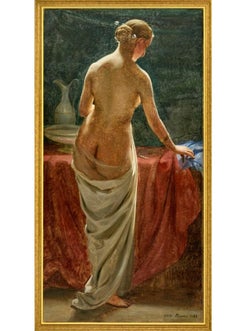
In this neoclassical oil on canvas signed and dated “Otto Bache 1864”, the artist depicts Psyche standing with her back turned to the viewer beside a red draped table. Her hair is arranged in a tight knot, secured with a hairpin adorned with two large pearls. She holds a light drapery that covers her legs, while the rest of her body remains nude. With her head turned toward the right, she gazes downward toward the table, where a blue gown or drapery lies, the garment she is about to put on.
Her softly illuminated profile emerges as she turns in the light falling from the upper left, creating a striking backlight that heightens the contrast along the contours of her body. On the richly red draped table before her rest her jewellery and, to her left, a large amphora-shaped jug and a tazza bowl. The light descending from above to the left defines the composition with sharp contrasts between brightness and shadow, revealing the delicate modelling of Psyche’s form and lending the scene a quiet sense of introspection and grace.
Exhibited: Winkel & Magnussen October 1915 no. 5, ill. p. 5.
Otto Bache was born in 1839 in Roskilde, Denmark, and died in 1927 in Copenhagen.
At the age of only eleven he was admitted to the Royal Danish Academy of Fine Arts in Copenhagen where he studied drawing and painting under the supervision of artists such as Wilhelm Marstrand. His early training gave him a basis in the Danish “Golden Age” tradition of realism and naturalism, but he went on to travel and extend his horizons. In 1866 he received an Academy travel-scholarship and went to Paris, then Italy (1867–68).
The influence of Paris is often noted: his palette became richer, his handling freer, his light stronger, and his subjects broader. Later in his career, from around 1887, he held the post as professor and on various occasions director of the Royal Danish Academy.
Bache’s early work reflects his rigorous academic training: careful drawing, subdued palette and interest in genre scenes and rural life. After his travel in Paris and Italy he adopted a somewhat more robust handling of color and light, but still remained essentially realist and narrative in approach.
He painted portraits, animal and hunting subjects, genre scenes, and large history-paintings depicting key moments from Danish history.
In particular, during the 1880s and 1890s when he was commissioned to execute large history canvases for the Museum of National History at Frederiksborg Castle and similar institutions, depicting events such as the exploits of Danish soldiers...
Category
1860s Other Art Style Figurative Paintings
Materials
Oil
Polyphemus and Acis Red Chalk Drawing, Italian, 17th-18th Century
Located in Stockholm, SE
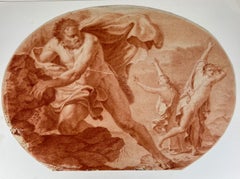
An Italian red chalk drawing depiction on paper, probably 17th or 18th century, illustrating the dramatic scene of Polyphemus hurling a boulder at Acis and Galatea. Attributed to an...
Category
17th Century Italian School Figurative Drawings and Watercolors
Materials
Paper, Chalk
$1,711 Sale Price
44% Off
Free Shipping
Allegory of Summer, 17th Century Italian Watercolor and Sepia Drawing
Located in Stockholm, SE
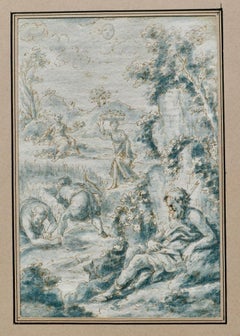
A fine Italian watercolor and sepia drawing, an allegory of summer. People harvesting, eating and drinking in a hilly landscape, probably by Antonio Grano (c.1669-1718). In the fron...
Category
Late 17th Century Italian School Figurative Drawings and Watercolors
Materials
Paper, Ink, Watercolor
You May Also Like
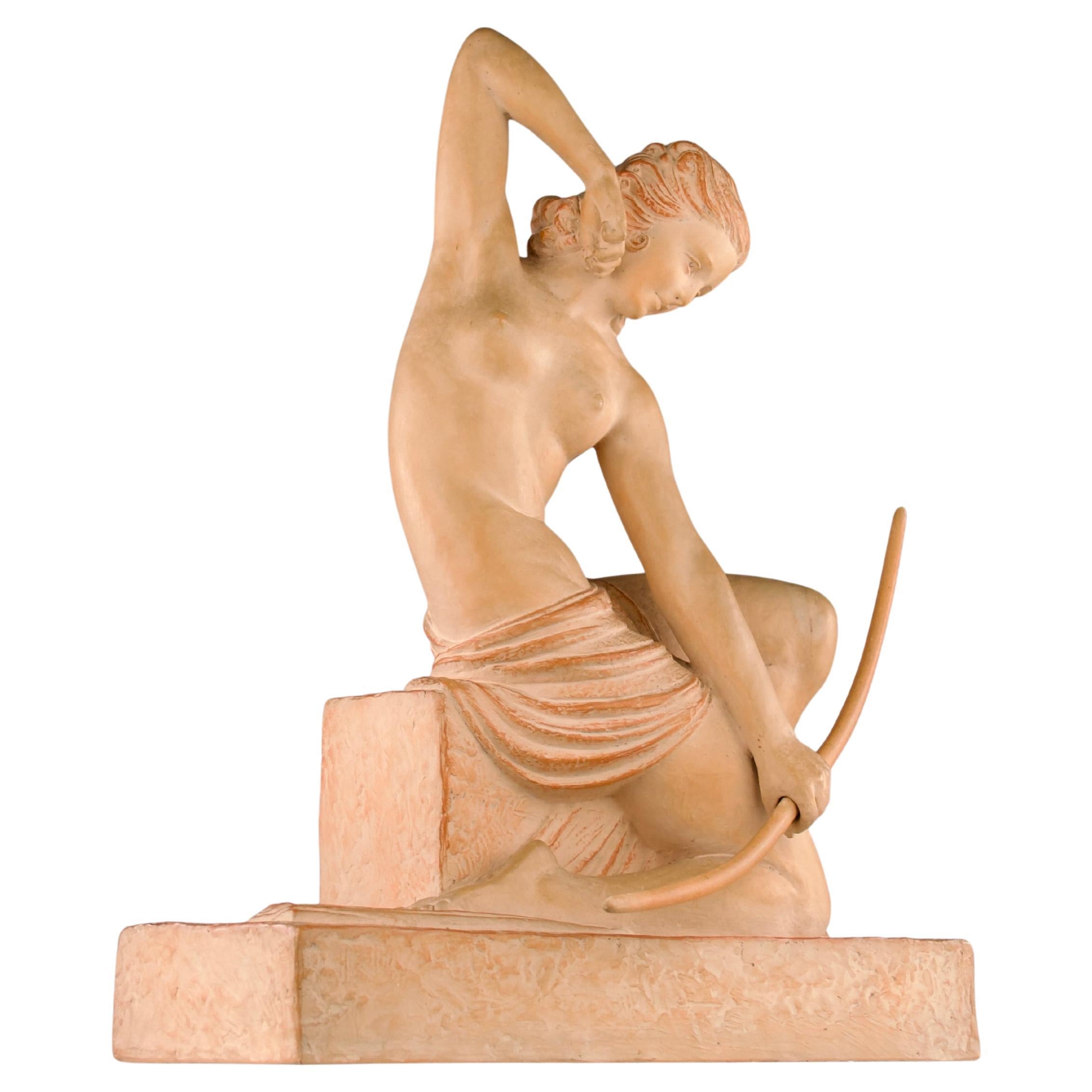
Demeter Haralamb Chiparus (1886-1947), "Diana the Huntress" Sculpture, France
By Editions Reveyrolis, Demetre Chiparus
Located in PARIS, FR
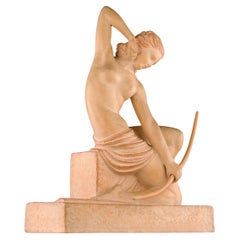
Superb and rare terracotta sculpture by Demeter Haralamb Chiparus (1886-1947) in collaboration with Reveyrolis Paris Editeur of Diana the Huntress in the nude drawing her wooden bow....
Category
Vintage 1920s French Art Deco Figurative Sculptures
Materials
Earthenware, Wood
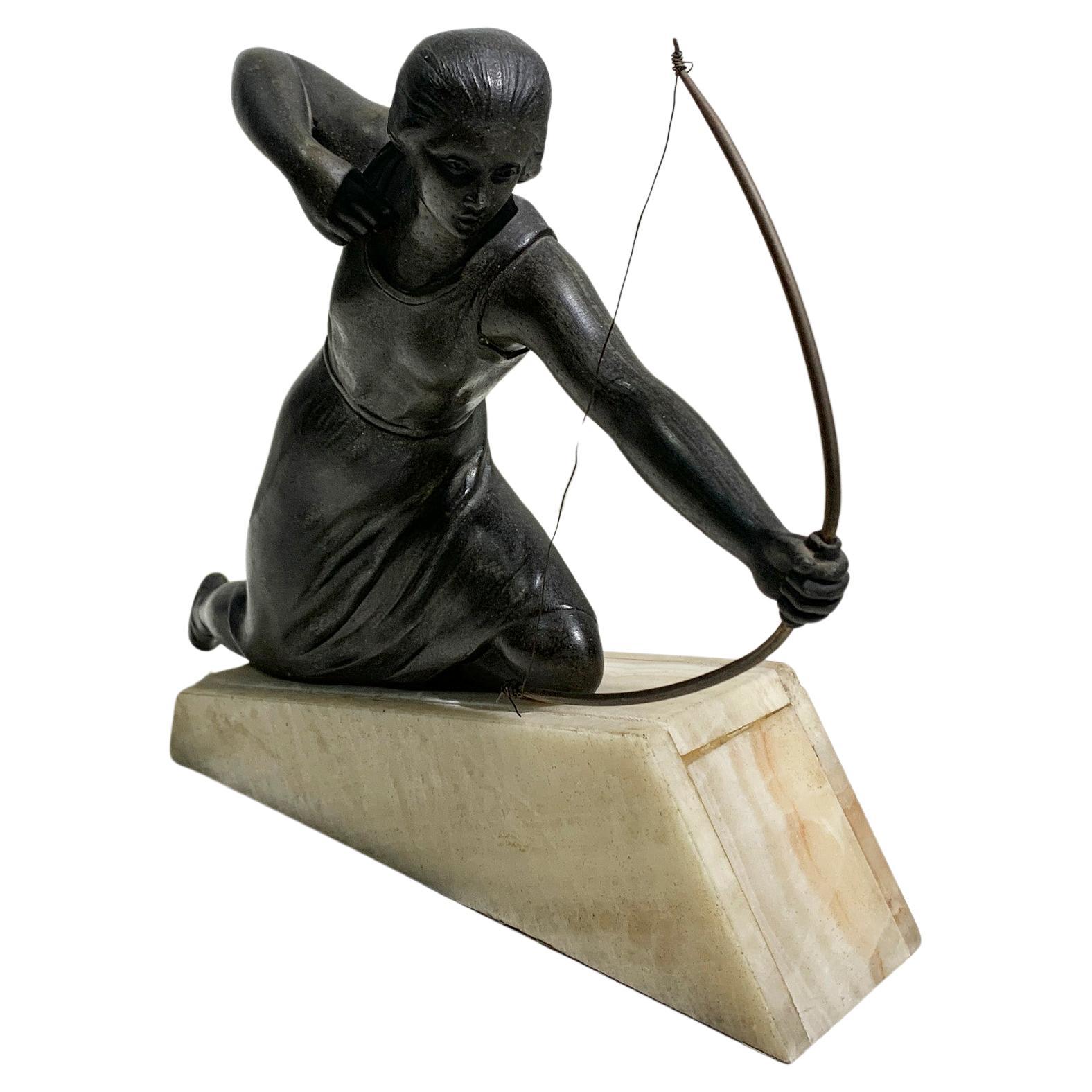
"Diana The Huntress" Art Deco Sculpture, Circa 1930
s
Located in Beirut, LB
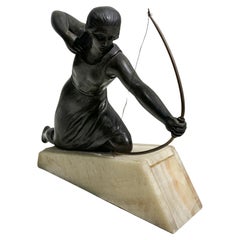
An elegant and quintessential Art Deco patinated sculpture of a kneeling female archer, dating to approximately 1930. The figure is captured in a moment of intense focus, her body te...
Category
Mid-20th Century French Adam Style Figurative Sculptures
Materials
Marble, Metal
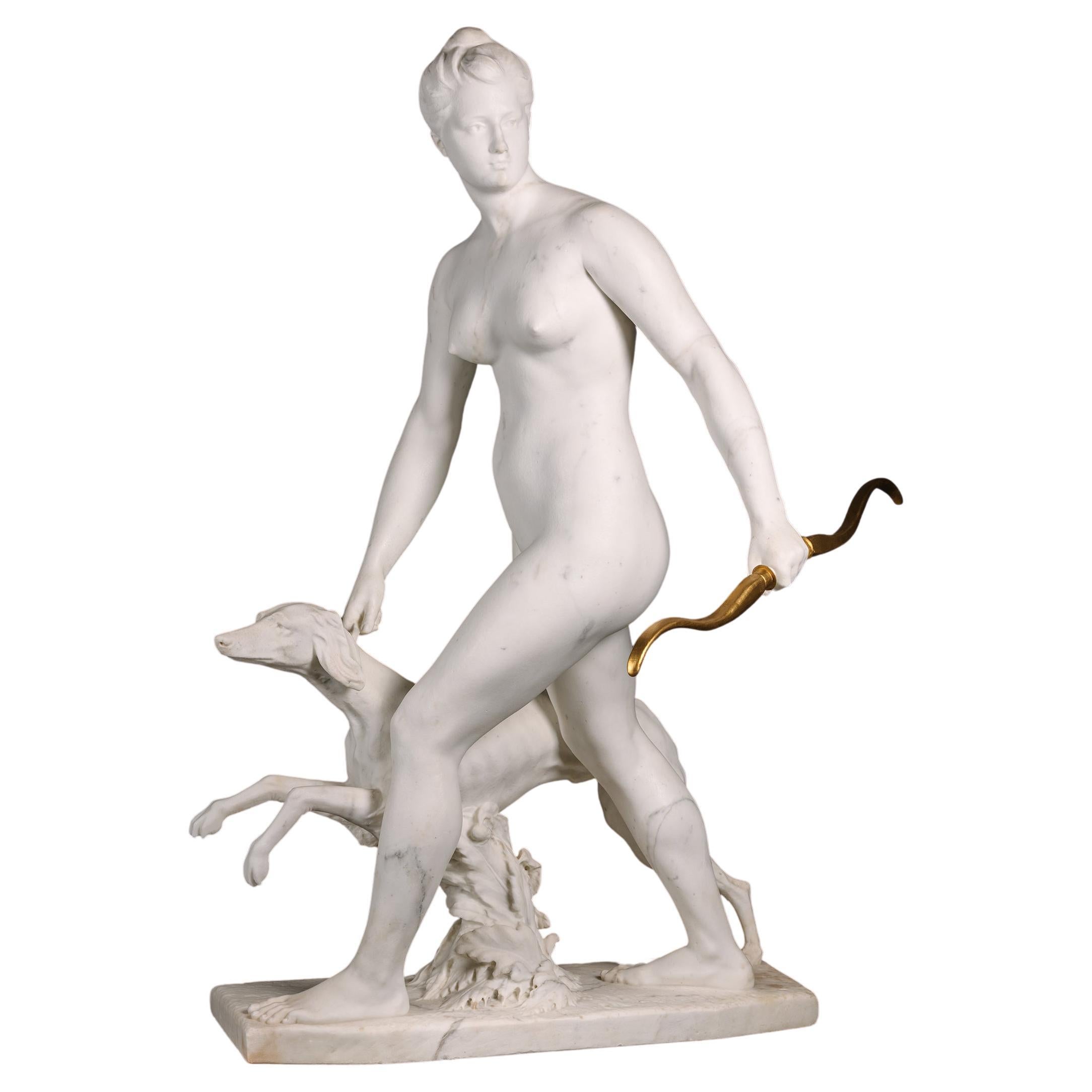
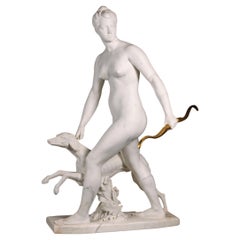
‘Diana the Huntress’. A Near Lifesize Statuary Marble Group
By Alfred Boucher
Located in Brighton, West Sussex
Alfred Boucher (French, 1850-1934), ‘Diana the Huntress’, A Near Lifesize Statuary Marble Group.
Modelled nude with head turned looking to her left, striding forward holding the greyhound by its collar with her right hand and a giltwood bow in her left hand. On an integral carved base with foliage support.
Signed 'A. BOUCHER'
Boucher’s choice of pose is deliberately indebted to the celebrated mid-16th century painting of Diana the Huntress by an anonymous artist of the School of Fontainebleau. The painting is a mythical representation of Diane de Poitiers, the mistress of King Henry II, in the guise of the goddess Diana, who is shown nude, walking forward beside a greyhound, looking over her left shoulder and holding a bow. Another clear antecedent for Boucher’s ‘Diane the Huntress...
Category
Antique 19th Century French Neoclassical Revival Figurative Sculptures
Materials
Carrara Marble
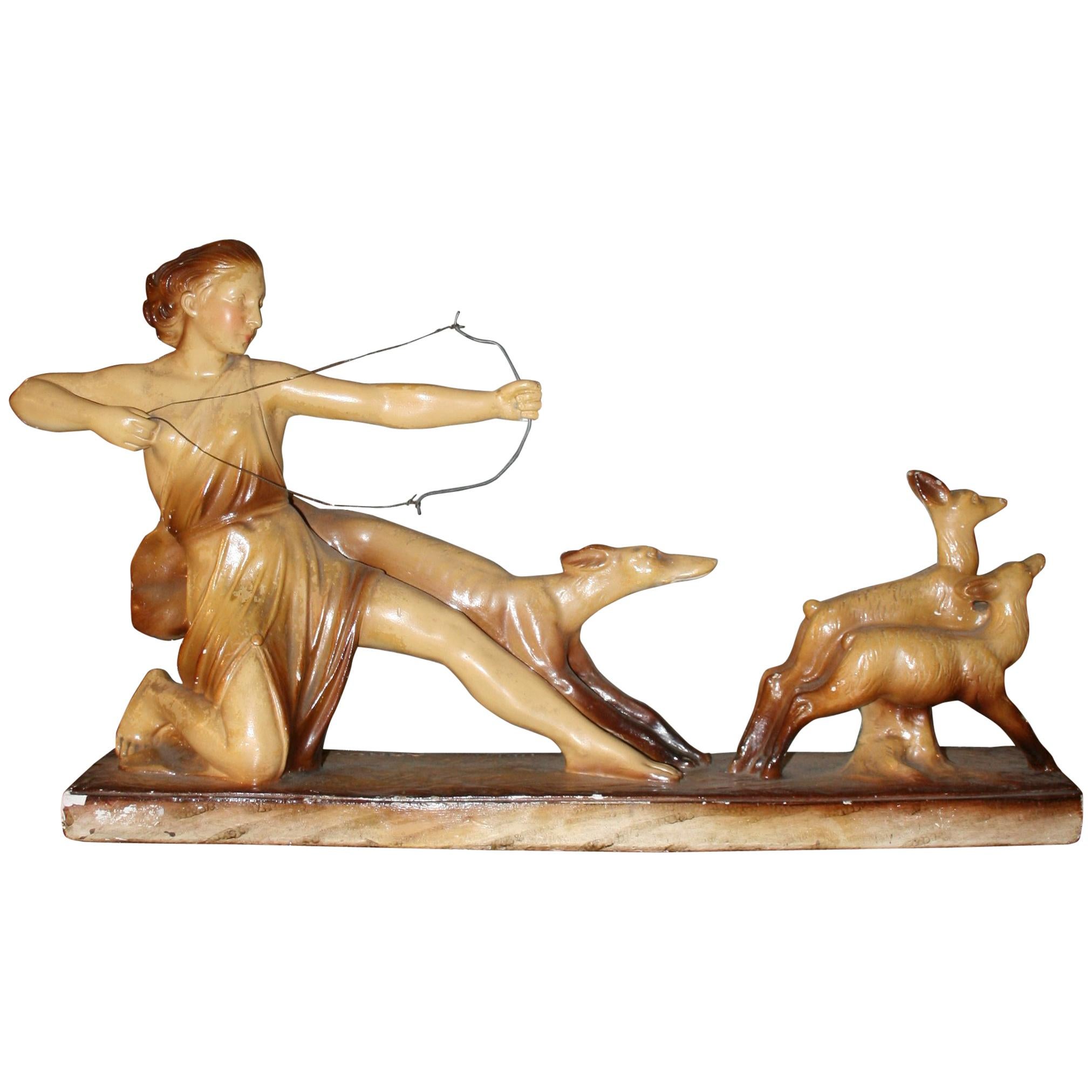
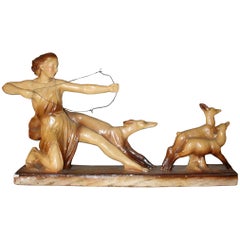
Art Deco Sculpture, Artemis "Diana the Huntress", Depose Arnova
Located in Dusseldorf, DE
French 1930s Art Deco sculpture made of hand painted plaster with engraving on the pedestal "DEPOSE ARNOVA".
The sculpture shows a representation of the Greek / Roman goddess of hunting called Artemis...
Category
Early 20th Century French Art Deco Figurative Sculptures
Materials
Plaster
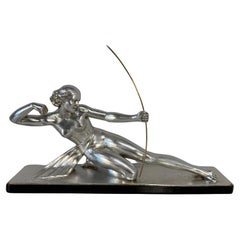
Diana the Huntress – Art Deco Silver Leaf Sculpture by Salvatore Melani, 1930s
By Salvatore Melani
Located in Meda, MB
Elegant Art Deco sculpture depicting Diana the Huntress with a bow, created in the 1930s by Italian sculptor Salvatore Melani. The figure is crafted from plaster and finished with si...
Category
Vintage 1920s Italian Art Deco Figurative Sculptures
Materials
Brass, Silver Leaf
Bronze Diana the Huntress on Marble Base
Located in Annville, PA
Graceful even when standing still the Bronze Diana the Huntress on Marble Base is a striking addition to any setting. Using traditional lost ...
Category
2010s Abstract Sculptures
Materials
Bronze

$465 / item