Want more images or videos?
Request additional images or videos from the seller
1 of 7
Otto MonestierRare 1970s Kinetic Puzzle Sculpture "Eva" Venice Biennale1972
1972
Price:$1,100
$1,300List Price
About the Item
- Creator:Otto Monestier (1918 - 1997, Italian)
- Creation Year:1972
- Dimensions:Height: 10 in (25.4 cm)Width: 4.5 in (11.43 cm)Depth: 5 in (12.7 cm)
- Movement Style:
- Condition:Minor scratches.
- Gallery Location:Surfside, FL
- Reference Number:1stDibs: LU382615182
About the Seller
4.9
Platinum Seller
Premium sellers with a 4.7+ rating and 24-hour response times
Established in 1995
1stDibs seller since 2014
1,858 sales on 1stDibs
Authenticity Guarantee
In the unlikely event there’s an issue with an item’s authenticity, contact us within 1 year for a full refund. DetailsMoney-Back Guarantee
If your item is not as described, is damaged in transit, or does not arrive, contact us within 7 days for a full refund. Details24-Hour Cancellation
You have a 24-hour grace period in which to reconsider your purchase, with no questions asked.Vetted Professional Sellers
Our world-class sellers must adhere to strict standards for service and quality, maintaining the integrity of our listings.Price-Match Guarantee
If you find that a seller listed the same item for a lower price elsewhere, we’ll match it.Trusted Global Delivery
Our best-in-class carrier network provides specialized shipping options worldwide, including custom delivery.You May Also Like
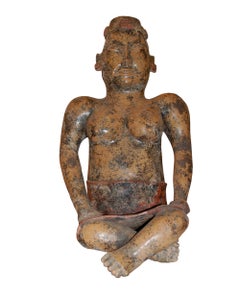
Seated Figure Clay Sculpture
By Walter Bastianetto
Located in Lake Worth Beach, FL
Seated Figure
Modern Pre Columbian style, large sculpture edition 21/30, artist signed.
This one was made approximately between 1982/83. Walter started making giant size copies of ...
Category
1980s Modern Figurative Sculptures
Materials
Clay, Terracotta, Oil
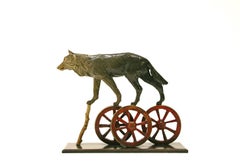
Renegade
By Brad Rude
Located in Bozeman, MT
Ed. 3/6
Artist Brad Rude was born in Montana and has lived in Walla Walla, Washington most of his life. His journeys through his grandfather's folk art st...
Category
2010s American Modern Figurative Sculptures
Materials
Bronze, Enamel
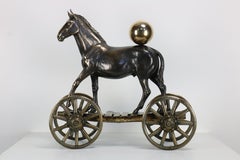
Show of Interest
By Brad Rude
Located in Bozeman, MT
Artist Brad Rude was born in Montana and has lived in Walla Walla, Washington most of his life. His journeys through his grandfather's folk art studio left...
Category
2010s American Modern Figurative Sculptures
Materials
Bronze, Enamel
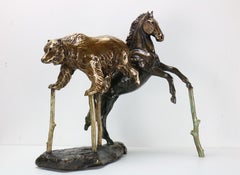
Combined Effort
By Brad Rude
Located in Bozeman, MT
Artist Brad Rude was born in Montana and has lived in Walla Walla, Washington most of his life. His journeys through his grandfather's folk art studio left...
Category
2010s American Modern Figurative Sculptures
Materials
Bronze, Enamel
Pandemic Panel, Figurative, Wood
Metal by Contemporary Indian Artist"In Stock"
Located in Kolkata, West Bengal
Rakesh Sadhak - Pandemic Panel
Wood & Metal, H 42 x W 54 x D 12 inches, 2020
Born : 1970
Qualification:
B.V.A. in Sculpture from Govt. College of Art & Craft 2012
M.F.A. in Sculptur...
Category
2010s Modern Figurative Sculptures
Materials
Metal
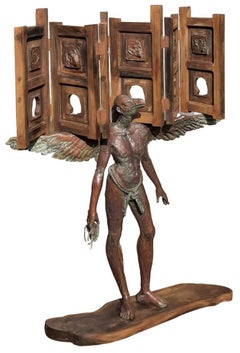
$9,449
H 42 in W 54 in D 12 in
Non-Stop, Figurative, Wood
Bronze by Contemporary Indian Artist "In Stock"
Located in Kolkata, West Bengal
Rakesh Sadhak - Non-Stop
Wood & Bronze, H 60 x 22 x 12 inches
Born : 1970
Qualification:
B.V.A. in Sculpture from Govt. College of Art & Craft 2012
M.F.A. in Sculpture from I.K.S. V...
Category
2010s Modern Figurative Sculptures
Materials
Bronze
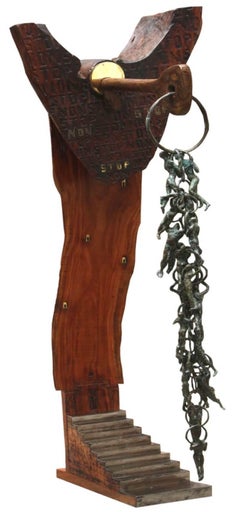
$4,539
H 60 in W 22 in D 12 in
Coming Home, Porcelain Sculptural Jar with Underglaze Sgraffito Detailing.
Located in Miami Beach, FL
This sculptural jar features two women gazing at one another in a domestic setting, which is signaled by the seated figure’s chair and the jar’s pattern ...
Category
2010s Modern Figurative Sculptures
Materials
Porcelain, Acrylic
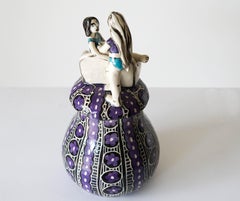
$1,700
H 11.5 in W 5.5 in D 5 in
Pipasha, Figurative, Bronze, by Modern Indian Artist Lalu Prasad Shaw "In Stock"
By Lalu Prasad Shaw
Located in Kolkata, West Bengal
Lalu Prasad Shaw - Pipasha
Bronze, Edition : 4/5
H 42 x W 17 x D 13 inches
( Delivered )
Lalu Prasad Shaw’s Pipasa captures a moment of quiet simplicity and human need with striking...
Category
2010s Modern Figurative Sculptures
Materials
Bronze
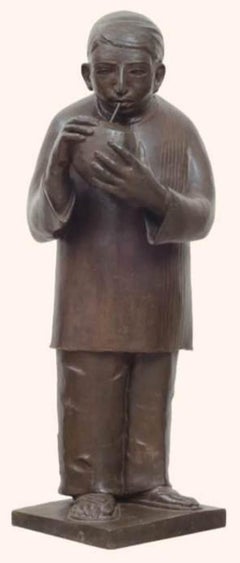
$10,550
H 42 in W 17 in D 13 in
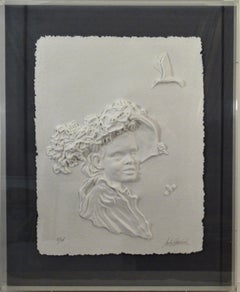
Lady with Bird
Located in San Francisco, CA
This artwork "Woman with Bird" c.2000 is an original cast paper bas relief by noted Swedish/American artist Carlo Wahlbeck, b. 1933. It is hand signed a...
Category
Early 2000s American Modern Figurative Sculptures
Materials
Other Medium
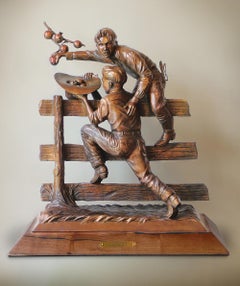
"TWO BAD APPLES" BRONZE SCULPTURE
Located in San Antonio, TX
John Bennett
(Born 1952)
Fredericksburg, Texas Artist
Image Size: 23 x 21 x 13
Medium: Bronze
"Two Bad Apples"
John Bennett (Born 1952)
John Bennett was designated Texas State Artist...
Category
20th Century Modern Figurative Sculptures
Materials
Bronze
More From This Seller
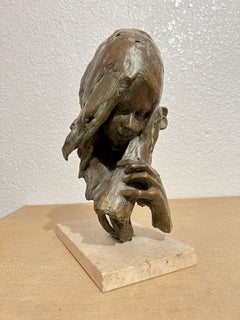
View AllBronze Sculpture American Modernist Art Stanley Bleifeld Girl with Bass or Cello
By Stanley Bleifeld
Located in Surfside, FL
Retaining a fine patina and in overall good condition.
Signed with initials SB.
I believe the edition size was 7 But I cannot find a mark.
Stanley Bleifeld (1924 – 2011) was an American sculptor.
Stanley Bleifeld was born and raised in Brooklyn, New York, Bleifeld earned bachelor of fine arts, bachelor of science in education and in 1949 a master of fine arts degree in painting at Tyler School of Art of Temple University. After a trip to Rome in 1959 or 1960 he gave up painting for sculpture. He began his fine-art career as a painter. However, a visit to Italy and exposure to the bronzes of Donatello, Michelangelo, and Ghiberti changed his direction He worked with the Art Foundry of Massimo del Chiaro and alongside artists such as Lucchesi, Harry Marinsky, Fernando Botero, Igor Mitoraj and Ivan Theimer. Many of his early pieces were religious subjects, and reflected both painting and sculptural techniques in bas reliefs* that had "liquid landscapes in undulating reliefs and free-flowing portraits reminiscent of classical fragments" (166-167). He later turned from these abstract pieces to more realistic figures in bronze.
Bleifeld was a National Academician in Sculpture, and a member of the National Academy of Design, and helped set policy for that organization. He was also President of the National Sculpture Society. Past presidents of the society have included John Quincy Adams Ward, James Earle Fraser, Chester Beach, Wheeler Williams, Leo Friedlander, Neil Estern, and Cecil de Blaquiere Howard. The first woman to gain admission into the NSS was Theo Alice Ruggles Kitson, in 1893. She was followed a few years later by Enid Yandell and Bessie Potter Vonnoh in 1898; Janet Scudder in 1904; Anna Hyatt Huntington in 1905 and Evelyn Longman and Abastenia St. Leger Eberle in 1906. In 1946, Richmond Barthé was likely the first African-American to be admitted.
In 1994, the NSS held their first exhibition outside the United States at the Palazzo Mediceo Di Seravezza in Italy. Titled “100 Years of the National Sculpture Society of the United States of America in Italy” it ran from the 16th of July through the 4th of September and was curated by Nicky and Stanley Bleifeld along with Costantino Paolicchi, Lodovico Gierut and Paolo Giorgi. Among the 60 notable American sculptors whose work was selected for the exhibition were Stanley Bleifeld, Andrew DeVries, Neil Estern, Leonda Finke...
Category
1970s American Modern Figurative Sculptures
Materials
Bronze
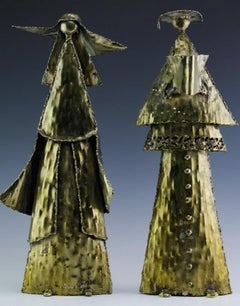
Marcello Fantoni Firenze Raymor Pair Figures Welded Brutalist Italian Sculpture
By Marcello Fantoni
Located in Surfside, FL
Marcello Fantoni brutalist welded torch cut metal figurines. Signed on base. Metal label reads "Fantoni Firenze Italy Raymor".
Italian Mid century modern Sculptural pair of students.
Marcello Fantoni (1915-2011) sculptor, ceramicist, metalworker, multimedia artist and designer
Born in Florence in 1915, Marcello Fantoni began studying ceramic art at age 12 at the Art Institute of Florence with ceramicist Carlo Guerrini, artistic director of the famed Cantagalli Factory. He continued years of training in ceramics and the arts, including sculpture with Libero Andreotti and Bruno Innocenti, and figurative art with Gianni Vagnetti, graduating as a maestro of art in 1934. After a stint as art director for a ceramics factory in Perugia, in 1936 he opened the Fantoni Ceramic Studio in Florence. Here he produced ceramic series as well as unique mod pieces, sculptures and furnishings. In 1937 Fantoni’s pieces were exhibited in the Florence National Arts and Crafts Exhibit where their unique combination of rustic forms decorated with African and marine motifs and painted figures garnered considerable acclaim. By the start of World War II Fantoni’s melding of ancient Italian pottery techniques with decidedly Modernist elements had won him artistic and commercial success both in Italy and abroad.
Having participated in the resistance, after the War Fantoni worked for the 500-year old Maiolica factory in Deruta, Umbria, renowned for its signature tin-glazed pottery. In the 1950s he refocused on his Florence studio, dedicating himself to larger sculptural pieces and working on many collaborations. He also expanded his experimenting with materials, forms, drawing from varied influences – Primitivism, Novecento style, Cubism and Abstract Expressionism. Fantoni gave special emphasis to ancient Etruscan ceramic techniques, glazes and colors, heightening the timeless appeal of his pieces. As well as clay, he also worked in metals to great effect. Whether created as a series or as a unique piece, every Fantoni piece was ultimately rendered unique by his hand-painting it. The extraordinary diversity of shapes and textures notwithstanding, one the most identifiable qualities of his creations was his painting style. Through the 50s and 60s he made many cubist-inspired vases and ewers painted in colors bordered by sgraffito lines scratched through the paint in a manner evoking Picasso and Braque. Along with figurative and abstract works, the 60s also saw Fantoni creating brutalist pieces with edgy, angular shapes, while in later life, his work took a minimalist turn.
In 1970 Fantoni founded the International School of Ceramic Art, dedicated to teaching ceramic arts and experimentation. (Many of his students and employees would go on to become noteworthy artisans and artists in their own right.) Maintaining great versatility throughout his career, Fantoni completed projects for public and private buildings, churches, schools, theaters, cinemas, and ships. His works, meanwhile, were collected by important museums worldwide. When Marcello Fantoni died in Florence in 2011 at the age of 95, his obituary in the Italian newspaper La Nazione hailed him “The master of beauty.”
Museums and Exhibitions
MoMA New York, Metropolitan Museum of Art of New York, Brooklyn Museum, Museum of Fine Art of Boston, Victoria and Albert Museum of London, Royal Scottish Museum of Edinburg, Museums of Modern Art of Tokyo and Kyoto, International Museum of Ceramics in Faenza, National Bargello Museum and Gabinetto Disegni e Stampe of the Uffizi in Florence.
“Materia e colore, l’arte di Marcello Fantoni”, Loggia della Limonaia di Palazzo Medici Riccardi di Firenze, 2015
"Marcello Fantoni, A Beautiful Form with Beautiful Color", Archaeological Museum of Fiesole, 2005
"Ceramics as Art, Marcello Fantoni Ceramist and Sculptor", Salone delle Regie Poste, Florence,
Marcello Fantoni’s work fused painting, Primitivism, tradition, Modern art, the revival of craft, and the base material of clay itself. Some aspects of Marcello Fantoni’s ceramics – their spikey and angular shapes, with their forms reduced to multiple flat planes of colour bordered by inscribed sgraffito lines – suggest inspiration from Cubist painters Pablo Picasso and Georges Braque.
Publications
Marcello Fantoni: Ceramista in Firenze Dal 1929 by Antonio Paolucci, Edizioni della Bezuga, 1999
Marcello Fantoni, Ceramica come Arte, Published by Octavo, 2000
Marcello Fantoni Mostra al Museo Archeologico di Fiesole
Select Fairs where his work has been exhibited:
2017 Maison Gerard at The Salon Art + Design 2017, Maison Gerard
2016 Patrick Parrish Gallery at The Salon Art + Design 2016, Patrick Parrish Gallery
2015 Galleria Rossella...
Category
Mid-20th Century Modern Figurative Sculptures
Materials
Metal
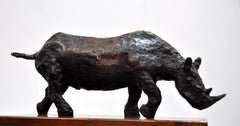
Polish Modernist Charging Rhino Bronze Expressionist Rhinoceros Sculpture
By Dominik Albinski
Located in Surfside, FL
Signed bronze from small edition of 8. plus 4 artists proofs
Dominik Albiński
(born 1975, South Africa)
He started carving at the age of twelve. When he was eighteen he went to Pari...
Category
Early 2000s Modern Figurative Sculptures
Materials
Granite, Bronze
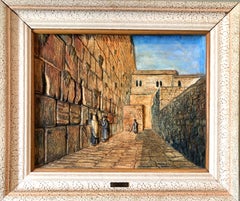
Vintage Jerusalem Western Wall Relief Sculpture Model Diorama Painting Judaica
By Manobla
Located in Surfside, FL
Joseph Manobla, (Israeli, 1930-1979), The Western Wall (The Wailing Wall), Painted diorama sculptural relief, 12.5 x 15.75 inches (relief), 17 x 20.25 inches (including original painted artist’s frame), Signed lower right. titled verso "the Wailing Wall".
I am not sure of the material used. I have seen some described as jerusalem stone and some as composition.
Provenance: The Engel Gallery Jerusalem. The Engel Gallery was founded in Jerusalem in 1955. Rafi Lavi, Arieh Aroch, Aviva Uri...
Category
20th Century Modern Figurative Sculptures
Materials
Mixed Media
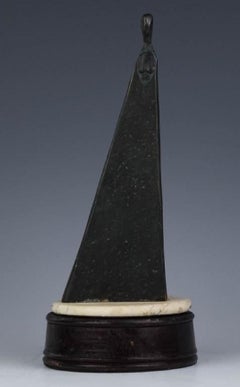
Sydney Kumalo Bronze Minimalist African Modernist Sculpture Figural Female Nude
Located in Surfside, FL
Sydney Kumalo. Features a bronze stylized female figural form sculpture fixed to a marble plinth and wood base. Bears signature on base. Measures 9 1/2" x 4 1/4". There is no edition number on the piece.
Sydney Kumalo (1935 - 1988) was born in Sophiatown, Johannesburg, on 13 April 1935. His was one of the families who had to move out of the "white" city to the South Western Townships, or Soweto. Raised in Diepkloof and educated at Madibane High School, he took with him from old Sophiatown the curious and diverse heritage of its heyday. Art classes in the Catholic school, "Sof' town" blues and jazz, the vibrant street culture and growing defiance of its population of various races who were gradually forced out into separate race-group areas. So it was that these various aspects of his early life created for Kumalo a cultural mix of a Zulu family related to the traditional royal house; city schooling, nascent township music and lingo; growing urbanised political defiance and the deep-rooted Zulu pride and respect for the legends and ancient stories of a tribal people. This mix of old and new cultures was reinforced when he began his studies at the Polly Street Art Centre in 1953 where he became a member of Cecil Skotnes group of serious artists who were encouraged to acquire professional skills. Skotnes introduced a basic training programme with modelling as a component, which marked the introduction of sculpting (in brick-clay) at Polly Street.
Kumalo was Skotnes’ assistant at Polly Street from 1957 to 1964, and having recognised his great talent as a sculptor, Skotnes encouraged him to become a professional artist.
After Kumalo’s very successful assistance with a commission to decorate the St Peter Claver church at Seeisoville near Kroonstad, with painting designs, sculpture and relief panels in 1957, Skotnes arranged for Kumalo to continue his art training by working in Edoardo Villa ’s studio from 1958 to 1960. Working with Villa, he received professional guidance and began to familiarize himself with the technical aspects of sculpting and bronze casting. In 1960 he became an instructor at the Polly Street Art Centre.
Kumalo started exhibiting his work with some of the leading commercial Johannesburg galleries in 1958, and had his first solo exhibition with the Egon Guenther Gallery in 1962. He was a leader of the generation who managed to leave behind the forms of African curios, reject the European-held paternalism which encouraged notions of "naive" and "tribal" African art, and yet still hold fast to the core of the old legends and spiritual values of his people. He introduced these subjects into his bronze sculptures and pastel drawings, evolving his own expressive, contemporary African "style".
Together with Skotnes, Villa, Cecily Sash and Giuseppe Cattaneo, Kumalo became part of the Amadlozi group in 1963. This was a group of artists promoted by the African art collector and gallery director Egon Guenther, and characterised by their exploration of an African idiom in their art. Elza Miles writes that Cecil Skotnes’ friendship with Egon Guenther had a seminal influence on the aspirant artists of Polly Street: “Guenther broadened their experience by introducing them to German Expressionism as well as the sculptural traditions of West and Central Africa. He familiarised them with the work of Ernst Barlach, Käthe Kollwitz, Gustav Seitz, Willi Baumeister and Rudolf Sharf.” It is therefore not surprising that some of Kumalo’s sculptures show an affinity with Barlach’s powerful expressionist works. Guenther organised for the Amadlozi group to hold exhibitions around Italy, in Rome, Venice, Milan and Florence, in both 1963 and 1964.
Kumalo’s career took off in the mid 1960s, with his regular participation in exhibitions in Johannesburg, London, New York and Europe. He also represented South Africa at the Venice Biennale in 1966, and in 1967 participated in the São Paulo Biennale.
EJ De Jager (1992) describes Kumalo’s sculpture as retaining much of the “canon and formal aesthetic qualities of classical African sculpture. His work contains the same monumentality and simplicity of form.” His main medium for modelling was terra cotta, which was then cast in bronze, always paying careful attention to the finish of both the model as well as the final cast. He began casting the pieces he modelled in clay or plaster into bronze at the Renzo Vignali Artistic Foundry in Pretoria North. He worked throughout his life with its owners, the Gamberini family, and enjoyed learning the technical aspects of the casting process, refining his surfaces according to what he learned would produce the best results in metal. De Jager further writes that Kumalo’s distinctive texturing of the bronze or terra cotta is reminiscent of traditional carving techniques of various African cultures. “In many respects Kumalo thus innovated a genuine contemporary or modern indigenous South African sculpture”. Kumalo came to admire the works of the Cubists, and of British sculptors Henry Moore and Lynn Chadwick. He became noted for adapting shapes from them into his own figures. The success of his use of the then current monumental simplicity and purely aesthetic abstractions of natural forms has been emulated by many South African sculptors since the 1970s.
He was in many ways the doyen of South African Black art. As such he was an important influence especially on younger African sculptors, by whom he is greatly revered. Through his teaching at Polly Street and at the Jubilee Centre, as well as through his personal example of integrity, dedication and ability, he inspired and guided students who in their own right became outstanding artists, for example, Ezrom Legae, Leonard Matsoso and Louis Maqhubela
From 1969 onward, he allied himself with Linda Givon, founder of The Goodman Gallery in Johannesburg, where he exhibited regularly until his death in December 1988. Working with Givon also perpetuated his associations with his many friends of strong principles. Skotnes, Villa, Legae and later such peers from the Polly Street era as Leonard Matsoso, Durant Sihlali and David Koloane have all exhibited at The Goodman Gallery. Kumalo, Legae, and later Fikile (Magadlela) and Dumile (Feni) were among the leading exponents of a new Afrocentric art...
Category
20th Century Modern Figurative Sculptures
Materials
Marble, Bronze
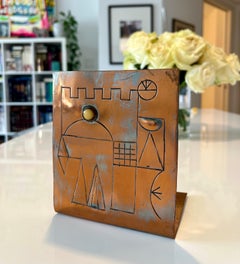
Israeli Mod Arts
Crafts Copper Sculpture Bookends Bezalel Schatz Yaad Studio
By Bezalel Schatz
Located in Surfside, FL
Bezalel Schatz, (1912-1978), Yaad Studio Workshop
Mid century modern
The standing part is 6 X 5 inches. The copper sheet is 10 X 5 inches each. This is for a pair. they are copper w...
Category
Mid-20th Century Modern Abstract Sculptures
Materials
Copper
Still Thinking About These?
All Recently ViewedMore Ways To Browse
Berrocal Puzzle
Berrocal Puzzle Sculpture
Miguel Berrocal Puzzle Sculptures
Chrome Torso
Russell Smith
Russian Collage
Salvador Dali Clocks
Sampson Paintings
Scottish Painting Henderson
Sea Painting Gold Frame
Seattle Poster
Sgraffito Painting
Sheep Pasture Painting
Simone Cantarini
Skip Whitcomb
Sonnets From The Portuguese
Spanish Church Painting
Springer Spaniel Painting