Items Similar to Virgin of the Rosary of Chiquinquirá with Saint Anthony of Padua and Saint Andre
Want more images or videos?
Request additional images or videos from the seller
1 of 4
Peruvian, Ayacucho SchoolVirgin of the Rosary of Chiquinquirá with Saint Anthony of Padua and Saint Andre1673
1673
$32,500
£24,454.13
€28,251.99
CA$45,629.28
A$49,294.58
CHF 26,225.20
MX$593,147.98
NOK 332,066.43
SEK 303,683.80
DKK 211,056.40
About the Item
Provenance: Private Collection, Uruguay, for the last 90 years.
Dated 1673 on the reverse (Fig. 1), this exceptional relief is an early example of a distinctly Spanish American artistic tradition that combined painting and sculpture. Beginning in the 17th century, local craftsmen in the town of Huamanga in the province of Ayacucho, Peru began to specialize in the production of small-scale, polychrome religious sculptures made from local stone. Known as Peruvian alabaster for its translucency and workability, piedra de Huamanga (or Huamanga stone) is a highly prized material, and the distinctive sculptures made from it are among the most accomplished examples of carving from the New World.
Huamanga stone was most often carved into small independent sculptures and sculptural groups. Reliefs of this kind are comparatively rare and desirable for their elaborate imagery and their approximation of painted compositions. The subject of the work is an advocation of the Virgin that was popularized in Colombia in the 16th century. The composition derives from an original painting of the Virgin of the Rosary that was commissioned in 1555 by Antonio de Santana, who kept the painting in a chapel on his estate. That painting had been so seriously damaged from water and exposure to be almost unrecognizable. After Santana’s death, his widow took it with her to Chiquinquirá and placed it in a small oratory that had a straw roof and no doors, which caused further damage to the image. Around 1585 Santana’s sister-in-law, María Ramos, decided to restore the oratory. Famously, it was divinely restored on a single day in the year 1586. An indigenous woman named Isabel happened to passed by, and she saw that the washed-out colors of the canvas had regained their original brilliance. The miracle caught the attention of the local populace and people in the surrounding region. In 1636 the Dominican order took charge of the site and the miraculous painting, and devotion to and depictions of the Virgin quickly spread to Venezuela, Ecuador, and Peru.
The original painting of the Virgin of the Rosary of Chiquinquirá and the majority of later copies are oriented in a horizontal format (Fig. 2). Our relief is vertically oriented—allowing for a larger view of the sky and putti above—but follows the basic formula of the composition. The Virgin is shown holding a rosary and a scepter in one arm and the Christ child in another while being crowned by two putti. The central holy figures are surrounded by a flaming aureole and are accompanied by Saint Anthony of Padua (the name saint of the original patron, Antonio de Santana) on the left, and the apostle Saint Andrew holding the X-shaped cross on which he was crucified on the right. Unusually, Saint Anthony holds a palm branch (rather than a lily) and his head is partially covered by the hood of his habit.
By their size and semi-precious material Huamanga stone reliefs of this kind were mostly intended for domestic devotion—prized as artistic objects, but providing religious and spiritual comfort.
- Creator:Peruvian, Ayacucho School (Peruvian)
- Creation Year:1673
- Dimensions:Height: 11.5 in (29.21 cm)Width: 8.63 in (21.93 cm)Depth: 0.88 in (2.24 cm)
- Medium:
- Movement Style:
- Period:1670-1679
- Condition:
- Gallery Location:New York, NY
- Reference Number:1stDibs: LU10216363512
About the Seller
5.0
Recognized Seller
These prestigious sellers are industry leaders and represent the highest echelon for item quality and design.
Established in 1997
1stDibs seller since 2012
24 sales on 1stDibs
Typical response time: 9 hours
- ShippingRetrieving quote...Shipping from: New York, NY
- Return Policy
More From This Seller
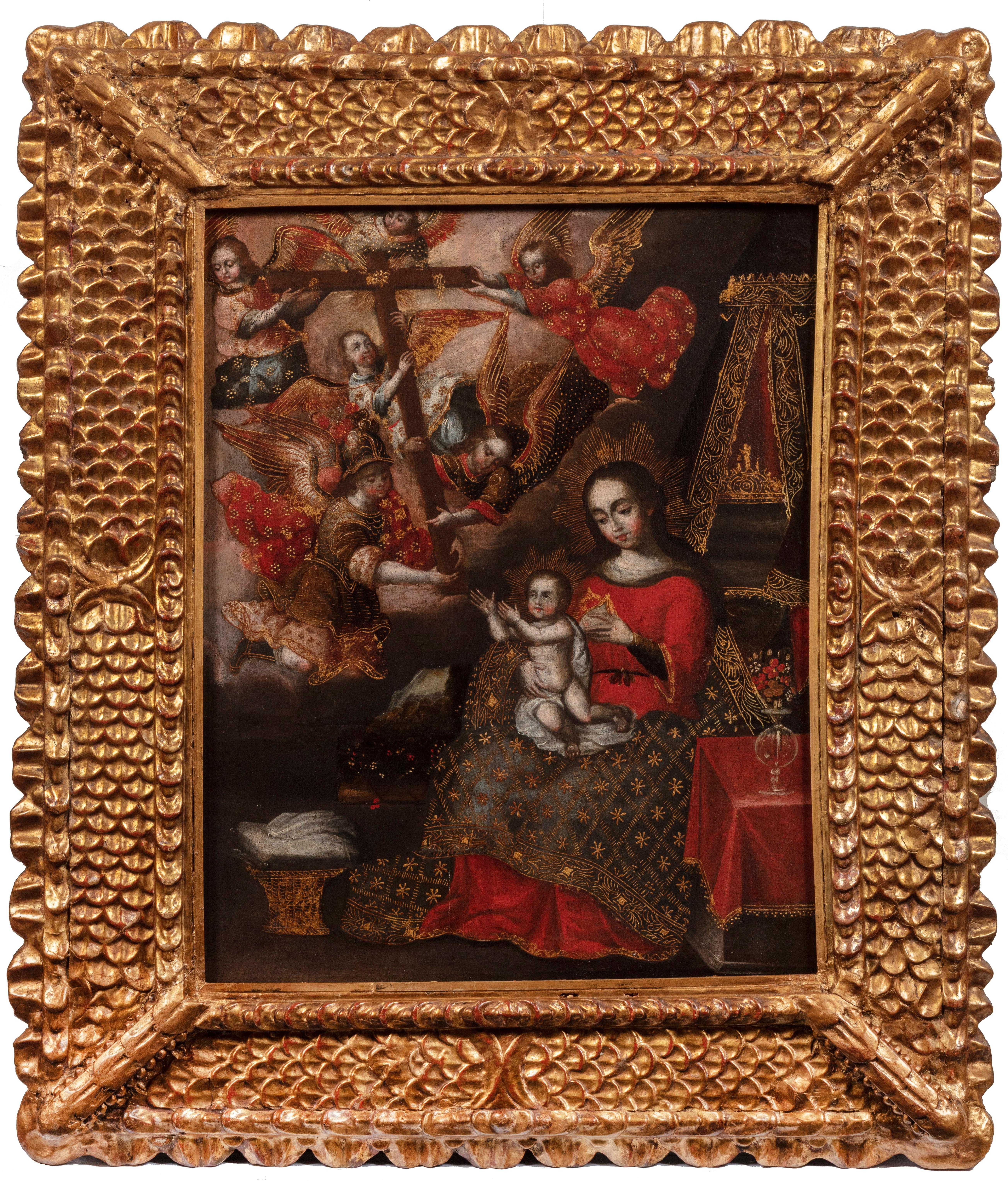
View AllVirgin and Child with Angels Carrying the Cross (Vision of the Cross)
Located in New York, NY
Provenance: Fernandez Jimenez, Spain; part a family collection for over 80 years.
Prints transported to the New World for use in missionary work and religious instruction often serv...
Category
18th Century Old Masters Figurative Paintings
Materials
Canvas, Oil
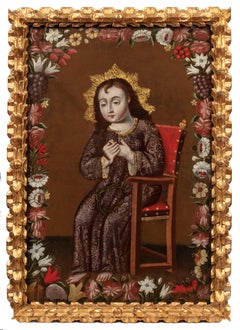
Young Christ Pricked by a Thorn (Niño de la Espina)
Located in New York, NY
Provenance: Private Collection, Paraguay, for at least the last 80 years
Painted in the Viceroyalty of Peru during the 18th century, the present work depicts the young Christ as the Niño de la Espina—a devotional representation of Christ as he looks down at his bleeding finger, which has been pricked by the crown of thorns resting on his lap. The subject of the Young Christ Pricked by a Thorn was especially popular in Cuzco, and the rich details and decorative elements of our work perfectly capture the essence and style of the Cuzco School of painting.
In our painting, Christ wears an intricately patterned floor-length robe trimmed with gilded cuffs and a gilded collar. The delicate gilding, including the halo of golden rays emanating from his head, are executed in brocateado, an ornamental over-gilding technique that is characteristic of the Cuzco School. The red chair on which Christ sits also includes brocateado in the decorative gilt elements. The form of the chair takes inspiration from those commonly used by friars both in Spain and the Andes, known as silla frailera or sillon frailero, and was also frequently employed in related depictions of the Virgin Mary Spinning. Here the young Christ is rendered with soft, elongated features that reflect the influence of the Italian Mannerist painters who were pivotal to the formation of the Cuzco School, including the Jesuit friar Bernardo Bitti and Matteo Pérez del Alesio. Additionally, while its origins can be traced to Northern European pictorial traditions, the lush flower garland that frames the work is a signature feature of Cuzqueño painting...
Category
18th Century Old Masters Figurative Paintings
Materials
Canvas, Oil
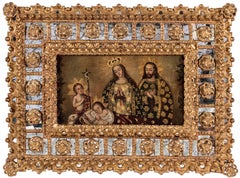
A Magnificent Gilt Wood Mirrored Frame
Located in New York, NY
Provenance: Private Collection, Argentina; there acquired by
Mr. and Mrs. Ernest T. Harper, New York, by 1960; by descent to:
Mr. and Mrs. Alan Harper, New York, until 2024.
This extraordinary mirrored frame is an exuberant and nearly perfectly preserved example of Andean 18th-century decorative art. Pierced mirrored rosettes surrounding floral motifs are set against mirrored surrounds along a broad frieze bordered within and without by elaborate raised moldings, inlaid by small, shaped mirrors. Repeating ornamental motifs reflecting both Spanish and indigenous designs surround both the inside panel and the exterior perimeter, the four corners of which are punctuated by mirrored rosettes.
Glass mirrors were unknown to the indigenous population of the Americas prior to the arrival of Europeans (obsidian mirrors...
Category
18th Century Old Masters Figurative Paintings
Materials
Canvas, Mirror, Wood, Oil
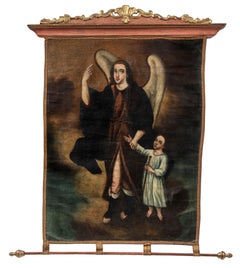
A Guardian Angel Leading a Child
Located in New York, NY
Provenance: Private Collection, Argentina; there acquired by
Mr. and Mrs. Ernest T. Harper, New York, by 1960; by descent to:
Mr. and Mrs. Alan Harper, New York, until 2024.
This s...
Category
18th Century Old Masters Figurative Paintings
Materials
Canvas, Oil
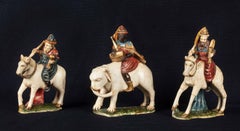
The Three Magi
Located in New York, NY
Provenance: Private Collection, Spain.
Known as Peruvian alabaster for its translucency and workability, Piedra de Huamanga is a highly prized material from the province of Ayacucho in Peru. In the 17th and 18th centuries, local craftsman in the town of Huamanga began to specialize in the production of small-scale, polychrome religious sculptures made from this distinctive stone. Huamanga sculptures are among the most accomplished examples of carving from the Spanish Americas, where polychrome wood sculpture was a far more common sculptural medium. These works, which were created as independent sculptures or as sculptural groups—such as our three Magi—were intended for ecclesiastical as well as domestics settings.
Our three figures likely formed part of a larger Nativity group—a New World variant of the tradition of the Neapolitan Crèche...
Category
Late 18th Century Figurative Sculptures
Materials
Alabaster
Madonna and Child with Angels in the Clouds
Located in New York, NY
Provenance: Charles H. and Virginia Baldwin, Claremont, Colorado Springs, Colorado ca. 1907-1934; thence by descent until sold in 1949 to:
Charles Blevins Davis, Claremont (renamed Trianon), Colorado Springs 1949 -until gifted in 1952 to:
The Poor Sisters of Saint Francis, Trianon, Colorado Springs, 1952 until acquired, 1960, by:
John W. Metzger, Trianon, renamed as the Trianon School of Fine Arts, Colorado Springs, 1960-1967; when transferred to:
The Metzger Family Foundation, Trianon Art Museum, Denver, 1967 - 2004; thence by descent in the Metzger Family until 2015
Exhibited: Trianon Art Museum, Denver (until 2004)
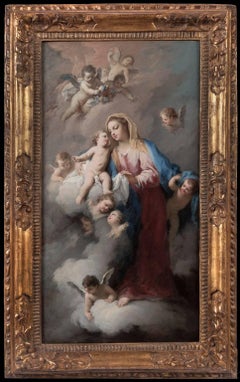
The present work is a spectacular jewel-like canvas by Amigoni, rich in delicate pastel colors, most likely a modello for an altarpiece either lost or never painted. In it the Madonna stands firmly upon a cloud in the heavens, her Child resting on a delicate veil further supported by a cloud, as he gently wraps his arm around his mother’s neck. From above angels prepare to lower flowers and a wreath, while other angels and seraphim surrounding the two joyfully cavort.
Dr. Annalisa Scarpa, author of the forthcoming monograph on Jacopo Amigoni...
Category
18th Century and Earlier Figurative Paintings
Materials
Canvas, Oil
You May Also Like
"Virgen del Carmen II" Peruvian Cusco School Style Virgin Mary by Martha Ochoa
By Martha Ochoa
Located in Austin, TX
By Martha Ochoa
Oil on Canvas
Canvas Size: 48" x 32"
Framed Size: 55.5" x 40.5"
This lovely painting by Martha Ochoa is from the Cusco tradition. The Cusco School was an artistic tradition that first emerged in the 16th and 17th centuries in Cusco, Peru, blending indigenous and European baroque artistic styles. It is renowned for its catholic iconography, which often feature vibrant colors, elaborate ornamentation, and blended elements combining Catholic and native symbolism.
This painting portrays the Virgen del Carmen...
Category
21st Century and Contemporary Baroque Paintings
Materials
Canvas, Oil
Virgin and Child in Polychrome Wood on a Cloud with Cherubs, Spanish/Colonial
Located in Madrid, ES
Virgin and Child in Polychrome Wood on a Cloud with Cherubs, Spanish/Colonial School, 18th Century
This devotional sculpture in carved wood, 61 cm in total height, depicts the Virgi...
Category
Antique Early 18th Century Spanish Baroque Figurative Sculptures
Materials
Silver
Latin American Colonial Cuzco School Holy Family with Sleeping Child
Located in New York, NY
Beautiful 18th Century oil on canvas Holy Family with Sleeping Child, Cuzco School. Good condition overall. Unsigned.
Category
18th Century Figurative Paintings
Materials
Canvas, Oil
Virgin of Miraflores in polychrome maguey wood with Child and copper crown, 18th
Located in Madrid, ES
Virgin of Miraflores in polychrome maguey wood with Child and copper crown, 18th century
Magnificent sculpture of the Virgin of Miraflores carved in polychrome maguey wood, from the ...
Category
Antique 18th Century Spanish Baroque Figurative Sculptures
Materials
Silver
"Virgen Huápulo" Peruvian Cusco School Painting of Virgin Mary by Martha Ochoa
By Martha Ochoa
Located in Austin, TX
By Martha Ochoa
Oil on Canvas
Canvas Size: 48" x 36"
Framed Size: 53.75" x 42.5"
This lovely painting by Martha Ochoa is from the Cusco tradition. The Cusco School was an artistic t...
Category
21st Century and Contemporary Baroque Paintings
Materials
Canvas, Oil
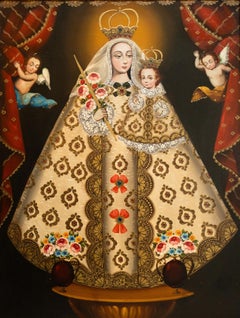
"Virgen de la Almudena" Cusco Style Image of the Virgin Mary and Baby Jesus
By Martha Ochoa
Located in Austin, TX
By Martha Ochoa
Oil on Canvas
Canvas Size: 24" x 16"
Framed Size: 27" x 19.25"
This lovely painting by Martha Ochoa is from the Cusco tradition. The Cusco School was an artistic tra...
Category
1990s Baroque Paintings
Materials
Canvas, Oil
