Items Similar to Eustace-Hyacinthe Langlois, called Langlois de L
Arche
Want more images or videos?
Request additional images or videos from the seller
1 of 3
Pierre Jean David d
AngersEustace-Hyacinthe Langlois, called Langlois de L
Arche1838
1838
$40,969.56
£30,000
€34,921.84
CA$56,443.07
A$61,513.01
CHF 32,573.79
MX$738,836.02
NOK 412,391.39
SEK 379,153.32
DKK 260,827.41
About the Item
Plaster
480 mm; 19 inches diameter
Inscribed: ‘H. Langlois du Pont de l’Arche Archeologue Peintre Graveur
par son ami P. J. David (D Angers) 1838’
Collections:
Sotheby’s, 22nd May 1996, lot 70 (bt Blairman on behalf of Clive Wainright);
Clive and Jane Wainright;
Jane Wainwright, to 2024;
Lowell Libson
Jonny Yarker Ltd.
Other versions:
Cast in bronze for Langlois’s monument, 1841, Cimetière Monumental, Rouen;
Plaster cast, Musées d’Angers, Galerie David D’Angers, inventory number MBA 506, given in 1901 by Hélène David d’Angers, the daughter of the artist
This large plaster portrait roundel was made by David D’Angers in 1838 shortly after the death of the sitter, Eustache-Hyacinthe Langlois. D’Angers had produced a bronze medal of Langlois in 1835 and had been commissioned to produce a larger cast for the artist’s tomb in Rouen following his death in 1838. Given the date and size of the present plaster it seems likely to have been cast by D’Angers in preparation for the bronze mounted on Langlois’s tomb which was constructed in the form of a druidic stone found in the forest of Rouvray. Langlois himself was a painter, engraver and writer best known for his important antiquarian activity in his native Normandy.
Langlois was born in Pont de L’Arche in Normandy, trained at the École de Mars in Paris under Jacques-Louis David. Based in Rouen from 1809, Langlois became a prolific designer of gothic subjects depicting the supernatural world of devils and sorcerers based on ancient legends and embellished by his imagination. Langlois devoted himself to the study and preservation of his Norman heritage, and gradually became well known for his writings and illustrations on historical subjects. In 1824 he became a member of the Rouen Academy, and began teaching art to young students. By 1825 he was a member of the Society of Antiquaries of Normandy, based in Caen, a member of the Royal Academy of Science, Belles-letters and Arts of Rouen. In 1828 Langlois was made professor de l’Ecole Gratuité de Dessin de Rouen. The school was situated in what had been the medieval convent of La Visitation Sainte-Marie in the rue Beauvoisine on a hill overlooking the cathedral. His pupils included Célestin Nanteuil, Frédéric Legrip and Gustave Flaubert. In 1831 the Musée des Antiquités was set up under the curatorship of Achille Deville, a friend of Langlois who immediately involved him in building and displaying the collection. Langlois’ antiquarian publication on Norman architecture was widely read and had an important influence on the work of both the antiquarian Augustus Charles Pugin and his son Augustus Welby Northmore Pugin. Pugin senior spent much time with Langlois whilst preparing his Specimens of the Architectural Antiquities of Normandy for publication. Langlois’s Essai historique illustrates and describes the celebrated window in Rouen Cathedral dedicated to Julian the Hospiraller, Pugin used the book when he was preparing his own lectures on stained glass.
Langlois and David d’Angers had known each other as students and remained friends. D’Angers sculpted a bust of Langlois now in the collection of the Musée des Beaux-Arts in Rouen. D’Angers additionally carved a profile of Langlois which was cast as a medallion and inscribed ‘to my friend’ Langlois by David and dated 1835. Both a bronze cast and a terracotta survive in the Louvre. Shortly after Langlois’s death in 1837 a fund was raised to erect a monument to Langlois, d’Angers was approached to provide an enlarged bronze medallion which was to be mounted on a druidic stone found in the forest of Rouvray. The bronze cast is on the same scale as the present plaster, it therefore seems likely that it was made in preparation for the funerary monument. The beautiful surface of the present plaster means that the lines from the individual sections of the mould are clearly visible, this gives a sense of the current plaster as forming part of the d’Angers’s process.
- Creator:Pierre Jean David d Angers (1788 - 1856, French)
- Creation Year:1838
- Dimensions:Height: 18.9 in (48 cm)Diameter: 18.9 in (48 cm)
- Medium:
- Movement Style:
- Period:
- Condition:
- Gallery Location:London, GB
- Reference Number:1stDibs: LU1507217299042
About the Seller
5.0
Recognized Seller
These prestigious sellers are industry leaders and represent the highest echelon for item quality and design.
1stDibs seller since 2021
5 sales on 1stDibs
- ShippingRetrieving quote...Shipping from: Mitchum, United Kingdom
- Return Policy
More From This Seller
View AllSir Charles Frederick
Located in London, GB
Oil on canvas
50 x 40 inches; 127 x 101.6 cm
Framed dimensions: 151.5 x 127 cm
Inscribed on plinth: ‘VOTIS X ET XX’
Painted c.1748
Collections:
Christie’s London, 23rd December 1...
Category
18th Century Old Masters Portrait Paintings
Materials
Canvas, Oil
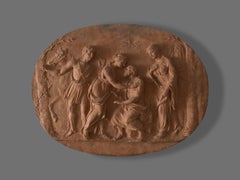
Oedipus before the Temple of the Furies at Colonus
Located in London, GB
Terracotta
19 x 25 ½ inches; 480 x 650 mm
Signed and dated: ‘W Tyler Excu. 1765’
Collections:
Cyril Humphris, London;
Humphris sale, Sotheby's, New York, 10-11 January 1995, lot 74...
Category
18th Century Old Masters Figurative Sculptures
Materials
Terracotta
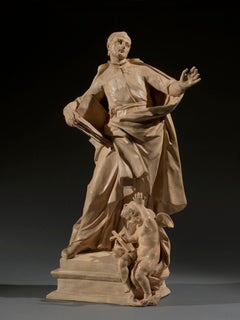
Roman 18th century terracotta model for the sculpture of San Camillo de Lellis
Located in London, GB
This remarkably fluid terracotta bozetto was made in preparation for Pietro Pacilli’s most important public commission, a large-scale marble statue of San Camillo de Lellis for the nave of St Peter’s Basilica in Rome. Expressively modelled, this terracotta sculpture is a rare and significant work made by a major Roman sculptor at a transformative moment of European sculpture. Pacilli began his working life on the great Baroque decorative projects initiated in the seventeenth century, but he found success as a restorer of ancient sculpture working to finish antiquities for a tourist market, becoming an important figure in the emergence of an archaeologically minded Neoclassicism. Pacilli trained Vincenzo Pacetti and provided important decorative work for the Museo Pio-Clementino, at the same time he is recorded restoring some of the most celebrated antiquities excavated and exported during the period.
Pacilli was born into a family of Roman craftsmen, his father Carlo was a wood carver, and Pacilli is recorded working with him on the Corsini Chapel in San Giovanni Laternao as early as 1735. In 1738 his terracotta model of Joseph and Potiphar’s Wife won the first prize in the second class of the sculpture concorso at the Accademia di San Luca, this is particularly notable as Bartolomeo Cavaceppi came third. He worked as a carver and stuccoist completing works for the churches of San Marco and SS. Trinita dei Domeniciani Spagnoli. Pacilli operated as a sculptor and restorer of antiquities from his studio at the top of the Spanish Steps, close to Santa Trinita dei Monti, where he is listed as a potential vendor to the Museo Pio-Clementino in 1770.
In 1763 Pacilli completed a silver figure of San Venanzio for the treasury of San Venanzio. He is recorded as Pacetti’s first master and it was evidently through Pacilli that he began to acquire his facility as a restorer of ancient sculpture. Pacilli, at his studio ‘poco prima dell’Arco della Regina alla Trinita dei Monti,’ exercised, what the nineteenth-century scholar, Adolf Michaelis called ‘rejuvenating arts’ on several important pieces of classical sculpture, including in 1760 the group of a Satyr with a Flute for the natural brother of George III, General Wallmoden, Hanovarian minister at Vienna. In 1765, Dallaway and Michaelis record that Pacilli was responsible for the restorations, including the addition of a new head, to the Barberini Venus which he had acquired from Gavin Hamilton. The Venus was then sold to Thomas Jenkins, who in turn passed it on to William Weddell at Newby Hall. In 1767 Pacilli exported a series of ancient busts ‘al naturale’ including portraits of Antinous, Julius Ceaser and Marus Aurelius, also a statue of a Muse and a Venus. As early as 1756 Pacilli seems to have been operating as an antiquarian, helping to disperse the collection of the Villa Borrioni. Pacilli supplied sculpture to notable British collectors, including Charles Townley, who on his first trip to Italy purchased the Palazzo Giustiniani statue of Hecate from Pacilli. Pacilli was involved with the Museo Pio Clementino from its conception, supplying busts of Julius Ceaser and a Roman Woman as well as completing stucco putti surmounting the arms of Pope Bendedict XIV to signal the entrance to the new Museo Critiano.
In 1750 Il Diario Ordinario del Chracas announced that Pacilli had begun work on a sculpture of San Camillo de Lellis for St Peter’s. Camillo de Lellis founded his congregation, the Camillians, with their distinctive red felt crosses stitched on black habits in 1591. Having served as a soldier in the Venetian army, Camillo de Lellis became a novitiate of the Capuchin friars, he moved to Rome and established a religious community for the purpose of caring for the sick. In 1586 Pope Sixtus V formerly recognised the Camillians and assigned them to the Church of Santa Maria Maddalena in Rome. Camillo de Lellis died in 1614 and was entombed at Santa Maria Maddalena, he was canonised by Benedict XIV on June 26, 1746. It was an occasion that prompted the Camillians to make a number of significant artistic commissions, including two canvases by Pierre Subleyras showing episodes from San Camillo’s life which they presented to Benedict XIV. In 1750 Pacilli was commissioned to fill one of the large niches on the north wall of the nave with a sculpture of San Camillo.
The present terracotta bozetto presumably had two important functions, to enable Pacilli to work out his ideas for the finished sculpture and at the same time to show his design to the various commissioning bodies. In this case it would have been Cardinal Alessandro Albani and Monsignor Giovan Francesco Olivieri, the ‘economo’ or treasurer of the fabric of St Peter’s. Previously unrecorded, this terracotta relates to a smaller, less finished model which has recently been identified as being Pacilli’s first idea for his statue of San Camillo. Preserved in Palazzo Venezia, in Rome, the terracotta shows San Camillo with his left hand clutching his vestments to his breast; the pose and action more deliberate and contained than the finished sculpture. In producing the present terracotta Pacilli has expanded and energised the figure. San Camillo is shown with his left hand extended, his head turned to the right, apparently in an attempt to look east down the nave of St Peter’s. The model shows Pacilli experimenting with San Camillo’s costume; prominently on his breast is the red cross of his order, whilst a sense of animation is injected into the figure through the billowing cloak which is pulled across the saint’s projecting right leg. The power of the restrained, axial contrapposto of bent right leg and outstretched left arm, is diminished in the final sculpture where a baroque fussiness is introduced to the drapery. What Pacilli’s terracotta demonstrates, is that he conceived the figure of San Camillo very much in line with the immediate tradition of depicting single figures in St Peter’s; the rhetorical gesture of dynamic saint, arm outstretched, book in hand, head pointed upwards was perhaps borrowed from Camillo Rusconi’s 1733 sculpture of St. Ignatius...
Category
18th Century Baroque Figurative Sculptures
Materials
Terracotta
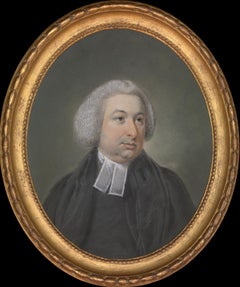
Eighteenth-century Irish portrait of the Rev. Henry Dabzac
By Hugh Douglas Hamilton
Located in London, GB
Pastel on paper, oval
9 x 7 ¼ inches; 230 x 185 mm
Inscribed on the verso:
‘The Revd Henry Dabzac D.D./ late Senior Fellow of/ Trinity College Dublin/ ever to be lamented by all that knew/ Him. Extensive learning, zeal, gently tempered/ by a spirit of charity & above all, a strong/ faith & a piety deservedly gained/ the character of a great and good man./ This exceptional man died 12th May 1790/ This picture was his give to Jane [Mary] Crofton, his sincerely [missing] sister.’
Collections:
Rev. Dr Henry Dabzac gift to his sister, Jane Crofton (d.1797);
Sir Hugh Crofton (1763-1834);
By descent to 1990;
Private collection, Dorset to 2020.
Literature:
Robert Staveley, Traces of Past and Present, Dublin, 1895, p.74;
Neil Jeffares, Dictionary of Pastellists Before 1800, online edition, no.J3751247
This characteristic pastel portrait by Hugh Douglas Hamilton was made early in his career; it depicts precisely the kind of education, well-connected Irish sitter who fuelled his success. The Reverend Henry Dabzac was from a distinguished Huguenot family, a celebrated academic historian, Dabzac received the Donegall lectureship in 1764 and from 1785 was Librarian and Senior Fellow of Trinity College, Dublin. According to his earliest biographer, Hamilton was the son of a peruke-maker based in Crow Street, Dublin. As Anne Hodge has pointed out, this places Hamilton’s father at the heart of the city: Crow street was a narrow thoroughfare formed part of the busy warren of streets bordered by the old Houses of Parliament and Trinity College at one end, and by Dublin Castle at the other. It is perhaps telling that in this early portrait, Hamilton shows Dabzac in a splendid powdered wig and his clerical bands. In 1754 Hamilton was apprenticed to James Mannin, a ‘pattern drawer’ who two years later was appointed master of the school of ornament at the Dublin Society’s drawing school, run by Robert West. Here Hamilton took the first prize in the 1755 competition, winning a premium of £1/16/. Hamilton developed a popular and profitable method of making pastel likenesses of sitters in a distinctive oval format. Hamilton developed a technique of using a sharpened pastel to hatch shaded areas of the features and, in the case of this portrait of Dabzac, the white powdered wig, which is drawn with particular care. In 1764 Hamilton moved to London where this small, oval pastels proved...
Category
18th Century Old Masters Portrait Drawings and Watercolors
Materials
Pastel
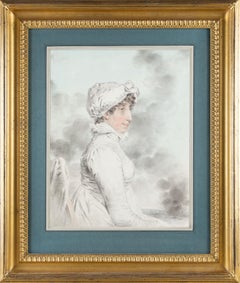
Regency portrait drawing of Arabella Graham-Clarke
By John Downman
Located in London, GB
Collections:
The sitter, and by descent;
Christie's, 19th March 1928, lot 6;
Private collection to 2019
Literature:
G.C. Williamson, John Downman, A.R.A., his Life and Works, Lon...
Category
Early 19th Century Old Masters Portrait Drawings and Watercolors
Materials
Pencil, Watercolor
Portrait drawing of Harriot Mellon, Mrs Thomas Coutts
By Henry Fuseli
Located in London, GB
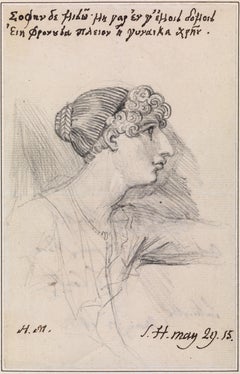
Inscribed by the artist in pen and brown ink, upper margin: 'σοφὴν δὲ μισῶ: μὴ γὰρ ἔν γ' ἐμοῖς δόμοις / εἴη φρονοῦσα πλείον' ἢ γυναῖκα χρή [Euripides, Hippolytus, 11, 640-41: “But a ...
Category
19th Century Old Masters Portrait Drawings and Watercolors
Materials
Pencil
You May Also Like
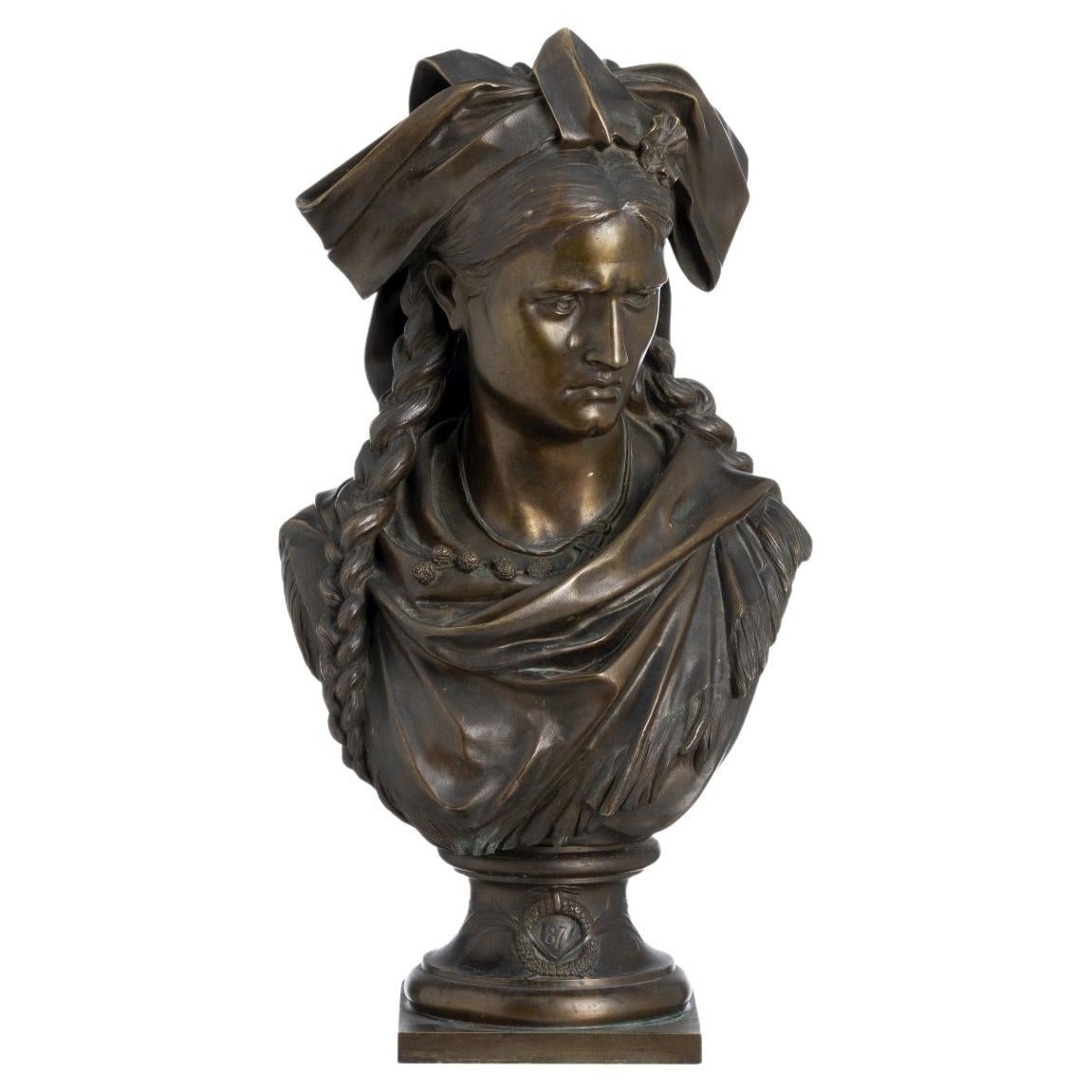
Jean-Louis Grégoire (1840-1890)
Located in Porto, PT
"Alsace 1871". Bronze sculpture. Signed and dated 1879. Dim. Height: 48 cm.
Category
Antique 19th Century French Figurative Sculptures
Materials
Bronze
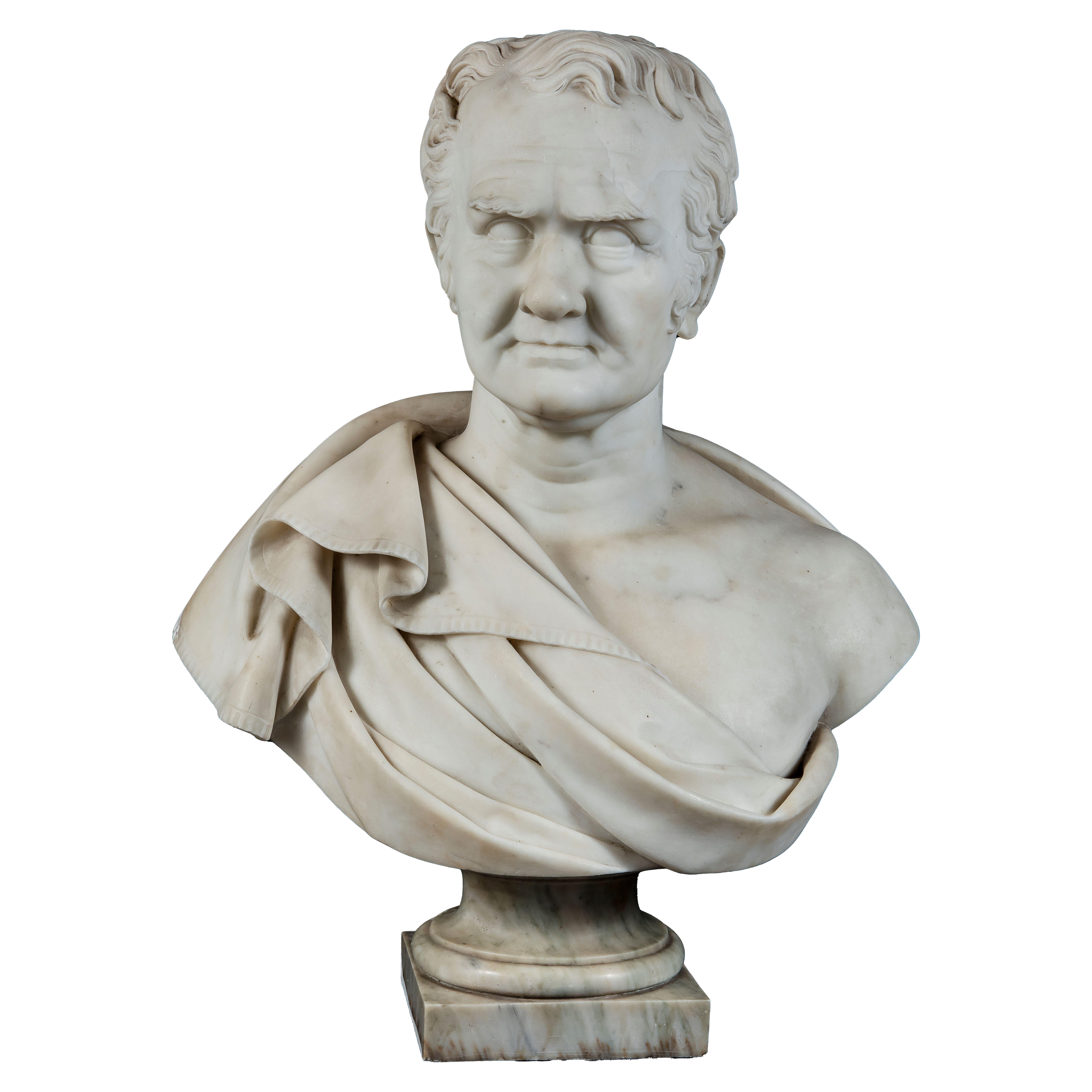
Giuseppe Bogliani, "Bust of Gianantonio Raggi"
Located in Milano, IT
Giuseppe Bogliani (Turin 1805 - 1881) "Bust of Gianantonio Raggi" ...
Category
Antique 19th Century Italian Figurative Sculptures
Materials
Marble
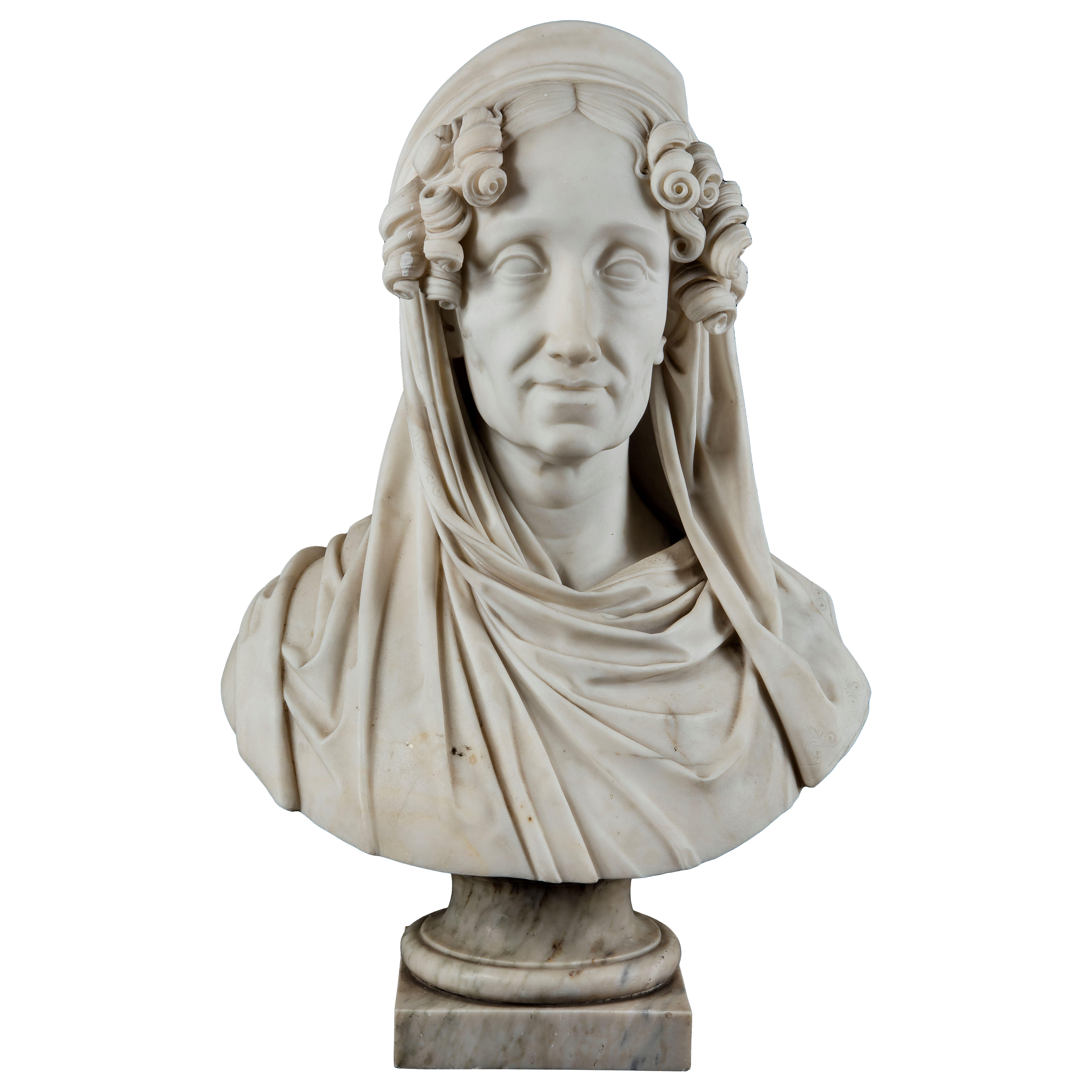
Giuseppe Bogliani, "Bust of Teresa Spinola Raggi."
Located in Milano, IT
Giuseppe Bogliani (Turin 1805 - 1881)
"Bust of Teresa Spinola Raggi." ...
Category
Antique 19th Century Italian Figurative Sculptures
Materials
Marble
Portrait of Albert Dubarry
Located in PARIS, FR
Portrait of Albert Dubarry
by Léon-Ernest DRIVIER (1878-1951)
Bronze with a nuanced greenish dark brown patina
signed "Drivier"
cast by "Montagutelli, Paris, cire perdue" (with the ...
Category
1930s French School Figurative Sculptures
Materials
Bronze
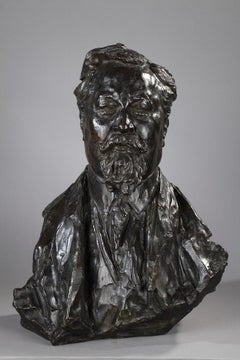
François, Marquis de Barbé-Marbois Portrait Sculpture After Honoré Daumier
By Honoré Daumier
Located in Plainview, NY
A sculpture of the portrait of François, Marquis de Barbé-Marbois originally crated by Honoré Daumier ( French, 1808 - 1879).
The sculpture made of carved wood is signed in the bott...
Category
Mid-20th Century Figurative Sculptures
Materials
Wood
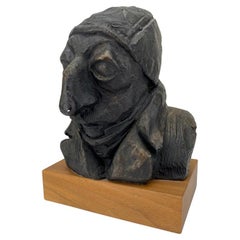
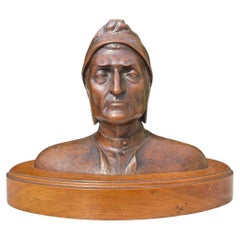
J. Chartron - Bust Of Dante
Located in Beaune, FR
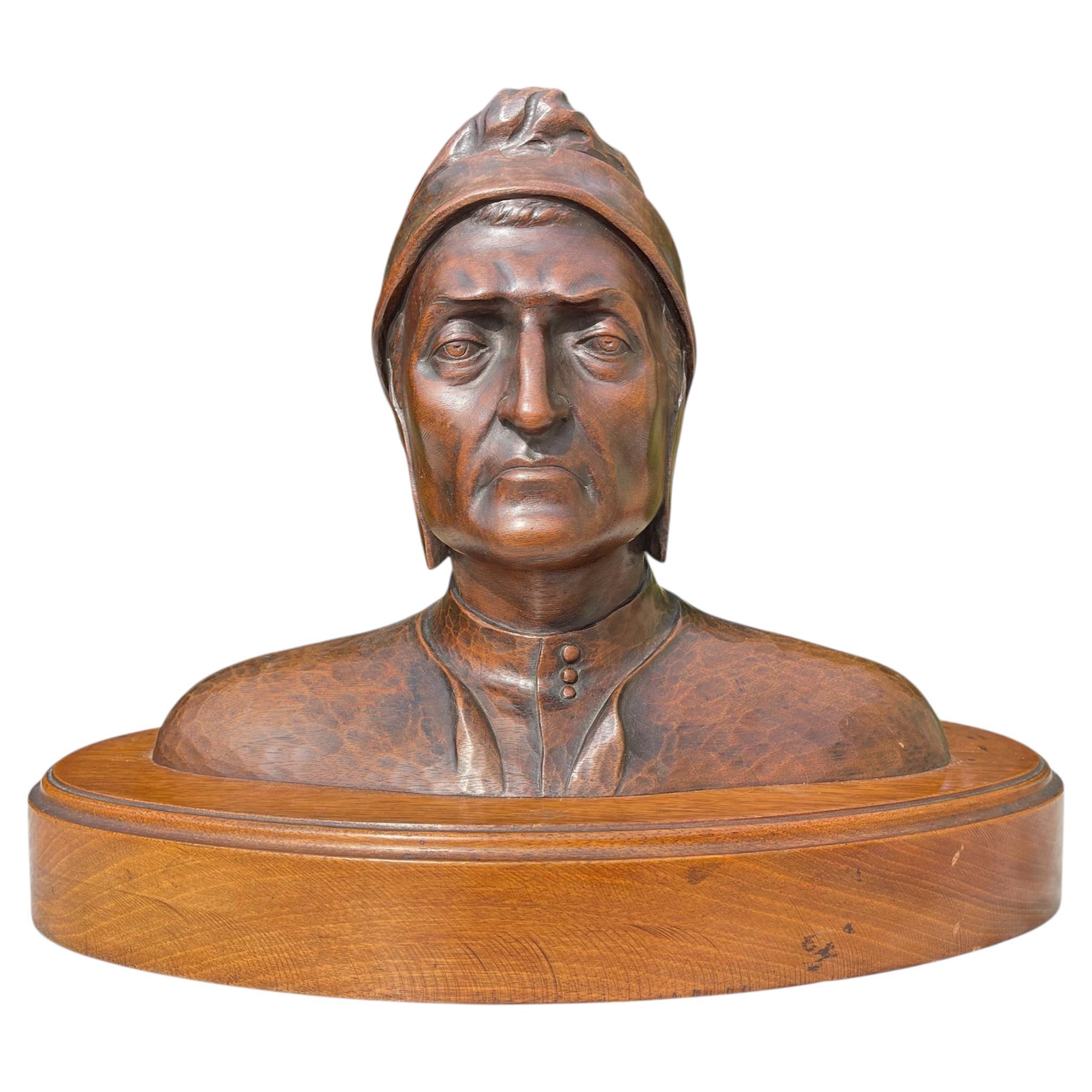
Bust of Dante in carved walnut signed "J. Chartron".
It in good condition.
Category
Antique 19th Century French Figurative Sculptures
Materials
Walnut