Items Similar to Ted Egri Taos Modernist Judaica Cubist Bronze Sculpture Rabbi
Torah WPA Artist
Want more images or videos?
Request additional images or videos from the seller
1 of 15
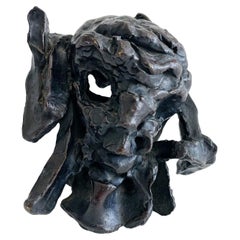
Ted EgriTed Egri Taos Modernist Judaica Cubist Bronze Sculpture Rabbi
Torah WPA Artist
$3,600
£2,726.67
€3,131.48
CA$5,044.78
A$5,484.69
CHF 2,907.99
MX$65,747.53
NOK 36,959.05
SEK 33,859.51
DKK 23,403.86
About the Item
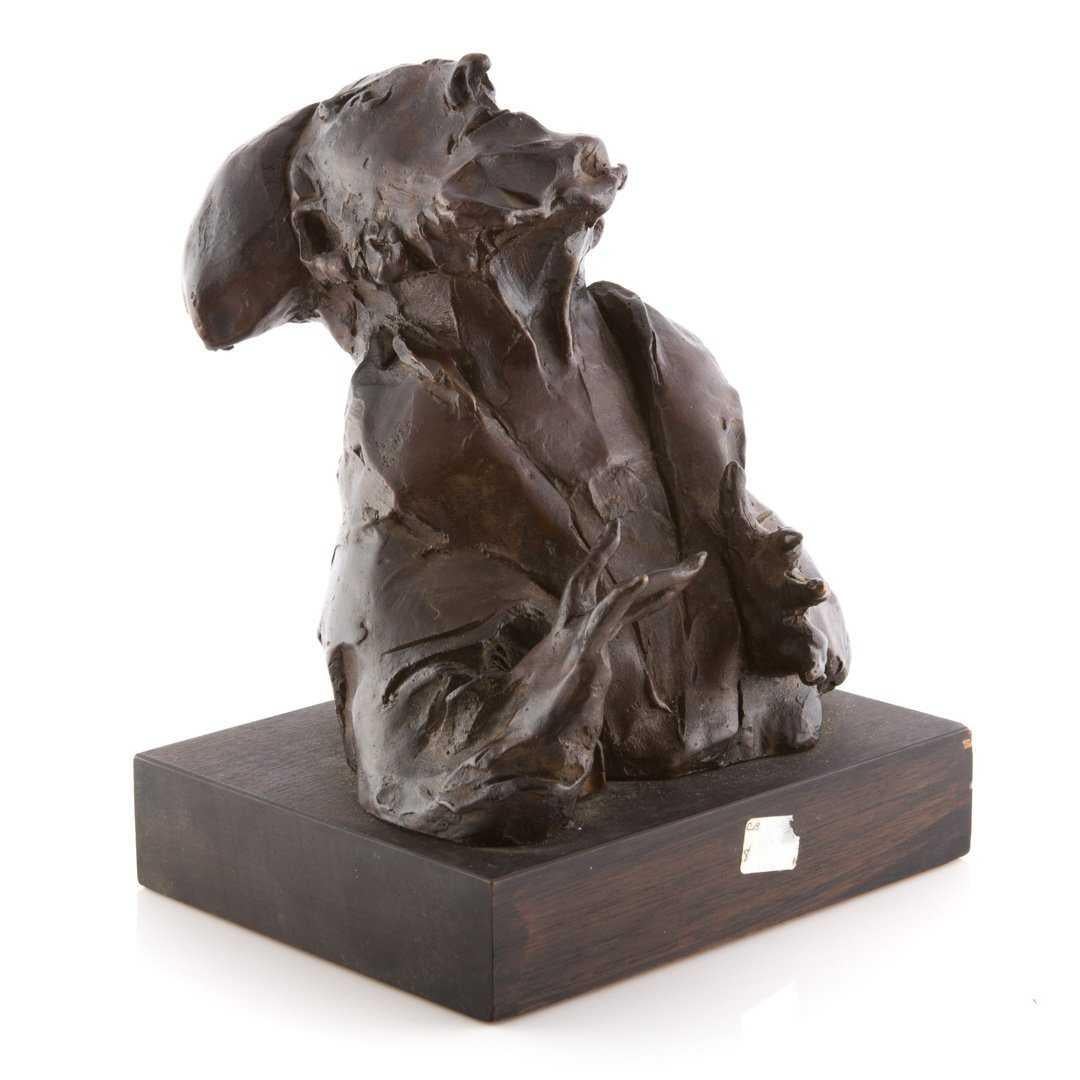
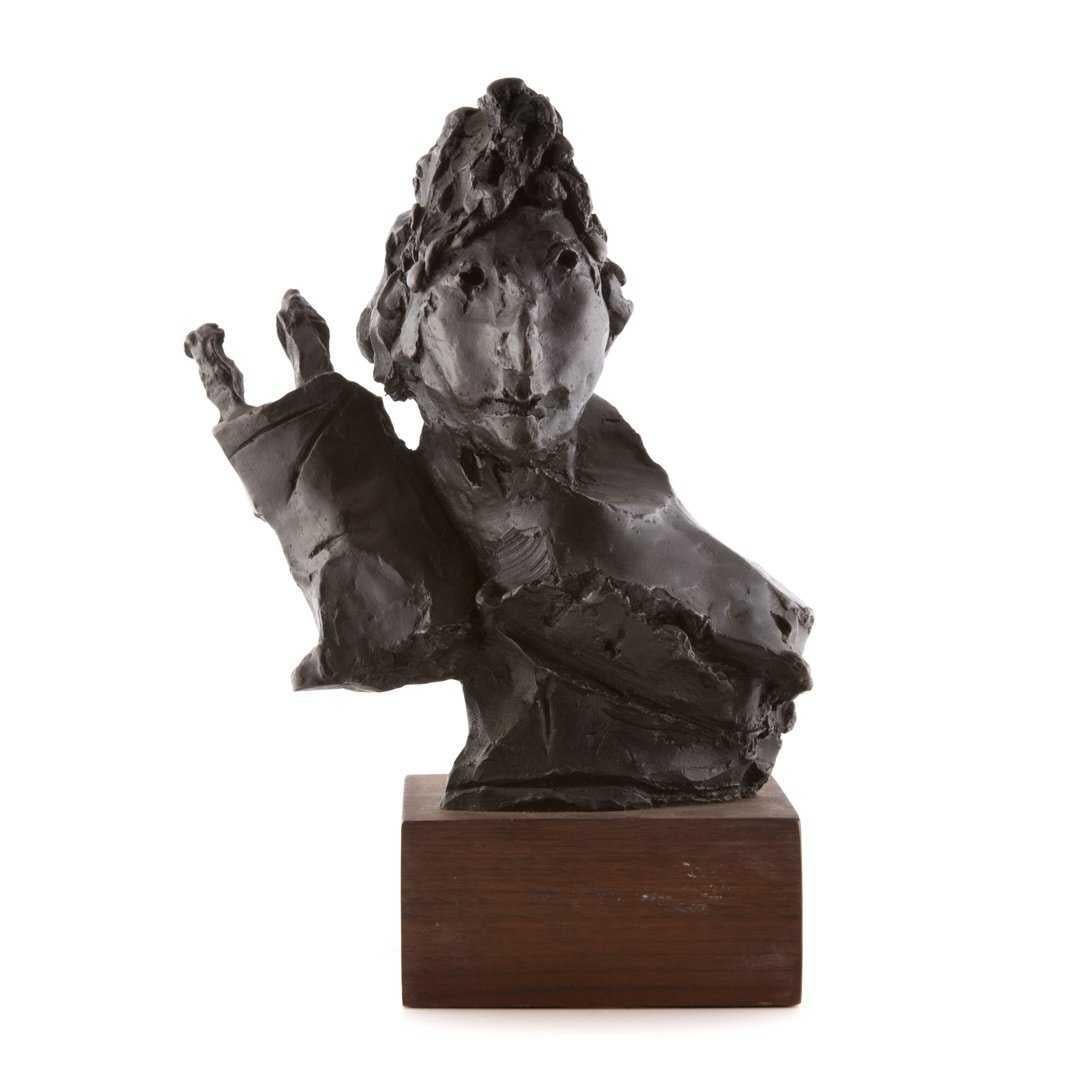
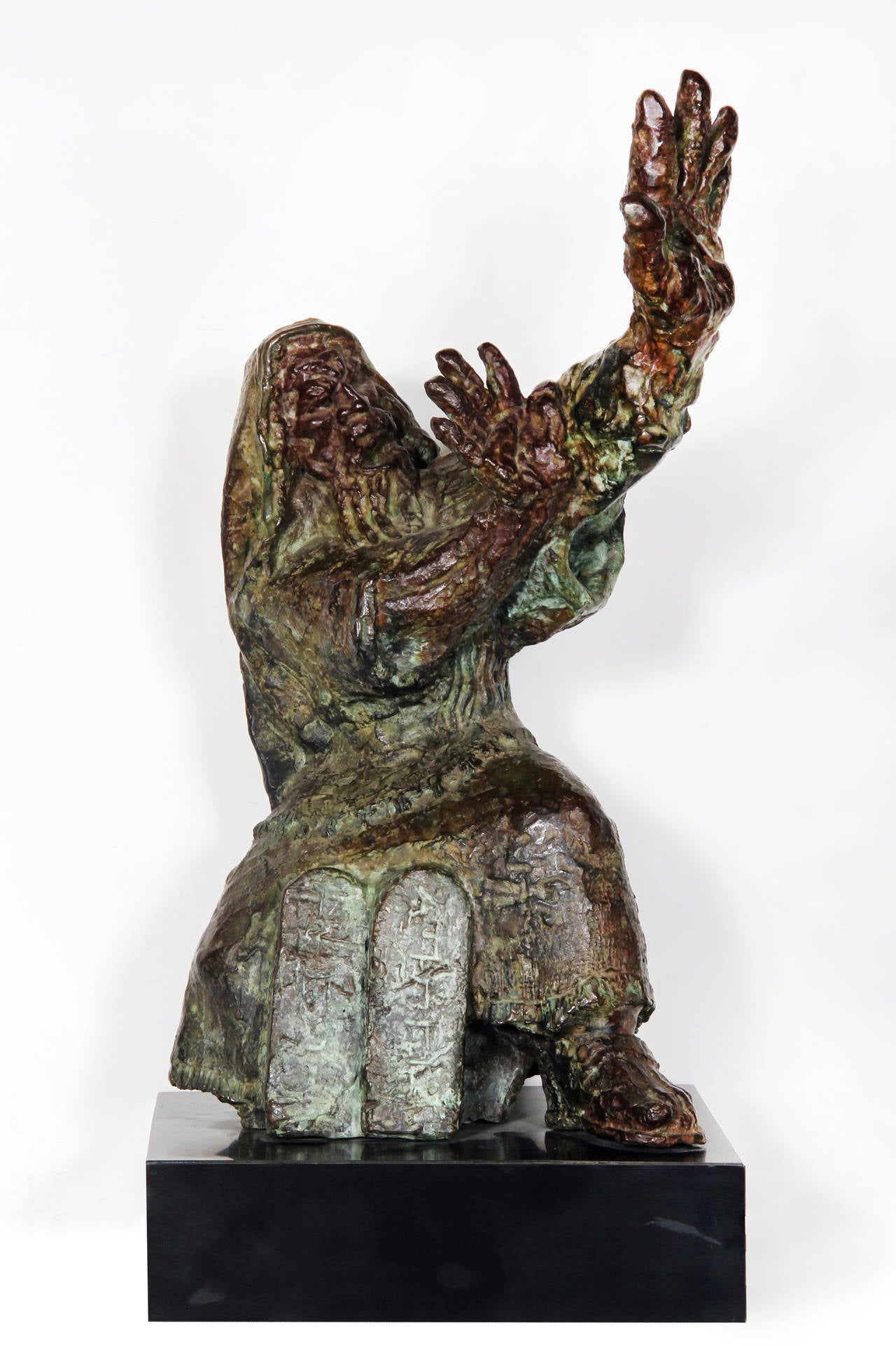
Ted Egri (American, 1913-2010)
Bronze sculpture
Rabbi
Signed Egri and numbered 4/30 on side.
Dimensions: 12"L x 8.5"H x 6.75" D
Born in New York city in 1913 to a Hungarian Jewish emigre family (both of his parents were born in Hungary), Egri was first exposed to music later dropping that for art. He studied with Howard Giles at the Master Institute of the Roerich Museum in New York where he was introduced to Oriental arts, Chinese and Japanese art forms, and later with Hans Hofmann. He worked for the Federal Arts Project, the WPA, making mural paintings and silkscreen prints as well as easel painting. Once WWII began, Egri signed up to serve as a map maker for the Navy, and was witness to some of the fiercest battles in the Pacific. As an artist, he painted many important depictions of his wartime experiences and these works have all be donated to the U.S. Naval Museum.
Already a practicing painter and instructor at the Kansas City Art Institute, Ted Egri came to Taos, New Mexico with his wife Kit in 1950 to continue his study of painting at Ribak's Taos Valley Art School on the GI Bill. Louis Ribak quickly introduced Egri to Eulalia Emetaz, the owner of La Galleria Escondida, who gave him his first one-person show in 1951.
A prolific and versatile artist, as well as arts organizer and advocate, Egri's contributions to underserved African American, Native American, Hispanic and women were honored by two Taos mayors, with no less than two Ted Egri days during his 50-year art career in Taos. Egri remained in Taos. He became widely known for his sculpture, influenced by cubism and painting, with his style ranging from abstract to realistic. Egri had incredible draftsmanship - charcoal, pencil, pastel, watercolor, oils, mixed media, pen and ink, acrylic, gouache Over time his work gradually shifted from its focus on human struggle to an exploration of natural elements and the changes that come about as a result of living in a physical environment like Taos. "The impact of the majestic Sangre de Cristo Mountain Range and the vast spaces of the mesas directed me toward space and form. I moved into sculpture," Egri said in a 1987 interview with ARTSPACE magazine. He was included in a show at Stables Gallery along with Emil Bisttram, Louis Catusco, Edward Corbett, Lawrence Calcagno, Keith Crown, Andrew Dasburg, John De Puy, Adeine de La Nöe, Ted Egri, R. C. Ellis, Louise Ganthiers, Barbara Harmon, Cliff Harmon, Bea Mandelman, Lee Mullican, Robert Ray, Louis Ribak, Wesley Rusnell, Oli Sihvonen, Clay Spohn, Earl Stroh and Michio Takayama and others. He is also included in the show Second Wave: The Beginning of a Post-War Era
at 203 Fine Art, Norman Bluhm, John Chamberlain, Richard Diebenkorn, Ted Egri, Leo Garel, Fred Hammersley, Janet Lippincott, Beatrice Mandelman, Louis Ribak and others. In 1996, Egri received the Governor’s Award of Excellence in the Arts.
Selected Sculpture Commissions
Tramway Park, Albuquerque, NM
Temple B’Nai Israel, Albuquerque, NM
Southwest Texas State University, San Marcos, TX
Northern Iowa University Campus, Cedar Fall, IA
City of Santa Monica, CA
Temple Sinai, Champaign, IL
Temple Shalom, Dallas, TX
Ave Maria Church, Parker, CO
Frank Waters Memorial, Taos, NM
- Creator:Ted Egri (1913 - 2010, American)
- Dimensions:Height: 12 in (30.48 cm)Width: 8.5 in (21.59 cm)Depth: 6.75 in (17.15 cm)
- Medium:
- Movement Style:
- Period:
- Condition:
- Gallery Location:Surfside, FL
- Reference Number:1stDibs: LU38217284332
About the Seller
4.9
Platinum Seller
Premium sellers with a 4.7+ rating and 24-hour response times
Established in 1995
1stDibs seller since 2014
1,855 sales on 1stDibs
Typical response time: <1 hour
- ShippingRetrieving quote...Shipping from: Miami, FL
- Return Policy
More From This Seller
View AllJudaica Bronze Sculpture "Rabbi" Figure Jewish American Boston Figural Modernist
By David Aronson
Located in Surfside, FL
Aronson, David 1923-
David Aronson, son of a rabbi, was born in Lithuania in 1923 and immigrated to America at the age of five. He settled in Boston, Massachusetts where he studied at the school of the Museum of Fine Arts under Karl Zerbe, a German painter well known in the early 1900s. Aronson later taught at the school of the Museum of Fine Arts for fourteen years and founded the School of Fine Art at Boston University where he is today a professor emeritus. An internationally renowned sculptor & painter, Aronson has won acclaim for his interpretation of themes from the Hebrew Talmud and Kabala. His best known works include bronze castings, encaustic paintings, and pastels. His work is included in many important public and private collections, and has been shown in several museum retrospectives around the country. He is considered to be one of the most important 20th century American artists.
At twenty-two David Aronson had his first one-man show at New York's Niveau Gallery. The next year, six of his Christological paintings were included in the Fourteen Americans exhibition at Manhattan's Museum of Modern Art where Aronson’s work was included alongside abstract expressionists Arshile Gorky, Robert Motherwell and Isamu Noguchi. In the 1950s, Aronson turned more toward his Jewish heritage for the inspiration for his art. Folklore as well as Kabalistic and other transcendental writings influenced his work greatly. The Golem (a legendary figure, brought to life by the Maharal of Prague out of clay to protect the Jewish community during times of persecution) and the Dybbuk (an evil spirit that lodges itself in the soul of a living person until exorcised) frequently appear in his work.
In the sixties, Aronson turned to sculpture. His work during this period is best exemplified by a magnificent 8’ x 4’ bronze door which now stands at the entrance to Frank Lloyd Wright's Johnson Foundation Conference Center for the Arts in Racine, Wisconsin. In the seventies and eighties, Aronson continued his work in pastel drawings, paintings, and sculptures, often exploring religion and the frailties of man's nature. During this time, in addition to a traveling retrospective exhibition and many one-man shows in New York, Los Angeles, Chicago, and Boston at the Pucker-Safrai Gallery on Newbury Street, Aronson won many awards and became a member of the National Academy of Design in New York. Two years ago he retired from teaching to work full-time in his studio in Sudbury, Massachusetts.
included in the catalog
Contemporary Religious Imagery in American Art
Catalog for an exhibition held at the Ringling Museum of Art, March 1-31, 1974.
Artists represented: David Aronson, Leonard Baskin, Max Beckmann, Hyman Bloom, Fernando Botero, Paul Cadmus, Marvin Cherney, Arthur G. Dove, Philip Evergood, Adolph Gottlieb, Jonah Kinigstein, Rico Lebrun, Jack Levine, Louise Nevelson, Barnett Newman, Abraham Rattner, Ben Shahn, Mark Tobey, Max Weber, William Zorach and others.
Selected Awards
1990, Certificate of Merit, National Academy of Design
1976, Purchase Prize, National Academy of Design
1976, Joseph Isidore Gold Medal, National Academy of Design
1976, Purchase Prize in Drawing, Albrecht Art Museum
1975, Isaac N. Maynard Prize for Painting, National Academy of Design
1973, Samuel F. B. Morse Gold Medal, National Academy of Design
1967, Purchase Prize, National Academy of Fine Arts
1967, Adolph and Clara Obrig Prize, National Academy of Design
1963, Gold Medal, Art Directors Club of Philadelphia
1961, 62, 63, Purchase Prize, National Institute of Arts and Letters
1960, John Siimon Guggenheim Fellowship
1958, Grant in Art, National Institute of Arts and Letters
1954, First Prize, Tupperware Annual Art Fund Award
1954, Grand Prize, Third Annual Boston Arts Festival
1953, Second Prize, Second Annual Boston Arts Festival
1952, Grand Prize, First Annual Boston Arts Festival
1946, Traveling Fellowship, School of the Museum of Fine Arts
1946, Purchase Prize, Virginia Museum of Fine Arts
1944, First Popular Prize, Institute of Contemporary Art
1944, First Judge's Prize, Institute of Contemporary Art
Selected Public Collections
Art Institute of Chicago
Virginia Museum of Fine Arts
Bryn Mawr College
Brandeis University
Tupperware Museum, Orlando, Florida
DeCordova Museum
Museum of Modern Art Print Collection, New York
Atlanta University
Atlanta Art...
Category
20th Century Expressionist Figurative Sculptures
Materials
Bronze
Bronze Sculpture Rabbi w Torah Judaica Figure American Boston Figural Modernist
By David Aronson
Located in Surfside, FL
Aronson, David 1923-
David Aronson, son of a rabbi, was born in Lithuania in 1923 and immigrated to America at the age of five. He settled in Boston, Massachusetts where he studied at the school of the Museum of Fine Arts under Karl Zerbe, a German painter well known in the early 1900s. Aronson later taught at the school of the Museum of Fine Arts for fourteen years and founded the School of Fine Art at Boston University where he is today a professor emeritus. An internationally renowned sculptor & painter, Aronson has won acclaim for his interpretation of themes from the Hebrew Talmud and Kabala. His best known works include bronze castings, encaustic paintings, and pastels. His work is included in many important public and private collections, and has been shown in several museum retrospectives around the country. He is considered to be one of the most important 20th century American artists.
At twenty-two David Aronson had his first one-man show at New York's Niveau Gallery. The next year, six of his Christological paintings were included in the Fourteen Americans exhibition at Manhattan's Museum of Modern Art where Aronson’s work was included alongside abstract expressionists Arshile Gorky, Robert Motherwell and Isamu Noguchi. In the 1950s, Aronson turned more toward his Jewish heritage for the inspiration for his art. Folklore as well as Kabalistic and other transcendental writings influenced his work greatly. The Golem (a legendary figure, brought to life by the Maharal of Prague out of clay to protect the Jewish community during times of persecution) and the Dybbuk (an evil spirit that lodges itself in the soul of a living person until exorcised) frequently appear in his work.
In the sixties, Aronson turned to sculpture. His work during this period is best exemplified by a magnificent 8’ x 4’ bronze door which now stands at the entrance to Frank Lloyd Wright's Johnson Foundation Conference Center for the Arts in Racine, Wisconsin. In the seventies and eighties, Aronson continued his work in pastel drawings, paintings, and sculptures, often exploring religion and the frailties of man's nature. During this time, in addition to a traveling retrospective exhibition and many one-man shows in New York, Los Angeles, Chicago, and Boston at the Pucker-Safrai Gallery on Newbury Street, Aronson won many awards and became a member of the National Academy of Design in New York. Two years ago he retired from teaching to work full-time in his studio in Sudbury, Massachusetts.
included in the catalog
Contemporary Religious Imagery in American Art
Catalog for an exhibition held at the Ringling Museum of Art, March 1-31, 1974.
Artists represented: David Aronson, Leonard Baskin, Max Beckmann, Hyman Bloom, Fernando Botero, Paul Cadmus, Marvin Cherney, Arthur G. Dove, Philip Evergood, Adolph Gottlieb, Jonah Kinigstein, Rico Lebrun, Jack Levine, Louise Nevelson, Barnett Newman, Abraham Rattner, Ben Shahn, Mark Tobey, Max Weber, William Zorach and others.
Selected Awards
1990, Certificate of Merit, National Academy of Design
1976, Purchase Prize, National Academy of Design
1976, Joseph Isidore Gold Medal, National Academy of Design
1976, Purchase Prize in Drawing, Albrecht Art Museum
1975, Isaac N. Maynard Prize for Painting, National Academy of Design
1973, Samuel F. B. Morse Gold Medal, National Academy of Design
1967, Purchase Prize, National Academy of Fine Arts
1967, Adolph and Clara Obrig Prize, National Academy of Design
1963, Gold Medal, Art Directors Club of Philadelphia
1961, 62, 63, Purchase Prize, National Institute of Arts and Letters
1960, John Siimon Guggenheim Fellowship
1958, Grant in Art, National Institute of Arts and Letters
1954, First Prize, Tupperware Annual Art Fund Award
1954, Grand Prize, Third Annual Boston Arts Festival
1953, Second Prize, Second Annual Boston Arts Festival
1952, Grand Prize, First Annual Boston Arts Festival
1946, Traveling Fellowship, School of the Museum of Fine Arts
1946, Purchase Prize, Virginia Museum of Fine Arts
1944, First Popular Prize, Institute of Contemporary Art
1944, First Judge's Prize, Institute of Contemporary Art
Selected Public Collections
Art Institute of Chicago
Virginia Museum of Fine Arts
Bryn Mawr College
Brandeis University
Tupperware Museum, Orlando, Florida
DeCordova Museum
Museum of Modern Art Print Collection, New York
Atlanta University
Atlanta Art...
Category
20th Century Expressionist Figurative Sculptures
Materials
Bronze
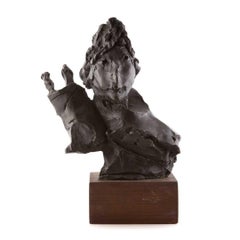
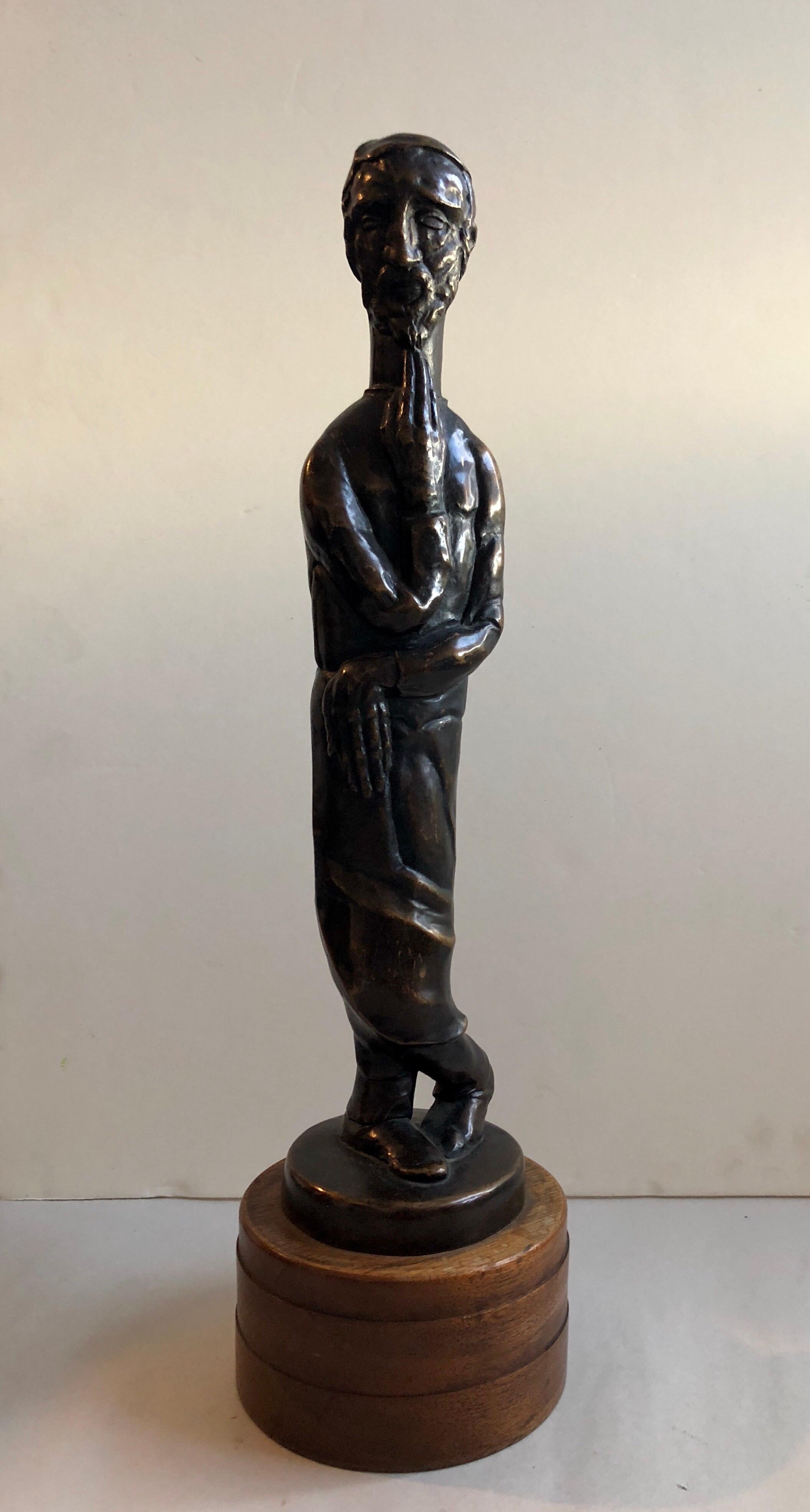
Art Deco Expressionist Bronze Judaica Rabbi Sculpture Los Angeles Modernist
By Peter Krasnow
Located in Surfside, FL
Bronze Jewish Rabbi. Original Patina. Art-deco wood carved base. It is signed with initials P.K. and marked "Calif Art Bronze Fdry LA" (California Art Bronze Foundry Los Angeles). it is not dated.
PETER KRASNOW (1886-1979), Russian-Ukrainian, American artist painter and sculptor, born Feivish Reisberg, was a California modernist and colorist artist known for his abstract wood sculptures and architectonic hard-edge paintings and drawings which were often based on Hebrew calligraphy and other subjects related to his Jewish heritage...
Category
1930s Expressionist Figurative Sculptures
Materials
Bronze
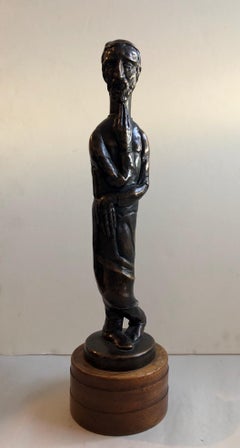
Large Bronze Sculpture "Virtuoso" Figure American Boston Figural Modernist
By David Aronson
Located in Surfside, FL
Aronson, David 1923-
David Aronson, son of a rabbi, was born in Lithuania in 1923 and immigrated to America at the age of five. He settled in Boston, Massachusetts where he studied at the school of the Museum of Fine Arts under Karl Zerbe, a German painter well known in the early 1900s. Aronson later taught at the school of the Museum of Fine Arts for fourteen years and founded the School of Fine Art at Boston University where he is today a professor emeritus. An internationally renowned sculptor & painter, Aronson has won acclaim for his interpretation of themes from the Hebrew Talmud and Kabala. His best known works include bronze castings, encaustic paintings, and pastels. His work is included in many important public and private collections, and has been shown in several museum retrospectives around the country. He is considered to be one of the most important 20th century American artists.
At twenty-two David Aronson had his first one-man show at New York's Niveau Gallery. The next year, six of his Christological paintings were included in the Fourteen Americans exhibition at Manhattan's Museum of Modern Art where Aronson’s work was included alongside abstract expressionists Arshile Gorky, Robert Motherwell and Isamu Noguchi. In the 1950s, Aronson turned more toward his Jewish heritage for the inspiration for his art. Folklore as well as Kabalistic and other transcendental writings influenced his work greatly. The Golem (a legendary figure, brought to life by the Maharal of Prague out of clay to protect the Jewish community during times of persecution) and the Dybbuk (an evil spirit that lodges itself in the soul of a living person until exorcised) frequently appear in his work.
In the sixties, Aronson turned to sculpture. His work during this period is best exemplified by a magnificent 8’ x 4’ bronze door which now stands at the entrance to Frank Lloyd Wright's Johnson Foundation Conference Center for the Arts in Racine, Wisconsin. In the seventies and eighties, Aronson continued his work in pastel drawings, paintings, and sculptures, often exploring religion and the frailties of man's nature. During this time, in addition to a traveling retrospective exhibition and many one-man shows in New York, Los Angeles, Chicago, and Boston at the Pucker-Safrai Gallery on Newbury Street, Aronson won many awards and became a member of the National Academy of Design in New York. Two years ago he retired from teaching to work full-time in his studio in Sudbury, Massachusetts.
included in the catalog
Contemporary Religious Imagery in American Art
Catalog for an exhibition held at the Ringling Museum of Art, March 1-31, 1974.
Artists represented: David Aronson, Leonard Baskin, Max Beckmann, Hyman Bloom, Fernando Botero, Paul Cadmus, Marvin Cherney, Arthur G. Dove, Philip Evergood, Adolph Gottlieb, Jonah Kinigstein, Rico Lebrun, Jack Levine, Louise Nevelson, Barnett Newman, Abraham Rattner, Ben Shahn, Mark Tobey, Max Weber, William Zorach and others.
Selected Awards
1990, Certificate of Merit, National Academy of Design
1976, Purchase Prize, National Academy of Design
1976, Joseph Isidore Gold Medal, National Academy of Design
1976, Purchase Prize in Drawing, Albrecht Art Museum
1975, Isaac N. Maynard Prize for Painting, National Academy of Design
1973, Samuel F. B. Morse Gold Medal, National Academy of Design
1967, Purchase Prize, National Academy of Fine Arts
1967, Adolph and Clara Obrig Prize, National Academy of Design
1963, Gold Medal, Art Directors Club of Philadelphia
1961, 62, 63, Purchase Prize, National Institute of Arts and Letters
1960, John Siimon Guggenheim Fellowship
1958, Grant in Art, National Institute of Arts and Letters
1954, First Prize, Tupperware Annual Art Fund Award
1954, Grand Prize, Third Annual Boston Arts Festival
1953, Second Prize, Second Annual Boston Arts Festival
1952, Grand Prize, First Annual Boston Arts Festival
1946, Traveling Fellowship, School of the Museum of Fine Arts
1946, Purchase Prize, Virginia Museum of Fine Arts
1944, First Popular Prize, Institute of Contemporary Art
1944, First Judge's Prize, Institute of Contemporary Art
Selected Public Collections
Art Institute of Chicago
Virginia Museum of Fine Arts
Bryn Mawr College
Brandeis University
Tupperware Museum, Orlando, Florida
DeCordova Museum
Museum of Modern Art Print Collection, New York
Atlanta University
Atlanta Art...
Category
20th Century Expressionist Figurative Sculptures
Materials
Bronze
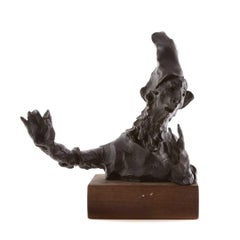
Polish Sculpture Granite Stone, Metal Judaica Jewish Holocaust Memorial Art
By Lubomir Tomaszewski
Located in Surfside, FL
Born in 1923, alumnus of the Warsaw Academy of Fine Arts. Student of the Warsaw University of Technology, is an extraordinary artist, searching for his own artistic way. Ambitious,...
Category
20th Century Modern Figurative Sculptures
Materials
Stone, Iron
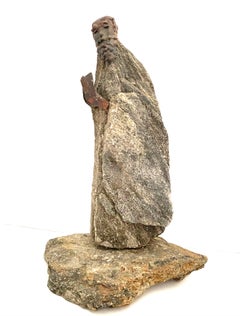
Rare Aharon Bezalel Israeli Gilt Modernist Bronze Sculpture Suite
By Aharon Bezalel
Located in Surfside, FL
The width dimensions are variable. the tallest height is 11.5 inches. Family group. A suite of three bronze sculptures.
Aharon Bezalel (born Afghanistan 1926) Born in Afghanistan in 1926 and immigrated to Israel at an early age. As a youth was engaged as a silversmith and craftsman, and was a student of the sculptor Zev Ben-Zvi from whom he absorbed the basic concepts of classic and modernist art and interpreted, according to them, ideas based on ancient Hebrew sources.
Aharon Bezalel works and resides in Jerusalem, he taught art for many years.
“I saw myself as part of this region. I wanted to find the contact between my art and my surroundings. Those were the first years of Jean Piro’s excavations at the Beer-Sheba mound. They found there, for example, the Canaanite figurines that I especially liked and that were an element that connected me with the past and with this place.” “…a seed and sperm or male and female. These continue life. The singular, the individual alone, cannot exist; I learned this from my father who dabbled with the Kabbalah.”
(Aharon Bezalel, excerpt from an interview with David Gerstein)
“The singular in Aharon Bezalel’s work is always potentially a couple if not a threesome[…] the one is also the many: when the individual is revealed within the group he will always seek a huddling, a clinging together.
The principle of modular construction is required by this perception of unity and multiplicity, as modular construction in his work is an act of conception or defense.
Two poles of unity, potentially alone, exist in A. Bezalel’s world: From a formal, sculptural sense these are the sphere and pillar, metaphorically these are the female in the final stages of pregnancy and the solitary male individual. Sphere-seed-woman; Pillar-strand-man. The disproportional, small heads in A. Bezalel’s figures leave humankind in it’s primal physical capacity. The woman as a pregnancy or hips, the man as an aggressive or defensive force, the elongated chest serves as a phallus and weapon simultaneously.
(Gideon Ofrat)
EIN HAROD About the Museum's Holdings: Israeli art is represented by the works of Reuven Rubin, Zaritzky, Nahum Gutman, Mordechai Ardon, Aharon Kahana, Arie Lubin, Yehiel Shemi, Yosl Bergner and others.
The graphic arts collection contains drawings and graphic works by Pissaro, Modigliani, Pascin, Chagall (almost all of his graphic work), and numerous other artists. The sculpture collection includes works by Jewish sculptors from all over the world including leading Israeli sculptors; Ben Zvi, Lishansky, David Palombo, Yehiel Shemi, Aharon Bezalel and Igael Tumarkin.
Many Jewish sculptors from all parts of the world, beginning with Antokolski, are represented in the collection. In the sculpture courtyard there are works by Chana Orloff, Jacob Epstein (the works he bequeathed to the Museum), Glicenstein, Loutchansky, Constant and Indenbaum from Western Europe; Glid from Yugoslavia; Zorach, Gross and Harkavy from the United States; and most of the outstanding sculptors of Israel : Ben-Zvi, Lishansky, Ziffer, Lehmann, Feigin, Sternschuss, Palombo ( who executed the iron gate...
Category
1970s Expressionist Abstract Sculptures
Materials
Bronze
You May Also Like
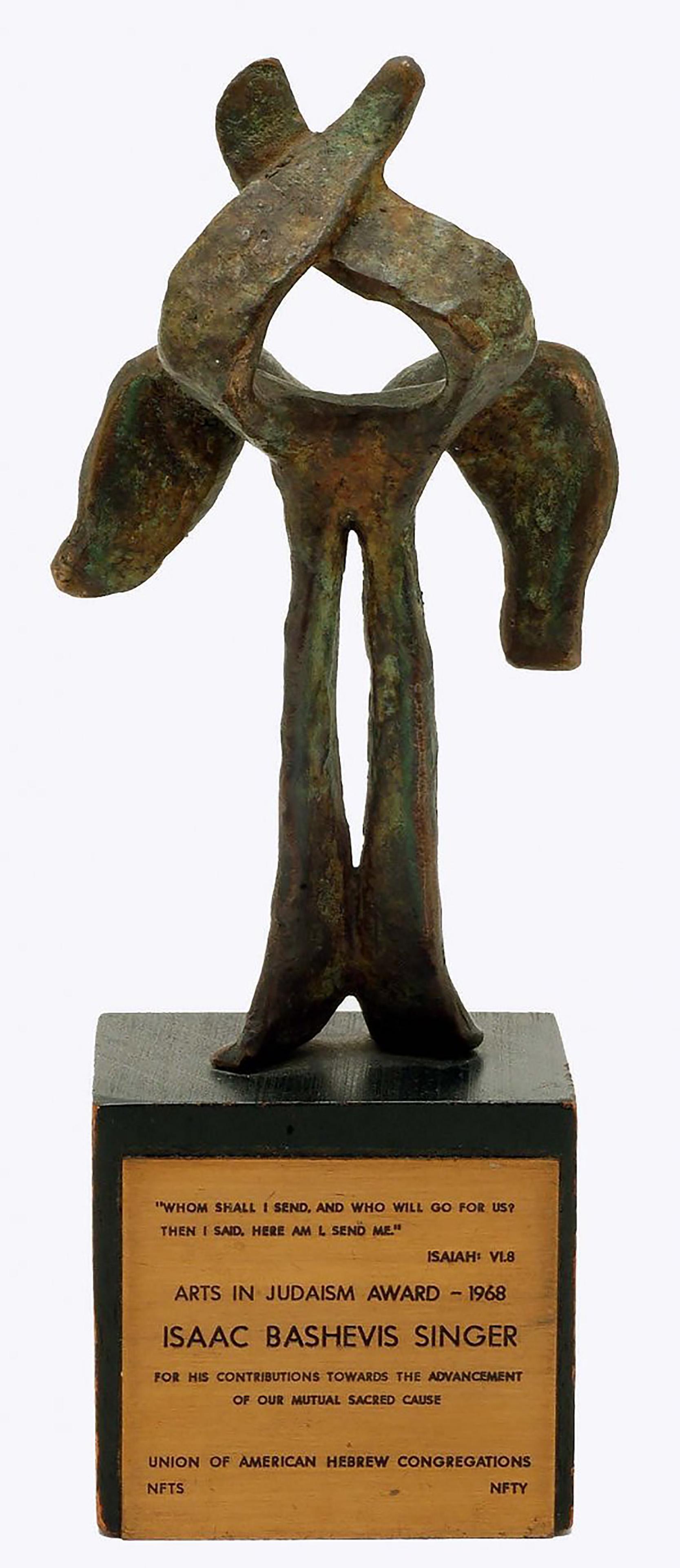
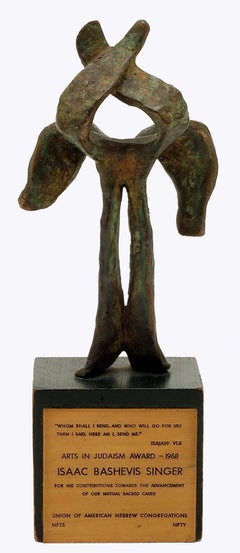
Bronze Sculpture to Isaac Bashevis Singer, Arts in Judaism Award signed Judaica
By Nathaniel Kaz
Located in New York, NY
Nathaniel Kaz
Bronze Sculpture to Isaac Bashevis Singer for Arts in Judaism Award, 1966
Bronze, Square wooden base, Metal tag
Signed and dated "66" to back of bronze portion of the w...
Category
1960s Abstract Expressionist Abstract Sculptures
Materials
Metal, Bronze
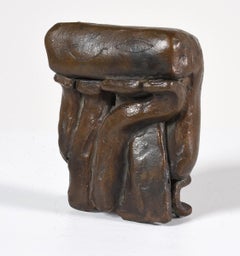
Eugene Caples "Bronze Sculpture II" Abstract Bronze Sculpture
By Eugene Caples
Located in Detroit, MI
This small exquisite "Bronze Sculpture II" is in excellent condition and a perfect example of Eugene Caples craftsmanship. This is mainly abstract with some graphic or architectural elements and is so delightful that mythical creatures demand to be considered. It cries out to be touched and held, looked at and caressed. The beautiful patina on the surface gives voice to the many hands that have done these things.
Eugene Caples is a designer and craftsman who worked in Kansas City in the 1960s and later through the early 21st century. He attended the Kansas City Art Institute, earning his Bachelors of Fine Arts in Industrial Design in 1959. In 1963 he was accepted to Cranbrook Academy of Art, Bloomfield Hills, Michigan. The Cranbrook Academy of Art was designed by architect and faculty member, Eliel Saarinen who collaborated with Charles and Ray Eames on chair and furniture design. Numerous creative artists are alumni of Cranbrook and include: Harry Bertoia, Florence Knoll, Jack Lenor Larsen, Donald...
Category
Late 20th Century American Modern Abstract Sculptures
Materials
Bronze

Moses, Bronze Sculpture by George Gach 1966
By George Gach
Located in Long Island City, NY
Artist: George Gach, Hungarian (1909 - 1996)
Title: Moses
Year: 1966
Medium: Bronze Sculpture, signature and date inscribed
Size: 17 x 11 x 10 in. (43.18 x 27.94 x 25.4 cm)
Category
1960s Modern Figurative Sculptures
Materials
Bronze
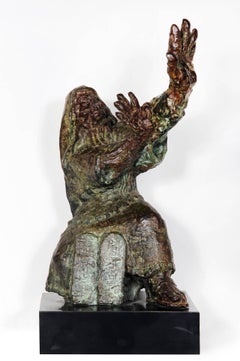
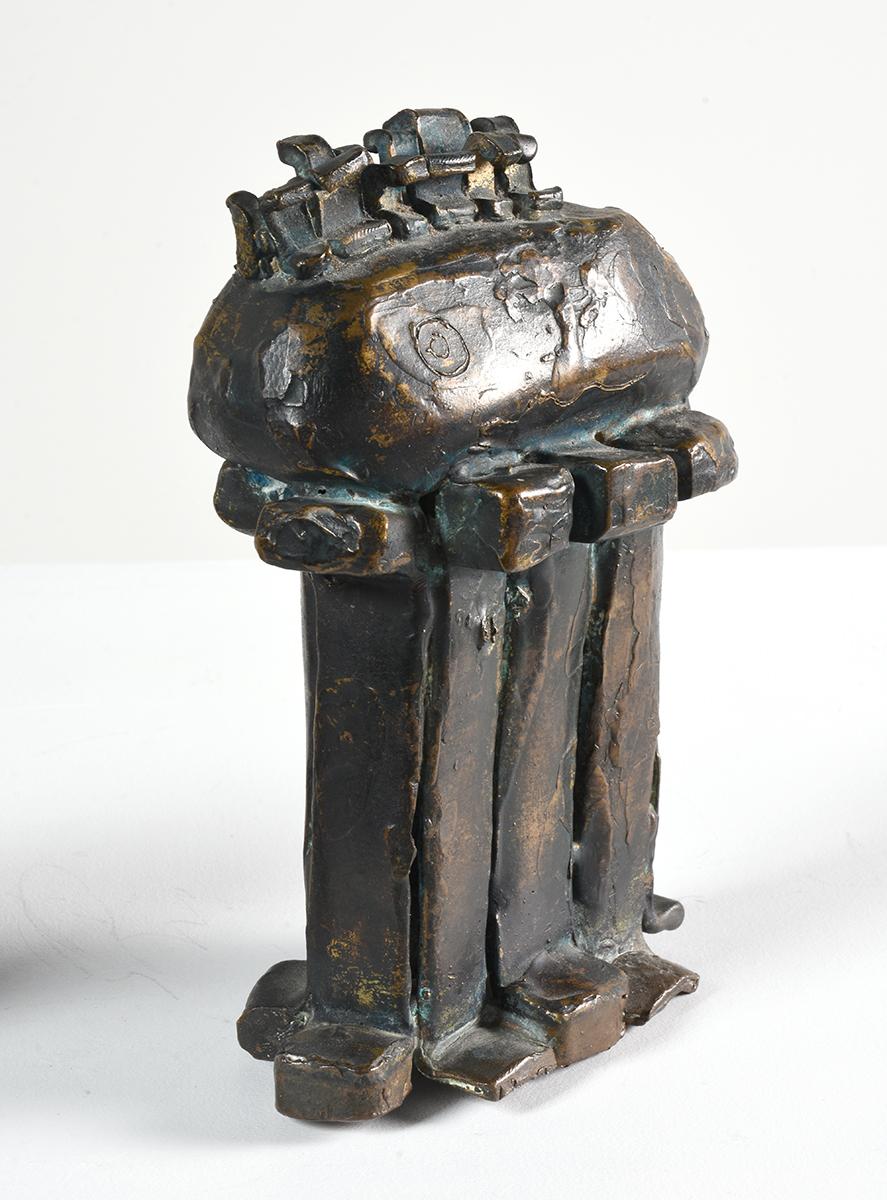
Eugene Caples "Bronze Sculpture I" Abstract Bronze Sculpture
By Eugene Caples
Located in Detroit, MI
This small exquisite "Bronze Sculpture I" is in excellent condition and a perfect example of Eugene Caples craftsmanship. Although it is mainly abstract, there are bits that look figurative either an arm or a leg attempting to emerge from a fold or attempting to hold a pose such as in yoga. It cries out to be touched and held, looked at and caressed. The beautiful patina on the surface gives voice to the many hands that have done these things.
Eugene Caples is a designer and craftsman who worked in Kansas City in the 1960s and later through the early 21st century. He attended the Kansas City Art Institute, earning his Bachelors of Fine Arts in Industrial Design in 1959. In 1963 he was accepted to Cranbrook Academy of Art, Bloomfield Hills, Michigan. The Cranbrook Academy of Art was designed by architect and faculty member, Eliel Saarinen who collaborated with Charles and Ray Eames on chair and furniture design. Numerous creative artists are alumni of Cranbrook and include: Harry Bertoia, Florence Knoll, Jack Lenor Larsen, Donald Lipski, Duane Hanson, Nick Cave, Hani Rashid, George Nelson, Urban Jupena (Nationally recognized fiber artist), Artis Lane (the first African-American artist to have her sculpture, "Sojourner Truth," commissioned for the Emancipation Hall in the Capital Visitor Center in Washington DC), Cory Puhlman (televised Pastry Chef extraordinaire), Thom O’Connor (Lithographs), and Paul Evans (Created Brutalist-inspired sculpted metal furnishings.)
Gene worked...
Category
Late 20th Century American Modern Abstract Sculptures
Materials
Bronze
Mid Century Abstract Face Bronze Sculpture by Jean Robert Ipousteguy
By Jean-Robert Ipoustéguy
Located in West Palm Beach, FL
Bronze abstract face sculpture by Jean-Robert Ipoustéguy (January 6, 1920 – February 8, 2006, a figurative French sculptor.. Signed on back underside Ipoustegy '66 2/9.
I'm many museum and public art collections such as:
Abu Dhabi, National Museum of Saadiyat Island.
Baltimore, Baltimore Museum of Art.
Berlin, Nationalgalerie.
Bobigny, Fonds Départemental d’Art Contemporain.
Cambridge, Massachusetts, US (Massachusetts Institute of Technology, MIT) — Cénotaphe (1957)[8]
Châlons en Champagne, Musée des Beaux-Arts et d'Archéologie.
Chicago, Art Institute.
Copenhagen, Carlsberg Glyptotek.
Darmstadt, Hessiches Landesmuseum.
Dun sur Meuse, Centre Ipoustéguy
Evanston, Illinois, Mary and Leigh...
Category
Vintage 1960s French Mid-Century Modern Abstract Sculptures
Materials
Bronze
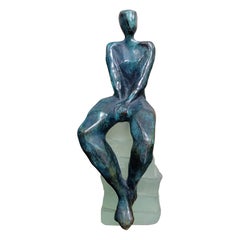
Bronze Cubist Figurative Sculpture by Dominique Dardek 5/50
Located in Fulton, CA
A bronze cubist style nude figure mounted to a stacked glass base by Dominique Dardek. Signed and numbered 5/50. France. Late 20th century or early 21st century.
9.13 inches high.
...
Category
20th Century French Modern Figurative Sculptures
Materials
Bronze