Want more images or videos?
Request additional images or videos from the seller
1 of 6
Thierry Van RyswyckAnimal sculpture : Chimpansee By Thierry Van Ryswyck Prov: Sladmore/Sotheby1950
1950
Price:$18,790
$20,617.55List Price
About the Item
- Creator:Thierry Van Ryswyck (1911 - 1958, Belgian)
- Creation Year:1950
- Dimensions:Height: 16.93 in (43 cm)Width: 22.84 in (58 cm)Depth: 9.85 in (25 cm)
- Medium:
- Movement Style:
- Period:
- Condition:Overall, in very good condition with minor surface dirt and wear consistent with age. There is a reattachment to one of the corners of the base, which is not visible to the naked eye.
- Gallery Location:Gent, BE
- Reference Number:1stDibs: LU2140211314652
About the Seller
5.0
Vetted Professional Seller
Every seller passes strict standards for authenticity and reliability
Established in 2018
1stDibs seller since 2022
6 sales on 1stDibs
Typical response time: 1 to 2 days
Authenticity Guarantee
In the unlikely event there’s an issue with an item’s authenticity, contact us within 1 year for a full refund. DetailsMoney-Back Guarantee
If your item is not as described, is damaged in transit, or does not arrive, contact us within 7 days for a full refund. Details24-Hour Cancellation
You have a 24-hour grace period in which to reconsider your purchase, with no questions asked.Vetted Professional Sellers
Our world-class sellers must adhere to strict standards for service and quality, maintaining the integrity of our listings.Price-Match Guarantee
If you find that a seller listed the same item for a lower price elsewhere, we’ll match it.Trusted Global Delivery
Our best-in-class carrier network provides specialized shipping options worldwide, including custom delivery.You May Also Like
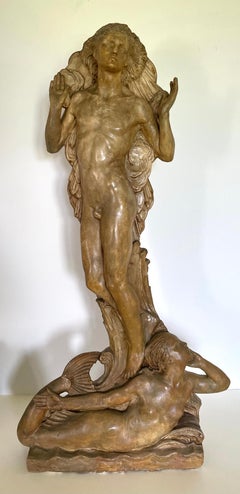
Richard Garbe - Helios - Early 20th Century British patinated plaster sculpture
By Richard Garbe
Located in London, GB
RICHARD LOUIS GARBE, RA
(1876-1957)
Helios
Signed and dated 1929
Plaster with patinated surface
86 cm., 33 ¾ in. high
Garbe was born in Dalston, London, the son of Gustave Garbe,...
Category
Early 20th Century Art Deco Nude Sculptures
Materials
Plaster
$7,501
H 33.86 in W 17.33 in
1, 000 piece Museum Quality Collection of Art
Objects from NYC 1939 Worlds Fair
By Chester Beach
Located in New York, NY
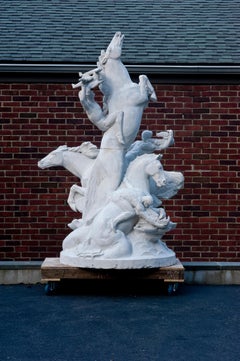
1,000 piece Museum Quality Collection of Art & Objects from NYC 1939 Worlds Fair is available for sale.
This sculpture, "Riders of the Elements," is the original 7' plaster maquette from the NYC 1939 World's Fair by Chester Beach...
Category
1930s Art Deco Figurative Sculptures
Materials
Plaster, Canvas, Oil, Photographic Paper
Price Upon Request
H 84 in W 54 in
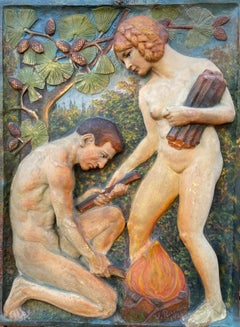
“Adam and Eve”
Located in Southampton, NY
Very rare Art Deco three dimensional terracotta sculpture of Adam and Eve by the Austrian artist, Virgil Rainer. Hand painted by the artist. Signed bott...
Category
1920s Art Deco Figurative Sculptures
Materials
Terracotta, Plaster
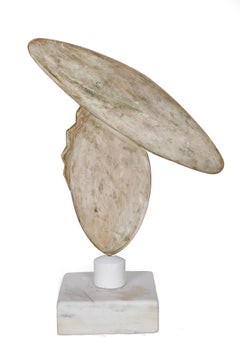
Carmen, Washington: Plaster Sculpture with Marble Base by Constantin Antonovici
By Constantin Antonovici
Located in Long Island City, NY
A minimalist depiction of a woman in a large hat by Constantin Antonovici. This white marble sculpture is composed almost entirely of two colliding ovals, with a few ridges visible o...
Category
1970s Art Deco Abstract Sculptures
Materials
Marble
$25,000
H 25 in W 25 in D 1 in
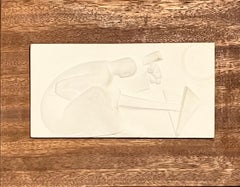
Plaster Sculpture Relief Art Deco Plaque WPA Artist Peace Swords to Ploughshares
By George Aarons
Located in Surfside, FL
Size includes wood mounting.
George Aarons (born Gregory Podubisky, in St. Petersburg, Russia, 1896 - died in Gloucester, Massachusetts 1980) was a distinguished sculptor who lived ...
Category
20th Century Art Deco Figurative Sculptures
Materials
Plaster, Wood
$1,100
H 8 in W 10 in D 1 in
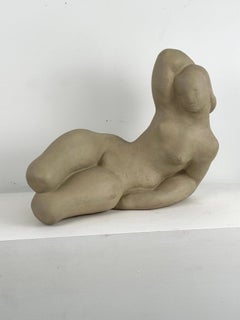
Relining Nude (WG6)
By Waylande Gregory
Located in Wilton Manors, FL
Waylande Gregory (1905-1971).
Nude Reclining, ca. 1950's. Painted composite cast from original sculpted in 1930's. Casting sanctioned and approved by the artist during his lifetime in partnership with MPI, Museum Pieces Incorporated. Very few examples were produced and even fewer survive.
Waylande Gregory was considered a major American sculptor during the 1930's, although he worked in ceramics, rather than in the more traditional bronze or marble. Exhibiting his ceramic works at such significant American venues for sculpture as the Whitney Museum of American Art in New York City and at the venerable Pennsylvania Academy of the Fine Arts in Philadelphia, he also showed his ceramic sculptures at leading New York City galleries. Gregory was the first modern ceramist to create large scale ceramic sculptures, some measuring more than 70 inches in height. Similar to the technique developed by the ancient Etruscans, he fired his monumental ceramic sculptures only once.
Gregory was born in 1905 in Baxter Springs, Kansas and was something of a prodigy. Growing up on a ranch near a Cherokee reservation, Gregory first became interested in ceramics as a child during a native American burial that he had witnessed. He was also musically inclined. In fact, his mother had been a concert pianist and had given her son lessons. At eleven, he was enrolled as a student at the Kansas State Teacher's College, where he studied carpentry and crafts, including ceramics.
Gregory's early development as a sculptor was shaped by the encouragement and instruction of Lorado Taft, who was considered both a major American sculptor as well as a leading American sculpture instructor. In fact, Taft's earlier students included such significant sculptors as Bessie Potter Vonnoh and Janet Scudder. But, Taft and his students had primarily worked in bronze or stone, not in clay; and, Gregory's earliest sculptural works were also not in ceramics. In 1924, Gregory moved to Chicago where he caught the attention of Taft. Gregory was invited by Taft to study with him privately for 18 months and to live and work with him at his famed "Midway Studios." The elegant studio was a complex of 13 rooms that overlooked a courtyard. Taft may have been responsible for getting the young man interested in creating large scale sculpture. However, by the 1920's, Taft's brand of academic sculpture was no longer considered progressive. Instead, Gregory was attracted to the latest trends appearing in the United States and Europe. In 1928 he visited Europe with Taft and other students.
"Kid Gregory," as he was called, was soon hired by Guy Cowan, the founder of the Cowan Pottery in Cleveland, Ohio, to become the company's only full time employee. From 1928 to 1932, Gregory served as the chief designer and sculptor at the Cowan Pottery. Just as Gregory learned about the process of creating sculpture from Taft, he literally learned about ceramics from Cowan. Cowan was one of the first graduates of Alfred, the New York School of Clayworking and Ceramics. Alfred had one of the first programs in production pottery. Cowan may have known about pottery production, but he had limited sculptural skills, as he was lacking training in sculpture. The focus of the Cowan Pottery would be on limited edition, table top or mantle sculptures. Two of the most successful of these were Gregory's Nautch Dancer, and his Burlesque Dancer. He based both sculptures on the dancing of Gilda Gray, a Ziegfield Follies girl.
Gilda Gray was of Polish origin and came to the United States as a child. By 1922, she would become one of the most popular stars in the Follies. After losing her assets in the stock market crash of 1929, she accepted other bookings outside of New York, including Cleveland, which was where Gregory first saw her onstage. She allowed Gregory to make sketches of her performances from the wings of the theatre. She explained to Gregory, "I'm too restless to pose." Gray became noted for her nautch dance, an East Indian folk dance. A nautch is a tight, fitted dress that would curl at the bottom and act like a hoop. This sculpture does not focus on Gray's face at all, but is more of a portrait of her nautch dance. It is very curvilinear, really made of a series of arches that connect in a most feminine way.
Gregory created his Burlesque Dancer at about the same time as Nautch Dancer. As with the Nautch Dancer, he focused on the movements of the body rather than on a facial portrait of Gray. Although Gregory never revealed the identity of his model for Burlesque Dancer, a clue to her identity is revealed in the sculpture's earlier title, Shimmy Dance. The dancer who was credited for creating the shimmy dance was also Gilda Gray. According to dance legend, Gray introduced the shimmy when she sang the Star Spangled Banner and forgot some of the lyrics, so, in her embarrassment, started shaking her shoulders and hips but she did not move her legs. Such movement seems to relate to the Burlesque Dancer sculpture, where repeated triangular forms extend from the upper torso and hips. This rapid movement suggests the influence of Italian Futurism, as well as the planar motion of Alexander Archipenko, a sculptor whom Gregory much admired.
The Cowan Pottery was a victim of the great depression, and in 1932, Gregory changed careers as a sculptor in the ceramics industry to that of an instructor at the Cranbrook Academy in Bloomfield Hills, Michigan. Cranbrook was perhaps the most prestigious place to study modern design in America. Its faculty included the architect Eliel Saarinen and sculptor Carl Milles.
Although Gregory was only at Cranbrook for one and one half years, he created some of his finest works there, including his Kansas Madonna. But, after arriving at Cranbrook, the Gregory's had to face emerging financial pressures. Although Gregory and his wife were provided with complimentary lodgings, all other income had to stem from the sale of artworks and tuition from students that he, himself, had to solicit. Gregory had many people assisting him with production methods at the Cowan Pottery, but now worked largely by himself. And although he still used molds, especially in creating porcelain works, many of his major new sculptures would be unique and sculpted by hand, as is true of Kansas Madonna. The scale of Gregory's works were getting notably larger at Cranbrook than at Cowan.
Gregory left the surface of Kansas Madonna totally unglazed. Although some might object to using a religious title to depict a horse nursing its colt, it was considered one of Gregory's most successful works. In fact, it had a whole color page illustration in an article about ceramic sculpture titled, "The Art with the Inferiority Complex," Fortune Magazine, December, 1937. The article notes the sculpture was romantic and expressive and the sculpture was priced at $1,500.00; the most expensive sculpture...
Category
1950s Art Deco Figurative Sculptures
Materials
Plaster
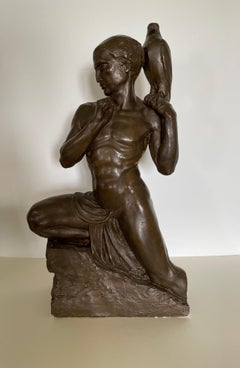
The Falconer, Art Deco British Plaster Sculpture by Richard Garbe RA
By Richard Garbe
Located in London, GB
RICHARD GARBE, RA
(1876-1957)
The Falconer
Signed and dated on the reverse: Richard Garbe, ARA / 1932
Patinated plaster
49.5 cm., 19 ½ in. high
Proven...
Category
1930s Art Deco Figurative Sculptures
Materials
Plaster
$5,455
H 19.49 in W 9.45 in D 5.12 in
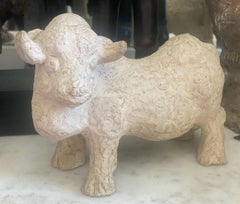
Taurus, A Characterful Guardian: Unique Hand-Modelled Bull Animalier Sculpture
Located in Norwich, GB
This striking, characterful bull is a wonderful, early, and truly unique piece by the Russian/French sculptor Joseph Constant (1892-1969). Dating from the 1940s, this animal subject ...
Category
1940s Art Deco Figurative Sculptures
Materials
Plaster
$900
H 7.49 in W 7.49 in D 3.94 in
Diana The Huntress - 1920´s Plaster Sculpture
Located in Stockholm, SE
Sculpture representing the goddess Diana by Danish sculptor Jens Jacob Bregno (1877–1946), executed in plaster around 1920. This is a highly unusual model by the artist, and possibly...
Category
1920s Art Deco Figurative Sculptures
Materials
Plaster
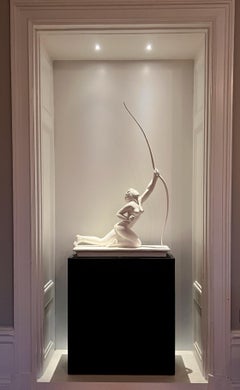
$8,127
H 40.56 in W 25.2 in D 7.88 in
Ram
s Head Contemporary Plaster Sculpture with Green Patina Ancient Rome Style
Located in Firenze, IT
This contemporary plaster sculpture of a ram’s head is inspired by the art of Ancient Rome and Ancient Greece with a reference to Neoclassicism and Neoclassical period old masters, when the discoveries of archaeological sites became the focal point in art history between the 18th and 19th century.
The artist is able to attribute incredible details to this work of art featuring a majestic appearance due to its large curling ridged horns.
This animal figurative work of art is sculpted on the round, the artist took inspiration both from his imagination and archaic reminiscences. He modeled the inert chalk creating an animal with very real facial expression and incredible realistic features with intricate detailed head.
This sculpture is the plaster cast hand modeled by the artist that served him as a reference model to create a bronze sculpture with the lost wax technique, also the bronze version is on sale on my page.
So it represents the first phase of a fascinating and long process of creating sculptural art, a studio piece made as a maquette before a bronze version was cast.
The present aries' head sculpture has been painted to simulate the green patina that archaeological metal sculptures take over the centuries. Two green patina sculptures...
Category
2010s Contemporary Still-life Sculptures
Materials
Plaster, Lacquer, Paint, Chalk
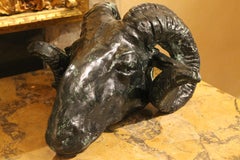
$1,553
H 7.88 in W 13 in D 13 in
More From This Seller
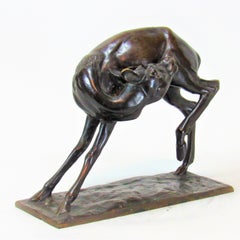
View AllItalian animal bronze: Young Deer or Antelope by Sirio Tofanari
Located in Gent, VOV
Young Antelope Or Young Deer
A nice bronze cast of a young antelope or a young male deer licking its back, by Sirio Tofanari (1886-1969). An old cast wi...
Category
1930s Art Deco Figurative Sculptures
Materials
Bronze
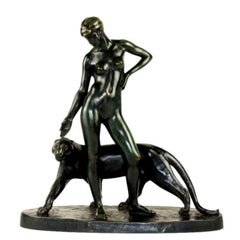
Woman and Panther - Bronze by Albert Poncin (1877-1954), Art Deco influence
Located in Gent, VOV
Albert Poncin’s Femme à la Panthère is a striking and elegant Art Deco bronze sculpture that perfectly encapsulates the movement’s characteristic blend of stylized modernity and clas...
Category
20th Century Art Deco Figurative Sculptures
Materials
Bronze
Thomas Cartier (1879-1943)+Bronze with silver patina « Tango Erotica »
Located in Gent, VOV
Thomas Cartier (French 1879-1943). "Tango Erotica" bronze sculpture. Art Deco.
Rare French silver plated bronze art deco dancer group with a Pierrot and Columbine.
This sculpture, ...
Category
1930s Art Deco Figurative Sculptures
Materials
Bronze

Terracotta Panthers Statue by Réne Rochard (1906 -1984)
By Irénée Rochard
Located in Gent, VOV
Panters
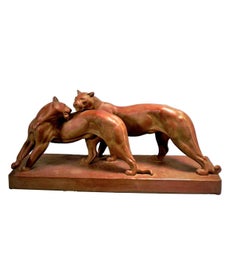
An imposing statue of a couple of panters by Irenée Rochard (1906-1884). A fine quality, much sought-after terracotta which was edited by Reveyrolis Paris. Before casting, ...
Category
Mid-20th Century Art Deco Figurative Sculptures
Materials
Terracotta
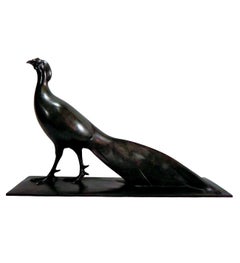
Profillet Anne-Marie (1898-1939), Bronze+ Chinese pheasant
Located in Gent, VOV
Golden Pheasant
Wonderfully sleek walking pheasant also called the (large) golden pheasant or Chinese pheasant
Bronze sculpture with a transparent thin black patina and green under...
Category
Early 20th Century Art Deco Figurative Sculptures
Materials
Bronze
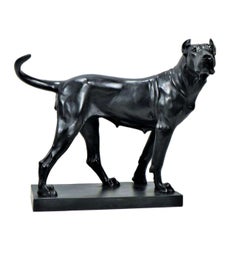
Great Dane - Gustav Reißmann (1887-1954)
Located in Gent, VOV
Wonderfully stylish statue of a great Dane, with a black patina, by Gustav Reissmann (1887-1954). The dog is standing still and fully alert. Signed on the side of the base, K. Gustav...
Category
Early 20th Century Art Deco Figurative Sculptures
Materials
Bronze
Still Thinking About These?
All Recently ViewedMore Ways To Browse
Sculpture Plaster 1940
Sculpture Plaster 1940
Sculpture Plaster 1940
Sculpture Plaster 1940
Sculpture Plaster 1940
Art Dumay
Arthur Diehl
Arthur Friedenson
Arthur Vidal Diehl
Artist Hunt S
Artist Paint Brushes Used
Audrey Hepburn With Hat
Audubon Deer
Audubon Double Elephant
Badia Camps
Barton Lidice Benes On Sale
Bea Sarrias
Beatles Red Door