Want more images or videos?
Request additional images or videos from the seller
1 of 6
Unknown16th Century Cameo Pendant of Christ the Redeemer in a Gilt Bronze Frame16th century
16th century
$2,931.77List Price
About the Item
- Creation Year:16th century
- Dimensions:Height: 3.35 in (8.5 cm)Diameter: 2.76 in (7 cm)
- Medium:
- Movement Style:
- Period:
- Condition:Nice condition. Possibly needs some cleaning.
- Gallery Location:Stockholm, SE
- Reference Number:1stDibs: LU2608213535942
About the Seller
5.0
Gold Seller
Premium sellers maintaining a 4.3+ rating and 24-hour response times
1stDibs seller since 2023
33 sales on 1stDibs
Authenticity Guarantee
In the unlikely event there’s an issue with an item’s authenticity, contact us within 1 year for a full refund. DetailsMoney-Back Guarantee
If your item is not as described, is damaged in transit, or does not arrive, contact us within 7 days for a full refund. Details24-Hour Cancellation
You have a 24-hour grace period in which to reconsider your purchase, with no questions asked.Vetted Professional Sellers
Our world-class sellers must adhere to strict standards for service and quality, maintaining the integrity of our listings.Price-Match Guarantee
If you find that a seller listed the same item for a lower price elsewhere, we’ll match it.Trusted Global Delivery
Our best-in-class carrier network provides specialized shipping options worldwide, including custom delivery.You May Also Like
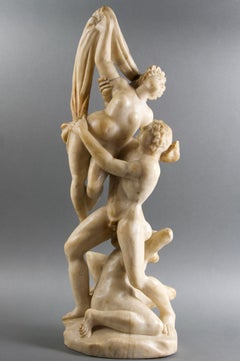
Italian Neoclassical Sculptural Group in Alabaster "The Rape of the Sabine Women" 18th
Located in Pistoia, IT
"The Rape of the Sabine Women," veined alabaster, large sculptural group with classical subject, Volterra manufacture, 18th century.
The so-called Rape of the Sabine Women is a scu...
Category
1790s Italian School Figurative Sculptures
Materials
Alabaster
$6,581
H 25.2 in W 10.63 in D 8.67 in
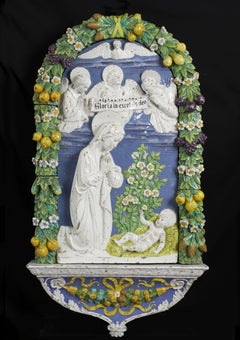
19th Century Madonna Adoring the Infant Jesus Italian School Ceramic White Blue
Located in Sanremo, IT
Cantagalli-manufactured ceramics measuring 125 x 67 cm depicting a sweet Madonna adoring the Child Jesus and the Holy Spirit.
At the beginning of the 19th century, Ulisse Cantagalli...
Category
1830s Italian School Figurative Sculptures
Materials
Ceramic
$17,949
H 49.22 in W 26.38 in
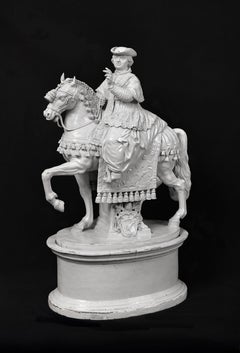
Pio VI blessing on horseback during the Cavalcata for the Possession
Located in Roma, RM
Volpato or Cialli manufacture, molded by Lorenzo Weber, Pio VI blessing on horseback during the Cavalcata for the Possession
English white terracotta of 45 x 29 x 17 cm, datable to...
Category
Mid-18th Century Italian School Figurative Sculptures
Materials
Terracotta
$41,882
H 17.72 in W 11.42 in D 6.7 in
Antique Italian Grand Tour Bronze Marble Bust Sculpture Dante Alighieri 1880
Located in Portland, OR
A good antique Italian Grand Tour Bronze and marble bust of Dante Alighieri, circa 1880.
The bronze is most likely Florentine and mod...
Category
Late 19th Century Italian School Figurative Sculptures
Materials
Marble, Bronze
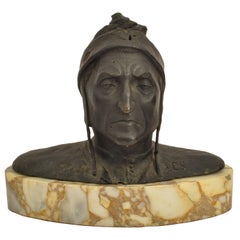
$2,895
H 16 in W 19 in D 9 in
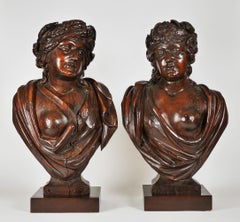
18th Century Italian Carved Neoclassical Semi Nude Female Busts
Located in Beachwood, OH
18th Century Italian Carved Neoclassical Semi Nude Female Busts
Wood affixed to wood plinths
"Leone Della Torra / Italy Country of Origin" labels on b...
Category
18th Century Italian School Figurative Sculptures
Materials
Wood
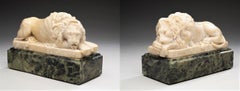
Pair of Italian "Alabaster Stone Lions" after Antonio Canova; Mid 19th Century
Located in SANTA FE, NM
"Pair Recumbent Stone Lions"
after Antonio Canova (1757-1822)
Italian (possibly Florence)
Mid 19th Century
Alabaster, marble
6 x 9 x 4 inches
This is an exquisite pair of Italian alabaster lions on marble bases based on the monumental lions carved by Antonio Canova (1757-1822), the greatest Italian neoclassical sculptor. Canova sculpted the marble lions for the monumental tomb of Pope Clement XIII in St. Peter’s, Rome in 1792
Canova Lions refers to the pair of copies of lion sculptures by Antonio Canova. When Canova created the sculptures in 1792, he installed them on the tomb of Pope Clement XIII. The marble sculptures are some of the most prominent features in St. Peter's Basilica in Rome. Given the intricacies of creating the original Canova lions, some artists created molds and replicated them. A good example is the pair of lion sculptures...
Category
1850s Italian School Figurative Sculptures
Materials
Alabaster, Marble
$6,150
H 6 in W 9 in D 4 in
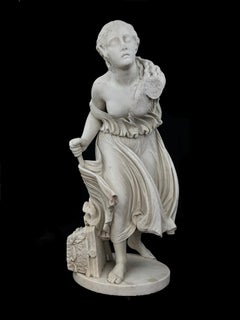
NYDIA, THE BLIND FLOWER GIRL OF POMPEII Marble Sculpture 1856-1870
Located in Soquel, CA
Randolph John Rogers (American, 1825 - 1892) Randolph Rogers' Nydia, the Blind Flower Girl of Pompeii debuted in 1856 to critical and public acclaim, solidifying Rogers’ position as a pre-eminent American sculptor and it remains one of the artist’s most celebrated works today. The subject of Nydia is drawn from Edward Bulwer-Lytton's The Last Days of Pompeii 1834. After touring the ruins of the ancient city in 1833, and inspired by the stories of blinding volcanic ash, he composed the tale of Nydia, a slave who led her master, Glaucus, to safety. Rogers depicts Nydia at the moment that she and Glaucus have become separated in their perilous journey through the rubble and Nydia seeks familiarity in the surrounding chaos, her distress evident in her pained expression. The grace of the sculpture is at odds with the turmoil portrayed; a toppled Corinthian capital lies at her feet and obstructs her next step, indicated by the tilt of her back foot and grip on her walking stick. Examples of this model can be found in major American collections, including The Metropolitan Museum of Art, the Art Institute of Chicago, the Detroit Institute of Arts, the Los Angeles County Museum of Art, and the Museum of Fine Arts, Boston.
Literature, Millard F Rogers, Jr. Randolph Rogers, American Sculptor in Rome. University of Massachusetts Press, 1971, American Figurative Sculpture in the Museum of Fine Arts Boston. Museum of Fine Arts, Boston, 1986. Joyce K Schiller. "Nydia, A Forgotten Icon of the Nineteenth Century." Bulletin of the Detroit Institute of Arts,
Born in Waterloo, New York, Randolph John Rogers became an expatriate* sculptor of idealized figures, portraits, and commemorative works in Neo-Classical* and Realist* styles. He worked in clay, plaster, marble and bronze, and lived both in Italy and the United States. He made 167 examples of Nydia in two sizes (varies depending on base height) 36" and 54'.
Rogers was raised in Ann Arbor, Michigan, and as a young man did woodcuts* for the local newspaper, The Michigan Argus, and also worked as a baker's assistant and a dry goods clerk. In 1847, he moved to New York City, where he hoped to find work as an engraver*, but failing to do so, worked in a dry goods store owned by John Steward...
Category
1850s Italian School Figurative Sculptures
Materials
Marble
$15,000
H 36 in W 19 in D 20 in
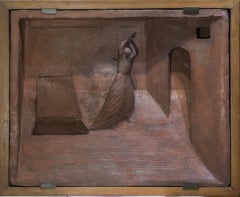
The Trapdoor
By Arturo Martini
Located in Roma, RM
Arturo Martini (Treviso 1889 - Milan 1947), La Botola (1930 / 1933)
Terracotta sculpture 34 x 42 x 9 cm signed lower left; label of Galleria del Milione, Milan, on back.
Provenance...
Category
1930s Italian School Figurative Sculptures
Materials
Terracotta
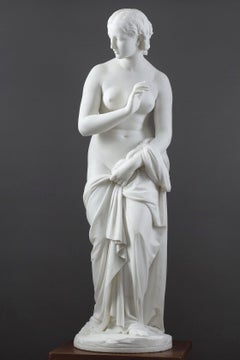
Musidora
Located in PARIS, FR
"Musidora"
by Odoardo FANTACCHIOTTI (1809-1877)
Sculpture made in white Carrara marble
signed on the side on the base " O. Fantacchiotti "
Italy
around 1862
height 110 cm
diameter ...
Category
1860s Italian School Nude Sculptures
Materials
Marble
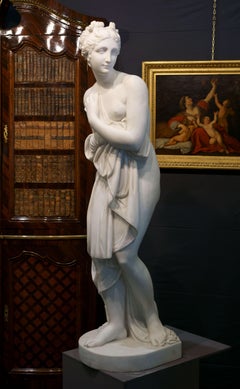
Large Neoclassical White Marble Sculpture Venus Italica mid-19th century
Located in Pistoia, IT
Venus Italica, imposing sculpture in white Carrara marble, mid-nineteenth-century Roman atelier.
Antonio Canova made several sculptures depicting Venus. The first was made as compen...
Category
Mid-19th Century Italian School Figurative Sculptures
Materials
Marble
$29,916
H 53.15 in W 14.18 in
More From This Seller
View AllArt Nouveau Sculpture - 19th Century Plaster
Located in Stockholm, SE
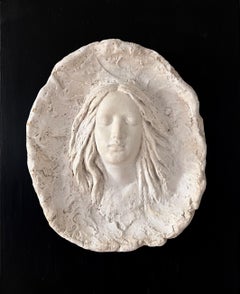
A wall-mounted Art Nouveau relief by the Swedish sculptor Johannes Collin, signed “JC 96”, represents one of his earliest known works. Executed in plaster, the oval composition features a stylistically mussel shaped base from which emerges the finely modelled face of a young woman with long flowing hair. Her eyes are closed, conveying a sense of calm introspection and timeless beauty. The softly curved forms and delicate modelling create a serene harmony between natural rhythm and sculptural precision. The work is mounted on a later black-painted wooden plaque (26 × 33 cm), while the sculpture itself measures 21 × 18.5 cm. It is an unusually early piece by the artist, displaying craftsmanship and sensitivity.
Born in Stockholm in 1873, Johannes Collin trained as a sculptor during the final years of the 19th century, a period marked by the transition from academic historicism to the organic, nature-inspired forms of Art Nouveau (Jugendstil). His early works, such as this 1896 relief, already reveal a refined awareness of contour, proportion, and the poetic interplay between human expression and natural form.
Collin studied at the Royal Swedish Academy of Fine Arts (Kungliga Akademien för de fria konsterna) in Stockholm, where he was influenced by sculptors such as John Börjeson and Christian Eriksson. Over the following decades, he developed a personal style that combined naturalistic modelling with decorative rhythm and symbolic depth. He participated in exhibitions at the Konstakademien in Stockholm, in shows organized by the Swedish Artists’ Association (Svenska konstnärernas förening), and at the Baltic Exhibition in Malmö (1914)—one of the era’s major showcases of Scandinavian art and design.
Throughout his career, Collin produced portraits, allegorical figures, and architectural sculpture in plaster, bronze, marble, and terracotta. His works are represented in several Swedish collections, including the Nationalmuseum in Stockholm and the Göteborgs konstmuseum, as well as in regional museums and private collections.
About Art Nouveau / Jugend
Art Nouveau, known in Sweden and Germany as Jugendstil, was an international artistic movement (c. 1890–1910) that sought to unite the arts under the guiding principle of nature’s harmony. Characterized by flowing lines, floral motifs, and organic rhythms, it aimed to dissolve the boundaries between fine and decorative art, bringing art into everyday life. In sculpture, this often meant a focus on the human body, sensual form, and the beauty of natural curves.
Within this aesthetic, Collin’s relief of a woman’s face emerging from a mussel-shaped base carries both mythological and symbolic resonance. The motif recalls the classical image of Venus rising from the sea...
Category
1890s Art Nouveau Figurative Sculptures
Materials
Plaster
Walking Tiger - Late 19th century Bronze Sculpture
Located in Stockholm, SE
Sculpture of a walking tiger in dark patinated bronze by Johan Axel Wetterlund (1858-1927), signed J. A. Wetterlund, mounted on a black-painted wooden base. This finely modelled bro...
Category
Late 19th Century Naturalistic Figurative Sculptures
Materials
Bronze

Diana The Huntress - 1920´s Plaster Sculpture
Located in Stockholm, SE
Sculpture representing the goddess Diana by Danish sculptor Jens Jacob Bregno (1877–1946), executed in plaster around 1920. This is a highly unusual model by the artist, and possibly...
Category
1920s Art Deco Figurative Sculptures
Materials
Plaster
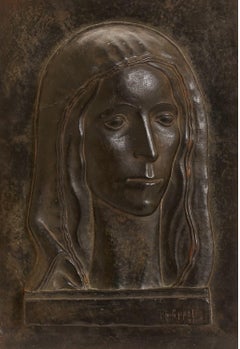
Arvid Knöppel, The Virgin Mary, Bronzed Wall Relief Plaster Sculpture, Signed.
Located in Stockholm, SE
A finely sculpted dark bronzed wall relief plaster sculpture of Virgin Mary by Arvid Knöppel, signed and dated 1921. An unusual subject of his...
Category
1920s Figurative Sculptures
Materials
Plaster
Italian School 18th Century Drawing - Red Chalk on Paper
Located in Stockholm, SE
An Italian red chalk drawing depiction on paper, probably 17th or 18th century, illustrating the dramatic scene of Polyphemus hurling a boulder at Acis and Galatea. Attributed to an...
Category
17th Century Italian School Figurative Drawings and Watercolors
Materials
Paper, Chalk
Italian School 17th Century Drawing of Putti
Located in Stockholm, SE
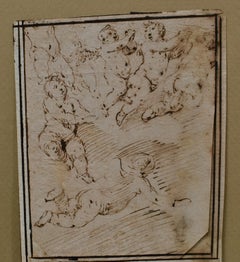
A fine small Italian 17th/18th century sepia ink study of 6 putti in different positions. Paper mounted on paper. A tergo written "Scuola Lombarda".
A putto/putti are figure in a wo...
Category
17th Century Italian School Figurative Drawings and Watercolors
Materials
Ink