Items Similar to Limestone figure of Virgin and child, Lorraine, 14th century, French Gothic
Want more images or videos?
Request additional images or videos from the seller
1 of 19
UnknownLimestone figure of Virgin and child, Lorraine, 14th century, French Gothiccirca 1330
circa 1330
$43,150.20
£32,279.20
€36,000
CA$59,408.68
A$65,015.66
CHF 34,355.07
MX$776,004.86
NOK 438,413.49
SEK 400,964.82
DKK 274,279.32
About the Item
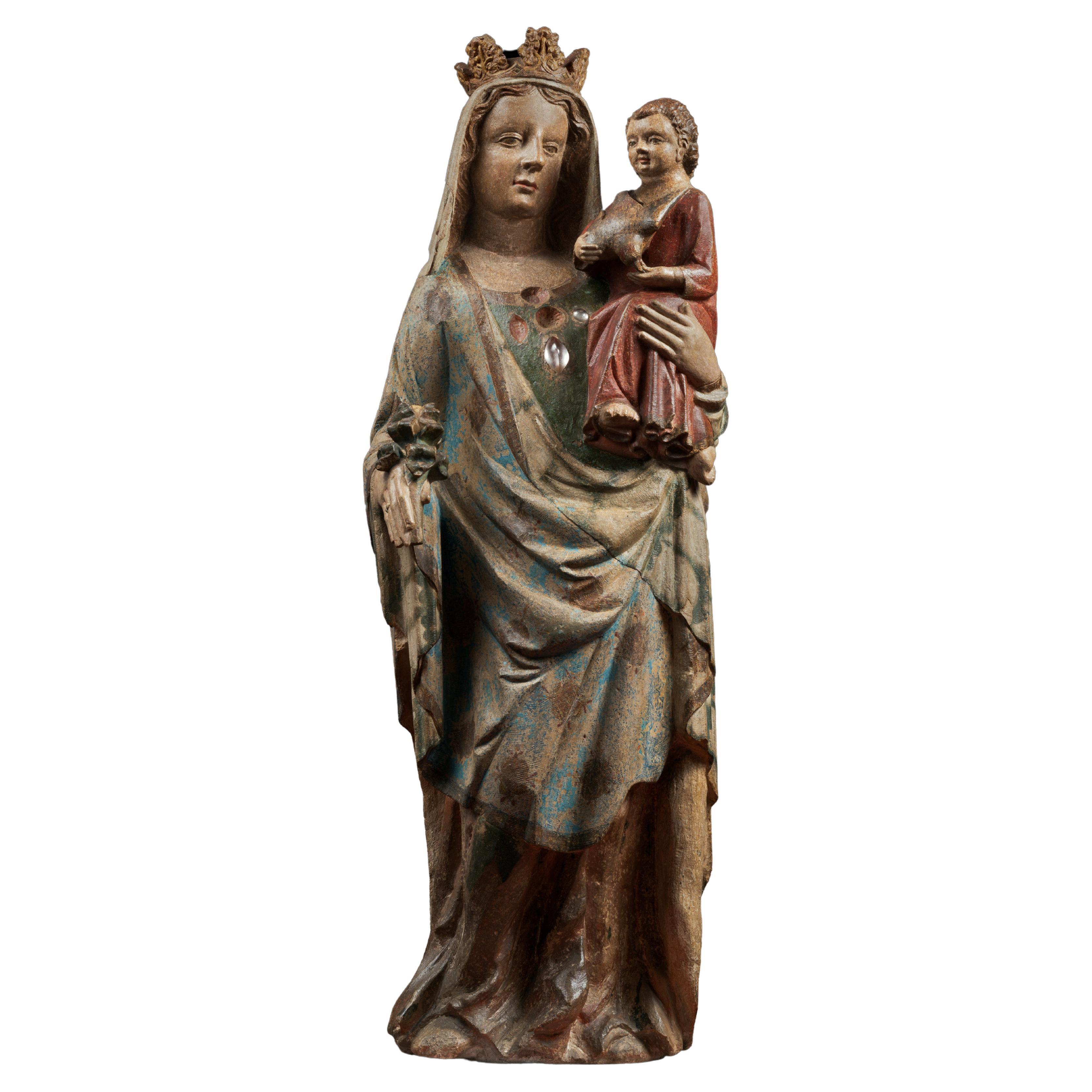
Virgin and Child with Goldfinch
Workshops of Metz, Lorraine, circa 1330
Limestone carved in the round with remains of polychromy
Height: 61 cm
The sculpture of the Virgin and Child that we present belongs, by its stylistic characteristics, to the very specific corpus of Lorraine statuary, where the Marian cult gained momentum at the end of the 13th century, reaching its artistic peak in the years 1320-1340. By its modest dimensions, it is part of the statuary of private devotion, intimate religious practice being increasingly popular.
Standing, slightly swaying, the Virgin carries the infant Jesus on her right arm. The face with its youthful features in the shape of a shield (specific to Lorraine) is framed by delicate wavy locks, enlivened by elongated almond-shaped eyes, a wide and short nose and a mouth with pursed lips. On the head of the Virgin rests a crown with trilobed fleurons on a short veil.
Mary is dressed in a dress and a loose-fitting mantle that, starting from her left shoulder, transforms into an apron above her knees, revealing her waist, which is emphasized by a tight belt that creates pocket-like folds of the dress on the chest. The presence of the delicately sculpted belt with its buckle and its drooping end carries an important meaning in the attributes of Marian worship, the belt being the symbol of chastity.
The movement of the mantle creates uneven falls of the side draperies. On the right, under the child Jesus, its fluted folds cascade richly. On the left, it is the bending of the arm that creates a fall with wider folds.
The drapes of the apron, hollowed out in a rounded shape, are followed in an offset fashion by a few beak-shaped folds created by the movement of the left knee.
The apron-like draping of the coat introduces an important transversal element into the silhouette and is part of the graphic and plastic research of this first third of the 14th century.
The folds of the dress in the lower part are more deeply carved, the sides of the coat skillfully released by the sculptor reveal the Virgin's pointed shoes.
The enveloping movement of the coat encourages one to turn around the work and provides a multitude of points of view, especially since the work is executed in the round.
The child Jesus is dressed in a tunic whose open collar allows one to glimpse a buttoned blouse. The round face with slightly slanted eyes is framed by small, very tight curls from which his large ears emerge. These coiled locks imitate a lamb's fleece, thus constituting a reference to the Passion.
In an affectionate gesture, he pulls with his left hand the strap that attaches the virgin's coat, the sculptor thus creating an emotional interaction between two protagonists.
In his right hand Jesus holds a goldfinch that nibbles his thumb. Symbolically, the presence of this bird announces the coming sacrifice of Christ during the Passion and the blood that will be shed. In addition, this bird eats thistle seeds whose thorns recall Christ's crown.
The gentleness of the Virgin's face, the lively and affectionate attitude of the Child, the suppleness and arrangement of the draperies, the clothing details highlighted by the sculptor contribute to making our sculpture both aesthetic and moving and make it a fine example of Gothic statuary from Lorraine.
The child carried on the right is rather rare in Lorraine iconography (he is usually carried on the left) which requires the sculptor to do additional work in order to reverse the positions and order the draperies from left to right. There are, however, other Lorraine sculptures with the child on the right listed in the reference work on Lorraine statuary in the 14th century by Professor JA Schmoll (among which the Virgin and Child in the Cluny Museum (inv. 18763, cat N° 114)). However, the art historian does not give any specific explanations on the child's disposition; we can only assume that it would probably be a specific request from the commissioner in relation to a chosen location and desired viewing angle.
The work we are presenting can be perfectly compared to a Virgin and Child made in Lorraine around 1340 and kept at the Bavarian National Museum in Munich, which has the same particularity of having the child on the right.
Related works:
• Virgin and Child, Bavarian National Museum in Munich (inv 65/278), limestone, h. 64.5 cm, around 1340, Metz workshop, (reproduced cat. No. 167)
• Virgin and Child, Schnutgen Museum, Cologne, limestone, h. 104 cm, around 1330, Metz workshop, (reproduced cat. No. 145)
• Virgin and Child, Kaisheim Abbey (Bavaria), Germany, h. 80 cm, Metz workshop around 1330 (cat. No. 361)
Bibliography: JA SCHMOLL, gene. Eisenwerth, Die Lothringische Skultur des 14. Jahrunderts, Michael Imhof Verlag, D-36100 Petersberg, 2005
- Creation Year:circa 1330
- Dimensions:Height: 24.02 in (61.02 cm)Width: 9.05 in (22.99 cm)
- Medium:
- Movement Style:
- Period:
- Condition:Head of the Virgin, formerly broken and reglued, missing the Virgin s left hand, missing part of the cloak strap. Head of the child, broken and reglued, missing part of the child s left foot.
- Gallery Location:PARIS, FR
- Reference Number:1stDibs: LU2433216366512
About the Seller
No Reviews Yet
Vetted Professional Seller
Every seller passes strict standards for authenticity and reliability
1stDibs seller since 2023
17 sales on 1stDibs
- ShippingRetrieving quote...Shipping from: PARIS, France
- Return Policy
More From This Seller
View AllVirgin with Child, studio of Giampietrino (Milano 1495-1550), 16th century Italy
Located in PARIS, FR
Virgin with Child,
studio of Giovanni Pietro Rizzoli, known as Giampietrino (active Milan 1495-1550)
Not signed
Oil on poplar panel, h. 63 cm (24.8 in), w. 49 cm (19.29 in)
Important...
Category
16th Century Old Masters Figurative Paintings
Materials
Oil, Wood Panel
Virgin with Child
St John, oil on marble, late 16th century Florentine school
By Andrea Del Sarto
Located in PARIS, FR
Virgin with Child & St John, late 16th c. Florentine school
Late 16th c. Florentine school
Virgin with Child and St John the Baptiste
Oil on white marble,
h. 41,5 cm, w. 32 cm
17th L...
Category
16th Century Old Masters Figurative Paintings
Materials
Marble
17th century Italian school, The Virgin and Child with Saint John the Baptist
Located in PARIS, FR
17th century Italian School
The Virgin and Child with Saint John the Baptist
Oil on canvas
Dimensions: h. 106 cm, l. 77 cm
Important 17th century Italian carved giltwood frame
Fram...
Category
17th Century Old Masters Figurative Paintings
Materials
Canvas, Oil
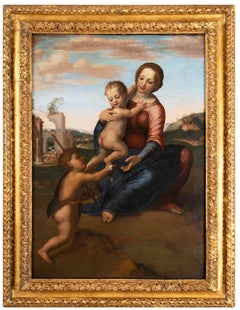
Virgin
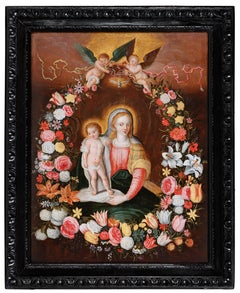
Child in a Flower Garland, Flemish, 17th century, studio of F. Francken
By Frans Francken II
Located in PARIS, FR
Virgin and Child in a Garland of Flowers
Studio of Frans Francken II (1581-1642)
This work is unsigned
17th century Antwerp School
Oil on oak panel
Dimensions: h. 63 cm, w. 48,5 cm (...
Category
Early 17th Century Old Masters Figurative Paintings
Materials
Oil, Wood Panel
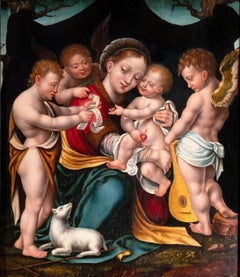
Madonna and child with angels, circle of Joos Van Cleve, 16th c. Antwerp school
By Joos van Cleve
Located in PARIS, FR
Madonna and Child with Saint John the Baptist and angels
Circle of Joos Van Cleve (1485 – 1541)
16th century Antwerp school
Oil on oak panel
Dimensions: h. 32 cm (13 in.), w. 28.5 cm...
Category
16th Century Old Masters Figurative Paintings
Materials
Oak, Oil
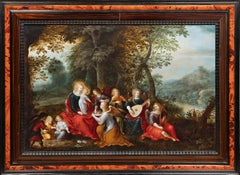
Madonna and Child with Angels, attributed to Louis de Caullery, Flemish, 17th c.
Located in PARIS, FR
Madonna and Child with Angels
Attributed to Louis de Caullery (1565 -1622) for figures & Abraham Govaerts (1589 - 1626) for landscape
Not signed
17th century Antwerp school, circa 16...
Category
Early 17th Century Old Masters Figurative Paintings
Materials
Copper
You May Also Like
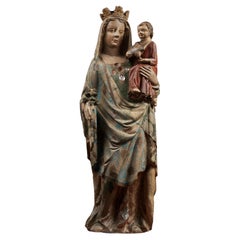
Important 14th Century Polychrome Limestone Virgin from Lorraine
Located in Saint-Ouen, FR
Provenance :
- Kunsthaus Heinrich Hahn, Frankfurt am Main, sale 16, June 17, 1930, lot 16.
- Sotheby's, Amsterdam, Feb. 26, 2006, lot 201.
HISTORIC
Located between Moselle valley and Meuse valley, framed by the Vosges Mountains on the south side and the duchy of Luxembourg on the north side, the duchy of Lorraine is the result of several partitions. It starts with the 9th century when the Carolingian empire is divided, with Lothar 1st inheriting Lotharingia. In 959 this territory was in turn divided in two; Lower and Upper Lotharingia, the latter being the forebear of the duchy of Lorraine. This duchy was under the rule of the Holy Roman Germanic Empire until 1736 when it was absorbed by the kingdom of France.
All along its history the duchy of Lorraine has found itself in the midst of many conflicts. Alliances and feuds marking European history were always particularly sensible in Lorraine where instability was frequent. Because of its geographic position the duchy of Lorraine was also an artistic crossroad.
Hence the duchy of Lorraine becomes from the 13th century onwards an important artistic centre where a particular type of Virgin and Child appears. According to professor J. A. Schmoll the characteristics of Lorraine sculpture burgeon around 1280-1300 in the Aube region. It presents “vigorous volumes, restrained movements, rare but solemn gestures and a strong interiorised and stern expression”. Those Virgins look similar with a wide forehead, a shield- or oval-shaped face, large neck, small lips and a cleft chin.
This model is particularly in favour during the 13th century because of the revival for Marial worship and for the theme of the Virgin and Child. It bears witness to a new religious sensibility with a more intimate vision of religious practice.
DESCRIPTION
The important 14th century Virgin we present to you is one of the most beautiful examples of sculptural art from Eastern France, with her fascinating distant gaze.
Her contrapposto posture is induced by the weight of the child she carries high on her left side. The child has a chubby face framed by blond hair with well defined curls and he wears a long red V-collared tunic from which emerge his feet. The fabric is animated by long folds. The position of the right foot turned to the back is a detail we can notice on several Virgins from Lorraine. He holds a bird that seems to be pecking his thumb.
“The bird /held by the child in his hands/ has been read as a reference to an episode from Christ’s childhood when he has moulded sparrows with clay before giving them life. It appears in the apocryphal gospel of Pseudo-Matthew (ch. 27) and later in the Quran (III, 43, v. 110). However the iconography seems to be more influenced by the concept of Redemption or of Eucharist, the bird symbolising the soul of the Christian about to be redeemed or revitalised.”
Mary wears a long dress with two rock crystal cabochons remaining from the original five. She is covered by a red cloak enriched with old-gold motifs draped as an apron falling in long pleats along her left hip. The relief treatment and the volume of the cloak developing a network of concentric pleats contrast with the the flat pleating of her dress. They nevertheless suggest the curve of her bent right leg.
She wears a floret crown securing a short thin veil carved in very low relief. From it emerges her blond curled hair characteristic of the 13th century. The large face with almond-shaped eyes, straight nose, small lips and cleft chin casts its gaze afar in a fashion typical of 13th century Virgins.
In her right hand she holds a lily flower. In a very refined manner the artist has carved a band on her right ring-finger.
In the back, carefully sculpted, spreads the minutely detailed short veil.
COMPARATIVE STUDIES
This sculpture of great quality presents obvious similarities with Virgins from Lorraine, designated by William Forsythe...
Category
Antique 15th Century and Earlier French Gothic Figurative Sculptures
Materials
Limestone
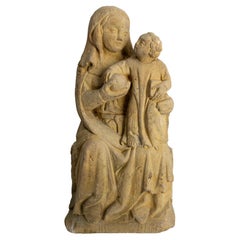
French Antique Statuette Virgin and Child Early 20 th Century
Located in Labrit, Landes
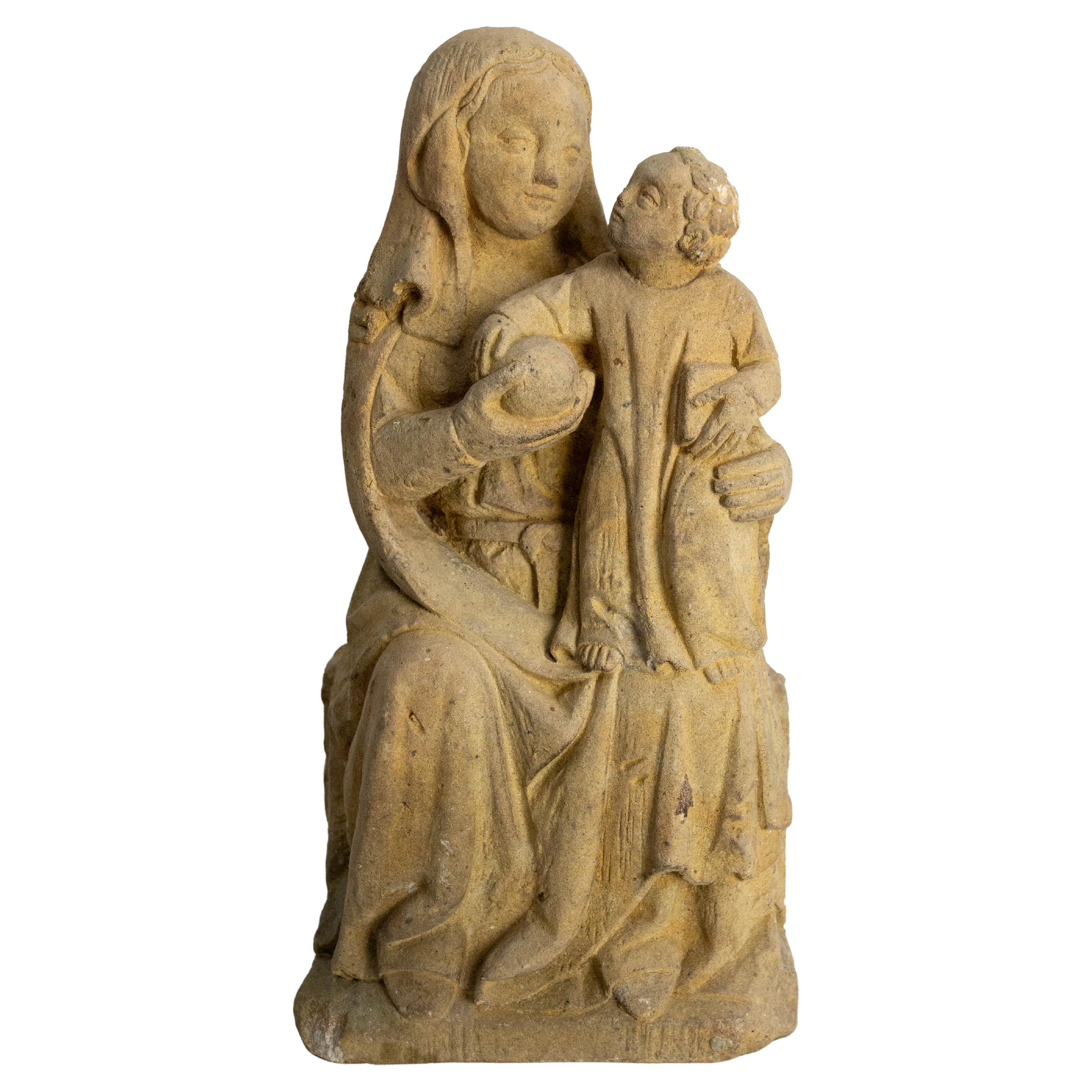
French handmade stone statue in stone Madonna and Child.
As you can see from the photos, the Mother and the Child exchange an expressive look full of tenderness.
The directing style ...
Category
Early 20th Century French Animal Sculptures
Materials
Stone
$747 Sale Price
20% Off
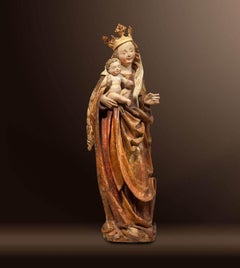
Virgin and Child
Located in Wien, Wien
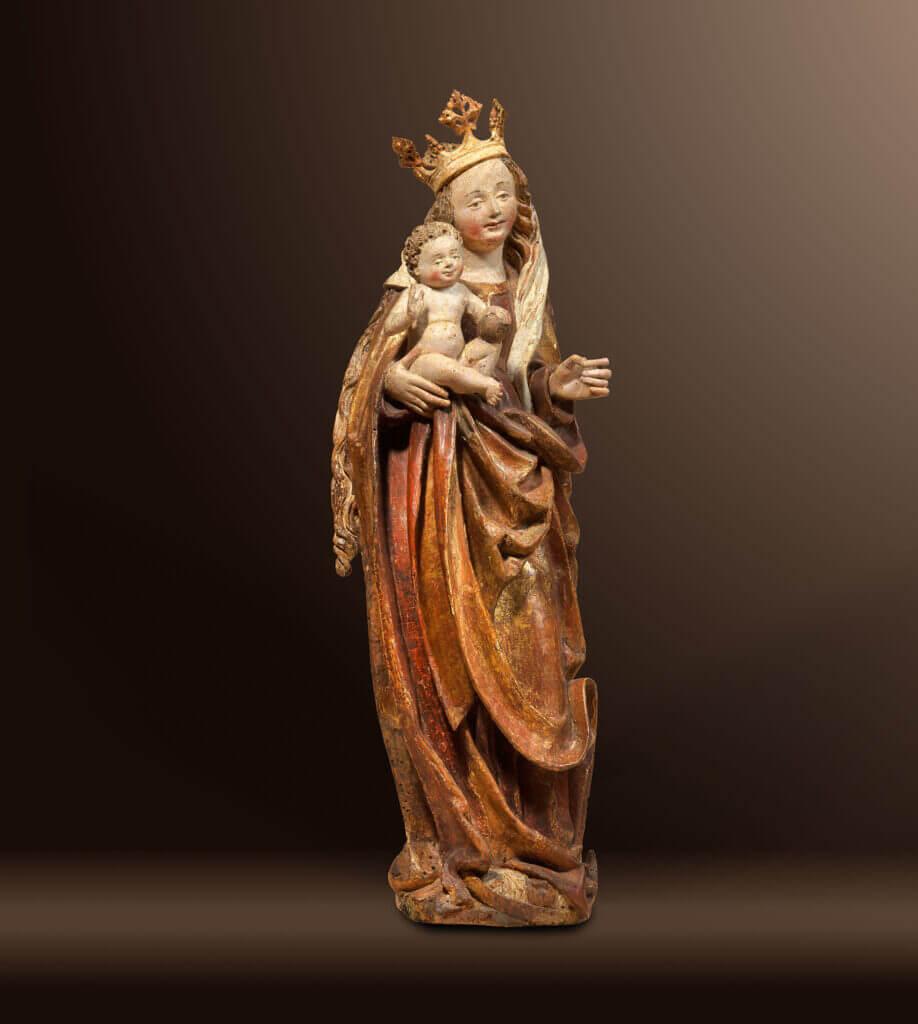
OUTSTANDING MADONNA
Bavaria
Around 1515/20
Lime wood carved
Original, polychrome version
Height 60 cm
This masterfully carved, full-round Madonna was created around 1515-20 in...
Category
16th Century Medieval Figurative Sculptures
Materials
Wood
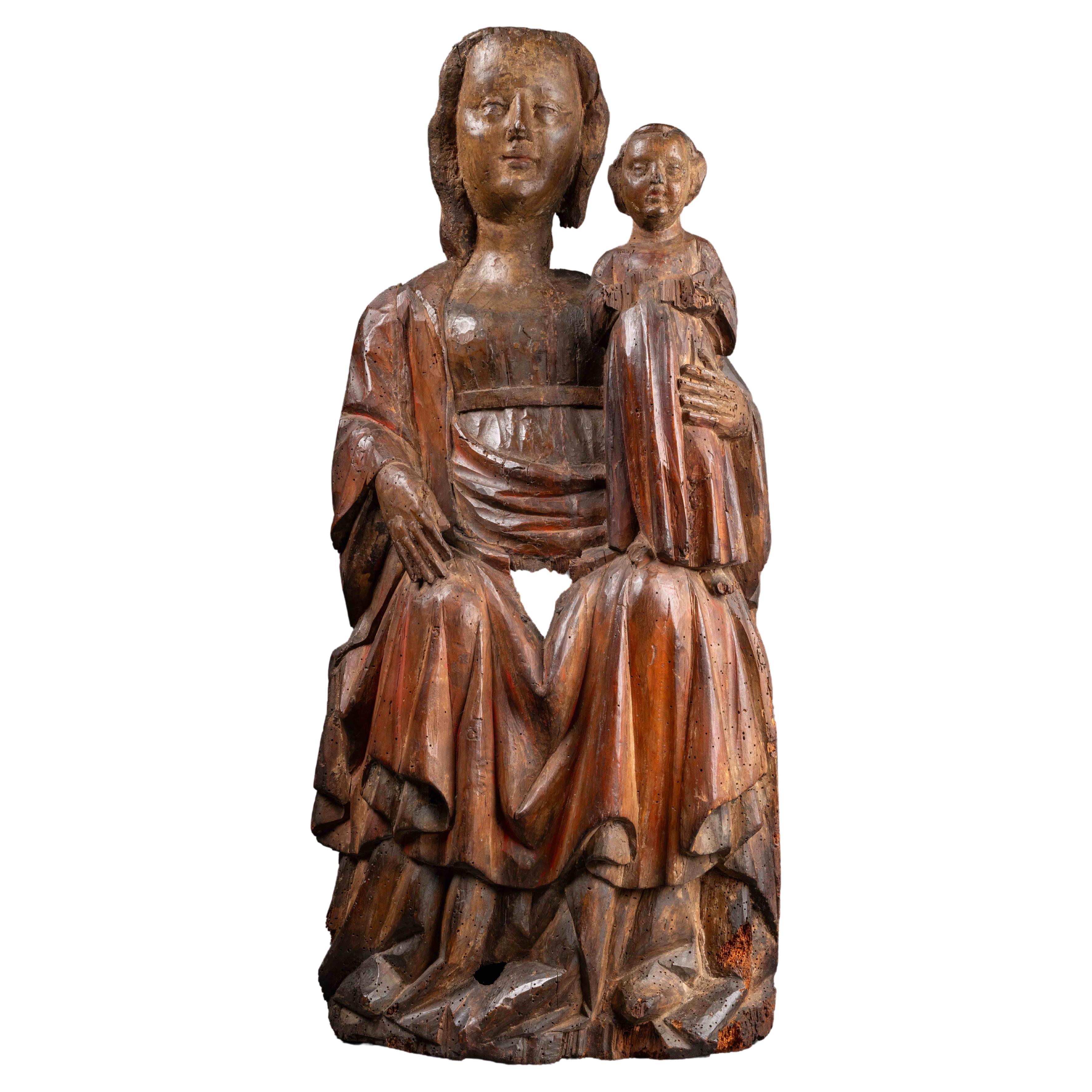
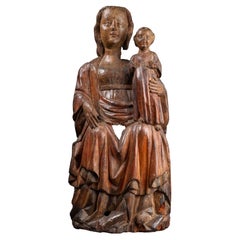
Virgin and the Child, Mosan Region, Second Half of 13th Century
Located in Bruxelles, BE
A polychrome sculpture depicting the Virgin and the Child
Mosan region, second half of 13th century
Polychrome wood
73 x 29 X 12 cm
Provenance :
Former Belgian private collection from the beginning of the 20th century
This remarkable early artwork portrays the Enthroned Virgin and Child, also known as Sedes Sapientiae, which translates to the 'Seat of Wisdom...
Category
Antique 15th Century and Earlier Belgian Medieval Figurative Sculptures
Materials
Wood
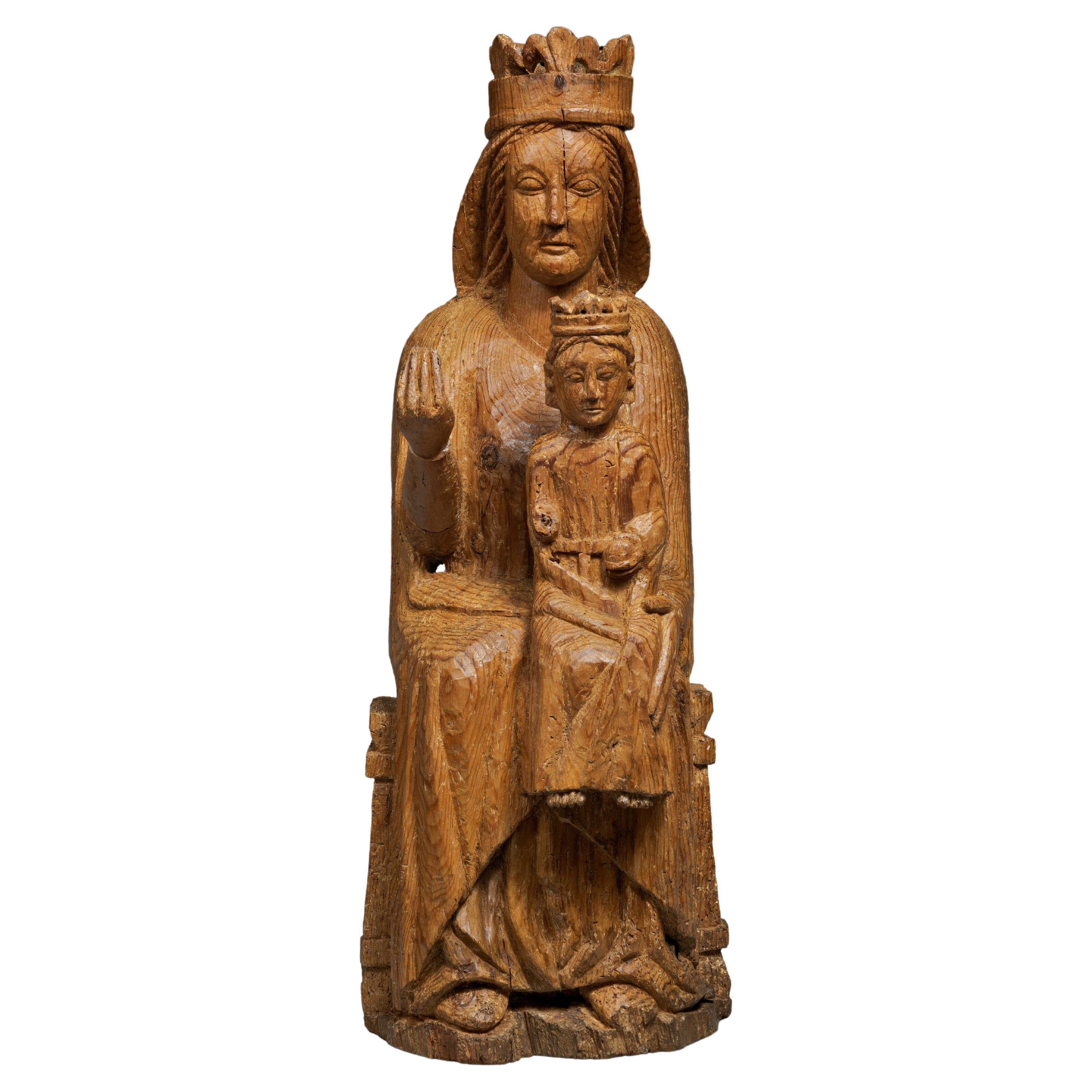
Virgin and Child in Majesty, also known as "Sedes Sapientae"
Located in Saint-Ouen, FR
VIRGIN AND CHILD IN MAJESTY, ALSO KNOWN AS "SEDES SAPIENTIAE"
ORIGIN : SPAIN, CATALOGNE
PERIOD: EARLY 13th CENTURY
Height : 95 cm
Width : 32 cm
Depth : 28 cm
Softwood
No polychromy
In the middle of the 12th century, the Virgin took her place in churches, seated in Majesty, serving as a throne for her son Jesus. She is then called Sedes Sapientiae, meaning the Throne of Wisdom.
At that time, she is not represented for herself and only exists because she has been designated as Theotokos, the mother of God, at the Council of Ephesus in 431, where the divine nature of Christ was proclaimed from his birth.
The upright and perfectly hieratic bust of this Virgin and Child in Majesty is seated on a throne-bench. She is dressed in a tunic with a rounded neckline and covered with a fine mantle placed on her narrow shoulders. The supple and natural drapery follows the lines of the body.
Large curls frame her face with delicate and regular features, a long straight nose, almond-shaped eyes, and small lips.
She supports the Infant Jesus with her left hand. Like his mother, he is dressed in a long tunic, and his little feet are visible in the folds. He holds a small sphere in his left hand, while with his right hand, he gestures in blessing. The face of Christ bears a strong resemblance to his mother’s one, and he gives a slight smile.
The position of the Child is no longer as hieratic, nor frontal or central as in the early 12th century, but his face still turns towards the faithful.
The 13th century indeed emerges as a period of transition in the artistic domain. The statuary, while retaining certain characteristics still belonging to the habits of the previous century, also develops new formal solutions.
As a result, Mary maintains a hieratic and frontal position, while her son shifts to place himself well to the left on her knee. Similarly, while the Virgin seems perfectly still, Jesus, on the other hand, appears much more animated, especially in the positioning of his hands. His left hand holds the orb, and judging by the raised right arm directed towards the faithful, one can easily imagine that he was making a gesture of blessing.
The influence of the Sedes Sapientiae from previous centuries still seems particularly prevalent in this work.
These few characteristics allow dating this Spanish Virgin...
Category
Antique 15th Century and Earlier Spanish Gothic Figurative Sculptures
Materials
Softwood
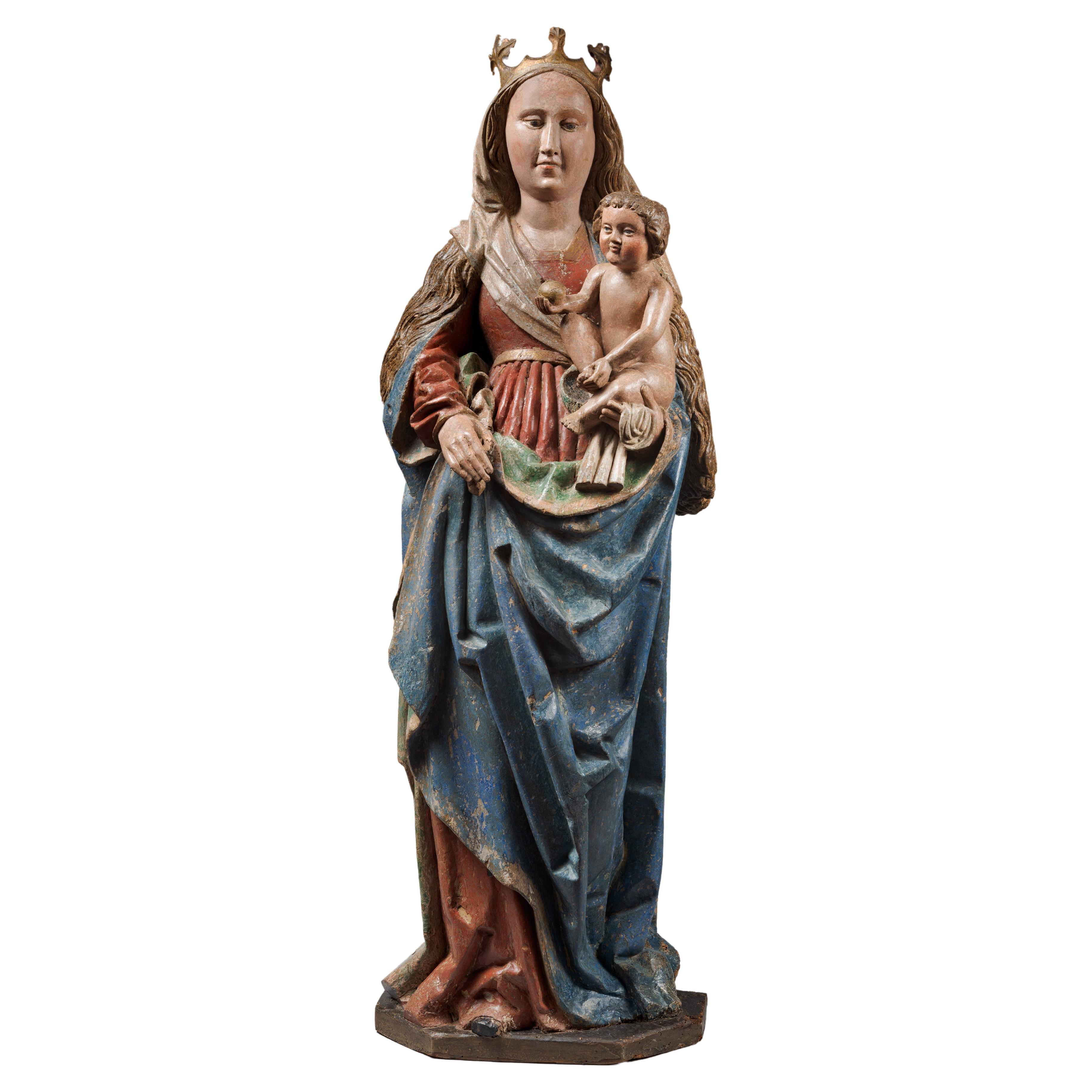
Important 15th Century Polychrome Wood Virgin and Child
Located in Saint-Ouen, FR
Important 15th century polychrome wood virgin and child
Origin: Southern Germany
Period: Late 15th Century, Ca. 1480-1490
Height : 125 cm
Polychrome limewood
Good condition
Provenance : Private collection, Alsace, France.
As soon as 1430, sculpture starts a major and deep stylistic evolution than will unfold over a century, until around 1530. We call it the International Gothic. This production is particularly interested in a quest for realism.
This important Virgin and Child wears a long red dress with a round gilded neckline. A delicate golden belt...
Category
Antique 15th Century and Earlier Figurative Sculptures
Materials
Wood
More Ways To Browse
Limestone Art
Bavarian Antique
Antique Shed
Virgin And Child
15th Century Gothic
Antique Belts And Buckles
Jesus And Mary Figure Sculpture
Chola Bronze
Chris Fraticelli
Christopher David White
Clark Bronson
Contemporary Art W Swimmers
Dali Bronze Christ John Cross
Dali Bronze John Saint
Dali Bronze Watch
Dali Gold Relief
Dali Silver Christ
Daniel Kafri