Video Loading
Want more images or videos?
Request additional images or videos from the seller
1 of 8
Ursula Hanke-ForsterFischer mit Netzen (Fisherman with Nets)1960
1960
$5,300List Price
About the Item
- Creator:Ursula Hanke-Forster (1924 - 2013, German)
- Creation Year:1960
- Dimensions:Height: 33.5 in (85.09 cm)Width: 28 in (71.12 cm)Depth: 11 in (27.94 cm)
- Medium:
- Movement Style:
- Period:
- Condition:
- Gallery Location:Missouri, MO
- Reference Number:1stDibs: LU74739454152
About the Seller
5.0
Vetted Professional Seller
Every seller passes strict standards for authenticity and reliability
Established in 1970
1stDibs seller since 2017
157 sales on 1stDibs
Typical response time: 1 to 2 days
Authenticity Guarantee
In the unlikely event there’s an issue with an item’s authenticity, contact us within 1 year for a full refund. DetailsMoney-Back Guarantee
If your item is not as described, is damaged in transit, or does not arrive, contact us within 7 days for a full refund. Details24-Hour Cancellation
You have a 24-hour grace period in which to reconsider your purchase, with no questions asked.Vetted Professional Sellers
Our world-class sellers must adhere to strict standards for service and quality, maintaining the integrity of our listings.Price-Match Guarantee
If you find that a seller listed the same item for a lower price elsewhere, we’ll match it.Trusted Global Delivery
Our best-in-class carrier network provides specialized shipping options worldwide, including custom delivery.You May Also Like
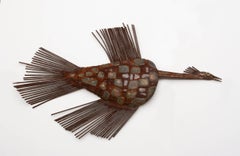
#1 Bird, Hand-Welded Bronze, Copper and Iron Sculpture by Delfin
By Victor Delfin
Located in Long Island City, NY
Artist: Victor Delfin, Peruvian (1927 - )
Title: #1 Bird
Year: 1978
Medium: Hand-Welded Bronze, Copper and Iron Sculpture
Size: 45 in. x 71 in. (114.3 cm x 180.34 cm)
Category
1970s Modern Figurative Sculptures
Materials
Bronze, Copper, Iron
$25,000
H 45 in W 71 in D 5 in
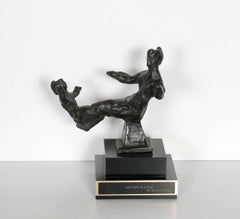
Mother Playing, Bronze and Wood Sculpture by Chaim Gross
By Chaim Gross
Located in Long Island City, NY
An abstract modern cubist rendition of a mother playing with her child by Chaim Gross (Austrian, 1904 - 1991). Chaim Gross is known for these playful works and similar works can be f...
Category
1970s Modern Figurative Sculptures
Materials
Bronze
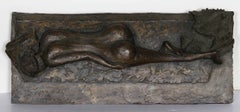
Sleeping Nude Woman Bronze Sculpture
Located in Long Island City, NY
Artist: Unknown
Title: Sleeping Nude Woman
Medium: Bronze Sculpture
Size: 4 in. x 24 in. x 10 in. (10.16 cm x 60.96 cm x 25.4 cm)
Category
20th Century Modern Figurative Sculptures
Materials
Bronze
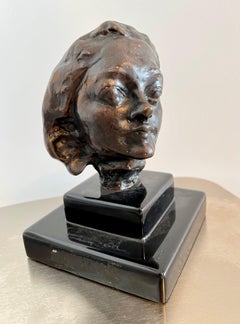
Small Bronze Sculpture Cast Head After Rodin "Petite tete au nez retrousse"
By Auguste Rodin
Located in Surfside, FL
(after) Auguste Rodin
Posthumous cast
"Petite tete au nez retroussé"
Featuring a bust of a woman.
Limited edition bronze is mounted on a marble base and is signed on the lower right. Great detail.
Dimensions: approx. 7-1/4" tall x 5" across x 5" deep with base
Foundry mark on the reverse, #13 of 299 produced.
François Auguste René Rodin (1840 – 1917) was a French sculptor generally considered the founder of modern sculpture. Rodin possessed a unique ability to model a complex, turbulent, and deeply pocketed surface in clay. He is known for such sculptures as The Thinker, Monument to Balzac, The Kiss, The Burghers of Calais, and The Gates of Hell. He modeled the human body with naturalism, and his sculptures celebrate individual character and physicality. Although Rodin was sensitive to the controversy surrounding his work, he refused to change his style, and his continued output brought increasing favor from the government and the artistic community.
Rodin became the preeminent French sculptor of his time. By 1900, he was a world-renowned artist. Wealthy private clients sought Rodin's work after his World's Fair exhibit, and he kept company with a variety of high-profile intellectuals and artists. His student, Camille Claudel, became his associate, lover, and creative rival. Rodin's other students included Antoine Bourdelle, Constantin Brancusi, and Charles Despiau.
Rodin entered the studio of Albert-Ernest Carrier-Belleuse, a successful mass producer of objets d'art. Rodin worked as Carrier-Belleuse' chief assistant until 1870, designing roof decorations and staircase and doorway embellishments. With the arrival of the Franco-Prussian War, Rodin was called to serve in the French National Guard, but his service was brief due to his near-sightedness. Rodin took classes with animal sculptor Antoine-Louis Barye. The teacher's attention to detail and his finely rendered musculature of animals in motion significantly influenced Rodin. Rodin won the 1880 commission to create a portal for a planned museum of decorative arts. Rodin dedicated much of the next four decades to his elaborate Gates of Hell, an unfinished portal for a museum that was never built. Many of the portal's figures became sculptures in themselves, including Rodin's most famous, The Thinker and The Kiss. With the museum commission came a free studio, granting Rodin a new level of artistic freedom.
By 1900, Rodin's artistic reputation was established. Gaining exposure from a pavilion of his artwork set up near the 1900 World's Fair (Exposition Universelle) in Paris, he received requests to make busts of prominent people internationally, As Rodin's fame grew, he attracted many followers, including the German poet Rainer Maria Rilke, and authors Octave Mirbeau, Joris-Karl Huysmans, and Oscar Wilde.
Rodin and Beuret's modest country estate in Meudon, purchased in 1897, was a host to such guests as King Edward, dancer Isadora Duncan, and harpsichordist Wanda Landowska. He left Beuret in Meudon and began an affair with the American-born Duchesse de Choiseul. From 1910, he mentored the Russian sculptor, Moissey Kogan...
Category
20th Century Modern Figurative Sculptures
Materials
Bronze
$1,800
H 7.25 in W 5 in D 5 in
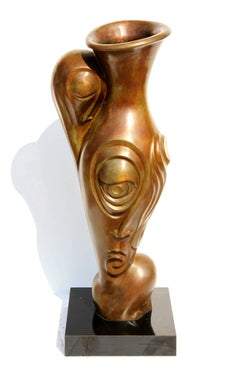
Profile Pitcher, Cubist Bronze Vase
Located in Long Island City, NY
Artist: Unknown, possibly Russian
Title: Profile Pitcher
Medium: Bronze Sculpture with Patina
Size: 26.5 in. x 9 in. x 5 in. (67.31 cm x 22.86 cm x 12.7 cm) Base: 2.5 x 10.5 x 10.5 i...
Category
20th Century Modern Figurative Sculptures
Materials
Bronze
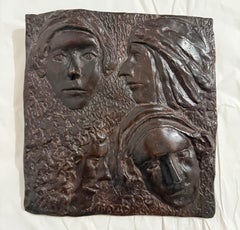
Bronze Sculpture Wall Relief Judaica Jewish Matriarchs Modernist Leonard Baskin
By Leonard Baskin
Located in Surfside, FL
Leonard Baskin (1922-2000)
Jewish Matriarchs, Sarah, Rebecca, Rachel and Leah
with Hebrew calligraphy
Bronze, 1998
9.5 X 9 inches
Judaic biblical bronze of Jewish mothers.
Leonard Baskin (August 15, 1922 – June 3, 2000) was an American sculptor, illustrator, wood-engraver, printmaker, graphic artist, writer and teacher.
Baskin was born in New Brunswick, New Jersey. While he was a student at Yale University, he founded Gehenna Press, a small private press specializing in fine book production. From 1953 until 1974, he taught printmaking and sculpture at Smith College in Northampton, Massachusetts. Subsequently Baskin also taught at Hampshire College in Amherst, Massachusetts.
He lived most of his life in the U.S., but spent nine years in Devon at Lurley Manor, Lurley, near Tiverton, close to his friend Ted Hughes, for whom he illustrated Crow. Sylvia Plath dedicated Sculpto to Leonard Baskin in her famous work, The Colossus and Other Poems (1960).
The Funeral Contege (1997) bronze, Franklin Delano Roosevelt Memorial, Washington, D.C.
His public commissions include a bas relief for the Franklin Delano Roosevelt Memorial and a bronze statue of a seated figure, erected in 1994 for the Holocaust Memorial in Ann Arbor, Michigan.
His works are owned by many major museums including the Metropolitan Museum of Art, the Museum of Fine Arts, Boston, the Museum of Modern Art, the Art Institute of Chicago, the Boca Raton Museum of Art, the British Museum, the Honolulu Museum of Art, the Udinotti Museum of Figurative Art and the Vatican Museums. The archive of his work at the Gehenna Press was acquired by the Bodleian Library at Oxford, England, in 2009. The McMaster Museum of Art in Hamilton, Ontario owns over 200 of his works (some religious and biblical), most of which were donated by his brother Rabbi Bernard Baskin.
Contemporary Religious Imagery in American Art. Catalog for an exhibition held at the Ringling Museum of Art, March 1-31, 1974. Artists represented: David Aronson, Leonard Baskin, Max Beckmann, Hyman Bloom, Fernando Botero, Paul Cadmus, Marvin Cherney, Arthur G. Dove, Philip Evergood, Adolph Gottlieb, Jonah Kinigstein, Arman, Rico Lebrun, Jack Levine, Louise Nevelson, Barnett Newman, Abraham Rattner, Ben Shahn, Mark Tobey, Max Weber, William Zorach and others.In 1955, he was one of eleven New York artists featured in the opening exhibition at the Terrain Gallery, they showed many great artists, Chaim Koppelman, for many years, headed the gallery's Print Division; printmakers such as Will Barnet, Leonard Baskin, Robert Conover...
Category
20th Century Modern Figurative Sculptures
Materials
Bronze
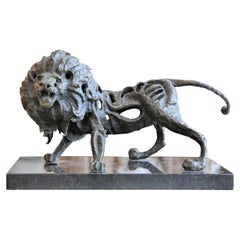
Modern Bronze Abstract Skeletal Lion Animal Sculpture
Located in Houston, TX
Modern bronze sculpture of a skeletal lion resting on a slab of black polished granite. Beautiful patina on the bronze that accentuates the intricate details.
Category
20th Century Modern Figurative Sculptures
Materials
Granite, Bronze
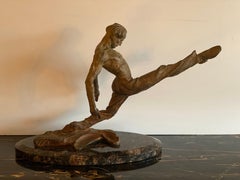
Suspension Flamenco
By Richard MacDonald
Located in Los Angeles, CA
A Stunning sculpture by Richard Macdonald titled "Suspension Flamenco"
Finely detailed and has captivating movement.
The work is patinated bronze on a mottled marble base.
Signed and...
Category
21st Century and Contemporary Modern Figurative Sculptures
Materials
Bronze
Contemporary Bronze Wildlife Sculpture
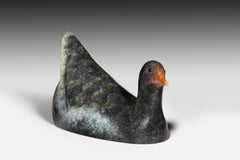
Moorhen
by Richard Smith
By Richard Smith b.1955
Located in Shrewsbury, Shropshire
'Moorhen' is full of character! Richard Smith is a part-time sculptor and a part-time gamekeeper, who surrounds himself with wildlife on a daily basis. His love and knowledge of the ...
Category
21st Century and Contemporary Modern Figurative Sculptures
Materials
Bronze
Price Upon Request
H 12 in W 5 in
Contemporary Bronze Bird Wildlife Sculpture
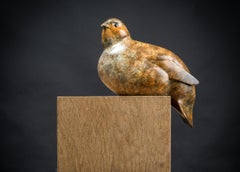
Perching Partridge
, wildlife
By Richard Smith b.1955
Located in Shrewsbury, Shropshire
'Perching Partridge' is full of character! Richard Smith is a part-time sculptor and a part-time gamekeeper, who surrounds himself with wildlife on a daily basis. His love and knowle...
Category
21st Century and Contemporary Modern Figurative Sculptures
Materials
Bronze
Price Upon Request
H 8 in W 8 in
More From This Seller
View AllFalling Man and Form
By Ernest Tino Trova
Located in Missouri, MO
Ernest Tino Trova
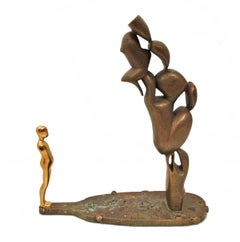
"Falling Man and Form" 1996
Brass and Bronze
14 x 4.5 x 4.5 inches
Signed and Numbered 1/1 (Unique)
Known for his Falling Man series in...
Category
1990s American Modern Figurative Sculptures
Materials
Brass, Bronze
Price Upon Request
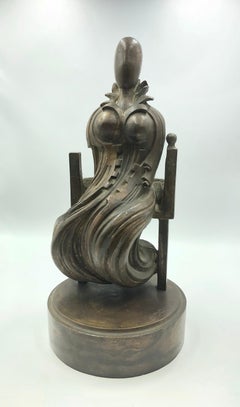
Regina Enthroned
By Lazzaro Donati
Located in Missouri, MO
Lazzaro Donati (Italian 1926-1977)
"La Regina"
Bronze
Signed on Base
Size: approx 19 x 9 x 9 inches
Lazzaro Donati (1926-1977) was born in Florence in 1926 and attended the Academy of Fine Arts. He began to paint in 1953, and in 1955 held his first exhibition at the Indiano Gallery in Florence. Within three years eleven exhibitions followed in Italy, and as his reputation grew he was invited to give major exhibitions in London, Paris, New York, Chicago, Rio de Janeiro and Montevideo. He is considered one of the foremost contemporary Italian painters and his paintings hang in museums and private collections throughout the Americas, Europe and Asia.
Mr. Donati lived and worked at 24 Piazza Donatello in Florence, the square where generations of artists have created works worthy of the great Florentine tradition. As you entered the narrow hallway to his studio, a gilded life-size Venetian angel beckoned you to his door. Once inside, the present faded away and you found yourself in an atelier where early masters might have worked during the Renaissance. Within, luxurious Persian rugs set off the innumerable objects d'art and antique furnishings. Light poured in through the sloping glass wall on the north side. A dramatic stairway led to an overhanging balcony which served as a private gallery where the artist hung some of his favorite early works. To the left of the entrance was a smaller studio where Donati sculpted, with a window overlooking the famous old English cemetery where tourists laid flowers on the grave of Elizabeth Barrett Browning.
In the main studio itself, where Donati received his clients in an atmosphere as polished as an office of a top executive, one hardly realized that it was here that the artist actually painted. His easel was covered with Persian blue velvet, the painting on the easel was already framed, his chair was upholstered in red velvet and on his palette the colors were arranged with the precision of a Byzantine mosaic. In a corner stand were his latest works, framed and ready to be sent off to his next exhibition in Europe or America.
Donati was a born host with a warm welcome, an elegant man who possessed enormous charm a good nature and a keen sense of humor. Apparently shy, he preferred to speak on subjects extraneous to his art, purposely distracting you from his paintings, then leading you back to them, tactfully and without pretension. He spoke fluent French and English as well as some Spanish and German. "After all", he said, "you've got to know how to sell a painting to everyone."
He had no sympathy for the "drip and splash" studios of his contemporaries, preferring to keep his studio tidy and spotless. "Painting is a matter of precision", he said, "If a painter can't put his paint where he wants it to go, I don't see how he can call himself a painter. For me it is absolutely necessary to control the paint."
When asked to reveal the technique he used to achieve the enamel-like finish typical of his paintings he answered, "That is a secret between me and my butler. Actually, most of my paintings are done by him!"
But in fact behind the façade, Donati was a serious craftsman who devoted to his painting as a way of life and means of expression. From the beginning of his career, his paintings revealed a striving for perfection and continual research in problems of style and technique. His early works indicated a momentary interest in surrealism and abstract art; they were predominantly two dimensional, depending on line and strong color. But by 1958, with his painting The Lady with a Fan...
Category
Late 20th Century Modern Figurative Sculptures
Materials
Bronze
Price Upon Request
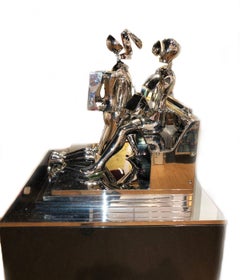
The Encounter
By Ernest Trova
Located in Missouri, MO
Ernest Trova
"The Encounter" 1994
Chrome Plated Steel
Approx 24 x 26 x 24 inches
Edition 1/8
Known for his Falling Man series in abstract figural sculpture, he created hard-edge ima...
Category
1990s American Modern Figurative Sculptures
Materials
Stainless Steel
Price Upon Request
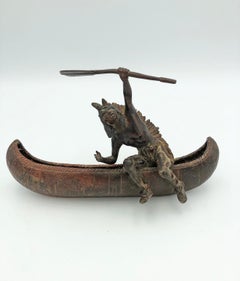
Native American in Canoe
By Carl Kauba
Located in Missouri, MO
Carl Kauba (1865-1922)
"Native American in Canoe"
Polychrome Bronze
Signed
approx 5.5 x 10 x 2.75 inches
This Austrian sculptor was born in Vienna in 1865. His teachers were Karl Waschmann (1848-1905), known for his ivory sculptures and portrait plaquettes of contemporary celebrities, and Stefan Schwartz (1851-1924), who exhibited in Paris, including the Exposition Universelle of 1900 where he won a gold medal. Kauba's intricate bronzes, imported to the United States between 1895 and 1912, were cast at the Roman Bronze Works. Kauba was part of the nineteenth-century tradition of polychrome bronze sculpture. There were several types of patinas on a single statue: he could render the color of buckskin, variously tinted shirts, blankets, feathers, as well as beaded moccasins. Reportedly, Kauba came to America around 1886. Inspired by the Western tales of German author Karl May, he traveled to the West and made sketches and models. Critics, however, pointed out inaccuracies of costume and other details. For instance, the guns that his "mid-nineteenth-century" figures use are models produced after 1898. Apparently he did all of his works back in Vienna.
Besides the variety of color, Kauba's bronzes show a great range of textures and his style is highly naturalistic. The sculptor loved ornament, some of which he rendered with coiled wire for reins, rope and feathers in headdresses. He successfully rendered figures in motion and often executed compositions with more than one figure. Berman (1974) illustrates non-Western subjects by Kaula, such as the pendants Where? and There (ca. 1910), a seated Scottish couple, impressive in the expressions and the details on patterned fabrics of both sitters. Another genre piece is Buster Brown...
Category
Early 20th Century Realist Figurative Sculptures
Materials
Bronze
Price Upon Request
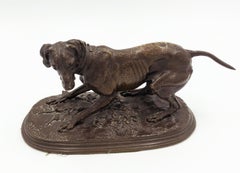
Chien Braque (Tom)
By Pierre Jules Mêne
Located in Missouri, MO
Pierre Jules Mene
"Chien Braque" (Tom)
Bronze
approx. 5 x 9 x 4.25
Signed
PIERRE JULES MENE (1810-1879)
Pierre Jules Mene, (P. J. Mene), was born in Pa...
Category
1860s Realist Figurative Sculptures
Materials
Bronze
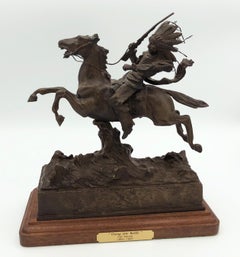
Going into Battle
By Carl Kauba
Located in Missouri, MO
Carl Kauba
"Going into Battle" c. 1920s
Bronze with Brown Patina
Signed
approx 10 x 10 x 4 (including wooden base)
This Austrian sculptor was born in Vienna in 1865. His teachers were Karl Waschmann (1848-1905), known for his ivory sculptures and portrait plaquettes of contemporary celebrities, and Stefan Schwartz (1851-1924), who exhibited in Paris, including the Exposition Universelle of 1900 where he won a gold medal. Kauba's intricate bronzes, imported to the United States between 1895 and 1912, were cast at the Roman Bronze Works. Kauba was part of the nineteenth-century tradition of polychrome bronze sculpture. There were several types of patinas on a single statue: he could render the color of buckskin, variously tinted shirts, blankets, feathers, as well as beaded moccasins. Reportedly, Kauba came to America around 1886. Inspired by the Western tales of German author Karl May, he traveled to the West and made sketches and models. Critics, however, pointed out inaccuracies of costume and other details. For instance, the guns that his "mid-nineteenth-century" figures use are models produced after 1898. Apparently he did all of his works back in Vienna.
Besides the variety of color, Kauba's bronzes show a great range of textures and his style is highly naturalistic. The sculptor loved ornament, some of which he rendered with coiled wire for reins, rope and feathers in headdresses. He successfully rendered figures in motion and often executed compositions with more than one figure. Berman (1974) illustrates non-Western subjects by Kaula, such as the pendants Where? and There (ca. 1910), a seated Scottish couple, impressive in the expressions and the details on patterned fabrics of both sitters. Another genre piece is Buster Brown...
Category
Early 20th Century Realist Figurative Sculptures
Materials
Bronze
Price Upon Request