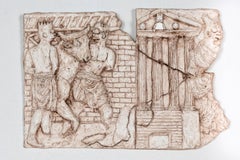
Items Similar to Oedipus before the Temple of the Furies at Colonus
Want more images or videos?
Request additional images or videos from the seller
1 of 6
William TylerOedipus before the Temple of the Furies at Colonus1765
1765
$61,454.34
£45,000
€52,382.76
CA$84,664.60
A$92,269.51
CHF 48,860.69
MX$1,108,254.03
NOK 618,587.09
SEK 568,729.98
DKK 391,241.12
About the Item
Terracotta
19 x 25 ½ inches; 480 x 650 mm
Signed and dated: ‘W Tyler Excu. 1765’
Collections:
Cyril Humphris, London;
Humphris sale, Sotheby's, New York, 10-11 January 1995, lot 74, as Diogenes;
English private collection, to 2023;
Anonymous sale, Sotheby’s, 4th July, 2023, lot 52 as Diogenes;
Lowell Libson
Jonny Yarker Ltd.
Literature:
Ingrid Roscoe, A Biographical Dictionary of Sculptors in Britain, 1660-1851, New Haven and London, 2009, p. 1269, no. 72, as Diogenes.
Exhibited:
Possibly London, Society of Artists, 1765, ‘a monumental medallion; a model’, no.181.
This finely modelled terracotta relief is a fascinating work of European neo-classicism. Signed and dated by William Tyler 1765, the relief is based on a design made in Rome by Anton Raphael Mengs, recorded in a finished drawing now in the Metropolitan Museum of Art, New York. The drawing was one of several designs Mengs made in preparation for carved gems for British patrons in the early 1760s. Precisely how Tyler, who seems not to have travelled to Italy, became aware of Mengs’s design is unclear. Tyler, a pupil of Louis-François Roubiliac, was a remarkably fluent sculptor and inventive designer who produced a series of distinguished funerary monuments, he was a founder Royal Academician and heavily involved in the administration of the Academy throughout its first thirty years. Tyler exhibited a number of ‘models’ of bas-reliefs at the Society of Artists in the 1760s and the present work may be identifiable as ‘a monumental medallion, a model’ shown in 1765.
Tyler was a successful and productive artist who completed a steady stream of ambitious sculpted funerary monuments from 1760 until his death in 1801. Tyler’s origins are obscure, although he described himself the ‘son and grandson of a citizen [of London] and many years student under the late Mr Roubiliac.’ Tyler was established by the early 1760s when he competed for two significant sculpture commissions, first for the monument to General Wolfe for Westminster Abbey, secondly for the statue of George III at the Royal Exchange. In both cases the commission went to Joseph Wilton. Tyler was involved with the foundation of the Foundling Hospital and exhibited at the Society of Artists from its inception. In 1765 he became one of the Society’s directors and in December 1768 he was one of the three sculptors, along with Joseph Wilton and Agostino Carlini, to be elected a founder member of the Royal Academy.
Tyler’s surviving sculptures, as Malcolm Baker has observed, owe much to Roubiliac, particularly ‘in the subtlety with which his portrait busts are carved.’ His best funerary monuments, such as tomb of Sir John Cust at Belton or Samuel Vassall in King’s Chapel, Boston have a lively dynamism which shows that he was a designer of considerable flair. Tyler had a close relationship with several architects, designing complex monuments with Henry Keene and Robert Adam. It is possibly in this context that the present grand terracotta model should be viewed.
Throughout the 1760s Tyler shows a sequence of models of reliefs at the Society of Artists: in 1764 ‘a basso-relievo, the story of Narcissus’, in 1765 ‘a tablet, Bacchus Sleeping’ and ‘a lion couchant’ and in 1766 ‘a model of the Thames, with his commercial attributes.’ All these works point to Tyler’s relationship with architects, the tablets being ideal for the centre of chimneypieces, several of which he is recorded carving for Milton Hall in Cambridgeshire and Wentworth Woodhouse in Yorkshire. The present beautifully modelled terracotta may well have been conceived as an overmantel or for inclusion in architectural schemes. One of the features of the new neo-classicism being championed by Robert Adam was a reliance on classically inspired ornament to articulate interiors. Adam harvested designs from a plethora of antiquarian sources to provide plaster and painter reliefs for his rooms. As Adriano Aymonino has recently demonstrated, Adam frequently took antique details out of context, radically altering their scale to fit his interiors, for example, he often reproduced designs from antique gems on an architectural scale, he also regularly mixed modern sources with the antique to provide a rich and varied language of ornament.
Tyler’s complex figural group is borrowed directly from Mengs’s design, a drawing Mengs seems to have made in around 1760. According to an inscription on the verso of Mengs’s drawing now in the Metropolitan Museum of Art, New York and identified here as being in the hand of the dealer Thomas Jenkins, states that the drawing was specifically made: ‘as an imitation of the antique in order to be engraved, Pichler accordingly copied it for me, who procured the drawing of Mengs himself in 1763 upon a fine onyx. Ld Montagu has its companion, Priam at Achilles’s feet, drawn by Mengs
engraved by Pichler.’ Jenkins was one of the major figures in the Roman art world from the early 1760s. On Mengs’s departure from Rome for Spain in 1763, he acquired a considerable number of works from Mengs’s studio, including the design of Oedipus Before the Temple of the Furies at Colonus. Mention on the verso of the drawing of John Montagu, Marquess of Monthermer is notable. Whilst in Rome, Montagu became a good client of Jenkins’s, as well as sitting to Mengs for his portrait. A drawing at Pavlovsk by Mengs recording an ancient cameo of the head of Minerva from the collection of Montagu is carefully inscribed by Jenkins that it was gift from the artist in 1762. Whilst neither Mengs’s design for Priam at Achilles’s Feet nor Anton Pichler’s carved gem after the design survive, we know of its appearance thanks to plaster impressions made and marketed in Rome by Cristiano Dehn.
The plaster impression is included in Dehn’s monumental catalogue of casts after engraved gems published by Francesco Mario Dolce and dedicated to the Society of Antiquaries in London in 1772. The Descrizione Istorica del Museo di Cristiano Dehn also includes an account and impression of Pichler’s gem of Oedipus Before the Temple of the Furies at Colonus where it is stated that the gem is in the collection of ‘Sig. Robinson.’ As Steffi Roettgen first pointed out, this is almost certainly the traveller and collector Thomas Robinson who sat to Mengs in 1760 and who bought extensively from Thomas Jenkins. The statement on the verso of the Mengs drawing at the Met suggests that Pichler did not carve the gem until after Mengs had left for Madrid in 1763, meaning it was probably not dispatched to Robinson until sometime later. All this points to Tyler’s relief having been made either from Pichler’s gem, or more likely one of Dehn’s impressions, very soon after its completion and arrival in Britain.
The fact that Dehn included the two Pichlers after Mengs’s designs in trays of impressions of antique gems, underscores their value to contemporaries as authentically ‘antique’ designs. Again, as Steffi Roettgen has pointed out, the subject Mengs treats, the blind Oedipus, led by his daughters Ismene and Antigone to the temple of the Eumenides at Colonus was iconographically unique; it appears to be the first time a modern artist treated the subject of Sophocles’s play. The composition is laid out like a relief in a horizontal oval, at the centre Antigone embraces her seated father, framed on either side by Ismene and the exiled Polynices, lamenting Oedipus’s miserable condition.
Tyler has more or less translated Meng’s design into terracotta, although throughout he makes subtle, but significant alterations. The frieze-like composition of Mengs’s design is given more three-dimensionality, Antigone, rather than being seen in strict profile, is positioned to give greater depth and volume to the composition, this, in turn, allows Tyler to give greater emphasis to Oedipus’s blind state. Details, such as the sculpture in the pediment of the temple have been altered. In short, Tyler has adapted the design to best capitalise on the larger scale and greater sculptural potential of terracotta. Long incorrectly identified as depicting Diogenes and Alexander the Great, the recognition of the source finally makes sense of Tyler’s signature - ‘Excu’ rather than ‘Inv’ – and enables us to associate it with the ‘monumental medallion; a model’ shown at the Society of Artists in 1765. The identification of the source also reveals this large relief to be an unusually ambitious record of the rapid transmission of neo-classical designs across Europe.
- Creator:William Tyler (1728 - 1801, British)
- Creation Year:1765
- Dimensions:Height: 18.9 in (48 cm)Diameter: 25.6 in (65 cm)
- Medium:
- Movement Style:
- Period:
- Condition:
- Gallery Location:London, GB
- Reference Number:1stDibs: LU1507217333212
About the Seller
5.0
Recognized Seller
These prestigious sellers are industry leaders and represent the highest echelon for item quality and design.
1stDibs seller since 2021
5 sales on 1stDibs
- ShippingRetrieving quote...Shipping from: Mitchum, United Kingdom
- Return Policy
More From This Seller
View AllRoman 18th century terracotta model for the sculpture of San Camillo de Lellis
Located in London, GB
This remarkably fluid terracotta bozetto was made in preparation for Pietro Pacilli’s most important public commission, a large-scale marble statue of San Camillo de Lellis for the nave of St Peter’s Basilica in Rome. Expressively modelled, this terracotta sculpture is a rare and significant work made by a major Roman sculptor at a transformative moment of European sculpture. Pacilli began his working life on the great Baroque decorative projects initiated in the seventeenth century, but he found success as a restorer of ancient sculpture working to finish antiquities for a tourist market, becoming an important figure in the emergence of an archaeologically minded Neoclassicism. Pacilli trained Vincenzo Pacetti and provided important decorative work for the Museo Pio-Clementino, at the same time he is recorded restoring some of the most celebrated antiquities excavated and exported during the period.
Pacilli was born into a family of Roman craftsmen, his father Carlo was a wood carver, and Pacilli is recorded working with him on the Corsini Chapel in San Giovanni Laternao as early as 1735. In 1738 his terracotta model of Joseph and Potiphar’s Wife won the first prize in the second class of the sculpture concorso at the Accademia di San Luca, this is particularly notable as Bartolomeo Cavaceppi came third. He worked as a carver and stuccoist completing works for the churches of San Marco and SS. Trinita dei Domeniciani Spagnoli. Pacilli operated as a sculptor and restorer of antiquities from his studio at the top of the Spanish Steps, close to Santa Trinita dei Monti, where he is listed as a potential vendor to the Museo Pio-Clementino in 1770.
In 1763 Pacilli completed a silver figure of San Venanzio for the treasury of San Venanzio. He is recorded as Pacetti’s first master and it was evidently through Pacilli that he began to acquire his facility as a restorer of ancient sculpture. Pacilli, at his studio ‘poco prima dell’Arco della Regina alla Trinita dei Monti,’ exercised, what the nineteenth-century scholar, Adolf Michaelis called ‘rejuvenating arts’ on several important pieces of classical sculpture, including in 1760 the group of a Satyr with a Flute for the natural brother of George III, General Wallmoden, Hanovarian minister at Vienna. In 1765, Dallaway and Michaelis record that Pacilli was responsible for the restorations, including the addition of a new head, to the Barberini Venus which he had acquired from Gavin Hamilton. The Venus was then sold to Thomas Jenkins, who in turn passed it on to William Weddell at Newby Hall. In 1767 Pacilli exported a series of ancient busts ‘al naturale’ including portraits of Antinous, Julius Ceaser and Marus Aurelius, also a statue of a Muse and a Venus. As early as 1756 Pacilli seems to have been operating as an antiquarian, helping to disperse the collection of the Villa Borrioni. Pacilli supplied sculpture to notable British collectors, including Charles Townley, who on his first trip to Italy purchased the Palazzo Giustiniani statue of Hecate from Pacilli. Pacilli was involved with the Museo Pio Clementino from its conception, supplying busts of Julius Ceaser and a Roman Woman as well as completing stucco putti surmounting the arms of Pope Bendedict XIV to signal the entrance to the new Museo Critiano.
In 1750 Il Diario Ordinario del Chracas announced that Pacilli had begun work on a sculpture of San Camillo de Lellis for St Peter’s. Camillo de Lellis founded his congregation, the Camillians, with their distinctive red felt crosses stitched on black habits in 1591. Having served as a soldier in the Venetian army, Camillo de Lellis became a novitiate of the Capuchin friars, he moved to Rome and established a religious community for the purpose of caring for the sick. In 1586 Pope Sixtus V formerly recognised the Camillians and assigned them to the Church of Santa Maria Maddalena in Rome. Camillo de Lellis died in 1614 and was entombed at Santa Maria Maddalena, he was canonised by Benedict XIV on June 26, 1746. It was an occasion that prompted the Camillians to make a number of significant artistic commissions, including two canvases by Pierre Subleyras showing episodes from San Camillo’s life which they presented to Benedict XIV. In 1750 Pacilli was commissioned to fill one of the large niches on the north wall of the nave with a sculpture of San Camillo.
The present terracotta bozetto presumably had two important functions, to enable Pacilli to work out his ideas for the finished sculpture and at the same time to show his design to the various commissioning bodies. In this case it would have been Cardinal Alessandro Albani and Monsignor Giovan Francesco Olivieri, the ‘economo’ or treasurer of the fabric of St Peter’s. Previously unrecorded, this terracotta relates to a smaller, less finished model which has recently been identified as being Pacilli’s first idea for his statue of San Camillo. Preserved in Palazzo Venezia, in Rome, the terracotta shows San Camillo with his left hand clutching his vestments to his breast; the pose and action more deliberate and contained than the finished sculpture. In producing the present terracotta Pacilli has expanded and energised the figure. San Camillo is shown with his left hand extended, his head turned to the right, apparently in an attempt to look east down the nave of St Peter’s. The model shows Pacilli experimenting with San Camillo’s costume; prominently on his breast is the red cross of his order, whilst a sense of animation is injected into the figure through the billowing cloak which is pulled across the saint’s projecting right leg. The power of the restrained, axial contrapposto of bent right leg and outstretched left arm, is diminished in the final sculpture where a baroque fussiness is introduced to the drapery. What Pacilli’s terracotta demonstrates, is that he conceived the figure of San Camillo very much in line with the immediate tradition of depicting single figures in St Peter’s; the rhetorical gesture of dynamic saint, arm outstretched, book in hand, head pointed upwards was perhaps borrowed from Camillo Rusconi’s 1733 sculpture of St. Ignatius...
Category
18th Century Baroque Figurative Sculptures
Materials
Terracotta
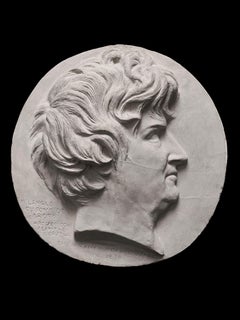
Eustace-Hyacinthe Langlois, called Langlois de L
Arche
Located in London, GB
Plaster
480 mm; 19 inches diameter
Inscribed: ‘H. Langlois du Pont de l’Arche Archeologue Peintre Graveur
par son ami P. J. David (D Angers) 1838’
Collections:
Sotheby’s, 22nd May...
Category
19th Century Old Masters Figurative Sculptures
Materials
Plaster
Sir Charles Frederick
Located in London, GB
Oil on canvas
50 x 40 inches; 127 x 101.6 cm
Framed dimensions: 151.5 x 127 cm
Inscribed on plinth: ‘VOTIS X ET XX’
Painted c.1748
Collections:
Christie’s London, 23rd December 1...
Category
18th Century Old Masters Portrait Paintings
Materials
Canvas, Oil
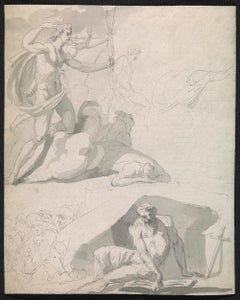
Eighteenth century Old Master drawing - Apollo destroying Niobe
s children
By John Hamilton Mortimer
Located in London, GB
Pen, ink and wash
Framed dimensions: 13 x 11 ¼ inches
Drawn c.1765
Verso: a study of a hanged man
Mortimer has filled this small sheet with action, depicting in the top right, Apollo and Artemis...
Category
18th Century Old Masters Figurative Drawings and Watercolors
Materials
Ink, Pen
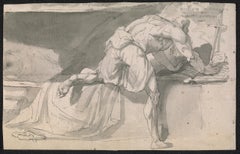
Eighteenth century Old Master drawing - St Jerome
By John Hamilton Mortimer
Located in London, GB
Pen, ink and wash
Framed dimensions: 9 ½ x 11 ¼ inches
Drawn c. 1763
This small, powerful study shows St Jerome contemplating the bible with a cross and sk...
Category
18th Century Old Masters Figurative Drawings and Watercolors
Materials
Ink, Pen
A young couple returning from the fields
Located in London, GB
Oil on panel
13 ⅜ x 9 ⅞ inches; 34 x 25 cm
Framed dimensions: 43.4 x 34.3 cm
c. 1730s
Collections:
James Brydges, Duke of Chandos;
Chandos sale, Christopher Cock, London, 8th Mar...
Category
18th Century Old Masters Figurative Paintings
Materials
Oil, Panel
You May Also Like
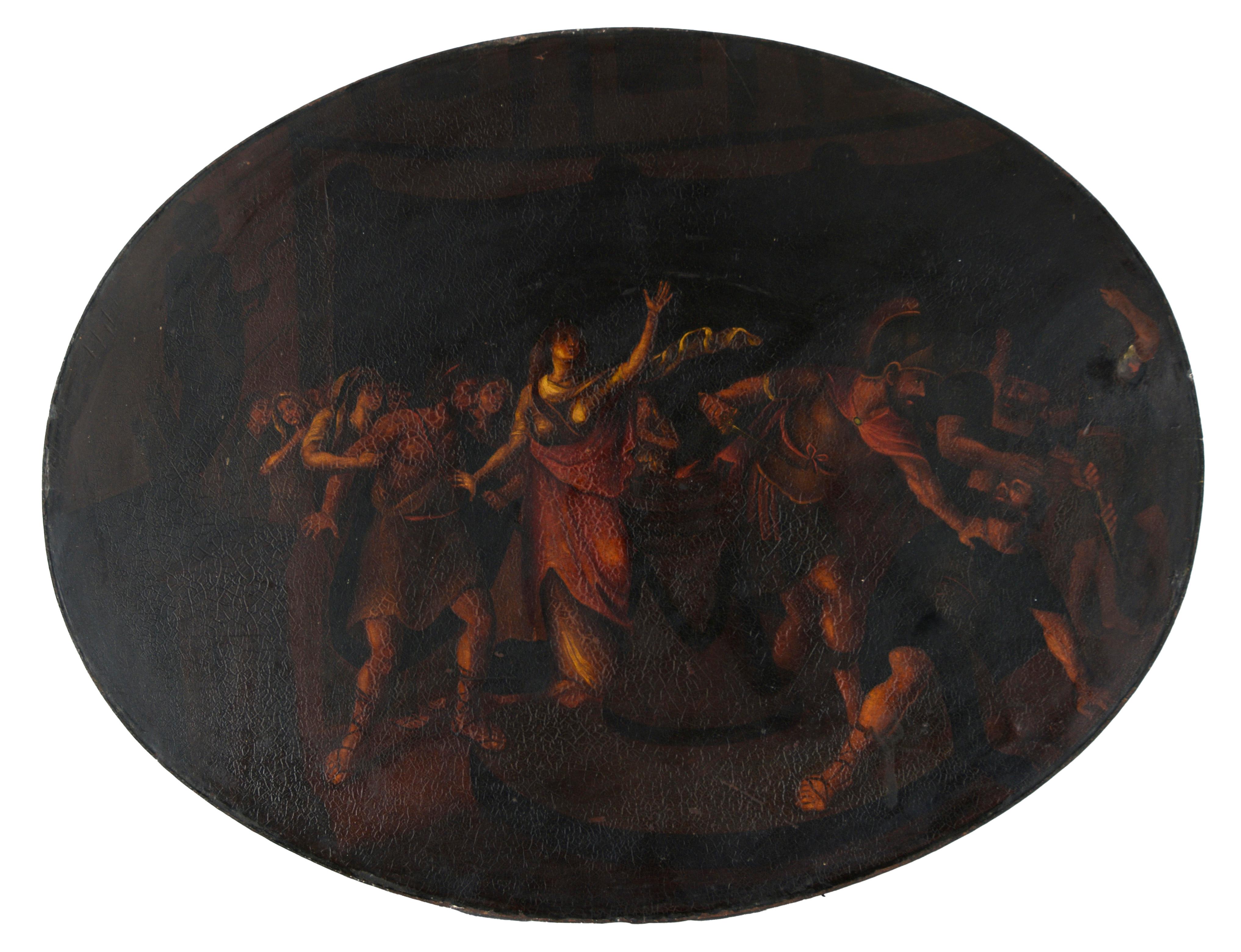
Greek Classical Scene of "Death of Agamemnon" Oil on metal
Located in Soquel, CA
Greek Classical Scene of "Death of Agamemnon" Oil on metal
Beautifully detailed oil painting with classical scene with romantic-esque brushwork and details by unknown artist. Painti...
Category
19th Century Romantic Figurative Paintings
Materials
Metal
$1,480 Sale Price
20% Off
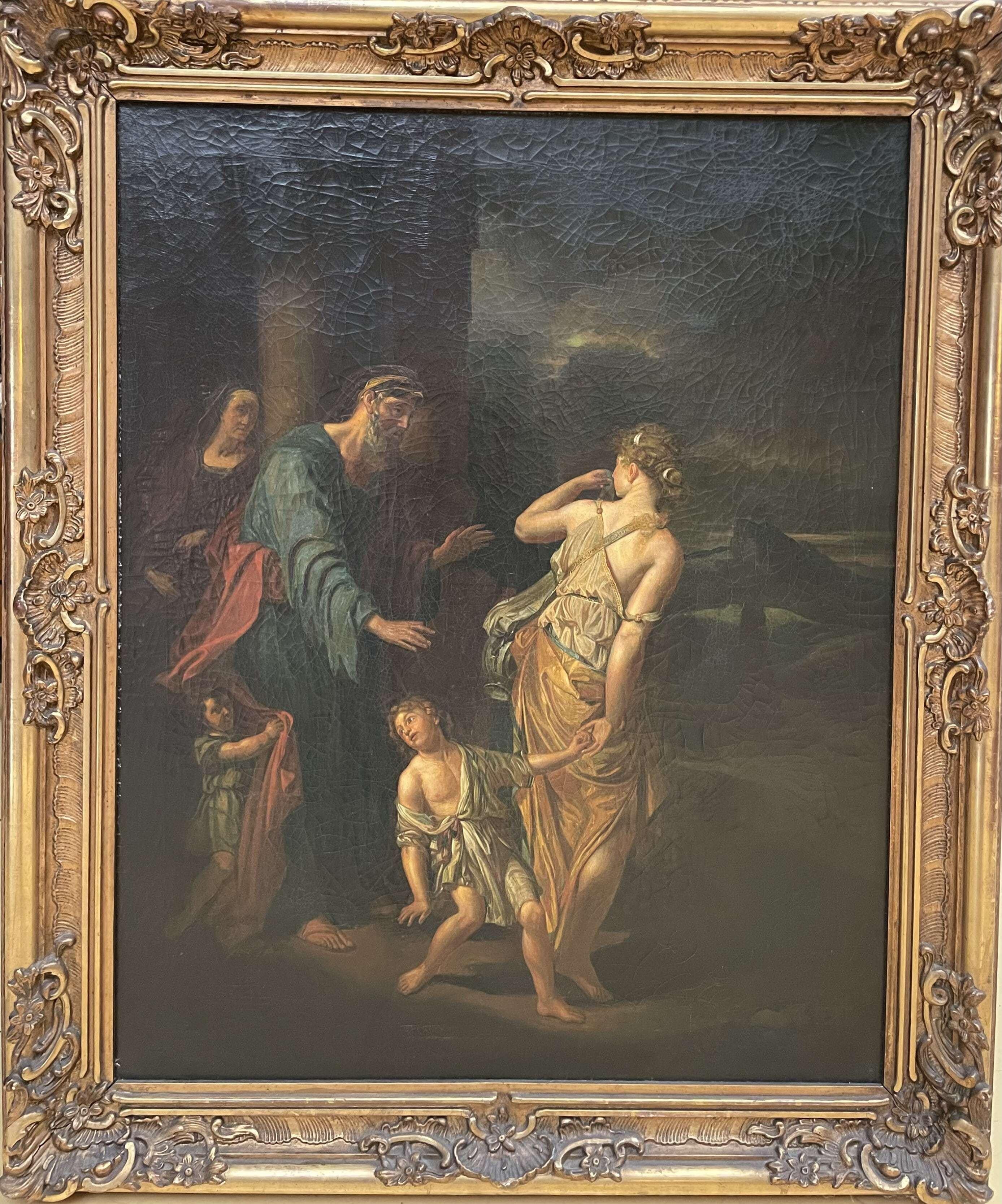
The Expulsion of Hagar and Ishmael
Located in Edinburgh, GB
Copy of artwork by Adriaen van der Werff "The Expulsion of Hagar and Ishmael"
Artist: Unidentified (18th Century)
Date: Circa 1760–1770
Medium: Oil on canvas
Dimensions:
Framed: 124...
Category
18th Century Rococo Figurative Paintings
Materials
Canvas, Oil
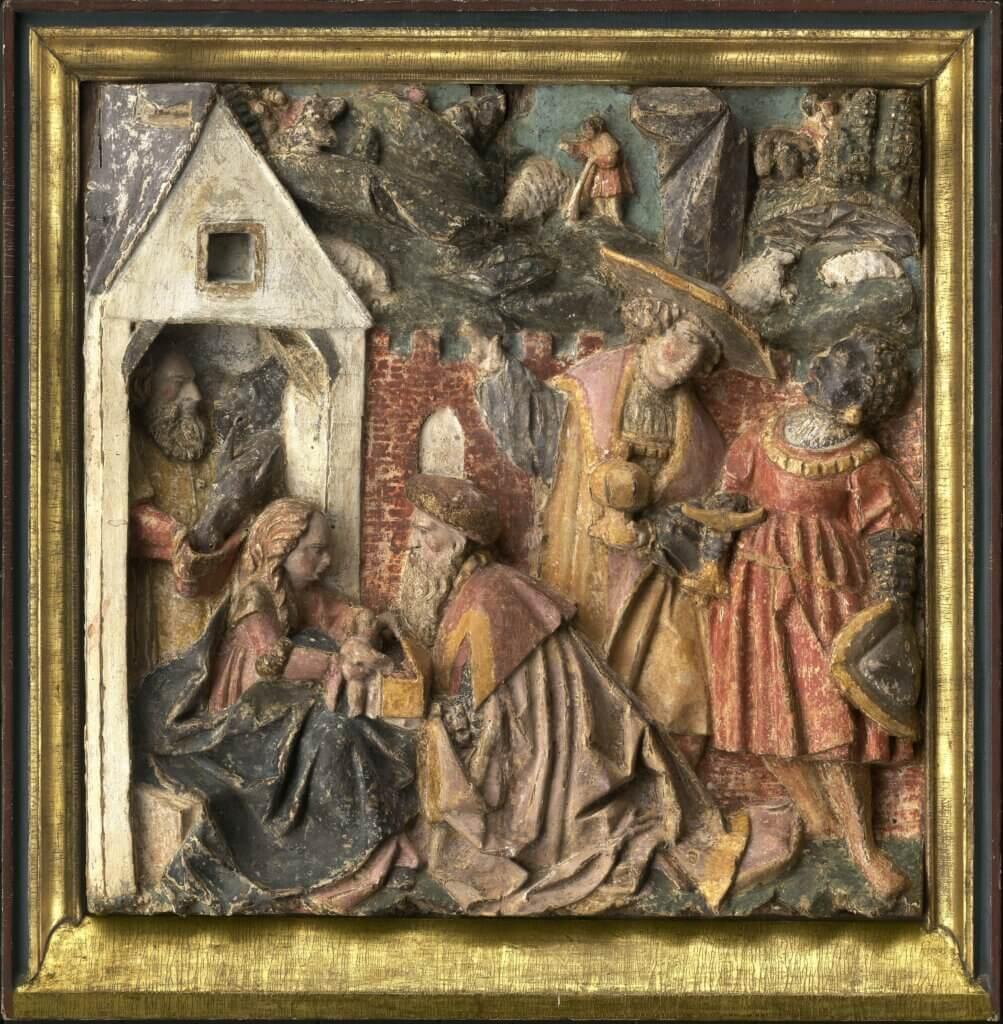
Late Gotic Relief "Adoration of the Magi"
Located in Wien, Wien
LATE GOTIC RELIEF “Adoration of the Magi
Lower Rhine
Around 1500
Oak wood, plastically carved
Original, polychrome version
Height 51 cm, widt...
Category
16th Century Gothic Figurative Sculptures
Materials
Wood, Oak
Oedipus leaves Thebes guided by Antigone
Located in Pasadena, CA
Oil on canvas attributed Rousseau-Decelle, French painter of the XIXth century.
Student of Bouguereau and Ferrier
In 1903, the artist whose studio is located at 235 rue du Faubourg ...
Category
1860s Romantic Figurative Paintings
Materials
Oil
$4,000 Sale Price
46% Off
The Sacrifice of Iphigenia
By Nicolas Beatrizet
Located in Roma, IT
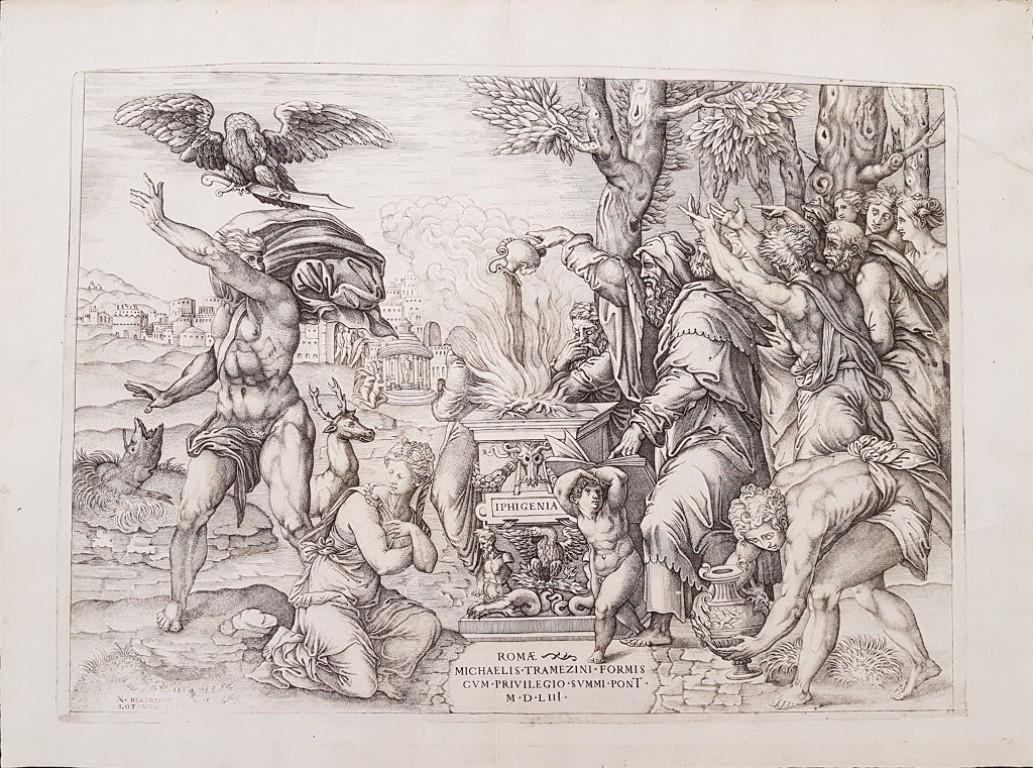
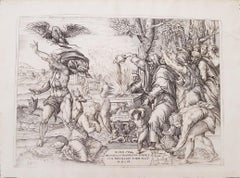
Black and white etching and drypoint on wire rod paper, representing the myth of the sacrifice of Iphigenia. On the altar is inscribed "Iphigenia" in capital letters. On the lower left margin is inscribed "N. Beatrizet Lo Taringus F.", slightly discolored (Beatrizet usually signed his plates with the letters "N. B. L. F."). At the center of the lower margin is inscribed "Romae, Michaelis Tramezini formis cum privilegio summi Pont. M.D.L.III".
After a drawing attributed to either Michelangelo Buonarroti, Salviati, or Baccio Bandinelli...
Category
16th Century Old Masters Figurative Prints
Materials
Drypoint, Etching
Bart and Homer Simpson in relief:
Sacrifice and Temple I
By Joshua Goode
Located in New York, NY
The most extraordinary relics discovered by Joshua Goode and the Aurora-Rhoman Institute of Archaeology and Cultural Relics during recent archaeological expeditions. The first eviden...
Category
2010s Contemporary Figurative Sculptures
Materials
Resin, Mixed Media