Want more images or videos?
Request additional images or videos from the seller
1 of 10
Yulla LipchitzWoman Dancing About Trees bronze sculpture by Yulla Lipchitzc.1973
c.1973
$12,500List Price
About the Item
- Creator:Yulla Lipchitz (1911 - 2003, German, American)
- Creation Year:c.1973
- Dimensions:Height: 20 in (50.8 cm)Width: 10 in (25.4 cm)Depth: 10.5 in (26.67 cm)
- Medium:
- Movement Style:
- Period:
- Condition:Very good condition, appropriate for the age of this artwork.
- Gallery Location:Hudson, NY
- Reference Number:Seller: LiYu0101stDibs: LU2465215091752
About the Seller
5.0
Vetted Professional Seller
Every seller passes strict standards for authenticity and reliability
Established in 1973
1stDibs seller since 2023
14 sales on 1stDibs
Authenticity Guarantee
In the unlikely event there’s an issue with an item’s authenticity, contact us within 1 year for a full refund. DetailsMoney-Back Guarantee
If your item is not as described, is damaged in transit, or does not arrive, contact us within 7 days for a full refund. Details24-Hour Cancellation
You have a 24-hour grace period in which to reconsider your purchase, with no questions asked.Vetted Professional Sellers
Our world-class sellers must adhere to strict standards for service and quality, maintaining the integrity of our listings.Price-Match Guarantee
If you find that a seller listed the same item for a lower price elsewhere, we’ll match it.Trusted Global Delivery
Our best-in-class carrier network provides specialized shipping options worldwide, including custom delivery.You May Also Like
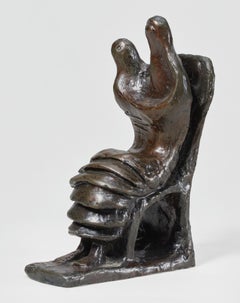
Mother and Child: Petal Skirt - Henry Moore, sculpture, modern, british, small
By Henry Moore
Located in London, GB
Henry Moore (1898-1986)
Mother and Child: Petal Skirt
conceived in 1955; cast in 1955
bronze; edition 4 of 6 plus 1 artist’s proof by the Fiorini foundry, London
19 x 9 x 15.5 cm (in...
Category
1950s Modern Figurative Sculptures
Materials
Bronze
$98,000
H 7.49 in W 3.55 in D 6.11 in
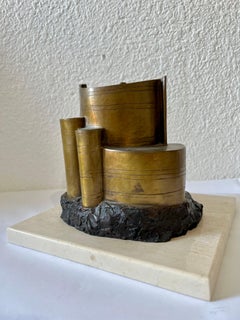
Bronze Abstract Space Age Book Sculpture LA California Modernist Charna Rickey
By Charna Rickey
Located in Surfside, FL
Charna Rickey 1923 - 2000 Mexican-American Jewish Woman artist.
Signed Bronze House of Books, Architecture Bronze sculpture, signed Charna Rickey and on the front "House of the book." It depicts an open Torah. Original patina.
Approx. dimensions: 7 in. H x 9 in. W x 8.5 in. D. Weight: 13.1 lbs.
Modernist Judaica Sculpture
Born Charna Barsky (Charna Ysabel or Isabel Rickey Barsky) in Chihuahua, Mexico, the future artist lived in Hermosillo and immigrated to Los Angeles when she was 11. She was educated at UCLA and Cal State L.A., she married furniture retailer David Rickey and explored art while raising their three daughters. Moving through phases in terra cotta, bronze, marble and aluminum, she found success later in life. Rickey became one of the original art teachers at Everywoman's Village, a pioneering learning center for women established by three housewives in Van Nuys in 1963. She also taught sculpture at the University of Judaism from 1965 to 1981.
As Rickey became more successful, her sculptures were exhibited in such venues as Artspace Gallery in Woodland Hills and the Courtyard of Century Plaza Towers as part of a 1989 Sculpture Walk produced by the Los Angeles Arts Council. Her sculptures have also found their way into the private collections of such celebrities as Sharon Stone.
Another of Rickey's international creations originally stood at Santa Monica College. In 1985, her 12-foot-high musical sculpture shaped like the Hebrew letter "shin" was moved to the Rubin Academy of Music and Dance at Hebrew University in Jerusalem. The free standing architectural Judaic aluminum work has strings that vibrate in the wind to produce sounds. Rickey also created art pieces for the city of Brea. They commissioned some amazing art pieces by Laddie John Dill, Walter Dusenbery, Woods Davy, Rod Kagan, Pol Bury, Niki de Saint Phalle, Magdalena Abakanowicz, Larry Bell, John Okulick...
Category
20th Century American Modern Abstract Sculptures
Materials
Marble, Bronze
$2,200
H 7 in W 9 in D 8.5 in
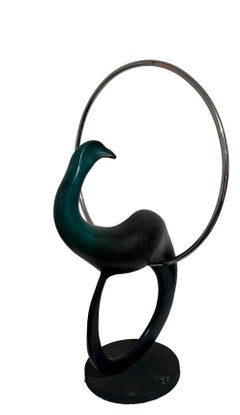
Large Bronze Modernist Biomorphic Sculpture Abstract Bird Colin Webster Watson
Located in Surfside, FL
Colin Webster Watson (1926-2007).
A patinated cast bronze sculpture of a stylized bird with a steel ring.
Signed, numbered and dated (1985). With a Tallix foundry mark.
Measu...
Category
1970s Modern Abstract Sculptures
Materials
Bronze, Stainless Steel
$8,500
H 30.5 in W 16 in D 18 in
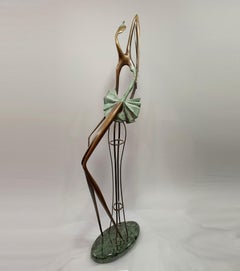
Ballerina on a chair
Located in Zofingen, AG
Sculpture from the Ballet series. The series is dedicated to classical ballet and includes over 30 sculptures. This sculpture depicts a dancer tying p...
Category
Early 2000s Modern Figurative Sculptures
Materials
Marble, Metal, Bronze
Brutalist Modern Abstract Bronze Sculpture Metropolis Manner of Louise Nevelson
By Abbott Pattison
Located in Surfside, FL
A very heavy, massive bronze sculpture by an important Chicago sculptor. Signed and marked "Firenze" with "Fuse Marinelli". METROPOLIS. Seven abstract shapes on black marble base. 1...
Category
20th Century Modern Abstract Sculptures
Materials
Marble, Bronze
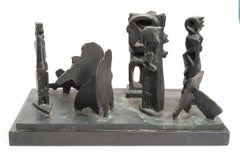
$7,500
H 12.5 in W 22.75 in D 12.5 in
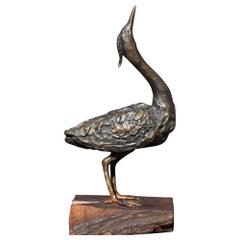
Bronze Heron Sculpture by Wayne F Williams
Located in Rochester, NY
Bronze heron by American sculptor Wayne Williams. Signed and dated 1993. Edition 2/2. Mounted on a walnut base.
From Finger Lakes Magazine 2001:
Art is everywhere in the Finger Lakes. Inspired by the region’s diverse scenery and lifestyles, artists pursue their creativity outdoors, in studios and in workshops. In the many well-established museums and galleries or at the newer fledgling arts organizations, a wide array of artistic styles and talents are represented. Often the artists, like Wayne Williams, share their artistic skill and passion through teaching at local colleges.
Williams, who is retired after a 35-year career at Finger Lakes Community College, found his calling there. “I didn’t want to teach in public schools,” explains Williams of his career choice. “I wanted to be at the college level. CCFL (the Community College of the Finger Lakes, as it was then known) was literally creating a college, right from scratch.” The year was 1968 and Williams was charged with coordinating the new college’s art program.
Rand Darrow, a CCFL student in that first year, remembers attending Williams’ art classes in a commercial building on Main Street just south of the railroad tracks in Canandaigua. Darrow appreciated his instructor’s relaxed manner. “He was a great teacher,” recalls Darrow, “cracking jokes all the time.” Darrow graduated with a major in Liberal Arts and continued on to SUNY Oswego where he earned a BA in fine arts. He taught art to elementary and middle school students for 30 years.
These days Williams and Darrow typically cross paths at the Wayne County Arts Council in Newark where Williams and his wife, Marleen, are heavily involved. Williams offers classes in figure drawing and sculpture and hangs the gallery’s shows, including his former student’s “Slavic Tales of Novgorod” this past August. “I’d like to take a sculpture class from him,” says Darrow.
In 2003 when Williams retired, the college honored him and another retiring art professor, Tom Insalaco, by renaming its art gallery the Williams-Insalaco Art Gallery. It was known formerly as Gallery 34 to recognize its origins at 34 North Main Street in Canandaigua. Williams held professor’s rank from 1976 and served as director of the art gallery beginning with its opening in 1983.
Williams, who was born and raised in Newark, New York, says he began doing art at about age 8. By the time he was in junior high school his career direction seemed clear. He received local and national awards for his art and a scholarship to Syracuse University, from which he graduated in 1958 with a Bachelor of Fine Arts in sculpture. He continued with graduate work at Syracuse, receiving an MFA in sculpture in 1962. He worked full time as a sculptor until he began teaching.
At one point Williams admits he wanted to be a painter, but didn’t want to adopt the abstract expressionist style in vogue in the 1950s, preferring to pursue the realist tradition. He advises any would-be artist to “do what you do because you love it.”
After graduation he traveled abroad, spending time in Belgium, the land of his ancestors. “My family’s name was originally Willems,” explains the 73-year old who still relishes the time spent in the Flemish countryside. Williams speaks excitedly about art, referencing the lives of great artists. He acknowledges that American artists do not have the same stature as those in Europe, where Old Masters like Brueghel and Rembrandt are national heroes.
These days the energetic Williams, known primarily as a sculptor, is active at the Phelps Arts Center where he is on the board of directors. In mid-September when a group of visitors on a motor coach tour explored artworks displayed in the beautiful church-turned- gallery, they were treated to a large number of Williams’ bronze and metal sculptures, along with his charcoal drawings. “I’ve always loved his work because he deals with things, people, and animals you understand,” says the center’s Director Emeritus Marion Donnelly, who has known him for many years.
Outside the Phelps Community Historical Society, Williams’ life-size figure of a farmer raises his pitchfork above a colorful flower garden on the front lawn. Inspired by the peasants working the fields in Europe, the metal figure is shown with wooden shoes. This is Williams’ largest copper piece, loaned to the Phelps museum in connection with Artistry in Sculpture, a community exhibition in 2009. Williams added a new base using a metal wagon...
Category
20th Century Modern Figurative Sculptures
Materials
Bronze
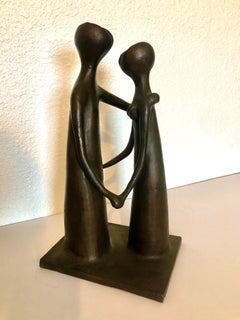
Israeli Bronze Sculpture Lovers Embrace Abstract Modernist Ein Hod Israel
By Gedalia Ben Zvi
Located in Surfside, FL
Bronze sculpture signed in Hebrew and numbered from small edition of 6
BIOGRAPHY
"I was born in Czechoslovakia in the year 1925, of traditional parents. I spent my youth partly in ...
Category
Mid-20th Century Modern Figurative Sculptures
Materials
Bronze
$1,800
H 17 in W 10 in D 8.5 in
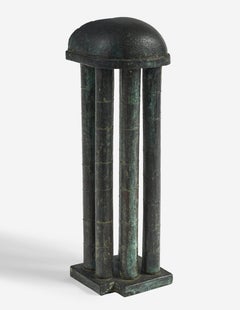
Bronze Architectural Model Sculpture Tempio Bretton Architecture Maquette
Located in Surfside, FL
TEMPIO BRETTON: from the catalogue MONUMENTA, 19th International Sculpture Biennale, Antwerp, Belgium.
Tempio Bretton was created in homage to the celebrated English landscapist Capability Brown for the occasion of an exhibition at Bretton Hall in the Yorkshire Sculpture Park , a park in the style of the great master of English garden design. The inclusion in the English garden of a temple ruin, or "eye-catcher," (architectural folly) was used to draw the eye and mind to a focus in time and space, present the beholder with an immediate relationship to an historic past made new within his or her own surroundings, and create a depth of space never before seen in garden design.
I took the idea of the temple ruin eye-catcher and reduced it to a scale at the point where architecture and sculpture merged. Tempio Bretton is not capacious enough to walk into, yet it is considerably larger than a man.
One view of it presents a knot of golden columns clustered together, topped by a dome shape. The only clue from this side to the temple's non-conformity to historic principle is a sharp notch cut into the square base.
Viewed from the opposite side, the cluster of columns capped by an angular top opens up as if to welcome someone in, yet the mysterious core is still impenetrable. These contradictions articulate a confrontation between past and present, and an exciting truth. The past is always at the heart of our constructions in the present.
Walter Dusenbery (born September 21, 1939 in Alameda, California) is an American sculptor. He attended the San Francisco Art Institute, earned an MFA from California College of Arts and Crafts, and then studied in Japan and Italy under Isamu Noguchi. He also held teaching positions at Harvard University and University of California, Berkeley Graduate School of Design. From 1971 to 1988, he lived both in Pietrasanta,Italy, and in Little Italy, New York City. Dusenbery's preferred material is stone, particularly travertine or granite. Dusenbery has a particular interest in adding sculpture to public places, such as federal buildings, to humanize the space, but in 1988, he assembled a show of small, entirely hand-carved alabaster sculptures, called "Walter Dusenbery, The Personal Side," at the Fendrick Gallery in Washington, D.C.. In 1977, Dusenbery created Pedogna, on permanent loan from The Metropolitan Museum of Art to Landmarks, the public art program of The University of Texas at Austin.
That same year, 1988, he was awarded a large commission for the Fulton County Building Atrium in Atlanta, Georgia. The commission was for three fountains and related structures over three stories in height, designed for informal and ceremonial public events, Limestone, marble, granite and travertine fountains, pavilions, seating and meeting areas, performance and concert platforms, staircases and planters for hanging gardens. After completion of the "Atlantacropolis," Dusenbery withdrew from the gallery world and focused his energy on site-specific commissions. (like the landscape works of Maya Lin and Beverly Pepper) Seeking a large-scale stone studio for projects closer to home, he discovered there were none. In 1995, he approached sculptor and patron of sculpture J. Seward Johnson Jr. with the idea of creating a state-of-the-art stone-carving studio, so that American sculptors would not have to travel abroad to realize their work. Johnson agreed to fund such a facility, if Dusenbery would direct it. In 1996, Dusenbery designed the facility for the Stone Division at Johnson Atelier Technical Institute of Sculpture, and was its first director. The facility was situated in "a building resembling an airplane hangar," The studio offered the ability to digitally scan three-dimensional forms. The Stone Division was a success and attracted a strong group of sculptors: Magdalena Abakanowicz, Lawrence Argent, Barry X Ball...
Category
20th Century American Modern Abstract Sculptures
Materials
Bronze
$4,000
H 12.5 in W 3.5 in D 3.5 in
"Couple II" Mid 20th Century Modern Abstract Figurative 1940s European Sculpture
By Jacques Lipchitz
Located in New York, NY
"Couple II" Mid 20th Century Modern Abstract Figurative 1940s European Sculpture
Jacques Lipchitz (1891-1973)
"Couple II"
Bronze
signed on the base
The sculpture was conceived in 19...
Category
1940s Modern Figurative Sculptures
Materials
Bronze
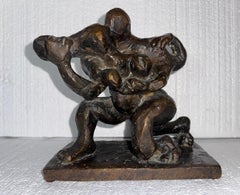
$75,000
H 8 in W 8 in D 5 in
Hattakitkosol Somchai Art Bronze Bird Sculpture, circa 1980
By Hattakitkosol Somchai
Located in Atlanta, GA
Soar into the realm of timeless artistry with this magnificent gilded bronze sculpture by celebrated Thai artist Hattakitkosol Somchai (1934–2000)—a commanding representation of a bi...
Category
1990s Modern Figurative Sculptures
Materials
Bronze

$1,700
H 16.94 in W 3.94 in D 4.75 in
More From This Seller
View AllWoman Lying Down
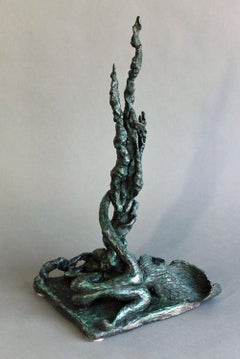
Growing with Tree bronze sculpture by Yulla Lipchitz
Located in Hudson, NY
Organic, abstract bronze sculpture by Yulla Lipchitz of a woman lying down with a tree.
About this artist: Yulla Lipchitz, née Halberstadt, was born on April 21, 1911 in Berlin, Ge...
Category
1970s Modern Figurative Sculptures
Materials
Bronze
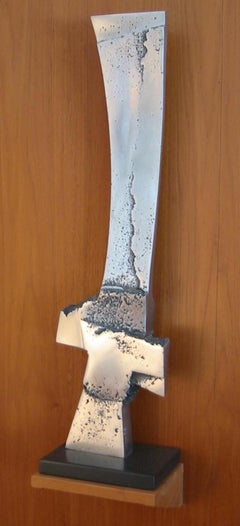
Ode to the Ancient Monarch aluminum sculpture by James C. Myford
Located in Hudson, NY
This work is aluminum on a black slate base, measuring 28.5" x 9" x 6".
Myford's interest in aluminum began in 1970 when he attended a workshop sponsored by Alcoa at the Art Center ...
Category
1970s Abstract Abstract Sculptures
Materials
Slate, Metal
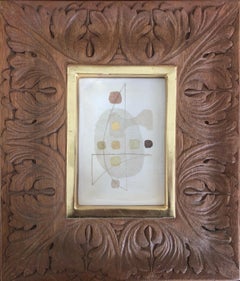
Untitled Abstraction with Gold by Annemarie Graupner
Located in Hudson, NY
Minimalist work by Annemarie Graupner, in a charming hand-carved wood frame. Perfect for an intimate nook.
About this artist: Swiss artist Annemarie Graupner, granddaughter of the S...
Category
20th Century Modern Abstract Drawings and Watercolors
Materials
Gold Leaf
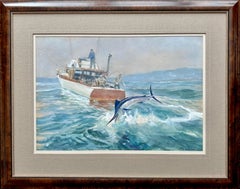
Leaping Marlin (with fisherman on the boat Islander) by John Whorf
By John Whorf
Located in Hudson, NY
John Whorf captures one of the thrilling moments of fishing in this watercolor – when the fish is on the line, but still trying to escape. One of the fastest fish in the world, marlin fishing...
Category
1950s American Modern Animal Drawings and Watercolors
Materials
Paper, Watercolor
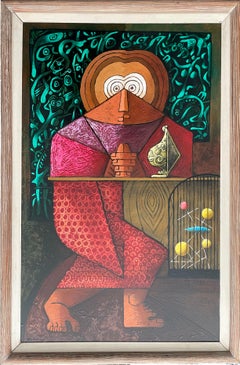
The Magician oil and tempera painting by Julio de Diego
By Julio de Diego
Located in Hudson, NY
Julio De Diego’s Atomic Series paintings made an extraordinary statement regarding the shock and fear that accompanied the dawn of the nuclear age. In the artist’s own words, “Scientists were working secretly to develop formidable powers taken from the mysterious depths of the earth - with the power to make the earth useless! Then, the EXPLOSION! . . . we entered the Atomic Age, and from there the neo-Atomic war begins. Explosions fell everywhere and man kept on fighting, discovering he could fight without flesh.”
To execute these works, De Diego developed a technique of using tempera underpainting before applying layer upon layer of pigmented oil glazes. The result is paintings with surfaces which were described as “bonelike” in quality. The forms seem to float freely, creating a three-dimensional visual effect. In the 1954 book The Modern Renaissance in American Art, author Ralph Pearson summarizes the series as “a fantastic interpretation of a weighty theme. Perhaps it is well to let fantasy and irony appear to lighten the devastating impact. By inverse action, they may in fact increase its weight.”
Exhibited
1964 Marion Koogler McNay Art Institute, San Antonio, Texas
This work retains its original frame which measures 54" x 42" x 2"
About this artist: Julio De Diego crafted a formidable persona within the artistic developments and political struggles of his time. The artist characterized his own work as “lyrical,” explaining, “through the years, the surrealists, the social-conscious painters and the others tried to adopt me, but I went my own way, good, bad or indifferent.” [1] His independence manifested early in life when de Diego left his parent’s home in Madrid, Spain, in adolescence following his father’s attempts to curtail his artistic aspirations. At the age of fifteen he held his first exhibition, set up within a gambling casino. He managed to acquire an apprenticeship in a studio producing scenery for Madrid’s operas, but moved from behind the curtains to the stage, trying his hand at acting and performing as an extra in the Ballet Russes’ Petrouchka with Nijinsky. He spent several years in the Spanish army, including a six-month stretch in the Rif War of 1920 in Northern Africa. His artistic career pushed ahead as he set off for Paris and became familiar with modernism’s forays into abstraction, surrealism, and cubism.
The artist arrived in the U.S. in 1924 and settled in Chicago two years later. He established himself with a commission for the decoration of two chapels in St. Gregory’s Church. He also worked in fashion illustration, designed magazine covers and developed a popular laundry bag for the Hotel Sherman. De Diego began exhibiting through the Art Institute of Chicago in 1929, and participated in the annual Chicago Artists Exhibitions, Annual American Exhibitions, and International Water Color Exhibitions. He held a solo exhibition at the Art Institute of Chicago in the summer of 1935. Though the artist’s career was advancing, his family life had deteriorated. In 1932 his first marriage dissolved, and the couple’s young daughter Kiriki was sent to live with friend Paul Hoffman.
De Diego continued to develop his artistic vocabulary with a growing interest in Mexican art. He traveled throughout the country acquainting himself with the works of muralists such as Carlos Merida, and also began a collection of small native artifacts...
Category
1940s American Modern Abstract Paintings
Materials
Masonite, Oil, Tempera
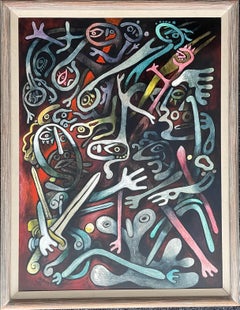
St. Atomic oil and tempera painting by Julio de Diego
By Julio de Diego
Located in Hudson, NY
Julio De Diego’s Atomic Series paintings made an extraordinary statement regarding the shock and fear that accompanied the dawn of the nuclear age. In the artist’s own words, “Scientists were working secretly to develop formidable powers taken from the mysterious depths of the earth - with the power to make the earth useless! Then, the EXPLOSION! . . . we entered the Atomic Age, and from there the neo-Atomic war begins. Explosions fell everywhere and man kept on fighting, discovering he could fight without flesh.”
To execute these works, De Diego developed a technique of using tempera underpainting before applying layer upon layer of pigmented oil glazes. The result is paintings with surfaces which were described as “bonelike” in quality. The forms seem to float freely, creating a three-dimensional visual effect. In the 1954 book The Modern Renaissance in American Art, author Ralph Pearson summarizes the series as “a fantastic interpretation of a weighty theme. Perhaps it is well to let fantasy and irony appear to lighten the devastating impact. By inverse action, they may in fact increase its weight.”
Exhibited
1950 University of Illinois at Urbana "Contemporary American Painting"
1964 Marion Koogler McNay Art Institute, San Antonio, Texas
This work retains its original frame which measures 54" x 36" x 2".
About this artist: Julio De Diego crafted a formidable persona within the artistic developments and political struggles of his time. The artist characterized his own work as “lyrical,” explaining, “through the years, the surrealists, the social-conscious painters and the others tried to adopt me, but I went my own way, good, bad or indifferent.” [1] His independence manifested early in life when de Diego left his parent’s home in Madrid, Spain, in adolescence following his father’s attempts to curtail his artistic aspirations. At the age of fifteen he held his first exhibition, set up within a gambling casino. He managed to acquire an apprenticeship in a studio producing scenery for Madrid’s operas, but moved from behind the curtains to the stage, trying his hand at acting and performing as an extra in the Ballet Russes’ Petrouchka with Nijinsky. He spent several years in the Spanish army, including a six-month stretch in the Rif War of 1920 in Northern Africa. His artistic career pushed ahead as he set off for Paris and became familiar with modernism’s forays into abstraction, surrealism, and cubism.
The artist arrived in the U.S. in 1924 and settled in Chicago two years later. He established himself with a commission for the decoration of two chapels in St. Gregory’s Church. He also worked in fashion illustration, designed magazine covers and developed a popular laundry bag for the Hotel Sherman. De Diego began exhibiting through the Art Institute of Chicago in 1929, and participated in the annual Chicago Artists Exhibitions, Annual American Exhibitions, and International Water Color Exhibitions. He held a solo exhibition at the Art Institute of Chicago in the summer of 1935. Though the artist’s career was advancing, his family life had deteriorated. In 1932 his first marriage dissolved, and the couple’s young daughter Kiriki was sent to live with friend Paul Hoffman.
De Diego continued to develop his artistic vocabulary with a growing interest in Mexican art. He traveled throughout the country acquainting himself with the works of muralists such as Carlos Merida, and also began a collection of small native artifacts...
Category
1940s American Modern Abstract Paintings
Materials
Masonite, Oil, Tempera
Still Thinking About These?
All Recently ViewedMore Ways To Browse
Bronze Sculpture Tree
Woman Dancer Sculpture
Bronze Woman Dancing Sculpture
Itzhak Ofer
J Pena
Jack Rabbit Sculpture
Jade Jaguar
Jane Dedecker Old Man
Japanese Temple Guardians
Johann Von Schwarz
Joseph Freelander
Josse Francois Joseph Leriche
Julien Marinetti
Karen Ehart
Kevin Cranmer
Kiawak Ashoona
Kota Reliquary Figure
Lapin Bijou Sandoz