Want more images or videos?
Request additional images or videos from the seller
1 of 14
Charles DespiauBacchantecirca 1930
circa 1930
$31,976.63
£23,882.32
€27,000
CA$44,407.51
A$47,682.56
CHF 25,657.09
MX$564,276.49
NOK 323,232.56
SEK 294,806.14
DKK 205,772.65
About the Item
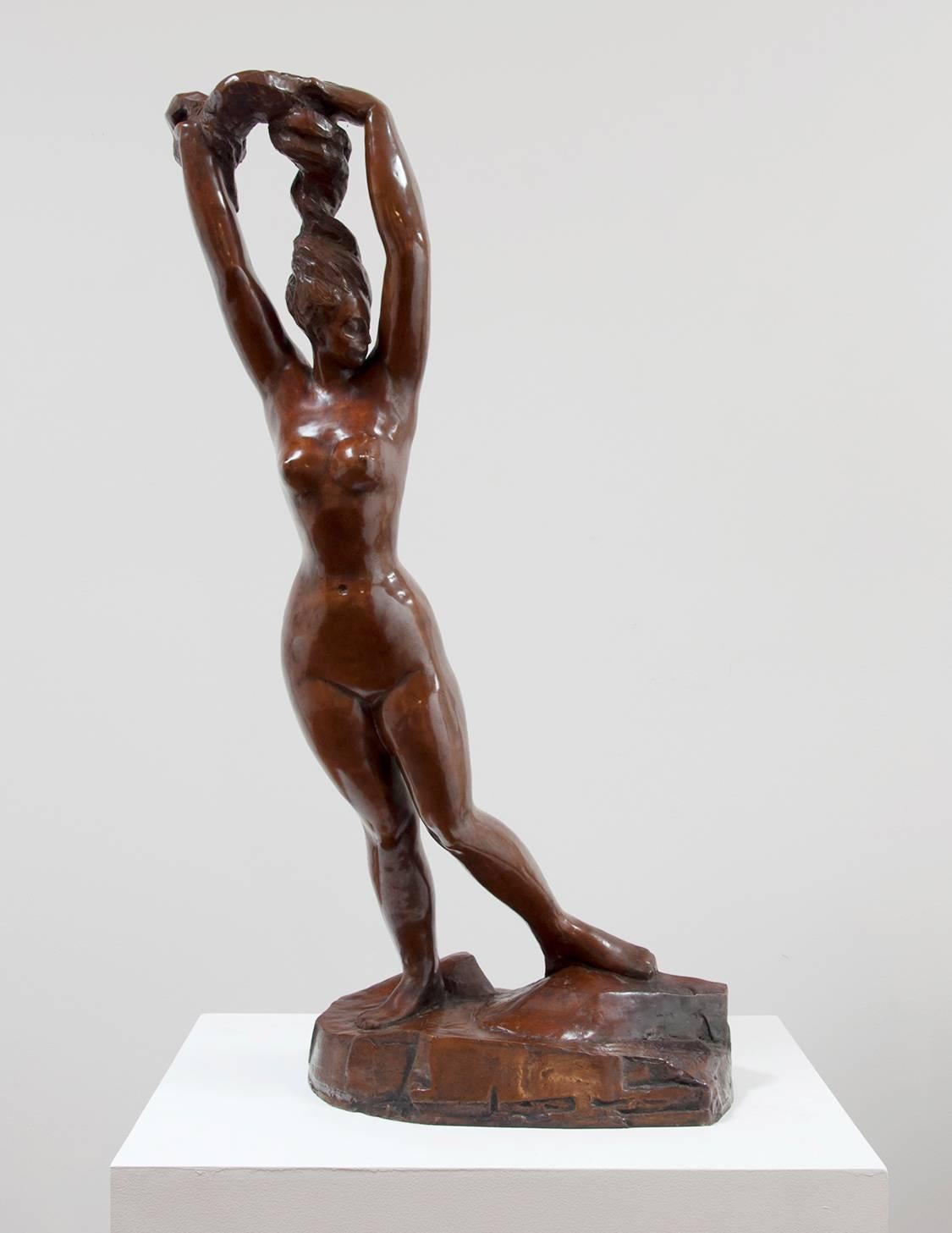
Bacchante
by Charles DESPIAU (1874-1946)
Sculpture in bronze with nuanced dark brown patina
Signed at the back "C. Despiau"
Cast by Alexis RUDIER
France
Vers 1930
Height 23 cm
Width 18 cm
Depth 13 cm
The plaster model of "Bacchante" was exhibited in 1909 at the Salon of the Société Nationale des Beaux-Arts.
Charles Despiau produced several variants of this work, including the one presented here.
Among other known versions, there is one cast with the right leg cut off, four casts with the torso alone and eight casts with the raised leg (1929).
Bibliography :
"Charles Albert Despiau", Collections du musée municipal de Mont-de-Marsan, 1982, p.20.
"Despiau vivant, l'homme et l'œuvre", W. George, Ed. Paul Dupont, Clichy, 1947, pl.XIX.
"Charles Despiau, sculptures et dessins", Exposition au Musée Rodin, Paris, 1974, p.20.
Biography :
Charles Despiau (1874-1946) was a French sculptor. He was essentially a portrait sculptor with an archaic style spirit and simplified features. He was considered one of the greatest sculptors of the interwar period. Son and grandson of master plasterers, student at Mont-de-Marsan, Charles Despiau was noticed by his drawing teacher, Louis Henri Ismaël Morin, of whom he kept a grateful memory. He moved to Paris in 1891, provided with a scholarship from the Landes department, and entered the National School of Decorative Arts where he was taught by Hector Lemaire, then at the School of Fine Arts in the studio of the sculptor Louis-Ernest Barrias, where he learned direct carving. He started at the Salon in 1898 where he was noticed.
In 1901, Charles Despiau was admitted to the National Society of Fine Arts, of which he was named a member in 1904, the year he presented his sculpture "Little girl from the Landes". Despiau joined the “Bande à Schnegg”, a group of sculptors who had all been a practitioner of Auguste Rodin at one time or another. This group of friends was nicknamed “La bande à Rodin” by Camille Claudel. Lucien Schnegg, Gaston Schnegg's brother, was the driving force, along with Antoine Bourdelle, Robert Wlérick, Léon-Ernest Drivier, François Pompon, Louis Dejean, Alfred Jean Halou, Charles Malfray, Auguste de Niederhausern, Élisée Cavaillon, Henry Arnold, Jane Poupelet, Yvonne Serruys, etc. Their works testified to their influence on modern sculpture, against the lyricism of Rodin and, above all, the academicism in place.
In 1907, Auguste Rodin asked Despiau to work with him after seeing his sculpture "Paulette" (exhibited at the Salon of 1910). Charles Despiau then began his activity as a practitioner which lasted until 1914, the year of his mobilization. He was then forced to abandon the carving in marble of the "Genius of Eternal Rest" entrusted to him by Rodin, intended for the commemorative monument to the painter Pierre Puvis de Chavannes. Demobilized after the war and Rodin having died in 1917, Despiau refused to finish the marble of the "Genius", Rodin no longer being there to supervise it.
Despiau became a professor at the Académie de la Grande Chaumière, the free academy founded by Antoine Bourdelle. In 1923, Despiau was a co-founding member of the Salon des Tuileries. He experienced his first commercial successes in 1927. The major private exhibition organized in New York at the Brummer gallery in 1927, on the initiative of the Barbazanges gallery, finally brought him fame and fortune, and made him a recognized sculptor in the United States. United, then, indirectly, in Europe.
Despiau met Arno Breker who came to work in Paris between 1926 and 1932 in Maillol's studio. Despiau always marked his friendship and his admiration for the German sculptor. In 1937, he received the order for a colossal statue six meters high, "Apollon", intended for the forecourt of the Museum of Modern Art of the city of Paris for the Universal Exhibition of 1937, where Despiau was included on the committee of selection of works, and exhibited fifty-two sculptures at the Petit Palais in a room dedicated to him. This figure of Apollo occupied Despiau so much that he never delivered it to the city. He worked on this subject until the end of his life.
- Creator:Charles Despiau (1874-1946, French)
- Creation Year:circa 1930
- Dimensions:Height: 9.06 in (23 cm)Width: 7.09 in (18 cm)Depth: 5.12 in (13 cm)
- Medium:
- Movement Style:
- Period:
- Condition:
- Gallery Location:PARIS, FR
- Reference Number:Seller: N.77401stDibs: LU2514215238672
About the Seller
5.0
Recognized Seller
These prestigious sellers are industry leaders and represent the highest echelon for item quality and design.
Established in 1992
1stDibs seller since 2023
11 sales on 1stDibs
Typical response time: 23 hours
- ShippingRetrieving quote...Shipping from: PARIS, France
- Return Policy
More From This Seller
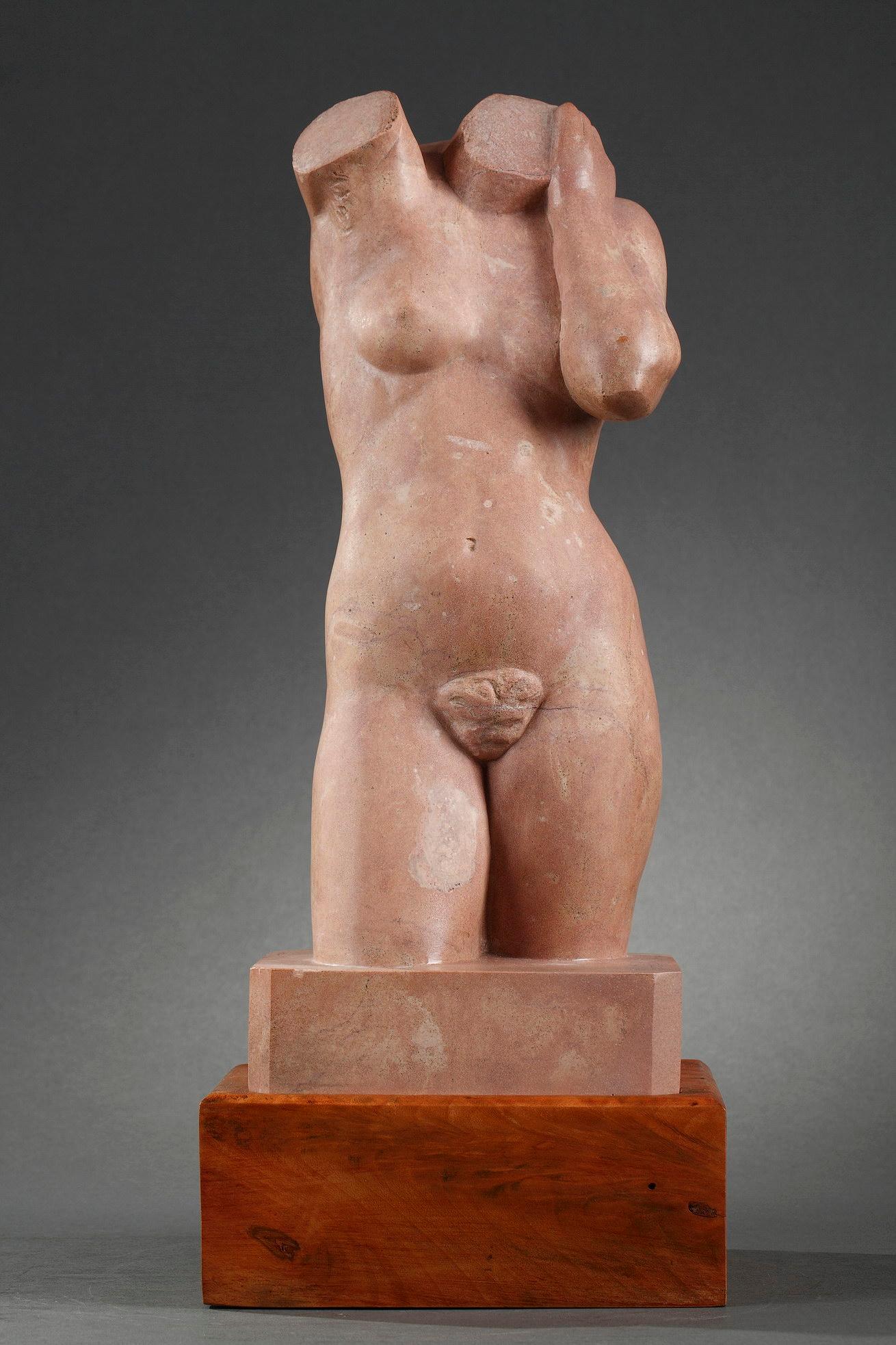
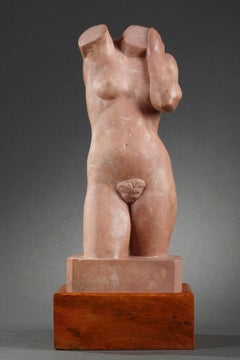
View AllTorso of a woman
Located in PARIS, FR
Torso of a woman
by Auguste HENG (1891-1968)
Sculpture in pink marble stone
Signed on the base " A. Heng "
Presented on an olive-wood base
France
circa 1925
height 34,5 cm
height ...
Category
1920s Art Deco Nude Sculptures
Materials
Stone
Desperate
By Aimé-Jules Dalou
Located in PARIS, FR
Desperate
by Jules DALOU (1838-1902)
A bronze sculpture with a nuanced dark brownish-green patina
Signed on the base " Dalou "
Cast by " Susse Frères Editeurs Paris " (with the fou...
Category
Late 19th Century French School Nude Sculptures
Materials
Bronze
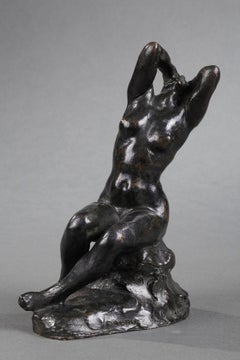
$10,658
Pandora
s Secret
Located in PARIS, FR
Pandora's Secret
by Maurice BOUVAL (1863-1916)
Sculpture made in bronze with a nuanced dual patina, light –and dark brown
signed on the base " M. Bouval "
old edition cast
presente...
Category
Early 1900s Art Nouveau Nude Sculptures
Materials
Bronze

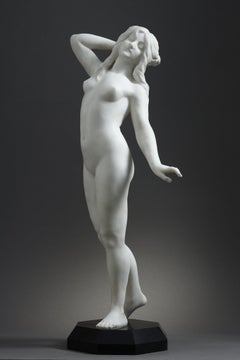
Dawn
Located in PARIS, FR
"Dawn"
by Dominique ALONZO (Early 20th c.)
Sculpture made in white Carrara marble
standing on a black marble base
signed on the base "Alonzo"
France
around 1920
height 83 cm
width...
Category
Early 20th Century Art Nouveau Nude Sculptures
Materials
Marble
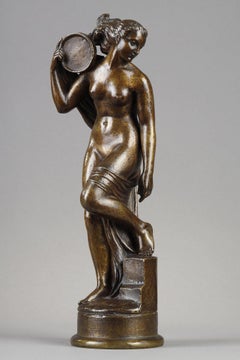
Terpsichore, Muse of Dance
Located in PARIS, FR
Terpsichore, Muse of Dance
by Pierre-Marie POISSON (1876-1953)
Sculpture with a dark old gold patina
signed on the base "P. Poisson"
Cast by Bisceglia (with the foundry stamp)
Fra...
Category
1920s French School Nude Sculptures
Materials
Bronze
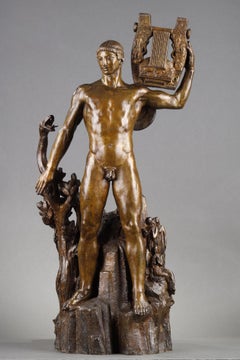
Apollo
By Henri Bouchard
Located in PARIS, FR
"Apollo" by Henri Bouchard (1875-1960)
An Art Deco period masterpiece!
Exceptional bronze sculpture with a golden-brown patina
Signed " H. Bouchard "
Unique piece
This work personifies Apollo, god of the Arts. Represented here as Apollo Musagète, leader of the procession of muses and winner of the serpent Python.
This subject was commissioned to adorn the entrance to the Palais de Chaillot in Paris, and whose monumental bronze is still exhibited there.
To participate in the Venice Biennale in 1938, Henri Bouchard had reduced in 1937 the large Apollo of the Palais de Chaillot, which had not yet been installed.
Vintage cast by Bisceglia (cast founder stamp) made during the artist's lifetime.
Incised dedication below signature : " à mon cher ami E. Sandoz "
This is a unique cast made for the sculptor Edouard-Marcel Sandoz (1881-1971).
This cast was exhibited at the 1938 Venice Biennale.
France
1937
height : 82 cm
width : 45 cm
depth : 30 cm
weight : 31,2 kgs
Stickers under the bronze cast :
- Sticker mentioning that this cast has been exhibited at the Venice Biennale of 1938 under the number 354 ("Biennale Internaz. d'Arte Venezia – 1938 – XVI – 354").
- Sticker mentioning that this cast went through Italian customs ("ne – merci – dogana italiana – visitate - 9622")
- Damaged Sticker mentioning the name ("A…") and the address ("25…") of the owner of the cast (maybe for the workshop "Atelier Henri Bouchard", 25 rue d’Yvettes, 75016 Paris).
Provenance :
- Edouard-Marcel Sandoz, Paris, according to the dedication.
- Property from the Collection of Seymour Stein (entrepreneur and founder of Sire Records, famous American record label ; and avid collector of 19th and 20th century fine art...
Category
1930s Art Deco Figurative Sculptures
Materials
Bronze
$198,965
You May Also Like
Nude
By Morgan Russell
Located in Dallas, TX
signed "1938-42 Morgan Russell" with monogram on base
cast circa 1982 with permission of the Estate of Morgan Russell
Category
Mid-20th Century Modern Figurative Sculptures
Materials
Bronze
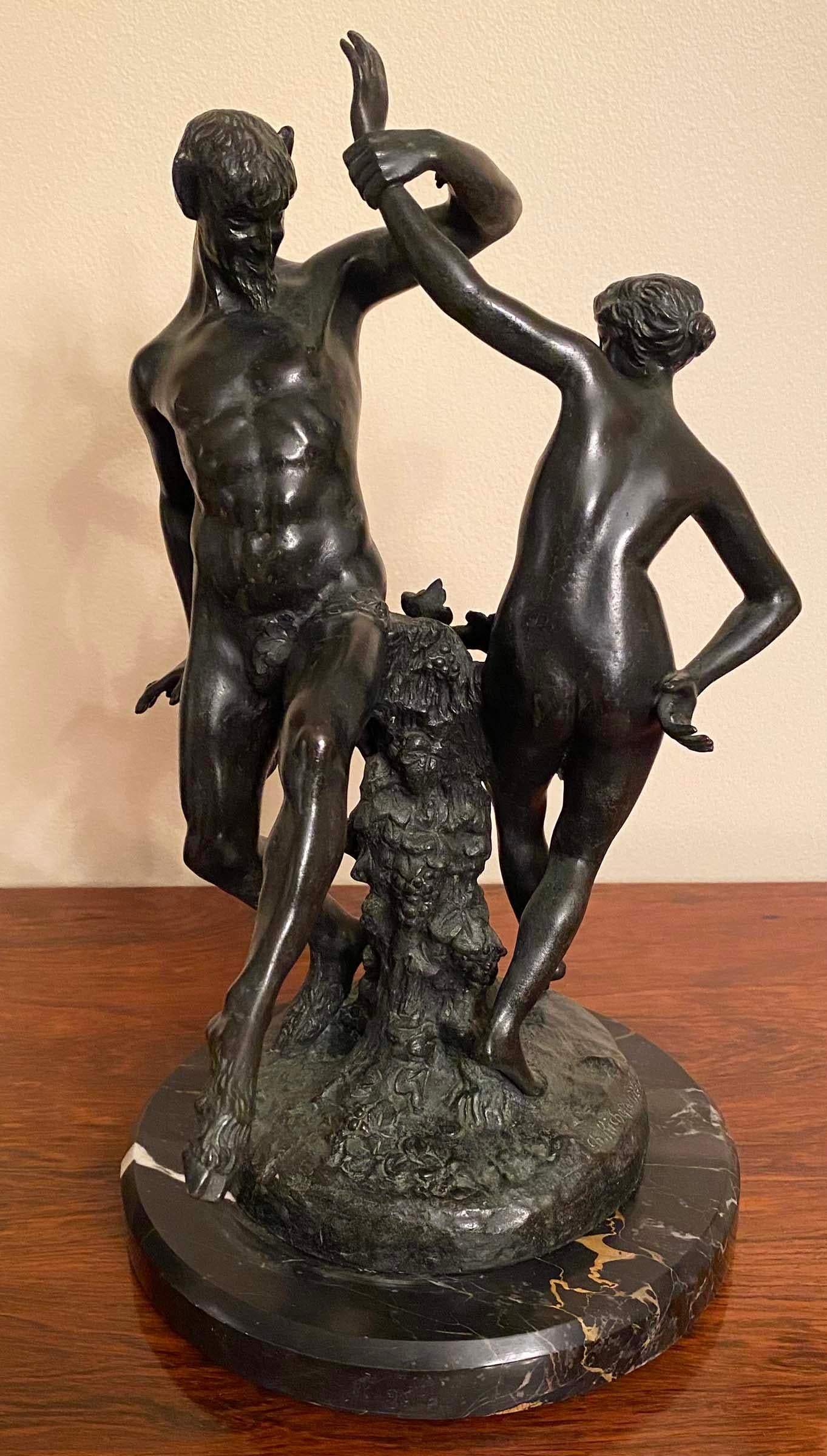
Bacchanal
Located in Los Angeles, CA
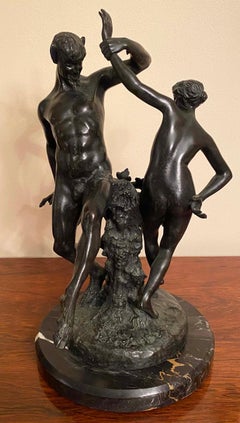
Charles Edouard Richefeu (1868-1945)
A stunning dated 1926.
A faun and nude woman dancing.
Signed RICHEFEU in the bronze. Foundry mark stamp "R. COTTIN & FILS Paris Bronze".
Definitely inspired by Diagilev Russian Ballet and Nijinsky dancer on Claude Debussy...
Category
1820s Art Deco Figurative Sculptures
Materials
Bronze
$2,368 Sale Price
20% Off
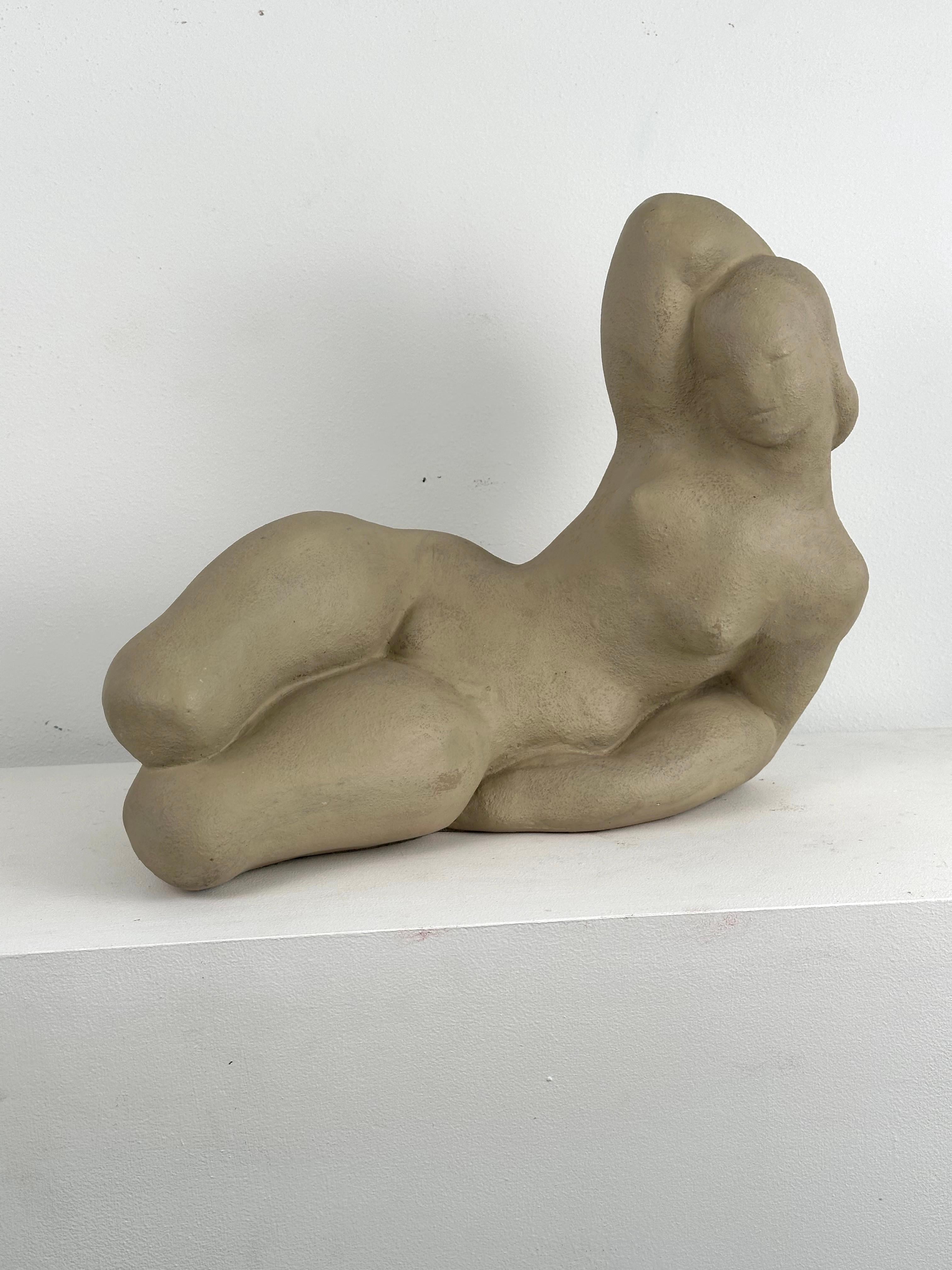
Relining Nude (WG6)
By Waylande Gregory
Located in Wilton Manors, FL
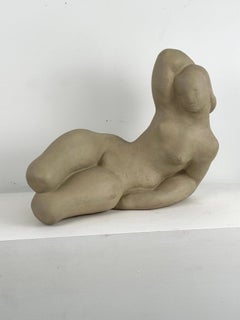
Waylande Gregory (1905-1971).
Nude Reclining, ca. 1950's. Painted composite cast from original sculpted in 1930's. Casting sanctioned and approved by the artist during his lifetime in partnership with MPI, Museum Pieces Incorporated. Very few examples were produced and even fewer survive.
Waylande Gregory was considered a major American sculptor during the 1930's, although he worked in ceramics, rather than in the more traditional bronze or marble. Exhibiting his ceramic works at such significant American venues for sculpture as the Whitney Museum of American Art in New York City and at the venerable Pennsylvania Academy of the Fine Arts in Philadelphia, he also showed his ceramic sculptures at leading New York City galleries. Gregory was the first modern ceramist to create large scale ceramic sculptures, some measuring more than 70 inches in height. Similar to the technique developed by the ancient Etruscans, he fired his monumental ceramic sculptures only once.
Gregory was born in 1905 in Baxter Springs, Kansas and was something of a prodigy. Growing up on a ranch near a Cherokee reservation, Gregory first became interested in ceramics as a child during a native American burial that he had witnessed. He was also musically inclined. In fact, his mother had been a concert pianist and had given her son lessons. At eleven, he was enrolled as a student at the Kansas State Teacher's College, where he studied carpentry and crafts, including ceramics.
Gregory's early development as a sculptor was shaped by the encouragement and instruction of Lorado Taft, who was considered both a major American sculptor as well as a leading American sculpture instructor. In fact, Taft's earlier students included such significant sculptors as Bessie Potter Vonnoh and Janet Scudder. But, Taft and his students had primarily worked in bronze or stone, not in clay; and, Gregory's earliest sculptural works were also not in ceramics. In 1924, Gregory moved to Chicago where he caught the attention of Taft. Gregory was invited by Taft to study with him privately for 18 months and to live and work with him at his famed "Midway Studios." The elegant studio was a complex of 13 rooms that overlooked a courtyard. Taft may have been responsible for getting the young man interested in creating large scale sculpture. However, by the 1920's, Taft's brand of academic sculpture was no longer considered progressive. Instead, Gregory was attracted to the latest trends appearing in the United States and Europe. In 1928 he visited Europe with Taft and other students.
"Kid Gregory," as he was called, was soon hired by Guy Cowan, the founder of the Cowan Pottery in Cleveland, Ohio, to become the company's only full time employee. From 1928 to 1932, Gregory served as the chief designer and sculptor at the Cowan Pottery. Just as Gregory learned about the process of creating sculpture from Taft, he literally learned about ceramics from Cowan. Cowan was one of the first graduates of Alfred, the New York School of Clayworking and Ceramics. Alfred had one of the first programs in production pottery. Cowan may have known about pottery production, but he had limited sculptural skills, as he was lacking training in sculpture. The focus of the Cowan Pottery would be on limited edition, table top or mantle sculptures. Two of the most successful of these were Gregory's Nautch Dancer, and his Burlesque Dancer. He based both sculptures on the dancing of Gilda Gray, a Ziegfield Follies girl.
Gilda Gray was of Polish origin and came to the United States as a child. By 1922, she would become one of the most popular stars in the Follies. After losing her assets in the stock market crash of 1929, she accepted other bookings outside of New York, including Cleveland, which was where Gregory first saw her onstage. She allowed Gregory to make sketches of her performances from the wings of the theatre. She explained to Gregory, "I'm too restless to pose." Gray became noted for her nautch dance, an East Indian folk dance. A nautch is a tight, fitted dress that would curl at the bottom and act like a hoop. This sculpture does not focus on Gray's face at all, but is more of a portrait of her nautch dance. It is very curvilinear, really made of a series of arches that connect in a most feminine way.
Gregory created his Burlesque Dancer at about the same time as Nautch Dancer. As with the Nautch Dancer, he focused on the movements of the body rather than on a facial portrait of Gray. Although Gregory never revealed the identity of his model for Burlesque Dancer, a clue to her identity is revealed in the sculpture's earlier title, Shimmy Dance. The dancer who was credited for creating the shimmy dance was also Gilda Gray. According to dance legend, Gray introduced the shimmy when she sang the Star Spangled Banner and forgot some of the lyrics, so, in her embarrassment, started shaking her shoulders and hips but she did not move her legs. Such movement seems to relate to the Burlesque Dancer sculpture, where repeated triangular forms extend from the upper torso and hips. This rapid movement suggests the influence of Italian Futurism, as well as the planar motion of Alexander Archipenko, a sculptor whom Gregory much admired.
The Cowan Pottery was a victim of the great depression, and in 1932, Gregory changed careers as a sculptor in the ceramics industry to that of an instructor at the Cranbrook Academy in Bloomfield Hills, Michigan. Cranbrook was perhaps the most prestigious place to study modern design in America. Its faculty included the architect Eliel Saarinen and sculptor Carl Milles.
Although Gregory was only at Cranbrook for one and one half years, he created some of his finest works there, including his Kansas Madonna. But, after arriving at Cranbrook, the Gregory's had to face emerging financial pressures. Although Gregory and his wife were provided with complimentary lodgings, all other income had to stem from the sale of artworks and tuition from students that he, himself, had to solicit. Gregory had many people assisting him with production methods at the Cowan Pottery, but now worked largely by himself. And although he still used molds, especially in creating porcelain works, many of his major new sculptures would be unique and sculpted by hand, as is true of Kansas Madonna. The scale of Gregory's works were getting notably larger at Cranbrook than at Cowan.
Gregory left the surface of Kansas Madonna totally unglazed. Although some might object to using a religious title to depict a horse nursing its colt, it was considered one of Gregory's most successful works. In fact, it had a whole color page illustration in an article about ceramic sculpture titled, "The Art with the Inferiority Complex," Fortune Magazine, December, 1937. The article notes the sculpture was romantic and expressive and the sculpture was priced at $1,500.00; the most expensive sculpture...
Category
1950s Art Deco Figurative Sculptures
Materials
Plaster
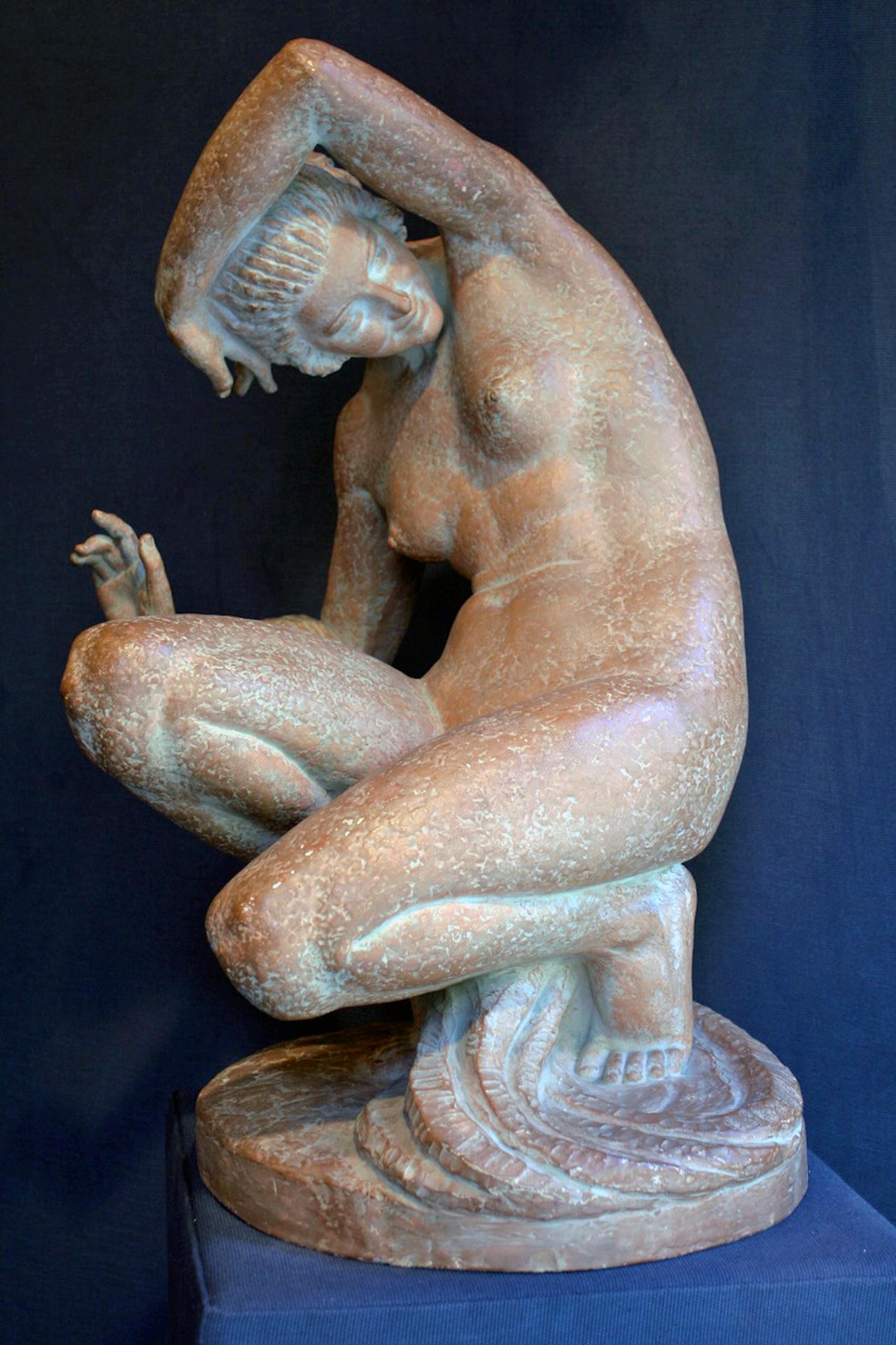
Sculpture Terracotta Female Nude From Marcel Bouraine (1886-1948)
By Marcel-André Bouraine
Located in Saint-Ouen, FR
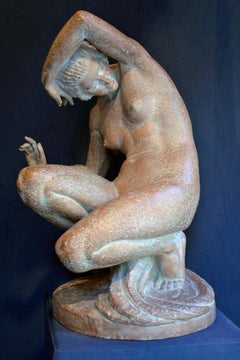
Sculpture Terracotta From Marcel Bouraine (1886-1948)"
Original terra cotta sculpture of Marcel Bouraine
Naïade of the 1930's Signed Bouraine
On the ...
Category
1930s Academic Nude Sculptures
Materials
Terracotta
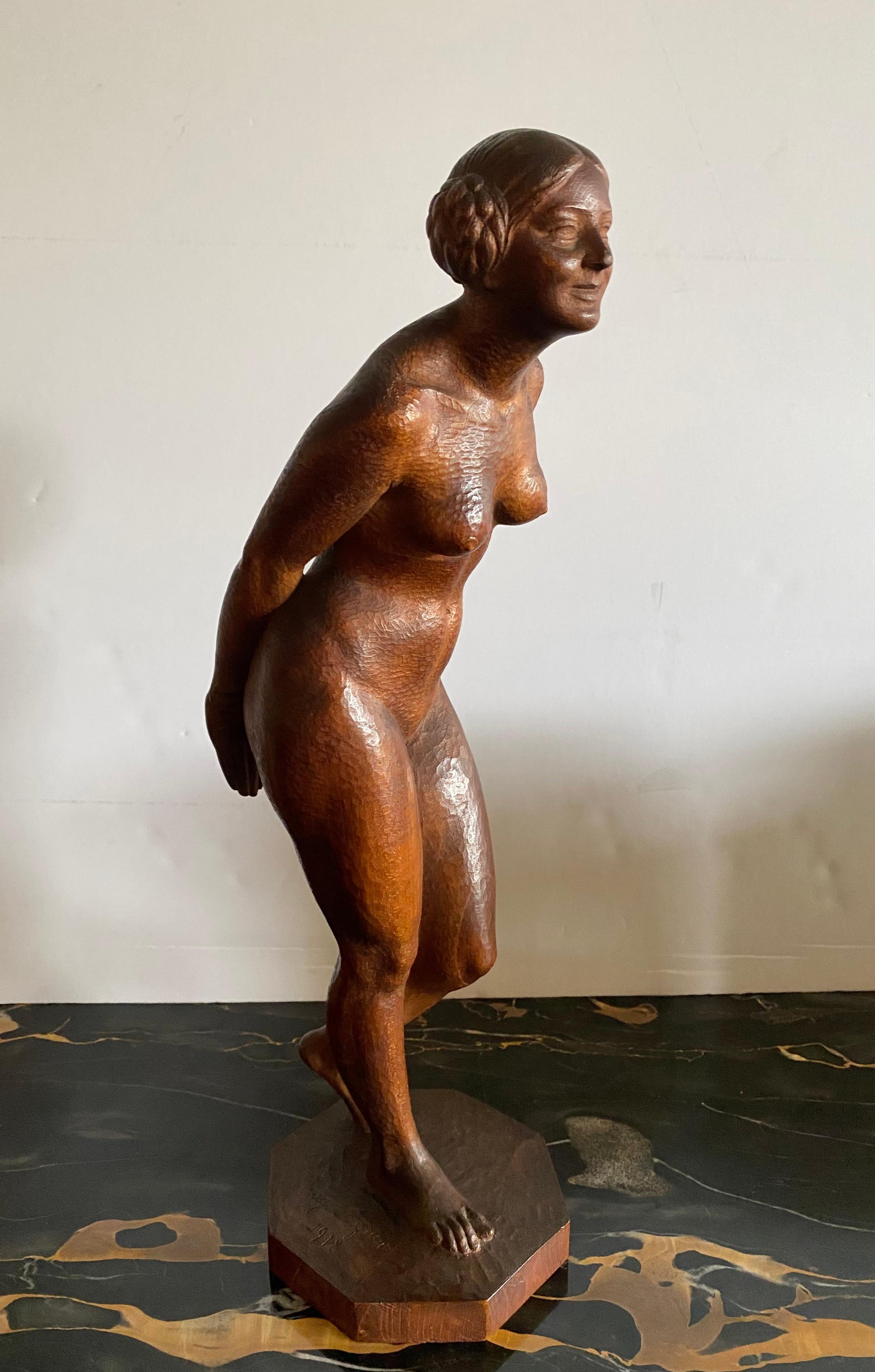
Standing Nude
By Eugene Wagner
Located in Los Angeles, CA
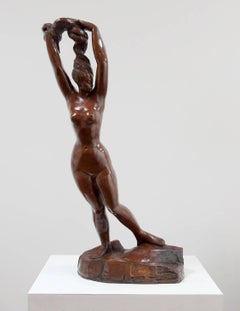
An original carved wood sculpture of an Art Deco standing nude .
German sculptor (1871 Berlin to 1942 ibid), studied at the Dresden Academy, took part in exhibitions in Munich, Düsse...
Category
1910s Art Deco Nude Sculptures
Materials
Wood
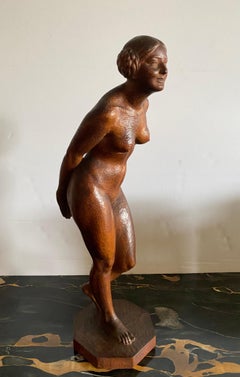
Life-Size Art Deco Diana Bronze
By Hans Harry Liebmann
Located in Miami, FL
This is a rare statement piece that commands that eye. It is of museum quality will be the centerpiece of any space. Masterfully crafted details of the human form are finely rendered in a pre-art deco style. Hans Harry Liebmann...
Category
1910s Art Deco Nude Sculptures
Materials
Bronze

More Ways To Browse
Art Deco Bronze Sculpture Nude
Art Deco Sculpture Nude
Societe Des Bronzes De Paris
Art Deco Bronze Nude
Vintage Leg Cast
Dupont Vintage
Alexis Vintage
Verlys France
Vintage Art Deco Plaster Figure Art Deco
Phillip Russell
Piano Artwork
Planetary Folklore
Pomeranian Dog
Portrait Of Cows
Portrait Of Dora Maar
Raccoon Painting
Racing Race Painting
Richard Bankes Harraden